Summary
Table of Content

Europe Trucks Market
Get a free sample of this report
Form submitted successfully!
Error submitting form. Please try again.
Thank you!
Your inquiry has been received. Our team will reach out to you with the required details via email. To ensure that you don't miss their response, kindly remember to check your spam folder as well!
Request Sectional Data
Thank you!
Your inquiry has been received. Our team will reach out to you with the required details via email. To ensure that you don't miss their response, kindly remember to check your spam folder as well!
Form submitted successfully!
Error submitting form. Please try again.
Europe Truck Market Size
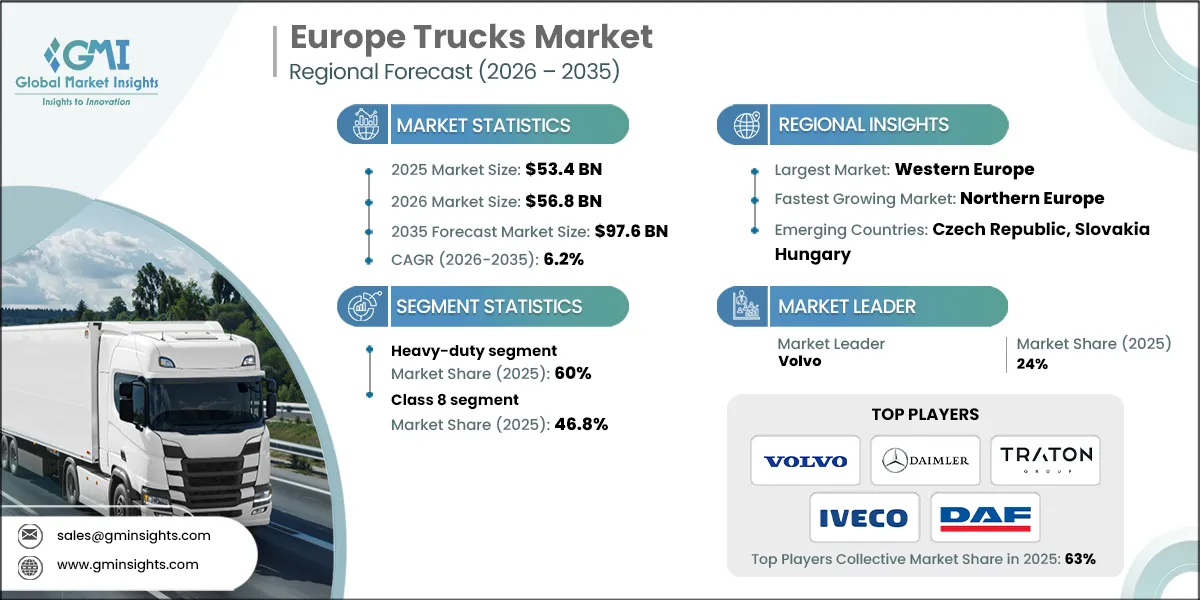
The Europe truck market was estimated at USD 53.4 billion in 2025. The market is expected to grow from USD 56.8 billion in 2026 to USD 97.6 billion in 2035, at a CAGR of 6.2% according to latest report published by Global Market Insights Inc
Europe Trucks Market Key Takeaways
Market Size & Growth
- 2025 Market Size: USD 53.4 Billion
- 2026 Market Size: USD 56.8 Billion
- 2035 Forecast Market Size: USD 97.6 Billion
- CAGR (2026–2035): 6.2%
Regional Dominance
- Largest Market: Western Europe
- Fastest Growing Country: Northern Europe
Key Market Drivers
- Stringent emission regulations and decarbonization targets.
- Growth in freight transport and e-commerce logistics.
- Infrastructure development and logistics corridor expansion.
- Technology-driven fleet modernization.
Challenges
- High upfront cost of zero-emission trucks.
- Limited charging and hydrogen infrastructure.
Opportunity
- Expansion of zero-emission freight corridors.
- Urban low-emission zones and city logistics.
- Digitalization and connected fleet solutions.
- Growth in Eastern and Northern Europe.
Key Players
- Market Leader: Volvo led with over 24% market share in 2025.
- Leading Players: Top 5 players in this market include Volvo, Dailmer, TRATON, IVECO, DAF, which collectively held a market share of 63% in 2025.
Get Market Insights & Growth Opportunities
Stringent European emission standards and decarbonization goals over the long term are moving the transition to cleaner truck technologies faster. Trucks of electric, hydrogen, and low-emission types are replacing and getting updated with policies. Financial incentives, scrappage schemes, and low-emission zones are also used to boost demand of next-generation trucks in medium- and heavy-duty segments that is beneficial to the long-term growth of the market.
Rising use of electric trucks is becoming a major growth factor for the European truck market. Their market share rose from 2.1% in 2024 to 3.8% in 2025, showing faster adoption. This growth results from stricter emission rules, lower overall ownership costs, and more charging stations. These factors are encouraging manufacturers to invest and speed up the electrification and replacement of fleets.
The growth of e-commerce and last-mile delivery is growing in freight movement in Europe. Trucks continue to be the source of regional and cross-border logistics, as they allow the flexing of routes and delivery within a certain time frame. Increasing parcel counts, warehouse growth, and omnichannel retailing frameworks are motivating fleet capacity investments, renewing cycles and tailored truck designs designed to deliver to the urban market and conduct transportation among cities.
The continuous investments in highways, intelligent transport corridors, logistics parks as well as cross-border trade routes are enhancing freight mobility in Europe. With better infrastructure, transit time and operation costs are minimized which leads to increased vehicle utilization. The ongoing development of multimodal logistics centers enhances the need to secure affordable trucking transportation, which is promoting the desire to grow fleet capacity in logistics companies, manufacturers, and third-party transport companies.
The operational efficiency is increasing as more telematics, sophisticated safety systems, predictive maintenance, and digital tools to manage the fleet are making use. These technologies minimize downtimes, fuel economy and aid in compliance with regulatory requirements. With the growing need to reduce the total cost of ownership and enhance productivity, the need in technologically advanced trucks remains to increase, increasing the replacement cycle speed.
Northern Europe is the most accelerating truck industry because of the early electrification process and effective sustainability policies. The introduction of zero-emission trucks is achieved quickly by high investment in charging infrastructure and renewable energy. The high level of freight intensity, sophistication in logistics systems and upstream environmental regulation promotes rapid fleet replacement which leads to more vigorous growth that is experienced in other parts of Europe.
Western Europe has the largest market share due to its busy logistics activities, solid industrial base, and key role in trade within Europe. High manufacturing output and freight volumes keep truck demand steady. The presence of major original equipment manufacturers established supply chains, and ongoing fleet renewal by large logistics companies strengthens the region’s leading market position.
To get key market trends
Europe Truck Market Trends
An increase in labor deficits in the ranks of professional drivers is driving the urge to seek newer and more automated types of trucks in Europe. To improve the safety, comfort, and retention of drivers, fleet operators are investing in vehicles with high driver-assistance systems, better ergonomics, and semi-autonomous capabilities. This is changing the demand as firms start focusing on productivity and labour stability.
The rising fuel volatility is also compelling fleet operators to use alternative-powered trucks that are fuel-efficient. The OEMs whose aerodynamics, engines, and energy management systems are optimized are gaining momentum. This emphasis on cost optimization of fuel prompts fleets to upgrade vehicles to more often, which underpins the need to buy next generation trucks, which have lower operating costs.
The increasing fleet ownership and leasing in Europe is growing due to growth in contract logistics and third-party logistics providers. The outsourcing of transport operations by the manufacturer and retailer heightens the need to have steady-scale truck fleets that are standardized. Long-term logistical contracts also encourage predictable fleet growth, which creates consistent purchasing of medium- and heavy-duty trucks on major European freight routes.
Growth in niche truck segments is being supported by increasing demand of temperature-controlled and specialized freight. Pharmaceutical distribution, food-logistics and cold-chain transportation need special refrigerated and insulated trucks. Increased safety and quality standards raise the demand of modern vehicles that are compliant, leading to an expansion of the market of higher-value trucks and custom body designs.
The purchasing behavior is being transformed because of the rising use of leasing, renting, and pay-per-use truck models. Flexibility in the financing schemes minimizes initial financial needs of the fleet operators and small car transporters. This change favors increased turnover rates of the fleets and promotes demand of new trucks, especially in small and mid-sized logistics providers.
The long-haul trucking is being sustained by the strengthening of the export-oriented industrial foundation in Europe. Expansion in the automotive, machinery, chemicals and consumer goods exports augments the use of road-based freigts to connect to the port and allocate distribution within the country. The increasing industrial production and trade volumes are encouraging enhanced truck usage and capacity expansion in most of the manufacturing zones.
Europe Truck Market Analysis
Learn more about the key segments shaping this market
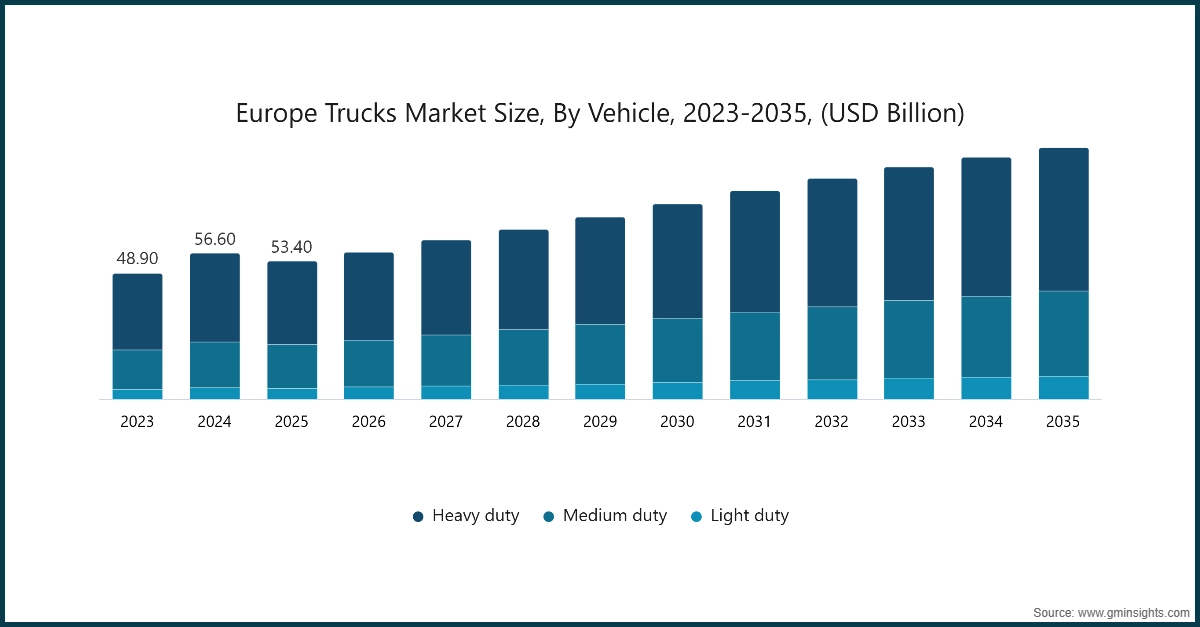
Based on vehicle, the Europe trucks market is divided into light duty, medium duty, and heavy duty. The heavy-duty segment dominated the market, accounting for around 60% in 2025 and is expected to grow at a CAGR of more than 5% through 2035.
- Emission and noise legislation is increasing the pace of renewal of heavy-duty diesel networks in Europe. To ensure compliance with the regulations and entry to the low-emission areas, long-haul operators are modernizing to Euro VI-compliant and electric chips and hydrogen-ready heavy trucks. This regulatory force is producing the long-lasting demand for new heavy-duty truck platforms that are efficient and compliant and ready to meet zero-emission requirements in the future.
- The growth of cross-border and long-haul freight in the European Union is growing demand for heavy-duty trucks. International trade, manufacturing supply chains, and port-to-inland logistics are growing thus in demand of high-capacity vehicles to move large volumes with much efficiency. Long-haul trucks will continue to play a vital role in expansion of the fleet and increased turnover rates on the main European freight corridors.
- An increase in the usage of high capacity, fuel-efficiency tractor-trailers is making economics better among the long-haul operators. OEMs are also coming up with high-level aerodynamics, optimizing powertrains, and lightweight materials to enhance efficiency in payload. These enhancements reduce the fuel per ton-kilometer, which motivates the fleet operators to buy new heavy-duty trucks to raise profitability and operational performance.
- The expansion in the heavy-duty market is being helped by the development of electric and hydrogen-powered truck alternative fuel corridors. High-power charging and hydrogen refueling of highways allow longer operations due to the public and private investment in these systems. Better infrastructure will alleviate range anxiety and zero-emission heavy-duty trucks can be considered operational in the case of a region and the long-haul uses.
- Increase in industrial, energy and infrastructure development within Europe is contributing to the need of heavy-duty vocational trucks. Construction, mining, utilities, and renewable energy projects involve the use of large trucks in relocation of materials and movement of equipment. The long-term investment in major projects by the public and the private has helped to maintain the demand of heavy-duty truck forms that are durable and demand extreme performance.
- Much emphasis on the optimization of total cost of ownership is impacting on the manner in which heavy-duty trucks are purchased. Operators of fleets are focusing on vehicles that have longer maintenance periods, predictive maintenance, and high uptime. Newer heavy-duty trucks are more appealing with OEM-sponsored service-related contracts, related diagnostics, and extended warranty, spurring replacement cycles and favoring long-term market expansion.
Learn more about the key segments shaping this market
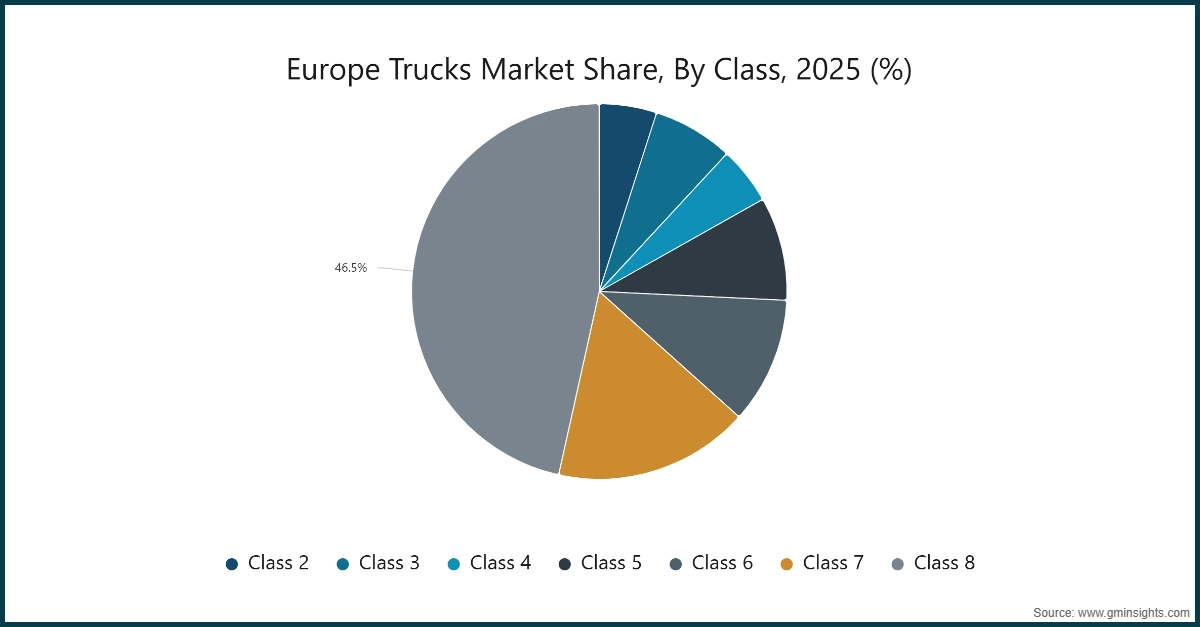
Based on class, the Europe trucks market is segmented into class 2, class 3, class 4, class 5, class 6, class 7, and class 8. The class 8 segment dominates the market accounting for 46.8% share in 2025, and the segment is expected to grow at a CAGR of over 5% from 2026 to 2035.
- Severer CO2 emission limits on heavy long-haul vehicles are prompting Europe to replace long-outdated Class 8 truck riots faster. Operators are also investing in next-generation Euro VI diesel, battery-electric, and hydrogen-ready tractors to be able to meet regulations. This shift in the policy is creating long-term need in new Class 8 trucks that can be low-emission, more efficient, and zero-emission capable.
- The high volume of long-haul and cross-border freight transport is one of the significant sources of Class 8 trucks in Europe. Expanding intra-European trade, port-to-inland freights and manufacturing supply chains are demanding large capacity tractors to effectively transport over long distances. Class 8 trucks will continue to be important as they will transport heavy loads over long distances, which will contribute to the consistent growth of a fleet.
- Increasing fuel and operating cost factors are compelling the fleet operator to convert toward more efficient Class 8 trucks. OEMs are also unveiling highly aerodynamic engines, optimized drive trains and fuel saving technologies that minimize the costs per kilometer. Such efficiency will enhance profitability among the long-haul operators, and this will prompt them to replace the older models with the new Class 8 models.
- The use of alternative-fuel infrastructure along major European freight routes is enhancing the feasibility of electric and hydrogen Class 8 trucks. Greater operating ranges and decreased downtimes are also promoted by high-power charging stations and hydrogen refueling hubs. Enhanced infrastructure reduces the risk of adoption, allowing the fleet operators to roll out the zero-emission Class 8 trucks outside of the pilot programs.
- Preference towards Class 8 configurations is growing with the increasing demand for high-payload and high-capacity movement. The automotive and industrial equipment, chemicals and consumer goods manufacturing sectors are growing and therefore need vehicles that can transport heavier loads efficiently. Class 8 trucks are superior in terms of payload capacity and durability, which is essential in the large volume and long-distance freight operations.
Based on propulsion, the Europe trucks market is divided into gasoline, diesel, BEV, PHEV, HEV, FCEV, and others. The diesel segment held the major market share in 2025.
- In spite of the trend of electrification, in Europe long-haul and heavy-duty markets are still dominated by diesel trucks, which are known to be reliable and have long range. Diesel powertrains are preferable to gasoline, with a higher energy density, faster refueling, and well-established service networks, and as such are favoured in strenuous freight operations, strong demand of diesel trucks persists where zero-emission alternatives continue to be operationally limited.
- Diesel trucks are increasingly becoming relevant by the continued enhancements in the efficiency of the diesel engine and emission control technologies. Better aftertreatment systems, advanced Euro VI engines and optimized combustion offer lower emissions and enhance better fuel economy. These developments allow the operators of the fleet to comply with the regulations and retain their performance, which will allow further use of diesel trucks in various applications.
- Inadequate charging and hydrogen systems in most areas support the use of diesel trucks. In the rural zones, interstate, and cross-border routes, there is not enough support for alternative fuels and diesel is the most convenient solution. This information gap keeps the demand of diesel trucks alive especially in long route transportation and time-based freight transportation operations in Europe.
- It is also important to mention that high initial expenses and uncertainty in operations with electric and hydrogen trucks push fleets to have a diesel fleet. Diesel trucks have predictable operation costs, maintenance practices and high resale values. Diesel is the most cost-effective option to most small and mid-sized operators, and its steady substitution demand as opposed to fast technological changes is driven.
- The increase in high-time and flexibility sectors contributes to the demand of diesel trucks. The construction, mining, agricultural, agricultural and emergency logistical industries require robust vehicles that can operate at any time and in diverse conditions. Consistency in performance and torque is found in diesel trucks, which makes them an unavoidable necessity in Europe as far as heavy-duty and vocational use is concerned.
Based on body, Europe trucks market is divided into pickup, box / cargo, flatbed, dump, refrigerated, tanker, concrete mixer, refuse, tow truck, and others. The box / cargo segment dominated the market.
- The growth of e-commerce and omnichannel retail in Europe is growing swiftly and it is placing stricter pressure on box and cargo trucks. The vehicles are necessary in the transportation of packages between the distribution centers, warehouses, and the city delivery terminals. Their enclosed nature shields the products and enhances the high-volume and speedy delivery, which is pushing the constant fleet growth among the logistics companies and last-mile delivery companies.
- The increase in urbanization and city consumption is causing a need for box and cargo trucks that are optimized to meet urban logistics needs. The small-scale cargo trucks needed in the urban areas are those used in retail replenishment, food delivery and transport of consumer goods. The tightening of access in urban areas leads to the adoption of newer models that meet the requirements, which is beneficial in creating a continuous demand in the metropolitan and suburban regions of cities.
- Increased demand in the box and cargo truck segment is being enhanced by increasing demands in temperature controlled and secured freight. Pharmaceuticals, fresh goods and high value consumer goods demand safe and insulated transportation. Box trucks are flexible to refrigerated and customized interiors, which has increased use in cold-chain logistics and controlled freight.
- The growing application of hub-and-spoke logistics models is increasing the need of medium-duty box and cargo trucks. There is the movement of goods through central warehouses to regional bases before ultimate delivery. The structure of distributions in this type supports the use of box trucks in the regional transportation, which is why the growth of the fleet is encouraged as the logistics companies increase the activities in order to accelerate the delivery process and its effectiveness.
- The need to reduce urban emissions by regulatory pressures is increasing the rate of replacement of old box and cargo trucks. Emission zones and sound limitations imply that the operators switch to newer diesel, hybrid, and electric box trucks. The common use of urban areas reduces the lifespan of the vehicles thus sustaining the demand of modern, compliant cargo truck fleets.
- The third-party logistics and contract delivery services are growing to own more fleets of box trucks, which are standard. Distribution is being outsourced to logistics experts, which use scalable, uniform fleets by retailers and manufacturers. The long-term delivery contracts promote consistent acquisition of box trucks to deliver services to service level needs in the various markets in Europe.
Looking for region specific data?
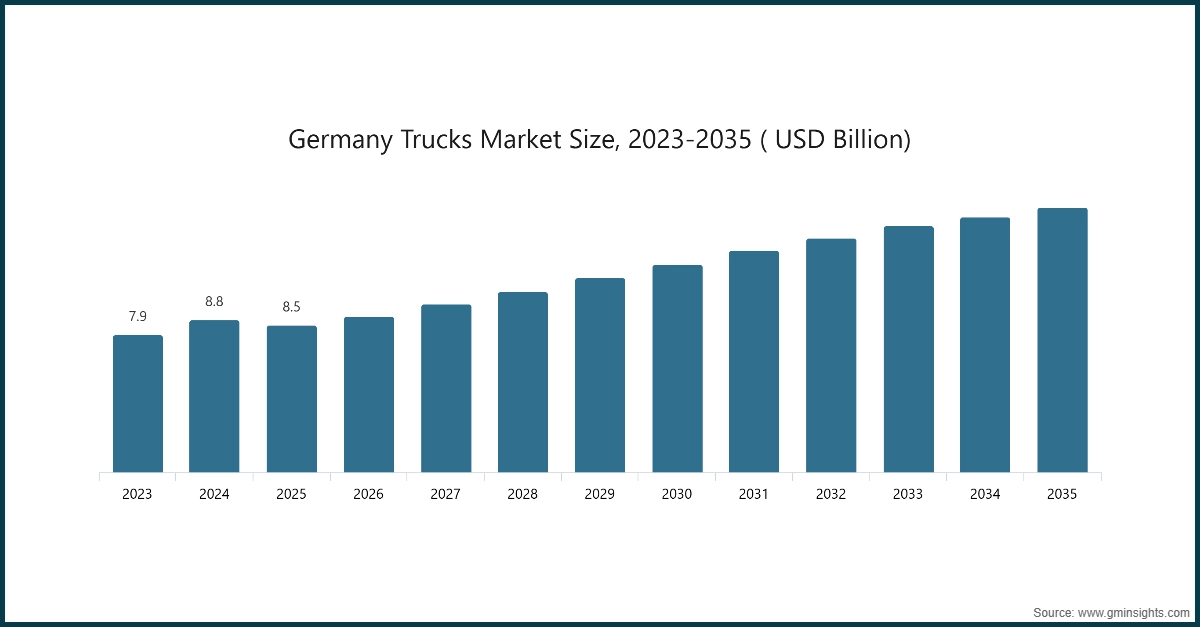
Germany dominated the trucks market in Western Europe with around 27% share and generated USD 8.5 billion in revenue in 2025.
- The truck market of Germany is a significant growth impetus due to the fact that the country is the largest manufacturing and export center of Europe. A large amount of automotive, machinery, chemicals, and industrial goods must be transported over the road on a regular basis by road infrastructure that is reliable. The demand of medium to heavy-duty truck in both domestic and international logistics transit is maintained through the continued production of industrial goods and high export levels.
- Being the main geographical position in Europe, Germany is an important freight transit route. Goods that are transported between Western, Eastern, and Northern Europe often transverse the country through trucks. Transit volumes are high, which will help to boost the level of vehicle utilization and shorten the replacement cycle, which will help maintain stable demand in long-haul and regional trucks to cater to the international logistics organizations.
- Investment in logistics infrastructure and transport infrastructure encourages the development of the truck market in Germany. Constant improvements on the highways, freight terminals and intermodal hubs enhance efficiency and lessen congestion. The improved infrastructure will allow increasing the productivity of trucks and capacity utilization, stimulating the growth of the fleet and its modernization of logistics providers and industrial operators.
- Germany is fast tracking the adoption of zero emission trucking programs. The government incentives, pilot projects and subsidies on electric and hydrogen trucks give fleet operators an incentive to invest in next generation of vehicles. Enhanced charging and hydrogen infrastructure increases operational feasibility, which increases incremental demand of new trucks along with traditional diesel substitutes.
- In Germany, the truck demand is sustained by the existence of a properly developed logistics and third party transport market. The large logistics companies, parcel companies and the contract carriers have large fleets to cater to the manufacturing, retail and e-commerce customers. The expansion of outsourced logistics and warehousing services contributes to lifelong fleet acquirement and substitution endeavors.
- High concentration of the truck OEMs and the suppliers of the world in Germany promotes adoption of technologies and fleet renewal. There is low ownership risk to the operators because of domestic production, wide dealer networks, and strong aftersales support. The availability of high-tech truck equipment, funding, and service approvals will promote more rapid replacement and increased adoption of high-quality and alternative-powertrain trucks.
The Poland trucks market is projected to exceed USD 2.5 billion in 2025, driven by expansion of automotive, electronics, and consumer goods manufacturing, which has increased freight movement between factories, warehouses, and export routes.
- Poland being at the crossroad of the Western and Eastern Europe is a key transit country in global road freight. Trucking is important in the cross-border transport of the high volumes of cargo between Germany, the Baltics, and Eastern Europe. Such transit intensity enhances the utilization of trucks and also increases the rate at which the fleet is replaced by the Polish transport operators.
- The Polish truck demand is being supported by a high growth in the third-party logistics and road transport market. The Polish logistics firms are increasing fleet to cater to the foreign clientele owing to the low operating costs and availability of skilled drivers. Continuous truck purchase is being encouraged by long-term transport contracts, increased outsourcing of freight services.
- High investment in road systems and logistics parks are enhancing the performance of freight in Poland. The development of expressways, highways and intermodal terminals minimizes the transit time and operation expenses. Better connectivity will allow increased truck utilization and promote fleet growth because logistics operators are increasing operations to accommodate increased demand.
- The fleet operators in Poland who are cost sensitive are increasing their pressure on fuel efficient and long-life cycle truck models. Emphasis on total cost of ownership will promote the substitution of the old vehicles with new, well-built vehicles that have good fuel efficiency with low maintenance expenses. This value buying trend favors constant demand on mid-range and high-efficiency truck platforms.
- The increased adoption of Poland into the European supply chain is enhancing the pressure on the adoption of efficient and compliant modern truck fleets. Strict EU emission and safety regulations demand upgrades of the fleet, especially the operators serving the customers in Western Europe. The replacement which is based on compliance, coupled with the increasing freight volume, promotes the development of the truck market in Poland over the long term.
The trucks market in UK is projected to grow at a 6% CAGR from 2026 to 2035. Growth in domestic distribution and regional freight is a key driver of the UK truck market. The strong retail, grocery, and consumer goods sector relies heavily on road transport for nationwide deliveries. High dependence on trucks for inland freight movement sustains demand for medium- and heavy-duty vehicles across regional, urban, and intercity logistics operations.
- There is demand for trucks in the UK due to expansion of e-commerce and home delivery services. Increased online retailing has necessitated high amounts of transport of goods in to and out of ports and warehouses and in to and out of urban delivery centers. This increase leads to fleet expansion and increased replacement rates, especially those of box, cargo, and regional haulage trucks to maintain time-sensitive distribution.
- UK being determined to become decarbonized and achieve net-zero is enhancing the uptake of low-emission trucks. Old diesel trucks are being replaced by new models to promote government incentives, clean air zones in the city, and fleet sustainability targets. Increased investment in electric truck trials and charging infrastructure reinforces the new vehicle platform demand, as well as market renewal of the traditional fleet.
- The long-haul truck demand is caused by high dependence on imported commodities in large-scale ports. Seaports like Felixstowe, Southampton, and Liverpool rely on road transportation in the distribution of their products inland. The high freight movement on port to warehouse supports the high utilization and long-distance operation of heavy-duty trucks.
- In the UK, the UK truck procurement is being sustained by a strong third-party logistics and contract distribution sector. Retail and manufacturing companies are offering transportation to logistics companies that manage big fleets of trucks. Different models Long-term service contracts and performance-based logistics models promote steady investment in fleets and quicker replacement.
- The adoption of modern trucks in the UK is due to focus on fleet efficiency and optimization of cost of operation. The increasing cost of fuel, labor and maintenance compel operators to switch towards cars that have superior fuel efficiency, telematics and safety devices. Fleet upgrades resulting in the demand for new trucks with low total cost of ownership are technology driven.
The trucks market in Italy is projected to grow at a CAGR of 3% from 2026 to 2035. Italy’s strong manufacturing base in automotive components, machinery, food processing, and consumer goods is a key driver for its truck market. Dense networks of small and mid-sized industrial clusters rely heavily on road transport for domestic distribution and exports. Continuous movement of goods between factories, ports, and logistics hubs sustains demand for medium- and heavy-duty trucks.
- Domestic transport that is heavily relying on road transport has maintained a steady demand of trucks in Italy. The geographical facts, few rail freight penetration, and the mountainous geography of the country have made trucks the most versatile means of transport. The fleets of trucks of different weight classes are consistently used and replaced in the northern industrial regions due to regional and intercity logistics.
- The increased food, drink and temperature-controlled logistics is increasing the demand of the special trucks in Italy. The agri-food industry in the country is large and that needs efficient transportation of fresh, frozen and processed foods. Food safety standards and nationwide and export-oriented distribution are becoming increasingly involved through the use of box, refrigerated, and cargo trucks.
- Italy is a major logistical hub in Southern Europe that favors the long-haul truck demand. Large ports like Genoa, Trieste and Naples are dependent on trucks to move cargo within their territories. The increase of trade flows between southern Europe and central Europe and the Balkans promote the demand of heavy-duty trucks to facilitate port to warehouse, and cross-border freight flows.
- The replacement of the trucks in Italy is quickened by the government incentives and regional policies of fleet renewal. The scrappage schemes and the promotion of low-emission vehicles motivate the operators to change the old, inefficient trucks. These programs decrease the age of fleets, enhance adherence to the emission standards, and stimulate the incremental demand of new diesel and other types of trucks fueled by alternative fuels.
- The truck market in Italy is growing with help of expansion of third-party logistics and parcel delivery services. The growing popularity of e-commerce and the outsourcing of transportation by retailers and manufacturers is making standardized and scalable fleets a demand. The logistics providers are still investing in trucks that enhance reliability of services and cater to increase the delivery frequency along the urban and regional routes.
Europe Truck Market Share
The top 7 companies in the solid-state battery for electric trucks industry are Volvo, Daimler, TRATON, IVECO, DAF, Renault, and Isuzu, together contributing around 69% of the market in 2025.
Volvo aims at electrification, providing a wide variety of battery-electric heavy-duty trucks with a long range and sophisticated safety equipment, continuing to be very competitive in the market of EV trucks work in Europe. It also spends a lot of money on digital services and charging infrastructure alliances in order to enable fleet electrification and sustainability objectives and maximize the efficiency and total cost of ownership to customers.
Daimler Truck is enhancing its competitiveness by reducing costs in Europe and increasing its pace in electric trucks, with long-haul able eActros trucks and diversified powertrain choice. It also participates in strategic international partnerships and infrastructural development balancing profitability and innovation to achieve extremely high emissions and customer requirements.
TRATON uses common platforms in its brands (Scania, MAN, Navistar) to reduce expenses and achieve efficiency in Europe and other parts of the world. It drives the electric truck solutions of Scania and creates global operations with cross-brand synergies by focusing on the conventional options and the zero-emission solutions despite the obstacles in the market.
IVECO reaches its alternative fuel and electrification initiatives by strategic alliances, such as autonomous truck tests with PlusAI, collaboration with EV models, and experiences a significant acquisition shift. Its wide product line in light to heavy trucks and moving to sustainable technologies assists in attracting the array of fleet requirements in Europe.
DAF focuses on the areas of performance, comfort of the driver, and low total cost of ownership to remain competitive supported by its solid dealer and service network. It is also electrifying its models such as the XD Electric to use in urban and regional areas, to meet the needs of the decarbonization trend and fleet performance in Europe.
Renault is speeding up the process of electrification by proposing a broad electric range of vehicles and has extensive support services, which have delivered significant EV adoption in Europe. It is also engaged in joint ventures and the growth of production to support the changing decarbonization and urban logistics needs and improve its sustainability image.
Isuzu also competes with fleet reliability and robust market share in small segments such as UK market of 7.5 tonnes. It is diversifying its portfolio to include new electric commercial vehicles like the all-electric D-Max pickup as well as investing in after-sales, connected services, and lifecycle support as a way to attract European commercial customers.
Europe Truck Market Companies
Major players operating in the truck industry are:
- BelAZ
- DAF Trucks
- Iveco
- MAN Truck
- Daimler
- Renault Trucks
- Scania
- Sisu Auto
- Tatra
- Volvo Trucks
- Europe trucks market is a competitive environment that boasts a topography of well-established OEMs that are competing to dominate the traditional diesel and the new zero-emission markets. In Europe, the sales of heavy trucks are still dominated by the large firms like the Volvo Group, Daimler Truck AG, Traton Group (including Scania and MAN), DAF Trucks, and Iveco that hold a large portion of the total registration and production. These firms are very competitive with each other in product innovation, fuel efficiency, safety technology and the introduction of electric or alternative fuel vehicles to comply with the strict EU regulations on emissions. Recently, Volvo Trucks has boasted the largest market share in the heavy truck market in Europe and a clear indication of the good relationship customers have with the company because of its wide range of powertrain choices and up-time support.
- Electrification and digital services are becoming the factors of strategic competition, and incumbents are investing heavily in battery-electric, hydrogen, and connected vehicle technologies to provide more differentiated offers and keep customers in their fleet. In addition to the conventional OEM competition, cost concerns and technological changes open up enhanced competitive threats of new entrants and Chinese manufacturers aiming at gaining grounds with price-competitive electric models. Partnering, localization and strong after sale networks also characterize competitive positioning with OEMs striking a balance between profitability and regulatory compliance and sustainability obligations in major markets in Europe, including Germany, France and the UK.
Europe Trucks Market Report Attributes
| Key Takeaway | Details |
|---|---|
| Market Size & Growth | |
| Base Year | 2025 |
| Market Size in 2025 | USD 53.4 Billion |
| Market Size in 2026 | USD 56.8 Billion |
| Forecast Period 2026-2035 CAGR | 6.2% |
| Market Size in 2035 | USD 97.6 Billion |
| Key Market Trends | |
| Drivers | Impact |
| Stringent emission regulations and decarbonization targets | Accelerates adoption of electric, hydrogen, and low-emission trucks, driving fleet replacement and technology upgrades |
| Growth in freight transport and e-commerce logistics | Increases demand for medium- and heavy-duty trucks for regional, long-haul, and last-mile delivery |
| Infrastructure development and logistics corridor expansion | Improves freight efficiency, boosts truck utilization, and supports fleet expansion |
| Technology-driven fleet modernization | Adoption of telematics, safety systems, and predictive maintenance improves productivity and lowers total cost of ownership |
| Pitfalls & Challenges | Impact |
| High upfront cost of zero-emission trucks | Slows adoption among small and mid-sized fleet operators |
| Limited charging and hydrogen infrastructure | Restricts large-scale deployment of electric and fuel-cell trucks |
| Opportunities: | Impact |
| Expansion of zero-emission freight corridors | Creates demand for electric and hydrogen trucks across long-haul routes |
| Urban low-emission zones and city logistics | Drives adoption of electric trucks for last-mile and municipal applications |
| Digitalization and connected fleet solutions | Enables recurring revenue through software, services, and data-driven optimization |
| Growth in Eastern and Northern Europe | Infrastructure development and sustainability focus support higher growth potential |
| Market Leaders (2025) | |
| Market Leader |
24% market share |
| Top Players |
Collective market share is 63% |
| Regional Insights | |
| Largest Market | Western Europe |
| Fastest Growing Market | Northern Europe |
| Emerging Countries | Czech Republic, Slovakia, Hungary |
What are the growth opportunities in this market?
Europe Truck Industry News
- In January 2026, IVECO stated that it has a new autonomous driving program, which was developed together with PlusAI, one of its long-term partners and a worldwide leader in AI-controlled virtual driver software. In this undertaking, the two companies will roll out the first implementation of the heavy-duty trucks with Level 4 Autonomous Driving Systems (ADS) in Southern Europe. The project is going to be implemented in partnership with Spanish logistics operator Sesé and the Government of Aragon, which will be a significant milestone in the autonomous freight transport in the area.
- In October 2025, Tatra Trucks unveils Tatra Force e-Drive FCEV 6x4 project with hydrogen fuel cells and autonomous driving. The European Union is the co-funders of the project and it is scheduled to be finalized by mid-2028. It is the second project of the company in this area, which seeks to provide a prototype of a three-axle utility vehicle in the municipal services, endowed with autonomous driving and remote control driving.
- In October 2025, Mars & Einride, expanded partnership with six new e-HGVs. Einride is assisting Mars to introduce six new Mercedes-Benz eActros 600 vehicles on its routes between Germany and the Netherlands, and 300 at least of its trucks will be EVs by 2030.
- In April 2025, Isuzu unveiled its new D-Max EV. The EV variant in the Isuzu D-Max does not compromise the commercial aspects such as full-time 4×4 capability, a payload of over 1 tonne and a towing capacity of 3.5 tonne. The car can cover 263km WLTP and uses 66.9kWh lithium-ion battery with two motors with a total power of 140 kW and 325 Nm torque.
The Europe trucks market research report includes in-depth coverage of the industry with estimates & forecasts in terms of revenue ($Bn), Volume (units) from 2022 to 2035, for the following segments:
Market, By Class
- Class 2
- Class 3
- Class 4
- Class 5
- Class 6
- Class 7
- Class 8
Market, By Vehicle
- Light duty
- Medium duty
- Heavy duty
Market, By Propulsion
- BEV
- PHEV
- HEV
- FCEV
Market, By Body
- Pickup
- Box / cargo
- Flatbed
- Dump
- Refrigerated
- Tanker
- Concrete mixer
- Refuse
- Tow truck
- Others
Market, By End Use
- Construction
- Logistics & transportation
- Mining
- Oil & gas
- Municipal services
- Agriculture
- Defense
- Retail & e-commerce
The above information is provided for the following regions and countries:
- Western Europe
- Germany
- Austria
- France
- Switzerland
- Belgium
- Luxembourg
- Netherlands
- Portugal
- Rest of Western Europe
- Eastern Europe
- Poland
- Romania
- Czechia
- Slovenia
- Hungary
- Bulgaria
- Slovakia
- Croatia
- Rest of Eastern Europe
- Northern Europe
- UK
- Denmark
- Sweden
- Finland
- Norway
- Rest of Northern Europe
- Southern Europe
- Italy
- Spain
- Greece
- Bosnia and Herzegovina
- Albenia
- Rest of Southern Europe
Frequently Asked Question(FAQ) :
What was the market size of the Europe truck in 2025?
The market size was USD 53.4 billion in 2025, with a CAGR of 6.2% expected through 2035. The growth is driven by stringent emission standards, decarbonization goals, and the adoption of cleaner truck technologies.
What is the projected value of the Europe truck market by 2035?
The market is poised to reach USD 97.6 billion by 2035, supported by policies promoting electric, hydrogen, and low-emission trucks, along with financial incentives and scrappage schemes.
What is the expected size of the Europe truck industry in 2026?
The market size is projected to reach USD 56.8 billion in 2026.
How much revenue did the heavy-duty segment generate in 2025?
The heavy-duty segment accounted for approximately 60% of the market in 2025 and is expected to grow at a CAGR of over 5% through 2035.
What was the market share of the Class 8 segment in 2025?
The Class 8 segment held a 46.8% market share in 2025 and is set to expand at a CAGR of over 5% till 2035.
Which country dominated the Europe truck sector in 2025?
Germany led the market with a 27% share, generating USD 8.5 billion in revenue in 2025. Its strong manufacturing and export base, coupled with reliable road infrastructure, drives demand for medium- and heavy-duty trucks.
What are the key trends driving the Europe truck market?
Key trends include automated and semi-autonomous trucks, fuel-efficient and alternative-fuel vehicles, growing fleet ownership and leasing, higher demand for specialized and temperature-controlled freight, and flexible financing models such as leasing and pay-per-use.
Who are the key players in the Europe truck industry?
Key players include BelAZ, DAF Trucks, Iveco, MAN Truck, Daimler, Renault Trucks, Scania, Sisu Auto, Tatra, and Volvo Trucks.
Europe Trucks Market Scope
Related Reports