Summary
Table of Content

Europe Smart Lock Market
Get a free sample of this report
Form submitted successfully!
Error submitting form. Please try again.
Thank you!
Your inquiry has been received. Our team will reach out to you with the required details via email. To ensure that you don't miss their response, kindly remember to check your spam folder as well!
Request Sectional Data
Thank you!
Your inquiry has been received. Our team will reach out to you with the required details via email. To ensure that you don't miss their response, kindly remember to check your spam folder as well!
Form submitted successfully!
Error submitting form. Please try again.
Europe Smart Lock Market Size
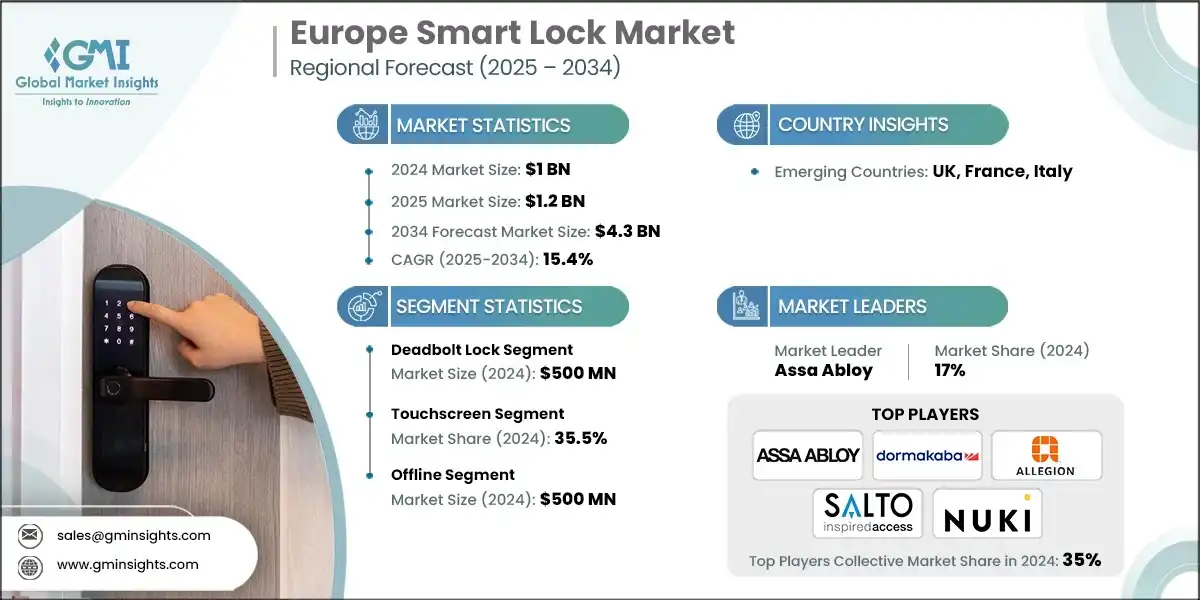
The Europe smart lock market size was estimated at USD 1 billion in 2024. The market is expected to grow from USD 1.2 billion in 2025 to USD 4.3 billion in 2034, at a CAGR of 15.4% according to latest report published by Global Market Insights Inc.
Europe Smart Lock Market Key Takeaways
Market Size & Growth
- 2024 Market Size: USD 1 Billion
- 2025 Market Size: USD 1.2 Billion
- 2034 Forecast Market Size: USD 4.3 Billion
- CAGR (2025–2034): 15.4%
Key Market Drivers
- Rising security awareness.
- Increase in adoption of smart homes.
- Integration of enhanced features with traditional lock systems.
Challenges
- High cost of adoption.
- Security concerns.
Opportunity
- Biometric and AI integration.
- Cloud-based access management.
Key Players
- Market Leader: Assa Abloy led with over 17% market share in 2024.
- Leading Players: Top 5 players in this market include Assa Abloy, Dormakaba, Allegion, Salto Systems, Nuki Home Solutions, which collectively held a market share of 35% in 2024.
Get Market Insights & Growth Opportunities
As the prevalence of burglaries, unauthorized access, and property offenses rises, consumers are increasingly conscientious about both residential and workspace security. Standard locking mechanisms are recognized as inadequate, particularly in urban settings where security offenses are more likely to occur. Smart locks provide the aforementioned features within the context of current consumer and commercial security concerns, including real-time alerts, tamper notifications, and remote access control which allows information and management of ingress and egress from anywhere in the world.
Further, tracking access history and issuing temporary digital keys increases the level of participation and control absent in prior mechanisms. This information is valuable considering households with children or elderly members, houses that host many visitors, and the short-term rental market. Once the benefits of accountability and control become commonplace, acceptance of smart locking mechanisms will be more consistent with the nature of modern security.
The market for smart locks in Europe is expanding, largely driven by the increasing acceptance of smart home technology within the continent. Consumers are rapidly adopting smart locks as a connected element of their home. The adoption is happening most quickly in Germany, the U.K., France, and the Netherlands, which are experiencing increases in urbanization, widespread access to high-speed internet, and growing knowledge and interest in the benefits of home automation. Smart locks not only serve as robust facilitators of keyless entry, they can also now easily be integrated with other smart-enabled devices such as cameras, alarms, and voice assistants, making smart locks an essential part of the modern home security experience.
Aspects of keyless entry, access via mobile apps from anywhere, and real-time monitoring resonate with European homeowners, especially in densely populated urban environments or multi-unit residences. The expansion to smart living will continue to occur as increasing disposable incomes drive renovation projects. In parallel, government measures to support energy-efficient and secure housing, as well as the large supply of Wi-Fi and Bluetooth-enabled devices on the market, create an optimal condition for an increase in the adoption of European residence-based smart locks. Smart-home ecosystems are becoming more general-use consumer products; however, smart locks will transition from luxury items to an essential part of the residence security market in Europe.
To get key market trends
Europe Smart Lock Market Trends
The smart lock market in Europe is expanding rapidly, as consumers are interested in services such as smart home integration, security, and technology that provide convenience. Smart locks are becoming ingrained in residential and commercial settings, as urbanization increases, smartphone penetration rises, and consumers are aware of the emerging technology that is home automation. Innovations in wireless communications technology, such as Wi-Fi, Bluetooth, Zigbee, and Z-Wave, are also contributors to this market expansion, providing some form of connectivity and remote access technologies.
- Smart locks are being outfitted with AI-enabled capabilities, such as food identification, inventory management, and predictive repairs. In addition, because of IoT, users can control and remotely monitor devices through smartphones or voice assistants. These technologies, among other things, make using appliances more convenient and empower users to obtain data-based information about their consumption to minimize waste and improve energy consumption.
- As consumers become increasingly environmentally focused, they are willing to pay more for energy-efficient appliances. The options for Smart Locks include advanced cooling systems, inverter compressors, and real-time energy monitoring. All of these features combined with notifications when food is about to expire or to keep track of food freshness help to minimize waste of the most valuable resources on Earth.
- Contemporary Smart Locks have customizable screens, nutrition-related suggestions, and the ability to interface with meal planning apps. They are making use of touchscreens, voice control, and flexible temperature zones to enable ease of use to create an experience that takes account of varying social or individual preferences that caters to diversified household goals. This pattern is indicative of the larger trend toward appliances that have a greater value proposition than simply being an appliance that runs by electricity or gas to perform basic functions and clearly supports lifestyle and wellness intentions.
- As technology prices trend downwards, Smart Locks are becoming more affordable, resulting in greater access to middle-income households. Product manufacturers are now producing models to tap into middle-income households by producing models with only the most valuable and essential answer, with profitable prices, that only appeal to the higher-income and premium buyers. This democratization of smart, Wi-Fi-connected appliances to manufacturers taps into a larger and equitable marketplace of households across multiple geographic and economic segments.
Europe Smart Lock Market Analysis
Learn more about the key segments shaping this market
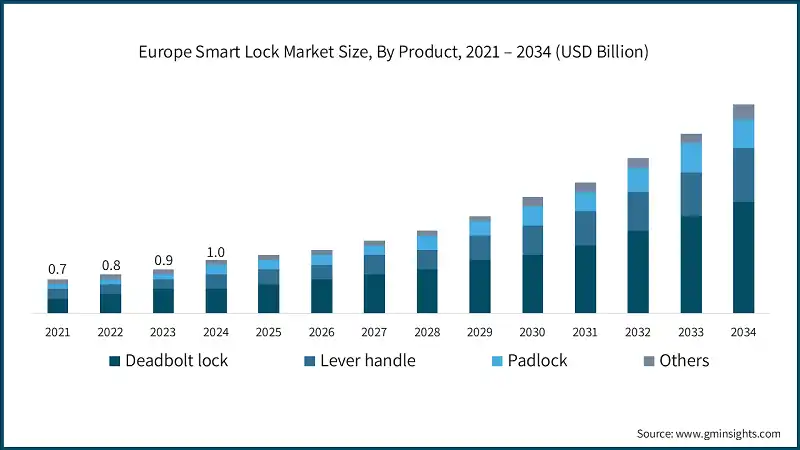
Based on product, the smart lock market is divided into deadbolt lock, lever handle, padlock and others. In 2024, deadbolt lock held the major market share, generating a revenue of USD 500 million.
- Deadbolt locks are a fundamental feature of smart lock systems because they are more resistant to forced entry in comparison to spring bolt locks. Deadbolts in smart locks are often motor-driven and tied into a digital access control system, providing the security of a strong deadbolt along with various electronic features, including automatic locking, tamper alerts, and remote locking and unlocking.
- Many manufacturers of smart locks will design their product to be a retrofit of an existing deadbolt system, making deadbolts an important part of the transition to smart home security. In compatibility with existing deadbolt systems, users can upgrade a deadbolt to smart without a full replacement of the locking mechanism. This adds towards a customer-friendly installation, because it creates less work in only installing one locking mechanism.
- More and more smart deadbolt locks are being integrated into broader systems that utilize the Internet of Things (IoT). Smart deadbolt locks may be controlled by a smartphone app, voice assistants (such as Alexa or Google Assistant), or applied to a home automation hub used to command the smart locking feature. This added aspect gives the user more convenience and security to manage real-time access, share temporary digital keys, and enable geofencing.
Learn more about the key segments shaping this market
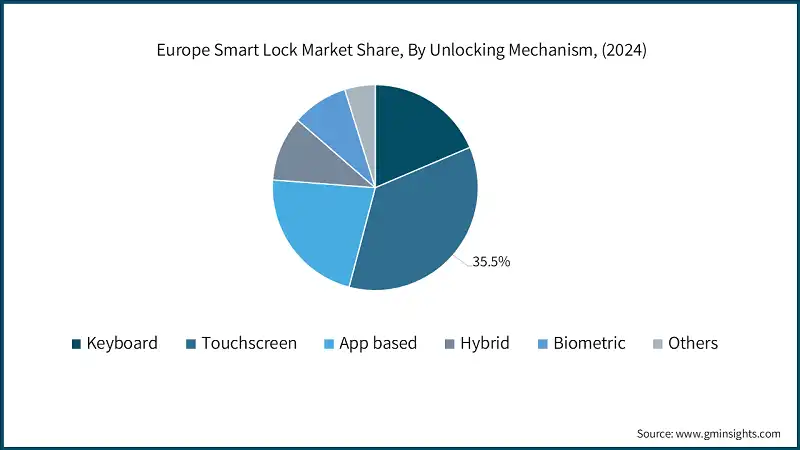
Based on unlocking mechanism, the smart lock market is segmented into keyboard, touchscreen, app based, hybrid, biometric and others. The touchscreen segment held the largest share, accounting for 35.5% of the Europe smart lock market in 2024.
- Touchscreen unlocking devices provide a stylish, contemporary interface to a lock and key system. In this case, inconvenient keys are replaced by PIN-based access control. While this added user convenience improves the access experience by removing the burden of carrying keys, it also empowers swift and feel-good access, especially in residential and hospitality scenarios.
- Touchscreen locks with keypads can often expand access control to creating user-specific or time-sensitive PIN codes. This feature is valuable to property managers, Airbnb hosts, or families, because it allows for selected access through a secure code; monitoring access and activity; and removing access without necessitating a full rekeying of the system.
- Smart locks with touchscreen keypads may include additional security features such as anti-peeping technology (where common covered digits may be included in the access code), auto-locking, and alarm features to indicate unauthorized access. All these features create a better security posture for smart homes and commercial properties.
Based on the distribution channel, the smart lock market is segmented into online and offline. In 2024, offline distribution channel held a major market share, generating a revenue of USD 500 million.
- Offline distribution via retail chains, hardware stores, and home improvement centers (Home Depot, Lowe’s, or others similar to those in their country) are a critical way to reach end-users who wish to evaluate products in person, look at smart locks, compare features and elements, and obtain installation assistance with products. All of which is extremely important for high-involvement purchases, like home security systems.
- In both commercial and urban development projects, local distributors and system integrators are a key component of the offline partnership in the market through bundled services, installation, and ongoing maintenance. They can leverage their technical capacities and existing relationships with builders, contractors, and facility managers to help penetrate institutional and B2B market segments in the smart lock sector.
Looking for region specific data?
Europe Smart Lock Market
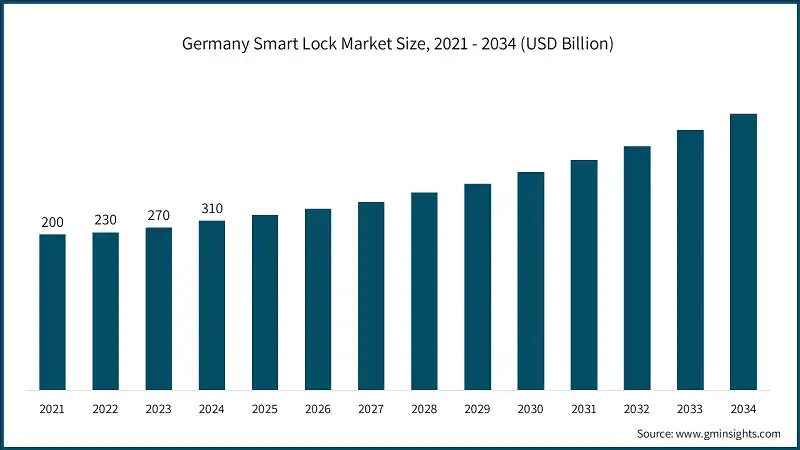
In 2024, the Germany dominated the Europe market, accounting for around 29.6% and generating around USD 310 million revenue in the same year.
- Interest in smart locks within the European market is increasing as part of smart home ecosystems. Consumers are eager to use connected devices for convenience, remote access, and improved home security control. Smart locks with seamless connectivity to voice assistants and home automation are particularly appealing.
- As data protection and privacy are a priority in the region, the smart lock companies that are operating in Europe must comply with regulations such as the General Data Protection Regulation (GDPR). Consequently, secure and privacy-focused smart lock products have been established, designed to prioritize encrypted communications and protect user data.
- Smart locks are gaining traction not only in residential use, but throughout commercial and hospitality. Urban adoption is being driven by the need for security, and keyless access to apartments, co-living, and short-term rental properties. With growing acceptance and expectation for digital conveniences and touchless solutions, the trend will continue.
Europe Smart Lock Market Share
Assa Abloy are leading with 17% market share. Assa Abloy, Dormakaba, Allegion, Salto Systems, Nuki Home Solutions collectively hold around 35%, indicating moderately fragmented market concentration. These prominent players are proactively involved in strategic endeavors, such as mergers & acquisitions, facility expansions & collaborations, to expand their product portfolios, extend their reach to a broad customer base, and strengthen their market position.
Assa Abloy is a worldwide frontrunner in access solutions and a leading provider of smart locks in Europe. Its well-established brands, including Yale and August Home, offer a diversified product portfolio of smart locking solutions suitable for residential, commercial, and institutional customers, featuring Bluetooth, Wi-Fi, and Z-Wave technologies that interoperate with major smart home ecosystems, including Apple HomeKit and Google Home.
Allegion is a significant global supplier of security and access control solutions, smart locks included. Allegion is positioned competitively in the global and European markets through brands such as Schlage and Onity and focuses on both residential and hospitality markets, which has experienced increased adoption of smart locks in recent years. Allegion's offerings feature smart locks with various connectivity options, all while integrating with smart home systems with worker and consumer at top of mind for usability and security in the hospitality environments.
Europe Smart Lock Market Companies
Major players operating in the smart lock industry are:
- Allegion
- Assa Abloy
- Avent Security
- August Home
- Cansec Systems
- Dormakaba
- Honeywell International
- Nuki Home Solutions
- Onity
- Salto Systems S.L.
- Schlage
- Spectrum Brands
- U-tec Group
- UniKey Technologies
- Yale Locks
Spectrum Brands, is a U.S. based consumer products company, is participating in the smart lock market via its lock hardware brands, most notably Kwikset and Baldwin. Despite its primary strength being in North America, Spectrum Brands has expanded into Europe and is offering smart locks that work with many of the smart home systems we recognize today. Spectrum Brands focuses on innovative design and user-friendly features aimed at homeowners looking for attractive and reliable security products.
Yale Locks, a household name in the European smart lock market, has a full lineup of smart locking products such as the Linus Smart Lock and Conexis L1 smart lock that are built for European doors. Yale is a preferred brand for many residential consumers across the UK, Nordics, and much of Europe because of Yale’s smart locks that can integrate with everything from some of the major smart home platforms to home security systems. In addition, Yale’s well-known brand and dedication to providing digital security has made it an established leader in the smart lock category.
Europe Smart Lock Market Report Attributes
| Key Takeaway | Details |
|---|---|
| Market Size & Growth | |
| Base Year | 2024 |
| Market Size in 2024 | USD 1 Billion |
| Market Size in 2025 | USD 1.2 Billion |
| Forecast Period 2025 - 2034 CAGR | 15.4% |
| Market Size in 2034 | USD 4.3 Billion |
| Key Market Trends | |
| Drivers | Impact |
| Rising security awareness | As home and data security increases it is heating the demand for smart lock and in particular smart locks supporting multiple factors authentication for encrypted communication. |
| Increase in adoption of smart homes | The overall increase in smart home devices being installed across Europe is increasing the incorporation of smart locks as consumers desire smart locks that can be integrated into their smart home devices, thus providing convenience and security. |
| Integration of enhanced features with traditional lock systems | Manufacturers are creating smart locks that pair traditional mechanical locks with digital features such as mobile access, thus decreasing the oversight required for existing homes. |
| Pitfalls & Challenges | Impact |
| High cost of adoption | Advanced solutions typically require some premium cost or expensive installation, examples displayed may delay the growth of certain segments or territories, particularly among cost-sensitive consumers. |
| Security concerns | While advanced solutions typically require some premium cost or expensive installation, examples displayed may delay the growth of certain segments or territories, particularly among cost-sensitive consumers. |
| Opportunities: | Impact |
| Biometric and AI integration | The incorporation of fingerprint scanning, facial recognition, and AI-powered predictive security will unlock new and different value propositions by creating a personalized, yet secure form of access. |
| Cloud-based access management | Cloud platforms with features such as remote controls, real-time alerts, and modular or multi-site management make Smart Locks a desirable option for residential and commercial applications alike and further support the growth of this category across Europes growing rental and hospitality use cases. |
| Market Leaders (2024) | |
| Market Leaders |
17% market share |
| Top Players |
The collective market share in 2024 is 35% |
| Competitive Edge |
|
| Regional Insights | |
| Emerging countries | UK, France, Italy |
| Future outlook |
|
What are the growth opportunities in this market?
Europe Smart Lock Industry News
- In February 2025, Assa Abloy launched the Aperio DR100 Wireless Wall Reader to provide access control in areas such as buildings with high traffic levels that are not easy to wire. The Aperio DR100 wireless reader integrates easily into an existing access control system and allows for secure installation without cabling at commercial and institutional facilities throughout Europe.
- In February 2025, Salto Systems S.L. launched the Neoxx G4 Smart Padlock, their newest rugged, keyless padlock designed for extreme and demanding environments. The G4 is a sophisticated padlock with full smart access capabilities, including mobile keys and compatibility with Salto's BLUEnet wireless technology, which allows secure remote access control for industrial, utility, and outdoor settings.
- In January 2025, Dormakaba launched the EntriWorX Ecosystem, a digital platform used to simplify integrated access planning and management. The EntriWorX digital platform comes in the form of software, which has a primary focus on connecting door hardware, electronic access systems, and digital services into one environment, allowing facility managers and architects to enhance building security and operational efficiency with real-time data and centralized control.
- In January 2025, Nuki Home Solutions launched Nuki Smart Lock Go, an entry-level smart lock targeted towards European homes. This new style of smart lock comes with built-in Wi-Fi capabilities as well as Matter support which allows for easy interoperability with the leading smart home ecosystems including Apple Home, Google Home, and Amazon Alexa. The Smart Lock Go is both affordable and offers new features but is also in keeping with Nuki's retrofit philosophy and can be installed to existing European style door cylinders without needing professional help.
- In September 2024, Spectrum Brands, through their Kwikset brand, introduced a new smart lock intended for the European smart home space, the Halo Touch Matter-enabled smart lock. The Halo Touch Matter-enabled smart lock features biometric fingerprint access as well as Matter protocol support to ensure interoperability with Apple Home, Google Home, and Amazon Alexa. The launch of this new product, according to Kwikset, represents an expansion of its efforts to provide convenience and security while growing with the Matter acceptance in Europe.
The Europe smart lock market research report includes in-depth coverage of the industry with estimates & forecasts in terms of revenue (USD Billion) and volume (Thousand Units) from 2021 to 2034, for the following segments:
Market, By Product Type
- Deadbolt lock
- Lever handle
- Padlock
- Others
Market, By Unlocking Mechanism
- Keyboard
- Touchscreen
- App based
- Hybrid
- Biometric
- Others
- Freestanding
Market, By Connectivity Type
- Wi-Fi
- Bluetooth
- Z-Wave
- Others
Market, By Price Range
- Low (<100$)
- Medium (100$-300$)
- High (>300$)
Market, By End Use
- Commercial
- HoReCa
- Hospitals
- Offices
- Malls
- Others
- Residential
- Condominium
- Individual houses
- Industrial
- Government
- Transportation and logistics
- Trucks
- Airports
- Others
- Others
Market, By Distribution Channel
- Online
- E-commerce
- Company website
- Offline
- Specialty stores
- Mega retail stores
- Others
The above information is provided for the following regions and countries:
- Europe
- Germany
- UK
- France
- Italy
- Spain
Frequently Asked Question(FAQ) :
What is the market size of the Europe smart lock market in 2024?
The market size was USD 1 billion in 2024, driven by increasing urbanization, growing adoption of smart home technologies, and rising consumer demand for enhanced security and convenience in residential and commercial spaces.
What is the projected market value of the Europe market by 2034?
The market is expected to reach USD 4.3 billion by 2034, growing at a CAGR of 15.4%, fueled by the integration of biometric and AI-powered authentication, cloud-based access management, and rising adoption of energy-efficient and connected security systems.
What is the estimated market size of the Europe smart lock industry in 2025?
The market is projected to reach USD 1.2 billion in 2025, supported by growing smart home penetration across Germany, the U.K., France, and the Netherlands, along with increasing interoperability between smart locks and home automation platforms.
Which product type segment dominated the Europe smart lock market in 2024?
The deadbolt lock segment led the market, generating USD 500 million revenue in 2024, as these locks offer superior resistance to forced entry and compatibility with retrofit smart lock systems, making them ideal for both new installations and upgrades.
Which unlocking mechanism segment held the largest share in 2024?
The touchscreen segment accounted for 35.5% of the market in 2024, driven by demand for keyless access, user-specific PIN control, and enhanced security features such as anti-peeping and automatic locking systems.
Which distribution channel dominated the Europe smart lock market in 2024?
The offline distribution channel held the largest share with USD 500 million revenue in 2024, as consumers prefer in-person evaluation, installation support, and after-sales services available through retail chains and hardware stores.
Which region within Europe leads the smart lock market?
Germany dominated the European smart lock market with a 29.6% share (USD 310 million) in 2024, supported by widespread adoption of home automation, robust construction activity, and strong consumer focus on security and privacy.
Which countries are emerging markets for smart locks in Europe?
The U.K., France, and Italy are key emerging markets, driven by urbanization, renovation projects, and increased integration of smart locks in hospitality, coworking, and rental property sectors.
Who are the key players in the Europe smart lock market?
Key players include Assa Abloy, Dormakaba, Allegion, Salto Systems, Nuki Home Solutions, Yale Locks, August Home, Spectrum Brands, Honeywell International, Onity, Avent Security, Schlage, and Cansec Systems.
Europe Smart Lock Market Scope
Related Reports