Summary
Table of Content

Europe Robotic Lawn Mower Market
Get a free sample of this report
Form submitted successfully!
Error submitting form. Please try again.
Thank you!
Your inquiry has been received. Our team will reach out to you with the required details via email. To ensure that you don't miss their response, kindly remember to check your spam folder as well!
Request Sectional Data
Thank you!
Your inquiry has been received. Our team will reach out to you with the required details via email. To ensure that you don't miss their response, kindly remember to check your spam folder as well!
Form submitted successfully!
Error submitting form. Please try again.
Europe Robotic Lawn Mower Market Size
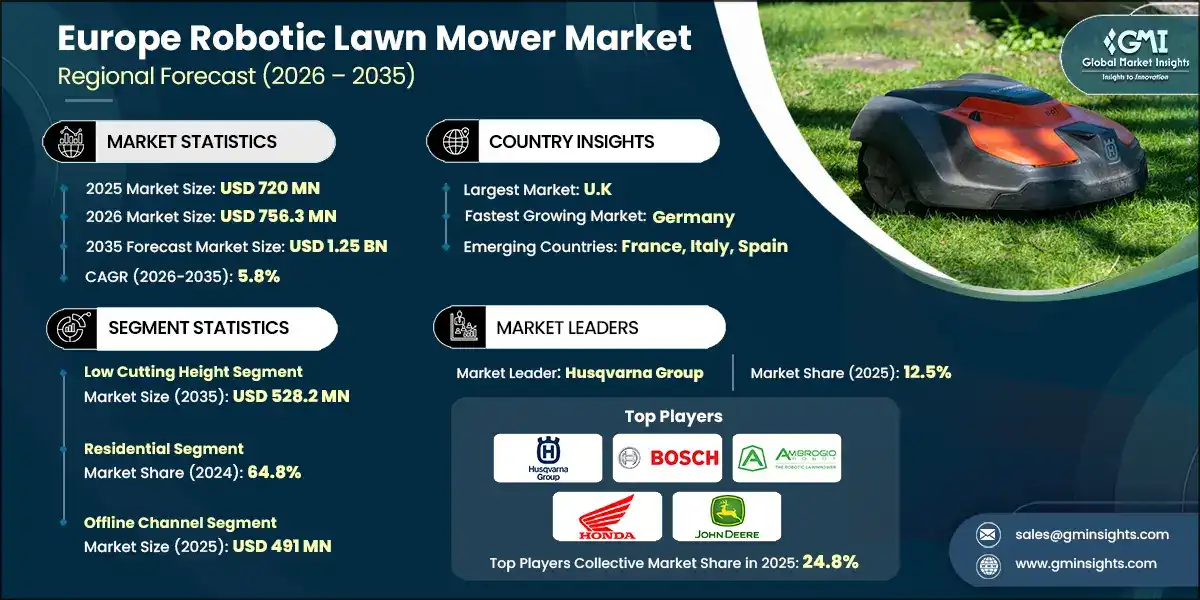
The Europe robotic lawn mower market was valued at USD 720 million in 2025. The market is expected to grow from USD 756.3 million in 2026 to USD 1.25 billion in 2035, at a CAGR of 5.8%, according to latest report published by Global Market Insights Inc.
Europe Robotic Lawn Mower Market Key Takeaways
Market Size & Growth
- 2025 Market Size: USD 720 Million
- 2026 Market Size: USD 756.3 Million
- 2035 Forecast Market Size: USD 1.25 Billion
- CAGR (2026–2035): 5.8%
Regional Dominance
- Largest Market: U.K
- Fastest Growing Country: Germany
Key Market Drivers
- Increasing demand for smart home automation.
- Growing labor costs and aging population.
- Rising awareness about sustainable landscaping.
Challenges
- High initial investment cost.
- Limited effectiveness on uneven or complex terrains.
Opportunity
- Technological advancement and offering competitive solution.
- Enabling lawn mower with advanced smart features and sensors.
Key Players
- Market Leader: Husqvarna Group led with over 12.5% market share in 2025.
- Leading Players: Top 5 players in this market include Husqvarna Group, Robert Bosch, Ambrogio, Honda Motor Company, John Deere, which collectively held a market share of 24.8% in 2025.
Get Market Insights & Growth Opportunities
With increasing demand for environmentally friendly automated lawn mowers that are simple to operate, robot lawn mowers have become an integral part of the outdoor power equipment category and offer consumers a way to easily and efficiently mow their lawns with minimal effort. The potential for future growth is also due to emerging technologies that provide enhanced capabilities for artificial intelligence (AI) navigation, a more extended period of use per charge and the inclusion of smart home features as part of a complete smart home system.
Currently, in the current environment, many manufacturers are taking different approaches to innovate their products by investing in overall performance improvements, time between charges and overall safety and ease of use. Furthermore, sustainability continues to be a focus for companies, and many are producing models that are energy-efficient and recyclable. Other businesses have begun providing customers with added benefits through digital platforms such as educating consumers about their products, including remote monitoring to enhance customer loyalty and engagement.
As a result of technological innovation and evolving consumer demands, Europe's robotics lawn mower industry continues to grow. Innovations such as AI-enabled navigation, an extended battery life, and seamless smart home integration are enabling robotic mowers to become increasingly efficient and user-friendly to meet the needs of today's households.
Another important factor driving the growth of robotic lawn mower market is the growing concern that people have about the environment. As a result, consumers are moving away from gasoline powered lawn mowers and towards electric powered robotic lawn mowers in an attempt to reduce their carbon footprint, which is reflective of the increased awareness of climate change and desire to use more sustainable methods of working towards a greener planet.
At the same time, continued urbanization and the increase in small living spaces have led to a demand for the use of automated lawn maintenance. Further the busy lifestyles and the aging population also play a role in the growth of the robotic lawn mower market as these individuals often want low maintenance and time savings associated with their lawn care. Collectively, all these factors make Europe a significant contributor to the growth of robotic lawn mower development in Europe.
To get key market trends
Europe Robotic Lawn Mower Market Trends
Changing innovation and technology transformation are important for the growth of the market.
- Europe's robotic lawn mower market is witnessing significant growth, driven by advancements in AI and navigation technologies. One of the primary contributors to the increase in interest in these types of products is the integration of AI, as well as increased accuracy and adaptability of equipment to various types of terrain based on where the mower is. Various EU countries like Germany are naturally seeing this uptick due to their strong support for automation and other technologies to enhance how consumers can use technology for convenience.
- As the use of mobile phones and smart homes grows within the EU, consumers are demanding more functionality from robotic mowing equipment. Remote control, scheduling, and monitoring are now typical functionalities. The EU's Digital Decade initiative is supporting the ability of businesses to offer enhanced digital transformation solutions to their consumers within their individual countries.
- There is a growing trend toward a focus on the environment and sustainable practices in Europe, and therefore environmental stewardship is a major driver of consumer purchasing behavior. The EU will generally focus on eliminating harmful greenhouse gas emissions by 2050 and as a result, manufacturers are concentrating on manufacturing electric and lower emission and noise machines.
- Government programs, like those in Sweden and Denmark supporting sustainable technology through subsidies, will drive energy-efficient robotic lawn mower sales. Manufacturers will also be challenged to innovate their designs and use more sustainable materials to meet changing legislation and appeal to eco-conscious consumers.
- Since 2024, the European push towards sustainability and digital transformation will continue to shape the robotic lawn mower sector. Companies that can align their business strategies with these trends and take advantage of government-funded programs are best positioned to increase their market share as this market continues to expand.
Europe Robotic Lawn Mower Market Analysis
Learn more about the key segments shaping this market
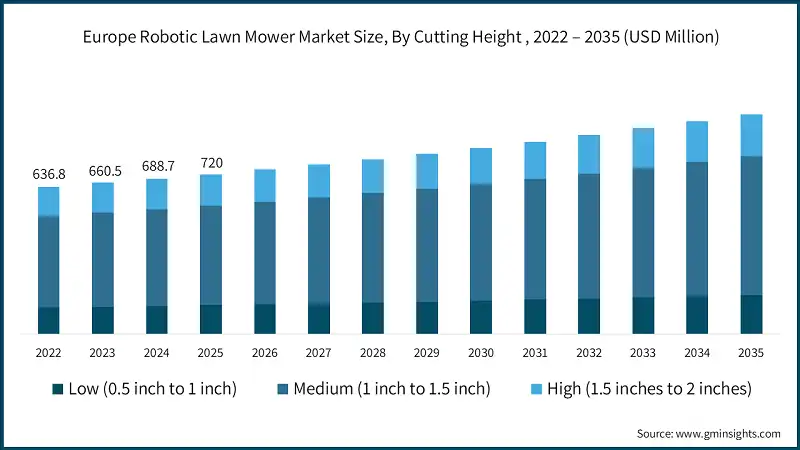
Based on cutting height, the Europe robotic lawn mower industry is segmented into low, medium and high. The low cutting height segment accounts for revenue of around USD 298 million in the year 2025 and is expected to reach USD 528.2 million by 2035.
- Driven by a growing consumer preference for well-maintained lawns, the demand for robotic lawnmowers with low-cutting height features is surging. The European Environment Agency reports that approximately 15% of urban areas in the EU are covered by green spaces, many of which are maintained with low-cutting height practices to enhance both aesthetic appeal and functionality. As a result, the low-cutting height segment is poised to lead the market during the forecast period.
- A low-cutting height allows for consistent and uniform cutting of grass and thus be an important part of the overall process when caring for a lawn. All robotic mowers have been designed to effectively operate at lower height levels, which increases their versatility. Thus, European Union are pushing for sustainable landscape practices, with the availability of robotic mowers specifically designed and manufactured to operate effectively with low-cutting heights has led to lower energy consumption and less manual working.
- This market segment serve both residential customers and commercial ones. An example would be many times golf courses and parks require very low cutting heights to provide what is viewed as a professional environment. Government programs such as the Green Spaces Fund in the UK support the use of new technologies for lawn maintenance.
- The low cut height segment is expected to grow steadily as it aligns with customer wants and needs, as well as government initiatives supporting sustainability. Keeping to this will also provide continued consistent results thus maintaining its dominance in the marketplace. .
Learn more about the key segments shaping this market
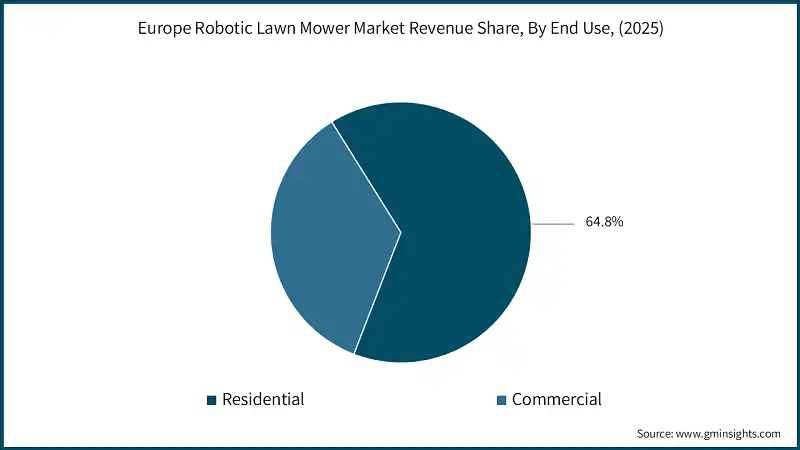
Based on the end-use, the Europe robotic lawn mower market is bifurcated into residential and commercial. The residential segments held the largest share, accounting for 64.8% of the market in 2025.
- Europe has seen a significant rise in popularity of robotic lawnmower as people become more interested in aesthetics and want more time-efficient solutions. In 2023, the EU reported a 4.5% increase in median household income according to Eurostat, leading people to spend more on Smart Home Technology such as robotic lawnmower.
- The combination of an increase in disposable income and a growing acceptance of smart home products will continue to drive the growth of residential robotic lawnmower. One example of this increasing acceptance can be found in the Consumer Technology Association's report of an 18% increase in IoT devices in 2023.
- Robotic mowers can often be a more aesthetically pleasing, and faster way to mow, which is an attractive feature for residential users. Unlike commercial services that mow lawns, the variables involved in mowing residential lawns are limited, including smaller size of lawns and simplicity of landscaping; hence robotic mower adoption is likely to result from this.
- Additionally, homes with manicured lawns can experience increases in overall property value of up to 15%, which provides an additional incentive for homeowners to invest in these products, according to the National Association of Realtors. Thus, the growth in this segment of the market shows a growing trend towards automated or more convenient means of maintaining one’s household, further continuing to grow in the robotic mower market over the period.
Based on distribution channels, the Europe robotic lawn mower market is segmented into online and offline channels. The offline channel segment held the largest share, generating a revenue of USD 491 million of the market in 2025.
- Consumer preference for being able to physically inspect items prior to purchasing them is the main reason that offline sales account for most of the total amount sold. Having a retail location allows customers to determine if the item they want to buy will meet their requirements, as well as determine its use. For example, over 60% of households in Germany have a garden, thus retail outlets are a major solution when it comes to fulfilling the needs of customers.
- Another factor that drives consumers to purchase items from offline retailers is the immediacy of receiving their order. By using an offline channel, customers can buy and receive their product immediately, without waiting for it to be shipped. The ability to purchase the product immediately is extremely important to customers in countries like France, where customers typically expect to buy items and receive them on the same day as they place their orders.
- In addition, consumers have access to local dealer networks, making it very convenient for customers shopping in-store, these outlets provide both customer support and after-sales support which are very important in markets where the use of e-commerce remains limited. For example, although the rate of e-commerce adoption in Italy is much slower than it is in Northern Europe, offline retail channels continue to be the primary method for consumers in Italy when shopping for products like robotic lawn mowers.
- Thus, the offline channel adds value to the European robotic lawn mower market, as there is a trust level between consumer and supplier, and customers have immediate access to products and services tailored to their specific needs.
Looking for region specific data?
U.K Europe Robotic Lawn Mower Market
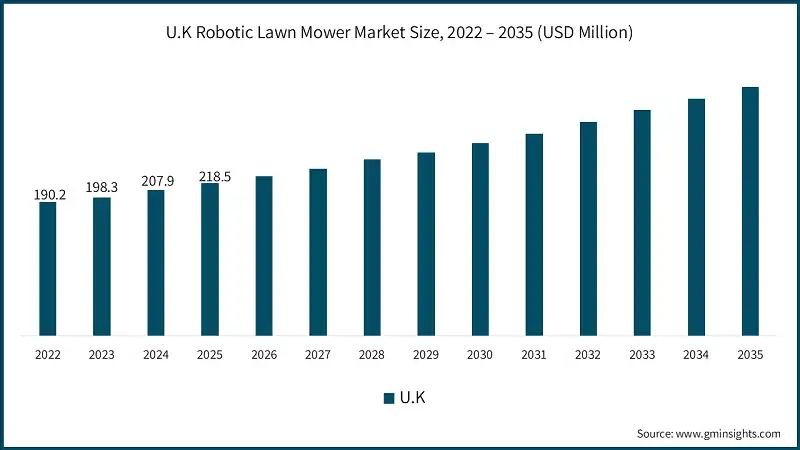
In 2025, the U.K dominated the market, accounting for 30.3% of the share in the region.
- The U.K.’s rapid adoption of smart-home technologies continues to accelerate robotic mower uptake. The influx of connected outdoor devices and automation through the Internet of Things (IoT) has led to a growing demand for robotic mowers across the continent, particularly in Western Europe, where the public has become increasingly aware of smart home technology
- Due to heightened expectations around being environmentally responsible and the rising numbers of programs aimed at reducing green emissions, robotic lawnmowers are becoming more popular in the UK. Experts have estimated that robotic mowers use 80% less energy than gas-powered equivalents and assist growers with meeting their sustainability commitments.
Germany Europe Robotic Lawn Mower Market
Germany market is expected to grow at 6.1% during the forecast period.
- Germany’s sizable urban population and active investment in smart-city infrastructure contribute to strong demand for automated outdoor solutions. Europe-wide data shows that over 75% of the population lives in urban areas, where time constraints and compact gardens fuel robotic mower adoption. Germany’s advanced tech-savvy consumer base mirrors Northern Europe’s high robotic-mower penetration levels, accelerating market growth.
- Germany’s strict environmental standards and consumer preference for sustainable devices support robotic mower expansion. European research shows robotic mowers use significantly less energy and produce fewer emissions than gasoline models, aligning well with Germany’s regulatory push for low carbon, quiet outdoor equipment. With over 60% of consumers in Germany and Denmark prioritizing eco-friendly products, adoption continues to rise.
Europe Robotic Lawn Mower Market Shares
The top companies in the market include Husqvarna Group, Robert Bosch GmbH, John Deere, Honda Motor Company and Ambrogio and collectively hold a share of 24.8% of the market in 2025. These prominent players are proactively involved in strategic endeavors, such as mergers & acquisitions, facility expansions & collaborations, to expand their product portfolios, extend their reach to a broad customer base, and strengthen their market position.
- Husqvarna leads the European Europe robotic lawn mower market with its Automower series, featuring advanced EPOS wire-free navigation for precise mowing. Its weather-resistant and reliable designs ensure year-round performance. Integration with smart home platforms and mobile apps enhances convenience for users. Husqvarna remains a top choice for both residential and commercial applications.
- Bosch excels in Europe with systematic mowing patterns that optimize battery life and ensure complete lawn coverage. Its weather-adaptive features protect lawns and devices by pausing operations during rain. Smart app control allows scheduling, tracking, and remote updates for user convenience. Bosch continues to innovate in robotic lawn care technology.
- John Deere applies its agricultural expertise to robotic mowers, offering vision-based navigation that eliminates the need for GPS or boundary wires. This reduces setup costs and enhances user-friendliness for customers. Known for durability and innovation, John Deere serves both residential and commercial markets. Its solutions advance autonomous and efficient mowing technology in Europe.
Europe Robotic Lawn Mower Market Companies
Major players operating in the Europe robotic lawn mower industry are:
- AIDA
- Ambrogio
- Echo Robotics
- Ecoflow
- Gardena
- Honda Motor Company
- Husqvarna Group
- John Deere
- Kress Robotics
- Mammotion
- Robert Bosch
- Robomow
- Segway Navimow
- Traqnology
- Worx Landroid
- Yarbo
Honda Miimo provides quiet, eco-friendly robotic mowers with adaptive mowing patterns and weather-based scheduling for improved battery efficiency. Smartphone and voice assistant integration ensure ease of use and control. Honda's focus on reliability, safety, and sustainability appeals to European consumers. Miimo is a preferred choice for smart, low-maintenance lawn care.
Ambrogio, a premium European brand, offers RTK GPS-enabled wire-free robotic mowers for precise and efficient performance. Its powerful multi-disc blades handle large and complex lawns with ease. Ambrogio supports both residential and commercial applications with dependable solutions. The brand remains at the forefront of robotic lawn care innovation in Europe.
Europe Robotic Lawn Mower Market Report Attributes
| Key Takeaway | Details |
|---|---|
| Market Size & Growth | |
| Base Year | 2025 |
| Market Size in 2025 | USD 720 Million |
| Market Size in 2026 | USD 756.3 Million |
| Forecast Period 2026 - 2035 CAGR | 5.8% |
| Market Size in 2035 | USD 1.25 Billion |
| Key Market Trends | |
| Drivers | Impact |
| Increasing demand for smart home automation | Smart home adoption across Europe is rising, driving demand for connected outdoor devices like robotic mowers. Growing IoT integration and consumer preference for automated lawn care further accelerate uptake. |
| Growing labor costs and aging population | Europe’s landscaping sector is facing labor shortages and rising wage costs, making automation more attractive. An aging population also increases reliance on robotic mowers to reduce physical workload. |
| Rising awareness about sustainable landscaping | Robotic mowers help meet Europe’s sustainability goals by offering lower emissions and quieter operation. They consume significantly less energy than gasoline models, appealing to eco conscious consumers. |
| Pitfalls & Challenges | Impact |
| High initial investment cost | Robotic mowers remain costly, limiting adoption among price?sensitive households in parts of Europe. Despite long?term savings, affordability continues to be a barrier in developing regions of the EU. |
| Limited effectiveness on uneven or complex terrains | Many European properties have irregular layouts or steep slopes, challenging standard robotic mower performance. Although improving, navigation technology still struggles in complex garden environments. |
| Opportunities: | Impact |
| Technological advancement and offering competitive solution | Technological improvements and wider competition are lowering hardware and battery costs. Subsidies for eco‑friendly equipment also make robotic mowers increasingly accessible across Europe. |
| Enabling lawn mower with advanced smart features and sensors | AI‑vision, virtual boundaries, and RTK navigation enable next‑generation models to handle complex European gardens. These advancements open new customer segments previously underserved by robotic mowing technology. |
| Market Leaders (2025) | |
| Market Leaders |
12.5% market share |
| Top Players |
|
| Competitive Edge |
|
| Regional Insights | |
| Largest market | U.K |
| Fastest growing market | Germany |
| Emerging countries | France, Italy, Spain |
| Future outlook |
|
What are the growth opportunities in this market?
Europe Robotic Lawn Mower Industry News
- In February 2025, Husqvarna announced its largest robotic lawn-mower launch in company history, introducing 13 new boundary-wire-free robotic lawn mowers for the 2025 season. These include both residential and professional models designed for use across European markets.
- In January 2025, At CES 2025, Segway showcased the Navimow X3 robotic mower, designed for European users with large lawns. It features AI-assisted mapping, 3D camera navigation, and coverage up to 5,000 m² in 24 hours. Though launched globally at CES, Navimow products are officially distributed in European markets, making this a Europe-relevant launch.
- In January 2025, Mammotion unveiled the Luba Mini AWD robotic mower at CES 2025, aimed at European terrain needs -steeper slopes up to 38 degrees and multi-zone mapping. It incorporates AI-vision mapping, virtual boundary operation, and advanced slope-handling capabilities, all highly suited to Europe’s residential landscape profile.
- In 2025, Ambrogio introduced its AI-Powered Robotic Lawn Mower line, featuring RTK satellite navigation, cloud mapping, 5.0 grade autonomy, and perimeter-wire-free operation. As Ambrogio is an Italian manufacturer with its primary footprint in European markets, this represents a 2025 Europe-relevant innovation release.
- In December 2024, Gardena revealed its first boundary-wire-free robotic mower, the Smart Sileno Free, launching in Europe in 2025. It uses satellite navigation (LONA), includes Trim-to-Edge and frost sensor technology, and comes in versions for 600 m², 800 m², and 1,200 m² lawns.
The Europe robotic lawn mower market research report includes in-depth coverage of the industry, with estimates & forecasts in terms of revenue (USD Million) (Thousand Units) (from 2022 to 2035), for the following segments:
Market, By Cutting Height
- Low (0.5 inch to 1 inch)
- Medium (1 inch to 1.5 inch)
- High (1.5 inches to 2 inches)
Market, By Lawn Size
- Small Lawns (up to 0.25 acres)
- Medium Lawns (0.25 - 0.5 acres)
- Large Lawns (0.5 acres and above)
Market, By Battery Capacity
- Up to 20V
- 20V to 30V
- Above 30V
Market, By Price
- Low
- Medium
- High
Market, By End Use
- Residential
- Commercial
Market, By Distribution Channel
- Online
- Offline
The above information is provided for the following countries:
- Germany
- France
- UK
- Italy
- Spain
Frequently Asked Question(FAQ) :
What is the projected value of the Europe robotic lawn mower market by 2035?
The market is expected to reach USD 1.25 billion by 2035, driven by advancements in AI, navigation technologies, and increasing demand for smart home integration.
What is the projected size of the Europe robotic lawn mower market in 2026?
The market is expected to reach USD 756.3 million in 2026.
How much revenue will the low cutting height segment generate by 2035?
The low cutting height segment is projected to generate USD 528.2 million by 2035, growing from USD 298 million in 2025.
What was the market share of the residential segment in 2025?
The residential segment held the largest share, accounting for 64.8% of the market in 2025.
Which distribution channel led the Europe robotic lawn mower market in 2025?
The offline channel dominated the market, generating USD 491 million in revenue in 2025.
Which country led the Europe robotic lawn mower industry in 2025?
The U.K. led the market, accounting for 30.3% of the regional share in 2025.
What are the upcoming trends in the Europe robotic lawn mower industry?
Key trends include the integration of AI for enhanced adaptability, increased functionality driven by smart home adoption, and support from the EU's Digital Decade initiative for digital transformation.
Who are the key players in the Europe robotic lawn mower market?
Key players include AIDA, Ambrogio, Echo Robotics, Ecoflow, Gardena, Honda Motor Company, Husqvarna Group, John Deere, Kress Robotics, Mammotion, and Robert Bosch.
Europe Robotic Lawn Mower Market Scope
Related Reports