Summary
Table of Content

Europe PV Inverter Market
Get a free sample of this report
Form submitted successfully!
Error submitting form. Please try again.
Thank you!
Your inquiry has been received. Our team will reach out to you with the required details via email. To ensure that you don't miss their response, kindly remember to check your spam folder as well!
Request Sectional Data
Thank you!
Your inquiry has been received. Our team will reach out to you with the required details via email. To ensure that you don't miss their response, kindly remember to check your spam folder as well!
Form submitted successfully!
Error submitting form. Please try again.
Europe PV Inverter Market Size
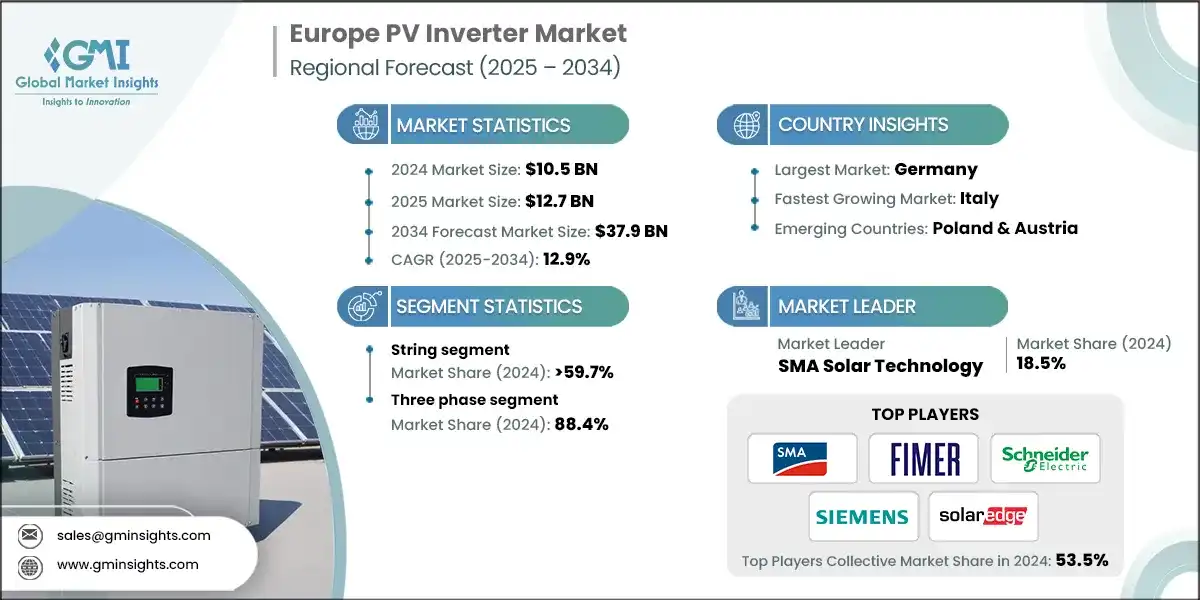
The Europe PV inverter market was estimated at USD 10.5 billion in 2024. The market is expected to grow from USD 12.7 billion in 2025 to USD 37.9 billion in 2034, at a CAGR of 12.9% according to Global Market Insights Inc.
Europe PV Inverter Market Key Takeaways
Market Size & Growth
- 2024 Market Size: USD 10.5 Billion
- 2025 Market Size: USD 12.7 Billion
- 2034 Forecast Market Size: USD 37.9 Billion
- CAGR (2025–2034): 12.9%
Regional Dominance
- Largest Market: Germany
- Fastest Growing Country: Italy
Key Market Drivers
- Government renewable policies.
- Technological advancements.
Challenges
- Grid compatibility issues.
- Supply chain disruptions.
Opportunity
- Rural electrification programs.
- Energy storage integration.
Key Players
- Market Leader: SMA Solar Technology led with over 18.5% market share in 2024.
- Leading Players: Top 5 players in this market include SMA Solar Technology, Fimer Group, Schneider Electric, Siemens, SolarEdge Technologies, which collectively held a market share of 53.5% in 2024.
Get Market Insights & Growth Opportunities
- Rapidly evolving regulatory frameworks to support PV inverter deployment through targeted renewable energy policies, strengthen the product growth. For instance, the Renewable Energy Directive (EU/2023/2413) sets a binding target of 42.5% renewable energy by 2030, encouraging smart grid integration and self-consumption. Additionally, Ecodesign and Energy Labelling regulations promote high-efficiency, durable, and recyclable inverters. These combined efforts ensure widespread deployment of advanced PV inverters, supporting Europe’s transition to a decentralized, clean energy future.
- Rapid solar energy deployment across Europe is significantly boosting demand for PV inverters, which are essential for converting solar-generated DC electricity into usable AC power. In 2024, the EU added a record 65.5 GW of solar PV capacity, which was 4% more than in 2023 but represented a drastic slowdown from the high growth rates of previous years. This significant increase brought the EU's total operating solar fleet to 338 GW by the end of 2024, though a decrease in growth rate has raised concerns about meeting future solar targets.
- The growing focus on grid modernization and the development of smart grids is significantly boosting demand for advanced PV inverters. To meet the evolving requirements of intelligent energy systems, companies are introducing next-generation inverters, particularly smart and grid-tied models. For instance, in September 2025, INVT, a provider of PV inverters and energy storage systems, showcased its new commercial and industrial solutions, XD30-60KTR and XG125KTR-PRO-NE, at InterSolar Europe 2025, the region’s leading solar event. These solutions aim to transform solar energy adoption for businesses and industrial users.
- The Europe PV inverter market was valued at USD 5.3 billion in 2021 and grew at a CAGR of 25.2% through 2024. Continuous innovation and economies of scale have led to significant reductions in the cost of solar panels and inverters. At the same time, inverter efficiency and reliability have improved, making solar systems more attractive to consumers and businesses. Lower upfront costs and higher performance are key drivers of widespread adoption across urban and rural areas.
- Germany is among the dominant countries, due to strong government support for renewable energy, including subsidies and grid integration mandates. The country’s massive solar capacity growth requires efficient inverter deployment, leading to propel the business scenario. Rising energy independence goals, especially post-Ukraine crisis, have intensified the shift toward self-consumption and grid resilience. Additionally, Germany’s push for smart grid integration and battery storage encourages the use of advanced inverters capable of real-time monitoring, load balancing, and storage management.
- Growing key players' focus on forming partnerships with local players to improve regional presence will further augment the business outlook. For instance, in September 2025, SMA Solar, a German company, partnered with Dean Solon’s Create Energy. SMA will launch its Sunny Highpower PEAK3 string inverters as scalable solutions for large PV systems and will manufacture the fully-integrated PowerSkid solution locally.
- Italy is the fastest-growing region in the market. Expanding building-integrated PV, especially in urban areas, where over 80% of new capacity is installed on buildings, boosts demand for compact, efficient inverters. Growing socio-cultural dynamics, such as neighborhood influence and community engagement, also play a role in areas with strong social networks and see higher adoption rates. Furthermore, regional policies targeting low-income households and agriculture enhance inclusivity and broaden market reach, complement the industry projections.
To get key market trends
Europe PV Inverter Market Trends
- Growing shift towards smart and hybrid inverters that integrate energy storage and advanced grid-support functionalities is set to influence the product growth. These inverters enable real-time monitoring, remote diagnostics, and seamless integration with energy management systems. Rising complexity of grid infrastructure and improved demand for decentralized solutions will propel smart inverters' adoption, essential for maintaining grid stability and optimizing energy flow.
- Surge in rooftop solar installation, driven by falling solar costs, supportive net metering policies, and rising electricity prices, is expected to drive the business trend. This trend is particularly strong in urban centers of the region, where space constraints favor distributed solar. For instance, as per SolarPower Europe, in 2022, rooftop solar installations surged by 25 GW, marking an 8 GW uptick from 2021. This boost was predominantly driven by the residential and small commercial sectors, where swift investment decisions and rapid system setups are the norm.
- Furthermore, to reduce dependency on global supply chains and meet local demand, inverter manufacturers are expanding production facilities within the region. Countries including Germany, France and Italy are emerging as manufacturing hubs due to favorable government incentives and lower labor costs. This localization trend not only shortens delivery timelines but also helps companies comply with domestic content requirements. For instance, in November 2021, Krannich Solar, after successful collaborations in Australia, India, and Central and Southern Europe since 2020, is expanding its partnership with GoodWe to the French market. GoodWe's range of string and hybrid inverters broadens Krannich's product portfolio with versatile and competitive solutions.
- Growing integration of solar inverters with energy storage and electric vehicle (EV) infrastructure is creating new opportunities for inverter technology. Inverters are evolving to support bidirectional power flow, enabling vehicle-to-grid (V2G) and home-to-grid applications. This trend is gaining traction in advanced markets, including Germany, the UK, and the Netherlands, where EV adoption is rising. Inverters that can manage solar generation, battery storage, and EV charging from a single platform are becoming central to future-ready energy ecosystems.
- Rapid digitalization and integration of AI into inverter systems is expected to augment the business trend. Growing solar installations in countries including the Netherlands, Germany, Denmark and Belgium are boosting the need for smarter, more responsive energy systems, driving modern solution adoption. These modern PV inverters are evolving into intelligent energy hubs capable of real-time data analysis, predictive maintenance, and dynamic grid interaction. Furthermore, AI-powered inverters can detect faults, optimize energy output based on weather forecasts, and even adjust operations to support grid stability during peak demand or outages, leading to foster the industry growth.
Europe PV Inverter Market Analysis
Learn more about the key segments shaping this market
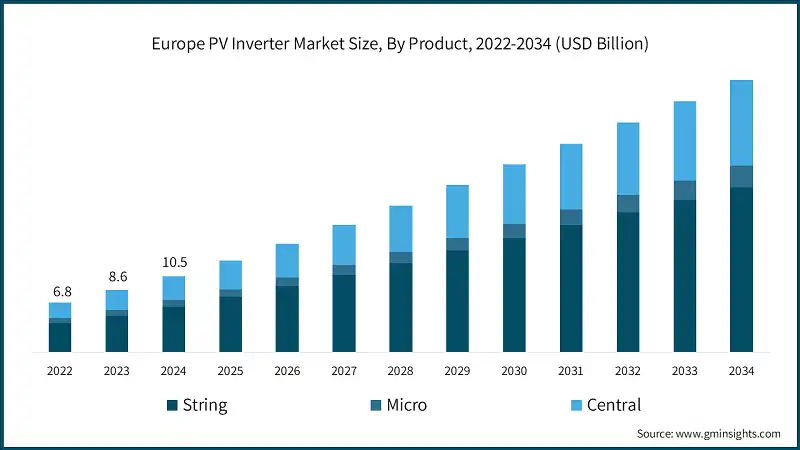
Based on the product, the industry is segmented into string, micro, and central categories. The string segment accounted for over 59.7% share in 2024 and is expected to grow at a CAGR of 13% through 2034.
- Rising demand for cost-effective, scalable and easy-to-install inverters is set to augment string products adoption. Their flexible architecture allows seamless system expansion and simplifies fault detection. Leading manufacturers are introducing new product lines to accelerate market growth and meet evolving energy demands. For instance, in May 2025, KACO New Energy unveiled its blueplanet 360 NX3 series 3-phase string inverters at Intersolar Europe 2025. Designed for utility-scale PV projects, these inverters feature 6 MPPT channels with up to 75 A DC capacity per channel and support high-efficiency bifacial PV modules.
- Micro inverter market will grow at a CAGR of 12.4% through 2034, on account of increasing demand for rooftop solar systems and the need for improved energy performance and safety. Growing government investment in promoting decentralized solar energy is boosting micro inverter adoption due to their ability to optimize power output at the individual panel level, especially on shaded or irregular rooftops. Additionally, their built-in safety features and module-level monitoring capabilities align with growing consumer expectations for smarter, safer, and more efficient solar solutions.
- Central inverters are likely to grow at a CAGR of 12.9% from 2025 to 2034. Increasing demand for inverters offering cost-efficiency for large-scale solar projects and simplified system design and maintenance is fostering central product adoption. These inverters are ideal for utility-scale solar farms, which are rapidly expanding across countries including Germany and, UK due to government-backed renewable energy targets. Their ability to handle high power capacities at a lower cost per watt makes them economically attractive. Additionally, central inverters offer advanced grid support features like reactive power control and fault ride-through, aligning with stringent European grid codes and enhancing system stability, which accelerates their deployment.
Learn more about the key segments shaping this market
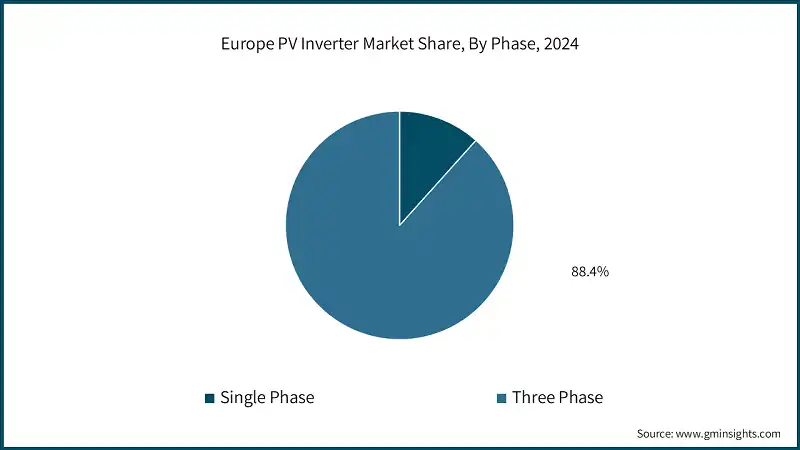
Based on the phase, the industry is segmented into single phase and three phase segments. The three phase segment dominated the market with an 88.4% share in 2024 and is expected to grow at a CAGR of 13.2% from 2025 to 2034.
- Rising emphasis on energy efficiency, grid stability, and the integration of distributed energy resources is strengthening multi-phase inverter adoption. Growing size and complexity of residential and commercial solar installations are improving three phase inverters' penetration, offering a more balanced and stable power output, reducing phase imbalance and improving overall grid performance. Additionally, the widespread use of three-phase power in European buildings and infrastructure makes these inverters a natural fit, ensuring compatibility and efficient energy distribution.
- Increasing companies' investments in developing advanced and new product lines will further complement the business scenario. For instance, in September 2025, SolarEdge Technologies introduced its first three-phase backup interface in Germany. Designed to work with the SolarEdge Home Hub three-phase inverter and SolarEdge Home Battery 48V, it provides full home backup during grid outages, catering to the increasing demand for self-consumption and grid independence among German homeowners. Furthermore, the European Union’s push for smart grid development and decentralized energy systems encourages the use of intelligent inverters that can communicate with grid operators and adapt to dynamic grid conditions.
- Single phase PV inverter market is set to grow at a CAGR of 10.3% through 2034, driven by the surge in residential solar installations, particularly in areas with low to moderate energy consumption. These inverters are favored for their cost-effectiveness, compact design, and ease of installation, making them ideal for small-scale rooftop solar systems. Technological advancements continue to enhance their efficiency, reliability, and integration with smart energy solutions. Additionally, rising electricity prices across Europe are encouraging homeowners to shift toward self-consumption models, where solar energy is used directly to reduce grid dependency, leading to uplift single phase inverter adoption.
Looking for region specific data?
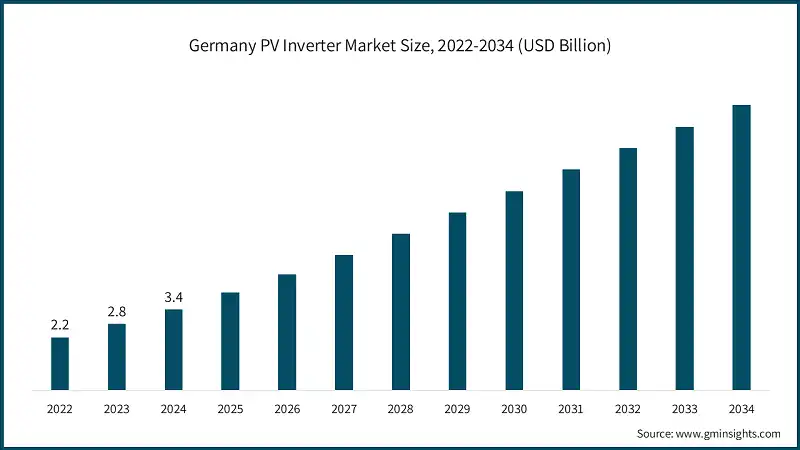
- Germany PV inverter market held around 32.9% share in 2024 and is expected to generate over USD 12 billion by 2034. Growing country' focus on energy independence and security due to high geopolitical tensions led to a surge in decentralized rooftop solar installations, making PV inverters essential for converting solar energy into usable power and reducing reliance on centralized grids. Furthermore, Germany’s Renewable Energy Sources Act, along with packages including the “Solarpaket I,” simplified permitting, increased feed-in tariffs, and classified renewables as a national interest. These reforms significantly boosted solar adoption and inverter demand.
- In the UK PV inverter market is anticipated to reach USD 1.5 billion by 2034. The UK’s commitment to achieving net-zero emissions by 2050 has led to strong policy support for solar energy. Incentives such as feed-in tariffs, grants, and tax benefits encourage residential and commercial solar installations, boosting demand for PV inverters. Increasing expansion of key players in the country further augments the business scenario. For instance, in October 2024, SolarEdge launched the TerraMax inverter system in the UK, designed for small to medium utility-scale solar PV installations. Paired with H1300 Power Optimisers, it delivers 99% efficiency to maximize solar energy output.
- Netherlands PV inverter market is set to grow at a CAGR of 12.6% through 2034. Increasing solar updates, with consistent annual additions of around 3 GW, drive the product demand. This surge in rooftop solar installations, especially in urban and suburban areas, fuels demand for efficient PV inverters to manage and convert solar energy for household use. Furthermore, increasing solar penetration has led to grid congestion challenges, encouraging the country to invest in smart inverters, local battery storage, and advanced grid management systems to optimize energy flow and support decentralized generation, thereby boosting the business outlook.
- The Italy PV inverter market is expected to reach USD 2.9 billion by 2034. Growing regulations that aim to support renewable energy communities and agrivoltaic systems, encouraging collective solar generation and innovative land use. These models require advanced inverter technologies for energy sharing and grid interaction, driving the product adoption. Furthermore, the rise of BIPV solutions, which blend solar modules into architectural elements, boosts demand for compact and efficient inverters suited for urban environments.
Europe PV Inverter Market Share
- The top 5 companies, including SMA Solar Technology, Fimer Group, Schneider Electric, Siemens and SolarEdge Technologies, account for around 53.5% market share. Companies are expanding production within Europe to reduce supply chain risks, meet EU sustainability goals, and benefit from regional incentives. This strategy enhances responsiveness to market demand and strengthens brand trust through local presence and compliance with European quality standards.
- Firms are investing in AI-enabled and IoT-compatible inverters that support smart grid interaction, predictive maintenance, and energy optimization. These innovations align with Europe’s digital energy transition and improve system performance, reliability, and user control, making products more attractive to technology-focused consumers and utilities.
- Additionally, manufacturers are developing hybrid inverters that integrate solar, battery storage, EV charging, and home energy management. This approach meets growing demand for multifunctional energy solutions, especially in residential and commercial sectors, and positions companies as comprehensive energy solution providers.
- Companies are also forming alliances with utilities, installers, and energy communities to deploy decentralized solar systems. These partnerships leverage policy support, collective self-consumption and grid-friendly technologies, expanding market reach and fostering long-term customer relationships.
Europe PV Inverter Market Companies
- SMA Solar Technology, a German leader in PV inverters, offers advanced string and hybrid solutions with strong grid integration, digital monitoring, and energy management features, serving residential, commercial, and utility-scale projects across Europe.
- Fimer Group an Italian-based company, specializes in flexible inverter solutions for residential and commercial markets, emphasizing sustainability, modular design, and compatibility with storage systems, supported by strong European service and distribution networks.
- Schneider Electric, a global energy management company, provides robust PV inverters integrated with smart energy platforms, focusing on efficiency, safety, and seamless integration with home automation and industrial energy systems in Europe.
- Siemens, delivers high-performance inverters for large-scale solar projects, leveraging expertise in automation and smart grids. Its solutions emphasize reliability, digitalization, and compatibility with advanced grid management systems for European markets.
- SolarEdge Technologies, known for power optimizer-based systems, dominates residential and C&I segments with smart inverters, energy storage integration, and advanced monitoring, offering enhanced safety and efficiency for Europe’s distributed solar networks.
Eminent players operating in the Europe PV inverter market are:
- Altenergy Power System
- Canadian Solar
- Darfon Electronics
- Delta Electronics
- Eaton
- Enphase Energy
- Fimer Group
- Ginlong Technologies
- GoodWe
- Growatt New Energy
- Huawei Technologies
- Omron Corporation
- Panasonic Corporation
- Schneider Electric
- Siemens
- Sineng Electric
- SMA Solar Technology
- SolarEdge Technologies
- Sungrow
- TMEIC
Europe PV Inverter Market Report Attributes
| Key Takeaway | Details |
|---|---|
| Market Size & Growth | |
| Base Year | 2024 |
| Market Size in 2024 | USD 10.5 Billion |
| Market Size in 2025 | USD 12.7 Billion |
| Forecast Period 2025 - 2034 CAGR | 12.9% |
| Market Size in 2034 | USD 37.9 Billion |
| Key Market Trends | |
| Drivers | Impact |
| Government renewable policies | Incentives and mandates accelerate solar adoption, boosting inverter demand across residential, commercial, and utility-scale solar installations. |
| Technological advancements | Smart inverters with grid-support features enhance efficiency, reliability, and integration, driving market growth and energy transition efforts. |
| Pitfalls & Challenges | Impact |
| Grid compatibility issues | Inverters lacking advanced grid support features can destabilize networks, limiting scalability and slowing solar energy integration efforts. |
| Supply chain disruptions | Component shortages and logistics delays increase costs and project timelines, hindering inverter deployment and regional solar growth momentum. |
| Opportunities: | Impact |
| Rural electrification programs | Expanding solar access in off-grid regions boosts inverter demand, supporting energy equity and sustainable development goals. |
| Energy storage integration | Pairing inverters with batteries enables smart energy management, enhancing grid resilience and unlocking new revenue streams for providers. |
| Market Leaders (2024) | |
| Market Leaders |
18.5% market share |
| Top Players |
Collective market share in 2024 is 53.5% |
| Competitive Edge |
|
| Regional Insights | |
| Largest Market | Germany |
| Fastest Growing Market | Italy |
| Emerging Countries | Poland & Austria |
| Future outlook |
|
What are the growth opportunities in this market?
Europe PV Inverter Industry News:
- In October 2025, Enphase Energy, Inc, a leading global energy technology company, partnered with Essent, a prominent residential energy provider in the Netherlands. This collaboration enables eligible Enphase solar customers to upgrade with IQ Batteries and join Essent’s Smart Steering program to enhance self-consumption and reduce energy costs.
- In August 2025, FIMER, a leading solar inverter manufacturer, joined SolarPower Europe, the top association for the European solar energy value chain. This move highlights FIMER's commitment to driving the global energy transition and advancing sustainable power solutions.
- In July 2025, Enphase Energy, Inc., a globally recognized energy technology leader and growing supplier of microinverter-based solar and battery systems, announced its ongoing expansion in Europe. The company has made its initial shipments of the IQ8P Microinverters, boasting a peak output AC power of 480 W, to Italy and Switzerland. This move is aimed at supporting the region's newer, high-powered solar modules.
This Europe PV inverter market research report includes an in-depth coverage of the industry with estimates & forecast in terms of revenue in “(USD Billion)” & volume (MW) from 2021 to 2034, for the following segments:
Market, By Product
- String
- Micro
- Central
Market, By Phase
- Single phase
- Three phase
Market, By Connectivity
- Standalone
- On grid
Market, By Nominal Output Power
- ≤ 0.5 kW
- 0.5 - 3 kW
- 3 - 33 kW
- 33 - 110 kW
- > 110 kW
Market, By Nominal Output Voltage
- ≤ 230 V
- 230 - 400 V
- 400 - 600 V
- > 600 V
Market, By Application
- Residential
- Commercial & industrial
- Utility
The above information has been provided for the following countries:
- Germany
- Italy
- Poland
- Netherlands
- Austria
- UK
- France
Frequently Asked Question(FAQ) :
What is the market size of the Europe PV inverter in 2024?
The market size was USD 10.5 billion in 2024, with a CAGR of 12.9% expected through 2034 driven by supportive renewable energy policies and rapid solar energy deployment.
What is the projected value of the Europe PV inverter market by 2034?
The Europe PV inverter market is expected to reach USD 37.9 billion by 2034, propelled by smart grid integration, energy storage adoption, and technological advancements.
What is the current Europe PV inverter market size in 2025?
The market size is projected to reach USD 12.7 billion in 2025.
How much revenue did the string inverter segment generate in 2024?
String inverters accounted for over 59.7% market share in 2024, leading the market due to their cost-effectiveness, scalability, and ease of installation.
What was the valuation of three phase segment in 2024?
Three phase segment dominated the market with 88.4% share in 2024, driven by energy efficiency requirements and grid stability needs.
What is the growth outlook for micro inverters from 2025 to 2034?
Micro inverters are projected to grow at a 12.4% CAGR through 2034, due to increasing rooftop solar installations and demand for module-level optimization.
Which country leads the Europe PV inverter market?
Germany held 32.9% share in 2024 and is expected to generate over USD 12 billion by 2034. Strong government support and energy independence goals fuel the country's dominance.
What are the upcoming trends in the Europe PV inverter market?
Key trends include adoption of smart and hybrid inverters, AI-powered predictive maintenance, integration with energy storage and EV infrastructure, and localization of manufacturing facilities.
Who are the key players in the Europe PV inverter market?
Key players include SMA Solar Technology, Fimer Group, Schneider Electric, Siemens, SolarEdge Technologies, Altenergy Power System, Canadian Solar, Darfon Electronics, Delta Electronics, Eaton, Enphase Energy, Ginlong Technologies, GoodWe, Growatt New Energy, Huawei Technologies, Omron Corporation, Panasonic Corporation, Sineng Electric, Sungrow, and TMEIC.
Europe PV Inverter Market Scope
Related Reports