Summary
Table of Content

Europe Personalized/Customized Skin Care Market
Get a free sample of this report
Form submitted successfully!
Error submitting form. Please try again.
Thank you!
Your inquiry has been received. Our team will reach out to you with the required details via email. To ensure that you don't miss their response, kindly remember to check your spam folder as well!
Request Sectional Data
Thank you!
Your inquiry has been received. Our team will reach out to you with the required details via email. To ensure that you don't miss their response, kindly remember to check your spam folder as well!
Form submitted successfully!
Error submitting form. Please try again.
Europe Personalized/Customized Skin Care Market Size
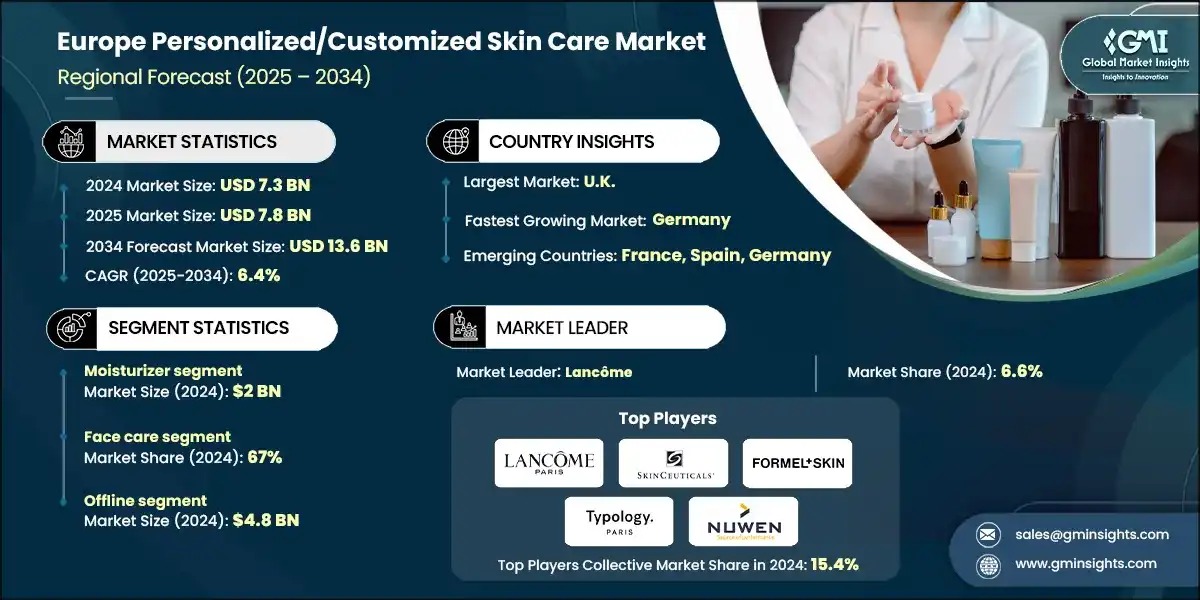
The Europe personalized/customized skin care market was estimated at USD 7.3 billion in 2024. The market is expected to grow from USD 7.8 billion in 2025 to USD 13.6 billion in 2034, at a CAGR of 6.4% according to latest report published by Global Market Insights Inc.|
Europe Personalized/Customized Skin Care Market Key Takeaways
Market Size & Growth
- 2024 Market Size: USD 7.3 Billion
- 2025 Market Size: USD 7.8 Billion
- 2034 Forecast Market Size: USD 13.6 Billion
- CAGR (2025–2034): 6.4%
Regional Dominance
- Largest Market: UK
- Fastest Growing Region: Germany
Key Market Drivers
- Heightened consumer awareness and demand for individualization.
- Rapid advancement and adoption of diagnostic technologies.
- Premiumization trend and willingness to pay among affluent segments.
Challenges
- Regulatory complexity and lengthy approval cycles under EU cosmetics regulation.
- Supply-chain complexity.
Opportunity
- Convergence with health-tech and clinical dermatology ecosystems.
- Leadership in clean, sustainable, and locally sourced personalization.
Key Players
- Market Leader: Lancome led with over 6.6% market share in 2024.
- Leading Players: Top 5 players in this market include Lancôme, SkinCeuticals, FORMEL Skin, Typology, Nuwen, which collectively held a market share of 15.4% in 2024.
Get Market Insights & Growth Opportunities
European consumers are becoming more discerning regarding efficacy in skincare due to a heightened awareness of both skin biology, the transparency of ingredients, and the limitations of "one-size-fits-all" formulations. Concerns around safety have led modern consumers to prefer dermatology-based content on social media plus direct-to-consumer brands that market ideas like “skin identity” or skincare intended for special skin conditions based on each person's unique microbiome profile. Therefore, consumer expectations have evolved from basic moisturization or anti-aging claims to highly focused solutions for specific concerns such as hormonal acne, rosacea, and hyperpigmentation associated with ethnic diversity, and aging from pollution exposure.
Market consumers like Gen Z and Millennials in the UK, France, Germany, and Scandinavia are at the forefront of this cultural shift, demanding products that are scientifically credible and ultimately customizable. This trend is a major demand-side growth driver of the personalized skincare space and signifies the start of personalized beauty in Europe.
The integration of advanced technologies such as artificial intelligence, computer-vision skin analysis, at-home DNA and microbiome testing kits (e.g., SkinDNA, Viome, Sequential Skin), and teledermatology platforms has significantly reduced the barriers to achieving genuine personalization in skincare. These innovations have enabled consumers to access tailored solutions that were previously limited to clinical settings. For instance, artificial intelligence and computer-vision technologies now allow for precise skin condition analysis, while at-home DNA and microbiome testing kits provide insights into genetic predispositions and skin health, empowering users to make informed decisions about their skincare routines.
European startups like Haut.AI, Revieve, Magnify (by L'Oréal), and the Skinome Project are leading the change. In addition to existing players like Proven Skincare, which is working to build its business in Europe, Germany's iTEC and above-mentioned startups have deployed clinically validated algorithms with diagnostic accuracy commensurate to in-office Visia imaging systems. The European Commission published a report indicating the AI-driven healthcare technology solution, dermatology being one such solution, demand is projected to grow at a compound annual growth rate (CAGR) of 15% between 2023-2028.
In addition, finding CE-marked at-home devices indicates safety and performance standards that are consistent with the high standard of European medical device regulations, as well as accountability to consumer privacy through GDPR-compliant data handling protocols. These concepts have substantially established a process for scalable and scientifically valid customization. For instance, Haut.AI's AI-powered platform can analyze 100+ skin characteristics to generate highly individualized recommendations, while Proven Skincare uses a database of >47 factors including climate, lifestyle, and genetics, to offer made-to-order skincare products. The growth of personalization is partially attributed to a growing awareness and demand from consumers for the efficacy of personalized skincare, and part to a technology environment that has advanced to allow for achievable/affordable solutions.
To get key market trends
Europe Personalized/Customized Skin Care Market Trends
The integration of artificial intelligence (AI) is revolutionizing the personalized skincare industry in Europe, shifting the paradigm from reactive product recommendations to predictive, data-driven strategies.
- In Europe, the lines between cosmetic and medical skincare are blurring. Consumers are opting for prescription-grade actives like tretinoin and high-dose niacinamide—through personalized platforms, sidestepping traditional dermatologist visits. Brands such as Dermatica and Klira have popularized the “teledermatology + bespoke compounding” model, boasting annual growth rates of 40–70%.
- European consumers now prioritize the skin microbiome over DNA testing in their skincare personalization journey. Brands like Skinome Project and Gallinée, along with newcomers Sequential Skin and Arete Labs, are pivoting from traditional “active-first” formulations to systems enriched with live probiotics and tailored to individual microbial profiles.
- Sustainability in skincare is evolving beyond just packaging reduction; it's about rethinking product architecture. Leading platforms, including Codage Paris My Blend and SkinCeuticals, are now offering personalized actives in modular, refillable devices, eliminating single-use packaging. These innovative systems boast a carbon footprint that's 70–85% lower than traditional bespoke bottles.
- In the realm of European prestige skincare, the buzz is shifting from anti-aging to “mood-enhancing” and “stress-adaptive” products. Brands like Elequra and Augustinus Bader are infusing their offerings with sensorially active peptides and adaptogenic botanicals, dosing them based on individual stress levels and sleep quality. Clinical studies from the University of Lyon, showing a tangible reduction in stress-induced inflammation. As a result, neurocosmetics now account for 15–20% of new personalized launches and are poised to dominate the narrative by 2027.
- Ingredients such as Alpine edelweiss stem cells from Valais, Swiss glacier water microbiomes, Breton algae from specific tidal zones, and Tuscan immortelle from single estates are gaining popularity. These geographically protected, traceable botanicals are being incorporated into personalization engines that match them to individual skin types and local environmental aggressors, such as urban pollution in Paris or photo-aging in Mediterranean climates. Consumers in France, Italy are particularly receptive to this trend, with many willing to pay a 30–50% premium for products that combine luxury provenance storytelling with proven efficacy. This trend is enabling independent European brands to differentiate themselves and remain competitive against global conglomerates, leveraging their unique regional expertise and heritage.
Europe Personalized/Customized Skin Care Market Analysis

Learn more about the key segments shaping this market
Based on product type, the market is segmented as cleanser, face serum, moisturizer, active, body lotion, body duo, and others. In 2024, the moisturizer segment generated a revenue of USD 2 billion and is expected to grow at a CAGR of around 7.1% during the forecast period.
- Consumers are increasingly seeking moisturizers designed to address specific skin concerns such as dryness, sensitivity, acne, and aging. Personalized moisturizers, which offer targeted benefits like enhanced hydration, inflammation reduction, and specific skin issue management, are driving this demand. The European market has seen a surge in demand for products catering to diverse skin types, including oily, dry, combination, and sensitive skin.
- The growing consumer focus on skin health and overall well-being has led to increased demand for moisturizers enriched with beneficial ingredients such as vitamins, antioxidants, and natural extracts. For instance, products containing hyaluronic acid, vitamin C, and plant-based oils are gaining popularity for their ability to improve skin texture and appearance. In Europe, the trend toward clean beauty and sustainable products has further fueled the demand for moisturizers with eco-friendly and organic formulations. Data from Cosmetics Europe indicates that 72% of European consumers prefer skincare products with natural and sustainable ingredients, highlighting the importance of this trend in the region.
- Compared to advanced skincare products, moisturizers are simpler to use, making them a preferred choice for consumers seeking convenient and effective solutions. This simplicity, combined with their versatility, has positioned moisturizers as a staple in daily skincare routines. Similarly, in Europe, the moisturizer segment has witnessed robust growth, supported by increasing consumer awareness and the rising popularity of customized skincare solutions.
- The moisturizer market has benefited from technological advancements and innovations in product formulations. Manufacturers are leveraging cutting-edge technologies to develop products with enhanced efficacy, such as time-release hydration systems and microbiome-friendly formulations. In Europe, leading brands are investing in research and development to create products tailored to regional preferences and climatic conditions. For example, lightweight, non-greasy moisturizers are particularly popular in Southern Europe, where consumers prioritize products suitable for warmer climates.
Learn more about the key segments shaping this market
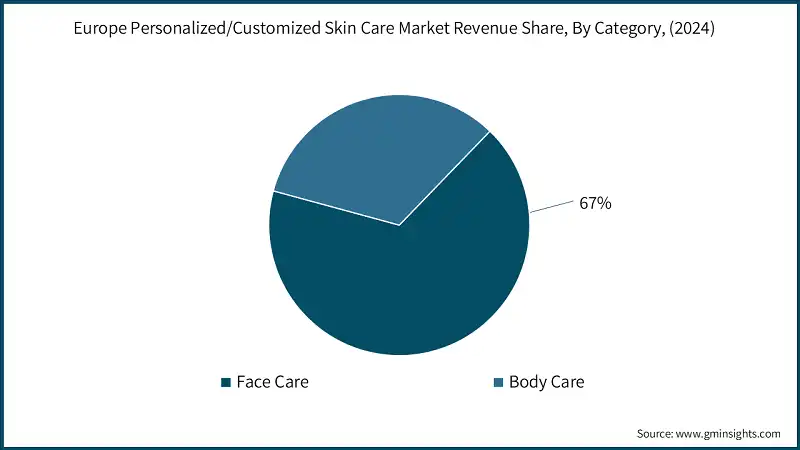
Based on category, the Europe personalized/customized skin care market is segmented into face care and body care. The face care segment held the largest share, accounting for 67% of the market in 2024.
- Face care products hold a dominant position in the skincare market because consumers perceive facial skin as more delicate, visible, and closely tied to personal identity. Issues such as acne, pigmentation, wrinkles, and sensitivity are highly noticeable, making consumers prioritize solutions for the face over the body. This focus is reinforced by social media trends and beauty influencers who emphasize facial routines, driving demand for specialized products like serums, masks, and treatments. As a result, brands allocate significant R&D resources to face care innovations, ensuring advanced formulations and personalized solutions for facial concerns.
- In contrast, body care remains a smaller segment, often viewed as a maintenance category rather than a core beauty investment. While body lotions and creams are widely used, they lack the urgency and emotional connection associated with facial care. Consumers typically seek hydration and basic protection for the body, whereas face care demands targeted solutions backed by clinical claims. This difference in perceived importance translates into higher spending on facial products, premium pricing, and faster adoption of personalization technologies in face care compared to body care.
Based on the distribution channel, the market is segmented into online and offline. In 2024, offline segment held a major market share, generating a revenue of USD 4.8 billion.
- Offline channels continue to dominate the personalized and customized skincare market, particularly in Europe. According to a report by Cosmetics Europe, approximately 70% of European consumers prefer purchasing skincare products through physical stores, as they value the ability to see, touch, and test products before making a purchase. This preference is especially significant for skincare products, which directly impact skin health and require a higher level of trust and assurance. Physical retail outlets provide an interactive shopping experience, allowing customers to consult with beauty experts or dermatologists who can recommend products tailored to their specific skin types and concerns. Many stores also offer advanced services, such as skin analysis machines, which use cutting-edge technology to assess skin conditions and recommend suitable products, enhancing the overall customer experience.
- In developing markets within Europe, offline stores are particularly favored due to limited access to online shopping infrastructure and a cultural preference for personal interactions during the purchasing process. These stores not only serve as a point of sale but also act as hubs for building consumer trust and loyalty. The integration of technology, such as augmented reality mirrors and digital skin diagnostic tools, further enhances the offline shopping experience, making it a preferred choice for a significant portion of the population.
Looking for region specific data?
UK Personalized/Customized Skin Care market
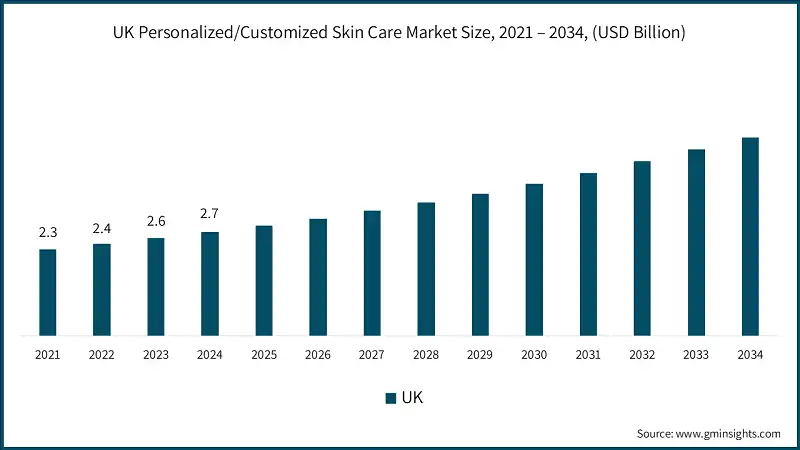
In 2024, the UK dominated the market, accounting for around 37.2% and generating around USD 2.7 billion revenue in the same year.
- The personalized skincare market in the United Kingdom is experiencing significant growth, driven by increasing consumer demand for tailored solutions that prioritize efficacy and ingredient transparency.
- Millennials and Gen Z consumers are particularly drawn to AI-powered personalization tools and data-driven skincare routines, reflecting a shift towards technology-integrated beauty solutions. Premium brands dominate the market, as consumers increasingly favor clinically validated formulations over mass-market alternatives. Facial care remains the largest segment, accounting for nearly 78% of the skincare market, with a strong focus on addressing concerns such as aging, acne, and sensitivity.
Germany Personalized/Customized Skin Care market
Germany personalized/customized is expected to grow at 6.4% during the forecast period.
- Personalized skincare is gaining traction as consumers increasingly seek solutions for aging, dryness, and stress-related skin concerns. Facial care dominates, supported by strong adoption of dermocosmetic and anti-aging products.
- German consumers favor natural, vegan, and cruelty-free formulations, aligning with the country’s sustainability ethos. Regulatory updates have tightened labeling and safety standards, reinforcing trust in personalized offerings.
France Personalized/Customized Skin Care market
France personalized/customized is expected to grow at 6.3% during the forecast period.
- French consumers prioritize premium, organic, and clinically validated products, making personalization a natural extension of the country’s beauty culture.
- AI and big data are increasingly integrated into skincare routines, enabling bespoke recommendations and formulations. The strong presence of pharmacy brands and luxury houses like L’Oréal ensures that personalization is positioned as both a scientific and aspirational offering.
Italy Personalized/Customized Skin Care Market
Italy personalized/customized skin care market are growing at a CAGR of 5.8% during the forecast period.
- The demand for personalized skincare is fueled by Italy’s heritage in luxury beauty and craftsmanship, combined with a rising preference for organic and eco-friendly products. AI-driven skin analysis and virtual consultations are gaining traction, particularly in premium segments. Italian consumers value authenticity and quality, making bespoke formulations highly appealing.
Europe Personalized/Customized Skin Care Market Share
Lancôme leading with 4.6% market share. Lancôme, SkinCeuticals, FORMEL Skin,Typology, Nuwen, collectively hold around 15.4%, indicating fragmented market concentration. These prominent players are proactively involved in strategic endeavors, such as mergers & acquisitions, facility expansions & collaborations, to expand their product portfolios, extend their reach to a broad customer base, and strengthen their market position.
Lancome leverages its luxury heritage and scientific innovation to dominate the personalized skincare space. Backed by L’Oréal’s R&D ecosystem, the brand integrates AI-powered diagnostic tools and biological age analysis into its offerings, such as the Cell BioPrint device. Its focus on longevity beauty targeting root causes of aging rather than symptoms sets it apart from competitors.
SkinCeuticals holds a competitive edge through its dermatologist-backed formulations and clinical credibility. Known for high-potency serums and antioxidant-based regimens, the brand emphasizes science-driven personalization. Its partnerships with dermatology clinics and integration into professional skincare channels reinforce trust among consumers seeking medically validated solution.
Europe Personalized/Customized Skin Care Market Companies
Major players operating in the Europe personalized/customized skin care industry are:
- Cosmesit SRL
- FORMEL Skin
- HSA Cosmetics SpA
- Ideapro GmbH
- Intercos Europe
- L.A. Schmitt GmbH
- Lancôme Le Teint Particulier
- Nuwen
- Perseida Belleza SL
- Pettenon Cosmetics Spa
- Pole Cosmetique
- SBLC Cosmetics
- SkinCeuticals Custom D.O.S.E
- Skinovators GmbH
- Typology
FORMEL Skin differentiates itself as a digital dermatology pioneer, offering subscription-based personalized treatments for chronic skin conditions like acne, rosacea, and melasma. Its platform combines telemedicine consultations, AI-driven diagnostics, and custom medicated products, addressing gaps in Europe’s traditional dermatology system.
Typology edge lies in its minimalist, ingredient-transparent approach combined with digital-first personalization tools. The brand offers clean, vegan formulations with short ingredient lists, appealing to Europe’s eco-conscious and health-aware consumers. Its online diagnostic quiz and direct-to-consumer model enable affordable customization without compromising quality.
Nuwen stands out as a raw material innovator specializing in marine and mineral-based ingredients for customized formulations. Its expertise in algae-derived actives and waterless powder cosmetics aligns with Europe’s sustainability and clean beauty trends. Nuwen provides tailor-made solutions for spas and cosmetic brands, enabling bespoke treatments with natural, preservative-free ingredients.
Europe Personalized/Customized Skin Care Market Report Attributes
| Key Takeaway | Details |
|---|---|
| Market Size & Growth | |
| Base Year | 2024 |
| Market Size in 2024 | USD 7.3 Billion |
| Market Size in 2025 | USD 7.8 Billion |
| Forecast Period 2025 - 2034 CAGR | 6.4% |
| Market Size in 2034 | USD 13.6 Billion |
| Key Market Trends | |
| Drivers | Impact |
| Heightened consumer awareness and demand for individualization | European consumers have become significantly more discerning about skincare efficacy, driven by widespread education on skin biology, ingredient transparency, and the limitations of one-size-fits-all formulations. |
| Rapid advancement and adoption of diagnostic technologies | The integration of artificial intelligence, computer-vision skin analysis, at-home DNA and microbiome testing kits (e.g., SkinDNA, Viome, Sequential Skin), and teledermatology platforms has dramatically lowered the barrier to genuine personalization |
| Premiumization trend and willingness to pay among affluent segments | Economic recovery in core Western European markets, combined with persistently high disposable income in countries. |
| Pitfalls & Challenges | Impact |
| Regulatory complexity and lengthy approval cycles under EU cosmetics regulation | Each time a new customized formulation is created, it often necessitates a distinct Product Information File (PIF) and a safety assessment, particularly when the concentration of active ingredients varies for each customer. The lack of a definitive regulatory pathway for “mass customization” (in contrast to products from compounded pharmacies) leads to notable delays and increased costs for brands navigating multiple EU member states, especially when they introduce novel actives or ingredients derived from biotechnology. |
| Supply-chain complexity | Producing genuinely personalized products on a large scale, all while ensuring a short shelf-life (achieved through clean formulations that avoid heavy preservative loads), demands either highly adaptable micro-batch production facilities or advanced on-site compounding systems. |
| Opportunities: | Impact |
| Convergence with health-tech and clinical dermatology ecosystems | Partnerships between personalized skincare brands and teledermatology platforms (e.g., Dermatica, Klira, Universkin with prescription actives) or integration into private clinics and medi-spas across Germany, France, and the UK offer a powerful growth vector. |
| Leadership in clean, sustainable, and locally sourced personalization | European consumers exhibit the world’s highest demand for clean beauty and sustainability metrics, since 67% claim they would pay more for sustainable packaging. |
| Market Leaders (2024) | |
| Market Leaders |
6.6% market share |
| Top Players |
Collective market share in 2024 is 15.4% |
| Competitive Edge |
|
| Regional Insights | |
| Largest market | UK |
| Fastest growing market | Germany |
| Emerging countries | France, Spain, Germany |
| Future outlook |
|
What are the growth opportunities in this market?
Europe Personalized/Customized Skin Care Industry News
- In November 2025, Cosmesit highlights its R&D focus on dermatological medical devices for fragile and mature skin, collaborating with universities for advanced formulations.
- In September 2025, L.A. Schmitt marks its centenary, unveiling a modern plant to support bespoke skincare and sustainable processes.
- In March 2025, FORMEL Skin, raises USD 39.09 Million to scale personalized dermatology treatments across Europe using AI-driven diagnostics and telemedicine.
The Europe personalized/customized skin care market research report includes in-depth coverage of the industry with estimates & forecasts in terms of revenue (USD Billion) and volume (Million Units) from 2021 to 2034, for the following segments:
Market, By Product Type
- Cleanser
- Face serum
- Moisturizer
- Active
- Body lotion
- Body duo
- Others (face masks, lip care, eye creams, etc.)
Market, By Category
- Face care
- Body care
Market, By Price
- Low
- Medium
- High
Market, By Consumer Group
- Men
- Women
- Kids
Market, By Distribution Channel
- Online
- E-commerce
- Company websites
- Offline
- Specialty stores
- Retail stores
- Spas & salons
- Pharmacies, dermatology clinics, etc.
The above information is provided for the following regions and countries:
- Europe
- Germany
- UK
- France
- Italy
- Spain
- Rest of Europe
Frequently Asked Question(FAQ) :
What is the market size of the Europe personalized/customized skincare market in 2024?
The market size was USD 7.3 billion in 2024, with a CAGR of 6.4% expected through 2034, driven by advancements in AI-based personalization and increasing consumer demand for tailored skincare solutions.
What is the projected value of the Europe personalized/customized skincare market by 2034?
The market is expected to reach USD 13.6 billion by 2034, fueled by innovations in microbiome-focused formulations, sustainability initiatives, and modular product designs.
What is the projected size of the Europe personalized/customized skincare market in 2025?
The market is projected to reach USD 7.8 billion in 2025.
How much revenue did the moisturizer segment generate?
The moisturizer segment generated USD 2 billion in 2024 and is expected to grow at a CAGR of approximately 7.1% during the forecast period.
What was the valuation of the offline distribution channel segment?
The offline distribution channel held a major market share, generating USD 4.8 billion in revenue in 2024.
Which region leads the Europe personalized/customized skincare market?
The UK led the market in 2024, accounting for 37.2% of the market share and generating approximately USD 2.7 billion in revenue. The region's dominance is attributed to high consumer adoption of personalized skincare platforms and innovations in teledermatology.
What are the upcoming trends in the Europe personalized/customized skincare industry?
Key trends include the integration of AI for predictive personalization, a shift towards microbiome-focused formulations, and the adoption of sustainable, refillable product systems with reduced carbon footprints.
Who are the key players in the Europe personalized/customized skincare market?
Key players include Cosmesit SRL, FORMEL Skin, HSA Cosmetics SpA, Ideapro GmbH, Intercos Europe, L.A. Schmitt GmbH, Lancôme Le Teint Particulier, Nuwen, Perseida Belleza SL, Pettenon Cosmetics Spa, and Pole Cosmetique.
Europe Personalized/Customized Skin Care Market Scope
Related Reports