Summary
Table of Content

Europe Passenger Electric Vehicle Market
Get a free sample of this report
Form submitted successfully!
Error submitting form. Please try again.
Thank you!
Your inquiry has been received. Our team will reach out to you with the required details via email. To ensure that you don't miss their response, kindly remember to check your spam folder as well!
Request Sectional Data
Thank you!
Your inquiry has been received. Our team will reach out to you with the required details via email. To ensure that you don't miss their response, kindly remember to check your spam folder as well!
Form submitted successfully!
Error submitting form. Please try again.
Europe Passenger Electric Vehicle Market Size
The electric vehicle (EV) market in Europe is the largest and most advanced market globally due to strict CO₂ emission regulations; aggressive targets for reducing greenhouse gas emissions from cars, trucks and buses across fleets; and a wide variety of national roadmaps to support the transition to fully electric vehicles. The transition has moved from an initial phase of early adopters in the Nordic countries to widespread market penetration in many countries, including Germany, the UK and France.
Europe Passenger Electric Vehicle Market Key Takeaways
Market Size & Growth
- 2025 Market Size: USD 232.2 Billion
- 2026 Market Size: USD 248.1 Billion
- 2035 Forecast Market Size: USD 509.7 Billion
- CAGR (2026–2035): 8.3%
Regional Dominance
- Largest Market: Western Europe
- Fastest Growing Country: Eastern Europe
Key Market Drivers
- Accelerates EV adoption, pressures OEMs to electrify fleets..
- Improves convenience, reduces range anxiety, boosts sales..
- Lowers vehicle prices improves affordability.
- Rapid adoption potential in underpenetrated markets..
Challenges
- Slows large-scale charging deployment in some regions..
- High upfront cost.
Opportunity
- Premium EV segment expansion.
- Local battery production & supply chain development.
Key Players
- Market Leader: Tesla led with over 18% market share in 2025.
- Leading Players: Top 5 players in this market include BMW, Chery, Mercedes-Benz, Tesla, VW Group, which collectively held a market share of 58% in 2025.
Get Market Insights & Growth Opportunities
Automakers are committing themselves to more electric vehicle production, which build additional giga factories and develop battery technology with the goal of improving energy density and reducing costs. The combined effect of these developments is improving the competitive landscape within the electric vehicle industry. In January 2026, 154,230 new battery electric vehicles were registered for sale within the European Union (EU), representing 19.3% of the total EU vehicle market.
The EV market has experienced significant growth throughout the COVID-19 pandemic and during the various supply chain bottlenecks created by the pandemic; the growth is mainly attributed to the availability of multiple models, increasing demand for electric vehicles and the growth of EV incentives and the growth of the overall electric vehicle market. With continued stricter CO₂ emissions standards for new vehicles being implemented by many countries throughout the EU; the future of electric vehicles in Europe is expected to grow as more vehicle manufacturers and jurisdictions adopt zero-emission vehicle mandates.
In Western Europe, electric vehicle (EV) registrations have grown to record levels. There are several reasons for this, including the development of a broader range of affordable electric vehicle models aimed at mass-market consumers; the construction of additional charging infrastructure on highways and within cities; and, in some of the largest EU Member States such as France and Germany, continued to provide tax incentives that reduce the upfront purchase price of electric vehicles. All these developments contributed to year-on-year growth in the electric vehicle market.
Eastern Europe is developing into the fastest-growing region for passenger electric vehicle registrations in Europe due to the low base effect, increased levels of EU funded support, strong purchasing activity of premium electric vehicles, and continued investment in in infrastructure to support electric vehicles. In February 2026, Jameel Motors Italia and its partner, Zeekr, announced the launch of Zeekr in Italy. As part of the Geely Auto Group, Zeekr intends to establish itself in Northern Europe’s premium electric vehicle segment through a strategy focusing on designs reflected in European cultures.
Europe passenger electric vehicle market was estimated at USD 232.2 billion in 2025. The market is expected to grow from USD 248.1 billion in 2026 to USD 509.7 billion in 2035, at a CAGR of 8.3% according to latest report published by Global Market Insights Inc.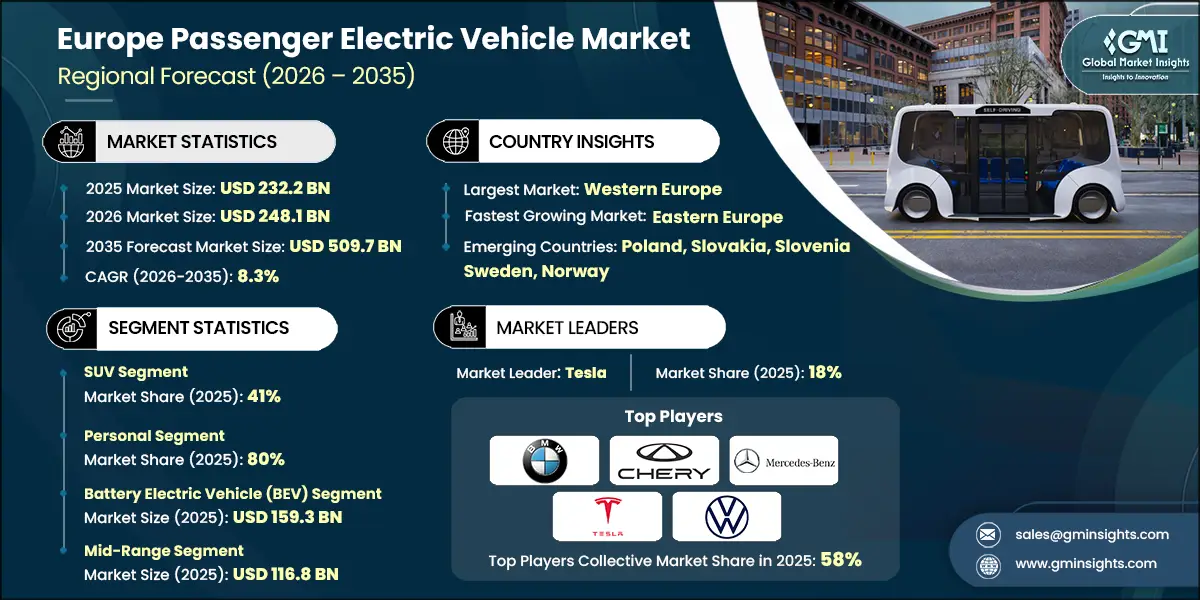
To get key market trends
Europe Passenger Electric Vehicle Market Trends
European governments are providing increasing levels of financial assistance to try to increase the adoption of EVs, illustrating a growing policy-driven trend in the EV market. As an example, in July 2025, the UK Government announced a purchase package of $77 million that will function as a supercharger for electric vehicle infrastructure, a clear indication of its commitment to develop infrastructures that will reduce range anxiety and expand public charging networks.
European governments are also setting ambitious EV adoption and domestic EV manufacturing goals, thereby encouraging automakers to localize and expand production in Europe. For example, Spain will invest approximately $1.52 billion in 2025 to support its electric vehicle market and hopes to achieve 95 percent of new electric vehicle production in the country by 2035. The development of manufacturing capacity, technology, and job growth in EV industries are the two primary objectives behind the ambitious goals outlined above.
As a result, large automakers are merging their operations in Europe to develop high-volume, cost-effective manufacturing bases for electric vehicles. An example of this is ElectriCity Initiative, which was started in Dec 2024, where three plants belonging to Renault formed the largest and most competitive electric vehicle production facility in Europe. By joining together, automakers can streamline supply chains, optimize the use of labor and resources, and accelerate the production of battery electric vehicles and plug-in hybrid electric vehicles.
Several investments in the mobility sector are helping shape Europe’s electric vehicle market. As a response to these investments, both governmental and private organizations are working closely together to improve the charging infrastructure throughout Europe, provide incentives for companies to electrify their fleets, and will help develop more integrated smart infrastructure. An example of this investment is when, in December 2024, Three Renault joined forces to build three factories in northern France as part of the Renault electric vehicle production programme. Douai, Maubeuge and Ruitz factories in northern France will come together to form the largest and most competitive electric vehicle assembly facility in Europe.
Europe Passenger Electric Vehicle Market Analysis
Learn more about the key segments shaping this market
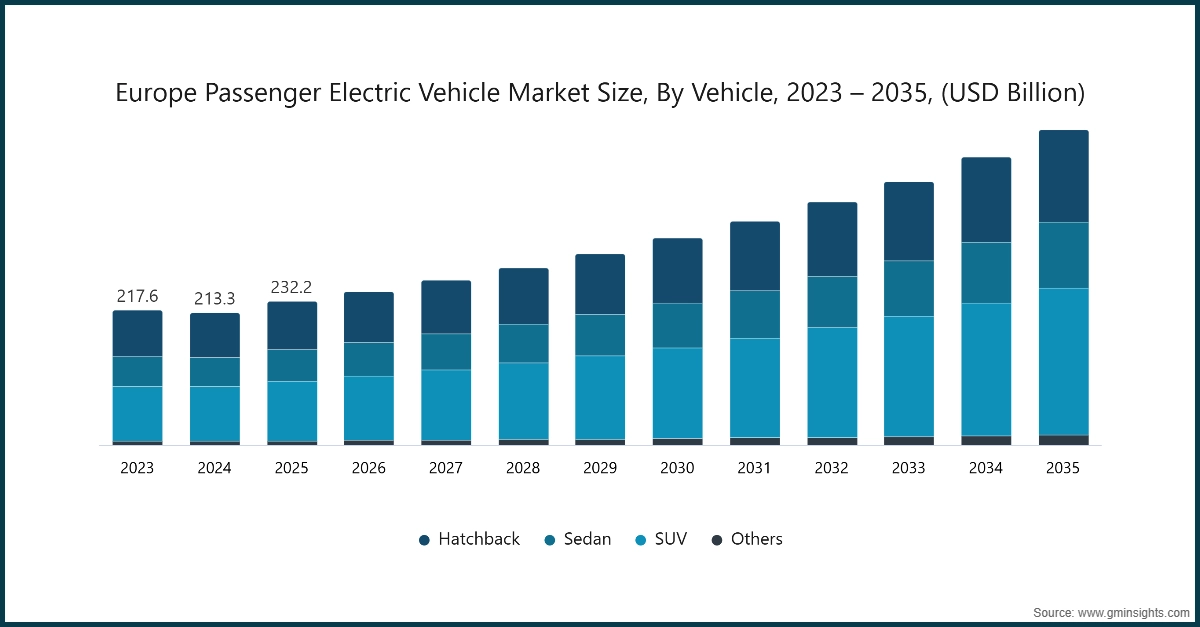
Based on vehicle, the passenger electric vehicle market is divided into hatchback, sedan, SUV, and others. SUV segment dominated the market accounting by 41% in 2025 and is expected to grow at a CAGR of 9.6% from 2026 to 2035.
- SUV segment as major passenger vehicle, manufacturers focus on producing high-margin vehicles for consumers. A notable example of this trend is the fully electric Volvo EX30 SUV, which was launched for production at Volvo's Belgian factory in May 2025. Volvo has invested about USD 250 million into this plant and has added approximately 600 new or refurbished robots, updated their battery production area, installed an additional door assembly line, and installed a new battery pack manufacturing line.
- The sedan segment remains a critical pillar for European EV adoption, particularly in urban and mid-size consumer markets where efficiency and affordability are prioritized. OEMs are adapting their sedan lineups to incorporate advanced battery technology, enhanced connectivity, and improved energy efficiency, bridging the gap between mainstream adoption and premium experience.
Learn more about the key segments shaping this market
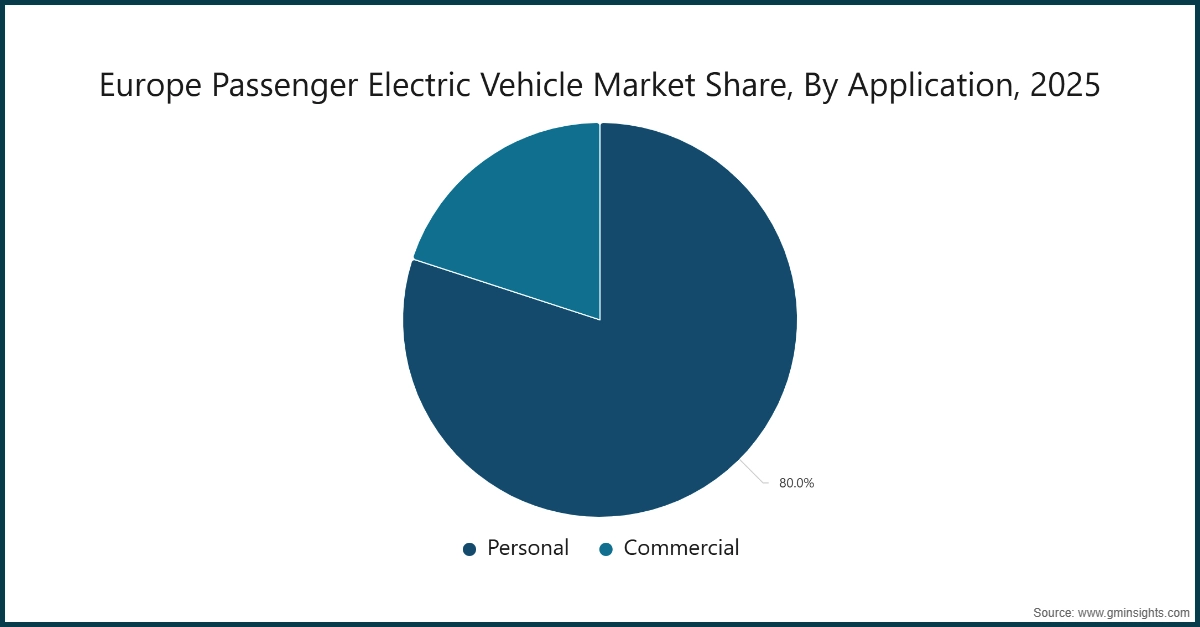
Based on the application, the passenger electric vehicle market is divided into personal and commercial. Personal segment dominated the market with 80% share in 2025, and the segment is expected to grow at a CAGR of 7.7% between 2026 to 2035.
- The personal passenger electric vehicle segment continues to see growth in Europe as more consumers utilize battery electric vehicles (BEVs) in their daily lives. In January 2026, there were 154,230 newly licensed BEVs, making up 19.3% of the entire EU market, illustrating the rapid acceptance of such vehicles by individual consumers. People are more environmentally conscious than ever before; they have an improved range of distance that they can drive on a single charge; and the charging networks within their geographic locations have improved.
- The commercial mobility landscape in Europe is also seeing an increase in the number of drivers who are making the switch to electric vehicles based on ride-hailing, fleet operations and last-mile delivery services. The SPARK report reflects Uber's determination to electrify its European ride-hailing operations and shows that there are many opportunities for collaboration between all industries and government policy makers to assist drivers making the change to fully electric vehicle options.
Based on propulsion, the market is divided into Battery Electric Vehicle (BEV), Fuel Cell Electric Vehicle (FCEV), and Plug-in Hybrid Electric Vehicle (PHEV). Battery Electric Vehicle (BEV) dominate the market and were valued at USD 159.3 billion in 2025.
- In Europe, the BEV segment has continued to lead the way in the electrification movement, benefiting from extensive financial commitments to local battery production and technology advancement. The Innovation Fund has awarded six projects for EV battery cell manufacture almost ~1 billion in funding as of July 2025, showing a strong commitment at the EU level to building battery supply chains domestically. Not only do these investments improve production capacity, but they also promote innovation in energy density, charging speed, and others.
- The PHEV segment is still an important transitional technology for European customers. According to ACEA, there has been significant growth within the PHEV market, with 78,741 units sold in January 2026 alone, indicating that buyers still want to have the flexibility of both electric and gasoline engines. PHEVs alleviate the fear of running out of battery range while still offering some electrification and incentives for consumers, making them attractive in areas where there is not a lot of charging infrastructure available.
Based on price, the passenger electric vehicle market is divided into entry, mid-range, and luxury. Mid-Range dominate the market and were valued at USD 116.8 billion in 2025.
- The mid-range EV segment is experiencing rapid growth in Europe due to high demand from consumers for affordable and technologically advanced electric vehicles. In February 2026, Volkswagen took over as the largest seller of EVs in Europe from Tesla due primarily to their mid-range offerings like ID.7. These types of cars offer a good balance of performance, price, and range, thus appealing to typical buyers looking for all three characteristics found in an electric car but without paying more than they would for a similar combustion engine vehicle.
- As the trend of high-end consumers incorporating electrification into their lifestyles continues to grow, the luxury electric vehicle (EV) market is also experiencing increased growth. The announcement by BYD in September 2025 that they plan to introduce their luxury electric vehicle brand, Yangwang, to Europe in 2027 can be seen as an indicator that more large manufacturers will be expanding their product offerings in the premium segment for electric models. Luxury EVs typically feature the latest technology, powerful drivetrains and beautiful interiors, giving manufacturers additional ways to differentiate themselves and garner higher profit margins than they would with standard gasoline-powered vehicles.
Looking for region specific data?
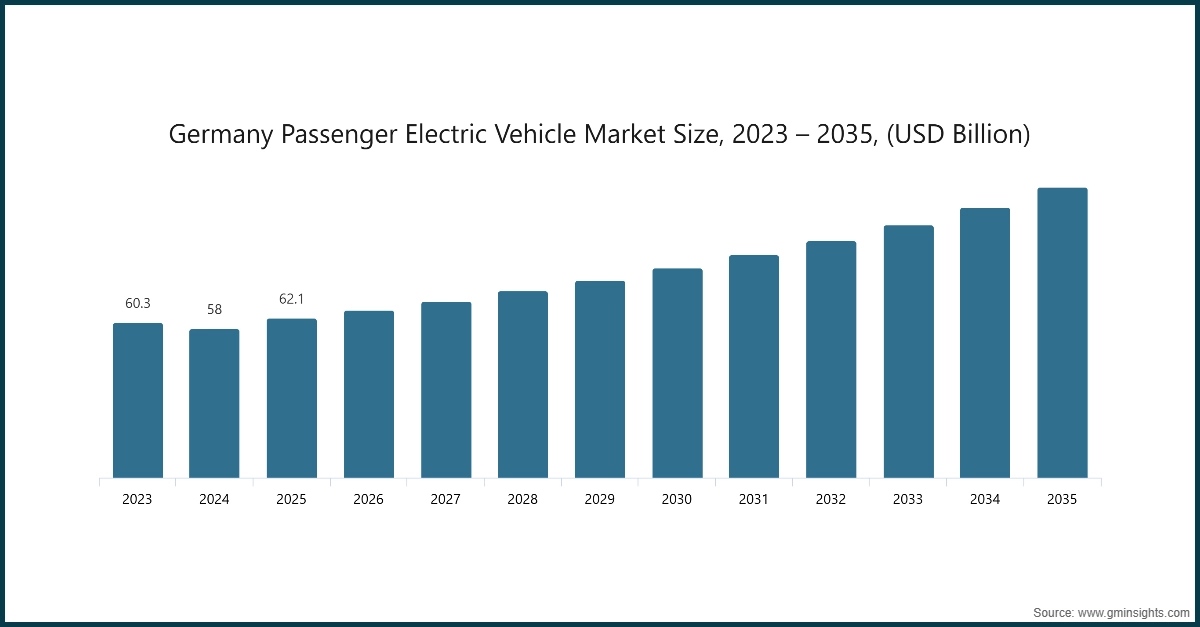
The Germany dominated Western Europe passenger electric vehicle market with revenue of USD 62.1 billion in 2025.
- Germany’s position as Europe’s largest passenger electric vehicle (EV) market is largely due to the strong support provided by the German government, the large number of Original Equipment Manufacturers (OEMs) producing electric vehicles in Germany and the high level of awareness consumers have about these vehicles. In January 2026, Germany’s government implemented a direct subsidy of up to $7,000 for low- and medium-income households purchasing new electric vehicles, significantly reducing the barrier to entry for mainstream consumers to enter the electric market.
- France is developing the French EV ecosystem by making substantial investments into the attributions of production and innovation. In 2023, the French government committed to investing approximately $2.64 billion dollars to support the production of nearly two million electric and hybrid vehicle units, as well as $1.27 billion dollars for research and development initiatives aimed at improving production capacity and fostering technological development and advancements of electric vehicles and encouraging the increased adoption of electric vehicles in both the passenger and commercial vehicle segments.
Eastern Europe passenger electric vehicle market in Poland sold more than 42,415 units in 2025.
- Poland has become a very important area for electric vehicle (EV) production within Europe, especially battery production. Poland creates approximately 60% of the EU’s EV battery production and is placing behind only China as a battery producer. The availability of battery production has led to increased investment by original equipment manufacturers and has created strong supply chains which ultimately making Poland a production and export center for EVs.
- Portugal has one of the highest rates of EV adoption in Europe, thanks to excellent consumer acceptance and supportive policies. In 2024, 33% of the total new car sales in Portugal were electric vehicles, significantly greater than the EU and global average. The high adoption rate of EVs in Portugal is a result of financial incentives for consumers to buy and use EVs; urban mobility policies that support using EVs and an increase in consumer awareness of the need to protect the local, regional, and global environments.
The UK dominated Northern Europe passenger electric vehicle market with revenue of USD 59.4 billion in 2025.
- UK continues to enhance its capabilities for manufacturing and adopting EVs through a combination of both government policy support and investment into expanding domestic manufacturing. In December 2021, Nissan improved its Sunderland manufacturing plant to build 100% electric vehicles there, which is a clear indication that Nissan supports UK-based battery electric vehicle (BEV) manufacturing despite a general reduction in transition targets across Europe. This investment improves the UK’s EV supply chain and allows the UK to position itself as a high-volume low-cost producer of affordable and mid-price electric vehicles.
- The Danish government wants heavy trucks to go electric as part of the country’s decarbonization effort and, in addition to growing the current funding for the program from DKK75 million or $10 million (or DKK25,000 per truck), the government has expanded the funding available to DKK425 million ($57 million). This funding increase shows Denmark is serious about supporting businesses in switching to zero emissions trucking and building out the charging infrastructure necessary to support commercial EVs.
Southern Europe passenger electric vehicle market in Italy sold more than 2,98,607 units in 2025.
- Targeted investments in manufacturing will help Italy develop its EV component supply chain. In March 2025, Stellantis announced an investment of €38 million ($41 million) at its facility in Verrone, Northern Italy to manufacture components for battery-electric vehicles. This investment aligns with Italy’s strategy for increasing the domestic production capacity for battery-electric and hybrid drivetrains, which will help both the domestic market connect with the global supply chain for battery-electric and hybrid vehicles.
- Spain is working on increasing EV adoption and growing the automotive industry in the country. In February 2026, Spain’s government announced an investment of $770 million for the purpose of increasing the adoption of electric vehicles and creating jobs in the electrification/EV industry in all areas associated with the use of electric vehicles. The plan will promote the investment needed to enhance production levels for electric vehicles, stimulate consumer demand through cash incentives and tax rebates, and provide R&D funding for electric vehicle technology.
Europe Passenger Electric Vehicle Market Share
The top 7 companies in the market are Audi, Chery, Skoda, Tesla, Mercedes-Benz, BMW, and VW. These companies hold around 72.2% of the market share in 2025.
- Audi has cemented its position in the EV market in Europe as a major player with the help of its premium brand reputation and superior engineering capabilities. The company’s all-electric portfolio is expanding rapidly with the introduction of the e-tron series and the forthcoming Q4 eTron, which will combine luxury, performance, and cutting-edge technology.
- Chery is gradually making inroads into the European EV market with a focus on affordable EVs for consumers who want an economical transportation solution. Although it is still a relatively small player compared to established European OEMs, Chery is clearing a path to new growth opportunities by leveraging its competitive pricing and the efficiency of its EV powertrains.
- Škoda has quickly recognized the growth of the EV market in Europe and has developed its EV presence by leveraging the Volkswagen Group's platform to produce competitively priced electric vehicles that are known for their reliability and practicality. Models like Enyaq iV have established a strong following with mid-priced consumers who are looking for spacious, efficient, and affordable EVs.
- Tesla continues to maintain its dominance in the European EV market by virtue of its leadership in technology, brand recognition, and high-performance electric vehicles. The production of its Model 3 and Model Y is still proving to be popular and demand continues to grow; in addition, with its Gigafactory Berlin production facility now in full production mode, Tesla can produce and deliver its products faster and at a lower cost than outsourcing the production process to another facility.
- Mercedes-Benz is keenly pursuing an aggressive strategy towards electrifying its entire product line in Europe - blending luxury with performance alongside sustainable solutions to meet growing global needs for environmentally conscious transportation. As part of its commitment to leading the premium segment of EVs, Mercedes will provide a complete lineup of electric vehicles (EVs) under the new EQ series.
- BMW has also been focused on expanding its presence within Europe's passenger EV market by offering premium-grade vehicles incorporating performance and design along with being electric. The launch of their fully electric BEVs such as i4 and iX is a demonstration of this commitment to producing world-leading electrified vehicles combining cutting-edge technology and efficiency, while also enhancing connectivity.
- Volkswagen is currently dominating Europe’s EV market, utilizing its size, platform standardisation practices, and diverse brand portfolio across the premium as well as mass-market segments. By making considerable investments in building local production facilities for batteries; developing modular electric platforms; and creating extensive charging infrastructure, it is aided by these initiatives in becoming increasingly competitive.
Europe Passenger Electric Vehicle Market Companies
Major players operating in the Europe passenger electric vehicle market include:
- Audi
- BMW
- Chery
- Ford
- Mercedes-Benz
- Renault
- Skoda
- Tesla
- Volvo
- VW
- The EV passenger car market in Europe is becoming increasingly competitive with established automakers as well as new players that will be contending for a share of the market across several segments. Established firms (OEM's) such as Volkswagen Group, BMW, Mercedes-Benz and Audi enjoy significant advantages from their vast networks of established dealers, large production units and well-known brands, which enable them to capture most of both mid and premium EV segments.
- Tesla's continuing development of an extensive charging network and its focus on delivering technology-driven products at or near to market, along with the recent opening of its European Gigafactory in Berlin, allows it to remain a contender for both technology and delivery time advantages within Europe today. In addition, several Chinese automotive manufacturers have recently entered the European market with electrified powertrain vehicles specifically targeting the mid and luxury EV segment.
- Partnerships, joint ventures and acquisition activities are also accompanying the momentum being created by the players and their development of EV capabilities and production capacity. Examples include full ownership of the Flexis electrical delivery van by Renault; collaboration between HKS and Caterham Cars on an electric sports vehicle; and the acquisition of ES-Tec GmbH by Tata Technologies intended to enhance their automotive engineering service capabilities.
Europe Passenger Electric Vehicle Market Report Attributes
| Key Takeaway | Details |
|---|---|
| Market Size & Growth | |
| Base Year | 2025 |
| Market Size in 2025 | USD 232.2 Billion |
| Market Size in 2026 | USD 248.1 Billion |
| Forecast Period 2026-2035 CAGR | 8.3% |
| Market Size in 2035 | USD 509.7 Billion |
| Key Market Trends | |
| Drivers | Impact |
| Accelerates EV adoption, pressures OEMs to electrify fleets. | European Union and national CO₂ and emission targets force automakers to accelerate electrification, increasing EV availability, pushing innovation in battery efficiency. |
| Improves convenience, reduces range anxiety, boosts sales. | Growth of fast-charging networks and urban charging hubs reduces range anxiety, supports long-distance travel. |
| Lowers vehicle prices improves affordability | Continuous reduction in lithium-ion battery prices lowers total vehicle cost, enables more competitive pricing against ICE vehicles, and supports wider adoption. |
| Rapid adoption potential in underpenetrated markets. | Rapid adoption potential exists in underpenetrated markets like Poland, Hungary, and Czechia, driven by EU funding. |
| Pitfalls & Challenges | Impact |
| Slows large-scale charging deployment in some regions. | Uneven electricity supply and limited grid capacity in certain regions, particularly Eastern and Southern Europe, can hinder large-scale EV charging deployment |
| High upfront cost | Despite falling battery costs, EVs remain more expensive than conventional vehicles, limiting adoption among price-sensitive buyers |
| Opportunities: | Impact |
| Premium EV segment expansion | Increasing consumer appetite for luxury and high-performance EVs presents opportunities for higher margins, brand differentiation. |
| Local battery production & supply chain development | Establishing gigafactories and local battery production reduces dependence on Asian imports, secures supply chains |
| Market Leaders (2025) | |
| Market Leader |
18% market share |
| Top Players |
Collective market share in 2025 is 58% |
| Competitive Edge |
|
| Regional Insights | |
| Largest Market | Western Europe |
| Fastest growing market | Eastern Europe |
| Emerging countries | Poland, Slovakia, Slovenia, Sweden, Norway |
| Future outlook |
|
What are the growth opportunities in this market?
Europe Passenger Electric Vehicle Industry News
- In February 2025 Chinese Automaker company Chery released its new automotive brand Lepas to Europe which will be placed above the Jaecoo and Omoda product lines. The Lepas brand will only be offered with electronic power trains, which is a strategic move to penetrate the expanding EV market in Europe.
- On February 2026 Renault announced that they had obtained full ownership of Flexis, the joint venture that had existed between them, Volvo Group and CMA CGM Group Godzilla (which developed the new Twisted EV) allowing for full control of the development and innovation cycle of New Commercial Electric Vehicle Products by Renault.
- In December 2025 HKS announced a partnership arrangement with Caterham Cars of UK. The purpose of this partnership is to jointly develop both of their respective brands' electric vehicle (EV) offerings. HKS Will Provide Suspension Parts to Caterham for Their EV, And HKS Will Provide Engineering Support for Development and Engineering Analysis.
- In September 2025 Tata Technologies acquired ES-Tec. The value of the total acquisition was not disclosed. Tata Technologies Is Appearing to Broaden Its Automotive Engineering Capabilities with the use of more than 500 Engineers and technical experts employed by ES-Tec to enhance the services.
Europe passenger electric vehicle market research report includes in-depth coverage of the industry with estimates & forecasts in terms of revenue ($ Bn) and Volume (Units) from 2022 to 2035, for the following segments:
Market By Vehicle
- Hatchback
- Sedan
- SUV
- Others
Market By Drive Type
- Front-wheel drive
- Rear-wheel drive
- All-wheel drive
Market By Propulsion
- Battery Electric Vehicle (BEV)
- Fuel Cell Electric Vehicle (FCEV)
- Plug-in Hybrid Electric Vehicle (PHEV)
Market By Application
- Personal
- Commercial
Market By Price
- Entry
- Mid-Range
- Luxury
The above information is provided for the following regions and countries:
- Western Europe
- Germany
- France
- Netherlands
- Belgium
- Switzerland
- Austria
- Ireland
- Luxembourg
- Eastern Europe
- Poland
- Czech Republic
- Portugal
- Serbia
- Albania
- Slovakia
- Romania
- Northern Europe
- UK
- Denmark
- Sweden
- Norway
- Iceland
- Faroe Islands
- Southern Europe
- Italy
- Spain
- Vatican City
- San Marino
Frequently Asked Question(FAQ) :
What is the market size of the Europe passenger electric vehicle market in 2025?
The Europe market size for passenger electric vehicle was valued at USD 232.2 billion in 2025 and is projected to grow at a CAGR of 8.3% through 2035.
What was the market size of the Europe passenger electric vehicle market in 2026?
The market is estimated to reach USD 248.1 billion in 2026, reflecting continued growth momentum supported by policy mandates, production expansion, and increasing consumer adoption across Europe.
What is the projected value of the Europe passenger electric vehicle market by 2035?
The market is expected to reach USD 509.7 billion by 2035, supported by increasing EV adoption.
How many new battery electric vehicles were registered in the EU in January 2026?
In January 2026, 154,230 new battery electric vehicles (BEVs) were registered in the European Union, accounting for 19.3% of the total EU vehicle market.
Which vehicle segment dominated the Europe passenger electric vehicle industry in 2025?
The SUV segment dominated the market with a 41% share in 2025 and is projected to grow at a CAGR of 9.6% from 2026 to 2035, supported by high consumer preference.
What is the market share of the personal application segment in 2025?
The personal application segment held 80% of the market share in 2025 and is expected to grow at a CAGR of 7.7% through 2035, driven by rising consumer awareness, improved driving range, and expanding charging networks.
Which country dominated the Western Europe passenger electric vehicle industry in 2025?
Germany led the Western Europe market with revenue of USD 62.1 billion in 2025, supported by strong OEM presence.
Who are the key players in the Europe passenger electric vehicle market?
Key players include Audi, BMW, Chery, Ford, Mercedes-Benz, Renault, Skoda, Tesla, Volvo, and Volkswagen (VW), collectively accounting for around 72.2% of the market share in 2025.
Europe Passenger Electric Vehicle Market Scope
Related Reports