Summary
Table of Content

Europe Outdoor Power Equipment Market
Get a free sample of this report
Form submitted successfully!
Error submitting form. Please try again.
Thank you!
Your inquiry has been received. Our team will reach out to you with the required details via email. To ensure that you don't miss their response, kindly remember to check your spam folder as well!
Request Sectional Data
Thank you!
Your inquiry has been received. Our team will reach out to you with the required details via email. To ensure that you don't miss their response, kindly remember to check your spam folder as well!
Form submitted successfully!
Error submitting form. Please try again.
Europe Outdoor Power Equipment Market Size
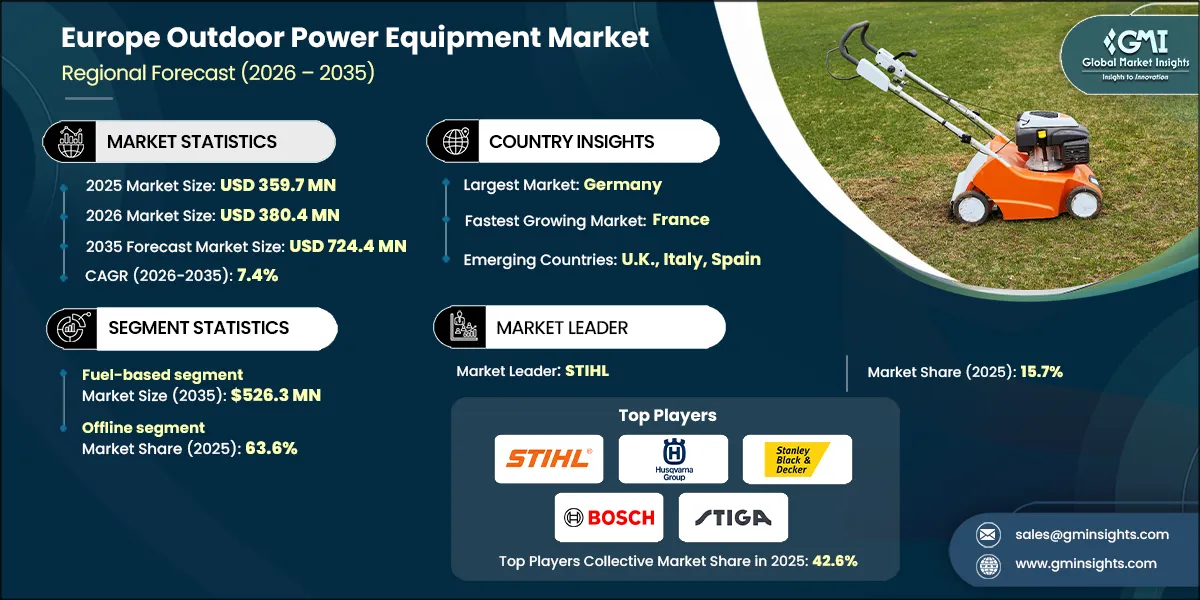
The Europe outdoor power equipment market was valued at USD 359.7 million in 2025. The market is expected to grow from USD 380.4 million in 2026 to USD 724.4 million in 2035, at a CAGR of 7.4%, according to latest report published by Global Market Insights Inc.
Europe Outdoor Power Equipment Market Key Takeaways
Market Size & Growth
- 2025 Market Size: USD 359.7 Million
- 2026 Market Size: USD 380.4 Million
- 2035 Forecast Market Size: USD 724.4 Million
- CAGR (2026–2035): 7.4%
Regional Dominance
- Largest Market: Germany
- Fastest Growing Country: France
Key Market Drivers
- Rising demand for landscaping and gardening services.
- Growing adoption of robotic lawn mowers.
- Rapid growth in the construction sector.
Challenges
- High dependence on weather conditions.
- Stringent environmental regulations.
Opportunity
- Sustainability‑driven solutions.
- Expansion in emerging markets with rising power equipment usage.
Key Players
- Market Leader: STIHL led with over 15.7% market share in 2025.
- Leading Players: Top 5 players in this market include STIHL, Husqvarna, Stanley Black and Decker, Robert Bosch, Stiga, which collectively held a market share of 42.6% in 2025.
Get Market Insights & Growth Opportunities
The Europe outdoor power equipment industry is on the rise due to an increase in the demand for tools to maintain gardens, lawns and landscapes. According to data released by the EEA, approximately four out of ten Europeans live in houses that have gardens and desire purchasing equipment such as trimmers, lawnmowers, and chainsaws.
Another sector that also plays a large part in driving the growth of this market is construction. Eurostat reported that construction output rose by approximately 2.3% throughout the EU as of 2023, illustrating growth in the construction sector. Outdoor power equipment such as compact utility loaders and portable generators are necessary for performing tasks such as land clearing and excavation. For example, STIHL has continually expanded its product offerings to meet the needs of the ever-growing construction professional community.
Urbanisation is also a contributor to the market growth, as approximately 75% of the population in Europe according to the United Nations reside in urban living arrangements, which can drive up the need for landscaping tools that will continue to develop green space within urban centres. Governmental initiatives such as the European Union primary initiative for green cities has also promoted sustainable urban development, thus driving further growth of this market.
A primary limit to acquisition as an auxiliary service is dependency on weather; adverse conditions, such as heavy rainfall and snowfall, hinder the ability to participate in outdoor activities that require equipment. This can have a significant impact on revenue generation, especially when adverse weather conditions persist for extended periods of time.
Despite challenges, the market is set to grow, driven by sustainability initiatives, urbanization, and product innovations. Companies like Bosch and Makita are investing in advanced technologies to enhance product efficiency and meet evolving consumer needs.
To get key market trends
Europe Outdoor Power Equipment Market Trends
Changing innovation and technology transformation are important for the growth of the Europe outdoor power equipment market.
- The European outdoor power equipment & jobs market continue to experience robust growth, particularly the increasing use of robotic lawnmowers. Innovations in the areas of robotics & AI have made these devices more reliable & user-friendly than ever before. According to the European Environment Agency (EEA), more than 60% of Urban households are now seeking eco-friendly solutions, thus enhancing the demand for electric emission free lawnmowers.
- The rental market for Outdoor Power Equipment has expanded as both corporate clients & individual users are looking for ways to save money when using outdoor power equipment. According to the European Rental Association (ERA), equipment rentals were up by 15% in 2023 over last year as corporations try to reduce costs & their environmental footprint.
- Technological innovations have changed how our industry operates with manufacturers now concentrating on developing smart, connected outdoor power equipment. Husqvarna has recently developed & introduced to the market an AI-enabled robotic lawnmower that utilizes GPS Technology to track its location and app-based technologies to allow for easier remote operation of the device, thereby fulfilling the growing demand for automated equipment. Furthermore, because of ECU’s initiatives to use technology to support digital transformation, they continue to create a technology rich & competitive environment within Europe.
- Continued emphasis is being placed on sustainable solutions by the industry based on stricter future emissions regulations as well as the introduction of updated emissions limits for equipment manufacturers. The European Union’s Green Deal has set forth targets for all member nations to achieve net-zero greenhouse gas emissions by 2050.
- More and more consumers are being drawn to buying multi-functional equipment due to the need to reduce both space and costs at home for example, the Bosch company launched its new 3-in-1 lawn/garden tool in 2023 as combined tools for mowing, trimming, and blowing grass clippings, etc.
Europe Outdoor Power Equipment Market Analysis
Learn more about the key segments shaping this market
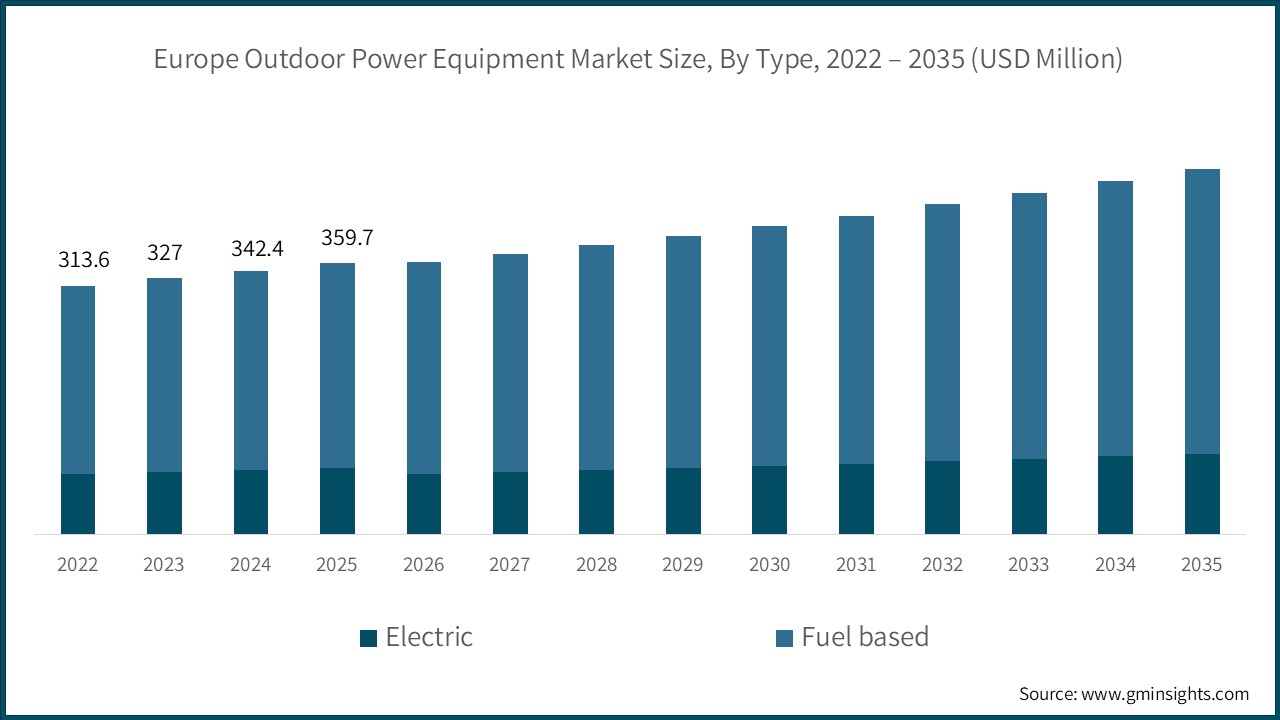
Based on power, the Europe outdoor power equipment market is segmented electric and fuel based. The fuel-based segment accounts for revenue of around USD 258.2 million in the year 2025 and is expected to reach USD 526.3 million by 2035.
- The fuel-based segment of recreational vehicles is still dominant within the market due to their superior efficiency and durability when compared to electric or battery-powered RVs. According to the EEA, approximately 58% of all heavy-duty equipment sold in 2023 was fuel-powered; the vast majority of this equipment is used for challenging jobs such as forestry and large landscaping projects.
- Professional users prefer using fuel-powered tools for their superior performance and extended operational time. As an example, John Deere sells fuel-powered equipment that is specifically designed to stand up in harsh environments. Electric tools are often not sufficient to meet the performance demands for these users.
- Further demonstrating the continued dominance of fuel-powered equipment, government studies have shown that over 65% of businesses operating in the landscaping or agriculture sectors are reliant on fuel-powered equipment for day-to-day operations as highly demanding industries such as landscaping and agriculture. Users rely on fuel power equipment to maintain adequate performance levels during demanding jobs done at remote locations and/or on a large scale.
- Husqvarna and STIHL are two examples of major manufacturers that are driving innovation in the fuel gas portion of the market with new engines that meet EU stage V emission standards. This innovation helps maintain the viability of fuel-based outdoor power equipment while also addressing environmental issues.
- Overall, fuel-powered outdoor power equipment continues to dominate the European outdoor power equipment marketplace due to their high levels of power, reliability, and adaptability for demanding applications. With continued growth in the electric alternative side of the Industry, the existing infrastructure of the fuel side along with technological advancement will keep this segment at the forefront of the market throughout the forecast period.
Learn more about the key segments shaping this market
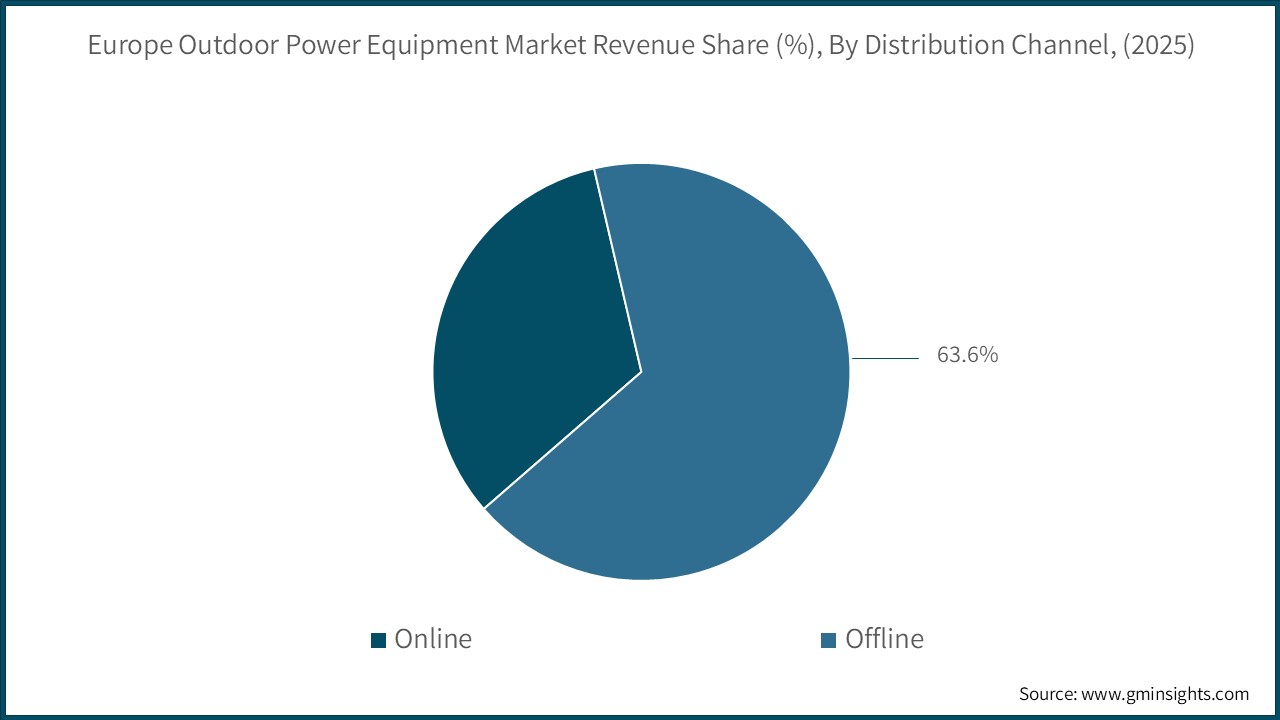
Based on the distribution channel, the Europe outdoor power equipment market is bifurcated into online and offline channel. The offline segments held the largest share, accounting for 63.6% of the market in 2025.
- The offline segment's dominance is largely due to the ability of customers to physically inspect products before purchasing. This hands-on experience allows buyers to evaluate the quality, features, and suitability of the equipment, which builds trust and confidence in their purchase decisions.
- Another critical factor is the personalized customer service offered by offline channels. In-store staff provide expert guidance and tailored recommendations, helping customers choose the most appropriate equipment for their specific needs. This personalized approach enhances the overall shopping experience and fosters customer loyalty.
- Immediate product availability is a significant advantage of offline channels. Unlike online platforms, offline stores enable customers to purchase and take-home products instantly, eliminating delivery delays. This is particularly beneficial for customers with urgent requirements.
- Additionally, offline channels often provide after-sales services, including maintenance, repairs, and product demonstrations. These services are essential for outdoor power equipment, ensuring long-term functionality and customer satisfaction. Such value-added offerings further strengthen the appeal of offline channels.
- Thus, the offline segment's dominance in the Europe outdoor power equipment market is driven by factors such as product inspection, personalized service, immediate availability, and comprehensive after-sales support. These advantages collectively position offline channels as the preferred choice for consumers in this market.
Germany Outdoor Power Equipment Market
Looking for region specific data?
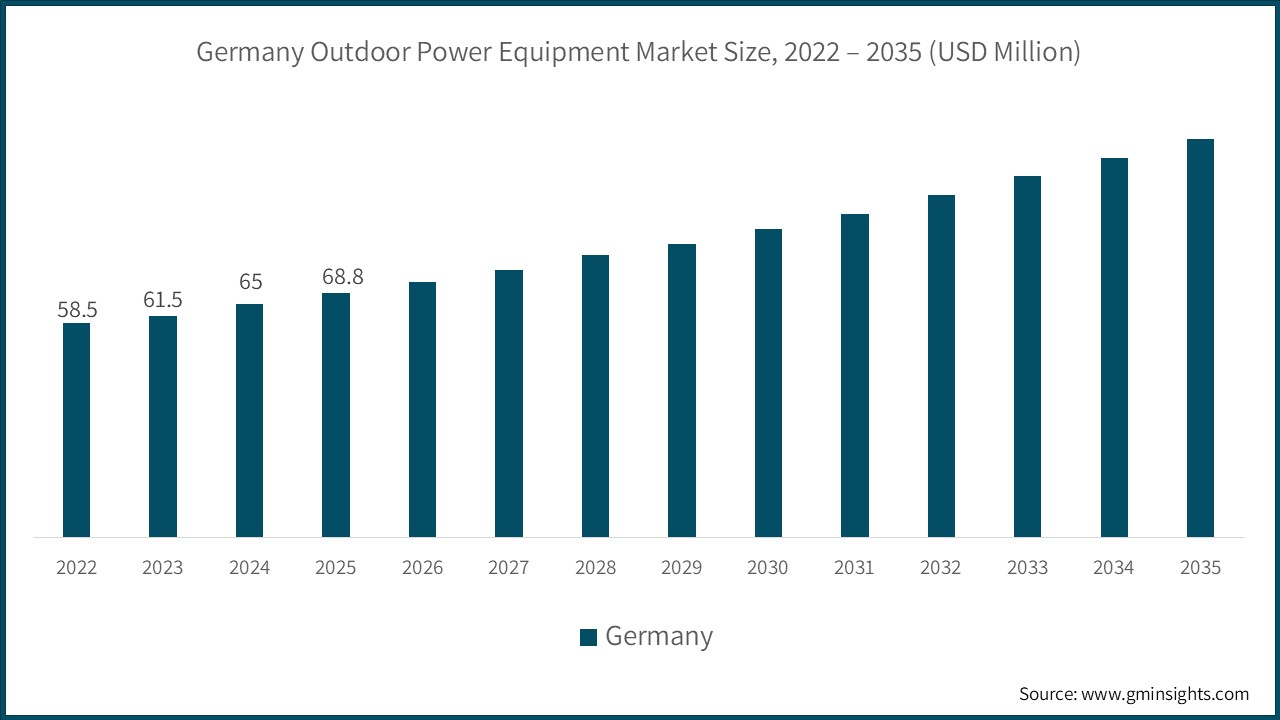
In 2025, Germany in the Europe outdoor power equipment market growth, accounted for 19.1% of the share in the region.
- Germany’s growth is driven by its large residential base with private gardens, well‑maintained public green spaces, and high spending on landscaping and municipal maintenance. The country’s strong DIY culture, combined with high purchasing power, continues to support steady replacement and upgrade cycles for lawn mowers, trimmers, and chainsaws.
- Another key growth driver is Germany’s strict environmental and noise regulations, which are accelerating the shift toward battery‑powered and low‑emission outdoor equipment. Government and municipal investments in urban green infrastructure, parks, and sustainable city development further stimulate demand.
U.K. Outdoor Power Equipment Market
U.K. outdoor power equipment market is expected to grow at 7.3% during the forecast period.
The region’s growth is primarily driven by rising home improvement activity and a strong gardening culture among homeowners. Increased investment in residential landscaping, fueled by lifestyle upgrades and remote‑working trends, has boosted demand for lawn mowers, trimmers, and battery‑powered handheld tools.
- Additionally, the U.K.’s transition toward electric and battery‑powered outdoor equipment is gaining momentum due to sustainability targets and tightening emission norms. Government initiatives linked to climate goals, including the Net Zero 2050 commitment, are encouraging the adoption of cleaner equipment.
Europe Outdoor Power Equipment Market Share
The top companies in the market include STIHL, Husqvarna, Stanley Black and Decker, Robert Bosch and Stiga and collectively hold a share of 42.6 % of the market in 2025. These prominent players are proactively involved in strategic endeavors, such as mergers & acquisitions, facility expansions & collaborations, to expand their product portfolios, extend their reach to a broad customer base, and strengthen their market position.
- STIHL is one of Europe’s leading outdoor power equipment manufacturers, with a strong focus on chainsaws, trimmers, blowers, and lawn care equipment. The company has a deep manufacturing and dealer footprint across Europe, supporting both professional forestry and residential users. STIHL is actively expanding its battery‑powered product portfolio to align with EU emission and noise regulations.
- Husqvarna holds a dominant position in Europe’s outdoor power equipment market, particularly in robotic lawn mowers, chainsaws, and professional landscaping tools. The company is a pioneer in robotics, electrification, and connected garden solutions, supported by strong R&D investments. Its brands, including Husqvarna and Gardena, serve both professional and consumer segments.
- Stanley Black & Decker participates in the European outdoor power equipment market through brands such as BLACK+DECKER, STANLEY, and WOLF‑Garten. The company primarily targets the residential and DIY segments, offering cordless lawn mowers, trimmers, chainsaws, and garden tools. Its strategy centers on battery‑powered platforms and mass‑market retail distribution .
Europe Outdoor Power Equipment Market Companies
Major players operating in the Europe outdoor power equipment industry are:
- Briggs and Stratton
- Einhell
- Emak
- Honda Motor
- Husqvarna
- John Deere
- Karcher
- Makita
- Robert Bosch
- STIHL
- Stanley Black and Decker
- Stiga
- Techtronic Industries
- The Toro Company
- Yamabiko
Robert Bosch operates in the European outdoor power equipment market through its Bosch DIY and Bosch Professional divisions. The company focuses on cordless, battery‑powered lawn mowers, hedge trimmers, chainsaws, and robotic mowers, supported by shared battery platforms. Bosch emphasizes smart, low‑noise, and energy‑efficient solutions tailored to urban and residential users
STIGA is a leading European manufacturer and distributor of lawn mowers, ride‑on mowers, robotic mowers, and garden tractors, headquartered in Italy. The company serves primarily residential and semi‑professional users, with a strong presence across Western and Northern Europe. STIGA focuses on battery systems, AI‑enabled robotic mowers, and operator‑friendly designs.
Europe Outdoor Power Equipment Market Report Attributes
| Key Takeaway | Details |
|---|---|
| Market Size & Growth | |
| Base Year | 2025 |
| Market Size in 2025 | USD 359.7 Million |
| Market Size in 2026 | USD 380.4 Million |
| Forecast Period 2026-2035 CAGR | 7.4% |
| Market Size in 2035 | USD 724.4 Million |
| Key Market Trends | |
| Drivers | Impact |
| Rising demand for landscaping and gardening services | The growing focus on residential gardens, urban green spaces, and municipal landscaping across Europe is directly increasing demand for lawn mowers, trimmers, and blowers. Professional landscaping services are also driving repeat equipment purchases and replacement cycles, especially in Western Europe. |
| Growing adoption of robotic lawn mowers | Robotic lawn mowers are gaining rapid acceptance due to labor shortages, rising wage costs, and increasing preference for automated lawn maintenance. Adoption is particularly strong in Germany, the Nordics, and the UK, accelerating value growth in the premium equipment segment |
| Rapid growth in the construction sector | Expansion in residential, commercial, and infrastructure construction is boosting demand for outdoor power tools used in site preparation and post?construction landscaping. This trend supports higher sales of durable, professional?grade equipment across Europe. |
| Pitfalls & Challenges | Impact |
| High dependence on weather conditions | The European outdoor power equipment market remains highly seasonal, with demand strongly influenced by weather variability. Unfavorable conditions such as prolonged rainfall or droughts can delay landscaping activities and disrupt sales cycles. |
| Stringent environmental regulations | EU?wide emission and noise regulations are increasing compliance costs for manufacturers and accelerating the phase?out of petrol?powered equipment. While promoting electrification, these regulations also pressure margins and require continuous investment in technology upgrades. |
| Opportunities: | Impact |
| Sustainability‑driven solutions | Rising environmental awareness and regulatory support are creating strong demand for battery‑powered, low‑noise, and zero‑emission outdoor equipment. Manufacturers offering sustainable solutions and circular battery platforms are well positioned for long‑term growth in Europe. |
| Expansion in emerging markets with rising power equipment usage | Eastern and Southern European countries present growth opportunities as urbanization and disposable incomes increase. Rising adoption of modern gardening practices in these markets is expanding the customer base for entry‑level and mid‑range outdoor power equipment. |
| Market Leaders (2025) | |
| Market Leader |
15.7% market share |
| Top Players |
Collective market share in 2025 is 42.6% |
| Competitive Edge |
|
| Regional Insights | |
| Largest Market | Germany |
| Fastest growing market | France |
| Emerging countries | U.K., Italy, Spain |
| Future outlook |
|
What are the growth opportunities in this market?
Europe Outdoor Power Equipment Industry News
- In October 2025, STIHL inaugurated its first battery‑exclusive manufacturing facility in Oradea, Romania, backed by an investment of EUR 125 million. The plant strengthens STIHL’s European production network and is dedicated to battery packs and cordless outdoor power equipment. This move directly supports growing demand for low‑emission tools under EU regulations.
- In September 2025, STIGA officially entered the professional outdoor power equipment segment at GroundsFest 2025, unveiling large‑format robotic mowers and fully electric front mowers. The new systems target municipalities, sports facilities, and professional groundskeepers.
- In August 2025, Makita launched a Europe‑wide push for battery‑powered outdoor equipment, supported by new product introductions and a flagship marketing campaign. The strategy reinforces Makita’s shift away from petrol‑powered garden tools toward its XGT and LXT battery platforms. The initiative aligns with stricter European emission and noise regulations.
- In April 2025, Bosch announced the closure of two power‑tool and garden‑equipment production sites in Germany as part of a wider European restructuring. The decision was driven by softer demand, high operating costs, and competitive pressure. Bosch confirmed continued investment in cordless and battery‑powered outdoor tools despite the plant shutdowns.
- In February 2025, Husqvarna Group launched its largest European robotic mower expansion, introducing 13 new boundary wire‑free models for residential and professional use. The new range supports lawns from 600 sqm to more than 50,000 sqm and integrates GPS, cloud connectivity, and AI‑ready features.
The Europe outdoor power equipment market research report includes in-depth coverage of the industry, with estimates & forecasts in terms of revenue (USD Million) and volume (Thousand Units) (from 2022 to 2035), for the following segments:
Market, By Type
- Lawn Mower
- Push-behind/Walk-Behind Lawn Mowers
- Riding/Ride-on Lawn Mowers
- Robotic Lawn Mowers
- Chainsaw
- Trimmer & Edger
- Blowers
- Tillers & Cultivators
- Snow Throwers
- Others
Market, By Power
- Electric
- Fuel Based
Market, By End User
- Residential
- Commercial/Industrial
Market, By Distribution Channel
- Online
- E-Commerce
- Company website
- Offline
- Supermarkets/Hypermarkets
- Specialty Stores
- Others (Individual stores, Departmental stores, etc.)
The above information is provided for the following countries:
- Germany
- France
- UK
- Italy
- Spain
Frequently Asked Question(FAQ) :
What was the market size of the Europe outdoor power equipment market in 2025?
The market size was USD 359.7 million in 2025, driven by advancements in robotics, artificial intelligence, and the increasing demand for eco-friendly solutions.
What is the projected value of the Europe outdoor power equipment industry by 2035?
The market is expected to reach USD 724.4 million by 2035, growing at a CAGR of 7.4%, fueled by innovations in electric and emission-free equipment and the expansion of the rental market.
What is the projected size of the Europe outdoor power equipment market in 2026?
The market is expected to grow to USD 380.4 million in 2026.
What was the market share of the fuel-based segment in 2025?
The fuel-based segment accounted for USD 258.2 million in revenue in 2025 and is projected to grow significantly, reaching USD 526.3 million by 2035.
What was the market share of the offline distribution channel in 2025?
The offline distribution channel held the largest share, accounting for 63.6% of the market in 2025.
Which country dominated the Europe outdoor power equipment market in 2025?
Germany led the market in 2025, contributing 19.1% of the regional market share.
What are the upcoming trends in the Europe outdoor power equipment industry?
Key trends include the growing adoption of robotic lawnmowers, advancements in AI and robotics, the increasing preference for electric and emission-free equipment, and the expansion of the rental market as users seek cost-effective and environmentally friendly solutions.
Who are the key players in the Europe outdoor power equipment market?
Major players include Briggs and Stratton, Einhell, Emak, Honda Motor, Husqvarna, John Deere, Karcher, Makita, and Robert Bosch.
Europe Outdoor Power Equipment Market Scope
Related Reports