Summary
Table of Content

Europe Ophthalmic Lenses Market
Get a free sample of this report
Form submitted successfully!
Error submitting form. Please try again.
Thank you!
Your inquiry has been received. Our team will reach out to you with the required details via email. To ensure that you don't miss their response, kindly remember to check your spam folder as well!
Request Sectional Data
Thank you!
Your inquiry has been received. Our team will reach out to you with the required details via email. To ensure that you don't miss their response, kindly remember to check your spam folder as well!
Form submitted successfully!
Error submitting form. Please try again.
Europe Ophthalmic Lenses Market Size
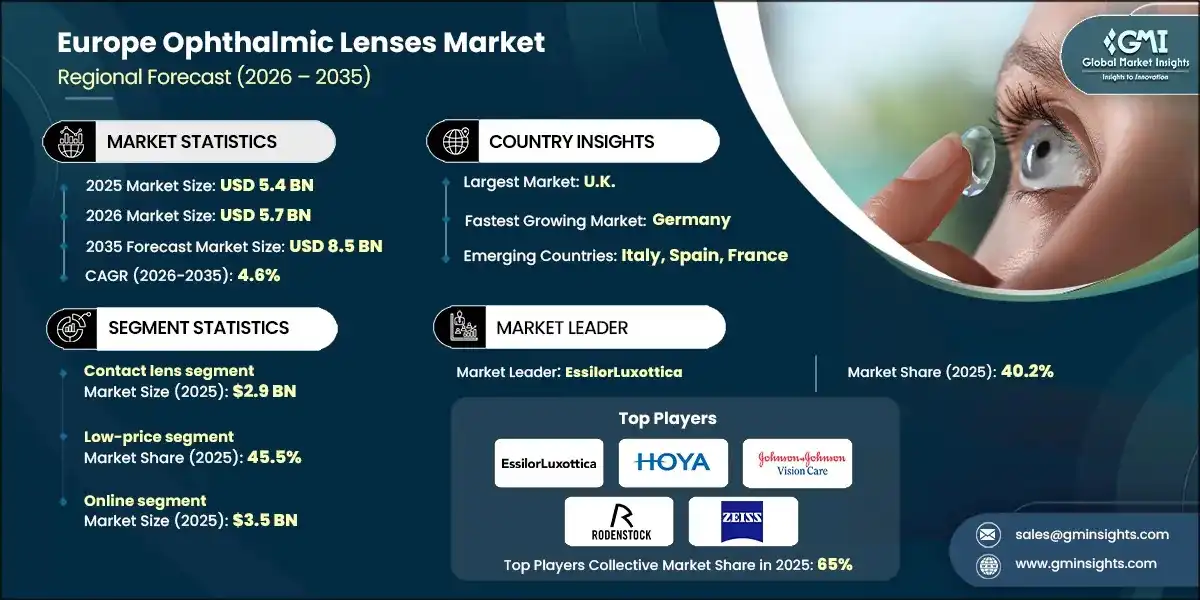
The Europe ophthalmic lenses market size was valued at USD 5.4 billion in 2025 and is anticipated to expected to grow from USD 5.7 billion in 2026 to USD 8.5 billion in 2035, at a CAGR of 4.6%, according to latest report published by Global Market Insights Inc.
Europe Ophthalmic Lenses Market Key Takeaways
Market Size & Growth
- 2025 Market Size: USD 5.4 Billion
- 2026 Market Size: USD 5.7 Billion
- 2035 Forecast Market Size: USD 8.5 Billion
- CAGR (2026–2035): 4.6%
Key Market Drivers
- Aging population.
- Rising prevalence of vision problems.
- Increasing awareness of eye health.
Challenges
- Regulatory complexity and compliance burden.
- Price sensitivity and market saturation.
Opportunity
- Technological advancements.
- Sustainability & eco-friendly materials.
Key Players
- Market Leader: EssilorLuxottica led with over 40.2% market share in 2025.
- Leading Players: Top 5 players in this market include EssilorLuxottica, HOYA Corporation, Johnson & Johnson Vision Care, Rodenstock GmbH, Carl Zeiss AG, which collectively held a market share of 65% in 2025.
Get Market Insights & Growth Opportunities
The ophthalmic lenses market in Europe is growing as vision disorders such as myopia, hyperopia, and astigmatism become more prevalent. The European Society of Ophthalmology estimates that more than 50% of the European population is expected to be nearsighted by 2025, due to prolonged screen time and changes in lifestyles. Accordingly, manufacturers like EssilorLuxottica are responding to this demand by introducing lenses such as the Eyezen range for reducing digital eye strain, further helping the market grow.
The aging population in Europe is another driver of the ophthalmic lenses market. In its 2020 data, Eurostat estimates that by 2025, persons aged 65 and over will represent more than 21% of the population in this region. The progressive transition to an older population will also drive the need for lenses that assist with age-related vision problems such as presbyopia. Companies like Hoya Vision are providing the aging population with progressive multifocal lenses that will provide distance, intermediate, and near vision correction.
There are an increased awareness and promotion of eye health and preventative care within the public health campaigns across the region, which will also contribute to the need for ophthalmic lenses. Public health initiatives through campaigns by groups such as the European Coalition for Vision (ECV), is promoting consumer awareness for eye health and the need for regular eye examinations, and thus there will be increased demand for ophthalmic lenses. For instance, Zeiss is developing lenses that not only correct vision but also provide full UV protection by a new technology, known as UVProtect technology.
The integration of fashion and functionality in eyewear is driving innovation in the market. Eyewear is increasingly perceived as a fashion accessory, prompting brands to introduce stylish yet technologically advanced products. For example, Safilo Group has launched collections that combine cutting-edge lens technology with contemporary designs, appealing to fashion-conscious consumers.
Opportunities in the market include the growing demand for eco-friendly and sustainable ophthalmic lenses. With increasing environmental awareness, manufacturers like Rodenstock are developing lenses made from recycled materials, tapping into the sustainability trend. Additionally, the expansion of tele-optometry services presents a significant opportunity, enabling consumers to access eye care remotely and increasing the accessibility of ophthalmic lenses across Europe.
To get key market trends
Europe Ophthalmic Lenses Market Trends
As screen time continues to increase due to digital device usage, there has been a significant rise in demand for ophthalmic lenses across Europe.
- The European market for ophthalmic lenses is experiencing growth due to increasing usage of blue light-blocking lenses. As per the report by the European Council of Optometry and Optics, in 2023 more than 60% of working professionals and students had reported symptoms of digital eye strain. This number is expected to continue to rise. Manufacturers like Essilor Luxottica and Hoya Vision Care are releasing new blue light-filtering technologies in response to increased demand from online work and education.
- Another emerging marketplace trend is sustainability, where consumers request eco-friendly products. According to the European Environmental Agency, at least 40% of eyewear products will contain sustainable materials in the next two years, by 2025. Brands like Zeiss and Safilo Group are leading this trend and encouraging consumers to request products made from recycled plastics, biodegradable acetate, and bamboo in their design.
- Innovations in lenses continue to drive growth in the marketplace. For example, adaptive lenses, or lenses that change in relation to the light are becoming increasingly accepted. The European Ophthalmic Industry Association states in 2023 that photochromic lenses will see adoption rates increase by 15% year after year to 2026 and further. Manufacturers such as Transitions Optical can increase offerings to capture the trend.
- The increasing prevalence of eye conditions such as myopia and presbyopia is helping grow demand for corrective lenses. According to the World Health Organization, almost 50% of the European population will require vision correction by 2025. Organizations such as CooperVision and Alcon have options including and (+/-) lenses to meet demand. The growth of e-commerce is changing how ophthalmic lenses are distributed from retail settings. A 2023 European E-commerce Association survey showed that online eyewear product sales in Europe increased 25% year-over-year, and that growth is expected to continue through 2025. E-commerce sites like Mister Spex and Vision Direct are using e-commerce models such as virtual try-ons and personalized recommendations in a recurring way to help enhance the consumer buying journey.
Europe Ophthalmic Lenses Market Analysis
Learn more about the key segments shaping this market
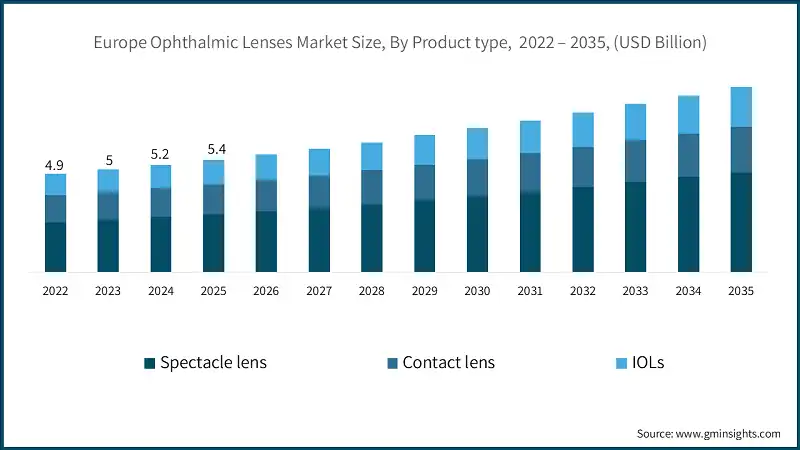
Based on product type, the Europe market is segmented into spectacles, contact lens, and IOLs. The contact lens dominated the market in 2025, generating a revenue of USD 2.9 billion and is expected to grow at a CAGR of 4% during the forecast period from 2026 – 2035.
- The increase in contact lenses is due to the growth of refractive errors like myopia and astigmatism, creating demand for CPE ophthalmic lenses market. According to the European Society of Ophthalmology, by 2025 around half the population in Europe will have some sort of refractive error. Manufacturers such as Alcon and Johnson & Johnson started developing innovative, daily disposable lenses like Acuvue Oasys 1-Day for the increased demand.
- The market demand for multifocal and toric lenses are increasing because of the aging population and the need for vision correction for presbyopia and astigmatism. Bausch + Lomb introduced “ultra multifocal” for astigmatism lenses in 2025, claiming clear vision at all distances. This product fit European demographics where, by 2030, Eurostat predicts that 22% of the population in the European Union will consist of senior demographics.
- Government and regional programs geared towards improving the understanding of eye health and well-being are driving an increase in contact lenses. The European Commission has initiative- "Vision 2025," emphasizes the importance of having your eyes examined on a regular basis and using corrective lenses. Manufacturers have developed products like Biofinity Energys, in response to the increasing diagnosis of Computer Vision Syndrome (CVS), that will help reduce digital eye strain from increased screen time.
- Innovations in lens materials, including water-gradient technology are providing increased comfort while increasing oxygen permeability. For instance, Alcon's Dailies Total1, featuring water-gradient technology lens has gained acceptance in the marketplace. These advances fit the need for high-performance lenses, especially among the younger generation, who are focused on comfort and convenience.
Learn more about the key segments shaping this market
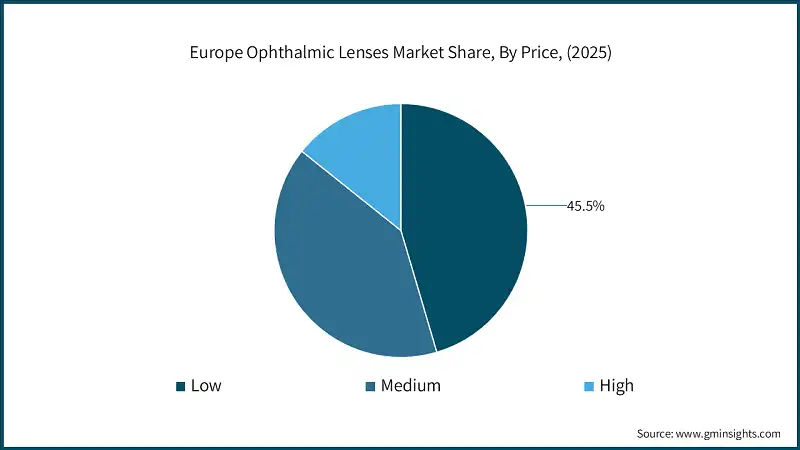
Based on price the Europe ophthalmic lenses market is categorized into low, medium and high. The low-price segment dominated the market in 2025, acquiring a market share of 45.5% and is expected to grow at a CAGR of 4.7% during the forecast period from 2026 – 2035.
- The low-price sector dominates the European ophthalmic sector to its affordability and widespread appeal among different consumer types. The low-price segment is responsive to customers with low disposable income in areas where healthcare expenditure is a priority. Additionally, the increased incidence of eye disorders is stimulating demand for low-cost ophthalmic products.
- According to a 2023 report from the European Commission, roughly 28% of the population in lower-income EU countries struggle to afford premium, and essential ophthalmic care products. The World Health Organization (WHO) has also consistently stressed the need of affordable eye care products to address preventable blindness and visual impairment throughout Europe.
- In 2022, in partnership with the Ministry of Social Rights and Consumer Affairs, the Spanish government presented initiatives intended to infuse affordable eyeglasses access to disadvantaged populations. These initiatives, intended to begin within the legislative period, intend to improve health equity of Spain's National Health System (SNS). The purpose is to subsidize inexpensive ophthalmic products for people who are economically disadvantaged. At the same time, in Eastern Europe, Poland is experiencing an increased demand for cheap eyeglasses in line with regional health priorities concerning vision, and health equity.
- The contribution of manufacturers to the low-price segment has included cost-effective production methods. As an example, EssilorLuxottica, launched a low-cost eyewear line in 2021 directed toward the price-sensitive consumer such as the Lite Lens Collection, to provide reasonably priced products has effectively enhanced the strength of the low-price segment in the European ophthalmic industry.
Based on distribution channel the Europe ophthalmic lenses market is categorized into online and offline. The online segment dominated the market in 2025, generating a revenue of USD 3.5 billion and is expected to grow at a CAGR of 4.2% during the forecast period from 2026 – 2035
- The online distribution channel is increasing rapidly as part of the Europe market due to its unparalleled convenience for consumers, such as their home delivery service, flexible payment abilities, and hassle-free return policies. For example, some manufacturers like EssilorLuxottica provide an easy-to-use platform for the users, where customers can upload prescriptions and track orders. Based on the European E-commerce Association, online eyewear sales in Europe will grow by 6% annually starting in 2025, which coincided with internet penetration and smartphone adoption.
- As technology is also advancing, manufacturers are finding ways to enhance the virtual shopping experience. For example, companies like Hoya Vision are providing virtual try-on tools that help people visualize how lenses or frames will look before purchasing the item. Technology such as this has played a significant role in establishing consumer confidence in making purchases online. In the European Optical Industry Association report for 2025, 72% of consumers purchasing eyewear online preferred sites with augmented reality features.
- Online platforms also pull customers in with competitive prices, discounts, and other subscription-based purchases. For example, Zeiss has special exclusive discounts for repeat buyers and loyalty program members. According to a consumer organization in 2025, 68% of respondents stated cost savings were the primary reason for purchasing an ophthalmic lens online.
- Also, these channels offer a wider variety of products when compared with offline means, addressing a wide range of consumer needs. Manufacturers like Rodenstock have expanded their online catalogs to include specialized lenses, such as blue-light blocking and progressive lenses. This extensive range has contributed to the growing popularity of online platforms. A 2025 study by the European Vision Council revealed that 60% of consumers prefer online shopping for its broader product selection.
Looking for region specific data?
U.K. Ophthalmic Lenses Market
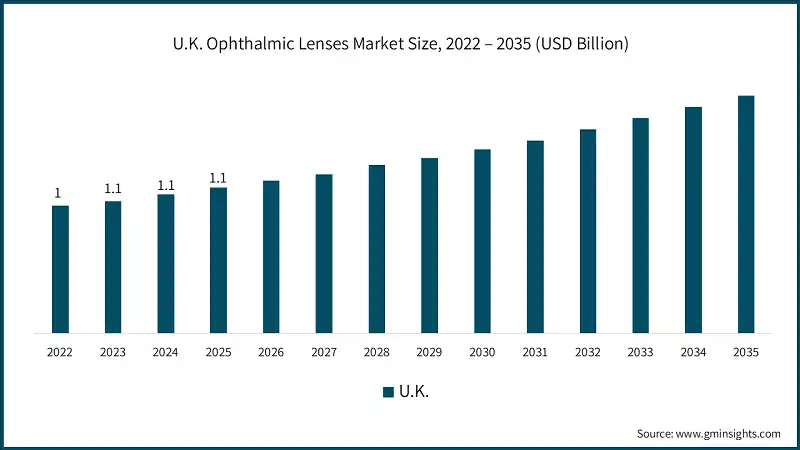
U.K. leads the Europe ophthalmic lenses market is leading the market generating a revenue of around USD 1.1 billion in the year 2025.
- The National Health Service (NHS) reports that more than 2 million cataract surgeries are completed in the U.K. each year, which increases the demand for intraocular lenses (IOLs). In addition, the increasing use of premium and stylish eyewear has resulted in spectacles being perceived as both a practical necessity and as a fashion accessory, which leads to a greater rate of market growth.
- Furthermore, the U.K. government's position on access to vision care promotes the market. The NHS reported that over 30 million eye tests were completed, which promotes early detection of vision problems and increases the use of corrective eyewear. Moreover, the availability of insurance through various NHS programs adds to affordability and increases the penetration of ophthalmic lenses.
Germany Ophthalmic Lenses Market
Germany ophthalmic lenses market in 2025 and is expected to grow at 5.6% during the forecast period.
- Germany's ophthalmic lens market is experiencing growth due to its aging population. According to the Federal Statistical Office of Germany, over 22% of the population is aged 65 and above in 2024, driving demand for corrective eyewear and intraocular lenses (IOLs). Additionally, advancements in lens technology and increasing awareness about vision health contribute to market expansion.
- The German government’s healthcare policies, such as mandatory health insurance coverage, ensure access to vision care services. This accessibility encourages the adoption of premium eyewear solutions, further fueling market growth.
Italy Ophthalmic Lenses Market
Italy ophthalmic lenses market in 2025 and is expected to grow at 4.9% during the forecast period
- Italy’s ophthalmic lens market is growing due to the increasing prevalence of vision-related issues. According to the Italian Ministry of Health, approximately 60% of Italians require corrective eyewear, creating a steady demand for ophthalmic lenses.
- The aging population, with over 23% aged 65 and above in 2024, further drives this demand. The Italian government’s support for healthcare services, including subsidies for vision care, enhances accessibility to ophthalmic products.
Europe Ophthalmic Lenses Market Share
The top companies in the Europe market are EssilorLuxottica, HOYA Corporation, Johnson & Johnson Vision Care, Rodenstock GmbH and Carl Zeiss AG and collectively hold a share of 65% in the market in 2025. These prominent players are proactively involved in strategic endeavors, such as mergers & acquisitions, facility expansions & collaborations, to expand their product portfolios, extend their reach to a broad customer base, and strengthen their market position.
- EssilorLuxottica leads with premium ophthalmic lenses combining advanced optics and stylish design. Its portfolio integrates blue-light protection, photochromic technology, and AI-driven personalization. Sustainability is central, with eco-friendly materials and energy-efficient processes. Strong retail and digital platforms ensure seamless access across Europe.
- HOYA delivers precision lenses engineered for clarity and comfort, leveraging cutting-edge coatings and adaptive technologies. Its focus on myopia management and digital eye strain solutions aligns with modern lifestyles. The company invests in eco-conscious manufacturing and recyclable materials. Robust partnerships strengthen its presence in European healthcare networks.
- Johnson & Johnson Vision Care offers innovative lens solutions emphasizing eye health and patient-centric care. Its products feature advanced UV protection, blue-light filtering, and personalized fitting technologies. Sustainability initiatives include bio-based materials and reduced carbon footprint. Strong collaboration with eye care professionals drives trust and adoption in Europe.
Europe Ophthalmic Lenses Market Companies
Major players operating in the Europe ophthalmic lenses industry include:
- BBGR Optical
- Carl Zeiss Vision
- Charmant Group
- De Rigo Vision
- EssilorLuxottica
- Fielmann AG
- HOYA Corporation
- Indo Optical
- JINS
- Marchon Eyewear (VSP Global)
- Rodenstock GmbH
- Safilo Group
- Seiko Optical Products
- Shamir Optical Industry Ltd.
- Silhouette International
Rodenstock combines German engineering with biometric precision to deliver highly customized ophthalmic lenses. Its technologies optimize vision based on individual eye measurements for superior performance. The brand champions sustainability through resource-efficient production and recyclable components. A strong heritage and digital integration position Rodenstock as a premium choice in Europe.
Carl Zeiss AG sets benchmarks in optical innovation with lenses designed for exceptional clarity and durability. Its portfolio includes smart coatings, adaptive light technologies, and solutions for digital eye strain. Sustainability goals drive eco-friendly materials and low-impact processes. Zeiss leverages its global expertise to deliver premium vision care across Europe.
Europe Ophthalmic Lenses Market Report Attributes
| Key Takeaway | Details |
|---|---|
| Market Size & Growth | |
| Base Year | 2025 |
| Market Size in 2025 | USD 5.4 Billion |
| Market Size in 2026 | USD 5.7 Billion |
| Forecast Period 2026-2035 CAGR | 4.6% |
| Market Size in 2035 | USD 8.5 Billion |
| Key Market Trends | |
| Drivers | Impact |
| Aging population | Europes aging demographic is fueling demand for presbyopia correction lenses and multifocal solutions, creating steady growth for premium lens categories. This trend is expected to accelerate as life expectancy rises. |
| Rising prevalence of vision problems | Digital device usage and lifestyle changes have led to increased cases of myopia, hyperopia, and astigmatism, especially among younger populations. This drives higher adoption of corrective lenses across all age groups. |
| Increasing awareness of eye health | Public health initiatives and growing awareness of digital eye strain are encouraging consumers to invest in regular eye exams and advanced lens technologies, boosting premium product sales. |
| Pitfalls & Challenges | Impact |
| Regulatory complexity and compliance burden | Strict EU medical device regulations and CE marking requirements increase time-to-market and compliance costs, posing challenges for smaller manufacturers and slowing innovation cycles. |
| Price sensitivity and market saturation | Intense competition and availability of low-cost alternatives make it difficult for brands to maintain margins. Premium lenses require strong differentiation to overcome price-driven purchasing behavior. |
| Opportunities: | Impact |
| Technological advancements | Innovations such as smart lenses, AR-enabled eyewear, and biometric customization offer significant growth potential. These technologies enable premium pricing and create new consumer segments. |
| Sustainability & eco-friendly materials | Rising consumer preference for recyclable lenses and green manufacturing processes opens opportunities for companies to position themselves as sustainability leaders, enhancing brand loyalty |
| Market Leaders (2025) | |
| Market Leaders |
40.2% market share |
| Top Players |
|
| Competitive Edge |
|
| Regional Insights | |
| Largest Market | U.K. |
| Fastest Growing Market | Germany |
| Emerging Country | Italy, Spain, France |
| Future Outlook |
|
What are the growth opportunities in this market?
Europe Ophthalmic Lenses Industry News
- In September 2025, ZEISS showcased major ophthalmic innovations at ESCRS 2025 in Copenhagen, introducing the CIRRUS PathFinder AI clinical support tool and expanding its surgical workflow solutions. Milestones include over 12 million eyes treated with SMILE and SMILE pro and enhanced predictive analytics through ZEISS VISULYZE 1.2 software. These advancements underline ZEISS’s leadership in precision optics and digital health integration.
- In September 2025, Rodenstock won the Silmo d’Or award for its B.I.G. EXACT Sensitive lenses, the world’s first spectacle lenses optimized for individual visual sensitivity and biometric data. This innovation builds on Rodenstock’s B.I.G. Vision philosophy, reinforcing its position as a pioneer in personalized lens technology.
- In September 2025, De Rigo renewed its eyewear licensing agreement with Mulberry until 2031, emphasizing sustainable materials such as bio-based acetate and bio-nylon lenses. This strategic move strengthens De Rigo’s premium portfolio and aligns with growing consumer demand for eco-conscious eyewear in Europe.
- In May 2025, EssilorLuxottica announced the acquisition of Optegra, a leading European ophthalmology platform with 70+ clinics across five countries. This move strengthens its med-tech strategy, integrating AI-powered diagnostics, surgical care, and smart eyewear into a seamless patient journey. The deal reinforces EssilorLuxottica’s ambition to lead in connected healthcare and personalized vision solutions.
- In May 2025, at the EAOO 2025 conference in Slovenia, HOYA unveiled visuReal MoveAI, an AI-powered pediatric fitting tool, alongside new clinical evidence for its MiYOSMART lenses. These innovations aim to improve myopia management and enhance precision in children’s eyewear fitting. HOYA also launched Sensity Colours photochromic lenses in April 2025, reinforcing its focus on lifestyle-driven lens technology.
The Europe ophthalmic lenses market research report includes in-depth coverage of the industry, with estimates & forecast in terms of revenue (USD Billion) and volume (Thousand Units) from 2022 to 2035, for the following segments:
Market, By Product Type
- Spectacles lens
- Single vision
- Multifocal
- Bifocal
- Progressive
- Reading glasses
- Safety glasses
- Others (blue light glasses, etc.)
- Contact lens
- Soft contact lens
- Rigid contact lens
- Others (toric contact lens)
- IOL
Market, By Type
- Prescription
- Non-prescription
Market, By Material
- Plastic
- Polycarbonate
- Glass
- Hydrogel
- Others
Market, By Shape
- Shape
- Oval & aviator
- Rectangular
- Round
- Square
- Others (oversized, shield, etc.)
Market, By Price
- Low
- Medium
- High
Market, By End Use
- Male
- Female
- Unisex
- Kids
Market, By Distribution Channel
- Online
- E-commerce
- Company site
- Offline
- Specialty stores
- Mega retail stores
- Others (optical camps, ophthalmic centers, etc.)
The above information is provided for the following countries:
- Europe
- Germany
- UK
- France
- Italy
- Spain
- Rest of Europe
Frequently Asked Question(FAQ) :
What was the market size of the Europe ophthalmic lenses market in 2025?
The Europe market for ophthalmic lenses was valued at USD 5.4 billion in 2025, driven by the rising prevalence of vision disorders, increasing screen time, and growing awareness of eye health across the region.
What is the estimated market size of the Europe ophthalmic lenses market in 2026?
The market is expected to reach USD 5.7 billion in 2026, supported by increasing demand for corrective lenses, aging demographics, and innovation in lens materials and coatings.
What is the projected value of the Europe ophthalmic lenses market by 2035?
The market is projected to reach USD 8.5 billion by 2035, growing at a CAGR of 4.6% from 2026 to 2035, driven by premium lens adoption and digital eye strain solutions.
Which product type dominated the Europe market in 2025?
The contact lenses segment dominated the market, generating USD 2.9 billion in revenue in 2025, supported by rising adoption of daily disposable and specialty lenses.
What was the market share of the low-price segment in 2025?
The low-price segment accounted for 45.5% market share in 2025, driven by affordability, public health initiatives, and increased demand in price-sensitive European regions.
Which distribution channel led the Europe market in 2025?
The online distribution channel led the market, generating USD 3.5 billion in 2025, supported by e-commerce growth, virtual try-on technologies, and competitive pricing strategies.
Which country leads the Europe ophthalmic lenses market?
The United Kingdom led the regional market, generating approximately USD 1.1 billion in 2025, driven by strong NHS support, high eye-test penetration, and growing demand for premium eyewear.
Which country is expected to grow the fastest during the forecast period?
Germany is expected to grow at the fastest rate, with a projected CAGR of 5.6%, supported by an aging population, advanced healthcare coverage, and strong adoption of premium ophthalmic lenses.
Who are the key players in the Europe ophthalmic lenses market?
Key players include EssilorLuxottica, HOYA Corporation, Johnson & Johnson Vision Care, Rodenstock GmbH, and Carl Zeiss AG, which collectively held 65% market share in 2025.
Europe Ophthalmic Lenses Market Scope
Related Reports