Summary
Table of Content

Europe Offshore Crane Market
Get a free sample of this report
Form submitted successfully!
Error submitting form. Please try again.
Thank you!
Your inquiry has been received. Our team will reach out to you with the required details via email. To ensure that you don't miss their response, kindly remember to check your spam folder as well!
Request Sectional Data
Thank you!
Your inquiry has been received. Our team will reach out to you with the required details via email. To ensure that you don't miss their response, kindly remember to check your spam folder as well!
Form submitted successfully!
Error submitting form. Please try again.
Europe Offshore Crane Market Size
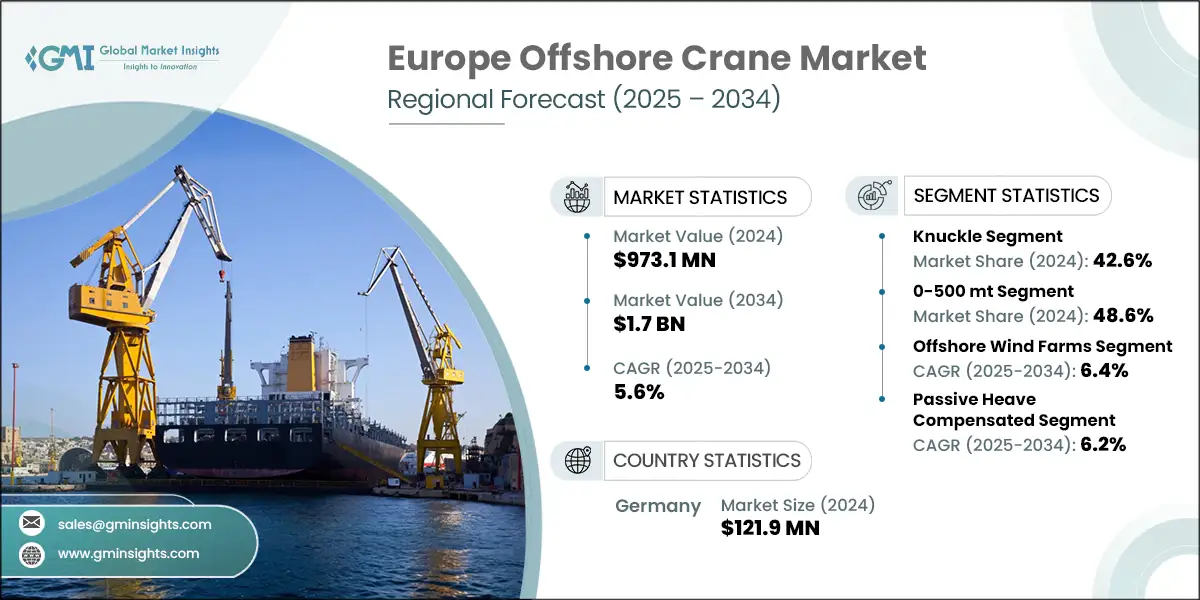
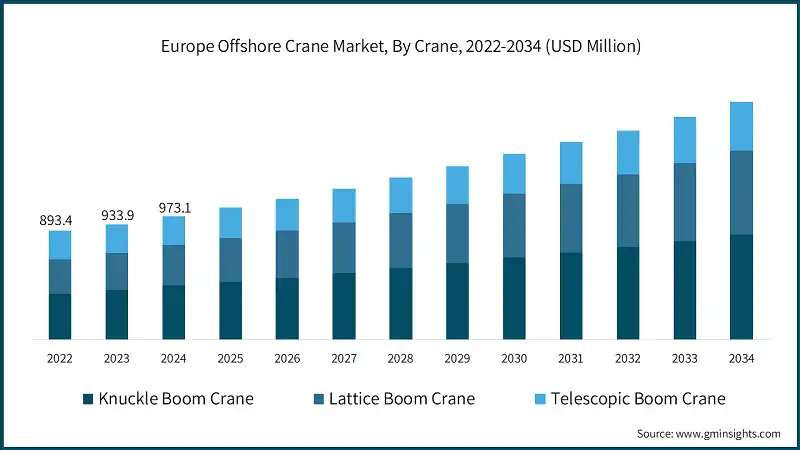
The Europe offshore crane market was estimated at USD 973.1 million in 2024. The market is expected to grow from USD 1 billion in 2025 to USD 1.7 billion in 2034, at a CAGR of 5.6%.
Europe Offshore Crane Market Key Takeaways
Market Size & Growth
- 2024 Market Size: USD 973.1 Million
- 2034 Forecast Market Size: USD 1.7 Billion
- CAGR (2025–2034): 5.6%
Key Market Drivers
- Rising Offshore Oil & Gas Exploration Activities.
- Expansion of Offshore Wind Energy Projects.
- Growing Investments in Port Infrastructure and Marine Logistics.
- Technological Advancements in Crane Systems.
- Government Support and Energy Security Policies.
Challenges
- High Installation and Maintenance Costs.
- Stringent Safety and Regulatory Compliance.
Opportunity
- Emerging Offshore Wind Projects.
- Adoption of Automated and Remote-Controlled Cranes.
- Expansion of Deepwater Exploration Activities.
Key Players
- Market Leader: Liebherr led with over 14.5% market share in 2024.
- Leading Players: Top 5 players in this market include Huisman Equipment, Liebherr, Melcal, National Oilwell Varco, Palfinger, which collectively held a market share of 30.9% in 2024.
Get Market Insights & Growth Opportunities
- Europe continues to set the global standard for offshore wind energy deployment, with substantial farms advancing in the North Sea, Baltic Sea and the Atlantic Ocean. These megaprojects rely on dedicated offshore cranes capable of precise installation of turbine generators, monopile and jacket foundations, and inter-array transmission systems.
- In July 2025, Huisman signed contracts to provide a 3,000 mt+ leg encircling crane (LEC) and a 40 mt pedestal-mounted crane for Cadeler’s new A-Class jack-up vessels, now under construction at COSCO and destined for North Sea service. Both crane systems are engineered to accommodate the largest monopile and jacket foundations projected for forthcoming offshore wind farm installations.
- The growth of Europe offshore crane market is largely attributable to the accelerated deployment of offshore wind projects in the North Sea, Baltic Sea and Atlantic regions, combined with increased funding for floating wind technologies and the revitalization of offshore oil and gas operations in the UK and Norway.
- The United Kingdom, Germany and the Netherlands constitute strategic pillars of the European offshore wind sector, leveraging the persistently strong wind regimes of the North Sea. Offshore cranes serve as indispensable platform assets, facilitating the transport, assembly, and maintenance of oversized turbine components across the increasingly distant and deep-water segments of these schemes.
- The European nations are significantly widening their capital commitments to port modernization and the enlargement of marine logistics systems that underpin offshore wind and broader marine energy supply chains. Central to this evolution are offshore cranes, whose capacity to transfer oversized wind turbine nacelles, substations and maintenance tooling between supply vessels and offshore wind farms is crucial.
- In March 2025, The UK government committed approximately USD 71.5 million to transform the Port of Cromarty Firth in Scotland into a dedicated base for floating offshore wind development. The funding will be used to strengthen quay walls and modernize port infrastructure, allowing larger installation vessels and their heavy-lift cranes to safely berth, thereby streamlining the logistics of turbine and foundation transport.
- The COVID-19 event presented a big short-term effect on the Europe offshore crane market as the pandemic resulted in project postponements and supply chain aggravations that prompted a decline in market growth over the period 2020-2021. Offshore wind and oil and gas developments were stalled due to delays in manufacturing and limitations of the workforce especially in important areas such as the North Sea. But with the solid backing of the government to renewable energy and green recovery programs, the rest of the market has gained traction, and the rate of recovery has recorded the rebound growth rate and it is expected to rise to the pre-pandemic levels by end of 2025.
- The recent developments in technology have benefitted the safety, automation, and performance efficiency of offshore cranes. Businesses are particularly attracted to new offshore cranes due to their advanced monitoring systems, remote control capabilities, and advanced system of load control which adds to operational safety and efficiency. These technologies are supporting the adoption of modern cranes in Europe offshore operations.
To get key market trends
Europe Offshore Crane Market Trends
- Crane systems are moving from hydraulic power to electric systems for better efficiency and sustainability. This change started since 2018 and is mainly based on the necessity to enhance offshore activities through a green perspective. This transition appears to be heightened by the increased regulatory pressure of low-emission solutions between 2022-2024.
- In February 2024, NOV Lifting & Handling recently delivered what it asserts is Europe’s inaugural electric subsea crane, a development signaling growing interest in zero-emission offshore lifting systems across the oil, gas and wind industries.
- The rapid scaling of offshore wind capacity across Europe is markedly increasing the demand for heavy-lift crane capacity. The United Kingdom, Germany and the Netherlands were the first markets to develop substantial offshore wind experience, and across the period from 2023 to 2025 another deployment peak is anticipated. Concurrent installation campaigns planned for France and Poland are projected to add further strain to crane supply.
- In February 2025, Van Oord’s installation vessel Svanen successfully inserted the inaugural monopile at the Baltic Power wind farm located offshore Poland. This milestone follows a comprehensive vessel enhancement programme, during which a 25-metre gantry extension was fitted. The upgrade augments Svanen’s capacity to handle increasingly oversized monopiles, thereby reinforcing its status as one of the leading heavy-lift vessels globally that have been specifically engineered for the installation of the latest-generation offshore wind turbine foundations.
- The advancements in offshore terminals are creating new requirements for the cargo and equipment handling cranes. This trend started in 2017 and reached its peak between 2023 and 2025 with the expansion of port capacity. Greater offshore crane utilization mark the more advanced loading operations results from enhanced offshore trade activities and significant capital investments.
Europe Offshore Crane Market Analysis
Learn more about the key segments shaping this market
Based on crane, the market is divided into knuckle boom crane, lattice boom crane, telescopic boom crane and others. The knuckle segment dominated around 42.6% market share in 2024 and is expected to grow at a CAGR of over 6.5% through 2034.
- The knuckle boom crane segment leads the offshore crane market in Europe due to having a compact structure, easy mobility and versatile hoist capability in narrow offshore spaces. Their advantage in this region derives from the efficiency these cranes offer in performing subsea operations, deck handling and maintenance activities on offshore vessels and platforms.
- In June 2025, the sales agreement for two 250 mt knuckle-boom cranes intended for Olympic group’s UT 7623 sustainable energy vessels received formal completion and the contract’s public disclosure circulated. Each unit will be equipped with Huisman’s patented active heave compensation, seamlessly interfaced with the vessels’ electrical architecture, thereby permitting energy-conscious, low-emission lifting operations throughout the specified offshore weather restrictions.
- Lattice boom crane grows at 6.3% CAGR through 2034, due to overcoming height and load restrictions in offshore constrained areas. These cranes have a high lifting capacity with a long reach which is suitable for deep-water oil rigs and large offshore wind turbine installations. Their modular design enables easier transport and assembly in remote or logistically difficult areas, supporting cost-effective deployment and enhanced operational flexibility.
- The telescopic boom cranes are preferred because of their compact outline as well as the adjustable boom length which facilitates lifting operations in space-constrained offshore platforms. Their fast deployment and simplicity of operation makes them well suited for maintenance work, supply transfers, as well as dynamic positioning work in shallow waters or nearshore installations.
Learn more about the key segments shaping this market
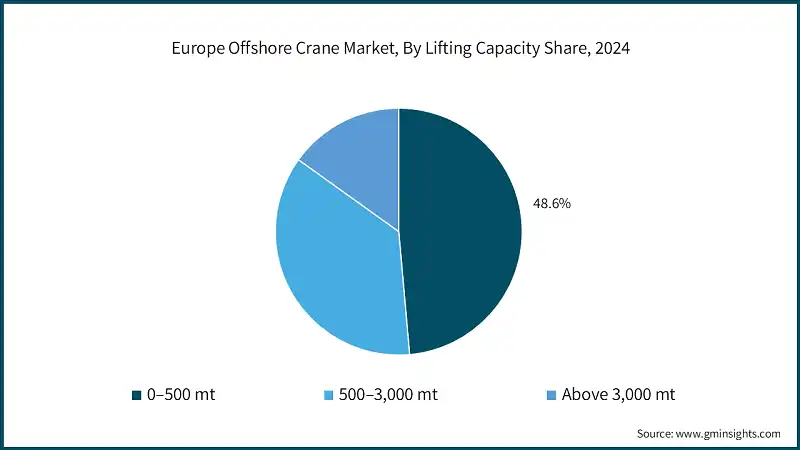
Based on lifting capacity, the market is segmented into 0-500 mt, 500-3,000 mt and above 3,000 mt. The 0-500 mt segment dominates the market with 48.6% share in 2024 and is expected to grow at a CAGR of over 5.5% from 2025 to 2034.
- The high demand for offshore equipment handling, personnel transfers, and maintenance activities, the Europe offshore crane market’s leading segment remains the 0-500 mt range. The cranes are also economical, easy to install and space-efficient on deck which is ideal for small to mid-offshore platforms. Moreover, lower OPEX and CAPEX further enhances adoption across the region.
- The 500-3000 mt grows at 6.1% CAGR through 2034, due to their simplicity and lower cost compared to ultra-heavy cranes make them favored during the expansion of offshore wind farms and oil platforms. Furthermore, advancements in technology have made these cranes more reliable and safer, making them harsher zone friendly in developing offshore areas.
- In May 2025, Liebherr has confirmed that it will supply three Ram Luffing RL 900 cranes to reinforce 50Hertz offshore grid connection schemes in the German Baltic Sea. Two cranes will be deployed at the OSS Darß and OSS Zingst substations as components of the OST-6-1 corridor, while the third crane will be allocated to the OSS Jasmund substation for the Ostwind 3 development.
- The over 3,000 mt segment of cranes is rising within Europe with the increasing size of offshore wind turbines and deep-water oil infrastructure. These cranes are essential for lifting the exceptionally heavy nacelles and monopiles of the latest turbine designs. The Netherlands, Norway and the United Kingdom are ordering state-of-the-art wind turbine installation vessels equipped with the cranes, significantly improving operational efficiency, safety margins and the pace of turbine deployment in offshore wind parks.
Based on application, the Europe offshore crane market is segmented into oil & gas platforms, offshore wind farms, subsea operations, marine vessels & FPSOS and others. The oil & gas platforms segment is expected to dominate as the ability to train thousands of employees across varying technical backgrounds, languages, and regulatory environments demands scalable, secure, and customizable training solutions.
- The oil and gas platforms segment continue to hold a dominant share of the Europe offshore crane market owing to the region’s active and growing exploration and production activities in deep and ultra-deep waters. Such operations demand powerful and high-capacity cranes for the safe lifting of heavy equipment and material handling. The sustained spending in this segment on offshore oil infrastructure also propels the demand for cranes.
- The offshore wind farms grow at 6.4% CAGR till 2034, due to their simplicity and lower cost compared to ultra-heavy cranes make them favored during the expansion of offshore wind farms and oil platforms. Furthermore, advancements in technology have made these cranes more reliable and safer, making them harsher zone friendly in developing offshore areas.
- In September 2024, Dragados Offshore operating under the VINCI umbrella has finalized a framework agreement with Liebherr for the delivery of 10 RL 2600 ram-luffing cranes, destined for electrical substation platforms serving the North Sea offshore wind sector. Each crane provides a maximum lift capacity of approximately 35 tons and achieves an outreach of up to 45 meters.
- The growing adoption of advanced offshore cranes throughout Europe underscores their strategic role in precision lifting operations that underpin subsea activities such as cable laying, deep-water equipment deployment and ROV support campaigns. Increasing investments in offshore wind array cable systems, subsea interconnectors, and deep-water oilfield expansions predominantly in the North Sea, the Baltic Sea, and the Norwegian Continental Shelf.
Based on design, the Europe offshore crane market is segmented into active heave compensated, passive heave compensated and non-compensated. The active heave compensated segment is expected to dominate as the ability to train thousands of employees across varying technical backgrounds, languages, and regulatory environments demands scalable, secure, and customizable training solutions.
- The active heave compensated segment is expected to dominate as it precisely and stably counteracts vessel movements in real-time. This enhances safety and efficiency during lifting operations in rough weather compared to passive or non-compensated systems, there is significantly less downtime and operational risk.
- In March 2025, Techano Ocean lift, a division of Nekkar ASA, has secured a contract to supply a 150-ton knuckle-boom crane featuring active heave compensation. The unit will be fitted to a new construction support vessel under construction at Sefine Shipyard in Turkey. The project is being propelled by a collaborative consortium that includes Agalas, Eidesvik and Reach Subsea.
- The passive heave compensated grow at 6.2% CAGR till 2034, due to their simpler mechanical structure and lower maintenance requirements. This makes them an attractive option for several offshore wind farms and oil platforms. Also, their reliability and safety have improved recently due to advancements in damping technology which enables better performance in difficult offshore conditions.
Looking for region specific data?
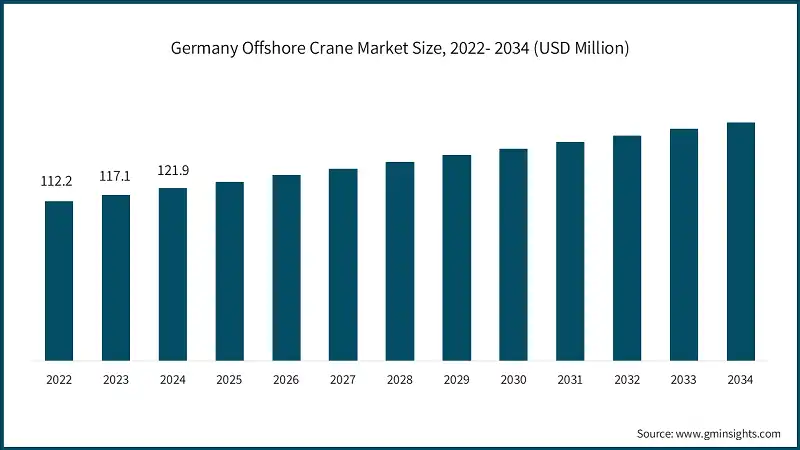
Germany dominated the Western Europe offshore crane market with around 29.4% share in 2024 and generated USD 121.9 million in revenue.
- Germany dominates the Europe’s offshore crane industry, driven by strategic and sustained investment in the offshore wind corridors of the North and Baltic Seas. Under the Energiewende initiative, the federal commitment to the decarbonization of the energy supply chain has accelerated the deployment of large-scale offshore wind farms, creating a correspondingly heightened demand for heavy-lift and intelligent crane systems.
- In May 2025, Palfinger Marine has unveiled its fully electric, remote-operated jib crane, designated DKJe, commissioned for Aker BP’s Hugin B platform located within the Yggdrasil area of the North Sea. The crane has just finished assembly at the Gdynia facility in Poland.
- The Netherlands and Belgium are having increase in demand for offshore cranes as they further expand their offshore wind initiatives in the North Sea. Each wind farm development phase turbine installation, cable laying, and ongoing maintenance necessitates heavy-lift and specialized crane vessels, thereby stimulating sustained growth in the regional market.
The offshore crane market in Eastern Europe is expected to experience significant and promising growth from 2025 to 2034.
- Poland is growing within the European offshore crane segment, this is due to the accelerated deployment of offshore wind farms across the Baltic Sea, especially in waters adjacent to the Pomeranian coastline. Policy frameworks favoring renewable energy, coupled with ongoing upgrades to the ports of Gdansk and Gdynia, the national agenda to establish the country as a pre-eminent offshore logistics nexus.
- In June 2025, the leading producer of lifting equipment in Poland, PROTEA have signed an agreement concerning supplying two knuckle-boom cranes with a lifting capacity of 6 tons to Baltic Power offshore wind station substation. The cranes are also optimized to maximize the safe and efficient cargo offloading between service vessels and the substation and also contain remote service connectivity which will promote efficiency of the maintenance activities on board when at sea.
- The countries situated in Central and Eastern Europe, notably Romania, Bulgaria and Croatia, are presently channeling capital toward the augmentation of offshore infrastructure in the Black and Adriatic Seas. Such initiatives are generating heightened procurement interest in offshore cranes, primarily to undergird ongoing oil and gas exploration campaigns and to facilitate the enlargement of associated port facilities in the region.
The offshore crane market in Northern Europe is expected to experience significant and promising growth from 2025 to 2034.
- The United Kingdom leads the European offshore crane industry, forecasted to grow at a compound annual rate of 5% through 2034. This is driven by the accelerated deployment of North Sea wind farms, sustained investment in the structured decommissioning of ageing oil and gas platforms, and purposeful upgrades to marine logistics infrastructure.
- In February 2025, Granada Cranes of the United Kingdom has entered into a contract against 72 Python-type davit cranes, to be used in the Inch Cape offshore wind farm, which is one of the major wind energy projects to be developed in Scotland.
- Denmark and Norway remain the drivers behind the accelerating offshore crane segment across Europe, driven by coordinated state and private capital directed at expanding offshore wind fleets and advancing oil and gas exploration. Denmark’s North Sea Energy Island initiative, soon to be sanctioned, requires next-generation, high-load lifting systems to both erect and service the wind turbine substations at the hub.
The offshore crane market in Southern Europe is expected to experience significant and promising growth from 2025 to 2034.
- Italy holds a significant portion of the share in the Europe offshore crane market, with an estimated CAGR of approximately 3.3%. The accelerated commissioning of offshore wind parks in the Adriatic and Mediterranean basins, the continuous upgrading of ports in accordance with EU green-transition targets, and sustained requirements for cranes in the shipbuilding and floating-structure fabrication sectors.
- In May 2025, Fratelli Fazio Group, the Italian port operator, has confirmed the acquisition of a Konecranes Gottwald ESP.9 mobile harbor crane, which will be the first Generation 6 model to enter service in Italy. Scheduled for deployment at the Group’s Augusta terminal in Sicily, the crane features a 200-tonne lifting capacity and a maximum outreach of 59 meters.
- Southern European states Spain, Greece, Bosnia and Herzegovina, and Albania are increasingly committing capital and policy toward offshore infrastructure and port renewal, propelled by investments in offshore wind, liquefied natural gas terminals, and ambitions to position themselves as regional transshipment centers. Of these, Spain is at the forefront, deploying sophisticated floating wind technologies and revitalizing coastal gateway facilities.
Europe Offshore Crane Market Share
- The top 7 companies in the Europe offshore crane industry are Liebherr, Palfinger AG, Huisman Equipment, Melcal, National Oilwell Varco, Kenz Figee and Heila Cranes contributing around 31.5% of the market in 2024.
- The Liebherr offshore cranes are renowned for their quality and performance in mobile and crawler deployment as well as tower crane off-shore operations. These cranes are particularly popular within the oil and gas industry as well as in renewable energy due to their specialized design for high-capacity load handling under tough operational conditions.
- Huisman pays special focus to innovation which sees the design and manufacture of powerful and lightweight equipment for complex offshore challenges. This company also designs offshore cranes and pipelay systems along with drilling units for the maritime and energy sectors. They focus on crafting ultra-deep water custom cranes with active heave compensation.
- Heila cranes are renowned all over the world for their wide application on vessels, offshore platforms, and harbor maintenance equipment. They provide stiff boom, telescopic, and knuckle boom cranes constructed for compact marine confined spaces.
- Kenz Figee engineers’ offshore cranes and motion-compensated gangway systems for the oil, gas, and renewable wind energy industries. The offering includes pedestal-mounted, knuckle boom, and walk-to-work cranes, all refined for harsh marine climates. The firm is committed to the energy transition, delivering adaptable systems that fit on multi-role vessels to service both conventional and emergent energy missions.
- Italian manufacturer Melcal produces compact offshore and marine cranes, offering foldable knuckle-boom and telescopic designs engineered for dependable performance in space-limited marine environments. The cranes are fabricated from materials and coatings selected for offshore durability and are dispatched only after thorough offshore certification.
- Palfinger AG, headquartered in Austria, focuses on hydraulic handling and lifting systems, crafting offshore cranes, winches, and access platforms engineered for the oil and gas, offshore wind and naval sectors. The firm recently unveiled crane systems that are both fully electrified and remotely operated; these units achieve significant reductions in energy use and provide exceptional precision control even under the harshest offshore conditions.
- National Oilwell Varco (NOV), based in the United States, designs advanced engineering solutions for upstream oil and gas applications and offers an entirely integrated suite of offshore hoisting systems. The product family includes knuckle-boom, lattice-boom and subsea crane designs, each customized for rigorous tasks including heavy lifts, riser deployment, and the upkeep of floating production, storage, and offloading vessels.
Europe Offshore Crane Market Companies
Major players operating in the Europe offshore crane industry are:
- Cargotec
- Heila Cranes
- Huisman Equipment
- Italgru S.r.l.
- Kenz Figee
- Liebherr
- Melcal
- National Oilwell Varco
- Palfinger
- PLM Cranes
- Huisman Equipment secured a landmark 2025 contract to fabricate a 5,000-ton tub-mounted crane for Penta-Ocean’s wind installation vessel, acting in concert with advanced knuckle-boom cranes bound for Sea1 Offshore. Konecranes expanded its offshore capacity by acquiring Peinemann Port Services together with Kock’s Kranbau, thereby enhancing crane service capability across marine sectors. Liebherr reported a surge in orders for electric offshore cranes, which will service both wind farm and FPSO programmers, thereby advancing sustainable marine technology.
- Melcal delivered bespoke offshore cranes specifically for floating production units in the Mediterranean, targeting shallow-water fields. Heila Cranes enlarged its service perimeter by opening new support centers in Italy and Northern Europe, thereby fortifying its offshore and marine crane portfolio. Italgru S.r.l. shipped lattice-boom pedestal cranes to offshore oil platforms in West Africa, tailored to the region’s specialized engineering demands.
- Palfinger AG launched a compact offshore crane series in 2024, designed for harsh marine conditions and reduced maintenance. Kenz Figee, in collaboration with CMIC, is supplying electric driven offshore pedestal cranes to the next generation of wind turbine installation vessels. PLM Cranes B.V. presented high-capacity offshore telescopic cranes, which enhance safety and lifting efficiency aboard FPSO units.
- Cargotec Corporation, through its MacGregor division, secured contracts for the supply of offshore crane systems and mooring winches for floating wind developments in both the North Sea and the Asia-Pacific region.
Europe Offshore Crane Market Report Attributes
| Key Takeaway | Details |
|---|---|
| Market Size & Growth | |
| Base Year | 2024 |
| Market Size in 2024 | USD 973.1 Million |
| Forecast Period 2025 - 2034 CAGR | 5.6% |
| Market Size in 2034 | USD 1.7 Billion |
| Key Market Trends | |
| Drivers | Impact |
| Rising Offshore Oil & Gas Exploration Activities | Leads to increased demand for heavy-duty offshore cranes for equipment handling and platform operations. |
| Expansion of Offshore Wind Energy Projects | Boosts the need for precision lifting cranes to install and maintain wind turbines at sea. |
| Growing Investments in Port Infrastructure and Marine Logistics | Drives crane adoption for efficient cargo handling and improved maritime logistics. |
| Technological Advancements in Crane Systems | Encourages deployment of smarter, safer, and more efficient offshore lifting solutions. |
| Government Support and Energy Security Policies | Accelerates offshore project approvals, directly increasing demand for offshore crane systems. |
| Pitfalls & Challenges | Impact |
| High Installation and Maintenance Costs | Limits adoption among smaller players and slows down project expansion. |
| Stringent Safety and Regulatory Compliance | Increases operational complexity and can cause delays in crane deployment. |
| Opportunities: | Impact |
| Emerging Offshore Wind Projects | Creates new demand for specialized cranes used in wind turbine installation and maintenance. |
| Adoption of Automated and Remote-Controlled Cranes | Enhances efficiency and safety, attracting tech-driven offshore operations. |
| Expansion of Deepwater Exploration Activities | Drives the need for advanced heavy-lifting cranes capable of operating in harsh marine environments. |
| Market Leaders (2024) | |
| Market Leaders |
14.5% Market Share |
| Top Players |
Collective market share in 2024 is 30.9% |
| Competitive Edge |
|
| Regional Insights | |
| Largest Market | Western Europe |
| Fastest growing market | Northern Europe |
| Emerging countries | Poland, Lithuania, Estonia, Romania, Ireland |
| Future outlook |
|
What are the growth opportunities in this market?
Europe Offshore Crane Market News
- In July 2025, Huisman signed contracts to provide a 3,000 mt+ leg encircling crane (LEC) and a 40 mt pedestal-mounted crane for Cadeler’s new A-Class jack-up vessels, now under construction at COSCO and destined for North Sea service. Both crane systems are engineered to accommodate the largest monopile and jacket foundations projected for forthcoming offshore wind farm installations.
- In March 2025, Techano Ocean lift, a division of Nekkar ASA, has secured a contract to supply a 150-ton knuckle-boom crane featuring active heave compensation. The unit will be fitted to a new construction support vessel under construction at Sefine Shipyard in Turkey. The project is being propelled by a collaborative consortium that includes Agalas, Eidesvik, and Reach Subsea.
- In February 2025, Van Oord’s installation vessel Svanen successfully inserted the inaugural monopile at the Baltic Power wind farm located offshore Poland. This milestone follows a comprehensive vessel enhancement programme, during which a 25-metre gantry extension was fitted.
- In January 2024, Subsea7 engaged Huisman to supply a fully electric 500-ton offshore mast crane intended for integration with a pipelay vessel optimized for deep-water deployment. The crane incorporates both passive and active heave compensation on the primary winch circuit, ensuring precise payload stabilization throughout seabed-level activities.
The Europe offshore crane market research report includes in-depth coverage of the industry with estimates & forecasts in terms of revenue ($ Mn/Bn) and volume (Units) from 2021 to 2034, for the following segments:
Market, By Crane
- Knuckle boom crane
- Lattice boom crane
- Telescopic boom crane
Market, By Lifting Capacity
- 0-500 mt
- 500-3,000 mt
- Above 3,000 mt
Market, By Application
- Oil & gas platforms
- Offshore wind farms
- Subsea operations
- Marine vessels & FPSOs
- Others
Market, By Design
- Active heave compensated (AHC)
- Passive heave compensated (PHC)
- Non-compensated
Market, By Installation
- New installation
- Replacement/Retrofit
The above information is provided for the following regions and countries:
- Western Europe
- Germany
- Austria
- France
- Switzerland
- Belgium
- Luxembourg
- Netherlands
- Portugal
- Eastern Europe
- Poland
- Romania
- Czechia
- Slovenia
- Hungary
- Bulgaria
- Slovakia
- Croatia
- Northern Europe
- UK
- Denmark
- Sweden
- Finland
- Norway
- Southern Europe
- Italy
- Spain
- Greece
- Bosnia and Herzegovina
- Albania
Frequently Asked Question(FAQ) :
What was the market size of the Europe offshore crane in 2024?
The market size was USD 973.1 million in 2024, with a CAGR of 5.6% expected through 2034, driven by offshore wind energy projects and rising oil & gas exploration activities.
What is the projected value of the Europe offshore crane market by 2034?
The Europe offshore crane market is expected to reach USD 1.7 billion by 2034, supported by technological advancements and government energy security policies.
Which crane type dominated the Europe offshore crane market in 2024?
The knuckle boom crane segment dominated the market with a 42.6% share in 2024 and is projected to grow at a CAGR of over 6.5% through 2034.
What was the market share of the 0-500 mt lifting capacity segment in 2024?
The 0-500 mt lifting capacity segment held a 48.6% market share in 2024 and is expected to grow at a CAGR of over 5.5% from 2025 to 2034.
What is the growth outlook for the lattice boom crane segment from 2025 to 2034?
The lattice boom crane segment is set to grow at a 6.3% CAGR through 2034, driven by its high lifting capacity, long reach, and modular design suited for offshore and remote installations.
Which region led the Europe offshore crane market in 2024?
Western Europe was the largest market in 2024, with Germany holding a 29.4% share and generating USD 121.9 million in revenue.
What are the upcoming trends in the Europe offshore crane market?
Key trends include the integration of advanced technologies for smarter and safer crane systems, and the rising adoption of automated and remote-controlled cranes to enhance operational efficiency and safety.
Who are the key players in the Europe offshore crane market?
Key players include Liebherr, Huisman Equipment, Melcal, National Oilwell Varco, Palfinger, Cargotec, Heila Cranes, Italgru S.r.l., Kenz Figee, and PLM Cranes.
Europe Offshore Crane Market Scope
Related Reports