Summary
Table of Content

Europe Indoor Pool Dehumidification Market
Get a free sample of this report
Form submitted successfully!
Error submitting form. Please try again.
Thank you!
Your inquiry has been received. Our team will reach out to you with the required details via email. To ensure that you don't miss their response, kindly remember to check your spam folder as well!
Request Sectional Data
Thank you!
Your inquiry has been received. Our team will reach out to you with the required details via email. To ensure that you don't miss their response, kindly remember to check your spam folder as well!
Form submitted successfully!
Error submitting form. Please try again.
Europe Indoor Pool Dehumidification Market Size
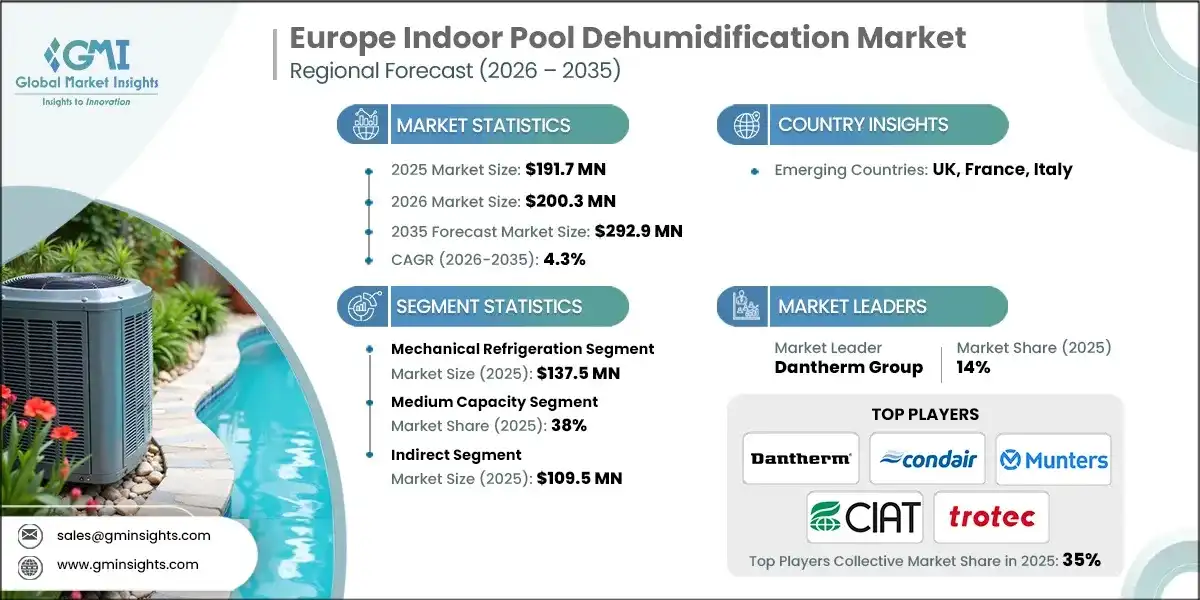
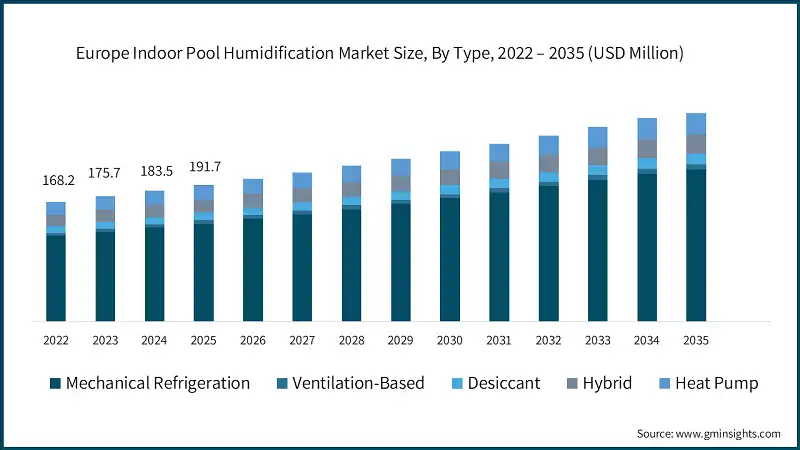
The Europe indoor pool dehumidification market was estimated at USD 191.7 million in 2025. The market is expected to grow from 200.3 million in 2026 to USD 292.9 million in 2035, at a CAGR of 4.3% according to latest report published by Global Market Insights Inc.
Europe Indoor Pool Dehumidification Market Key Takeaways
Market Size & Growth
- 2025 Market Size: USD 191.7 Million
- 2026 Market Size: USD 200.3 Million
- 2035 Forecast Market Size: USD 292.9 Million
- CAGR (2026–2035): 4.3%
Key Market Drivers
- Expansion of indoor pool infrastructure.
- Rising awareness of indoor air quality (IAQ).
- Shift toward energy efficient and sustainable HVAC systems.
Challenges
- High initial and operational costs.
- Maintenance complexity in high humidity environments.
Opportunity
- Rising popularity of wellness, fitness, and luxury housing.
- Smart & IoT‑enabled dehumidification solutions.
Key Players
- Market Leader: Dantherm Group led with over 14% market share in 2025.
- Leading Players: Top 5 players in this market include Dantherm Group, Condair Group, Munters Group, CIAT, TROTEC, which collectively held a market share of 35% in 2025.
Get Market Insights & Growth Opportunities
Indoor pools are becoming increasingly common throughout Europe as new homes, hotels, commercial facilities, and sports complexes are adding climate-controlled structures to their properties. The growth of climate controlled indoor pools is directly correlated to the increase in funding for recreation facilities and the growing popularity of wellness-oriented amenities such as fitness facilities, day spas and luxury hotels quality. To support this increase in climate controlled indoor pools, the development of advanced technologies for dehumidification is also being encouraged by the demand for dependable, efficient, and effective systems.
In the residential marketplace, many builders are offering indoor climate-controlled pools as a standard amenity in upscale homes. The trend of homeowners wanting a private wellness sanctuary located within their home is also increasing the need for properly designed dehumidification systems to maintain both a healthy indoor air environment and to protect the quality of the home's interior finishes. As the standard of luxury living for Europeans continues to rise, builders are now designing pools with humidity controlling systems integrated into the overall structure. The growth of both publicly and privately owned climate controlled indoor pools will also continue to encourage the expansion of the market for specialized dehumidification equipment.
The importance of good air quality is being recognized more across Europe, especially when it comes to humid indoor environments like swimming pools. A high level of humidity can lead to mold, corrosion and general discomfort and, therefore, makes indoor air quality (IAQ) extremely important for building owners and operators as well as architects. As increased awareness is brought to this issue, many people and businesses have begun to prioritize the installation of efficient dehumidification systems to keep the humidity level at an acceptable range while creating a safe and comfortable environment for the people that will be using the pool and facility as well as protecting the physical structure itself. This is consistent with the increased expectation for health and safety among users of recreation centers and swimming pools.
In addition to government regulation focusing on air quality management to promote sustainable building practices, the increased use of higher-performance dehumidification technologies by commercial and residential building operators can also be attributed to the increasing number of consumers who have come to expect more from the air quality in their homes and workplaces. More frequently, European building codes are now becoming more supportive of both environmentally responsible and reliable humidity control systems. Because of this shift in consumer expectations, system manufacturers are focusing on technology development in areas such as energy-efficient dehumidifiers, hybrid systems, and enhanced air filtering. At the same time, the use of smart building technology companies like Google to monitor, control and automate humidity in their buildings has enhanced the focus on maintaining healthy IAQ. The result is that the indoor swimming pool industry is becoming a significant driving force for the development of next-generation IAQ solutions for the European region.
To get key market trends
Europe Indoor Pool Dehumidification Market Trends
The development of indoor swimming pool dehumidifiers is influenced by the increasing concern of indoor swimming pool operators about the long-term health of indoor swimming pool facilities, energy savings from operation of their indoor swimming pool facility, and the development of an optimal indoor environment for indoor swimming pool user. Currently, the increasing popularity of indoor swimming pools in the residential, commercial, and recreational sectors of the marketplace will increase the need for moisture control in indoor swimming pools and will elevate the use of humidification and dehumidification in indoor swimming pools to a priority item, rather than a value-added optional upgrade.
- Indoor swimming pools are being included in more wellness-related facilities, such as fitness centers, spa facilities, boutique hotels, and luxury homes, creating a higher demand for dehumidification equipment capable of providing and maintaining balanced humidity levels. As these types of environments emphasize the importance of providing the user with a comfortable environment, visually attractive, and a positive experience, dehumidification systems must provide a level of quietness while providing moisture control and recirculating high-quality, fresh air for the user. As more and more indoor swimming pools are becoming established, therefore, more dependent humidity control is required in the operation of indoor swimming pools.
- The need to incorporate humidity control into the field of indoor air quality is gaining increasing acceptance, particularly in conjunction with the continual evaporation of water from an indoor pool. Due to the absence of sufficient levels of dehumidification in the surrounding environment of an indoor pool, the potential for developing odor, condensation, and/or mold in these spaces is high. The presence of these factors negatively impacts both the durability of the physical structure as well as the comfort level of occupants. As a result, many owners and designers of facilities are now placing equal emphasis on the IAQ aspect of their facility when designing indoor pool areas and how well their chosen system can provide adequate ventilation, moisture removal, and improve the overall healthiness of an indoor environment.
- Dehumidification systems are being engineered to accommodate sustainability expectations, with evidence of structural design trends developing within the industry focusing on the reduction of energy costs while continuing to provide environmentally friendly products. Operators are seeking efficient equipment to recapture heat, optimize airflow, and continue to operate efficiently regardless of fluctuating seasonal temperatures. This trend is consistent with larger efforts being made within the construction and HVAC industries regarding the considerations of long-term operating costs and ecological impacts when selecting equipment and designing facilities.
- Modern indoor swimming pools have now turned to smart control and automation as their primary means of keeping the environment stable with no need for continuous hands-on monitoring of the equipment. As an example, the new dehumidification systems incorporate a digital display, sensors, and remote access to the operator's computer to allow him/her to monitor temperature, humidity, and equipment performance in real-time. By giving them current updates on their equipment, operators can bring problems to the attention of the staff prior to a crisis occurring, manage their energy consumption better, and continue to operate without interruption daily. As more and more buildings are being connected through technology, a greater demand will continue to be created for intelligent dehumidification systems.
Europe Indoor Pool Dehumidification Market Analysis
Learn more about the key segments shaping this market
- Indoor pools experience high evaporation rates from their surface due to high temperatures of their individual pools and air, resulting in extremely humid conditions. Mechanical refrigeration is used to reduce high levels of humidity that result from these conditions. Mechanical refrigeration systems utilize a fan to blow warm, humid air over an evaporator coil (cooled by refrigerant). When the warm, humid air passes through the cooled evaporator coil, all moisture in that warm, humid air condenses into liquid on the evaporator coil surface, which is removed from the evaporator coil via a drain. After this cycle is complete, the cooled air, which now has substantially reduced total airborne water content, can be returned to the room by re-heating it and sending it back into the pool area. By continually removing water from an air-conditioned room or area, mechanical refrigeration systems maintain safe and comfortable levels of relative humidity while preventing the build-up of condensation on surfaces, maintaining structural integrity, and providing comfort for swimmers.
- The warm, humid air associated with indoor pools creates an ideal condition for mechanical refrigeration systems to provide humidity control due to enhanced efficiency in removing moisture via coil-based cooling methods. Furthermore, induction of ducted air to the indoor pool environment allows for stabilization of temperature differences between the pool water temperature and the air temperature to allow for adequate swimmer comfort and to reduce unwanted heat loss from the pool water. Through both pool air and space conditioning, the maintenance of low dew points and the elimination of moisture from windows, metals, and building surfaces will ultimately preserve finishes and facilitate reduced risk of mold, corrosion, and structural deterioration over time.
- Many modern-day refrigeration systems are equipped with heat-recovery capabilities. By capturing heat generated during dehumidification, these systems can either use it to reheat the air inside the room or use it to heat pool water heating. As a result, the facility can operate at the lowest possible energy consumption while still maintaining optimal conditions for its occupants. Additionally, mechanical refrigeration can easily integrate with your facility’s existing ventilation strategies, computerized building management systems and air-handling systems, making it very flexible to accommodate different-sized pools and building designs across Europe. The ability of mechanical refrigeration systems to control moisture, manage heat and operate efficiently, makes it an attractive option for all indoor pool facilities.
Learn more about the key segments shaping this market
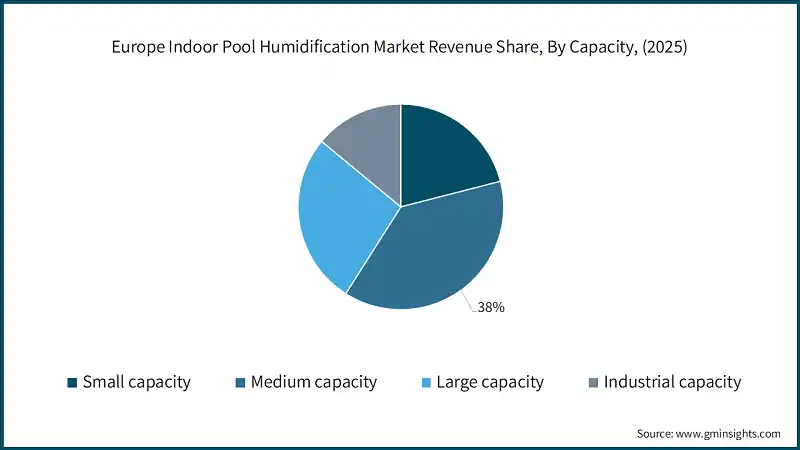
Based on capacity, the indoor pool dehumidification market is segmented into small capacity: 20-100 L/day, medium capacity: 100-500 L/day, large capacity: 500-2,000 L/day and industrial capacity: 2,000+ L/day. The medium capacity segment held the largest share, accounting for 38% of the market share in 2025.
- In Europe, where humidity levels in indoor swimming facilities are high due to the large volume of moisture generated by swimming pools, medium capacity dehumidifiers that can remove approximately 100 - 500 L/day are quite popular. This type of dehumidifier can effectively provide enough dehumidification requirements for mid-sized residential swimming pools as well as hotel wellness centers, fitness clubs and community recreation facilities where humidity generation is continuous during the day. The capacity of these machines enables them to maintain stable humidity levels in the facility thereby eliminating condensation and protecting the interior finishes without requiring large installations or large amounts of energy as required by large, engineered dehumidification systems.
- Medium-capacity dehumidifiers provide a flexible combination of airflow strength, moisture extraction, and energy efficiency. Typically, these products will be built to take on the high humidity conditions found in indoor pool facilities, allowing for continuous operation at the most demanding rates of evaporation. Depending on a particular facility's layout, some systems can be installed as wall, ceiling, or ducted, making them very adaptable to the many different types of buildings throughout Europe. Their ease of integration into ventilation systems and their ability to provide evenly distributed dry air to maintain a comfortable indoor environment make them an excellent choice for operators needing reliable moisture control, yet do not have the need for high-capacity commercial dehumidifying equipment.
- Medium capacity dehumidifiers are becoming more aligned with the expectations of governments and operators as energy efficiency, sustainability and indoor air quality are becoming more important in the building design process throughout Europe. medium capacity dehumidifiers are designed to offer such options as heat recovery, quiet operation and automatic control of humidity which help reduce the day-to-day operational cost while still providing comfort for users. The moderate capacity of medium capacity dehumidifiers helps facility operators achieve high levels of performance without sacrificing environmental responsibility and maximizing the long-term durability of facilities and to ensure that swimmers and staff have access to a pleasant environment.
Based on the distribution channel, the indoor pool dehumidification market is segmented into direct and indirect. In 2025, indirect distribution channel held a major market share generating a revenue of USD 109.5 million.
- Specialty HVAC distributors, dealers, and manufacturer's reps typically serve as an indirect distribution method for this market. The intermediaries facilitate the link between HVAC equipment manufacturers and end users. As intermediaries, they provide product & technical presales support, manage regional inventories, and help contractors and specifiers match the HVAC loads, system types & control methods to the unique environment of the natatorium. They assist with the understanding of local standards and regulatory/documentation requirements, along with coordinating logistics and training on commissioning and maintenance.
- Other indirect distribution channels are through HVAC Contractors and System Integrators who create turnkey solutions that integrate design, installation, balancing and ongoing service. These partners also influence specifications with the A/E community and bundle dehumidification systems with air handling units, heat recovery units, and controls to achieve the owner's comfort & envelope protection goals. The aftermarket service offerings of spare parts, preventive maintenance, and coil cleaning along with filter programs and control recalibration are often packaged under longer-term service agreements with the same intermediaries to provide consistent performance during the different cycles of pool usage throughout the year.
Looking for region specific data?
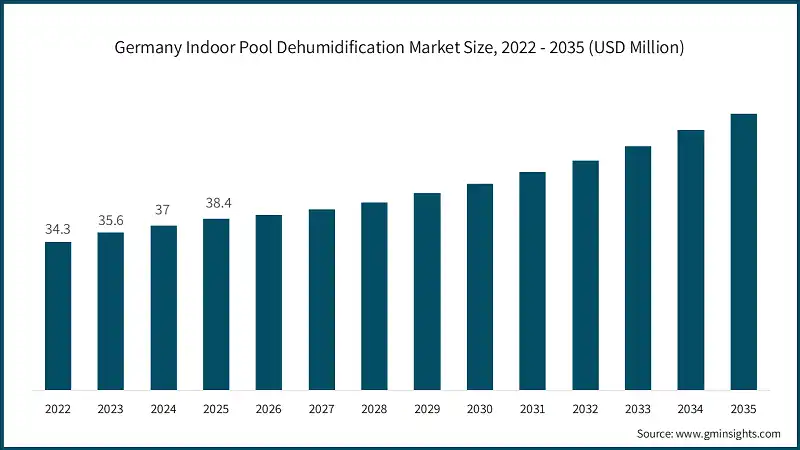
Germany dominated the Europe indoor pool dehumidification market with around 20% share and generating around USD 38.4 million revenue in 2025.
- In general, owners of German facilities and HVAC professionals focus their efforts on the development of solutions that provide reliable moisture removal, while also providing energy-efficient and accurately controlled designs. Many warm pool halls utilize mechanical refrigeration units, in conjunction with heat-recovery and intelligent control systems, to maintain both temperature and humidity levels with minimal energy waste. In addition, where space restrictions or operating demands require it, many of these establishments employ hybrid designs, a combination of dry-coil technology and airflow management specific to the facility to help eliminate cold zones and protect the structural integrity of the building's envelope. While lifecycle issues are, of course, an important factor in developing these solutions, the characteristics of the product, such as maintainability, corrosion resistance, and compatibility with building management systems have the greatest impact on purchasing decisions.
- In Germany, dehumidification of indoor swimming pools is viewed as an extension of several larger objectives related to building performance, occupant health, and protecting the long-term value of the facility. The emphasis on building envelope insulation, the development of engineered building performance standards, and the focus on creating spaces that promote the well-being of occupants all require the pool environment to effectively manage moisture to limit problems that can be caused by condensation, corrosion, and poor air quality within the pool. The engineers who design and operate natatorium dehumidification systems typically seek a solution that integrates with the facility's HVAC system, takes into consideration the acoustic comfort of the user, and protects the surfaces around the glazing, metal fixtures, and other moisture-sensitive surfaces from excessive humidity.
Europe Indoor Pool Dehumidification Market Share
Dantherm Group are leading with 14% market share. Dantherm Group, Condair Group, Munters Group, CIAT, TROTEC collectively hold around 35%, indicating moderately fragmented market concentration. These prominent players are proactively involved in strategic endeavors, such as mergers & acquisitions, facility expansions & collaborations, to expand their product portfolios, extend their reach to a broad customer base, and strengthen their market position.
Dantherm Group is an established leader in climate control in Europe, producing all types of climate control, heating, cooling, dehumidifying, air handling equipment, and indoor pools for commercial, industrial and public sector customers since 1954. The company values energy efficiency, sustainable development, and high-quality engineering across all of their product categories. Dantherm operates globally through a large network of sales and service locations with its European manufacturing base being a key strength of the company.
Condair Group is the largest manufacturer of humidification, dehumidification, and cooling technologies in the world. Condair Group provides scientifically engineered solutions that improve indoor air quality, as well as the health and productivity of occupants. Condair Group was started in Switzerland in 1948 and today operates production facilities in Europe, North America, and China. Condair Group has a global presence through its own sales organizations and a network of partners. Condair Group serves the health care industry, data centers, manufactured products, hospitality operations, and commercial building systems.
Europe Indoor Pool Dehumidification Market Companies
Major players operating in the Europe indoor pool dehumidification industry are:
- Aktobis
- CDH Industries
- CIAT
- Condair Group
- Cotes
- Cuoghi
- Dantherm Group
- Fral Srl
- Hidros
- Microwell
- Munters Group
- Seibu Giken DST
- TROTEC
- WOLF
- Zodiac Pool Care
Microwell is a European producer of high-tech swimming pool dehumidifiers and heat pumps with an emphasis on energy-efficient, long-lasting, and precise climate-control systems. Microwell manufactures both standard and specialized systems like the DRY series of condensation dehumidifiers, as well as renewable energy-based heat pumps that are capable of supporting specialized engineering, innovation, and large selections of accessories for individual residential, commercial, or industrial pool environments.
CIAT is headquartered in Culoz, France, and has become one of Europe’s leading HVAC producers, specializing in air conditioning, heating, air-handling units, and energy-efficient climate-control systems. In addition to serving the commercial, industrial, and residential markets, CIAT’s core competence is developing sustainable solutions for improving indoor air quality, indoor comfort, and improving the overall energy-optimization of indoor air, with the support of various European manufacturing locations and participation in the global Carrier Group.
Europe Indoor Pool Dehumidification Market Report Attributes
| Key Takeaway | Details |
|---|---|
| Market Size & Growth | |
| Base Year | 2025 |
| Market Size in 2025 | USD 191.7 Million |
| Market Size in 2026 | USD 200.3 Million |
| Forecast Period 2026-2035 CAGR | 4.3% |
| Market Size in 2035 | USD 292.9 Million |
| Key Market Trends | |
| Drivers | Impact |
| Expansion of indoor pool infrastructure | An increase in demand for dependable humidity management systems will help ensure solely the comfort of users and better protect buildings. |
| Rising awareness of indoor air quality (IAQ) | Promotes the use of high-tech dehumidification that produces healthier indoor air quality. |
| Shift toward energy efficient and sustainable HVAC systems | Stimulates the use of energy-efficient, environmentally friendly, low energy dehumidification. |
| Pitfalls & Challenges | Impact |
| High initial and operational costs | Slowing the development of dehumidification, especially for small facilities with limited budgets. |
| Maintenance complexity in high humidity environments | Requires ongoing maintenance, making long-term ownership more labor-intensive and costly. |
| Opportunities: | Impact |
| Rising popularity of wellness, fitness, and luxury housing | Expanding the reach of high-performance dehumidification systems designed for indoor pools. |
| Smart & IoT‑enabled dehumidification solutions | Smart & IoT‑enabled dehumidification solutions |
| Market Leaders (2025) | |
| Market Leaders |
14% market share |
| Top Players |
|
| Competitive Edge |
|
| Regional Insights | |
| Emerging countries | UK, France, Italy |
| Future outlook |
|
What are the growth opportunities in this market?
Europe Indoor Pool Dehumidification Market News
- In 2025, Cuoghi introduced the “NEW WMDs” dehumidifier. It has a depth of 217 mm, removes up to 25 L/day of moisture, and contains natural refrigerant R290. The unit offers high performance in a compact size whilst maintaining the level of durability and quality that has been synonymous with the WMD series.
- In 2025, Cuoghi launched The WMD 50 dehumidifier on their new product platform. This wall mounted unit is intended for use in environments where high volumes of moisture need to be removed quickly. Features of the WMD50 include- Hot gas defrost operation to facilitate operation at a minimum of +2 °C ; an updated electronic control system; and the use of environmentally friendly refrigerants. These features are intended to ensure longevity, reliability, efficiency and durability when used in applications with high humidity levels.
- In 2024, Microwell upgraded its DRY-series swimming pool dehumidifiers with the following new features: SoundSteel noise reduction, a new generation of controllers (multi-functional), the ability to integrate into photovoltaic systems, new aluminum covers, and DRY-Orient Wi-Fi/Modbus connectivity. These enhancements were developed specifically to improve acoustic performance, energy efficiency, longevity, and smart-system operability in challenging pool humidity conditions.
The Europe indoor pool dehumidification market research report includes in-depth coverage of the industry with estimates & forecasts in terms of revenue (USD Million) and volume (Thousand Units) from 2022 to 2035, for the following segments:
Market, By Type
- Mechanical refrigeration
- Ventilation-based
- Desiccant
- Hybrid
- Heat pump
Market, By Capacity
- Small Capacity: 20-100 L/day
- Medium Capacity: 100-500 L/day
- Large Capacity: 500-2,000 L/day
- Industrial Capacity: 2,000+ L/day
Market, By Installation Configuration
- Ceiling-mounted units
- Wall-mounted systems
- Freestanding/tower units
- Integrated HVAC systems
Market, By Application
- Commercial swimming pools
- Residential pools
- Therapeutic and rehabilitation pools
- Competition and training facilities
Market, By Distribution Channel
- Direct
- Indirect
The above information is provided for the following regions and countries:
- Europe
- Germany
- UK
- France
- Italy
- Spain
Frequently Asked Question(FAQ) :
What is the market size of the Europe indoor pool dehumidification in 2025?
The market size was USD 191.7 million in 2025, with a CAGR of 4.3% expected through 2035 driven by rising adoption of climate-controlled indoor pools across residential, hospitality, and commercial facilities, along with growing awareness of indoor air quality.
What is the projected value of the Europe indoor pool dehumidification market by 2035?
The Europe indoor pool dehumidification market is expected to reach USD 292.9 million by 2035, propelled by expansion of indoor pool infrastructure, energy-efficient HVAC system adoption, and smart IoT-enabled dehumidification solutions.
What is the forecasted market size for Europe indoor pool dehumidification in 2026?
The market size is projected to reach USD 200.3 million in 2026.
How much revenue did the mechanical refrigeration segment generate in 2025?
Mechanical refrigeration generated USD 137.5 million in 2025, dominating the market due to its efficiency in removing moisture through coil-based cooling methods and heat-recovery capabilities.
What was the market share of the medium capacity segment in 2025?
The medium capacity segment (100-500 L/day) held 38% market share in 2025, driven by its suitability for mid-sized residential pools, hotel wellness centers, fitness clubs, and community recreation facilities.
What is the revenue outlook for the indirect distribution channel in 2025?
The indirect distribution channel generated USD 109.5 million in 2025, facilitated through specialty HVAC distributors, dealers, contractors, and system integrators who provide technical support and turnkey solutions.
Which country leads the Europe indoor pool dehumidification market?
Germany held approximately 20% share with USD 38.4 million revenue in 2025, led by focus on energy-efficient solutions, reliable moisture removal, and integration with building management systems.
What are the key trends in the Europe indoor pool dehumidification market?
Key trends include integration of smart controls and automation for real-time monitoring, emphasis on energy-efficient designs with heat recovery capabilities, IoT-enabled remote access systems, and growing demand from wellness facilities, luxury homes, and boutique hotels.
Who are the key players in the Europe indoor pool dehumidification market?
Key players include Dantherm Group, Condair Group, Munters Group, CIAT, TROTEC, Aktobis, CDH Industries, Cotes, Cuoghi, Fral Srl, Hidros, Microwell, Seibu Giken DST, WOLF, and Zodiac Pool Care.
Europe Indoor Pool Dehumidification Market Scope
Related Reports