Summary
Table of Content

Europe Fan Coil Unit Market
Get a free sample of this report
Form submitted successfully!
Error submitting form. Please try again.
Thank you!
Your inquiry has been received. Our team will reach out to you with the required details via email. To ensure that you don't miss their response, kindly remember to check your spam folder as well!
Request Sectional Data
Thank you!
Your inquiry has been received. Our team will reach out to you with the required details via email. To ensure that you don't miss their response, kindly remember to check your spam folder as well!
Form submitted successfully!
Error submitting form. Please try again.
Europe Fan Coil Unit Market Size
The Europe fan coil unit market was estimated at USD 1.02 billion in 2024. The market is expected to grow from USD 1.06 billion in 2025 to USD 1.66 billion in 2034, at a CAGR of 5.1%, according to latest report published by Global Market Insights Inc.
Europe Fan Coil Unit Market Key Takeaways
Market Size & Growth
- 2024 Market Size: USD 1.02 Billion
- 2025 Market Size: USD 1.06 Billion
- 2034 Forecast Market Size: USD 1.66 Billion
- CAGR (2025–2034): 5.1%
Regional Dominance
- Largest Market: Germany
- Fastest Growing Region: Netherlands
Key Market Drivers
- Stringent Energy Efficiency Regulations.
- Rising Focus on Indoor Air Quality (IAQ).
- Growth in Commercial Construction and Retrofit Projects.
Challenges
- High Initial Capital Costs.
- Complexity in System Design and Integration.
Opportunity
- Integration of Smart and IoT-Enabled FCUs.
- Expansion into Green Building Certifications and Retrofit Programs.
Key Players
- Market Leader: Carrier Corporation led with over 5.5% market share in 2024.
- Leading Players: Top 5 players in this market include Carrier Corporation, Daikin Industries, Ltd., Lennox International, Johnson Controls, Mitsubishi Electric Corporation, which collectively held a market share of 20% in 2024.
Get Market Insights & Growth Opportunities
The EU set a target of achieving climate neutrality by 2050 and has created legislative pressure related to energy efficiency through binding legislation under Directive 2023/1791, for example, that requires HVAC systems (including FCUs) to be energy efficient. All HVAC systems must be operated at an energy use level that is optimally designed and integrate renewables. The Energy Efficiency Directive requires energy consumption be reduced by at least 11.7% by 2030. Therefore, EU's push for FCUs will create many opportunities for building owners to utilize FCUs that conform to Ecodesign legislation, as they need to be more efficient and will encourage new innovation and the removal of less efficient technologies from the marketplace. In addition, since buildings represent approximately 40% of EU's total energy consumption, and 36% of total greenhouse gas emissions, they are a specific area of focus for many decarbonisation activities. FCUs, in particular, are modular and adaptable systems that meet the need for providing temperature control in a localized manner and providing compatibility to low-temperature heating systems; therefore, they address the requirements for creating nearly net-zero energy buildings. Additionally, although much of the emphasis related to energy efficiency is on compliance with new regulations, the current environment offers many advantages for manufacturers producing FCUs with higher efficiency ratings, such as having more competitive bidding opportunities in public sector procurement activities, as well as from increased use of energy-efficient technology in general.
By 2030, the European Union (EU) Renovation Wave Strategy has targeted renovations of 35 million buildings with the goal to double the current level of energy-efficient renovations achieved by Europe every year. The majority of existing buildings within the EU (85%) were built before the year 2000, and a considerable proportion (75%) are considered to have low energy performance; this means that retrofitting the HVAC systems in these homes/locations will provide the opportunity to improve living conditions for millions of people. Specifically, FCUs offer a viable solution for renovation projects due to their versatility. They can be mounted on ceilings, placed on the floor, or integrated into walls with little to no required structural changes. This initiative is being financed through a multitude of resources provided by different EU programs such as NextGenerationEU, which is intended to promote green renovations of existing buildings. The financial benefits of increased energy efficiency, as a result of increased energy performance in residential and commercial HVAC systems, also have a positive effect on the ability of approximately 40 million individuals in Europe to afford their energy expenses. So, as a result of the Renovation Wave Strategy, many individuals' interest in renovating their homes will translate into increased demand for all types of energy-efficient HVAC systems.
According to World Health Organization (WHO) research, poor indoor air quality (IAQ) is one of the leading risk factors for mortality and morbidity and has been identified as a major health risk factor for respiratory and cardiovascular diseases. Research has shown that indoor concentrations of pollutants may greatly exceed those found outdoors, thus creating a need for new regulatory structures combining source control against indoor pollution and ventilation criteria. In many parts of Europe, this has led to the establishment of more stringent guidelines for both ventilation and air filtration in buildings, particularly in light of the COVID-19 pandemic, where the health and comfort of building occupants have become an integral part of the building design process. One such product that has been specifically designed to help mitigate IAQ issues is a fan coil unit (FCU) that is equipped with advanced filtration systems and variable control of airflow. Considering that approximately 80% of the energy consumed in residential buildings in the EU is used for heating and cooling, the use of FCUs that can deliver both thermal comfort and clean air is essential. This emphasis is further supported by increased consumer and regulatory pressures for homeowners to provide a healthy indoor environment, giving rise to IAQ compliance as a key differentiating feature of FCU products.

To get key market trends
Europe Fan Coil Unit Market Trends
The integration of smart and connected technologies into HVAC systems is a major trend driving the European Fan Coil Unit (FCU) market. The growth of IoT-enabled building automation systems and the EU’s drive toward digitalizing energy management is fueling this trend. Today's modern FCUs are being developed with features such as smart thermostats, occupancy sensors, and remote monitoring capabilities, which allow users to optimize their energy consumption and indoor air quality in real-time. The Energy Performance of Buildings Directive has promoted the use of building automation systems as a means of reducing energy loss. Many commercial and residential property owners are looking to meet the stringent energy efficiency requirements while improving occupant comfort. As a result, there will be a significant increase in the adoption of smart FCUs with predictive maintenance capabilities and the ability to connect to renewable energy sources, giving manufacturers that already provide these advanced digital products a competitive advantage.
- The dominant trend in fan coil units is the combination of IoT-enabled controls and building automation systems. European regulations have created conditions for fan coil units to move towards being more efficient and better integrated with low temperature heating systems and heat pump technology, ultimately allowing for compliance with Ecodesign regulations and achieving near zero energy standards.
- Another important trend is the post pandemic realization of needing more advanced filtration, UV disinfection and variable air flow control features in order to create healthy indoor environments. This has led to increased demand for advanced filtration, UV disinfection, and variable air flow control fan coil units in many sectors including commercial, health care and educational. In order to help establish this, many manufacturers are creating new ways to design and produce fan coil units with advanced technology using sophisticated ventilation and indoor air quality (IAQ) requirements.
- By processing data on devices that are located near the source, Edge AI differs from traditional AI technologies, which primarily use large data centers to conduct this work through cloud-based networks. The local processing of data helped reduce latency and increased privacy while enabling a significant reduction in the amount of energy consumed; this aligns with Europe's high level of commitment to sustainability. Edge AI allows for real-time responses to situations that require rapid action, such as healthcare, manufacturing and smart cities. An example of Edge AI being able to assist with efficiency measures in industrial automation is its ability to conduct predictive maintenance, optimize energy consumption and reduce operating expenses without needing a constant connection to a cloud network, thereby reducing both the operational expenses and carbon footprint associated with this business model. Edge AI capabilities also greatly enhance the integration of renewable energy sources and electric vehicles; thus, contributing to Europe’s climate goals through improved grid efficiency and battery-management practices. The European Innovation Council identifies Edge AI as a key enabling technology in democratizing advanced technologies, making them less expensive and allowing the broader application of the technology across various industries. With an emphasis on data sovereignty and green innovation in regulatory initiatives in Europe, Edge AI is presented as a transformative technology that is driving both technological development and environmental stewardship within Europe.
Europe Fan Coil Unit Market Analysis

Learn more about the key segments shaping this market
Based on the product type, the market is segmented into horizontal fan coil units, vertical fan coil units, console fan coil units, cassette fan coil units, and EC motor fan coil units. The horizontal fan coil units segment leads the market and was valued at USD 319.1 million in 2024 and is projected to reach USD 471.5 million by 2034.
- Horizontal FCUs are increasingly preferred due to the level of flexibility they offer in terms of installations in both commercial and residential applications, as well as their ability to create maximized usable floor spaces by utilizing ceiling-mounted units. Concealment of horizontal FCUs in false ceilings will allow for a more unified overall building aesthetic and also ensure the effective distribution of air. These features help to match the current trends within modern architectural design, where the ideals are minimal visual obstruction and open layouts, making horizontal FCUs the unit of choice for office buildings, hotels and luxurious residential construction.
- Horizontal FCUs often provide greater access for servicing than other configurations due to the method of installation (i.e., putting them into easily accessible ceiling spaces, compared to vertical shafts or floor mounts that require accessibility). Thus, the reduced servicing time and labor associated with servicing horizontal FCUs provides a distinct advantage for large commercial buildings or facilities that contain multiple units. The standardized designs and universal product availability of most horizontal FCUs further assist in lowering the cost of procurement and installation, also ensuring that they remain the product of choice for any project that is extremely cost-sensitive and will still perform at a high level.
Learn more about the key segments shaping this market
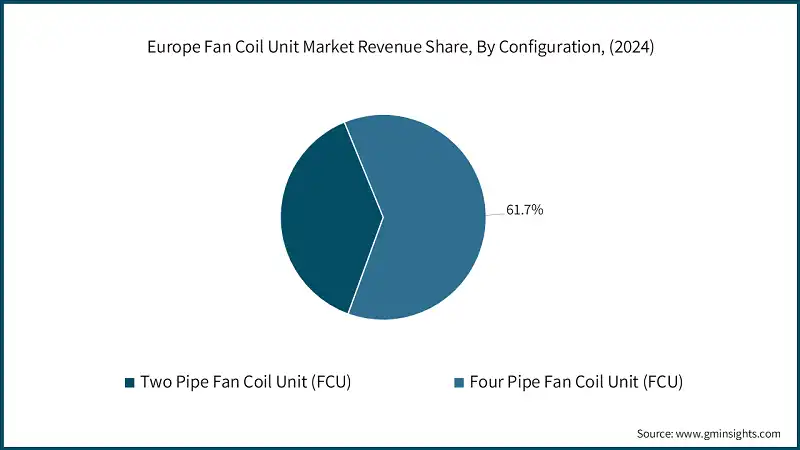
The fan coil unit market by configuration is segmented into two pipe fan coil unit (FCU) and four pipe fan coil unit (FCU). The four pipe fan coil unit (FCU) segment held around 61.7% market share with a revenue of USD 626.7 million in 2024.
- The Four-Pipe Fan Coil Unit (FCU) has become the preferred choice for cooling large buildings due to its ability to provide simultaneous heating and cooling capabilities. Many commercial building types require simultaneous heating and cooling, such as hotels and large-scale offices. This means that while one side of the building needs heat, the opposite side may need cooling. Four-pipe Fan Coil Units are capable of providing both heating and cooling simultaneously, thus allowing for continuous operation and eliminating the delays that occur when switching from one type of system to another.
- Additionally, the ability to independently control the heating and cooling circuits of each FCU reduces the amount of wasted energy and maximizes the comfort level of occupants during extreme temperature differences and changing occupancy patterns, thus resulting in reduced energy costs and increased comfort level of occupants. Therefore, four-pipe Fan Coil Units represent a solution to the issue of reconciling the needs of Sustainable Design, Regulatory Compliance, and Occupant Comfort; hence, they are the preferred solution for many high-performance projects.
- Four-pipe fan coil units are commonly used in hospitals, luxury hotels, and large corporate offices, where occupant comfort and reliable operation are absolute requirements. Even though four-pipe systems tend to have a higher initial cost than two-pipe systems, the reduced operational disruptions and enhanced flexibility provided by four-pipe systems more than offset the difference in upfront costs, making them the number one choice within markets that are focused on performance rather than on first cost.
Looking for region specific data?
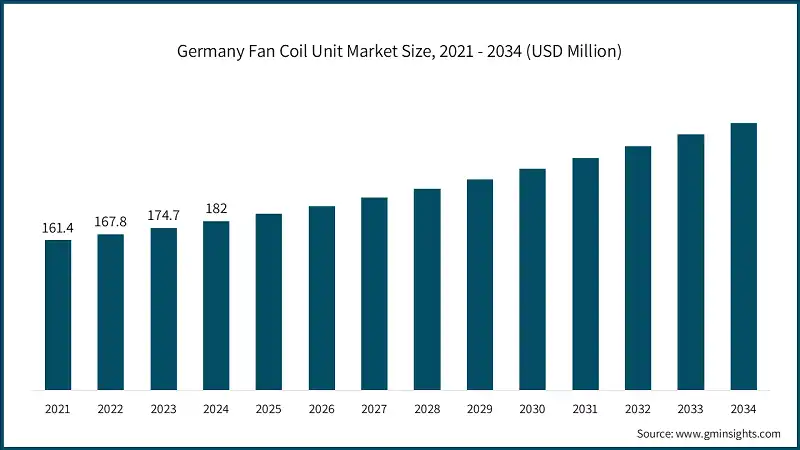
The Germany fan coil unit market was valued at around USD 182 million in 2024 and is anticipated to register a CAGR of 4.7% between 2025 and 2034.
- Germany's leadership in the European HVAC industry is based on the country's commitment to the country developing an "Energiewende" or "Energy Transition," which is aimed at having 80% of its electricity come from renewable sources by 2030, and being carbon neutral by 2045. The way Germany is going to reach these goals is by imposing strict energy efficiency regulations and giving monetary rewards to individuals and companies for utilizing lower carbon heating and cooling systems such as heat pumps. FCUs were developed to function in harmony with renewable energy sources and low-temperature heating systems, thereby successfully supporting the achievement of Germany's Energy Transition goals. Germany's promotion of heating electrification through the use of heat pumps has created many positive impacts within the HVAC industry and has promoted the use of advanced technologies such as energy-efficient FCUs as integrated components of overall building design and construction techniques.
- In Europe, Germany has the most extensive and oldest building stock, with over 19 million dwellings and two million commercial buildings. Modernizing this aging building stock represents a massive opportunity under both the EU Renovation Wave and Germany's Long-term Renovation Strategy. While Germany's renovation rates are currently lagging significantly behind targets (i.e., renovation rate of 0.7% vs the targeted 1.7-1.9% per annum), the German government is investing massively in efforts to close this gap through national recovery plans and European funding, committing billions.
- As fans can be installed without extensive structural changes required to facilitate their installation, they are ideally suited for retrofitting because of their flexibility in design and installation. Upgrading thermal and energy performance in older properties would be best achieved with fan-coil units.
- Germany's strength in HVAC technology innovation, supported by a strong industrial base and continued R&D expenditure gives it a competitive advantage. Germany has some of the world’s leading manufacturers and certification agencies; examples include the Bundesverband Wärmepumpe (BWP), who are actively promoting efficiency in both heating and cooling solutions. German manufacturers are at the forefront of responding to the increased demand for compliant indoor air quality and digital building automation by integrating smart controls, IoT connectivity, and advanced filtration capabilities into fans.
Europe Fan Coil Unit Market Share
- The top 5 companies in the Europe fan coil unit industry, such as Carrier Corporation, Daikin Industries, Ltd., Lennox International, Johnson Controls, and Mitsubishi Electric Corporation, hold a market share of 20%.
- The incorporation of IoT-supported Smart FCUs enhances Carrier's position within its market by addressing the growing need for Energy-Efficient HVAC Systems that can be controlled remotely. Smart FCUs are part of a building management system and allow end-users to view real-time energy consumption and control their energy usage more effectively. BMS-enabled FCU systems in Commercial Buildings can reduce overall energy consumption by up to 20%. Additionally, Carrier has established a significant indirect channel to reach many different markets through its extensive network of distributors and service partners. Indoor Air Quality (IAQ) and Sustainability are key focus areas for Carrier and provide commercial customers with the tools necessary to comply with current Energy Efficiency Standards.
- The cornerstone of Daikin’s strategy is its FUSION 25 management plan that places emphasis on carbon neutrality, customer-connectivity solutions, and creating value via air. Daikin's aggressive growth strategy has been realized through strengthening production and distribution capabilities in emerging markets of growth in regions such as India and Europe. Additionally, Daikin expects to continue expanding resources in R&D (research and development), digital transformation, and supply chain resilience over $5 billion. Product innovation for Daikin includes FCUs (fan coil units) utilizing eco-friendly refrigerants and innovative filtration systems, which address regulatory requirements and customer desires for more sustainable indoor environments.
- By incorporating FCUs into the entire smart building ecosystem and benefiting from their extensive knowledge and experience in building automation and control, Johnson Controls improves its offerings and allows users to utilize every feature of those systems through its proprietary platforms such as Metasys, ensuring complete integration of all components. Moreover, the modularity and scalability of all products offered by Johnson Controls were engineered with commercial and institutionally acceptable environments in mind. By designing all of Johnson Controls products around energy optimization, customization and aftermarket service offerings, Johnson Controls guarantees both the continued retention of customers and the operational efficiency of those customers.
Europe Fan Coil Unit Market Companies
Major players operating in the Europe fan coil unit industry are:
- Aermec
- Carrier Global Corporation
- Climate Control Group (CCG)
- Daikin Industries
- Dunham-Bush
- Fujitsu General Limited
- Gree Electric Appliances
- Johnson Controls International
- Lennox International
- LG Electronics
- Mitsubishi Electric Corporation
- Swegon Group
- Systemair AB
- Trane Technologies
- TROX GmbH
Lennox has adopted a multi-pronged growth strategy focused on product innovation, strategic partnerships, and service expansion. A key move was its joint venture with Samsung HVAC, which led to the launch of advanced ductless mini-split and VRF systems featuring smart connectivity and low-GWP refrigerants. This collaboration allows Lennox to tap into the growing demand for energy-efficient and IoT-enabled HVAC solutions, positioning it strongly in both residential and commercial segments.
Mitsubishi Electric leverages a dual strategy of product innovation and strategic partnerships to maintain its leadership. The company has introduced low-GWP refrigerant-based heat pump systems under its Mitsubishi Electric Trane HVAC US joint venture, meeting new AIM Act requirements while enhancing energy efficiency and cold-climate performance. Furthermore, Mitsubishi Electric continues to pioneer Hybrid VRF systems, which reduce refrigerant use by up to 43% and improve safety and compliance with ASHRAE standards, making them ideal for institutional and commercial applications. On the distribution side, its collaboration with Trane ensures extensive dealer networks and integrated building automation solutions, enabling seamless adoption of advanced HVAC technologies across Europe.
Europe Fan Coil Unit Market Report Attributes
| Key Takeaway | Details |
|---|---|
| Market Size & Growth | |
| Base Year | 2024 |
| Market Size in 2024 | USD 1.02 Billion |
| Market Size in 2025 | USD 1.06 Billion |
| Forecast Period 2025 - 2034 CAGR | 5.1% |
| Market Size in 2034 | USD 1.66 Billion |
| Key Market Trends | |
| Drivers | Impact |
| Stringent Energy Efficiency Regulations | HVAC manufacturers are accelerating innovation in fan coil units to meet international energy standards, driving widespread adoption of high-efficiency systems. |
| Rising Focus on Indoor Air Quality (IAQ) | Heightened health awareness worldwide is boosting demand for FCUs with advanced filtration and humidity control, making IAQ a key differentiator in building design. |
| Growth in Commercial Construction and Retrofit Projects | Expanding commercial infrastructure and retrofit initiatives across emerging and developed economies are fueling large-scale FCU installations, strengthening global market penetration. |
| Pitfalls & Challenges | Impact |
| High Initial Capital Costs | Elevated upfront investment discourages small-scale projects and slows adoption in cost-sensitive regions, limiting overall market expansion. |
| Complexity in System Design and Integration | Technical challenges in integrating advanced FCUs into existing building layouts increase project timelines and costs, reducing market penetration in retrofit segments. |
| Opportunities: | Impact |
| Integration of Smart and IoT-Enabled FCUs | The growing trend toward smart buildings and IoT-based HVAC systems presents a significant opportunity for FCU manufacturers to develop units with intelligent controls, remote monitoring, and predictive maintenance capabilities. |
| Expansion into Green Building Certifications and Retrofit Programs | Increasing adoption of green building standards such as LEED and ENERGY STAR, coupled with government-backed retrofit programs, creates a strong demand for FCUs that meet stringent sustainability criteria. |
| Market Leaders (2024) | |
| Market Leaders |
Market share of ~5.5% |
| Top Players |
Collective market share in 2024 is ~20% |
| Competitive Edge |
|
| Regional Insights | |
| Largest Market | Germany |
| Fastest growing market | Netherlands |
| Emerging countries | Belgium, Spain, Austria |
| Future outlook |
|
What are the growth opportunities in this market?
Europe Fan Coil Unit Industry News
- In March 2025, Trane introduced its Fan Coil Wall platform with cooling capacity up to 400 kW specifically designed for data center thermal management. This innovation helps the company capture the rapidly growing mission-critical cooling market driven by AI and high-density computing demands.
- In November 2024, AAON purchased a 787,000 square-foot manufacturing facility in Memphis to expand production of thermal management equipment including computer room air handlers for data centers. This expansion helps the company meet surging data center cooling demand and diversify its manufacturing footprint to mitigate operational risks.
- In October 2024, Daikin launched new fan coil unit and air handling unit products for the European market. This expansion helps the company strengthen its HVAC product portfolio and compete more effectively in commercial building applications.
- In July 2024, Johnson Controls announced a definitive agreement to sell its Residential and Light Commercial HVAC business to Bosch Group for USD 8.1 billion in an all-cash transaction. This divestiture helps Johnson Controls streamline its portfolio, focus on commercial building solutions, and return capital to shareholders while strengthening its balance sheet.
The Europe fan coil unit market research report includes in-depth coverage of the industry, with estimates & forecasts in terms of revenue (USD Million) and volume (Thousand Units) from 2021 to 2034, for the following segments:
Market, By Product Type
- Horizontal fan coil units
- Vertical fan coil units
- Console fan coil units
- Cassette fan coil units
- EC motor fan coil units
Market, By Configuration
- Two pipe fan coil unit (FCU)
- Four pipe fan coil unit (FCU)
Market, By Air Flow
- Below 500 m³/h
- 500 m³/h - 1000 m³/h
- 1000 m³/h - 1500 m³/h
- 1500 m³/h - 2000 m³/h
- Above 2000 m³/h
Market, By End Use
- Residential
- Commercial
- Office spaces
- Hotels
- Restaurants
- Hospitals
- Retail
- Supermarkets
- Departmental stores
- Brand outlet stores
- Logistics (warehouse)
- Others (manufacturing, etc.)
- Industrial
Market, By Distribution Channel
- Direct sales
- Indirect sales
The above information is provided for the following countries:
- UK
- Germany
- France
- Italy
- Spain
- Netherlands
- Belgium
- Switzerland
- Austria
Frequently Asked Question(FAQ) :
What is the market size of the Europe fan coil unit in 2024?
The market size was USD 1.02 billion in 2024, with a CAGR of 5.1% expected through 2034 driven by rapid innovation in high-efficiency systems as HVAC manufacturers adapt to international energy standards.
What is the projected value of the Europe fan coil unit market by 2034?
The Europe fan coil unit market is expected to reach USD 1.66 billion by 2034, propelled by EU Green Deal compliance, Renovation Wave initiatives, and heightened indoor air quality awareness.
What is the current Europe fan coil unit market size in 2025?
The market size is projected to reach USD 1.06 billion in 2025.
How much revenue did the horizontal fan coil units segment generate in 2024?
Horizontal fan coil units generated USD 319.1 million in 2024 and are projected to reach USD 471.5 million by 2034, leading the product type segment.
What was the valuation of the four pipe fan coil unit (FCU) configuration segment in 2024? The four
pipe FCU segment held 61.7% market share and generated USD 626.7 million in 2024, supported by simultaneous heating and cooling capabilities.
What is the growth outlook for Germany fan coil unit market from 2025 to 2034?
Germany fan coil unit market is projected to grow at a 4.7% CAGR till 2034, supported by Energiewende energy transition goals, extensive building renovation opportunities, and leadership in HVAC technology innovation.
What are the upcoming trends in the Europe fan coil unit market?
Key trends include integration of IoT-enabled controls and building automation systems, advanced filtration and UV disinfection for improved indoor air quality, Edge AI for real-time energy optimization, and compatibility with low-temperature heating systems.
Who are the key players in the Europe fan coil unit market?
Key players include Aermec, Carrier Global Corporation, Climate Control Group (CCG), Daikin Industries, Dunham-Bush, Fujitsu General Limited, Gree Electric Appliances, Johnson Controls International, Lennox International, LG Electronics, Mitsubishi Electric Corporation, Swegon Group, Systemair AB, Trane Technologies, and TROX GmbH.
Europe Fan Coil Unit Market Scope
Related Reports