Summary
Table of Content

Europe Eye Cream Market
Get a free sample of this report
Form submitted successfully!
Error submitting form. Please try again.
Thank you!
Your inquiry has been received. Our team will reach out to you with the required details via email. To ensure that you don't miss their response, kindly remember to check your spam folder as well!
Request Sectional Data
Thank you!
Your inquiry has been received. Our team will reach out to you with the required details via email. To ensure that you don't miss their response, kindly remember to check your spam folder as well!
Form submitted successfully!
Error submitting form. Please try again.
Europe Eye Cream Market Size
The Europe eye cream market was estimated at USD 0.9 billion in 2025. The market is expected to grow from USD 1.0 billion in 2026 to USD 1.8 billion in 2035, at a CAGR of 7.1% according to latest report published by Global Market Insights Inc.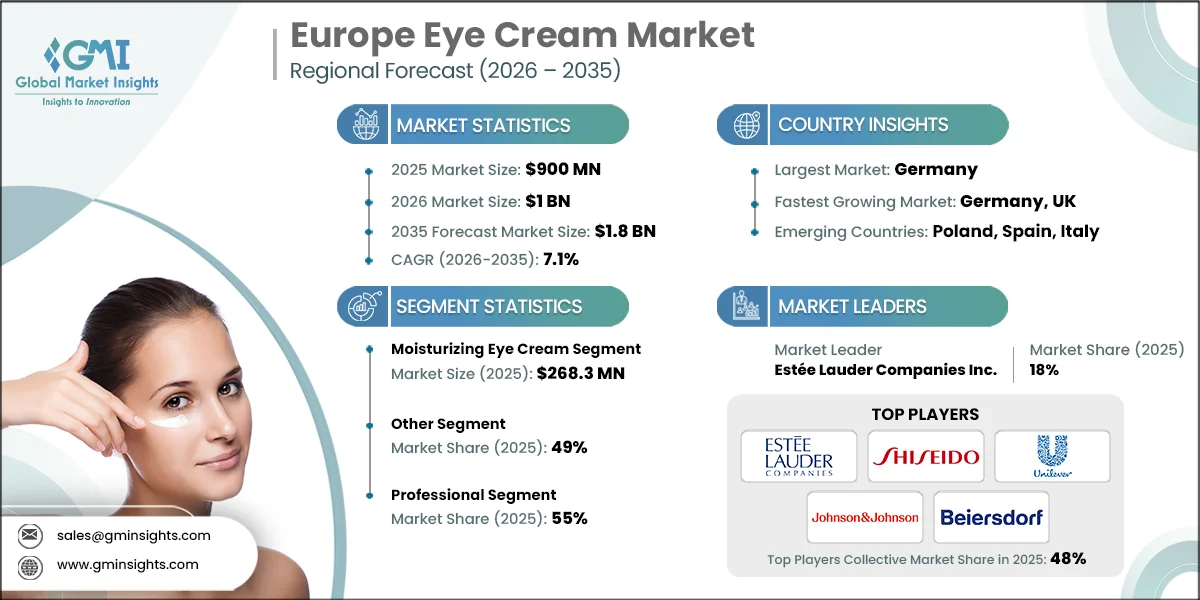
To get key market trends
The Europe eye cream market has emerged as a well-developed and steadily growing market in the regional skincare market, backed by a high level of consumer awareness about specialized eye care and a strong focus on preserving young and healthy-looking skin. Consumers in Europe are increasingly worried about the appearance of aging signs like fine lines, wrinkles, dark circles, and puffiness, caused by lifestyle stress, environmental factors, and an aging population. Eye creams have become increasingly popular due to their specialized formulation specifically targeting the sensitive area around the eyes, providing benefits such as hydration, anti-aging, brightening, and protection against environmental factors. The market is steadily growing with consistent momentum, driven by the increasing trend of adopting preventive skincare regimens and demands for scientifically proven and highly effective products.
Cost-effectiveness and value-for-money considerations continue to play a significant role in shaping consumer buying behavior in the Europe market. Even though eye creams are generally considered a premium or specialized skincare product, consumers in Europe are increasingly viewing them as an integral part of their long-term skincare regimen, rather than a luxury item.
Sustainability is one of the most prominent trends in the Europe eye cream market, as consumers in the region show a high level of awareness and concern for environmental sustainability and ethical consumption. There is a growing demand for clean label products, cruelty-free and vegan products, and sustainably sourced ingredients such as plant extracts and bio-fermented actives. Furthermore, the European market has driven manufacturers to opt for eco-friendly packaging solutions such as recyclable materials, refill packaging, and the reduction of plastic use, reflecting the region’s focus on sustainability and the circular economy.
Advances in cosmetic science and formulation technology have greatly impacted the innovation of the Europe eye cream market. The incorporation of encapsulated actives, peptide-based products, advanced hyaluronic acid complexes, and controlled release delivery systems has improved product performance and skin absorption. Additionally, multi-functional eye creams that provide hydration, anti-aging, brightening, and UV protection in one product are also gaining popularity, especially among consumers who are looking for simplified and effective skincare regimens. Lightweight, fast-absorbing, and non-irritating products are especially favored in the European market.
As per the prevailing market trends, the premium segment of the Europe market is steadily expanding, thanks to the relatively high disposable income and affinity for high-quality skincare products. The average selling price of eye creams has escalated as manufacturers have started using advanced ingredients such as retinol alternatives, ceramides, antioxidants, stem cell extracts, and probiotic-based actives. The premiumization trend is most evident in Western Europe, where high-end skincare brands, dermo cosmetic brands, and skincare brands based on pharmacies are intensely competing to enhance their market shares.
Sustainability-driven initiatives are also proving to be a significant growth driver for the Europe eye cream market. Manufacturers are increasingly adopting sustainable production practices, conserving water, minimizing carbon emissions, and increasing supply chain transparency. Many of the prominent European skincare brands have pledged to ban harmful chemicals, improve ingredient traceability, and shift to renewable energy sources in their manufacturing facilities. These efforts have gained immense momentum from environmentally conscious consumers and government agencies across Europe.
The composition of ingredients is a very important factor in determining market dynamics in the Europe market. The most common active ingredients are caffeine, peptides, retinol, niacinamide, vitamin C, hyaluronic acid, and botanical extracts, which have been found to be very effective in the reduction of puffiness, wrinkles, and pigmentation. At the same time, there is an increasing demand for natural, organic, dermatologist-tested, and hypoallergenic eye creams, especially among people with sensitive skin. The rising demand for fragrance-free and ophthalmologist-approved eye creams further increases consumer confidence and brand loyalty.
The distribution channels in Europe have changed dramatically, adding to the development of the eye cream market. The rise of e-commerce platforms, brand websites, and direct-to-consumer e-commerce has increased the availability of products in the region. Online shopping allows consumers to compare ingredients, read product reviews, and make informed purchasing decisions, especially among the younger generation. Along with digital platforms, pharmacies, specialty beauty stores, and department stores remain an important part of product distribution. This well-established omnichannel retail structure is expected to fuel the growth of the Europe market.
Europe Eye Cream Market Report Attributes
| Key Takeaway | Details |
|---|---|
| Market Size & Growth | |
| Base Year | 2025 |
| Market Size in 2025 | USD 0.9 Billion |
| Market Size in 2026 | USD 1 Billion |
| Forecast Period 2026-2035 CAGR | 7.1% |
| Market Size in 2035 | USD 1.8 Billion |
| Key Market Trends | |
| Drivers | Impact |
| Rising awareness of targeted skincare | Growing consumer focus on under‑eye concerns such as dark circles, puffiness, fine lines, and wrinkles is driving sustained demand for specialized eye creams across Europe, particularly among aging populations and urban consumers. |
| Growth of anti‑aging and preventive skincare | Early adoption of eye creams as part of daily skincare routines is boosting demand, especially among millennials and Gen Z, who prioritize long‑term skin health and preventive care. |
| Influence of dermatologists, pharmacies & beauty platforms | Dermatologist recommendations, pharmacy‑led skincare, social media education, and influencer‑driven product reviews are accelerating adoption of eye creams across European markets |
| Pitfalls & Challenges | Impact |
| High product pricing | Premium pricing of eye creams can limit penetration among price‑sensitive consumers in Southern and Eastern Europe, particularly for first‑time users. |
| Product efficacy skepticism | European consumers often demand visible, clinically proven results, making brand credibility, dermatological validation, and transparent ingredient communication critical for purchase decisions. |
| Opportunities: | Impact |
| Clean, organic & dermatologist tested formulations | Demand for natural, fragrance free, vegan, and ophthalmologist approved eye creams creates strong differentiation opportunities. |
| Advanced ingredient innovation | Use of peptides, retinol alternatives, caffeine, ceramides, and encapsulated actives enhances product performance and premium appeal. |
| Market Leaders (2025) | |
| Market Leader |
18% market share |
| Top Players |
Consolidate share of 48% |
| Competitive Edge |
|
| Regional Insights | |
| Largest Market | Germany |
| Fastest growing market | Germany, UK |
| Emerging countries | Poland, Spain, Italy |
| Future outlook |
|
What are the growth opportunities in this market?
Eye Cream Market Trends
The Europe eye cream industry is presently undergoing a strategic shift from a traditional corrective and problem-solving skincare product category to a science-driven, preventive, and sustainability-focused market segment in the overall beauty and personal care industry. European consumers have shown a strong affinity for dermatologically proven, highly effective, and sustainably manufactured eye cream products addressing both cosmetic and long-term skin health issues. Industry players are increasingly shifting their attention from simple hydration to multi-functional products, ingredient disclosure, and strict adherence to European cosmetic regulations. Breakthroughs in cosmetic science, clean beauty trends, and the continued growth of omnichannel retail channels are collectively transforming competition and consumer demands in the region.
- Technological advancements & product innovation: The Europe eye cream market is presently experiencing steady innovation due to breakthroughs in dermatological research and formulation know-how, especially in Germany, France, and Switzerland. Industry players are increasingly resorting to encapsulated active agents, peptide combinations, plant-derived retinol alternatives, caffeine, ceramides, and multi-layered hyaluronic acid delivery systems to improve product efficacy while maintaining skin tolerance. Controlled release and micro-delivery systems are being employed to improve the stability and absorption of these ingredients, which is particularly important in the sensitive skin area under the eyes.
- Premiumization & lifestyle integration: In Europe, eye creams are now a crucial part of the daily skincare and self-care lifestyle, rather than a standalone solution. Premiumization fuels the need for eye creams that highlight pharmaceutical-grade formulas, dermatological testing, eco-certified ingredients, and simple yet luxurious packaging. European consumers are increasingly looking for eye care products that seamlessly integrate into morning and evening routines, providing benefits such as anti-aging, moisturizing, brightening, and protection against blue light and environmental stressors. This shift has led to an overall strengthening of the premium and dermo cosmetic segments, especially in Western Europe, where pharmacy-based skincare brands and luxury cosmetic brands continue to enjoy a high level of consumer trust.
- Sustainability & clean beauty movement: Sustainability is a key driver of consumer preference in the Europe eye cream market. European consumers are some of the most environmentally conscious in the world, which has fueled a high demand for clean-label, cruelty-free, vegan, organic, and ECOCERT/COSMOS-certified products. Brands are increasingly working on reformulating products to remove controversial ingredients, using bio-based or responsibly sourced actives, and developing recyclable, refillable, and sustainable packaging designs.
- Supply chain optimization & ingredient innovation: The increasing regulatory complexity, raw material prices, and consumer demands for ingredient safety are compelling eye cream manufacturers in Europe to emphasize supply chain optimization and next-generation ingredient innovation. Bio-engineered actives, fermented ingredients, plant-derived retinoid alternatives, probiotics, and biotechnology-based skincare solutions are increasingly being developed and utilized. Manufacturers with optimized regional supply chains, transparent sourcing, and close partnerships with European ingredient suppliers are better equipped to ensure formulation consistency, regulatory compliance, and sustainable cost structures, making them more competitive in both mass-premium and luxury segments.
- Anti-aging awareness & preventive skincare demand: The rising awareness of preventive skincare and healthy aging is profoundly impacting eye cream consumption in Europe. Consumers are increasingly turning to eye creams at a younger age, not only to address the visible signs of aging but also to prevent the development of fine lines, dark circles, and skin fatigue. Millennials and Gen Z are especially driven by dermatologist endorsements, science-based brand storytelling, and long-term skin health positioning.
Eye Cream Market Analysis
Learn more about the key segments shaping this market
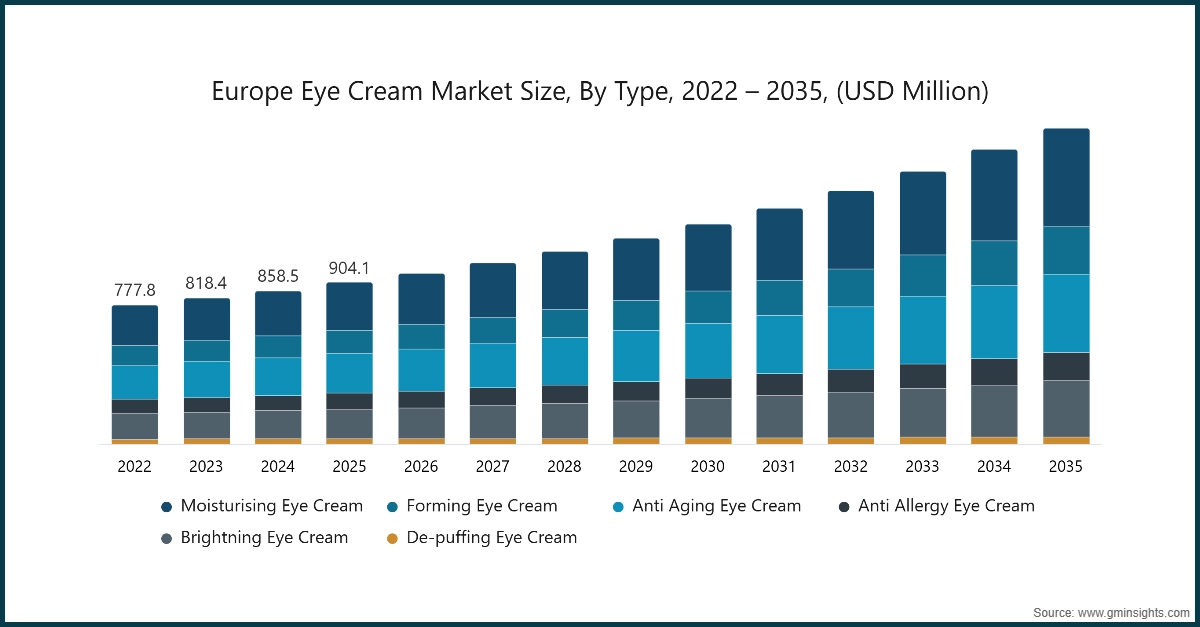
Based on the type, the Europe eye cream market is segmented into moisturizing eye cream, forming eye cream, anti-aging eye cream, anti-allergy eye cream, brightening eye cream, de-puffing eye cream. The moisturizing eye cream segment dominated the market in 2025, capturing a substantial market share of 29.7% with the revenue of USD 268.3 million.
- There is strong demand across Europe for eye creams that tighten the skin and reduce sagging, particularly among aging populations. Products formulated with peptides and collagen‑stimulating ingredients are widely sought after, as they help improve skin firmness and elasticity. European consumers value products that deliver visible yet natural-looking results, contributing to a more youthful appearance.
- The anti‑aging segment remains resilient, with continued focus on reducing fine lines, wrinkles, and age spots. Eye creams containing retinol and plant‑based retinol alternatives are especially popular in Europe due to their proven ability to stimulate cell renewal while aligning with the region’s preference for gentle, dermatologically tested formulations.
- With rising awareness of skin sensitivity and allergies, eye creams in Europe are increasingly shifting toward fragrance‑free, hypoallergenic, and dermatologically approved products. Formulations containing ceramides and barrier‑repair ingredients are particularly favored, especially among consumers with sensitive or reactive skin.
- Eye creams addressing concerns such as dryness, puffiness, and uneven skin texture continue to gain traction, making them suitable for a broad range of age groups and skin types.
Learn more about the key segments shaping this market
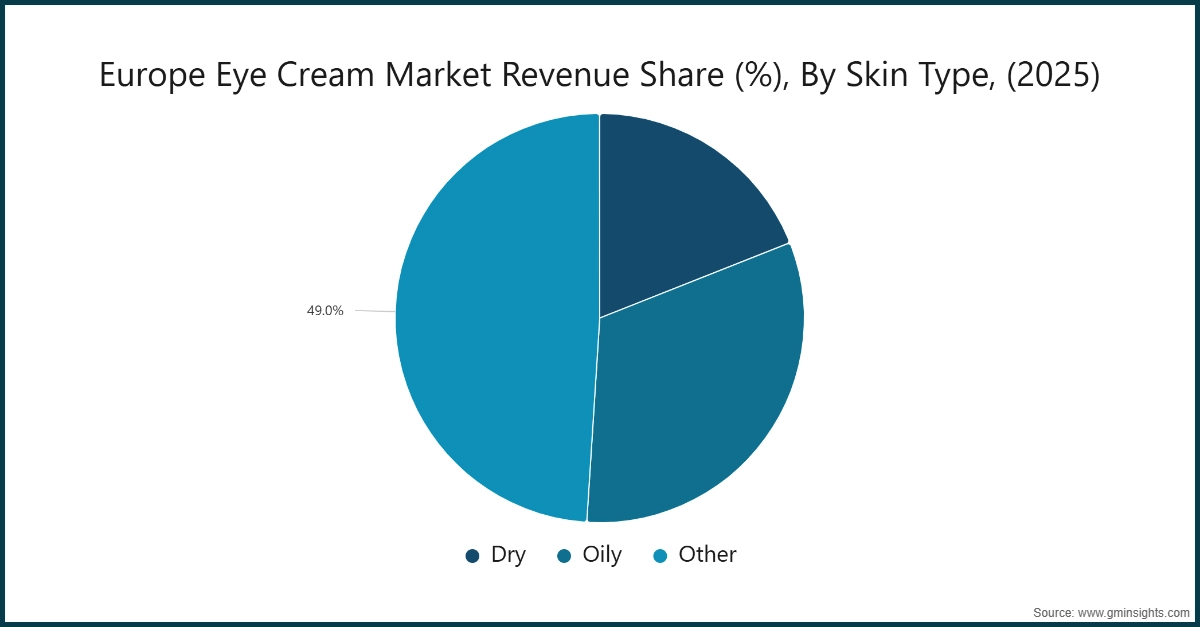
Based on skin type, the Europe eye cream market is divided into dry, oily, others. The other segment dominated the market in 2025, capturing a substantial market share of 49% and anticipated to maintain its lead by 2035.
- Eye creams formulated for all skin types, including sensitive skin, are significantly driving market growth in Europe. These inclusive products appeal to a wide consumer base with diverse skin concerns, particularly in regions where skin sensitivity awareness is high.
- Such eye creams often include soothing and calming ingredients like chamomile, aloe vera, calendula, and hypoallergenic compounds, making them suitable for sensitive and reactive skin. This emphasis on gentleness helps build consumer trust and encourages repeat purchases.
- Additionally, increased skincare education through dermatologists, pharmacies, social media, and beauty platforms has made European consumers more mindful of choosing products that suit their specific skin needs, including sensitivity.
Based on application, the eye cream market is segmented into professional and personal. Professional segment made up 55% of the market in 2025, due to rising demand for specialized skincare treatment.
- Professional eye creams typically contain higher concentrations of active ingredients and are designed for use under the supervision of skincare professionals in dermatology clinics, aesthetic centers, and pharmacies. These products cater to consumers seeking targeted solutions for concerns such as deep wrinkles, pronounced puffiness, and dark circles, a trend particularly strong in Western Europe.
- The personal use segment continues to grow, supported by increasing interest in at‑home skincare routines, rising awareness of eye care, and the convenience of self‑care practices. The widespread availability of eye creams through online platforms and pharmacy-led retail channels has made it easier for consumers to access a wide variety of products.
- Brands are responding by launching easy‑to‑use, high‑efficacy formulations that address common concerns such as aging signs, dark circles, and under‑eye fatigue. For instance, skincare expert Caroline Hirons’ Skin Rocks eye cream, formulated with actives such as phytosterols, winter cherry, and cucumber seed extract, reflects the European market’s preference for science-led yet skin‑friendly solutions that promise smoother and more youthful‑looking eyes.
 Looking for region specific data?
Looking for region specific data?
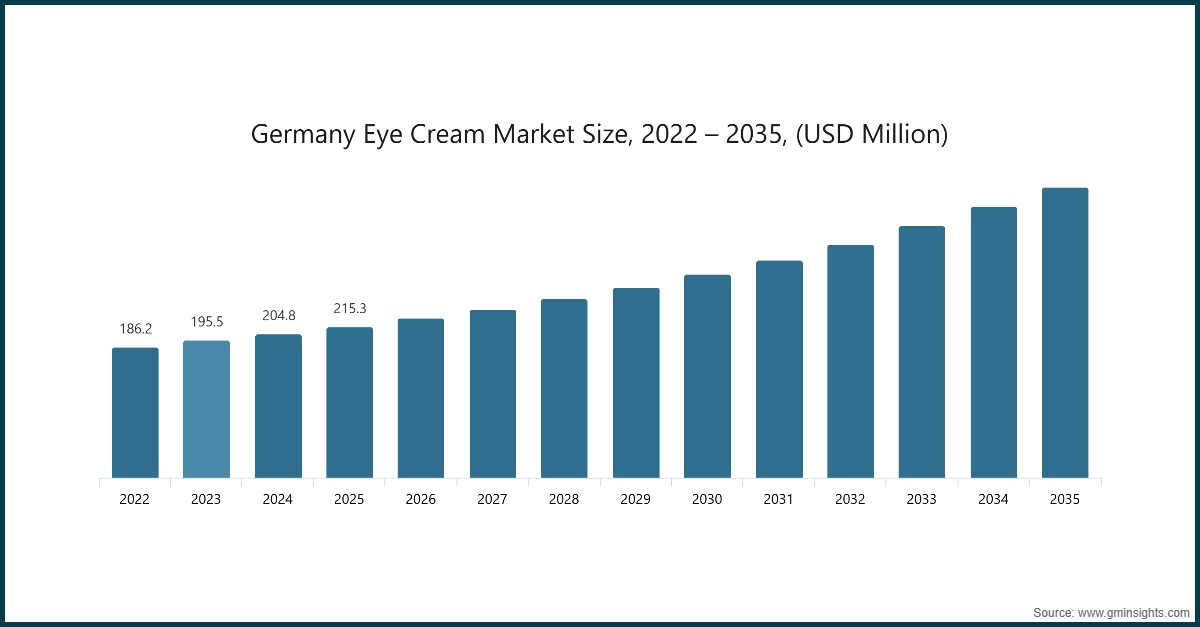
Germany is the largest market with an estimated value of USD 215.13 million in 2025 and a projected growth rate of 6.9% through 2035. The European eye cream market is strongly shaped by stringent cosmetic regulations, sustainability standards, and evolving consumer preferences toward clean, effective, and ethically produced skincare products. Europe remains a global leader in ingredient safety, eco‑design, and responsible manufacturing, which significantly influences product formulation, packaging innovation, and brand positioning across the region.
- Germany stands as one of Europe’s largest and most influential eye cream markets, supported by high consumer purchasing power, strong trust in science‑backed skincare, and a preference for functional, dermatologist‑tested products. German consumers prioritize efficacy, ingredient safety, and long product lifecycles, making the market highly receptive to clinically validated and sensitive‑skin formulations.
- The United Kingdom represents a mature and innovation‑driven eye cream market, characterized by strong demand for anti‑aging and brightening solutions, high penetration of premium skincare brands, and a well‑developed omnichannel retail ecosystem. The UK market benefits from strong influence of beauty influencers, dermatologists, and digital skincare education, driving rapid adoption of new formulations.
- France is one of Europe’s most style‑conscious and beauty‑centric eye cream markets, where skincare is deeply embedded in daily routines. French consumers emphasize gentle formulations, luxury aesthetics, and long‑term skin health, driving demand for premium eye creams that combine elegance with proven performance.
Europe Eye Cream Market Share
Estée Lauder is leading with approximately 18% market share. Estée Lauder, Johnson & Johnson, Unilever, Beiersdorf, and Shiseido collectively hold around 48%, highlighting a market structure where scale, innovation capability, and brand equity provide significant competitive advantages. These leading companies actively pursue strategic initiatives such as ingredient innovation, clinical validation, sustainability investments, omnichannel expansion, and supply‑chain optimization to strengthen their market positioning. Continuous investments in advanced actives, clean and dermatologist‑tested formulations, eco‑friendly packaging, and digital commerce platforms remain central to competitive differentiation, particularly within the premium, cosmeceutical, and anti‑aging eye cream segments.
- Estée Lauder Companies continues to reinforce its leadership position in the Europe eye cream market through science‑led innovation, luxury brand portfolios, and strong penetration in department stores, specialty beauty retailers, and e‑commerce platforms. Flagship brands such as Estée Lauder, La Mer, Clinique, and The Ordinary (DECIEM) enable the company to address diverse consumer needs across price points. Its sustained focus on clinically backed formulations, personalized skincare solutions, and premium packaging has driven strong performance in the anti‑aging and luxury eye cream segments, particularly in Western Europe.
- L’Oréal Group maintains a dominant and diversified presence across the Europe eye cream market through its extensive brand portfolio spanning dermatological, premium, and mass‑market categories. Brands including Lancôme, Kiehl’s, Vichy, La Roche‑Posay, and L’Oréal Paris allow the company to cater to a broad consumer base. L’Oréal’s emphasis on dermatological research, ingredient safety compliance, sustainable sourcing, and digital beauty technologies has strengthened its position in pharmacy‑led and sensitive‑skin eye care segments, which are especially important in Europe.
Europe Eye Cream Market Companies
Major players operating in the Europe eye cream industry are:
- Amorepacific Corporation
- Avon Products, Inc.
- Beiersdorf AG
- Cadila Pharmaceuticals
- Estée Lauder Companies Inc.
- Eye Care Cosmetics
- Johnson & Johnson
- Clinique
- Dior
- Chanel Beauty
- Clarins
- Sisley Paris
- Shiseido Company, Limited
- The Body Shop International Limited
- Unilever
Amorepacific continues to strengthen its European presence by introducing K‑beauty innovation focused on hydration science, fermentation technology, and gentle yet high‑performance formulas. The company’s eye‑care offerings emphasize moisture barrier repair, brightening benefits, and lightweight textures suitable for European consumers seeking non‑greasy, fast‑absorbing solutions. Its brand portfolio leverages rising demand for Korean skincare routines, offering multi‑step eye treatments that appeal to younger demographics and ingredient‑conscious buyers.
Avon remains competitive in Europe’s value‑driven eye‑cream segment through widespread direct‑selling networks, affordable pricing, and frequent product innovation in anti‑aging and brightening eye care. The brand focuses on accessible, yet science‑backed formulations designed to reduce puffiness, wrinkles, and dark circles. Its strong presence in Eastern and Southern Europe contributes to steady market penetration, supported by grassroots beauty advisors and digital selling strategies.
Europe Eye Cream Industry News
- In October 2025, Amorepacific was profiled as one of the key players in the Europe Eye Cream Market, recognized for strengthening competitiveness across its global premium skincare portfolio. The company continued expanding in major overseas markets, with Europe, the Middle East, and Africa recording a 42% surge in revenue, supported by strong demand for skincare and brand diversification.
- In October 2025, Estée Lauder was highlighted as a leading stakeholder in the Europe Eye Cream Market, driven by continuous product innovation and strong consumer demand for targeted eye‑care solutions such as anti‑aging and dark‑circle treatments. Luxury positioning, advanced ingredient formulations, and digital retail expansion kept Estée Lauder among top European premium eye‑care brands.
- In October 2025, Johnson & Johnson was identified as a notable player in the Europe Eye‑Cream market, benefiting from growing EU consumer preference for dermatologist‑recommended, clinically validated skincare. Its presence in the dermocosmetic channel aligned with rising demand for gentle, ophthalmologist‑tested formulations tailored to sensitive skin.
- In July 2025, Beiersdorf (NIVEA) expanded its dermatologist‑tested eye‑cream portfolio across major European markets. The expansion emphasized fragrance‑free, sensitive‑skin‑friendly formulations offering long‑term hydration and barrier support. Strengthening pharmacy networks and online availability helped boost accessibility across the region.
- In February 2026, Beiersdorf (NIVEA) plays a key role in the mass‑premium eye‑cream segment, supported by strong brand trust, dermatological research, and wide retail penetration. The company’s focus on gentle, effective, and accessible eye‑care solutions has helped it maintain consistent demand across Europe’s pharmacy, grocery, and online channels. Sensitive‑skin‑friendly, fragrance‑free positioning continues to resonate with consumers prioritizing barrier care and long‑term hydration.
- In February 2026, Cadila Pharmaceuticals brings a dermaceutical lens to Europe’s eye‑care niche, concentrating on evidence‑based actives for dark circles, under‑eye pigmentation, and irritation‑prone skin. With treatment‑oriented claims and cost‑effective formulations, Cadila targets pharmacy and clinic‑adjacent channels, appealing to consumers who value efficacy and tolerability over luxury branding.
The Europe eye cream market research report includes in-depth coverage of the industry with estimates & forecasts in terms of revenue (USD Billion) and volume (Thousand Units) from 2022 to 2035, for the following segments:
Market, By Type
- Moisturizing eye cream
- Forming eye cream
- Anti-aging eye cream
- Anti-allergy eye cream
- Brightening eye cream
- De-puffing eye cream
Market, By Ingredients
- Vitamin E
- Niacinamide
- vitamin A
- Retinol
- Other (hyaluronic Acid, etc.)
Market, By Skin Type
- Dry skin
- Oily skin
- Other (all skin, sensitive skin)
Market, By Price
- Low
- Medium
- High
Market, By Application
- Professional
- Personal
Market, By Sales Channel
- Online
- E-commerce
- Company website
- Offline
- Specialty store
- Mega Retail stores
- Others
The above information is provided for the following countries:
- UK
- Germany
- France
- Italy
- Spain
- Rest of Europe
Frequently Asked Question(FAQ) :
Who are the key players in the Europe eye cream industry?
Key players include Amorepacific Corporation, Avon Products, Inc., Beiersdorf AG, Cadila Pharmaceuticals, Estée Lauder Companies Inc., Eye Care Cosmetics, Johnson & Johnson, Clinique, Dior, Chanel Beauty, Clarins, and Sisley Paris.
What are the upcoming trends in the Europe eye cream market?
Trends include advancements in dermatology, premium eye care products, clean beauty initiatives, optimized supply chains, and growing demand for preventive and anti-aging skincare.
Which country leads the Europe eye cream sector?
Germany leads the market with an estimated value of USD 215.13 million in 2025 and a projected growth rate of 6.9% through 2035.
What is the growth outlook for the professional segment from 2026 to 2035?
The professional segment, which accounted for 55% of the market in 2025, due to rising demand for specialized skincare treatments in dermatology clinics, aesthetic centers, and pharmacies.
What was the market share of the 'other' segment in 2025?
The 'other' segment held a substantial 49% market share in 2025 and is anticipated to maintain its lead by 2035, driven by inclusive formulations catering to all skin types, including sensitive skin.
What is the expected size of the Europe eye cream industry in 2026?
The market size is projected to reach USD 1 billion in 2026.
How much revenue did the moisturizing eye cream segment generate in 2025?
The moisturizing eye cream segment generated approximately USD 268.3 million in 2025, capturing a 29.7% market share.
What is the projected value of the Europe eye cream market by 2035?
The market is poised to reach USD 1.8 billion by 2035, fueled by demand for scientifically proven, multifunctional, and sustainably produced products.
What was the market size of the Europe eye cream in 2025?
The market size was USD 0.9 billion in 2025, with a CAGR of 7.1% expected through 2035. The growth is driven by increasing consumer awareness of specialized eye care and preventive skincare regimens.
Europe Eye Cream Market Scope
Related Reports