Summary
Table of Content

Europe Connected Car Market
Get a free sample of this report
Form submitted successfully!
Error submitting form. Please try again.
Thank you!
Your inquiry has been received. Our team will reach out to you with the required details via email. To ensure that you don't miss their response, kindly remember to check your spam folder as well!
Request Sectional Data
Thank you!
Your inquiry has been received. Our team will reach out to you with the required details via email. To ensure that you don't miss their response, kindly remember to check your spam folder as well!
Form submitted successfully!
Error submitting form. Please try again.
Europe Connected Car Market Size
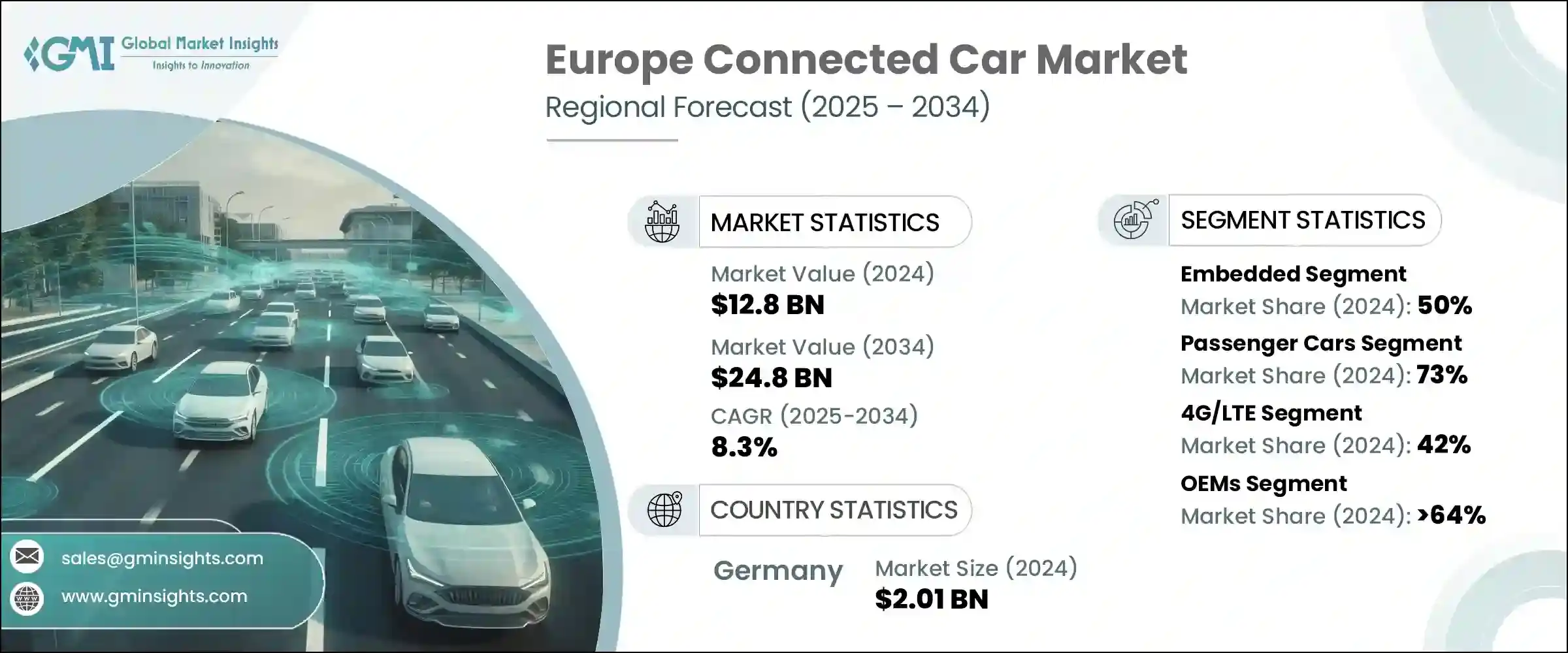
The Europe connected car market size was estimated at USD 12.8 billion in 2024. The market is expected to grow from USD 13.1 billion in 2025 to USD 24.8 billion in 2034, at a CAGR of 8.3%.
Europe Connected Car Market Key Takeaways
Market Size & Growth
- 2024 Market Size: USD 12.8 Billion
- 2034 Forecast Market Size: USD 24.8 Billion
- CAGR (2025–2034): 8.3%
Key Market Drivers
- Increased consumer focus on driver and pedestrian safety.
- Expansion of 5G and V2X communication.
- Growth in electric and autonomous vehicles.
- Growing consumer preference for in-car digital experience.
- Fleet management and telematics adoption.
- Increased consumer focus on driver and pedestrian safety.
Challenges
- Data privacy and security concerns.
- High infrastructure investment requirements.
Opportunity
- Enhanced in-car infotainment and personalization.
- Smart city infrastructure integration.
- Vehicle-to-everything (V2X) communication.
- 5G network expansion.
Key Players
- Market Leader: Volkswagen Group led with over 20% market share in 2024.
- Leading Players: Top 5 players in this market include Volkswagen, Stellantis, Renault, Mercedes-Benz, BMW, which collectively held a market share of 55% in 2024.
Get Market Insights & Growth Opportunities
- The connected car industry in Europe is growing steadily, driven by expanding 5G networks, EV adoption, and demand for safer, smarter mobility. To improve the user experience, automakers are incorporating over-the-air updates, diagnostics, and real-time navigation. Innovation in the region is being accelerated by regulatory support for V2X technology.
- The market was valued at USD 13.4 billion in 2023; the market is projected to expand significantly by 2030 up to 17 billion. Investments in ADAS, infotainment, and telematics systems drive growth. To provide modern drivers with seamless connectivity and individualized services, top OEMs are collaborating with tech companies.
- Initially, COVID-19 delayed production and affected supply networks, but by 2022, demand had recovered in both the mass market and premium markets. Digital integration is getting increasingly valued by European drivers as a component of the ownership experience. In-car voice assistants and connected entertainment systems are becoming mainstream.
- To improve road safety, in April 2025, Volkswagen extended its Car2X platform, allowing real-time communication between automobiles and infrastructure. Scandinavia, the Netherlands, and Germany are implementing similar programs. These developments support the EU's objectives for connected transport corridors and smart mobility.
- European companies and suppliers are driving connected car technology forward with advancements in in-vehicle cybersecurity, fleet intelligence, and real-time diagnostics. Data-driven solutions that improve productivity and safety are being developed by businesses like Teralytics and Faurecia. With the help of digital policies, Europe is developing a strong ecosystem for connected mobility.
To get key market trends
Europe Connected Car Market Trends
- In 2023, automakers started using embedded connectivity to make features like predictive maintenance, remote software updates, and real-time diagnostics possible. These options were extended to include both high-end and mid-range automobiles by brands like Stellantis and BMW. As customers want more seamless digital in-car experiences, the trend is predicted to pick up speed.
- According to the EU's revised General Safety Regulation, all new vehicles must have connected safety measures as of July 2024. This comprises event recorders, intelligent speed assistance, and ADAS. To meet the impending extensions of these laws by 2026, automakers are currently investing in V2X and edge computing solutions.
- In 2024, countries like Germany, France, and the Netherlands began testing 5G-enabled V2X infrastructure to improve communication between vehicles and infrastructure. By 2027, these initiatives, which are supported by EU mobility grants and the 5G Automotive Association, should expand throughout the region, enabling safer and more intelligent urban driving environments.
- In 2024, Renault and Google expanded their collaboration to develop software defined cars with cloud-based infotainment and artificial intelligence services. As automakers place a greater emphasis on in-car customization, over-the-air features, and long-term digital services, these partnerships between OEMs and tech companies are growing in frequency.
- Europe's commercial mobility industry has seen an increase in demand for connected fleet telematics solutions since 2023. Platforms for energy management, data security, and predictive maintenance are available from companies like ZF and Targa Telematics. It is anticipated that this momentum will continue as fleet operators make investments in electric vehicle optimization and real-time visibility.
- In 2024, ACEA reported that more over 45% of new cars in Western Europe had at least one paid connected service. Companies like Mercedes-Benz, Audi, and BMW expanded the range of services they offered, such as remote start and real-time traffic information. This percentage is expected to rise to over 65% by 2026 due to the demand for adaptable, real-time digital experiences.
Europe Connected Car Market Analysis
Learn more about the key segments shaping this market
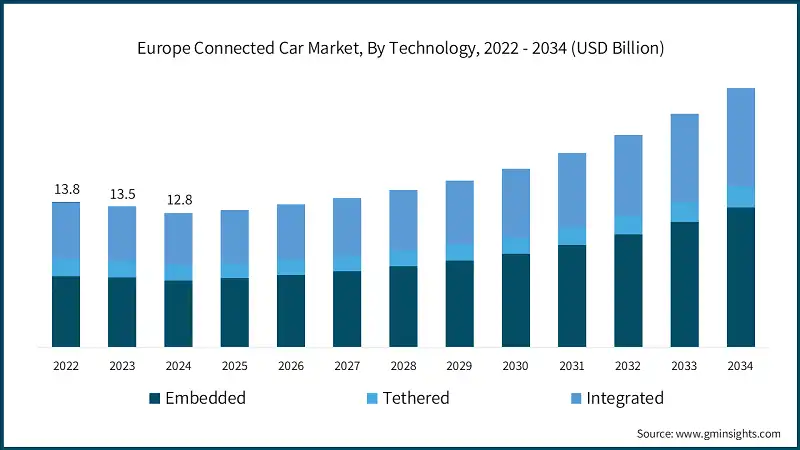
Based on technology, the Europe connected car market is divided into Embedded, Tethered, and Integrated. The embedded segment dominated the market, accounting for around 50% in 2024 and is expected to grow at a CAGR of over 9% through 2025 to 2034.
- The embedded segment led the Europe connected car market as embedded systems provide superior data security, always-on connectivity, and compliance with EU standards like eCall, automakers prefer them.
- For instance, in May 2024, The Renault Group announced that Google-based infotainment would be integrated into all future electric and hybrid vehicles, including Scenic E-Tech and Rafale. Without a smartphone, the integrated system enables OTA updates, Maps, and Assistant. This action demonstrates how embedded technology is starting to appear in major European brands.
- The most rapidly rising segment is the integrated technology with a CAGR of over 8% from 2025 to 2034. This solution harmoniously combines connectivity in mobile devices with embedded hardware and, therefore, allows us to provide such advanced functionalities as real-time telematics, over-the-air updates, remote diagnostics, and in-vehicle infotainment. Integrated platforms especially among European car manufacturers (especially Germany, France and Sweden) are gaining in popularity to have a harmonized digital experience.
- The growth of electric vehicles and autonomous cars accelerates this trend even further since systems including them make it possible to support complicated streams of information and constant connectivity. OEMs are harnessing this technology to improve driver comfort, meet EU product safety requirements and provide mobility solutions of the future in the connected vehicle environment.
- With its reasonably priced connectivity via smartphone pairing, the tethered segment remains relevant in Europe. Mid-range cars frequently have it for features like navigation and remote access. In March 2024, Skoda updated its MySkoda app, allowing drivers throughout Europe to operate essential functions through tethered smartphone connections.
- Embedded, tethered, and integrated technologies together power Europe’s connected car ecosystem, each serving distinct market needs. Embedded leads with built-in connectivity, while tethered supports budget models and integrated combines both. When combined, they promote broad adoption and enhance in-car experiences, safety, and services.
Learn more about the key segments shaping this market
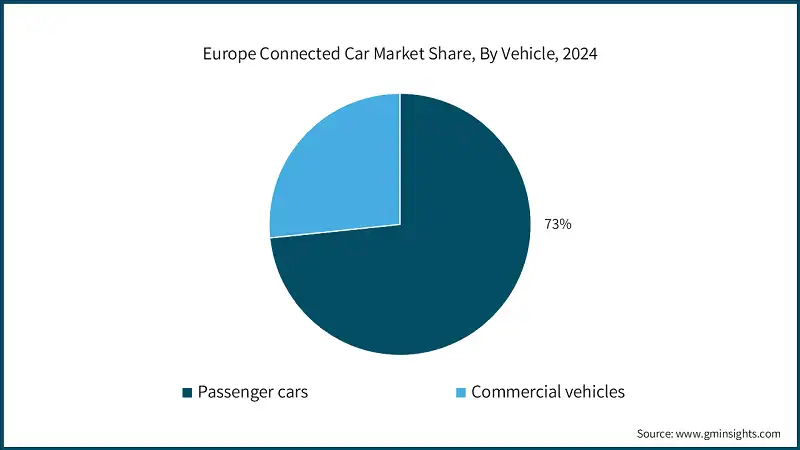
Based on vehicles, the Europe connected car market is segmented into passenger cars and commercial vehicle. The passenger cars segment dominates the market with 73% share in 2024, and the segment is expected to grow at a CAGR of over 8% from 2025 to 2034.
- The boom of passenger vehicles is due to the rising demand of consumers who are interested in a vehicle with smart infotainment, features of high safety, and anything that involves nonstop connection.
- European based manufacturers are also engaged in integrating connected systems to remain competitive in line with the regulatory changes. Remarkably, Renault presented new electric and hybrid cars one of them was Scenic E-Tech and Rafale with Google-connected solutions, such as Assistant, Maps, and OTA updates, and the advance toward the world of digital ecosystem in the mass passenger vehicle market.
- Connected technologies are being adopted by commercial vehicles more frequently to enhance fleet operations and visibility. In March 2024, Daimler Truck stated that more than a million of its trucks and buses are now connected worldwide, allowing for remote monitoring and predictive maintenance across European fleets due to services like Uptime and TruckLive.
- Passenger car connectivity in the Europe connected car market is being driven by rising demand for OTA updates, digital cockpits, and integrated EV features. In cities like Munich, Paris, and Milan, automakers are prioritizing embedded solutions to support growing fleets of smart EVs and premium vehicles. This trend reflects a broader regional shift toward software-defined vehicles tailored to urban mobility and digital lifestyles.
- For commercial fleets, connected services are revolutionizing the efficiency of logistics. Across various European transport networks, real-time data is assisting operators in ensuring compliance, optimizing delivery routes, and monitoring vehicle health, especially in long-haul and last-mile sectors.
Based on application, the market is segmented into telematics, navigation, infotainment, remote diagnostics, safety & security, and fleet management. The telematics segment is expected to dominate the market.
- Safety and security constrict a significant part of the Europe connected car market that calculates the 34% of the connected vehicle revenues in 2024. In April 2024 Volvo revealed its newest Care Key feature that enables the owner to set an upper speed limit of a vehicle to be safer when the car is handed over to a younger or less skilled driver. The development in road safety with connected vehicle technologies is demonstrated by this novelty and improvement in call systems (eCall) and driver assistance systems (automated). The European regulations still contribute to the spread of these safety-oriented technologies, so they remain the basis of connected car offers.
- Telematics is the second largest segment in the market, accounting for around 21% of embedded telematics revenue in 2024. In March 2024, The Pro One range of Stellantis' Mobilisights Data Pack, which offers four years of real-time vehicle data to improve fleet operations without the need for aftermarket equipment was announced.
- Navigation is a key growth area in Europe’s connected car market, supported by rising EV adoption and demand for real-time route optimization. With the launch of e-ROUTES in June 2024, Stellantis gave European drivers dynamic, charger-aware navigation by integrating the EV route planner into infotainment systems from companies like Fiat and Peugeot.
- Infotainment is rapidly evolving across the European connected car market, driven by rising demand for immersive media, personalized content, and real-time updates. Nowadays, consumers anticipate voice assistants, digital services, and entertainment apps to integrate seamlessly. To satisfy these demands, automakers are giving native infotainment systems top priority.
- Remote diagnostics, and fleet management together held nearly 15% share in 2024. Predictive maintenance is made possible by these services, which also improve vehicle uptime and assist adherence to EU safety standards. Together, they play a critical role in connected ecosystems' operational effectiveness and driving safety.
Based on connectivity, the Europe connected car market is segmented into 4G/LTE, 5G, 3G, Wi-Fi and Bluetooth. The 4G/LTE segment is expected to dominate the market.
- 4G/LTE remains the backbone of connected car deployments in Europe, powering around 42% of vehicles in 2024. For instance, In July 2024, fleet telematics company Geotab keeps using 4G LTE to provide real-time EV fleet information throughout European operations, assisting companies in cutting expenses and promoting sustainability.
- With its ultra-low latency and high throughput, 5G is rapidly gaining acceptance and is perfect for C-V2X and HD navigation. At the Mobile World Congress in Barcelona, in February 2024, Harman unveiled their Ready Connect 5G TCU, which is based on Qualcomm's Snapdragon Digital Chassis and shows OEM readiness for faster, smarter cars.
- 4G/LTE continues to dominate connected car networks in Europe due to its broad coverage and proven reliability for real-time fleet management. Meanwhile 5G, is rapidly developing and offers greater bandwidth and reduced latency, making it perfect for sophisticated use cases like C-V2X.
- 3G, Wi-Fi, and Bluetooth serve as vital support layers in connected vehicles across Europe. Bluetooth facilitates smooth in-cabin pairing in countries like Germany and Italy, and Wi-Fi hotspots improve the traveler experience, particularly in high-end aircraft. When cellular coverage is scarce, these solutions offer crucial media connectivity and fallback.
Based on sales channel, the Europe connected car market is segmented into OEM and Aftermarket. The OEM segment is expected to dominate the market.
- OEMs dominate Europe’s connected car landscape, with over 64% of deployments in 2024 as automakers standardize factory-fitted connectivity. The move toward software rich automobiles was highlighted in March 2025 when Volkswagen Group teamed up with Ecarx to equip Skoda models in Europe with embedded infotainment.
- Aftermarket adoption is rising, as fleet owners and older vehicle users retrofit systems to access telematics, infotainment, or safety upgrades. Third-party plug-and-play kits are in high demand in countries like Spain and Poland, particularly among ride-hailing fleets and logistics businesses.
- The connecting service providers are also taking advantage of the growing market by providing a subscription-based model and data-driven solution. Telecom operators such as Vodafone, Orange and Hutchison Telecommunications have introduced new car-specific data plans to support diagnostic functions in real time, advanced navigation and pay-per-mile insurance. This movement in mind to flexible, scalable connectivity solutions is also assisting in the acceleration of adoption in the European markets, especially those markets with older vehicle fleets, where seamless integration has not been achieved.
- Leasing companies and ride sharing providers are increasingly adopting dealer installed and mobility linked solutions. In cities like Berlin, Milan, and Amsterdam, tailored installations like as tracking, remote diagnostics, and driver analytics are made possible by these channels.
Looking for region specific data?
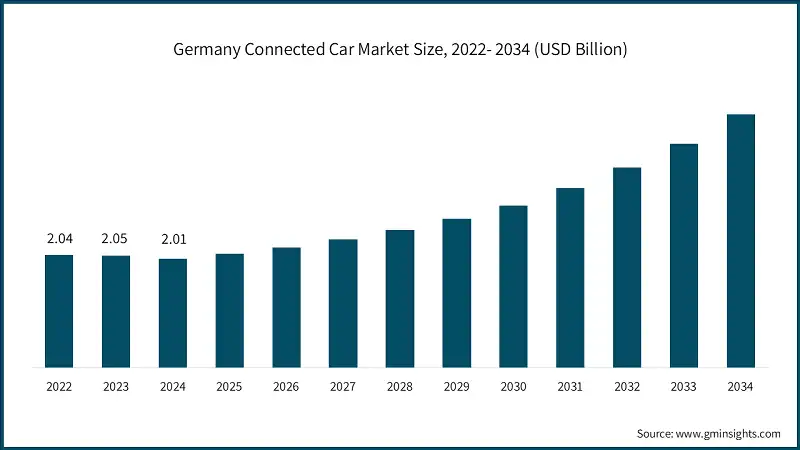
Germany in Western Europe dominated the Europe connected car market with around 43% market share and generated around USD 2.01 billion revenue in 2024.
- The boom of passenger vehicles is due to the rising demand of consumers who are interested in a vehicle with smart infotainment, features of high safety, and anything that involves nonstop connection.
- In February 2024, Mercedes-Benz and Nvidia extended their collaboration to improve software-defined cars with OTA updates, AI-powered help, and intelligent infotainment. As a result of Germany's transition to intelligent, cloud-connected mobility, these features are now standard in E-Class and EQ models.
- The legislative framework in Germany has also made it possible for V2X and telematics technologies to grow safely. Initiatives such as the "Digital Test Bed Autobahn" of the German Federal Ministry of Transport promote the practical validation of linked and autonomous technologies. Germany is becoming a test site for Europe's next-generation transportation solutions due to these public-private efforts.
- The country's position is further reinforced by its strong supplier ecosystem. Both domestic and European automakers continue to receive telematics control units, sensors, and connection platforms from companies like as Bosch and Continental. Germany is a vital engine for Europe's connected mobility future because of its unwavering commitment on innovation, which is establishing standards in data-driven vehicle services.
The Europe connected cars market in Italy (Southern Europe) is expected to experience significant and promising growth from 2025 to 2034.
- Italy’s connected car market in Southern Europe is expected to grow at a CAGR of over 8% from 2025 to 2034, supported by digital transformation and smart mobility initiatives. Strong public-private partnerships, urban tech adoption, and EU climate alignment are important growth drivers.
- Italy is digitizing important highways including the A90 and A2 as part of the "Smart Road ANAS" project to facilitate real-time data exchange and V2X communications. These corridors enhance traffic safety and predictive infrastructure maintenance, and they are crucial for future autonomous driving.
- For instance, in June 2024, Stellantis partnered with TIM and Almaviva to launch a connected mobility platform in Turin. Fiat and Maserati are also rolling out cars with OTA updates, remote diagnostics, and AI-based driver assistance, aligning with Italy’s software-first strategy.
- Additionally, Italy is working with Austria and Slovenia to build cross-border V2X routes. To establish Italy as a digital gateway in Southern Europe, these EU-backed initiatives seek to standardize digital infrastructure and improve regional freight and passenger connectivity.
- As part of its Smart Mobility 2030 Plan, in May 2024, Milan installed V2X-enabled smart traffic signals at 25 junctions. These systems demonstrate how Italian cities are facilitating scalable connected car integration by supporting real-time notifications and traffic optimization.
The Europe connected car market in Sweden (Northern Europe) is expected to experience significant and promising growth from 2025 to 2034.
- Between 2025 and 2034, Sweden's connected automobile market in Northern Europe is expected to develop at a compound annual growth rate CAGR of around 9%. The country's desire for intelligent, connected mobility is fueled by robust environmental regulations, digital infrastructure, and frameworks for public-private innovation.
- Through green procurement laws and infrastructure incentives, the Swedish government aggressively promotes networked transportation systems and vehicle electrification. Sweden is a testbed for data-driven urban mobility because of its clear regulations and city-level pilot programs.
- Cities like Gothenburg, Malmö, and Stockholm are incorporating connected services like AI-based fleet analytics, smart traffic integration, and predictive maintenance into both public and private mobility. These initiatives seek to improve road safety, lessen traffic, and maximize energy consumption.
- By combining charging infrastructure with wind and hydroelectric power, Sweden is also coordinating the rollout of connected vehicles with its renewable energy targets. This approach improves energy grid efficiency while guaranteeing reduced carbon footprints for electric and data heavy vehicles.
- For instance, in September 2024, Nobina and Svensk Fordonsladdning installed 29 high-capacity chargers at Stockholm’s Gubbangen depot to power 58 connected electric buses. The project illustrates Sweden’s commitment to combining connectivity, electrification, and clean energy.
The Europe connected cars market in Poland (Eastern Europe) is expected to experience significant and promising growth from 2025 to 2034.
- Poland’s connected car market is showing strong progress, contributing an estimated USD 500 million in revenue in 2024. The expansion of smart mobility integration across electric bus fleets in key cities like Warsaw, Krakow, and Gdansk is bolstered by national climate targets that are in line with the European green deal and clean vehicles directive.
- The "Green Public Transport" project, which provides co-finance for smart charging systems and zero-emission buses, is speeding up the development of infrastructure. With the help of regional supply chains and continuous grid upgrades, local governments are putting in depot based and pantograph chargers.
- Domestic manufacturer Ekoenergetyka plays a pivotal role, producing high capacity, interoperable chargers used widely in Polish cities. This establishes Poland as a developing hub for scalable and dependable linked public transportation systems in Eastern Europe.
- Together with Poznan and Lodz, Ekoenergetyka delivered ultra-fast charging facilities in October 2024 to serve more than 100 electric buses. These initiatives support Poland's shift to connected, effective urban mobility, which is supported by robust industry and public cooperation.
Europe Connected Car Market Share
- The top 7 companies in the Europe connected car industry are Volkswagen Group, Mercedes-Benz Group, BMW Group, Stellantis N.V., Renault Group, Tesla, and Hyundai Motor Company contributing around 58% of the market in 2024.
- Volkswagen is expanding its connected ecosystem across VW, Audi, and Skoda brands. In March 2025, it began integrating Ecarx infotainment systems into Skoda’s European lineup to strengthen cockpit capabilities. The group focuses on embedding digital services directly at the factory level. Its platforms support OTA updates, voice assistance, and app-based vehicle control.
- Mercedes-Benz uses the MBUX system to improve the user experience by providing individualized profiles, AR navigation, and smart voice assistance. Additionally, the brand permits software subscriptions for premium features and in-car transactions. It continues to innovate with safety alerts and predictive maintenance tools. Both its luxury ICE and EV versions rely heavily on these systems.
- BMW's ConnectedDrive provides remote control, real-time traffic information, and insights into driver behavior. In 2024, it upgraded its infotainment system to include AI trip recommendations and in-car sports streaming. Older versions are kept current by OTA upgrades. Most of its European lineup now comes with these features as standard.
- Stellantis N.V. integrates telematics across brands like Peugeot, Opel, and Citroen. In March 2024, it introduced Mobilisights, a subscription service that provides four years of real-time fleet data. Throughout Europe, technology facilitates driver behavior surveillance and predictive maintenance.
- Renault has teamed with Google, in order to integrate Maps, Assistant, and the Play Store into new models like Scenic E-Tech and Rafale. For European drivers, this native integration makes infotainment easier to use. EV route planning and over-the-air updates are supported by the system. Renault's strategy emphasizes user-friendly, app-based driving experiences.
- Tesla leads in software first vehicles with always-on connectivity, autopilot data streaming, and OTA updates. It provides rich infotainment, which includes games, satellite maps, and streaming videos. Tesla is still improving its autopilot system's compliance aspects in Europe. All models come with smart navigation and real-time diagnostics.
- Hyundai and Kia operate connected services via Bluelink and Kia Connect, offering real-time charging status, remote climate control, and geo-fencing. New EVs like the EV6 and Ioniq 5 come equipped with these features as standard. The group's main focus is on integrating mobile apps seamlessly. Its systems meet the increasing need for digital driving tools in Europe.
Europe Connected Car Market Companies
Major players operating in the Europe connected car industry are:
- BMW
- Ford Motors
- Hyundai Motor
- Mercedes-Benz
- Renault
- Robert Bosch
- Stellantis
- Tesla
- Volkswagen
- Volvo
- BMW Group enhances connectivity in Europe with ConnectedDrive, offering AI-powered infotainment and real-time updates while ensuring data privacy. Hyundai expands its reach by offering safety features, EV charging, and remote controls through Bluelink and Kia Connect. Both emphasize stringent adherence to European data regulations and scalable cloud systems.
- Mercedes-Benz Group and Renault Group focus on secure, user-friendly connected car solutions. Mercedes-Benz prioritizes data privacy and compliance while advancing AI personalization and OTA upgrades through MBUX. With seamless updates and robust privacy, Renault incorporates Google-powered infotainment into EVs and hybrids. Both place a strong emphasis on governance and innovation to adhere to stringent European regulations.
- Stellantis N.V. and Tesla focus on connected car innovation through data and software. Stellantis enhances fleet management across brands like Peugeot and Opel. Tesla delivers OTA updates, autopilot features, and real-time diagnostics. Both prioritize seamless user experiences and constant improvement.
- Volkswagen Group uses integrated software platforms and digital cockpits to propel connected car innovation. It emphasizes real-time updates, cloud connectivity, and seamless user experiences with AI elements. Rapid rollout across its brands is made possible by scalable platforms. The organization places a high value on flexibility to accommodate changing mobility requirements.
Europe Connected Car Market Report Attributes
| Key Takeaway | Details |
|---|---|
| Market Size & Growth | |
| Base Year | 2024 |
| Market Size in 2024 | USD 12.8 Billion |
| Forecast Period 2025 – 2034 CAGR | 8.3% |
| Market Size in 2034 | USD 24.8 Billion |
| Key Market Trends | |
| Drivers | Impact |
| Increased consumer focus on driver and pedestrian safety | Boosts demand for advanced driver assistance systems and real-time hazard detection features. |
| Expansion of 5G and V2X communication | Enables faster, low-latency data exchange, enhancing vehicle responsiveness and connectivity. |
| Growth in electric and autonomous vehicles | Accelerates integration of intelligent software, sensors, and over-the-air update capabilities. |
| Growing consumer preference for in-car digital experience | Drives development of personalized infotainment, voice assistants, and smart cockpit systems. |
| Fleet management and telematics adoption | Increases investment in predictive analytics, remote diagnostics, and real-time vehicle tracking. |
| Increased consumer focus on driver and pedestrian safety | Boosts demand for advanced driver assistance systems and real-time hazard detection features. |
| Pitfalls & Challenges | Impact |
| Data privacy and security concerns | Increasing regulatory pressure will compel automakers to enhance data protection systems. |
| High infrastructure investment requirements | High costs may slow down large-scale V2X and 5G deployments across developing EU regions. |
| Opportunities: | Impact |
| Enhanced in-car infotainment and personalization | Improves driver satisfaction and creates new revenue streams through personalized content and services. |
| Smart city infrastructure integration | Strengthens vehicle coordination with urban systems, enabling efficient traffic flow and reduced emissions. |
| Vehicle-to-everything (V2X) communication | Enhances real-time safety alerts and supports autonomous driving through continuous data exchange. |
| 5G network expansion | Powers seamless connectivity for high-speed data transmission, enabling advanced telematics and services. |
| Market Leaders (2024) | |
| Market Leaders |
20% market share |
| Top Players |
Collective market share in 2024 is 55% |
| Competitive Edge |
|
| Regional Insights | |
| Largest Market | Western Europe |
| Fastest growing market | Eastern Europe |
| Emerging countries | Poland, U.K., Germany, Spain, France |
| Future outlook |
|
What are the growth opportunities in this market?
Europe Connected Car Industry News
- In June 2025, Renault began a massive vehicle-to-grid (V2G) car sharing experiment in Utrecht, with 50 bidirectional EVs. The initiative promotes grid stabilization and was carried out in collaboration with MyWheels and We Drive Solar. There are plans to increase the fleet size to 500 vehicles.
- In June 2025, Tata Consultancy opened three automotive software hubs services in Germany and Romania. These facilities will assist OEMs such as Stellantis and BMW in developing digital cockpit systems, ADAS, and SDVs. This is the biggest expansion of TCS's auto tech business in Europe.
- In September 2024, Daimler Truck introduced new connected services, such as OTA updates and real-time traffic alerts, for its eActros 600 EVs. The suite is intended to increase fleet uptime and efficiency. It was revealed at IAA Transportation, in Germany.
- In August 2024, BMW introduced UNO gaming and Bundesliga live streaming to more than 500,000 cars with ConnectedDrive. The 7 Series, i5, and MINI vehicles now provide more infotainment options thanks to the update. This increases European users' in-car engagement.
- In June 2024, Stellantis launched its e-ROUTES EV planning software, virtual assistant, AppMarket, Free2move Connect Fleet, and MyTasks, which were implemented in more than 20 European nations and featured brands like Peugeot, Opel, Citroen, DS, Jeep, and Fiat. These features facilitate improved fleet management, natural language communication, and EV navigation.
- In January 2024, ACCESS Europe demonstrated their Twine4Car in-car infotainment system at CES. This platform is an automotive app store that is integrated with Bosch and TomTom IVI systems. The system is based on a blended infotainment/ADAS architecture and provides centralized in-car media, communication services, and apps.
The Europe connected car market research report includes in-depth coverage of the industry with estimates & forecasts in terms of revenue ($ Mn) and shipment (Units) from 2021 to 2034, for the following segments:
Market, By Technology
- Embedded
- Tethered
- Integrated
Market, By Vehicle
- Passenger cars
- SUV
- Sedan
- Hatchback
- Commercial vehicle
- Light-duty
- Medium-duty
- Heavy-duty
Market, By Application
- Telematics
- Navigation
- Infotainment
- Remote diagnostics
- Safety & security
- Fleet management
Market, By Connectivity
- 4G/LTE
- 5G
- 3G
- Wi-Fi
- Bluetooth
Market, By Sales Channel
- OEM
- Aftermarket
The above information is provided for the following regions and countries:
- Western Europe
- Germany
- France
- Netherlands
- Belgium
- Switzerland
- Austria
- Luxembourg
- Liechtenstein
- Ireland
- Eastern Europe
- Poland
- Czech Republic
- Portugal
- Serbia
- Albania
- Slovakia
- Romania
- Slovenia
- Bulgaria
- Estonia
- Northern Europe
- UK
- Denmark
- Sweden
- Norway
- Iceland
- Faroe Islands
- Southern Europe
- Italy
- Spain
- Vatican City
- San Marino
- Greece
- Cyprus
Frequently Asked Question(FAQ) :
What is the market size of the Europe connected car in 2024?
The market size was estimated at USD 12.8 billion in 2024, with a CAGR of 8.3% expected through 2034. The growth is driven by expanding 5G networks, EV adoption, and demand for safer, smarter mobility solutions.
The market size was estimated at USD 12.8 billion in 2024, with a CAGR of 8.3% expected through 2034. The growth is driven by expanding 5G networks, EV adoption, and demand for safer, smarter mobility solutions.
The market is projected to reach USD 24.8 billion by 2034, supported by advancements in V2X technology, over-the-air updates, and regulatory support for connected safety features.
Which segment dominated the Europe connected car industry in 2024?
The passenger cars segment dominated the market with a 73% share in 2024 and is set to expand at a CAGR of over 8% till 2034.
What was the market share of the embedded segment in 2024?
The embedded segment led the market, accounting for over 50% of all connected vehicles in 2024. Automakers prefer embedded systems for their superior data security, always-on connectivity, and compliance with EU standards like eCall.
What is the market size of the 4G/LTE segment in 2024?
The 4G/LTE segment is expected to power approximately 42% of connected vehicles in Europe in 2024, driven by its role as the backbone of connected car deployments.
Which country led the Europe connected car sector?
Germany led the market, generating approximately USD 2.01 billion in revenue in 2024. Its success is attributed to robust digital infrastructure, strong OEM-tech supplier collaboration, and a rich automotive legacy.
What are the key trends in the Europe connected car market?
The adoption of 5G-enabled V2X, automaker-tech partnerships, rising fleet telematics demand, and regulatory mandates for ADAS and event recorders.
Who are the major players in the Europe connected car industry?
Major players include BMW, Ford Motors, Hyundai Motor, Mercedes-Benz, Renault, Robert Bosch, Stellantis, Tesla, Volkswagen, and Volvo.
Europe Connected Car Market Scope
Related Reports