Summary
Table of Content

Europe Cloud Carbon Management System Market
Get a free sample of this report
Form submitted successfully!
Error submitting form. Please try again.
Thank you!
Your inquiry has been received. Our team will reach out to you with the required details via email. To ensure that you don't miss their response, kindly remember to check your spam folder as well!
Request Sectional Data
Thank you!
Your inquiry has been received. Our team will reach out to you with the required details via email. To ensure that you don't miss their response, kindly remember to check your spam folder as well!
Form submitted successfully!
Error submitting form. Please try again.
Europe Cloud Carbon Management System Market Size
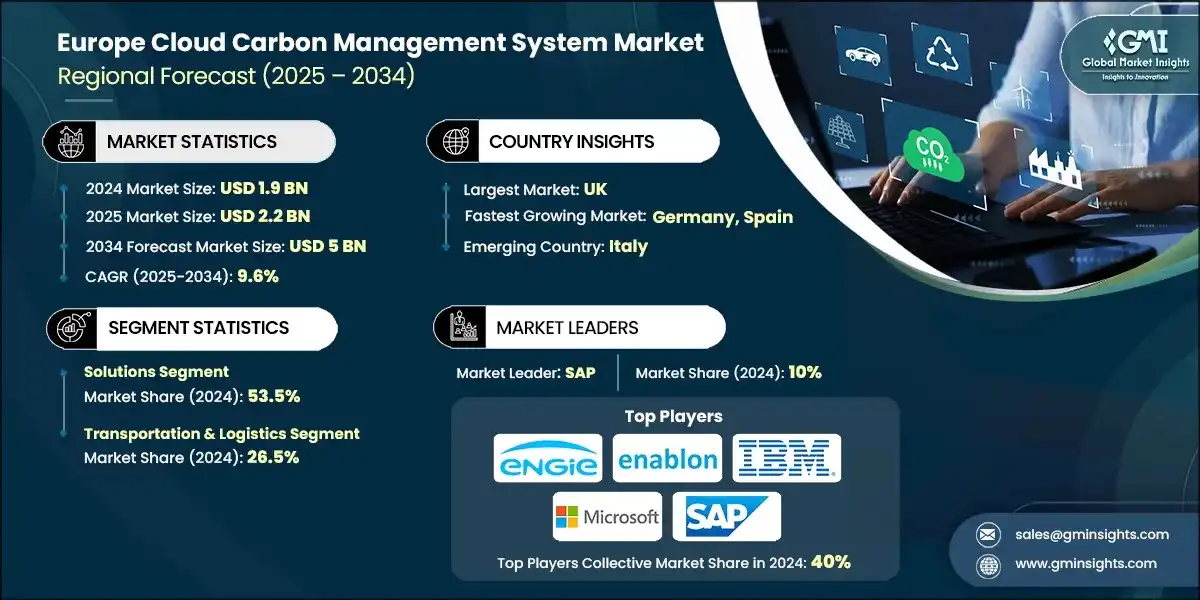
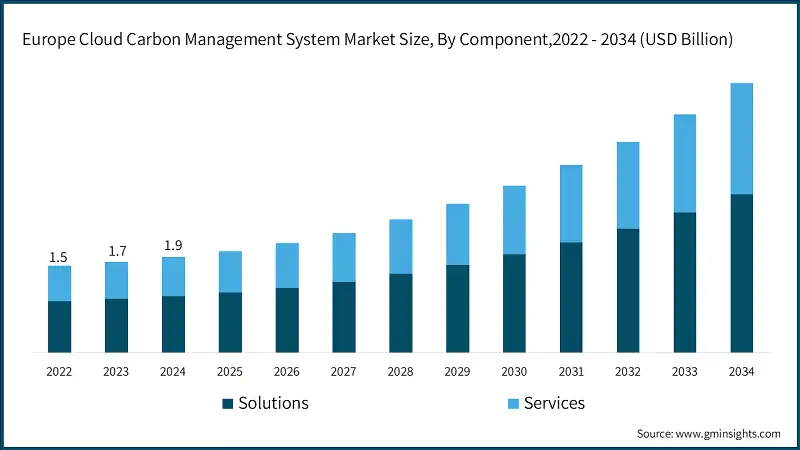
According to a recent study by Global Market Insights Inc., the Europe cloud carbon management system market was estimated at USD 1.9 billion in 2024. The market is expected to grow from USD 2.2 billion in 2025 to USD 5 billion in 2034, at a CAGR of 9.6%.
Europe Cloud Carbon Management System Market Key Takeaways
Market Size & Growth
- 2024 Market Size: USD 1.9 Billion
- 2025 Market Size: USD 2.2 Billion
- 2034 Forecast Market Size: USD 5 Billion
- CAGR (2025–2034): 9.6%
Regional Dominance
- Largest Market: UK
- Fastest Growing Region: Germany, Spain
Key Market Drivers
- Increasing regulatory pressure.
- Corporate net-zero commitments.
Challenges
- Data integration challenges.
Opportunity
- SME adoption growth.
- AI & automation.
Key Players
- Market Leader: SAP led with over 10% market share in 2024.
- Leading Players: Top 5 players in this market include Engie, Enablon, IBM, Microsoft, SAP, which collectively held a market share of 40% in 2024.
Get Market Insights & Growth Opportunities
- Regulatory acceleration through the EU green deal coupled with favorable climate law have created a robust legislative framework that mandates aggressive decarbonization targets across all sectors. These regulations are legally binding, pushing industries to adopt digital tools including cloud-based carbon management systems to monitor, report, and reduce emissions.
- The Fit for 55 package, which aims to reduce net greenhouse gas emissions by at least 55% by 2030, has further intensified the need for scalable, transparent, and real-time carbon tracking solutions. Cloud platforms offer the agility and integration needed to comply with these evolving regulations, especially as companies face increasing scrutiny from both regulators and investors.
- For instance, in 2023, the European Commission revised the EU Emissions Trading System (EU ETS) under the Fit for 55 package, enforcing stricter carbon caps and expanding coverage to new sectors. This revision is now fully in force and is driving digital transformation in emissions monitoring across Europe. The regulatory landscape is no longer static and are dynamic and data-driven, making cloud-based systems indispensable for compliance and strategic planning.
- Continuous & exponential rise of carbon pricing along with market-based incentives has emerged as few of the most effective tools for incentivizing emissions reduction. The EU ETS has demonstrated that putting a price on pollution drives innovation and accelerates the adoption of clean technologies. As carbon prices become more predictable and impactful, businesses are increasingly turning to cloud-based carbon management systems to optimize their carbon strategies.
- For instance, as per European Commission, in 2024, the EU ETS helped cut emissions by 5% compared to 2023, with carbon pricing driving oner USD 90 billion in green tech exports. The Innovation Fund, financed by ETS revenues, invested over USD 12 billion in clean tech projects, including low-carbon steel and floating wind farms.
- These platforms assists companies simulate pricing scenarios, forecast financial impacts, and identify cost-effective mitigation pathways. The integration of carbon pricing into business models has become a competitive necessity. Cloud systems enable real-time analytics and decision-making, helping firms navigate the complexities of carbon markets while aligning with sustainability goals.
- The European Commission’s Industrial Carbon Management Strategy (COM/2024/62) has laid out a comprehensive roadmap for scaling carbon capture, utilization, and storage (CCUS) technologies. This strategy emphasizes the need for a unified CO2 market and robust transport infrastructure, which in turn demands sophisticated digital platforms for tracking, reporting, and optimizing carbon flows.
- Cloud-based carbon management systems are uniquely positioned to support this transformation by offering centralized data repositories, predictive analytics, and cross-border collaboration tools. As CCUS projects scale, the complexity of managing carbon assets increases, making cloud solutions essential for operational efficiency and regulatory compliance.
To get key market trends
Europe Cloud Carbon Management System Market Trends
- Rising corporate sustainability reporting directive (CSRD) enforcement combined with digital product passport (DPP) integration for lifecycle carbon transparency I augmenting the industry outlook. The CSRD, which came into effect in 2024, mandates detailed sustainability disclosures from over 50,000 companies across Europe. This directive requires firms to report on Scope 1, 2, and 3 emissions, climate risks, and mitigation strategies using standardized formats.
- Cloud-based carbon management systems are critical enablers of this reporting transformation. They automate data collection, ensure auditability, and facilitate real-time updates across global operations. With ESG performance now directly influencing investor confidence and access to capital, companies are investing heavily in digital platforms that can meet the CSRD’s rigorous demands.
- The shift from voluntary to mandatory reporting is driving widespread adoption of cloud solutions. Furthermore, the EU’s rollout of the Digital Product Passport (DPP) under the Ecodesign for Sustainable Products Regulation marks a transformative shift in how product-level carbon data is tracked and shared. The DPP mandates that nearly all products sold in the EU carry a digital record detailing their environmental footprint, including carbon emissions across the lifecycle.
- This initiative is driving demand for cloud-based carbon management systems capable of ingesting, processing, and visualizing granular product data. These platforms enable manufacturers and retailers to comply with DPP requirements while gaining insights into Scope 3 emissions, supplier performance, and circularity metrics.
- The DPP also fosters interoperability across supply chains, making cloud systems essential for real-time collaboration and compliance. As regulation matures, companies will need scalable digital infrastructure to manage the complexity of product-level carbon data. For instance, since 2024, the EU began implementing the Digital Product Passport across nearly all product categories, requiring detailed lifecycle carbon data to be digitally accessible.
- Expansion of enterprise-grade carbon management platforms are being increasingly adopting cloud-native platforms to manage carbon data at scale. These platforms offer modular capabilities such as emissions tracking, scenario modeling, and automated reporting aligned with global standards. In addition, Cloud-based solutions also offer enhanced security, scalability, and real-time analytics, making them indispensable for multinational firms navigating complex regulatory and operational landscapes.
- For instance, in October 2024, NTT DATA announces the launch of "SAP integration with SiGREEN” solution as part of Siemens Xcelerator. Siemens’ SiGREEN platform enables dynamic product carbon footprint (PCF) tracking across supply chains, supporting peer-to-peer data exchange and compliance with the EU’s Carbon Border Adjustment Mechanism (CBAM).
Europe Cloud Carbon Management System Market Analysis
Learn more about the key segments shaping this market
- Based on component, the market is segmented solutions & services. The solutions segment dominated 53.5% of the market share in 2024 and is set to grow at a CAGR of 9% by 2034. Increasingly embedding artificial intelligence (AI) and machine learning to forecast emissions patterns and simulate reduction strategies is bolstering the business landscape.
- These tools allow enterprises to model future carbon footprints based on operational changes, regulatory shifts, and supply chain dynamics. Predictive analytics not only enhances decision-making but also supports proactive compliance with evolving EU climate laws. The ability to anticipate carbon liabilities and optimize mitigation efforts is becoming a core feature of modern cloud platforms, especially for industries with complex Scope 3 emissions.
- For instance, in September 2025, in UK, around six projects using satellite technology and artificial intelligence to address climate change, transport networks and accessibility have secured over USD 1.5 million in government funding. This will support innovations ranging from a carbon emissions dashboard for shipping to satellite-enabled navigation tools for visually impaired pedestrians.
- Growing use of blockchain technology within cloud carbon management solutions to ensure traceability and integrity of emissions data is further adding to the overall industry growth. Blockchain enables secure, immutable records of carbon transactions, which is particularly valuable for carbon credits, offsets, and supplier disclosures.
- The cloud services will grow at a CAGR of 10% by 2034, driven by the use of blockchain technology within cloud carbon management solutions to ensure traceability and integrity of emissions data. Blockchain enables secure, immutable records of carbon transactions, which is particularly valuable for carbon credits, offsets, and supplier disclosures.
- Real-time carbon accounting supported by distributed ledger technology is gaining traction among companies participating in voluntary carbon markets or those subjects to the EU’s Carbon Border Adjustment Mechanism (CBAM). This trend reflects a broader push toward transparency and trust in carbon data across global value chains.
- For instance, in September 2025, UK based Carbon3.ai company announced its plans to deliver the country’s first sustainable sovereign AI platform. The platform is being designed to scale up the AI infrastructure responsibly, sustainably, and securely. This in turn will create a favorable scenario for the services industry for other companies as well to remain competitive in the market, thereby adding to the industry growth.
- A critical service trend in Europe is the rise of carbon literacy programs integrated into cloud platform rollouts. As carbon management becomes a cross-functional responsibility, service providers are offering training modules for finance, operations, procurement, and executive teams. These programs focus on interpreting carbon data, understanding regulatory frameworks, and using cloud dashboards effectively.
Learn more about the key segments shaping this market
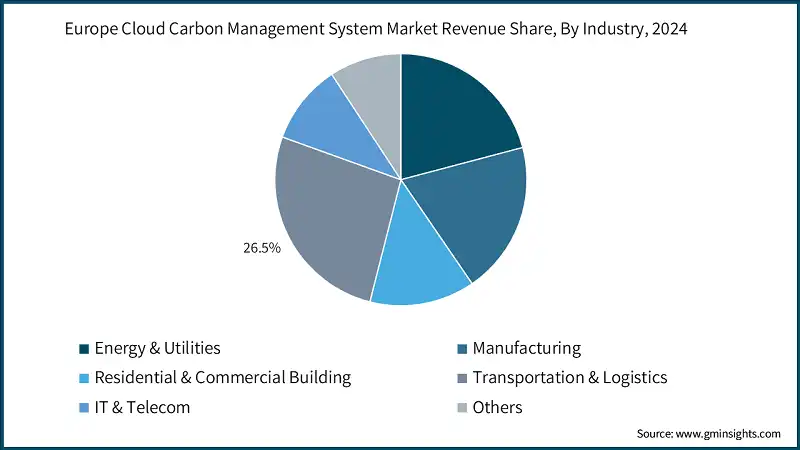
- Based on industry, the market is segmented into energy & utilities, manufacturing, residential & commercial building, transportation & logistics, IT & telecom. Transportation & logistics industry held a market share of 26.5% in 2024 and will grow at a CAGR of 9.7% through 2034.
- Increasing fleet emissions monitoring & optimization along with rising integration with telematics and mobility platforms is augmenting the industry scenarios. Logistics companies are adopting cloud platforms to monitor fleet emissions, optimize routes, and transition to low-carbon vehicles. These systems support compliance with EU mobility regulations and help reduce Scope 1 and 3 emissions from transportation activities.
- For instance, in 2022, two companies in UK, B&Q & GXO, engaged in retail transport network, introduced the B&Q Sustainability Glidepath, establishing a clear roadmap for logistics fleet decarbonization. Through performance optimization, improved emissions reporting, and targeted initiatives, emissions forecasts were reduced by 40% in 2024, keeping the companies ahead of their net-zero schedule.
- Furthermore, telematics data from vehicles and mobility platforms is being integrated into cloud carbon systems to provide real-time emissions insights. This supports dynamic carbon accounting and helps logistics providers align with EU Green Deal transport targets.
- Energy & utilities industry exceeded USD 400 million in 2024, driven by grid decarbonization initiatives that are driving real-time carbon monitoring across the region. As Europe accelerates its transition to renewable energy, utilities are adopting cloud-based carbon management systems to monitor emissions in real time across distributed energy resources.
- For instance, in September 2025, the government of Germany decided to adapt the rollout of renewables to the lagging grid expansion and lower its hydrogen ambitions, in a bid to reduce the costs of its landmark energy transition. This in turn will increase the grid expansion powered by renewables, thereby adding to market growth.
- Moreover, utilities are leveraging cloud systems to automate compliance with EU climate regulations and optimize participation in carbon credit markets. These platforms enable scenario modeling, emissions forecasting, and digital reporting aligned with the Fit for 55 package and the Renewable Energy Directive.
- The manufacturing industry will grow at a CAGR of 9% through 2034. The market growth is driven by rising scope 3 emissions mapping across supply chains combined with integration with ERP & production systems. Manufacturers are using cloud carbon management systems to map Scope 3 emissions across complex supply chains. These platforms facilitate supplier engagement, lifecycle analysis, and emissions attribution, helping companies meet CSRD and EU Taxonomy requirements.
- Cloud platforms are being integrated with enterprise resource planning (ERP) and manufacturing execution systems (MES) to track emissions at the process level. This enables real-time carbon foot printing of products and supports eco-design initiatives under the Ecodesign for Sustainable Products Regulation.
- For instance, in October 2025, the government of Germany has pledged to support the country’s chemicals, mining and energy industries in their transition to climate neutrality. The initiative included the allocation of free allowances to certain energy-intensive industry businesses including manufacturing sector, which in turn will sway the business outlook across the country.
Looking for region specific data?
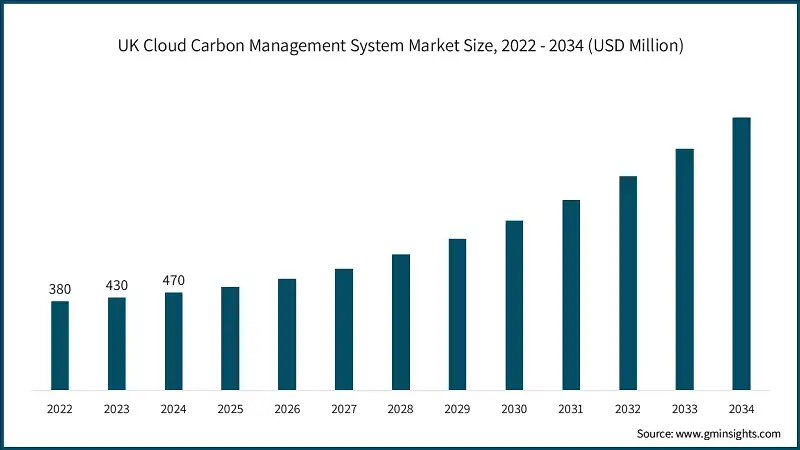
- UK dominated the cloud carbon management system market in Europe with around 24% share in 2024 and generated USD 470 million in revenue. The country’s growth is driven by regulatory alignment with net-zero strategy along with increasing integration with smart grid & IoT infrastructure.
- The UK’s legally binding Net Zero Strategy is driving widespread adoption of cloud carbon management systems. Enterprises are leveraging these platforms to meet carbon budgeting requirements and align with the Climate Change Act. Cloud systems offer real-time emissions tracking and automated reporting, helping businesses comply with the UK’s carbon reduction targets.
- For instance, the 2025 UK Net Zero Business Census surveyed over 2,000 British businesses, providing the most in-depth insight to date on the UK private sector’s attitudes and actions towards net zero. Various firms with 8 in 10 large businesses (79%) consider net zero to be a strategic priority, which in turn will witness an increase down the line.
- Germany cloud carbon management system market will grow at a CAGR of 9.8% by 2034, driven by increasing carbon accounting innovation along with favorable government incentives for cloud sustainability. German companies including SAP and Siemens are leading innovation in carbon accounting software. Their platforms integrate with ERP systems to provide real-time emissions data, enabling compliance with the Corporate Sustainability Reporting Directive (CSRD) and the EU Taxonomy.
- For instance, in February 2025, the European Investment Bank addressed that more than nine in 10 German companies have moved to cut emissions of greenhouse gases. In addition, companies are investing in strengthening their supply chains, in reducing their greenhouse gases and innovation, especially in digital technologies, including robotics and drones.
- France cloud carbon management system market will reach USD 500 million by 2034, owing to strong utility sector adoption combined with rapid expansion in commercial real estate is benefitting the market across the country. France’s energy sector is rapidly adopting cloud carbon management systems to monitor emissions from renewable and conventional sources. Cloud platforms assist utilities meet EU carbon caps and optimize energy efficiency.
- For instance, in September 2025, TotalEnergies was selected by the France as operator of the country’s largest renewable energy project. The company will be responsible for designing, developing, building, and operating a 1.5 gigawatt (GW) offshore wind farm off the coast of Normandy.
- Spain cloud carbon management system industry will grow at a CAGR of 9.7% by 2034, driven by increasing transportation sector digitalization along with favorable EU funding for SMEs adoption. Spain’s logistics and transport companies are using cloud platforms to track fleet emissions and optimize routes. These systems support compliance with EU mobility regulations and help reduce Scope 1 and 3 emissions.
- For instance, Royal Decree 214/2025 came into force on June 6th, 2025, as part of Spain’s climate emergency plan, making it mandatory for in-scope companies to calculate and publish their carbon footprint. The framework for climate action was adopted in 2021 with the goal of being climate neutral by 2050.
Europe Cloud Carbon Management System Market Share
- The top 5 companies in Europe cloud carbon management system industry, Engie, Enablon, IBM, Microsoft, and SAP held over 40% market share in the year 2024. SAP holds a major market share in Europe’s cloud carbon management system market. Its integrated sustainability tools like SAP Sustainability Control Tower and Green Ledger are widely adopted by large enterprises for Scope 1, 2, and 3 emissions tracking.
- Schneider Electric commands a strong market presence, leveraging its expertise in energy automation and digital solutions. Its EcoStruxure Resource Advisor platform supports real-time carbon and energy tracking across complex operations across majority of the countries in Europe.
Europe Cloud Carbon Management System Market Companies
Major players operating in the Europe cloud carbon management system industry are:
- Carbmee
- Emitwise
- Enablon
- ENGIE
- Greenly
- Greenstone+
- IBM
- IsoMetrix
- Microsoft
- Net0
- Persefoni
- Plan A
- Salesforce
- SAP
- Schneider Electric
- Simble Solutions
- Sphera
- Sweep
- Terrascope
- Watershed
- SAP is in enterprise application software, with a strong foothold in Europe’s cloud carbon management market. Its SAP Sustainability Control Tower and Green Ledger tools are widely adopted by large enterprises for tracking Scope 1, 2, and 3 emissions. The company’s strength lies in its deep integration with ERP systems, enabling seamless sustainability reporting and compliance.
- ENGIE is a major European utility and energy services company with a strong focus on decarbonization and energy transition. In the cloud carbon management space, ENGIE leverages its expertise in energy efficiency, decentralized energy systems, and smart infrastructure to offer digital platforms that help clients monitor and reduce emissions.
- Microsoft is a global technology company with a growing presence in Europe’s sustainability tech landscape. Its Cloud for Sustainability platform, integrated with Azure, provides tools for emissions tracking, ESG reporting, and sustainability analytics. Microsoft’s strengths include scalability, AI integration (via Copilot), and seamless compatibility with enterprise IT systems.
Europe Cloud Carbon Management System Market Report Attributes
| Key Takeaway | Details |
|---|---|
| Market Size & Growth | |
| Base Year | 2024 |
| Market Size in 2024 | USD 1.9 Billion |
| Market Size in 2025 | USD 2.2 Billion |
| Forecast Period 2025 - 2034 CAGR | 9.6% |
| Market Size in 2034 | USD 5 Billion |
| Key Market Trends | |
| Drivers | Impact |
| Increasing regulatory pressure | The EU Green Deal and CSRD (Corporate Sustainability Reporting Directive) are compelling companies to adopt robust carbon tracking and reporting systems. |
| Corporate net-zero commitments | A surge in voluntary climate pledges is pushing enterprises to invest in cloud-based carbon management platforms for transparency and accountability. |
| Pitfalls & Challenges | Impact |
| Data integration challenges | Various companies struggle to unify emissions data across complex supply chains and legacy systems, limiting the effectiveness of carbon management platforms. |
| Opportunities: | Impact |
| SME adoption growth | As solutions become more modular and affordable, small and medium enterprises across Europe are emerging as a new growth segment for cloud carbon tools. |
| AI & automation | Integration of AI for predictive emissions modeling and automated compliance reporting is opening new frontiers for innovation. |
| Market Leaders (2024) | |
| Market Leaders |
10% market share |
| Top Players |
Collective market share in 2024 is 40% |
| Competitive Edge |
|
| Regional Insights | |
| Largest Market | UK |
| Fastest Growing Market | Germany, Spain |
| Emerging Country | Italy |
| Future outlook |
|
What are the growth opportunities in this market?
Europe Cloud Carbon Management System Industry News
- In October 2025, the government of Germany decided to invest over USD 6 billion in industrial decarbonization program, including CCS technology. The program targets energy-intensive sectors such as chemicals, steel, cement and glass, as Germany navigates stringent climate targets amid concerns over industrial competitiveness.
- In May 2025, the European Commission adopted secondary legislation under the NZIA to accelerate clean tech manufacturing and mandate carbon tracking in public procurement.
- In March 2025, Microsoft released version 2.29 of its Sustainability Manager, adding features for alternate emissions scenarios, ESG metric tracking, and CBAM-based carbon fee estimation.
- In February 2024, the European Commission adopted the Industrial Carbon Management Strategy, aiming to establish a single CO2 market and attract investments in CCUS technologies. This initiative is a cornerstone of the EU’s decarbonization efforts.
This Europe cloud carbon management system market research report includes in-depth coverage of the industry with estimates & forecast in terms of revenue (USD Million) from 2025 to 2034, for the following segments:
Market, By Component
- Solutions
- Services
Market, By Industry
- Energy & utilities
- Manufacturing
- Residential & commercial building
- Transportation & logistics
- IT & telecom
- Others
The above information has been provided for the following countries:
- Germany
- France
- UK
- Spain
- Italy
Frequently Asked Question(FAQ) :
What is the market size of the Europe cloud carbon management system in 2024?
The market size was USD 1.9 billion in 2024, with a CAGR of 9.6% expected through 2034 driven by CSRD enforcement and digital product passport integration for carbon transparency.
What is the projected value of the Europe cloud carbon management system market by 2034?
The Europe cloud carbon management system market is expected to reach USD 5 billion by 2034, propelled by regulatory pressure, corporate net-zero commitments, and AI-powered carbon tracking solutions.
What is the current Europe cloud carbon management system market size in 2025?
The market size is projected to reach USD 2.2 billion in 2025.
How much revenue did the solutions segment generate in 2024?
Solutions dominated with 53.5% market share in 2024, led by AI and machine learning integration for emissions forecasting.
What was the market share of transportation & logistics industry in 2024?
Transportation & logistics held 26.5% market share in 2024, supported by fleet emissions monitoring and telematics integration.
What is the growth outlook for cloud services from 2025 to 2034?
Cloud services are projected to grow at a CAGR of 10% through 2034, driven by blockchain technology integration for carbon data traceability and automated compliance reporting.
Which country leads the Europe cloud carbon management system market?
UK held 24% market share with USD 470 million revenue in 2024. Regulatory alignment with net-zero strategy and smart grid integration fuel the country's dominance.
What are the upcoming trends in the Europe cloud carbon management system market?
Key trends include CSRD and Digital Product Passport compliance, AI-powered predictive emissions modeling, blockchain for carbon credit verification, and integration with ERP and IoT systems for real-time tracking.
Who are the key players in the Europe cloud carbon management system market?
Key players include Carbmee, Emitwise, Enablon, ENGIE, Greenly, Greenstone+, IBM, IsoMetrix, Microsoft, Net0, Persefoni, Plan A, Salesforce, SAP, Schneider Electric, Simble Solutions, Sphera, Sweep, Terrascope, and Watershed.
Europe Cloud Carbon Management System Market Scope
Related Reports