Summary
Table of Content

Europe Class 7 Trucks Market
Get a free sample of this report
Form submitted successfully!
Error submitting form. Please try again.
Thank you!
Your inquiry has been received. Our team will reach out to you with the required details via email. To ensure that you don't miss their response, kindly remember to check your spam folder as well!
Request Sectional Data
Thank you!
Your inquiry has been received. Our team will reach out to you with the required details via email. To ensure that you don't miss their response, kindly remember to check your spam folder as well!
Form submitted successfully!
Error submitting form. Please try again.
Europe Class 7 Trucks Market Size
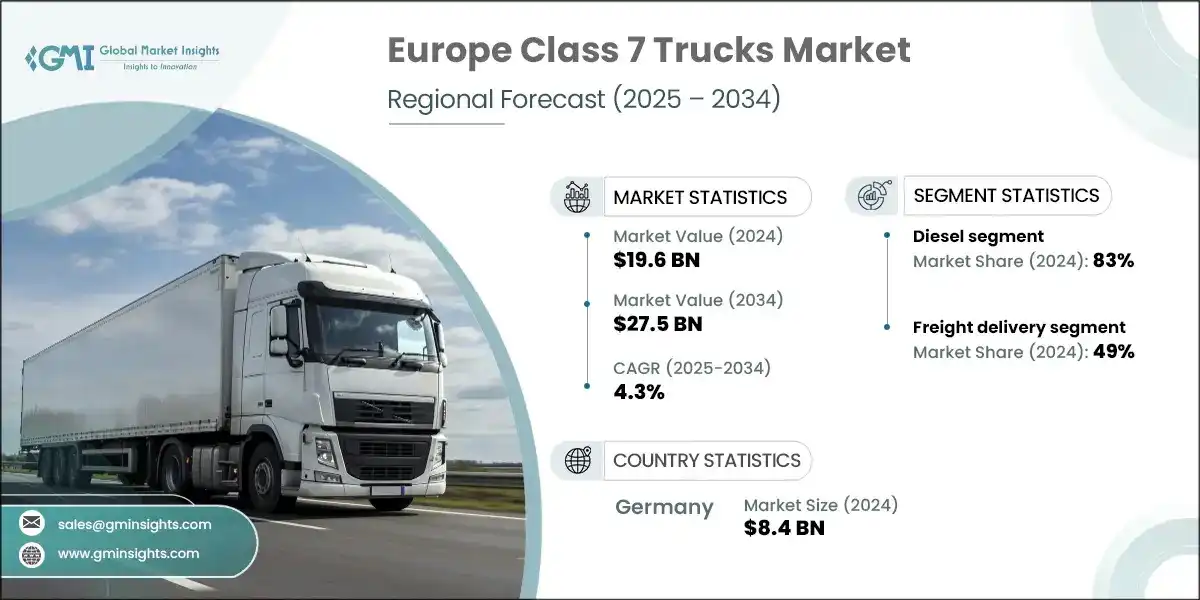
The Europe class 7 trucks market size was estimated at USD 19.6 billion in 2024. The market is expected to grow from USD 18.8 billion in 2025 to USD 27.5 billion in 2034, at a CAGR of 4.3%.
Europe Class 7 Trucks Market Key Takeaways
Market Size & Growth
- 2024 Market Size: USD 19.6 Billion
- 2025 Market Size: USD 18.8 Billion
- 2034 Forecast Market Size: USD 27.5 Billion
- CAGR (2025–2034): 4.3%
Regional Dominance
- Largest Market: Western Europe
- Fastest Growing Region: Northern Europe
Key Market Drivers
- Stricter emission norms and transition to low-emission vehicles.
- Digitalization of logistics and fleet connectivity.
- Surge in regional freight movement due to e-commerce growth.
- Government incentives and infrastructure support for clean transport.
Challenges
- High initial cost of electric and hydrogen trucks.
- Limited charging and refuelling infrastructure.
Opportunity
- Expansion of urban micro-warehousing and last-mile delivery networks.
- Advancements in battery and hydrogen fuel technologies.
Key Players
- Market Leader: Daimler Truck led with over 43% market share in 2024.
- Leading Players: Top 5 players in this market include Daimler Truck, Iveco, MAN Truck & Bus, PACCAR, Volvo Truck, which collectively held a market share of 78% in 2024.
Get Market Insights & Growth Opportunities
- The adoption of low-emission Class 7 trucks was significantly accelerated by the implementation of stricter emissions regulations after 2018. Earlier, fleet operators were reluctant to shift due to the clean technologies’ mounting infrastructure costs, underutilized clean tech infrastructure and enforcement lax regulations. In future, the anticipated Euro VII regulations and zero-emission freight targets will be most likely to fuel the transition of electric and hydrogen-powered Class 7 trucks throughout Europe.
- In April 2024, the European Parliament has officially accepted the new Euro 7 emission regulations set forth by the European Commission. As with previous Euro classifications, the new regulations set exhaust emission limits for specified groups of buses and trucks, while passenger cars and vans continue to operate under the Euro 6 limits.
- Since 2019, the digital revolution of logistics networks has accelerated the adoption of smart and connected Class 7 trucks. Today, a very robust trajectory exists relative to the market uptake of V2X capable trucks smart fleet features, integrated fleet management, predictive maintenance, and real-time diagnostics. Soon, we will see a dramatic expansion of the market for trucks featuring digital capability due to advanced V2X communication and AI logistics.
- The e-commerce trend following the 2020 pandemic disruptions greatly propelled the use of mid-weight trucks. Previously, the freight segment was monopolized by long-haul trucks. Also, the limited availability of warehouses near cities resulted in Class 7 vehicles being Regionally underused.
- In July 2025, Hived, a UK-based e-commerce logistics provider, secured USD 42 million in funding to grow their all-electric delivery truck fleet. With this funding, Hived expects to expand into southern cities, such as Bristol, Bath, and Brighton in late 2025, with expected expansion into Birmingham and Manchester in 2026. This announcement supports Hived's commitment to zero-emission sustainable last-mile delivery solutions.
- Since 2021 trucks have profited from infrastructure spending and financial incentives. In the past, expansion was constrained by the high costs of hydrogen refueling stations, batteries, and public charging infrastructure lack of policy support. Now, electric and low-emission trucks qualify for public purchase grants, tax allowances, and toll exemptions.
- Tighter emissions regulations, sophisticated road infrastructure, and increasing urban e-commerce demands for mid-weight Class 7 hardgoods delivery, are steering Europe towards sustainable logistics. These trends have paved the way for increased implementation of clean, smart logistics systems and electric fleet solutions. As a result, Europe is at the forefront of the deployment of mid-sized and regionally sourced clean vehicles and strengthening its position in sustainable transport and urban delivery.
To get key market trends
Europe Class 7 Trucks Market Trends
- The progression towards electric Class 7 trucks started in 2018 with the evolution of emission standards and the development of battery technology. By the mid-2020s the fleet focus greatly improves due to the rising fuel prices, growing charging infrastructure, and sustainability in logistics. In the future Class 7 electric trucks are expected to take over regional freight activities and will be widely adopted by logistics service providers throughout Europe.
- In January 2025, Amazon has purchased more than 140 units of the Mercedes-Benz eActros 600 and 8 Volvo FM Electric trucks which is the UKs largest zero-emission heavy truck fleet. This marks Phase 1 of a more comprehensive plan which aims to utilize 1,500 electric trucks in Europe by 2027, supported by a green transport initiative of 300 million pounds, planning to achieve net-zero carbon emissions by 2040.
- Class 7 trucks were underutilized in regional logistics due to the dominance of long-haul trucking prior to 2020. The pandemic accelerated the use of these trucks due to an increase in e-commerce as well as the adoption of decentralized warehousing. Furthermore, Class 7 trucks are expected to continue being essential for short-haul and intra-city freight across Europe as urbanization, as well as micro-fulfillment, increases.
- The alternate fuels for commercial trucking before 2019 had no trust due to their lack of testing, high price and a lack of refueling infrastructure. Currently, hydrogen and biofuels are receiving attention due to the carbon-neutral logistics initiative of the early 2020s, backed by pilot programs and funding from the EU. Provided that the refueling infrastructure and technology continue to advance, hydrogen and biofuels stand to complement electrification for longer range Class 7 operations.
- In February 2025, as part of the Clean Hydrogen Partnership’s H2Haul project, Iveco has provided BMW with two S-eWay Fuel Cell heavy-duty trucks for logistics testing between BMW's locations in Bavaria. These trucks have a range of 800 km and refill in less than 20 minutes, with recently established hydrogen filling stations in Leipzig and Hormersdorf.
- The Class 7 trucks until 2016 only had basic safety features equipped, which included cruise control and ABS. By the early 2020s, regulatory pressures and insurance policies promoted advanced safety features like ADAS, with collision detection, lane keeping assist, and blind spot monitoring becoming the industry standard. In the coming years, AI-powered safety mechanisms and semi-autonomous functionalities are set to reshape the industry standard for mid-weight commercial vehicles.
Europe Class 7 Trucks Market Analysis
Learn more about the key segments shaping this market
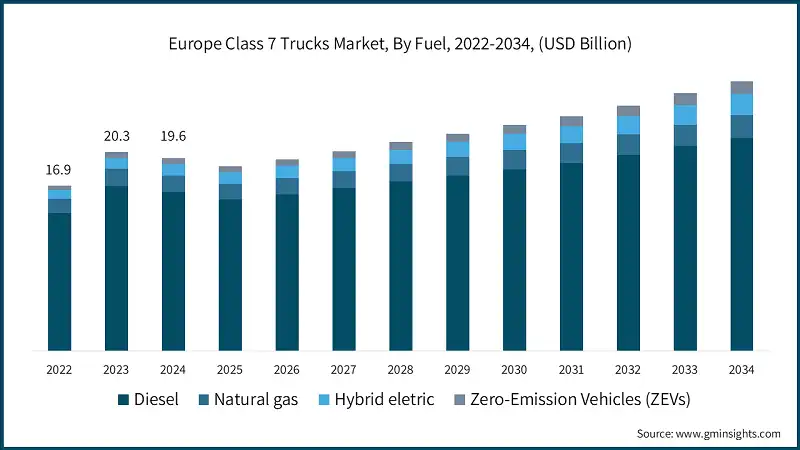
Based on fuel, the Europe class 7 trucks market is divided into diesel, natural gas, hybrid electric and zero-emission vehicles (ZEVs). The diesel segment dominated the market accounting for around 83% in 2024 and is expected to grow at a CAGR of over 3% through 2034.
- The diesel segment remains dominant since the strengths of diesel include superior fuel efficiency in intra-country and transnational freight operations. Although interest in alternative fuels is growing rapidly, the overall advantages of diesel including existing infrastructure, long-haul efficiencies, and high surge torque remain a strong consideration in heavy-duty applications. However, the segment has a slower adoption of new technologies and better performance measures leading to a negative lag in evolving technology relative to the regulatory and organizational landscape for sustainability.
- Zero-emission vehicles are witnessing a 9% CAGR till 2034, attributable to stricter emissions regulations, government incentives, and advances in electric drivetrain technologies. Fleets are increasingly transitioning to battery and hydrogen powered trucks, particularly in urban logistics and short-haul portion of the value chain. OEMs are ramping up production and hydrogen infrastructure investments are improving. As such, zero-emission trucks are expected to start capturing additional market share over the next decade.
- In May 2025, ZF announced the launch of TraXon 2 Hybrid, a modular transmission system for medium and heavy-duty trucks, including Class 7 vehicles. It can be obtained in different forms including mild hybrid to plug-in variants. ZF forecasts reductions of 16% in CO? and fuel emissions, with plug-in versions achieving reductions of 40% in some cases.
- The natural gas is rising as it is cheaper in price and less polluting than diesel. Italy and Germany already have advanced natural gas refueling infrastructure. Increased natural gas adoption is also being aided by less governmental support and more aggressive pollution regulations.
- In Europe, hybrid electric trucks have been increasing in the market. Hybrid trucks offer a more fuel-efficient option, lower emissions and operational costs while still providing enough range and performance for regional haul applications. Government incentives and low emissions zones in urban areas, along with the need for transitional technologies in fleet electrification, are helping to drive the sales of this technology among logistics and vocational operators.
Learn more about the key segments shaping this market
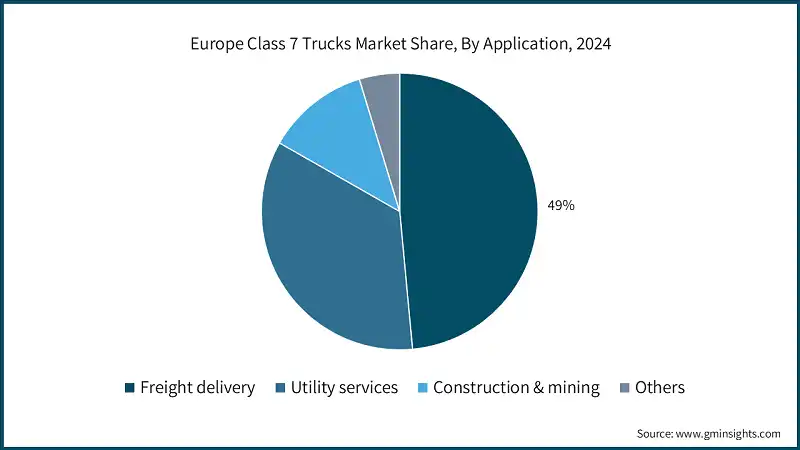
Based on application, the Europe class 7 trucks market is segmented into freight delivery, utility services, construction & mining and others. The freight delivery segment dominates the market with 49% share in 2024, and the segment is expected to grow at a CAGR of over 4% from 2025 to 2034.
- Freight delivery has the highest share in terms of value in the Europe class 7 trucks market. This is due to the recently increasing need for regional and last-mile shipping services in the wake of the surging e-commerce and retail supply chains. These trucks strike a proper equilibrium between high fuel efficiency and adequate load capacity for both intra-city and inter-city delivery which is a bonus for logistics and distribution companies.
- In February 2025, DHL Group’s subsidiary implemented 21 new electric vans in Lower Saxony, Saxony, Berlin, Bavaria and Baden-Württemberg for the large and bulky e-commerce furniture and appliance deliveries. This move is in line with the group’s sustainability goals and greatly reduces CO? and diesel emissions.
- Utility service grows at 5% CAGR, due to increasing adoption of trucks for their capacity to carry heavy equipment, accommodate long service hours, and operate in harsh conditions. These trucks are essential during waste management, power line maintenance, and other emergencies.
- The use of Class 7 trucks is used heavily in construction and mining and have increased due to their ability to transport a large weight over uneven terrain. The continued growth of the construction and mining industries in Europe will continue to drive the need for these dependable trucks.
Based on horsepower, the Europe class 7 trucks market is segmented into below 300 HP, 300–400 HP and above 400 HP. The 300-400 HP segment is expected to dominate as the ideal balance between power and fuel efficiency, making it suitable for long-haul freight and regional transport.
- The 300-400 HP segment drives the market as a balance between performance and fuel economy. This horsepower range supports regional freight, utility, and construction-related performance drivers while minimizing fuel expenditures. Furthermore, it aids in meeting emission standards and guarantees reliable operations in different types of environments.
- In May 2025, Scania revealed the new Super 11-liter diesel engine which is offered with three horsepower options 350 hp, 390 hp and 430 hp. Although intended for applications where fuel and weight savings are important, the engine still offers 7% fuel saving over its predecessor 9-litre and is also 85 kg lighter than the 13 Super engines.
- Below 300 HP grows at 6% CAGR due to their combination of power, payload capacity, and maneuverability for dense city routes and moderate terrain, they are advantageous to French, German and Austrian economies where there is a need for short to mid-distance freight movement, for instance, between industrial centers and construction sites.
Based on ownership the Europe class 7 trucks market is segmented into fleet operator and independent operator. The fleet operator segment is expected to dominate as focus on total cost of ownership, fuel efficiency, and regulatory compliance, there is rising demand for durable, low-maintenance, and performance-optimized components.
- The fleet operator segment dominates the Europe class 7 trucks market owing to the growing need for organized and large-scale freight and logistics services. Fleet operators reap the benefits of economies of scale, sophisticated telematics, along with easier adherence to emissions and safety regulations.
- In October 2024, Simon Loos, based in the Netherlands, has added to the industry's largest fleet of fully electric vehicles with the order of 75 Mercedes-Benz eActros 600 electric trucks, incorporating a total of 150 vehicles, thereby placing Simon Loos among Europe's leading medium-duty electric vehicle fleet owners and marking a unique milestone for sustainable logistics.
- Independent operators grow at 2% CAGR. Self-employed operators in the European Class 7 truck market are also leaning toward vehicle customization - albeit belatedly through the vehicle adoption of fuel-efficient tires, driver-assist technology, or lightweight body parts retrofit after the initial purchase.
Looking for region specific data?
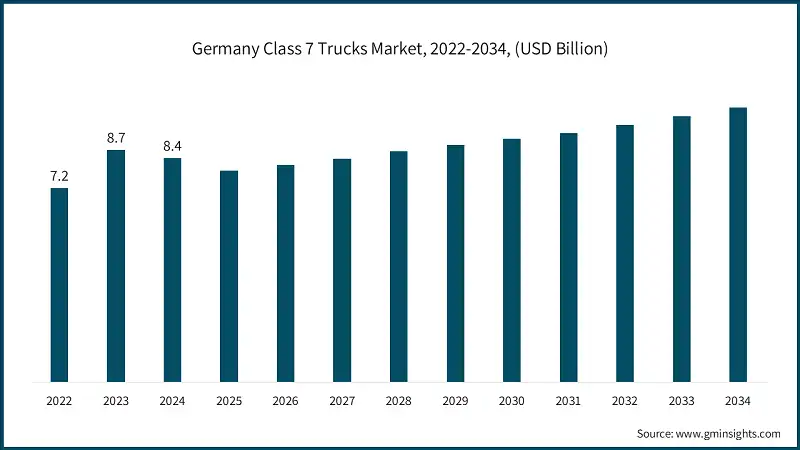
Germany dominated the Europe class 7 trucks market with around 43% share and generated USD 8.4 billion in revenue in 2024.
- Germany leads in the market due to strong manufacturing base, developed automotive infrastructure and well-functioning logistics industry. Its considerable market share is supported by its Central location in Europe which allows cross border transportation and its supportive clean transportation policies as well as investment in refueling and charging infrastructure.
- In July, Germany will begin a national leadership effort called "Power to the Road" which will establish a fast-charging network for heavy-duty trucks (similar to EV charging) on almost 95% of federally designated highways. Germany hopes to further drive the transition to zero-emission logistics, by promoting the use of electric Class 7 and higher trucks.
- The government expenditure in France along with the adoption of policies enforcing EU emissions standards and the adoption of digital logistics, is nurturing a clean transportation infrastructure. France’s secondary freight and utility services are being improved by these initiatives.
- The UK is progressing towards its low-emission freight goals with its Net Zero Strategy, expanding the EV charging infrastructure, and smart fleet initiatives. Encompassed by increasing local logistics and green policy motivation.
The class 7 trucks market in Eastern Europe is expected to experience significant and promising growth from 2025 to 2034.
- Poland leads the market; it is becoming an important logistics center for the whole of Eastern Europe. With Poland's upgraded infrastructure, expanding industrial regions, European Union investments towards environmentally friendly transport solutions and increased construction, there is a rising demand for Class 7 trucks in the freight and construction sectors.
- In March 2025, Poland has announced two funding programs worth €440 million each to bolster the electrification of heavy transport. The funding covers: the construction of charging stations and the purchase or leasing of N2/N3 zero-emission trucks along pivotal TEN-T corridors and at logistics hubs.
- The expanding manufacturing industry in Czechia along with growing international freight traffic with Germany, Austria and Slovakia is driving the growth of Class 7 truck market in the country.
- The Class 7 trucks have outstanding logistic and road development investment opportunities for Romania, notably due to the ongoing construction of the A3 and A7 motorways and the Port of Constanta’s expansion. Romania’s recovery investment plans, along with EU funding, are significantly driving freight activity, which in turn accelerates the need for medium-duty regional trucks.
The class 7 trucks market in Northern Europe is expected to experience significant and promising growth from 2025 to 2034.
- The overall truck market for Sweden is set to reach nearly 8,790 units by 2025. Due to the efforts and subsidization along with its logistical position elevate Sweden to one of the key enablers of growth for the Class 7 truck market in Northern Europe.
- In May 2025, PreZero, a Swedish company specializing in waste management, has received a substantial order of 35 battery-electric Volvo trucks which includes several Volvo FM Low Entry models specially designed for electric use.
- Norway’s goal to fully decarbonize heavy-duty transport by mandating 50% adoption of zero-emission trucks by 2030 and complete transition to emission-free heavy vehicles by 2040 is flocking fleet renewal. Enova’s recent funding of €11.5 million to subsidize the deployment of over 100 electric commercial vehicles and the construction of 108 fast-charging hubs along important corridors is accelerating fleet renewal.
- The markets for Class 7 trucks in Finland and Iceland are small, they are growing steadily due to the continuing need for dependable transport in rugged and navigable terrains. Finland focuses on the forestry and construction industries, while Iceland emphasizes transports due to the country’s clean energy focus. Both countries are adopting environment-friendly trucks owing to eco-sustainable policies and green targets.
The class 7 trucks market in Southern Europe is expected to experience significant and promising growth from 2025 to 2034.
- In Southern Europe, Italy is the leader in Class 7 trucks, thanks to strong logistics activity and good government clean transport initiatives. The market is expected to grow significantly, especially with the recent €8 million initiative to promote the purchase of electric, hybrid, and LNG-powered trucks.
- The investment in logistics hubs such as the Port of Barcelona and the Mediterranean TEN–T network is greatly bolstering the Class 7 truck market in Spain. The surge in cross-border freight traffic is also contributing. The manufacturing industry along with e-commerce, and infrastructure transport are driving demand.
- Albania is an upcoming growth point for Class 7 trucks as new highways are being built, and the Tirana Logistic Park is underway. The integration into EU transport corridors, such as Pan-European Corridor VIII is also substantially improving connectivity and the investment attractiveness of the region.
- Greece and Slovenia are becoming emerging markets for Europe class 7 trucks, given the increase in infrastructure spend, EU-supported clean transport policies and rising freight demand in the region. Greece is investing in the logistics sector with enhancements to ports and highways and Slovenia is strategically positioned on major EU freight corridors, including the TEN-T corridors, which has given it the opportunity to enhance the transit market with more road-based freight transit.
Europe Class 7 Trucks Market Share
- The top 7 companies in the Europe class 7 trucks industry are Daimler Truck, Volvo Truck, MAN Truck & Bus, Scania, PACCAR, Iveco, and Volkswagen contributing around 83% of the market in 2024.
- Daimler Truck is a global leader in the manufacturing of commercial vehicles and operates the Mercedes Benz, Freightliner, and FUSO brands. The company is heavily invested in zero-emission battery electric and hydrogen fuel cell trucks. In addition, the company has further advanced in autonomous driving technology and digital fleet management.
- Volvo is a key player in the heavy-duty truck segment of the Volvo Group. The company has electric, and hydrogen fueled fuel cell trucks in development. Volvo further prioritizes safety, sustainability, and innovation along with offering driver assistance technologies.
- MAN Truck is important in the Europe Class 7 Trucks market, offering flexibility with medium duty vehicles for distribution, construction, and municipal use. They are part of the TRATON Group and use very efficient diesel and alternative powertrains. They have a good dealer presence and provide digital fleet solutions, continuing to support fleet operators with the ongoing changes to emissions and urban mobility rules.
- PACCAR is the parent company of well-known truck brands like Kenworth, Peterbilt, and DAF. These brands are recognized for high-performance, durable trucks in North America and Europe. PACCAR is diversifying through investments in the electric and autonomous technologies ecosystem and is known for excellent aftermarket support.
- Iveco Group, an Italian company, manufactures light, medium and heavy commercial vehicles, as part of the group, Iveco also produces light vehicles. Furthermore, the company is also known for researching pioneering work on electric vehicles and natural gas alternative fuels.
- Scania, as a TRATON Group brand, participates in the premium end of the Europe Class 7 Trucks market with great strength in its engineering, fuel-efficient drivetrains, and driver comfort. With Scania's hybrid and electric models taking center stage, Scania is keen to follow the EU requirement for reducing emissions. Scania has a modular vehicle platform, allowing for varied vocational and logistics use while emphasis on sustainability and lifecycle support helps to shape the transition to lower-emission transport.
- Volkswagen has a limited and indirect footprint in the Europe Class 7 segment. Volkswagen focused on connectivity and electrification innovation, and although it has some influence on platform and technology-sharing that would indirectly be a benefit to the Class 7 market. Volkswagen Truck & Bus is ultimately making investments as part of the long-term transition of its European commercial vehicle portfolio.
Europe Class 7 trucks Market Companies
Major players operating in the Europe class 7 trucks industry are:
- Ashok Leyland
- Daimler Truck
- Iveco
- Kamaz
- MAN Truck & Bus
- PACCAR (DAF Trucks)
- Scania
- Tata Motors
- Volvo Trucks
- Renault Trucks
- Daimler Truck, TRATON Group and Volvo Trucks are working together to further increase sales of e-trucks in Europe. TRATON has set a goal to significantly increase the share of BEVs and also achieve a return on sales of 9–11% by 2029.
- Daimler Truck and Volvo Trucks have jointly established Core Tura, a Swedish software defined vehicle spin-off which focuses on the development of software trucks on the internet of things.
- Tata Motors and PACCAR along with Ashok Leyland are expanding global operations further; Leyland anticipates earning 20 percent of revenue from exports within five years, bolstered by Switch Mobility’s plans to target Europe with EV buses.
- Tata Motors, Iveco, and Ashok Leyland are updating their product lines; Ashok plans to release six new LCV variants by 2025, Iveco S&P launched the S-eWay tractor, a fully electric grade vehicle with 500 km range and Tata introduced prima trucks with ADAS features.
Europe Class 7 Trucks Market Report Attributes
| Key Takeaway | Details |
|---|---|
| Market Size & Growth | |
| Base Year | 2024 |
| Market Size in 2024 | USD 19.6 Billion |
| Market Size in 2025 | USD 18.8 Billion |
| Forecast Period 2025 - 2034 CAGR | 4.3% |
| Market Size in 2034 | USD 27.5 Billion |
| Key Market Trends | |
| Drivers | Impact |
| Stricter emission norms and transition to low-emission vehicles | Accelerated fleet upgrades to electric and hydrogen-powered Class 7 trucks. |
| Digitalization of logistics and fleet connectivity | Improved operational efficiency and real-time fleet management. |
| Surge in regional freight movement due to e-commerce growth | Increased deployment of Class 7 trucks for urban and regional deliveries. |
| Government incentives and infrastructure support for clean transport | Boosted adoption of sustainable trucks through subsidies and charging infrastructure. |
| Pitfalls & Challenges | Impact |
| High initial cost of electric and hydrogen trucks | Slows adoption among small and medium-sized fleet operators. |
| Limited charging and refuelling infrastructure | Restricts the operational range and scalability of clean Class 7 trucks. |
| Opportunities: | Impact |
| Expansion of urban micro-warehousing and last-mile delivery networks | Drives demand for agile, mid-weight Class 7 trucks in city logistics. |
| Advancements in battery and hydrogen fuel technologies | Enhances range, efficiency, and affordability of low-emission trucks. |
| Market Leaders (2024) | |
| Market Leaders |
43% market share |
| Top Players |
|
| Competitive Edge |
|
| Regional Insights | |
| Largest Market | Western Europe |
| Fastest growing market | Northern Europe |
| Emerging countries | Ireland, Romania, Finland, Albania, Greece, Slovenia |
| Future outlook |
|
What are the growth opportunities in this market?
Europe Class 7 Trucks Industry News
- In May 2025, a corridor of hydrogen fueling stations will be built across eastern, central, and western Europe, to include Germany, Hungary, and Turkey. With money provided by the EU and energy partners OMV, and Total Energies, the hydrogen trucking corridor for long-distance travel. The vision of the initiative is to eliminate infrastructure barriers and allow for the movement of goods from country to country using hydrogen-powered Class 7 trucks.
- In April 2025, a joint venture between Daimler Truck and Volvo AB will begin producing hydrogen fuel cells in Europe, positioning adjacent upstream fuel logistics alongside truck delivery systems.
- In February 2025, as part of the Clean Hydrogen Partnership’s H2Haul project, Iveco has provided BMW with two S-eWay Fuel Cell heavy-duty trucks for logistics testing between BMW's locations in Bavaria. These trucks have a range of 800 km and refill in less than 20 minutes, with recently established hydrogen filling stations in Leipzig and Hormersdorf.
- In January 2025, Amazon has purchased more than 140 units of the Mercedes-Benz eActros 600 and 8 Volvo FM Electric trucks which is the UKs largest zero-emission heavy truck fleet. This marks Phase 1 of a more comprehensive plan which aims to utilize 1,500 electric trucks in Europe by 2027, supported by a green transport initiative of 300 million pounds, planning to achieve net-zero carbon emissions by 2040.
- In August 2024, European truck manufacturers such as MAN and Volvo are adapting their existing diesel engine systems to function with hydrogen combustion engines, as this approach is quicker and more economical than transitioning to fuel cell technologies. By 2025, MAN expects to operationalize 200 hydrogen-powered truck units for European customers.
The Europe class 7 trucks market research report includes in-depth coverage of the industry with estimates & forecasts in terms of revenue (USD Million) and shipments (Units) from 2021 to 2034, for the following segments:
Market, By Fuel
- Diesel
- Natural gas
- Hybrid electric
- Zero-emission vehicles (ZEVs)
Market, By Horsepower
- Below 300 HP
- 300–400 HP
- Above 400 HP
Market, By Application
- Freight delivery
- Utility services
- Construction & mining
- Others
Market, By Ownership
- Fleet operator
- Independent operator
Market, By Transmission
- Manual transmission
- Automatic transmission
The above information is provided for the following regions and countries:
- Western Europe
- Germany
- France
- UK
- Netherlands
- Belgium
- Austria
- Switzerland
- Ireland
- Luxembourg
- Eastern Europe
- Poland
- Czech Republic
- Hungary
- Romania
- Slovakia
- Bulgaria
- Ukraine
- Serbia
- Northern Europe
- Sweden
- Denmark
- Norway
- Finland
- Iceland
- Southern Europe
- Italy
- Spain
- Greece
- Croatia
- Slovenia
- Albania
Frequently Asked Question(FAQ) :
What is the market size of the Europe class 7 trucks in 2024?
The market size was USD 19.6 billion in 2024, with a CAGR of 4.3% expected through 2034. The growth is driven by stricter emissions regulations, advancements in clean technologies.
What is the projected value of the Europe class 7 trucks market by 2034?
The market is poised to reach USD 27.5 billion by 2034, supported by the transition to electric and hydrogen-powered trucks, sustainability initiatives, and advancements in safety features.
How much revenue did the diesel segment generate in 2024?
The diesel segment generated approximately 83% of the market revenue in 2024 and is expected to witness over 3% CAGR through 2034.
What was the market share of the freight delivery segment in 2024?
The freight delivery segment held a 49% market share in 2024 and is anticipated to expand at a CAGR of over 4% from 2025 to 2034.
What is the growth outlook for zero-emission vehicles in the market?
Zero-emission vehicles segment is likely to showcase around 9% CAGR till 2034.
Which country leads the Europe class 7 trucks sector?
Germany leads the market with a 43% share, generating USD 8.4 billion in revenue in 2024. The country's dominance is attributed to its strong logistics sector and early adoption of clean technologies.
What are the upcoming trends in the Europe class 7 trucks market?
Trends include electric/hydrogen trucks, better battery/refueling systems, AI safety features, and semi-autonomous functions in mid-weight vehicles.
Who are the key players in the Europe class 7 trucks industry?
Key players include Ashok Leyland, Daimler Truck, Iveco, Kamaz, MAN Truck & Bus, PACCAR (DAF Trucks), Scania, Tata Motors, Volvo Trucks, and Renault Trucks.
Europe Class 7 Trucks Market Scope
Related Reports