Summary
Table of Content

Europe Ceramic Tiles Market
Get a free sample of this report
Form submitted successfully!
Error submitting form. Please try again.
Thank you!
Your inquiry has been received. Our team will reach out to you with the required details via email. To ensure that you don't miss their response, kindly remember to check your spam folder as well!
Request Sectional Data
Thank you!
Your inquiry has been received. Our team will reach out to you with the required details via email. To ensure that you don't miss their response, kindly remember to check your spam folder as well!
Form submitted successfully!
Error submitting form. Please try again.
Europe Ceramic Tiles Market Size
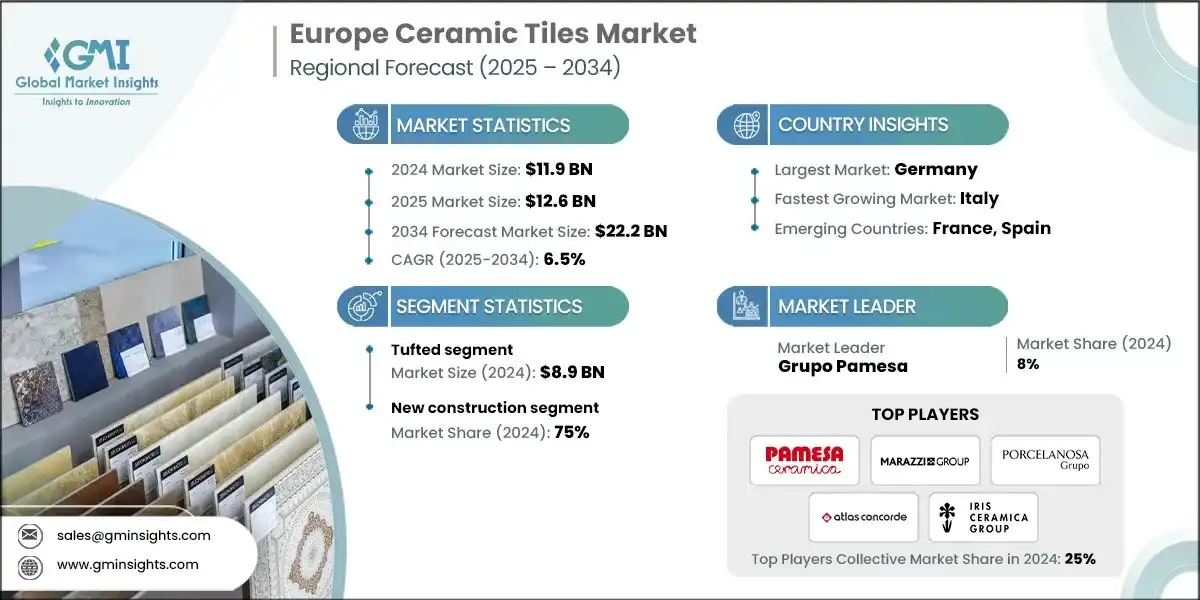
The Europe ceramic tiles market was estimated at USD 11.9 billion in 2024. The market is expected to grow from USD 12.6 billion in 2025 to USD 22.2 billion in 2034, at a CAGR of 6.5% according to latest report published by Global Market Insights Inc.
Europe Ceramic Tiles Market Key Takeaways
Market Size & Growth
- 2024 Market Size: USD 11.9 billion
- 2025 Market Size: USD 12.6 billion
- 2034 Forecast Market Size: USD 22.2 billion
- CAGR (2025–2034): 6.5%
Key Market Drivers
- Urbanization and housing development.
- Rising preference for sustainable materials.
- Technological advancements in design and production.
Challenges
- High energy costs in manufacturing.
- Intense competition and price pressure.
Opportunity
- Growth in renovation and remodeling projects.
- Expansion of online distribution channels.
Key Players
- Market Leader: Grupo Pamesa led with over 8% market share in 2024.
- Leading Players: Top 5 players in this market include Grupo Pamesa, Marazzi Group, Porcelanosa Grupo, Atlas Concorde S.p.A., Iris Ceramica Group, which collectively held a market share of 25% in 2024.
Get Market Insights & Growth Opportunities
The Europe ceramic tile industry is advancing in the area, under the convergence of age-old craftsmanship into modern design sensibilities. The demand is still mostly driven by construction and renovation work, as tiles are always a feasible option - given their strength and durability, low maintenance, and versatility. The manufacturing output is still heavily biased towards the Southern European countries of Italy and Spain, as both have a strong manufacturer and design base. Germany and France are also leading tile consumers - primarily in the commercial space and upper-end renovation.
Design trends are toward larger format tiles - porcelain tiles are sometimes digitally printed to mimic the natural look of materials, such as wood and stone, in order to achieve a cleaned up, polished look for interior application. Sustainability has now become a theme for the ceramic tile industry for all aspects of production and manufacturers are adhering to eco-friendly systems and complying with strict EU emissions and recycling regulations.
Government renovation schemes and green building initiatives under the EU Green Deal legislation are also moving demand towards energy efficient building materials; the ceramic tile is now being touted as a favorable building material due to its thermal properties.
To get key market trends
Europe Ceramic Tiles Market Trends
The ceramic tiles market is undergoing continuous transformation, driven by innovative manufacturing technologies and changing consumer preferences.
- Oversized porcelain tile escalation: The demand for large-size porcelain tiles is on a rise as customers desire a sleek, modern design. With a durable and water-resistant tile with fewer grout joints comes lower maintenance, hence this type of tile is increasingly used in open spaces and in modern design projects both for residential and commercial applications.
- Fast-growing competitive business sense in print technology: As green technology capability advances for print technology, manufacturers can mimic hyper-realistic stone, wood, and marble finishes. Print technology also has enabled designs to have unimaginable flexibility of personalization and design which has increased demand for high-end and beautiful tiles in renovation or luxurious home segments of the European tile industry.
- Sustainability and environmentally friendly production: Stricter, ecologically oriented regulations of the EU, together with the awareness of consumers for sustainability issues, are gradually shifting tile manufacturing towards sustainable production. In the European market, sustainability and eco-friendly practices now involve the use of recycled materials, low-carbon content production processes, and energy-efficient manufacturing approaches, reflecting both the EU Green Deal and EU Renovation Wave.
- Renovation work and green buildings: Renovation programs sponsored by governments and urban redevelopment programs from the EU Green Deal contribute significantly to the demand for ceramic tiles due to their thermal insulation properties; in this respect, ceramic tiles are one of the main enablers in energy-efficient construction and participate in Europe's sustainability goals.
- Hygiene and antibacterial tile focus: The post-pandemic populism trends in Europe have raised consumers' demand for surface materials with built-in antibacterial properties or, at least, self-cleaning capabilities. Self-cleaning and antibacterial functionality came to the forefront in healthcare environments.
Europe Ceramic Tiles Market Analysis
Learn more about the key segments shaping this market
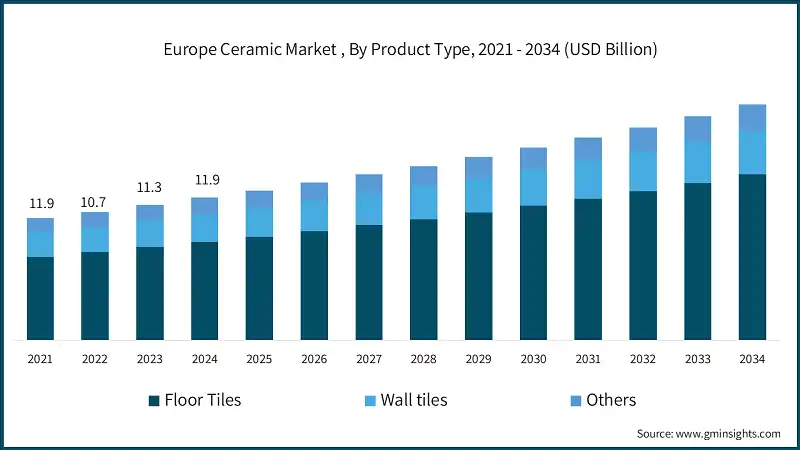
Based on product, the market is divided into floor tiles, wall tiles, and others. In 2024, tufted held the major market share, generating a revenue of USD 8.9 billion.
- Ceramic floor tiles represent the largest market share, due to their indispensable role in building and renovation work. Floors need building materials that can withstand heavy foot traffic, water and general wear and tear over time; ceramic tiles meet those needs perfectly.
- Durability, water resistance, and low maintenance are but a few of the reasons ceramics are still preferred for residential, commercial, and industrial spaces. Additionally, the ability to design ceramic tiles for modern looks or the appearance of natural stone finish helps maintain their mass appeal.
- The floor also covers more space than walls or other decorative applications, so naturally more is consumed. Ceramic floor tiles continue to be the first choice of both builders and homeowners because of their relatively low cost and success with under floor heating systems installed in many more homes, especially in colder countries in Europe. These overall benefits contribute to the continued strength of the ceramic floor tile market.
- Wall tiles represent a much smaller portion of market share, and they are used to complement the others in the total market. Wall tile is primarily used for decorative or beautification purposes and is used to give more fined appearance to the interior of any space. Wall tiles can be used for the aesthetic presentation of kitchen or bathroom spaces and are generally more popular in more areas with a water resistant feature.
Learn more about the key segments shaping this market
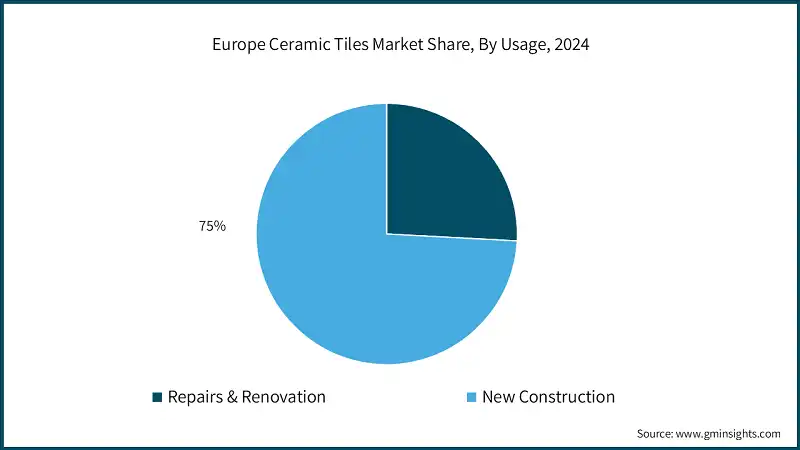
Based on usage, the Europe ceramic tiles market is segmented into repairs & renovation and new construction. The new construction segment held the largest share, accounting for 75% of the global market in 2024.
- The expansion of urban and infrastructure redevelopment in Europe has strengthened the role of new construction in the market for ceramic tiles. Multi-family residential and commercial projects have utilized ceramic tiles in flooring, walls, and facades. Moreover, ceramic tile is preferred by builders due to its performance, longevity, water tolerance, and design flexibility.
- As a result, it has become an established material in contemporary architecture. Demand for housing is steady in countries such as Germany, France, and the UK, while the major focus on tourist and hospitality-related construction in Southern Europe increases the demand for tiles.
- Energy efficiency and sustainability of the buildings are some of the priorities, given existing EU legislation on green building. Ceramic tiles also perform well with sustainability in mind due to their thermal performance and long life cycle, which will reduce costs over time. Due to these attributes, ceramic tile is an ideal product in environmentally sensitive building designs.
- If renovation projects are defined as selective renovations, new construction projects, by definition, will have full installations in a multitude of areas. This inherently means that there will be an increase in the demand for ceramic tile based on size alone. New construction projects inherently create higher tile volumes than renovation projects. In Addition, the public sector, through housing support and urban renewal schemes, will create additional opportunities for new construction as well.
Based on the distribution channel, the Europe ceramic tiles market is segmented into direct sales and indirect sales. In 2024, residential dominates the market by holding most of the market share.
- There is a growing trend in Europe towards indirect sales channels, which continue to dominate the distribution landscape. Indirect sales imply wider reach and accessibility to the end consumer, including retailers, wholesalers, and distributors. The availability of ceramic tile options, through these channels, is also found to be greater for a more varied set of consumer tastes and budgets. Established distributor and retailer networks, on the other hand, make supply chain management smoother, thereby facilitating easier market penetration by manufacturers.
- Direct sales, though not as dominant, are very crucial in the market. This channel is mainly adopted by those manufacturers who aim for projects of substantial magnitude, such as commercial or residential construction, where bulk sales are usually expected. The manufacturers therefore get to engage directly with the clients, ensuring better customization, better pricing, and better after-sales services. The reach of direct sales is limited compared with that achieved by indirect channels, hence it restricts its dominance in the overall market.
- Both the distribution channels are important for the growth in the Europe ceramic tiles market. Indirect sales make up most sales because of their wide network and easy accessibility, whereas direct sales help to cater to the demand from niche segments or large-scale projects. Coexistence of both types of channels provides a balanced approach towards the segmented demand in the marketplace.
Looking for region specific data?
Europe Ceramic Tiles Market
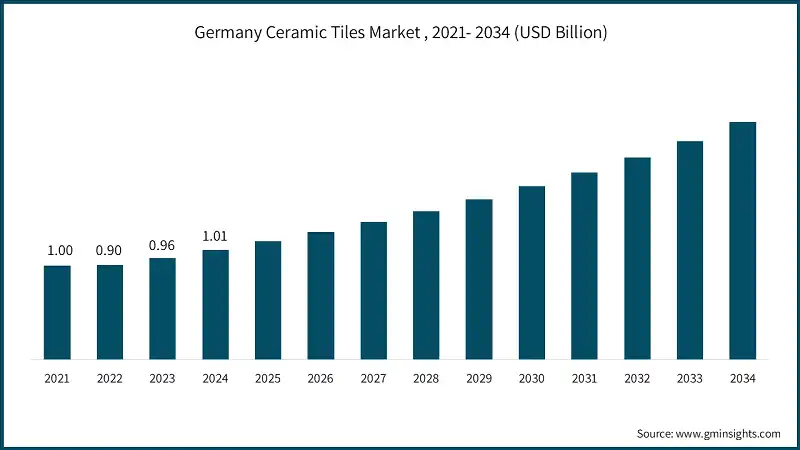
Europe ceramic tiles market, Germany leads the market 8.5% share in 2024 and is expected to grow at 6.2% during the forecast period.
- The French ceramic tile market dominates the European region, as renovation and construction activities are on their peak, supported by urbanization and governmental sustainability programs. Cities like Paris and Lyon continue to grow in terms of residential and commercial buildings that require resistant and aesthetically pleasing flooring. The country's emphasis on ecological building materials complements the EU Green Deal goals and further propels the growth of ceramic tiles.
- France's focus on value-added designs and advanced technologies, such as digital printing, continues to drive growth within the premium segment of the market. Major industry players like Saint-Gobain and local fabrication companies contribute to greater efficiencies in the supply chain and implement innovative advancements, which in turn continue to establish France as a manufacturing and consumption center in the ceramic tile industry.
- Germany is in second place, with construction benefiting from an overall boom, largely from low financing and high consumer spending on residential real estate. In addition to being an important raw materials producer of kaolin, Germany is also a basic innovator of innovative technologies for tile production that contribute to the quality and sustainability of the product. Once again rapid urbanization and industrialization have accelerated housing and commercial construction.
- German manufacturers are able to point to green/eco-friendly production processes and innovative designs as a means of meeting consumer demand for high environmental standards. Ultimately, trade fairs and modern architectural trends are further opportunities to bolster ceramic tile use in interior layouts. These variables reinforce Germany's importance as the next major European market after France.
Europe Ceramic Tiles Market Share
Mohawk Industries is leading with 8% market share. Grupo Pamesa, Mohawk Industries Porcelanosa Grupo, Atlas Concorde S.p.A., and Iris Ceramica Group collectively hold around 25%, indicating moderately fragmented market concentration. These prominent players are proactively involved in strategic endeavors, such as mergers & acquisitions, facility expansions & collaborations, to expand their product portfolios, extend their reach to a broad customer base, and strengthen their market position.
- Grupo Pamesa, one of the biggest Spanish manufacturers of ceramic products, produces a wide assortment of wall and floor tiles with various textures and specialties. Its size and manufacturing capability, along with an established distribution mechanism throughout Europe has established Grupo Pamesa as a major source for wall and floor tile products for residential and commercial markets.
- Marazzi, ceramic tile division of Mohawk, has established a solid position in the European market. There are only a small number of competitors in this category internationally, and Mohawk offers extensive products for distinct lines with unique design orientations, and strong manufacturing capability, which can capture substantial shares of the market.
- Porcelanosa Grupo is an international Spanish manufacturer of high-end ceramic tile and has further diversified its offering to provide solutions for kitchens, bathrooms, and building products. Porcelanosa has developed and established its premium brand position by offering distinctive designs, superior quality, and inventive approaches to ceramic tile products. With its showroom and distribution presence across Europe, Porcelanosa is able to remain an influential player in the high-end segment.
Europe Ceramic Tiles Market Companies
Major players operating in the Europe ceramic tiles industry are:
- Ceramiche Atlas Concorde S.p.A.
- China Ceramics Co., Ltd.
- Crossville, Inc.
- Florida Tile, Inc.
- GRUPO LAMOSA
- GRUPO PAMESA
- Gruppo Ceramiche Ricchetti S.p.A.
- KAJARIA CERAMICS
- Mohawk Industries, Inc.
- Porcelanosa Grupo
- RAK CERAMICS
- Ras Al Khaimah Ceramics
- SCG CERAMICS
- Siam Cement Group
- Solvay S.A.
- VICTORIA PLC
Atlas Concorde S.p.A. is an Italian company that provides a global standard of ceramic surfaces and comprehensive range of porcelain and wall tiles. The company has managed to play an important role in the European ceramic tile business with emphasis on high quality design, production technology and sustainable practice.
Iris Ceramica Group is a leading manufacturer from Italy known for their innovation and sustainable ceramic and porcelain stoneware. The company's emphasis on high-tech materials, architectural solutions and design-centered product innovation to remain a strong presence in Europe with a focus on environmental sustainability.
Europe Ceramic Tiles Market Report Attributes
| Key Takeaway | Details |
|---|---|
| Market Size & Growth | |
| Base Year | 2024 |
| Market Size in 2024 | USD 11.9 billion |
| Market Size in 2025 | USD 12.6 billion |
| Forecast Period 2025 - 2034 CAGR | 6.5% |
| Market Size in 2034 | USD 22.2 billion |
| Key Market Trends | |
| Drivers | Impact |
| Urbanization and housing development | Rapid urban growth in Europe is increasing demand for ceramic tiles in residential and commercial projects |
| Rising preference for sustainable materials | Consumers and builders favor eco-friendly tiles, driving innovation in recycled and low-emission products |
| Technological advancements in design and production | Digital printing and automation enable high-quality, customizable tile designs, boosting market appeal |
| Pitfalls & Challenges | Impact |
| High energy costs in manufacturing | Ceramic tile production is energy-intensive, and rising energy prices impact profitability |
| Intense competition and price pressure | Numerous regional and global players create strong price competition, limiting margins. |
| Opportunities: | Impact |
| Growth in renovation and remodeling projects | Increasing renovation activities in Europe offer significant demand for premium and innovative tiles. |
| Expansion of online distribution channels | E-commerce platforms are creating new avenues for reaching customers and increasing sales. |
| Market Leaders (2024) | |
| Market Leaders |
8% market share |
| Top Players |
Collective market share in 2024 is 25% |
| Competitive Edge |
|
| Regional Insights | |
| Largest Market | Germany |
| Fastest Growing Market | Italy |
| Emerging Country | France, Spain |
| Future Outlook |
|
What are the growth opportunities in this market?
Europe Ceramic Tiles Industry News
- In September 2025, Nôsa introduced its Signature Terra range to the European ceramic tile market. Inspired by Spanish and Italian craftsmanship, the collection features versatile porcelain designs, including marble-inspired Alicante, earthy Cadiz and Elche, bold Nero Marquina and Leon, Cordoba’s herringbone patterns, and metallic Elche in Copper and Mint, reflecting contemporary luxury.
- In October 2024, RAK Ceramics signed a framework agreement with Sobha Group establishing RAK as the exclusive surface solutions partner for upcoming Sobha development projects. This will help the company in securing a long-term project pipeline, expanding market presence in European developments, and strengthening commercial relationships with major property developers.
- In July 2024, Iris Ceramica Group partnered with Edison Next to establish H2 FACTORY, the world's first ceramic plant powered by on-site green hydrogen production. This will help the company in decarbonizing energy-intensive tile production, achieving energy self-sufficiency, enhancing sustainability credentials, and establishing technology leadership in European green manufacturing.
- In March 2024, Iris Ceramica Group published multiple Environmental Product Declarations (EPDs) for porcelain stoneware slabs across its Italian and German production sites. This will help the company in meeting EU green procurement requirements, enhancing sustainability transparency, supporting architect specifications, and strengthening competitive positioning in environmentally conscious European markets.
- In February 2024, Porcelanosa invested in two SACMI Continua+ presses (PCR2180 and PCR2120) at its Vila-real, Spain facilities, enabling large-format slab production. This will help the company in producing slabs up to 1600x3200mm, achieving productivity exceeding 21,500 m²/day, improving product quality uniformity, and capturing premium large-format market segments.
The Europe ceramic tiles market research report includes in-depth coverage of the industry with estimates & forecasts in terms of revenue (USD Billion) and volume (Million Square Meter) from 2021 to 2034, for the following segments:
Market, By Product Type
- Floor tiles
- Wall tiles
- Others
Market, By Type
- Traditional ceramic tiles
- Glazed ceramic tiles
- Unglazed ceramic tiles
- Ceramic mosaics
- Porcelain tiles
- Standard porcelain
- Large-format porcelain
- Ultra-thin porcelain
- Specialty ceramic products
- Ceramic slabs
- Technical ceramics
- Smart ceramics
Market, By Usage
- Repairs & renovation
- New construction
Market, By End Use
- Residential
- Single-family homes
- Multi-family housing
- Luxury residential segment
- Commercial
- Office buildings
- Retail and shopping centers
- Hospitality
- Institutional
- Healthcare facilities
- Educational institutions
- Government buildings
Market, By Distribution Channel
- Direct sales
- Indirect sales
The above information is provided for the following countries:
- Germany
- UK
- France
- Italy
- Spain
- Turkey
- Russia
Frequently Asked Question(FAQ) :
What is the market size of the Europe ceramic tiles market in 2024?
The market size was USD 11.9 billion in 2024, with a CAGR of 6.5% expected through 2034, driven by innovative manufacturing technologies and evolving consumer preferences.
What is the projected value of the Europe ceramic tiles market by 2034?
The market is expected to reach USD 22.2 billion by 2034, fueled by demand for durable, aesthetically appealing tiles and advancements in print technology.
What is the projected size of the Europe ceramic tiles market in 2025?
The market is expected to reach USD 12.6 billion in 2025.
How much revenue did the tufted tile segment generate?
The tufted tile segment generated USD 8.9 billion in 2024, holding the largest market share.
Which country leads the Europe ceramic tiles market?
Germany led the market with an 8.5% share in 2024 and is projected to grow at a CAGR of 6.2% during the forecast period.
What are the upcoming trends in the Europe ceramic tiles industry?
Key trends include the rising demand for oversized porcelain tiles for modern designs and advancements in print technology enabling hyper-realistic finishes and personalized designs.
Who are the key players in the Europe ceramic tiles market?
Key players include Ceramiche Atlas Concorde S.p.A., China Ceramics Co., Ltd., Crossville, Inc., Florida Tile, Inc., GRUPO LAMOSA, GRUPO PAMESA, Gruppo Ceramiche Ricchetti S.p.A., KAJARIA CERAMICS, Mohawk Industries, Inc., Porcelanosa Grupo, RAK CERAMICS, and Ras Al Khaimah Ceramics.
Europe Ceramic Tiles Market Scope
Related Reports