Summary
Table of Content

Europe Carbon Management System Market
Get a free sample of this report
Form submitted successfully!
Error submitting form. Please try again.
Thank you!
Your inquiry has been received. Our team will reach out to you with the required details via email. To ensure that you don't miss their response, kindly remember to check your spam folder as well!
Request Sectional Data
Thank you!
Your inquiry has been received. Our team will reach out to you with the required details via email. To ensure that you don't miss their response, kindly remember to check your spam folder as well!
Form submitted successfully!
Error submitting form. Please try again.
Europe Carbon Management System Market Size
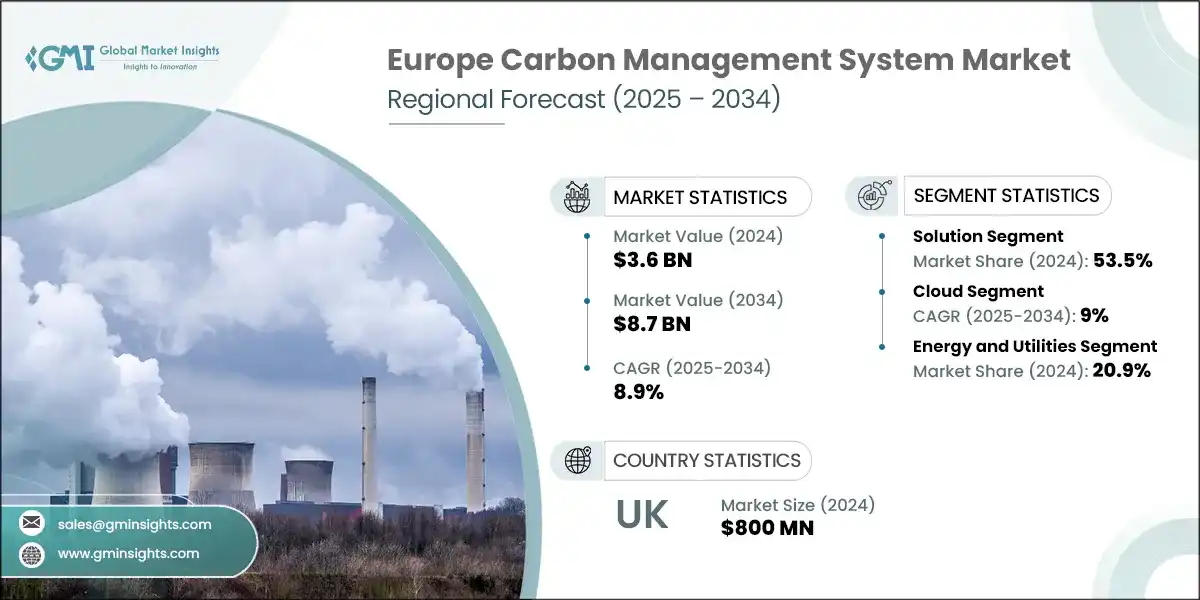
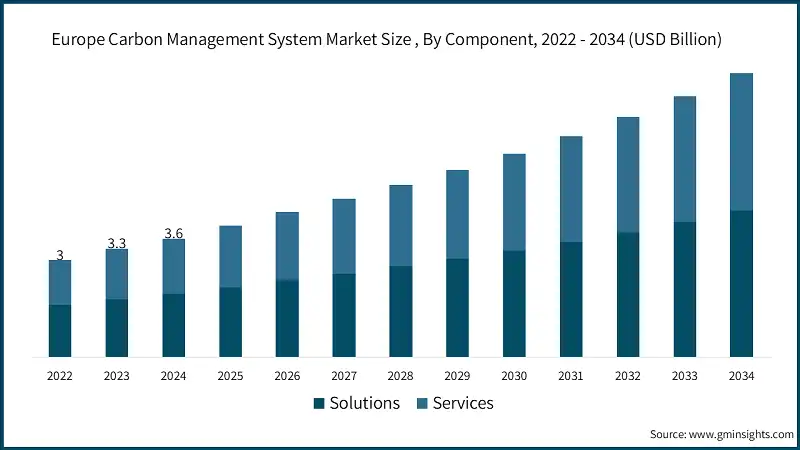
According to a recent study by Global Market Insights Inc., the Europe carbon management system market was valued at USD 3.6 billion in 2024. The market is expected to grow from USD 4 billion in 2025 to USD 8.7 billion by 2034, at a CAGR of 8.9%.
Europe Carbon Management System Market Key Takeaways
Market Size & Growth
- 2024 Market Size: USD 3.6 Billion
- 2034 Forecast Market Size: USD 8.7 Billion
- CAGR (2025–2034): 8.9%
Regional Dominance
- Largest Market: UK
- Fastest Growing Country: Germany
Key Market Drivers
- Rising government efforts to promote low carbon policies.
- Growing industrial demand for energy consumption.
Challenges
- Monitoring & reporting issues.
Opportunity
- AI-Powered personalization.
- Collaboration and partnerships.
Key Players
- Market Leader: SAP SE led with over 11% market share in 2024.
- Leading Players: Top 5 players in this market include SAP SE, Schneider Electric, Engie, IBM, Carbon Footprint Ltd., which collectively held a market share of 30% in 2024.
Get Market Insights & Growth Opportunities
- The European market for carbon management system is driven by stringent regulatory frameworks that are aimed at achieving climate goals. Policies including the EU ETS, are becoming increasingly strict, with tighter carbon caps, additionally the corporate sustainability reporting mandates comprehensive emissions reporting, pushing companies to adopt advanced systems for accurate data collection and disclosure.
- For instance, Europe’s Fit for 55 package is a set of laws aiming to reduce EU greenhouse gas emissions by at least 55% by 2030 and put the EU on the path to achieving climate neutrality by 2050. In January 2024, EU ETS was made a part of the EU's “Fit for 55” package with intentions to combat climate change by reducing greenhouse gas emissions.
- The European Union has committed to achieving climate neutrality by 2050, supported by interim goals including reducing greenhouse gas emissions by at least 55% by 2030 under the European Green Deal. Individual countries, including Germany, France, and Netherland, have introduced their own national low-carbon strategies to align with these targets. To meet these objectives, companies across sectors are increasing pressure to monitor, report, and reduce their emissions.
- For instance, in January 2024, German industrial equipment manufacturer GEA Group received validation from the Science Based Targets initiative (SBTi) for its net zero emission goal by 2040. GEA’s Climate Transition Plan 2040 specifies timings and measures to be implemented as well as the investments needed to achieve the net zero target.
- Rising carbon prices are a significant driver of the Europe carbon management systems market. Under the EU ETS, the cost of carbon allowances has increased substantially in recent years, creating strong financial incentives for industries to monitor and reduce their emissions. As carbon prices continue to rise, companies are facing higher operating costs if they fail to manage their carbon footprint effectively. This encourages businesses, including power generation, manufacturing, and transportation, to adopt advanced carbon management solutions for accurate tracking and forecasting of emissions.
- Rising regional transition to cleaner energy sources including wind, solar, and green hydrogen under the European Green Deal, companies are required to monitor and report on the carbon intensity of their energy mix. Carbon management systems play a crucial role in tracking lifecycle emissions, ensuring compliance with renewable energy certification schemes like Guarantees of Origin, and supporting Power Purchase Agreements (PPA’s).
- ESG has become central to investment decisions for the businesses, hence the companies are liable for providing transparent and verifiable data on their carbon emissions. Institutional investors, banks, and asset managers are prioritizing companies with credible decarbonization strategies, while shareholders and customers are demanding greater accountability on climate performance from the companies. ESG and transparent emission data is pushing businesses to adopt advanced carbon management systems that can track emissions across operations and supply chains.
- For illustration, in February 2025, a group of over 200 financial services firms and organizations issued a public statement urging the European Commission not to weaken sustainability reporting rules by introducing Omnibus package to amend key sustainability finance regulations such as CSRD and CSDDD. The investors advised that rolling back these regulations could impact the capital flows towards sustainability objectives and reduce trust in carbon disclosure.
To get key market trends
Europe Carbon Management System Market Trends
- Rise in adoption of advanced carbon management system by companies that achieve certifications including carbon neutrality or low carbon product label, which enhance their brand image and market appeal is augmenting the business scenario. These systems support alignment with global disclosure frameworks including the Task force on Climate Related Financial Disclosures (TCFD) and other ESG standards, enabling firms to build trust with investors, regulators and consumers.
- Rising organizations efforts for emission transparency is augmenting them to turn external service providers for guidance for emission audits, regulatory compliance consulting, carbon strategy development and third-party verifications. These services are emerging as a practical solution for ongoing monitoring, data management and reporting, assisting the companies to streamline their carbon management efforts without investing in in-house resources.
- For instance, in February 2025, UK saw an increase in corporate spendings on sustainability consultancy up to 6% over 2024 driven by urgent compliance needs under regulations like Corporate Sustainability Reporting Directive (CSRD). Companies are engaging consultants not just for emission reporting, but also for materiality assessment and strategic guidance, which in turn is fueling the Europe carbon management system market potential.
- Companies are entering into strategic alliances with technology providers, industrial firms, energy suppliers and consulting agencies as the demand for integrated and scalable carbon solutions grows. These partnerships enable the development of comprehensive systems that combine emissions monitoring, data analytics, renewable integration and regulatory compliance support.
- Public-private partnerships also play a significant role along with government backed initiatives and EU climate funds and carbon reduction programs. For illustration in August 2025, Germany’s antitrust authority has approved the construction of two major carbon capture pipelines to be jointly developed by Open Grid Europe GmbH (OGE), ONTRAS Gastransport GmbH, and Fluxys a Belgian company.
- European Union with programs including the Green Deal Industrial Plan, Horizon Europe and Innovation Fund is providing substantial financial support to promote the adoption of low carbon technologies and digital infrastructure. These funding mechanisms help offset the cost of implementing advanced carbon monitoring and reporting systems for small and medium enterprises that face budget constraints.
- Governments are offering tax incentives in emissions reductions and compliance solutions to small and medium enterprises which aid in fostering innovation, lower entry barriers and accelerating the deployment of carbon management systems across industries. By leveraging these incentives, companies not only meet regulatory requirements but also enhance their competitiveness and sustainability performance in transitioning economy.
- For instance, in March 2025, the European Commission’s Innovation Fund allocated USD 4.9 billion in grants to support 77 decarbonization projects across 18 European countries. These projects will seek to accelerate decarbonization in sectors including energy-intensive industries, renewable energy, energy storage, industrial carbon management, net zero mobility (maritime and aviation) and buildings.
- Financial institutions are increasingly linking funding related to environmental performances resulting in companies being under constant pressure to demonstrate measurable progress in reducing carbon emissions. Carbon management systems play a vital role by providing accurate data, transparent reporting and verifiable results aligning with global sustainability standards.
- By integrating the data into financial disclosures, the organizations enhance their credit worthiness and attract environmentally conscious investors. For instance, in June 2025, the Community of Madrid issued a European Green Bond (EuGB) under the new EU Green Bond Standard (Regulation (EU) 2023/2631) engrossed USD 583 million. The five-year bond attracted USD 2.8 billion in demand from 89 investors, securing a coupon rate of 2.487%, thereby will complement the industry outlook.
Europe Carbon Management System Market Analysis
Learn more about the key segments shaping this market
- Based on component, the market is segmented into solutions and services. The solution segment dominated with 53.5% market share in 2024 and will grow at a CAGR of 8% through 2034. The Solutions segment plays a crucial role in offering software platforms that enable organizations to monitor, analyze and report their carbon emission effectively. These solutions help in designing and supporting compliance with regulatory frameworks.
- Modern Carbon management solutions integrate advanced technologies including artificial intelligence, cloud computing and real-time data analytics allowing accurate tracking of scope 1,2 and 3 emissions. They also facilitate emission forecasting, carbon offset planning and sustainability performance benchmarking. As organizations increasingly prioritize decarbonization and ESG reporting the solutions component is expected to witness robust growth across industrial, commercial and public sectors in Europe.
- Services segment will showcase 9% CAGR till 2034 as the segment offers essential support throughout the implementation, operation and optimization of carbon management initiatives. These services include consulting, system integration, training and maintenance and managed services which are critical for enduring the effective deployment of long-term functionality of carbon management systems.
- Based on deployment, the market is segmented into cloud and on-premises. Cloud deployment is expected to showcase about 9% CAGR till 2034. Cloud deployment holds a significant share in Europe region due to its scalability, flexibility and cost-effectiveness. The solutions enable organizations to access real time emission data, automate reporting process and collaborate across departments and geographies without the need for extensive on-premises infrastructure.
- The on-premises deployment segment in Europe will cross USD 3.7 billion by 2034, owing to the involvement of large enterprises and heavily regulated industries that prioritize data security, customization and internal control. On-premises solutions allow organizations to host carbon management software within their own infrastructure, giving them a greater oversight of sensitive emission data and compliance processes, in turn adding growth to the market.
Learn more about the key segments shaping this market
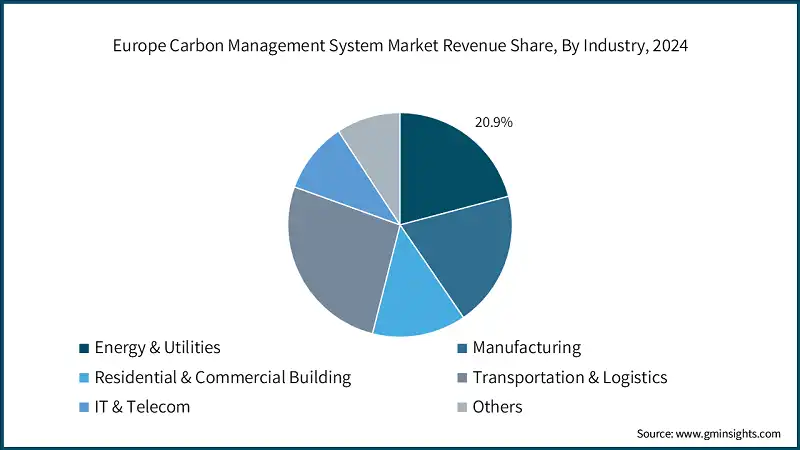
- Based on industry, the market is segmented into energy & utilities, manufacturing, residential & commercial building, transportation and logistics, IT & telecom, and others. Energy and utilities segment dominated 20.9% market share in 2024. It is one of the most prominent industries in Europe driven by significant contribution to greenhouse gas emission and increasing regulatory scrutiny.
- Transportation and logistics segment is expected to showcase about 9.1% CAGR till 2034 and is emerging as a vital end user in the Europe carbon management systems market, driven by the sector’s substantial carbon footprint and increasing pressure to align with the European Union’s climate targets.
- Rising stricter emission standards, fuel efficiency regulations, and growing emphasis on scope 3 emissions tracking, transportation companies including freight, shipping, rail and aviation are adopting carbon management systems to monitor, report and reduce their greenhouse emissions.
- IT and telecom industry is increasingly adopting carbon management systems in Europe as part of their commitment to sustainability and compliance with evolving environmental regulations. Although this industry has a relatively low direct carbon footprint compared to heavy industries, its indirect emissions through data centers, network infrastructure and supply chain are significant and growing with rising digitalization and data consumption.
Looking for region specific data?
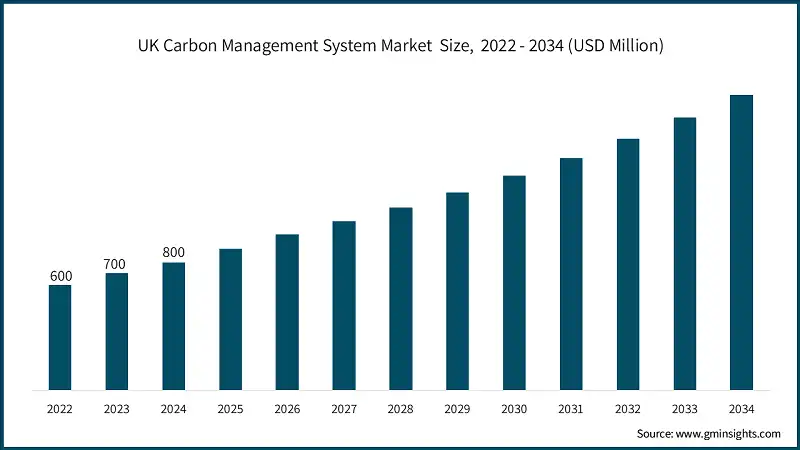
- The UK dominated the carbon management system market in Europe with around 23% share in 2024 and generated USD 800 million in revenue. The UK represents dynamic and evolving carbon management systems, driven by ambitious climate policies, corporate sustainability commitments, and stringent regulatory frameworks.
- The Germany carbon management system market is projected to surpass USD 1.9 billion by 2034. The market is driven by a strong regulatory framework, ambitious climate goals, and industrial leadership. As Europe’s largest economy and major emitter, Germany has committed to becoming climate neutral by 2045. This commitment has led to the widespread implementation of carbon monitoring, reporting, and reduction systems across energy, manufacturing, chemical, automotive, and logistics.
- France is emerging as a key player in the Europe carbon management system market and will grow at a CAGR of 8.9% till 2034 owing to strong policy framework, industrial decarbonization goals, and commitment to international climate agreements. The French government’s target to achieve carbon neutrality by 2050 and national initiatives such as the National Low Carbon Strategy (SNBC) and the Energy and Climate Law mandate emission reductions across all sectors.
Europe Carbon Management System Market Share
- The top 5 companies in Europe carbon management system industry are SAP SE, Schneider Electric, IBM, Carbon Footprint Ltd., and ENGIE, collectively contributed around 30% of the market in 2024. SAP SE offers a suite of carbon management solutions designed to benefit businesses measure, manage, and reduce their carbon footprint. These solutions include SAP Sustainability Footprint Management, SAP Green Ledger, and SAP Sustainability Control Tower and integrate with existing SAP systems to provide a comprehensive view of carbon emissions across the value chain.
- The market is driven by demand from energy, manufacturing, transportation, and utility sectors. These companies have built a strong reputation through comprehensive offerings that integrate software, analytics and advisory services tailored to the evolving needs of businesses and regulators. These firms continue to invest in digital technologies such as AI, cloud computing and real time data analytics to enhance their carbon tracking and reporting capabilities.
- Schneider Electric leverages its strong expertise in energy management, automation and digital solutions to support organizations in achieving their sustainability goals. The company offers robust suite of carbon management and ESG platform, with its flagship solution, EcoStruxure resource Advisor, enabling real-time tracking of energy use, carbon emissions and sustainability metrics across complex operations.
- Strategic alliances and partnerships play a crucial role in development and expansion of the Europe carbon management systems market. As the businesses across industries face increasing pressure to meet regulatory standards and achieve sustainability targets, collaborations between technology providers, consulting firms, and industry players have become essential. These alliances often focus on integrating advanced software solutions with domain specific expertise, enabling organizations to implement effective carbon tracking, reporting and reduction strategies.
Europe Carbon Management System Market Companies
Major players operating in the Europe carbon management system industry are:
- Accuvio
- BlueSens Gas Sensor GmbH
- Carbon Footprint Ltd.
- Dakota Software
- EnergyCap
- ENGIE
- Envirosoft
- ESP
- Graforce Hydro GmbH
- Greenly
- Intelex
- IBM
- Microsoft
- Plan A
- Persefoni
- Salesforce
- SAP SE
- Schneider Electric
- Sphera
- Trinity Consultants
- Salesforce offers a robust platform called Net Zero Cloud, which empowers organizations to measure, manage, and report ESG performance along with real-time tracking of Scope 1, 2, and 3 emissions. By integrating ESG insights across the enterprise ecosystem, Salesforce enables businesses to streamline compliance, enhance transparency, and drive sustainable decision-making. The company’s revenue was USD 34.9 billion in 2024.
- SAP SE is a leading provider in the Europe carbon management system market, offering integrated solutions that enable companies to capture, analyze, and report emissions across scopes 1, 2, and 3. For illustration, SAP Green Ledger is designed to align corporate carbon accounting and financial reporting, making sustainability disclosures to align with traditional balance sheets. The company’s revenue was USD 10.5 billion in 2025 Q2.
- Schneider Electric is a key contributor to the carbon management systems landscape in Europe, using its extensive expertise in energy management, automation, and digital infrastructure. Its solution enables businesses to monitor, analyze, and optimize their carbon footprint across operations particularly in energy-intensive environments. The company’s revenue was USD 11.6 billion in 2025 Q2.
Europe Carbon Management System Market Report Attributes
| Key Takeaway | Details |
|---|---|
| Market Size & Growth | |
| Base Year | 2024 |
| Market Size in 2024 | USD 3.6 Billion |
| Forecast Period 2025 – 2034 CAGR | 8.9% |
| Market Size in 2034 | USD 8.7 Billion |
| Key Market Trends | |
| Drivers | Impact |
| Rising government efforts to promote low carbon policies | Encouragement for companies to invest in emission monitoring and reduction solutions to access financial benefits and comply with evolving regulations. |
| Growing industrial demand for energy consumption | The companies are adopting advanced carbon management systems to track energy related emissions and identify efficiency opportunities. |
| Pitfalls & Challenges | Impact |
| Monitoring & reporting issues | Organizations struggle with inconsistent data collection methods, fragmented reporting across multiple facilities. |
| Opportunities: | Impact |
| AI-Powered personalization | AI driven analytics for emissions forecasting and IoT based real-time monitoring in industrial facilities. Use of blockchain for transparent carbon credit and offset verification. |
| Collaboration and partnerships | Joint venture between software providers, industrial firms and energy companies to create integrated solutions and public-private partnerships that are supported by EU climate funds. |
| Market Leaders (2024) | |
| Market Leaders |
11% market share |
| Top Players |
Collective market share in 2024 is 30% |
| Competitive Edge |
|
| Regional Insights | |
| Largest Market | UK |
| Fastest Growing Market | Germany |
| Emerging Countries | France, Spain, Italy |
| Future outlook |
|
What are the growth opportunities in this market?
Europe Carbon Management System Industry News
- In March 2025, Persefoni secured funding of USD 23 million in Series C to enhance their carbon accounting software. Persefoni’s platform offers comprehensive solutions for streamlined carbon footprint calculations, decarbonization strategy development, and audit-ready disclosures aligned with global standards. The funding will help the company in expanding its product range, including the development of new AI functionalities.
- In May 2025, the European Commission and UK Government announced their commitment to establishment of a linking Emission Trading Systems (ETS) which is expected to stabilize carbon prices and accelerate emissions reductions in both jurisdictions. This will enable regulated entities under the EU ETS or UK ETS to seamlessly trade allowances, increasing the size of the allowance market and enhancing its stability and efficiency. This would further boost the companies willing to analyze, monitor, and optimize carbon emissions and help in the expansion of the carbon management market.
- In December 2024, SAP announced the general availability of the SAP Green Ledger Solution, a part of SAP Sustainability Solutions, to businesses for addressing regulatory requirements by integrating financial and environmental data. It will help companies navigate the complex global landscape of sustainability regulations such as the EU CSRD.
This Europe carbon management system market research report includes in-depth coverage of the industry with estimates & forecasts in terms of revenue (USD Billion) from 2021 to 2034, for the following segments:
Market, By Component
- Solutions
- Services
Market, By Deployment
- Cloud
- On-premises
Market, By Industry
- Energy and utilities
- Manufacturing
- Residential & commercial building
- Transportation & logistics
- IT & telecom
- Others
The above information has been provided for the following countries:
- UK
- France
- Germany
- Spain
- Italy
Frequently Asked Question(FAQ) :
What is the market size of the Europe carbon management system in 2024?
The market size was USD 3.6 billion in 2024, with a CAGR of 8.9% expected through 2034 driven by stringent regulatory frameworks aimed at achieving climate goals.
What is the projected value of the Europe carbon management system market by 2034?
The Europe carbon management system market is expected to reach USD 8.7 billion by 2034, propelled by rising carbon prices, ESG mandates, and the transition to cleaner energy sources.
How much market share did the solutions segment hold in 2024?
Solutions segment dominated with 53.5% market share in 2024 and will grow at a CAGR of 8% through 2034, offering software platforms for monitoring, analyzing and reporting carbon emissions.
What was the market share of the energy & utilities segment in 2024?
Energy and utilities segment dominated with 20.9% market share in 2024, being one of the most prominent industries due to significant greenhouse gas emissions and increasing regulatory scrutiny.
What is the growth outlook for cloud deployment from 2025 to 2034?
The cloud deployment is projected to grow at about 9% CAGR till 2034, due to scalability, flexibility, cost-effectiveness, and real-time emission data access capabilities.
Which country leads the Europe carbon management system market?
The UK held 23% share with USD 800 million in revenue in 2024, representing a dynamic market driven by ambitious climate policies and stringent regulatory frameworks.
What are the upcoming trends in the Europe carbon management system market?
Key trends include AI-powered analytics for emissions forecasting, IoT-based real-time monitoring, blockchain for carbon credit verification, and increasing adoption by mid-sized enterprises for ESG compliance.
Who are the key players in the Europe carbon management system market?
Key players include Accuvio, BlueSens, Carbon Footprint, Dakota Software, EnergyCap, ENGIE, Envirosoft, ESP, Graforce Hydro, Greenly, Intelex, IBM, Microsoft, Plan A, Persefoni, Salesforce, SAP, Schneider Electric, Sphera, Trinity Consultants.
Europe Carbon Management System Market Scope
Related Reports