Summary
Table of Content

Europe Bunker Fuel Market
Get a free sample of this report
Form submitted successfully!
Error submitting form. Please try again.
Thank you!
Your inquiry has been received. Our team will reach out to you with the required details via email. To ensure that you don't miss their response, kindly remember to check your spam folder as well!
Request Sectional Data
Thank you!
Your inquiry has been received. Our team will reach out to you with the required details via email. To ensure that you don't miss their response, kindly remember to check your spam folder as well!
Form submitted successfully!
Error submitting form. Please try again.
Europe Bunker Fuel Market Size
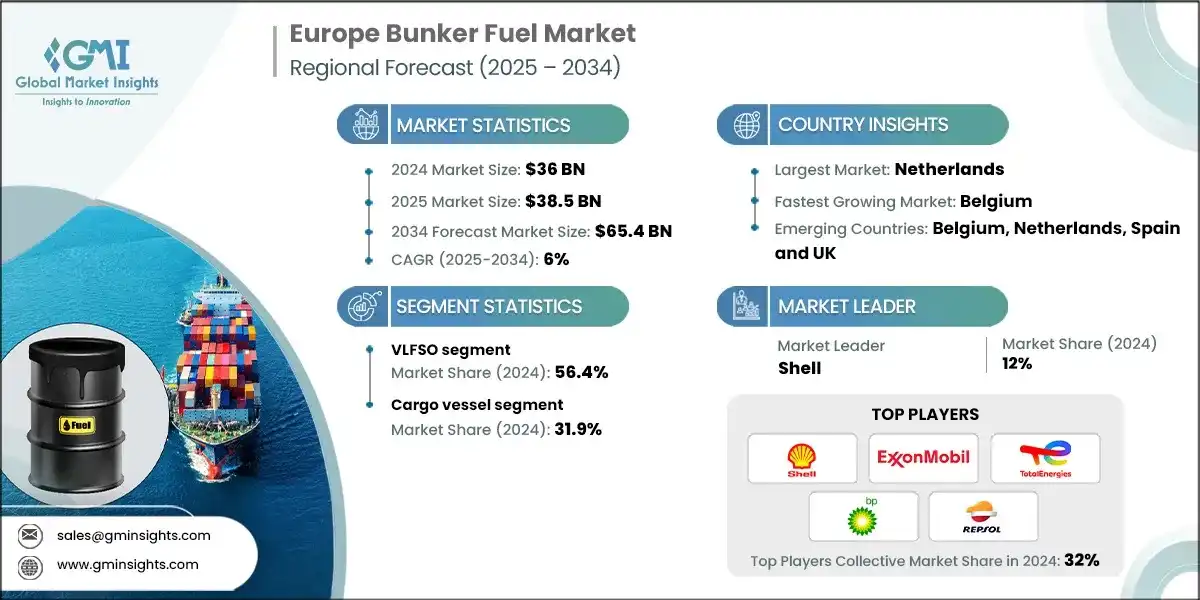
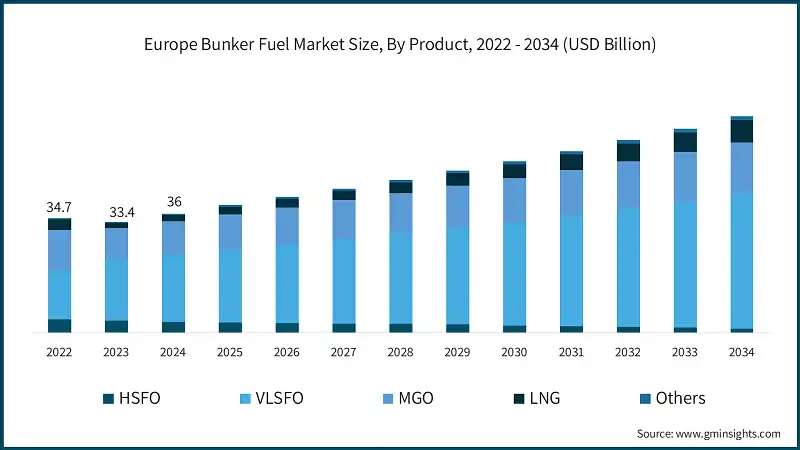
According to a recent study by Global Market Insights Inc., the Europe bunker fuel market was estimated at USD 36 billion in 2024. The market is expected to grow from USD 38.5 billion in 2025 to USD 65.4 billion in 2034, at a CAGR of 6%.
Europe Bunker Fuel Market Key Takeaways
Market Size & Growth
- 2024 Market Size: USD 36 Billion
- 2025 Market Size: USD 38.5 Billion
- 2034 Forecast Market Size: USD 65.4 Billion
- CAGR (2025–2034): 6%
Regional Dominance
- Largest Market: Netherlands
- Fastest Growing Region: Belgium
Key Market Drivers
- Expansion of port infrastructure.
- Stringent maritime regulations and emission mandates.
- Technological advancements in ship engines and fuel efficiency.
Challenges
- Increasingly stringent environmental regulations raise operational and compliance costs for suppliers, potentially squeezing margins and limiting competitiveness in a highly regulated maritime sector.
Opportunity
- Increasing LNG adoption.
- Digitalization and smart port initiatives.
- Rising demand for Low emission-compliant fuel.
- Technological advancements improving fuel efficiency.
Key Players
- Market Leader: Shell led with over 12% market share in 2024.
- Leading Players: Top 5 players in this market include Shell, ExxonMobil, TotalEnergies, BP p.l.c, Repsol, which collectively held a market share of 32% in 2024.
Get Market Insights & Growth Opportunities
- Increasing marine trade, stringent regulations toward environment safety and ongoing transition toward adoption of cleaner fuels will augment the industry landscape. The region’s strong network of ports and extensive trade routes along with shipping operators aimed at improving the operational efficiency of vessel technology will positively influence Europe bunker fuel market dynamics.
- For instance, in June 2024, Belgium and the Netherlands have introduced new green fuel mandates for bunker suppliers, targeting major ports like Rotterdam and Antwerp under the revised EU Renewable Energy Directive. The move aims to accelerate the adoption of sustainable marine fuels and aligns with Europe’s broader decarbonization goals for shipping, reinforcing these ports as key hubs for the energy transition.
- Stringent government regulations have increased the adoption of low-sulfur fuels and alternative options including liquefied natural gas (LNG) and bio-based marine fuels further complementing business dynamics. Fuel suppliers and refiners have been focusing on developing cleaner fuel blends that meet the stringent sulfur content requirements while maintaining fuel quality and performance. Rising investments in fuel storage facilities, blending facilities, and bunkering infrastructure to accommodate the growing demand for compliant fuels will augment Europe bunker fuel market outlook.
- For instance, in August 2025, Hamburg Port Authority has authorized ship-to-ship bunkering of methanol and LNG at Waltershofer Hafen, enabling vessels to refuel with alternative fuels directly at sea. The approval covers central container terminals Burchardkai and Predöhlkai, marking a significant step toward greener shipping and reinforcing nation’s commitment to climate and energy goals.
- Growing adoption of cleaner bunker fuels along with ship operators are increasingly aligning their fuel procurement strategies with international sustainability objectives and carbon reduction targets, is shaping industry outlook. Ongoing transition toward low sulphur fuels has prompted several energy companies and bunker suppliers to diversify their product offerings and introduce innovative fuel solutions. In addition, port authorities and energy providers maintain reliable supply chains for alternative fuels to enhance market stability and competitiveness.
- Netherlands dominates the Europe bunker fuel industry owing to its strategic location and world-class port infrastructure along with high volumes of international trade and maritime traffic consistently driving demand for bunker fuel. Significant investments in LNG and alternative fuel infrastructure coupled with advanced digital bunkering platforms and integrated supply chains to enhance operational efficiency and transparency will augment Europe bunker fuel market outlook.
- For instance, from January 2026, bunker vessels in Rotterdam and Antwerp-Bruges must utilize Mass Flow Meter systems for fuel deliveries. These systems accurately measure transferred fuel quantities, ensuring precise transactions between bunker vessels and sea-going ships for operational integrity. The initiative aims to enhance transparency, efficiency, and reliability within the bunker fuel market across both major European ports.
- Belgium is one of the fastest growing market in Europe bunker fuel industry owing to expansion of maritime trade along with favorable initiatives towards development of port infrastructure. Ongoing investments across LNG terminal, multi-fuel bunkering facilities and shore power installations further augmenting the industry landscape. Rapid digitalization for accurate fuel measurement, pilot projects for green fuels including LNG and paradigm shift toward low-carbon maritime solutions will positively augment the Europe bunker fuel market outlook.
- For instance, in July 2025, NYK begun the regular utilization of bio-LNG fuel for its LNG-based car carriers. The fuel is supplied by Titan Supply B.V. at Belgium’s Zeebrugge port. The first vessel, Daisy Leader, received bio-LNG, followed by another vessel named Sumire Leader, marking a significant step toward sustainable marine operations.
To get key market trends
Europe Bunker Fuel Market Trends
- Rising global seaborne trade, coupled with vessels requiring fuel for port operations and long voyages, and transition from traditional heavy fuel oils to low-sulfur and alternative marine fuels will stimulate industry outlook. Increased hydrocarbon exploration and development activities in offshore regions, along with the establishment of new reserves, have significantly expanded both offshore and onshore resources, further driving demand for bunker fuel across regional shipping industry.
- Growing demand for compliant and cleaner fuels and ship operators aiming to meet stringent emission norms while maintaining operational efficiency is positively influencing business dynamics. For instance, in November 2025, TT-Line and EnviTec Biogas signed a bio-LNG supply agreement following a successful trial delivery of 40 tonnes at Travemünde, Germany, aboard TT-Line’s Ro-Pax ferry Peter Pan. Under the new contract, EnviTec delivered renewable biomethane-based LNG by truck to support TT-Line’s efforts to meet EU FuelEU Maritime regulations.
- Implementation of international maritime regulations, enforcement of sulfur emission limits has accelerated the adoption of very low sulfur fuel oils and marine gas oils across the European ports. Shipowners are increasingly focusing on fuel quality and sustainability credentials along with favorable initiatives by refineries to enhance their production processes, shaping the Europe bunker fuel market outlook.
- For instance, in September 2025, Malik Energy A/S launched full-scale deliveries of co-processed marine gas oil with renewable content across Denmark’s major ports. Produced by Swedish refiner Preem AB, this next-generation fuel is designed to help shipowners meet EU FuelEU Maritime requirements while enabling a smooth transition to low-carbon operations without disrupting existing workflows.
- Growing emphasis on decarbonization and energy transition is actively exploring alternative fuels including liquefied natural gas (LNG), biofuels, and methanol to reduce carbon emissions from maritime operations. Infrastructure development for alternative fuel bunkering including LNG terminals and supply networks maintains a strategic priority for major ports shaping the Europe bunker fuel market landscape.
- Digitalization and technological advancements influence the bunker fuel supply chain with the integration of digital platforms for fuel procurement, inventory tracking, and quality assurance is improving transparency and efficiency. Developments enabling shipowners and suppliers to make informed decisions, optimize fuel consumption and enhance compliance management.
- For instance, in August 2025, Axpo Group implemented Ofiniti’s FuelBoss platform to digitalize LNG bunkering operations, enhancing scheduling, delivery execution, and electronic documentation processes. FuelBoss demonstrates its capability to serve diverse stakeholders, including traders, operators, and shipowners, reinforcing its value across European LNG bunkering operations.
- Flourishing investments in refining and bunkering infrastructure to enhance operational efficiency and profitability along with growing preference for sustainable and regulation-compliant fuels is complementing industry landscape. Growing inclination on encouraging innovation, diversification and long-term stability while reinforcing the environmentally friendly solutions in bunkering operations will shape the industry outlook.
- For instance, in March 2024, UNIMOT Group has entered Poland’s bunker market with its first physical supply operation, marking a strategic expansion into marine fuel services. This move strengthens the company’s presence in the energy sector and supports shipping operators with reliable, compliant fuel solutions at Polish ports.
Europe Bunker Fuel Market Analysis
Learn more about the key segments shaping this market
- Based on product, the industry is categorized into HSFO, VLSFO, MGO, LNG and others. VLSFO segment accounted for 56.4% of the market share in 2024 and is set to grow at a CAGR of 7% through 2034.
- The VLSFO market is set to grow driven by the transition toward fuels with reduced sulfur emissions and lower environmental impact. Shipowners and operators are focusing to comply with stringent regulations, remove SOx emissions, improve air quality, and maintain compatibility with existing marine engines, augmenting business landscape. Furthermore, ongoing investments in fuel efficiency, integration of digital bunkering platforms to streamline VLSFO procurement and delivery, will stimulate Europe bunker fuel market outlook.
- For instance, in August 2025, Monjasa completed its first ship-to-ship bunkering of 0.5% sulphur marine fuel in Southampton, UK. The operation included the supply of VLSFO and marine gas oil (MGO), marking a key milestone in the company’s preparations for the global sulphur cap and reinforcing its commitment to cleaner shipping solutions.
- The HSFO segment was evaluated at USD 3.3 billion in 2024. High sulfur fuel oil is adopted by vessels equipped with exhaust gas cleaning systems and remains relevant in operations where scrubber retrofitting is economically feasible, particularly for long-haul routes and bulk carrier fleets. Evolving regulatory and environmental pressures within the maritime fuel along with paradigm shift toward low-sulfur alternatives, have impacted the industry landscape.
- Installation of scrubbers has enabled the fleet to consume HSFO while adhering to environmental guidelines coupled with utilization of HSFO maintains its compatibility with larger engines and its established performance track record. For instance, in September 2024, Wärtsilä secured a contract for retrofit project enabling in-service vessels to integrate carbon capture and storage within emissions scrubbers. German shipping company Leonhardt & Blumberg installed next-generation CCS-ready scrubbers on three feeder containerships, anticipating future carbon regulations and EU emission fees.
- The LNG segment accounted for around 5.2% of market share in 2024. Growing emphasis on reducing emissions from shipping activities along with shifting focus toward adoption of alternatives from conventional fuels is shaping the business dynamics. Significant investments in LNG bunkering infrastructure, coupled with rapid expansion of LNG-powered vessel fleets across major international ports will augment industry outlook.
- For instance, in July 2025, Axpo Solutions AG completed Portugal’s first vessel-to-vessel LNG bunkering at the Port of Sines, delivering 2,700 metric tons of LNG to the container ship named MSC Togo. Conducted in Simultaneous Operations (SIMOPS), the transfer adhered to operational standards and international safety, ensuring company’s focus to deliver advancing sustainable marine fuel solutions.
- In addition, digitalization is becoming an integral part of LNG bunkering operations with the improved monitoring tools, documentation systems and scheduling platforms enabling smoother and more transparent transactions. Growing inclination toward delivering LNG bunker services by operators with higher accuracy, reduced delays and enhanced compliance tracking along with authorities prioritizing the development of LNG-compatible infrastructure will positively influence business dynamics.
Learn more about the key segments shaping this market
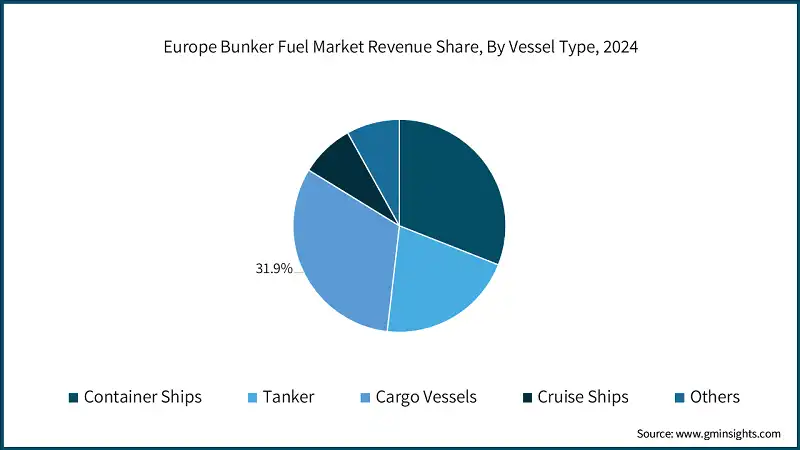
- Based on the vessel type, the Europe bunker fuel market is classified into container ships, tankers and cargo vessels and cruise ships. The cargo vessel dominated around 31.9% of market share in 2024 and is set to grow at a CAGR of 5.4% through 2034.
- Cargo vessels comprising bulk carriers, general cargo ships, and specialized freight vessels play a pivotal role in global trade by transporting raw materials and finished goods across continents. Increasing bunker fuel demand among cargo vessels, driven by long-haul operational requirements and ongoing retrofitting initiatives, will augment the industry outlook. Ongoing modernization of fleet operations to comply with evolving environmental regulations vessels consume large volumes of fuel for long-haul operations, and ongoing retrofitting for compliance with emission norms, coupled with LNG-ready designs is shaping the Europe bunker fuel market dynamics.
- For instance, in August 2025, The Global Centre for Maritime Decarbonisation (GCMD) and INTERCARGO entered a two-year partnership to accelerate decarbonization in the dry bulk sector. Combining GCMD’s technical expertise with INTERCARGO’s industry reach, the initiative aims to promote energy efficiency technologies and low-carbon solutions for cargo ships. This collaboration seeks to address operational challenges and advance sustainable practices across the world’s largest shipping segment by tonnage.
- Rising technological innovation in vessel design and propulsion systems impact bunker fuel consumption patterns in the container ships coupled with the adoption of energy-efficient engines, hybrid systems and digital monitoring solutions allow operators to optimize fuel use and reduce emissions. Increasing regional trade and international business activities along with increased reliance on bunker fuel for powering large fleets operating across major shipping routes, is contributing to Europe bunker fuel market growth.
- For instance, in August 2025, The Port of Hamburg has expanded its alternative fuel infrastructure, enabling container ships to refuel with LNG and methanol at Burchardkai and Predöhlkai terminals via ship-to-ship bunkering. Previously limited to cruise ships at Steinwerder, this development supports the Hamburg Port Authority’s decarbonization strategy and vision of a climate-neutral port.
- The tankers segment was evaluated at USD 7.5 billion in 2024. Rising demand for chemical and petrochemical across various industries along with tanker vessels transporting liquid cargoes including crude oil, petroleum products and chemicals between refineries and consumption centers is complementing business landscape. Stringent government regulations to measure the tanker compliance with the IMO emission norms which have led operators to shift toward cleaner fuel options, further shaping the Europe bunker fuel market landscape.
- For instance, in April 2025, Rohe Solutions achieved a milestone by completing the first Bio-LNG bunkering at the Hamina LNG terminal in collaboration with E&S Tankers. The operation was executed safely and efficiently, marking a significant step toward advancing sustainable fuel options for maritime transport in the region.
- The cruise ships segment is set to witness a CAGR of 7.2% through 2034. Shifting preferences toward unique leisure experiences, coupled with rising disposable incomes, are driving industry growth. Modern ports and terminals worldwide have enhanced accessibility, enabling cruise lines to expand operations coupled with strict emission control measures introduced by the IMO and introduction of hybrid and LNG-powered will complement the Europe bunker fuel market landscape.
- For instance, in August 2025, Burando Energies joined forces with World Fuel Services and Norwegian Cruise Line Holdings to supply biofuels to cruise ships during port calls in the Netherlands. The collaboration covers NCLH’s three brands Norwegian Cruise Line, Oceania Cruises, and Regent Seven Seas Cruises and marks a significant step toward reducing emissions and advancing sustainable fuel use in the European cruise sector.
Looking for region specific data?
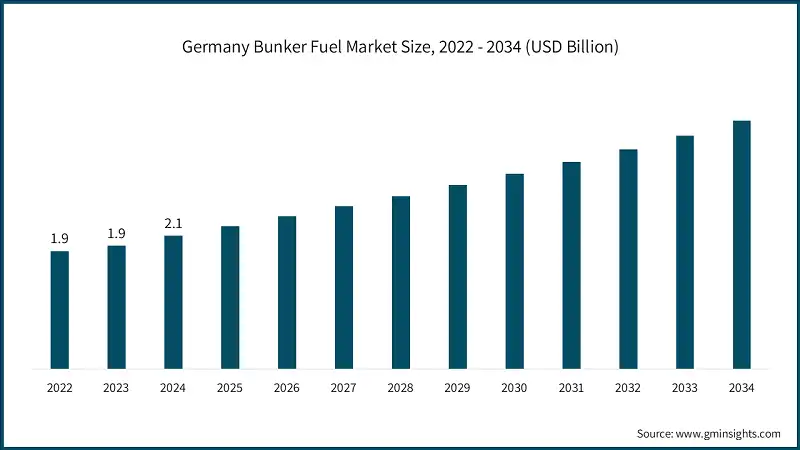
- Germany bunker fuel market was evaluated with around 6% market share in 2024 and generated over USD 2.1 billion in revenue. Rising demand for bunker fuel for vessel operations along with expansion of port infrastructure across major routes is shaping the business dynamics. Ship operators are gradually shifting toward low emission fuels, which enhances refiners and distributors to invest in upgraded production capabilities, storage systems and distribution channels contributing to industry growth.
- For instance, in July 2025, Germany has announced a USD 463.3 million funding program to accelerate the development of alternative fuel bunkering infrastructure, reinforcing its commitment to maritime decarbonization. The initiative aims to support ports and operators in establishing facilities for cleaner fuels including LNG, methanol, ammonia, and hydrogen, in line with EU climate targets and IMO regulations
- Netherlands dominated bunker fuel market and is expected to witness a CAGR of 6.3% by 2034. Favorable initiatives by authorities toward expansion of port infrastructure and increasing collaboration between energy companies and shipping operators to ensure reliable and efficient availability of bunker fuel will augment industry landscape. Investments in LNG bunkering infrastructure and shore power facilities along with fuel traders, refineries, terminal operators and bunkering firms are collaborating to optimize distribution flows and reduce inefficiencies is shaping business outlook.
- For instance, in November 2025, Peninsula strengthened its marine energy infrastructure at the Port of Rotterdam by introducing a biofuel storage and blending facility at Chane Terminal. The ISCC-certified site offers nine tanks with a 30,000-cubic-metre capacity, enabling flexible blending of bunker fuels from B5 to B100, including HSFO and VLSFO. Equipped with multiple jetties and berths, the facility ensures efficient operations while supporting Europe’s decarbonization objectives through sustainable fuel solutions.
- Belgium bunker fuel industry was evaluated at USD 10 billion in 2024 and is set to grow owing to ongoing port modernization programs, investments initiatives for expansion of storage capacity, upgraded berthing facilities, and enhanced logistical networks. Rising integration of digital platforms into bunker fuel procurement and delivery processes to streamline documentation, enhance transaction transparency and reduce turnaround times is augmenting industry landscape.
- For instance, in August 2025, Shell Marine has successfully completed LNG bunkering for Höegh Sunlight, a Pure Car and Truck Carrier, at the Port of Zeebrugge using its bunker barge Energy Stockholm. This operation, part of a series of recent bunkering activities for Höegh vessels, supports the company’s decarbonization strategy. Höegh Autoliners is introducing Aurora Class ships with dual-fuel LNG engines and future ammonia capability, advancing sustainable bunker fuel adoption.
- The UK bunker fuel market is set to surpass USD 4.4 billion by 2034. Regulatory pressures and sustainability goals pushing ship operators to explore lower-emission alternatives and fuel blends aligning with maritime environmental standards contributing to industry growth. Growing inclination toward expansion of bunkering bases among companies are encouraging them to expand offerings and invest in upgraded storage, blending units, and testing capabilities to ensure fuel quality and compliance.
- For instance, in October 2025, Bunker One expanded its footprint in the UK by acquiring the assets of Quay Energy Solutions, a well-established marine fuel supplier. The move strengthens Bunker One’s supply network and customer base, reinforcing its commitment to delivering reliable, high-quality bunkering services across the region.
- Spain bunker fuel market is anticipated to observe a CAGR of 6.7% from 2025 to 2034. Growing emphasis on environmental compliance influencing bunker fuel demand operators navigating waters face stringent emission guidelines, prompting gradual shifts in fuel preferences. Operational efficiencies within the ports with investments in digital port management systems and improved berthing processes and streamlined bunkering schedules for vessels is contributing to Europe bunker fuel market growth.
- For instance, in November 2025, Spain has introduced a bill, counting marine bio-blends, including B30 toward its national renewable energy targets aligning with EU mandates requiring marine fuels to meet increasing sustainability thresholds. The proposal would permit bunker vessels calling at Spanish ports to carry blends with up to 30% fatty-acid methyl ester (B30) provided tanks meet safety and discharge standards.
Europe Bunker Fuel Market Share
- The top 5 players operating across the Europe bunker fuel industry include Exxon Mobil, Total Energies, BP p.l.c., Shell, and Repsol collectively contributing around 32% of the market share in 2024.
- Leading players in the European bunker fuel market are focusing on strategies that ensure compliance with stringent environmental regulations while maintaining operational efficiency. Companies producing low-sulfur fuels to meet international emission standards, investing in infrastructure upgrades at major ports to improve storage and distribution and diversifying fuel offerings by incorporating alternatives including LNG and biofuels positively shaping the Europe bunker fuel market outlook.
- TotalEnergies recorded sales revenue of USD 136.4 billion for nine months of 2025. The company is accelerating the transition to cleaner shipping by investing in advanced LNG bunkering infrastructure worldwide. With operations spanning over 120 ports, the company delivers a comprehensive portfolio of marine fuels, including MGO, VLSFO, LNG, and biofuels, ensuring flexibility and sustainability for its customers.
- BP Marine offers advanced marine fuels while prioritizing emissions compliance and digital solutions for bunkering operations. The company is actively developing LNG bunkering services and collaborating with ship operators to design effective decarbonization strategies. The company reported revenue for 9 months of 2025 amounting to USD 144.8 billion, while its total revenue for the full year 2024 stood at USD 196.6 billion.
- In 9 months of 2025, Repsol reported USD 42.8 billion in revenue. The company offers marine fuels to vessels through a global supply network, emphasizing reliability, compliance, and sustainability. Repsol offers traditional fuels including very low sulfur fuel oil and marine gas oil, alongside advanced alternatives like liquefied natural gas and certified biofuels. Its strategy focuses on supporting the maritime sector’s transition to cleaner energy by integrating renewable solutions and collaborating with shipping partners to reduce emissions.
- Shell reported USD 202.7 billion in revenue for 9 months of 2025 and a revenue of USD 289 billion in 2024. The company operates through a global network that supplies marine fuels and related services to vessels across major shipping routes. The company provides a wide range of products, including conventional fuel oils and marine gas oil, as well as advanced alternatives with liquefied natural gas and biofuels. It focuses on supporting the maritime industry’s transition to cleaner energy by investing in infrastructure for low-carbon fuels and offering technical solutions to improve efficiency and reduce emissions.
Europe Bunker Fuel Market Companies
Major players operating in the Europe bunker fuel industry are:
- Axpo Holding AG
- BP p.l.c.
- BUNKER HOLDING
- Chevron Corporation
- Dan-Bunkering
- Exxon Mobil
- GAC
- Ganor
- Gasum Ltd
- Hans Rinck Brennstoffe GmbH & Co. KG
- Innospec
- Malik Energy
- Minerva Bunkering
- Petrobras
- Repsol
- Shell
- SHV Energy
- Stena Metall
- TFG Marine Pte. Ltd.
- TotalEnergies
- Vitol Bunkers
- BP p.l.c. provides marine fuels and related services to shipping companies through a global network of supply points. The company offers conventional fuels including very low sulfur fuel oil and marine gas oil and biofuels to support the industry’s decarbonization goals. It focuses on delivering reliable, compliant products, investing in cleaner energy technologies and infrastructure to help customers meet evolving environmental standards.
- ExxonMobil offers a wide range of marine fuels, including compliant low-sulfur fuel oils and marine gas oil exploring advanced alternatives including LNG and biofuels to support decarbonization efforts. It emphasizes operational reliability, product quality and adherence to international environmental standards offering technical expertise and integrated logistics to ensure efficient delivery.
- Repsol delivers top-quality, efficient, and flexible marine fuel services and supports efficient bunkering operation, ensuring reliability and precision across all fuel grades that it supplies. The company provides, MGO, VLSFO and LNG in various ports across the region including Barcelona, Tarragona, Valencia, Algeciras, Corunna, Bilbao, Cartagena located in Spain.
- TotalEnergies supplies ULSFO 0.1% Sulphur within the European Sulfur Emission Control Areas (SECA) and expanded its portfolio in late 2019 to include VLSFO 0.5%S at major bunkering hubs. The company has developed multiple VLSFO blends that comply with the latest regulations and ISO 8217 standards while each blend undergoes rigorous testing by research teams to ensure quality and performance.
Europe Bunker Fuel Market Report Attributes
| Key Takeaway | Details |
|---|---|
| Market Size & Growth | |
| Base Year | 2024 |
| Market Size in 2024 | USD 36 Billion |
| Market Size in 2025 | USD 38.5 Billion |
| Forecast Period 2025 – 2034 CAGR | 6% |
| Market Size in 2034 | USD 65.4 Billion |
| Key Market Trends | |
| Drivers | Impact |
| Expansion of port infrastructure | Enhanced port capacity drives higher marine traffic, increasing bunker fuel demand for vessels operating in major trade hubs and supporting industry growth. |
| Stringent maritime regulations and emission mandates | Compliance with IMO emission standards accelerates adoption of low-sulfur and alternative fuels, reshaping fuel mix and creating opportunities for cleaner bunker fuel solutions. |
| Technological advancements in ship engines and fuel efficiency | Innovations in propulsion systems and fuel optimization reduce consumption per voyage, prompting demand for premium, compliant fuels and influencing long-term bunker fuel industry dynamics. |
| Pitfalls & Challenges | Impact |
| Increasingly stringent environmental regulations raise operational and compliance costs for suppliers, potentially squeezing margins and limiting competitiveness in a highly regulated maritime sector | Enter impact of this challenge |
| Opportunities: | Impact |
| Increasing LNG adoption | Increasing LNG bunkering infrastructure creates opportunities for suppliers to diversify fuel offerings, meet emission norms, and capture demand for cleaner marine fuel alternatives. |
| Digitalization and smart port initiatives | Integration of digital bunkering platforms enhances operational efficiency, transparency, and customer trust, creating competitive advantages for suppliers adopting advanced digital solutions. |
| Rising demand for Low emission-compliant fuel | Stricter IMO regulations accelerate demand for low-sulfur and alternative fuels, offering suppliers opportunities to innovate and capture premium segments in the bunker fuel market. |
| Technological advancements improving fuel efficiency | Enhanced fuel efficiency reduces operational costs for shipping companies, increases competitiveness, and drives demand for premium, compliant fuels, positively influencing profitability and sustainability. |
| Market Leaders (2024) | |
| Market Leaders |
12% market share |
| Top Players |
Collective market share in 2024 is 32% |
| Competitive Edge |
|
| Regional Insights | |
| Largest Market | Netherlands |
| Fastest Growing Market | Belgium |
| Emerging Countries | Belgium, Netherlands, Spain and UK |
| Future outlook |
|
What are the growth opportunities in this market?
Europe Bunker Fuel Industry News
- In October 2025, Molgas Energy Group reached a new milestone in its clean energy efforts by completing its inaugural bioLNG bunkering operation at the Port of Le Havre. The operation, which provided low-emission marine fuel to United European Car Carriers (UECC), marks the company’s first venture into France’s busiest container port. This achievement underscores Molgas’s growing influence in Europe’s push toward sustainable maritime solutions.
- In August 2025, Axpo completed inaugural vessel-to-vessel Bio-LNG bunkering at the Port of Algeciras in Spain. More than 4,000 cubic metres of Bio-LNG certified by ISCC were successfully supplied to the vessel CMA CGM FORT BOURBON, that builds on its LNG bunkering operations in strategic ports including Málaga, Algeciras, and Sines.
- In July 2025, TotalEnergies and the CMA CGM Group have joined forces to establish a 50/50 logistics joint venture aimed at delivering liquefied natural gas (LNG) bunkering services at the Port of Rotterdam. This strategic alliance marks a significant step in both companies’ efforts to drive the maritime industry’s transition toward cleaner energy.
- In April 2025, Mabanaft signed a Heads of Agreement with HIF Global, a trailblazer in e-Fuels innovation. The collaboration aims to drive the adoption of e-methanol as a sustainable alternative fuel for the maritime industry. This agreement highlights both companies shared vision for reducing carbon emissions and supporting the global shift toward low-carbon energy in marine transport.
The Europe bunker fuel market research report includes in-depth coverage of the industry with estimates & forecast in terms of “USD Billion” from 2021 to 2034 for the following segments:
Market, By Product
- HSFO
- VLSFO
- MGO
- LNG
- Others
Market, By Vessel Type
- Container Ships
- Tankers
- Cargo Vessels
- Cruise Ships
- Others
The above information has been provided for the following countries:
- Germany
- UK
- Netherlands
- Spain
- Belgium
Frequently Asked Question(FAQ) :
What is the market size of the Europe bunker fuel in 2024?
The market size was USD 36 billion in 2024, with a CAGR of 6% expected through 2034 driven by expanding marine trade, stricter environmental regulations, and a steady shift toward cleaner fuel alternatives.
What is the projected value of the Europe bunker fuel market by 2034?
The Europe bunker fuel market is expected to reach USD 65.4 billion by 2034, propelled by stringent maritime regulations, LNG adoption, and increasing demand for low-emission compliant fuels.
What is the current Europe bunker fuel market size in 2025?
The market size is projected to reach USD 38.5 billion in 2025.
How much revenue did the VLSFO segment generate in 2024?
VLSFO accounted for 56.4% of the market share in 2024, leading the market as shipowners transition toward fuels with reduced sulfur emissions and lower environmental impact.
What was the valuation of the cargo vessel segment in 2024?
Cargo vessels dominated around 31.9% of market share in 2024, playing a pivotal role in global trade by transporting raw materials and finished goods across continents.
What is the growth outlook for the cruise ships segment from 2025 to 2034?
The cruise ships segment is set to witness a CAGR of 7.2% through 2034, supported by shifting preferences toward leisure experiences, rising disposable incomes, and the introduction of hybrid and LNG-powered vessels.
Which country leads the Europe bunker fuel market?
Germany held around 6% share with USD 2.1 billion in 2024, supported by growing vessel fuel demand and expanding port infrastructure.
What are the upcoming trends in the Europe bunker fuel market?
Key trends include expansion of LNG bunkering infrastructure, integration of digital platforms for fuel procurement, adoption of renewable marine fuels including bio-LNG and methanol, and implementation of advanced fuel testing technologies.
Who are the key players in the Europe bunker fuel market?
Key players include Shell, ExxonMobil, TotalEnergies, BP p.l.c., Repsol, Axpo Holding AG, BUNKER HOLDING, Chevron Corporation, Dan-Bunkering, GAC, Ganor, Gasum Ltd, Hans Rinck Brennstoffe GmbH & Co. KG, Innospec, Malik Energy, Minerva Bunkering, Petrobras, SHV Energy, Stena Metall, TFG Marine Pte. Ltd., and Vitol Bunkers.
Europe Bunker Fuel Market Scope
Related Reports