Summary
Table of Content

Europe Biomedical Refrigerators and Freezers Market
Get a free sample of this report
Form submitted successfully!
Error submitting form. Please try again.
Thank you!
Your inquiry has been received. Our team will reach out to you with the required details via email. To ensure that you don't miss their response, kindly remember to check your spam folder as well!
Request Sectional Data
Thank you!
Your inquiry has been received. Our team will reach out to you with the required details via email. To ensure that you don't miss their response, kindly remember to check your spam folder as well!
Form submitted successfully!
Error submitting form. Please try again.
Europe Biomedical Refrigerators and Freezers Market Size
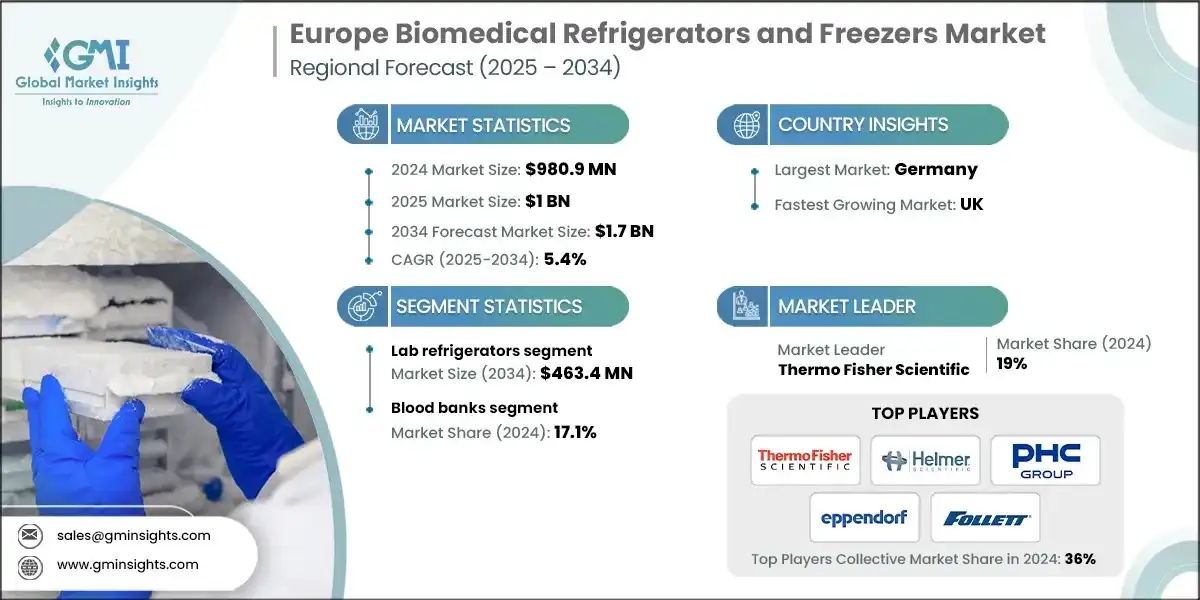
The Europe biomedical refrigerators and freezers market size was valued at USD 980.9 million in 2024 and is projected to grow from USD 1 billion in 2025 to USD 1.7 billion by 2034, expanding at a CAGR of 5.4%, according to the latest report published by Global Market Insights Inc.
To get key market trends
The steady growth of the market is driven by various factors, such as the rising prevalence of chronic diseases across Europe, an increasing geriatric population, technological advancements in biomedical refrigerators and freezers, and growing investment in biopharmaceutical research. Major companies in the industry include Thermo Fisher Scientific, Helmer Scientific, LLC, PHC Corporation, and Eppendorf.
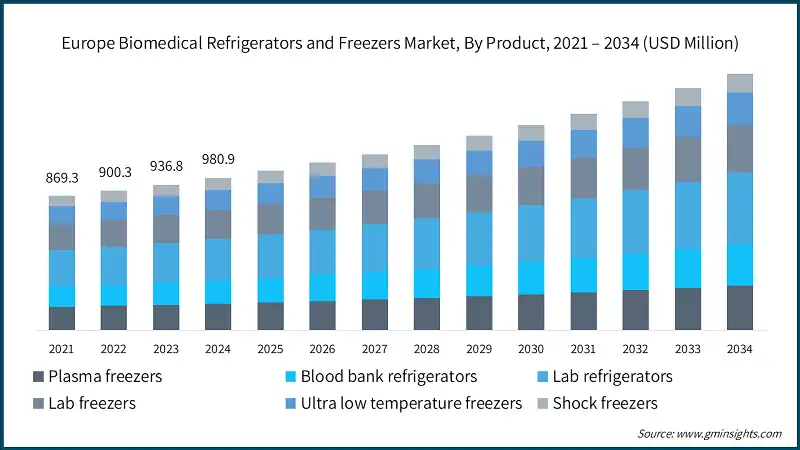
The market increased from USD 869.3 million in 2021 to USD 936.8 million in 2023. The rising prevalence of chronic diseases is a significant driver for the biomedical refrigerators and freezers market. For instance, according to the International Diabetes Federation (IDF), 9.8% of the population in the European (EUR) region, approximately 66 million individuals, currently live with diabetes. This number is expected to increase by 10% by 2050. Notably, the Europe region also has the highest global incidence of type 1 diabetes, with 2.7 million cases, 15% of which are individuals under the age of 20.
This surge in chronic conditions necessitates consistent and reliable storage of temperature-sensitive medications, insulin, biological samples, and diagnostic reagents. Biomedical refrigerators and freezers are important for maintaining the efficacy and safety of medical and research materials. The increasing demand for personalized medicine, biologics, and chronic disease management is driving innovation and fostering market growth in advanced cold storage technologies.
The increasing geriatric population is a significant driver for the biomedical refrigerators and freezers market. As of January 2024, the European Union’s population stands at 449.3 million, with 21.6% aged 65 years and above. This demographic shift is associated with a higher prevalence of age-related chronic conditions, which require ongoing medical care and the use of temperature-sensitive pharmaceuticals, vaccines, which is estimated to reach USD 145.8 billion by 2034, and biological samples.
Healthcare facilities, long-term care centers, and diagnostic laboratories are increasingly reliant on biomedical refrigeration systems to ensure the safe storage and integrity of these critical materials. The growing elderly population also contributes to a rise in hospital admissions, clinical testing, and personalized treatments, further amplifying the need for advanced, energy-efficient, and regulation-compliant cold storage solutions, thereby driving sustained growth in the biomedical refrigeration market.
Biomedical refrigerators and freezers are essential devices used in the pharmaceutical, research, and healthcare industries. These devices are critical for storing vaccines, medications, samples, and other temperature-sensitive materials under precise and optimal conditions to maintain the integrity and efficacy of the materials.
Europe Biomedical Refrigerators and Freezers Market Report Attributes
| Key Takeaway | Details |
|---|---|
| Market Size & Growth | |
| Base Year | 2024 |
| Market Size in 2024 | USD 980.9 Million |
| Market Size in 2025 | USD 1 Billion |
| Forecast Period 2025 - 2034 CAGR | 5.4% |
| Market Size in 2034 | USD 1.7 Billion |
| Key Market Trends | |
| Drivers | Impact |
| Increasing prevalence of chronic diseases across Europe | Drives the demand for reliable cold storage of temperature-sensitive medications diagnostic samples, and blood products. Encourages expansion of refrigeration infrastructure in hospitals, clinics, and diagnostic labs. |
| Growing investment in biopharmaceutical research | Boosts demand for high-performance refrigeration systems to store sensitive biologics, cell cultures, and reagents. Encourages innovation in storage technologies. |
| Increasing geriatric population base | Leads to higher healthcare needs, increasing demand for vaccines, diagnostics, and treatments that require cold storage. Expands the market for medical-grade refrigeration in hospitals and clinics. |
| Technological advancements in biomedical refrigerators and freezers | Drives adoption of smart, energy-efficient, and IoT-enabled refrigeration units. Enhances reliability, compliance, and operational efficiency across healthcare and research facilities. |
| Pitfalls & Challenges | Impact |
| Environmental regulations and sustainability concerns | Manufacturers are being pushed to transition toward eco-friendly refrigerants and energy-efficient designs, which increases R&D and production costs. If compliance becomes too expensive, it may slow down adoption. |
| High cost of advanced equipment | Limits accessibility for smaller labs and clinics. May lead to slower market penetration in cost-sensitive regions or institutions. Encourages demand for refurbished or budget alternatives. |
| Opportunities: | Impact |
| Expansion of biobanks across the region | Creates strong demand for ultra-low temperature freezers and specialized storage units. Supports long-term growth in research, diagnostics, and personalized medicine. |
| Market Leaders (2024) | |
| Market Leaders |
19% |
| Top Players |
Collective market share in 2024 is 36% |
| Competitive Edge |
|
| Regional Insights | |
| Largest market | Germany |
| Fastest growing market | UK |
| Future outlook |
|
What are the growth opportunities in this market?
Europe Biomedical Refrigerators and Freezers Market Trends
- Technological advancements in biomedical refrigerators and freezers are significantly transforming the landscape of medical cold storage. Modern units now feature temperature control systems, real-time monitoring, and alarm functions, ensuring optimal storage conditions for sensitive biological materials.
- For instance, Helmer Scientific’s OptiCool technology delivers precise temperature uniformity and quiet operation, making it ideal for clinical and pharmacy environments.
- Modern units are increasingly designed with sustainability. Energy-efficient compressors, improved insulation, and the use of natural refrigerants such as R290 and R600a contribute to reduced energy consumption and environmental impact. Eppendorf’s CryoCube ULT freezers utilize green cooling technologies and offer low power consumption while maintaining ultra-low temperatures, supporting both performance and sustainability goals.
- Additionally, advanced biomedical refrigerators and freezers now incorporate compliance-focused technologies such as lockable doors, access control, and audit trails, ensuring the safe storage of sensitive materials. These innovations, exemplified by PHCbi’s WHO and CDC-compliant units, are driving market growth by meeting the evolving regulatory and operational needs of the healthcare and research sectors.
Europe Biomedical Refrigerators and Freezers Market Analysis
Learn more about the key segments shaping this market
The Europe biomedical refrigerators and freezers market was valued at USD 869.3 million in 2021. The market size reached USD 936.8 million in 2023, from USD 900.3 million in 2022.
Based on the product, the market is segmented into plasma freezers, blood bank refrigerators, lab refrigerators, lab freezers, ultra-low temperature freezers, and shock freezers. The lab refrigerators segment dominated the market in 2024, holding the largest share due to the widespread adoption across research laboratories, diagnostic centers, and hospitals for storing reagents, samples, and other temperature sensitive materials.
The lab refrigerators segment was valued at USD 267.4 million in 2024 and is projected to reach USD 463.4 million by 2034, growing at a CAGR of 5.7% during the timeframe. In comparison, the blood bank refrigerators segment, valued at USD 149.6 million in 2024, is expected to grow to USD 264.3 million by 2034, with a CAGR of 5.9% during the forecast period.
- Laboratory refrigerators are specialized cooling units designed to maintain precise temperature conditions for storing sensitive materials such as biological samples, reagents, chemicals, and pharmaceuticals in scientific, medical, and research settings.
- They play an important role in preserving the integrity of these materials, making them essential in clinical labs, research institutions, and diagnostic centers. For example, the PHCbi MDF-DU901VHA-PA ultra-low temperature freezer offers high-capacity storage, energy efficient inverter compressors, and reliable sample protection, addressing the growing need for sustainable, high performance cold chain solutions in biomedical research and diagnostics.
- Additionally, as the demand for reliable cold storage continues to rise, innovations in energy efficiency, temperature control, and regulatory compliance are making laboratory refrigerators and freezers increasingly important for ensuring sample viability and adherence to safety standards.
Learn more about the key segments shaping this market
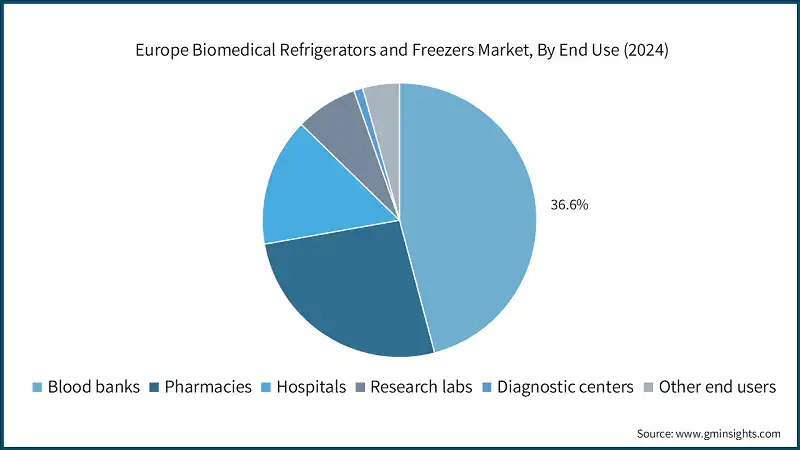
Based on end use, the Europe biomedical refrigerators and freezers market is segmented into blood banks, pharmacies, hospitals, research labs, diagnostic centers, and other end users. The blood banks segment accounted for the market share of 17.1% in 2024.
- The blood banks segment is emerging as the fastest-growing segment in the biomedical refrigerators and freezers market, driven by rising healthcare demands, technological advancements, and stringent regulatory standards. The increasing need for blood transfusions due to surgeries, trauma cases, chronic illnesses, and cancer treatments has significantly boosted blood collection and storage requirements.
- Blood banks depend on specialized refrigeration units to maintain strict temperature ranges to preserve the viability of blood components. For example, according to the International Society of Blood Transfusion, Europe has 15 million donors and 1,400 blood collection services, collectively processing around 20 million units of whole blood into red blood cells, platelets, and plasma, all requiring precise cold storage.
- Furthermore, the expansion of blood donation programs and the growing number of blood banks across Europe further amplify the demand for advanced, reliable refrigeration solutions, fueling market growth.
Looking for region specific data?
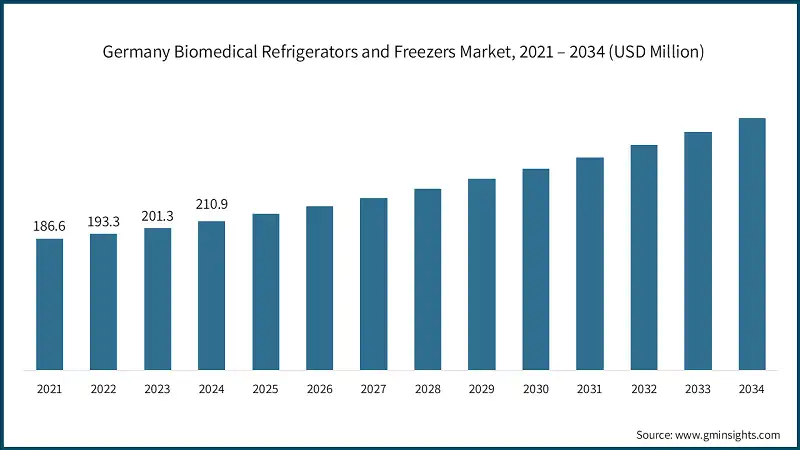
The Germany biomedical refrigerators and freezers market was valued at USD 186.6 million and USD 193.3 million in 2021 and 2022, respectively. In 2024, the market size reached USD 210.9 million from USD 201.3 million in 2023.
- Germany's increasing healthcare infrastructure, along with its advanced pharmaceutical and biotech sectors, demonstrates a strong commitment to innovation.
- For example, according to data from Statista, pharmaceutical R&D spending in the country reached approximately USD 10.6 billion in 2023, highlighting substantial investment in medical research and diagnostics. This growing focus is driving demand for high-performance, compliant cold storage solutions across hospitals, laboratories, and blood banks.
- Germany's emphasis on precision, regulatory compliance, and sustainability further supports the adoption of high performance biomedical refrigeration systems in hospitals, research labs, and biobanks. Additionally, its leadership in engineering and manufacturing enables the development and export of cutting-edge refrigeration technologies across Europe.
UK biomedical refrigerators and freezers market accounted for USD 166.6 million in 2024 and is anticipated to show lucrative growth over the forecast period.
- The UK enforces stringent regulations for biomedical storage, ensuring high standards of safety and reliability. Compliance with guidelines from bodies such as the Medicines and Healthcare products Regulatory Agency (MHRA) and the National Health Service (NHS) ensures that refrigeration units meet rigorous performance and safety benchmark.
- Significant public and private investments in healthcare infrastructure across the UK are boosting the biomedical refrigeration market. The expansion of hospitals, research labs, and diagnostic centers is creating new opportunities for refrigeration system installations.
France biomedical refrigerators and freezers market is projected to experience steady growth between 2025 and 2034.
- France's aging population is driving increased demand for advanced healthcare infrastructure, including reliable biomedical cold storage, as age-related diseases lead to more frequent hospital visits and a greater need for temperature-sensitive medical supplies such as vaccines, blood products, and biological samples.
- For instance, projections indicate that by 2050, people aged 65 and older will make up 27% of France's population compared to 21% today. Additionally, the proportion of individuals aged 80 and above is expected to nearly double, rising from 6% to over 11%. This increase in the elderly population will lead to more hospital visits and a higher demand for reliable biomedical cold storage.
- France is also home to leading research institutions and biotech hubs, which require advanced refrigeration technologies to support clinical trials, vaccine development, and biobanking.
Italy biomedical refrigerators and freezers market was projected to be valued at USD 110.4 million in 2025 and is expected to reach USD 167.3 million by 2034.
- The rising prevalence of chronic diseases is significantly influencing the growth of Italy's market. As of 2023, approximately 3.7 million Italians were living with diabetes, with a large proportion aged 75 years or older. With an age-standardized prevalence of 7.7% among adults aged 20–79, projected to increase to 9.2% by 2050, Italy ranks fourth in the IDF Europe Region for diabetes cases, highlighting the national scale of the condition.
- The rising prevalence of diabetes in Italy is driving demand for biomedical refrigerators and freezers, essential for safely storing temperature-sensitive medications such as insulin. As the aging population grows, reliable and precise cold storage solutions are increasingly vital for effective chronic disease management in healthcare and elderly care settings.
Spain biomedical refrigerators and freezers market is poised to witness lucrative growth between 2025 - 2034 with CAGR of 5%.
- Spain, with one of the fastest-aging populations, faces a growing burden of chronic diseases. As of 2023, approximately 54.3% of the population aged 15 and older, over 22 million people, were living with at least one chronic condition. This demographic shift is driving significant demand for biomedical refrigerators and freezers, which are essential for the safe storage of temperature-sensitive medications.
- With strong healthcare infrastructure and expanding home care adoption, reliable cold storage solutions are essential for ensuring medication efficacy and supporting long-term disease management across clinical and residential settings.
Europe Biomedical Refrigerators and Freezers Market Share
- The Europe biomedical refrigerators and freezers industry is strongly influenced by the presence of major industry players such as Thermo Fisher Scientific, Helmer Scientific, PHC Corporation, Eppendorf, and Follett Products, which collectively account for around 36% of the total market share.
- These companies maintain a dominant position due to their broad product portfolios, well-established distribution networks, and ongoing investments in research and development. Their ability to deliver reliable, high-performance cold storage solutions tailored to diverse healthcare needs provides them with a competitive advantage across the region.
- Eppendorf’s biomedical refrigerators and freezers are designed to ensure the safe storage of sensitive samples through features such as vacuum insulation panels, eco-friendly cooling systems, and remote monitoring via VisioNize. Their focus on energy efficiency, ergonomic design, and reliable temperature control makes them suitable for clinical, research, and pharmaceutical environments.
- Emerging players and new entrants in the Europe biomedical refrigerators and freezers market are gaining momentum by prioritizing innovation, strategic acquisitions, and specialized applications. By targeting underserved markets and niche segments, these companies are expanding their presence without directly challenging established leaders. Their approach contributes to market diversification, fosters technological advancement, and enhances access to high-quality cold storage solutions across the region.
Europe Biomedical Refrigerators and Freezers Market Companies
Few of the prominent players operating in the Europe biomedical refrigerators and freezers industry include:
- Aegis Scientific
- Azbil Corporation
- Angelantoni Life Science
- B Medical Systems
- Binder
- Eppendorf
- EVERmed
- Follett Products
- Fiocchetti Scientific
- Helmer Scientific
- NuAire
- PHC Corporation
- Stirling Ultracold
- Thermo Fisher Scientific
- Vestfrost Solutions
- NuAire
NuAire is a global manufacturer of biomedical refrigerators and freezers, offering precision-engineered units designed for storing sensitive materials such as vaccines and biological samples. Known for their reliability and temperature accuracy, NuAire’s products meet the rigorous standards of medical and scientific environments, ensuring safe and consistent storage.
PHC Corporation, under the PHCbi brand, provides high-performance biomedical refrigerators and freezers designed for precise temperature control, sample security, and energy efficiency. Their units feature advanced technologies such as VIP ECO insulation, dual cooling systems, and natural refrigerants, making them ideal for vaccine, pharmaceutical, and biological sample storage in sustainable healthcare and research environments.
Eppendorf is renowned for its CryoCube ULT freezers with advanced insulation, energy efficiency, and digital monitoring via VisioNize. These systems ensure long-term protection of high-value biological samples in clinical, pharmaceutical, and research settings.
Europe Biomedical Refrigerators and Freezers Industry News:
- In April 2024, Thermo Fisher Scientific launched the TSX Universal Series ULT Freezers, designed to enhance lab efficiency and adaptability across various workflows. This innovation strengthened the company’s leadership in advanced laboratory solutions, boosting its market presence and customer loyalty.
The Europe biomedical refrigerators and freezers market research report includes in-depth coverage of the industry with estimates and forecasts in terms of revenue in USD Million and from 2021 - 2034 for the following segments:
Market, By Product
- Plasma freezers
- Blood bank refrigerators
- Lab refrigerators
- Lab freezers
- Ultra-low temperature freezers
- Shock freezers
Market, By End Use
- Blood banks
- Pharmacies
- Hospitals
- Research labs
- Diagnostic centers
- Other end use
Frequently Asked Question(FAQ) :
Who are the key players in the Europe biomedical refrigerators and freezers industry?
Key players include Thermo Fisher Scientific, Helmer Scientific, LLC, PHC Corporation, Eppendorf, Aegis Scientific, Azbil Corporation, Binder, EVERmed, Follett Products, Fiocchetti Scientific, NuAire, and Stirling Ultracold.
What is the growth outlook for the lab refrigerators segment from 2025 to 2034?
The lab refrigerators segment is set to expand at a CAGR of 5.7% till 2034, reaching USD 463.4 million by 2034.
Which country leads the Europe biomedical refrigerators and freezers sector?
Germany leads the market, with a valuation of USD 210.9 million in 2024, supported by its advanced healthcare infrastructure and strong pharmaceutical and biotech sectors.
What are the upcoming trends in the Europe biomedical refrigerators and freezers market?
Real-time monitoring, temperature control, and compliance-focused tech; plus sustainability trends like energy-efficient compressors and natural refrigerants.
What was the valuation of the blood banks segment in 2024?
The blood banks segment accounted for 17.1% of the market share in 2024, led by increasing demand for blood transfusions and stringent regulatory standards.
How much revenue did the lab refrigerators segment generate in 2024?
The lab refrigerators segment generated approximately USD 267.4 million in 2024 and is expected to witness over 5.7% CAGR through 2034.
What is the market size of the Europe biomedical refrigerators and freezers in 2024?
The market size was USD 980.9 million in 2024, with a CAGR of 5.4% expected through 2034. Growth is driven by the rising prevalence of chronic diseases, an aging population, technological advancements, and increased investment in biopharmaceutical research.
What is the expected size of the Europe biomedical refrigerators and freezers industry in 2025?
The market size is projected to reach USD 1 billion in 2025.
What is the projected value of the Europe biomedical refrigerators and freezers market by 2034?
The market is poised to reach USD 1.7 billion by 2034, supported by advancements in refrigeration technology, sustainability initiatives, and compliance-focused innovations.
Europe Biomedical Refrigerators and Freezers Market Scope
Related Reports