Summary
Table of Content

EMEA Aquaculture Equipment Market
Get a free sample of this report
Form submitted successfully!
Error submitting form. Please try again.
Thank you!
Your inquiry has been received. Our team will reach out to you with the required details via email. To ensure that you don't miss their response, kindly remember to check your spam folder as well!
Request Sectional Data
Thank you!
Your inquiry has been received. Our team will reach out to you with the required details via email. To ensure that you don't miss their response, kindly remember to check your spam folder as well!
Form submitted successfully!
Error submitting form. Please try again.
EMEA Aquaculture Equipment Market Size
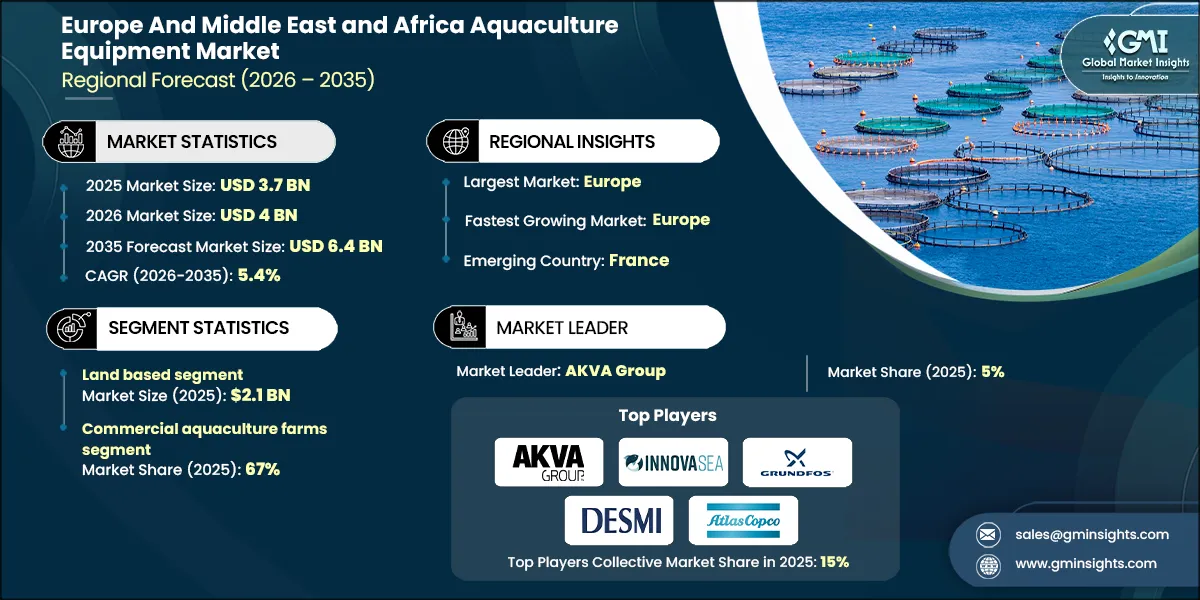
The EMEA Aquaculture Equipment Market was estimated at USD 3.7 billion in 2025. The market is expected to grow from 4 billion in 2026 to USD 6.4 billion in 2035, at a CAGR of 5.4% according to latest report published by Global Market Insights Inc.
EMEA Aquaculture Equipment Market Key Takeaways
Market Size & Growth
- 2025 Market Size: USD 3.7 Billion
- 2026 Market Size: USD 4 Billion
- 2035 Forecast Market Size: USD 6.4 Billion
- CAGR (2026–2035): 5.4%
Regional Dominance
- Largest Market: Europe
- Fastest Growing Country: Europe
Key Market Drivers
- Growing Demand for Farmed Seafood.
- Focus on Controlled and Sustainable Farming.
- Modernization of Aquaculture Operations.
Challenges
- High Initial Setup and Upgrade Costs.
- Operational Complexity and Skill Gaps.
Opportunity
- Expansion of Commercial Aquaculture Projects.
- Growing Adoption in Emerging Regions.
Key Players
- Market Leader: AKVA Group led with over 5% market share in 2025.
- Leading Players: Top 5 players in this market include AKVA Group, Innovasea, Grundfos Holding A/S, DESMI, Atlas Copco AB, which collectively held a market share of 15% in 2025.
Get Market Insights & Growth Opportunities
The aquaculture equipment market across Europe and the Middle East and Africa reflects a story of steady change shaped by food needs, resource limits, and growing attention to responsible farming. In Europe, aquaculture is part of a mature food system where producers focus on improving control, reliability, and animal welfare. Equipment suppliers in the region often work closely with fish farms to refine feeding systems, water handling tools, and monitoring solutions that fit strict environmental rules and quality expectations. The emphasis is less on expansion and more on doing things better, reducing waste, keeping stocks healthy, and ensuring stable output in a highly regulated setting. This mindset has encouraged innovation that is practical and farm-focused rather than experimental.
Across the Middle East and Africa, the market follows a different but equally compelling path. Many countries are looking at aquaculture to strengthen local food supply and reduce reliance on imports. Equipment demand here is shaped by the need for durability, ease of use, and adaptability to challenging climates and varied water conditions. Simpler, robust systems that can operate with limited support often see stronger interest, especially where skills and infrastructure are still developing.
At the same time, larger commercial projects are emerging in select markets, bringing in more advanced equipment and outside expertise. Taken together, Europe and the Middle East and Africa present a diverse landscape where aquaculture equipment supports both refinement and growth, driven by local priorities but connected by a shared goal of building reliable and sustainable fish production.
Competition in the aquaculture equipment market is fierce, with global brands and domestically based companies competing based on their ability to innovate and provide user-friendly interfaces. The development of smart ovens that come equipped with the ability to be controlled with smart phone apps or through voice commands represents an emerging but rapidly growing segment of the aquaculture equipment market.
To get key market trends
EMEA Aquaculture Equipment Market Trends
The Europe, Middle East, and Africa (EMEA) aquaculture equipment market is experiencing dynamic growth and transformation, driven by increasing seafood demand, technological advancements, and a strong focus on sustainable practices.
- Growing Adoption of Recirculating Aquaculture Systems (RAS): RAS technology, enabling land-based fish farming with minimal water exchange, is gaining significant traction across EMEA. This trend is driven by environmental concerns, the need for biosecurity, and a desire to produce fish closer to consumer markets, reducing transportation costs and environmental footprint.
- Emphasis on Automation and Digitalization: The market is witnessing increased integration of automation, sensors, and IoT solutions in aquaculture operations. This includes automated feeding systems, water quality monitoring, and remote-control capabilities, aiming to optimize efficiency, reduce labor costs, and enhance precision in farm management.
- Demand for Sustainable and Eco-Friendly Equipment: With heightened regulatory scrutiny and consumer awareness, there's a strong push for aquaculture equipment that minimizes environmental impact. This encompasses waste treatment systems, energy-efficient pumps, and materials that are recyclable or have a reduced carbon footprint, aligning with circular economic principles.
- Focus on Disease Prevention and Biosecurity: Preventing disease outbreaks is paramount for aquaculture profitability, leading to increased demand for robust biosecurity equipment. This includes advanced filtration systems, UV sterilizers, ozone generators, and specialized farm hygiene tools to protect stock and ensure sustainable production.
- Expansion of Offshore and Open-Ocean Aquaculture: As coastal areas become saturated, there's a growing interest in developing aquaculture further offshore. This drives demand for durable, robust cages, advanced mooring systems, and remote monitoring technology capable of withstanding harsher marine conditions in deeper waters.
- Technological Advancements in Feed Management: Optimizing feed conversion ratios and reducing feed waste are crucial for economic viability. The market is trending towards sophisticated feed management systems, including underwater cameras, AI-powered analysis of fish behavior, and precise dispensing mechanisms to ensure efficient nutrient delivery.
EMEA Aquaculture Equipment Market Analysis
Learn more about the key segments shaping this market
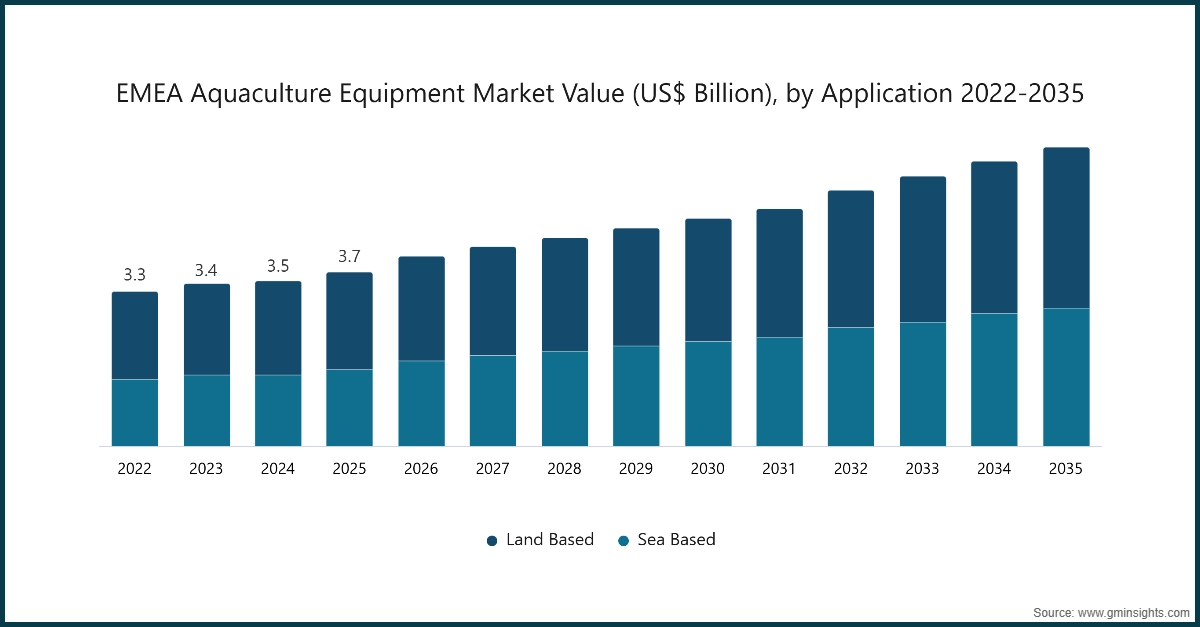
Based on application, the Europe and Middle East and Africa aquaculture equipment market is divided into land based and sea based. In 2025, land based aquaculture equipment held the major market share, generating revenue of USD 2.1 billion.
- Land-based aquaculture is dominating today mainly because it offers farmers a stronger sense of control and predictability. These systems are located onshore, which makes daily operations easier to manage and risks easier to reduce. Farmers can closely monitor water quality, feeding, and fish health without being affected by rough seas, storms, or changing ocean conditions. Land-based setups also fit well with government rules, especially in regions where coastal space is limited or carefully protected. For investors and farm operators, these systems feel more secure because production is stable, losses are easier to manage, and operations can continue year-round without heavy dependence on weather.
- At the same time, land-based farming aligns well with growing concerns around environmental impact and food safety. Waste control is easier, escape of farmed species can be avoided, and disease risks are more contained. This makes it attractive in markets where regulators and consumers expect responsible farming practices. Equipment suppliers also benefit because land-based farms often upgrade systems over time, creating ongoing demand for feeding, filtration, and monitoring tools. These factors together explain why land-based aquaculture holds a strong position in the market.
- Sea-based aquaculture, however, is the fastest growing segment because it offers scale and natural advantages. Open seas provide vast space and natural water exchange, allowing larger operations without land constraints. Improvements in cages, anchoring systems, and remote monitoring are making offshore farming more practical and reliable. As coastal demand for seafood grows, sea-based farming is increasingly seen as the long-term solution for expansion, driving rapid adoption despite higher initial challenges.
Learn more about the key segments shaping this market
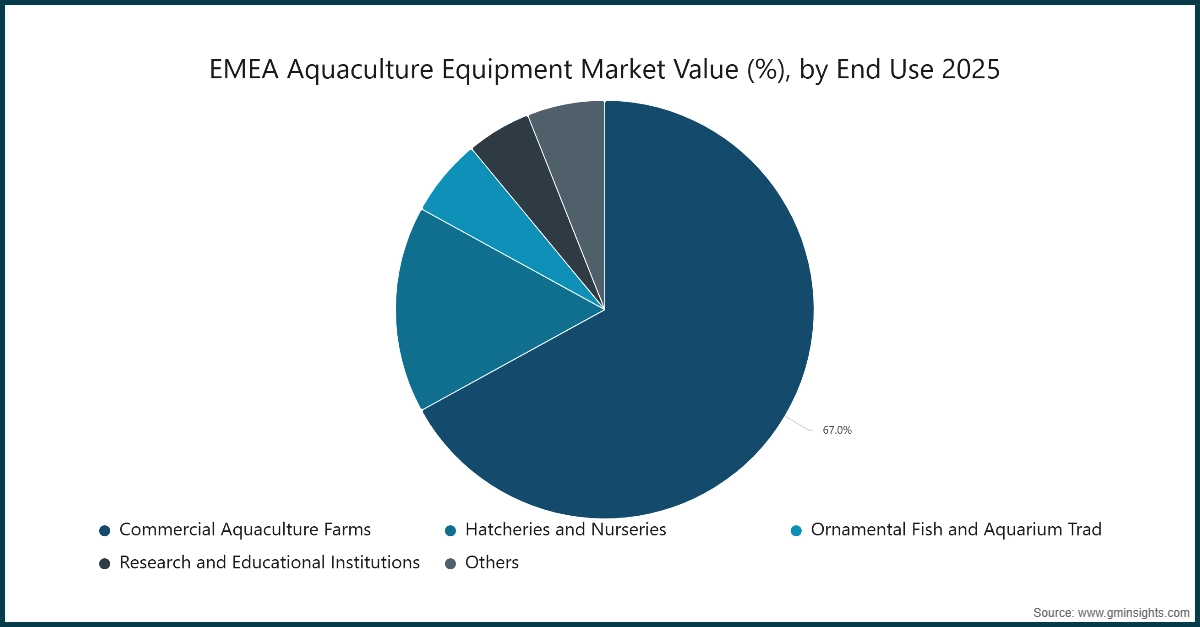
Based on end use, the Europe and Middle East and Africa aquaculture equipment market is segmented into commercial aquaculture farms, hatcheries and nurseries, ornamental fish and aquarium trad, research and educational institutions, and others. The commercial aquaculture farms segment held the largest share, accounting for 67% of the market in 2025.
- Commercial aquaculture farms dominate the market mainly because they sit at the center of seafood production and revenue generation. These farms are where fish and shellfish are grown to full size and prepared for sale, making them the most visible and economically important part of the value chain. Their operations run daily and at scale, which creates constant demand for equipment related to feeding, water management, health monitoring, and harvesting. Commercial farms also tend to invest more consistently in systems that improve efficiency and reliability, as even small gains can have a direct impact on output quality and business stability. Because of this, equipment suppliers often design solutions with commercial farms as the primary customer.
- Another reason for their dominance is market pressure. Growing seafood consumption, supply gaps in wild catch, and retailer expectations push commercial farms to operate efficiently and deliver steady volumes. To meet these demands, farms rely heavily on equipment that supports smooth operations throughout the production cycle. Many commercial players also follow strict quality and sustainability standards, which further increases the need for dependable farming systems and regular upgrades.
- Hatcheries and nurseries emerge as the second dominating segment because they form the foundation of successful aquaculture. These facilities focus on breeding and early-stage growth, where survival rates and quality are critical. While smaller in scale than commercial farms, they require specialized equipment and careful management. Their close link to commercial farms ensures steady demand, securing their strong position in the market.
Based on distribution channel, the Europe and Middle East and Africa aquaculture equipment market is segmented into direct sales and indirect sales. In 2025, the direct sales segment is dominating the market with highest market share.
- Direct sales dominate the aquaculture equipment market because most large and established farms prefer dealing straight with manufacturers. These buyers often require customized systems, technical guidance, integration support, and long-term maintenance, all of which are easier to manage through direct engagement. Direct sales also allow manufacturers to control product quality, pricing, and after-sales service more tightly, which is important in a market where equipment performance directly affects fish health and production outcomes. For major projects such as RAS facilities or offshore cage systems, direct sales ensure smoother coordination, faster installation, and reliable troubleshooting, making this channel the natural choice for high-value customers.
- At the same time, direct sales dominate because the market has traditionally been centered around regions like Northern Europe, where farms are technologically advanced and prefer comprehensive solutions. These buyers have clear requirements and often work with suppliers to develop farm-specific systems. Since many equipment categories pumps, oxygenation units, feeding systemsmust fit into tailored farm designs, direct sales give manufacturers the ability to offer complete and cohesive support that distributors may not be equipped for.
- Indirect sales, however, are the fastest-growing segment as the market expands into emerging regions and smaller-scale farms. Many newer markets rely on local distributors for affordability, quick delivery, and on-ground technical help. As adoption grows among mid-sized farms, hobby aquaculture operators, and regional hatcheries, distributors play a vital role in bridging the gap between global manufacturers and local buyers. This shift is driving rapid growth in the indirect channel, especially where cost sensitivity and accessibility matter more than full system customization.
Looking for region specific data?
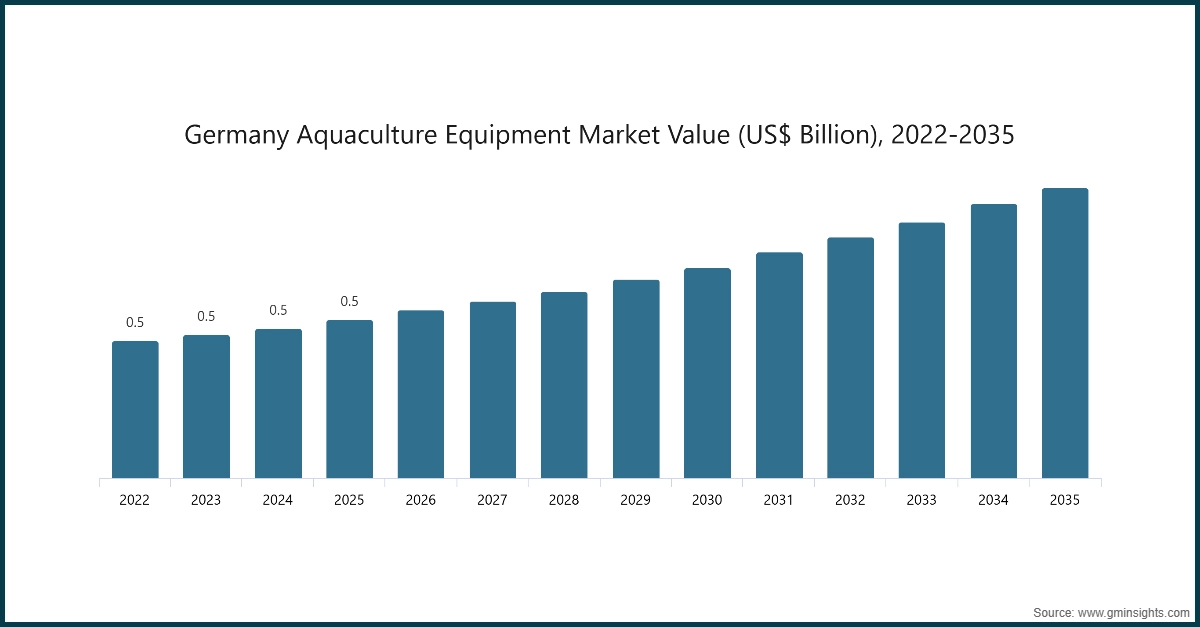
In 2025, the Germany dominated the Europe Aquaculture equipment market, accounting for around 19% and generating around USD 0.5 billion revenue in the same year.
- The aquaculture equipment market in Europe reflects a mature and structured industry shaped by strong regulation, high environmental expectations, and well-established farming practices. European fish producers prioritize efficiency and consistency rather than rapid expansion, which drives stable demand for equipment that enhances water quality, feeding precision, and farm management.
- Farmers place strong emphasis on sustainability, prompting adoption of tools that reduce waste, improve fish welfare, and lower energy use. Because coastal and freshwater farming areas are tightly regulated, equipment must align with strict environmental rules, pushing suppliers to design reliable, compliant, and long-lasting systems.
- Europe’s market is also highly collaborative manufacturers work closely with farms to customize solutions based on species, climate, and local regulations. This creates a steady ecosystem where innovation focuses on refinement rather than disruption, with digital monitoring, advanced feeding technologies, and optimized water systems becoming key areas of investment
In 2025, the Saudi Arabia dominated the Middle East and Africa Aquaculture equipment market, accounting for around 24% and generating around USD 0.3 billion revenue in the same year.
- The MEA aquaculture equipment market is shaped by growing demand for local seafood production, government-backed food security programs, and the need to adapt farming systems to challenging environments. In the Middle East, limited freshwater resources and high temperatures encourage the use of controlled and technology-supported systems such as RAS, advanced filtration, and durable aeration units. Equipment purchasers prioritize reliability, easy maintenance, and systems that can operate efficiently in warm, high-salinity conditions. Strong government initiatives and private investment are accelerating the adoption of modern aquaculture technologies, especially in Gulf countries.
- Across Africa, the market is in an earlier stage but is expanding steadily. Many regions focus on simple, robust equipment suited to small and medium farms, while larger commercial projects are beginning to introduce more advanced systems. As countries work to improve nutrition, create jobs, and build local seafood industries, demand for affordable and scalable aquaculture equipment is expected to rise, making the region one of the most promising growth areas.
EMEA Aquaculture Equipment Market Share
AKVA Group is leading with 5% market share. AKVA Group, Innovasea, Grundfos Holding A/S, DESMI, Atlas Copco AB collectively hold around 15%, indicating moderately fragmented market concentration. These prominent players are proactively involved in strategic endeavors, such as mergers & acquisitions, facility expansions & collaborations, to expand their product portfolios, extend their reach to a broad customer base, and strengthen their market position.
- AKVA Group is a leading global technology and service partner delivering complete solutions for both sea-based and land-based aquaculture. They provide comprehensive farming systems, cage technologies, sophisticated feed systems, and specialized software. Their strong presence across Europe, particularly in salmon farming nations, and integrated approach to aquaculture solutions solidify their significant position, driving efficiency and sustainability in the region.
- Innovasea specializes in advanced aquaculture technology, offering sophisticated fish tracking and monitoring systems, environmental sensors, and intelligent farm management software. They also provide submerged cage systems. Their data-driven precision aquaculture solutions are vital for optimizing farm performance, enhancing fish health, and ensuring environmental compliance across EMEA, helping farms operate smarter and more sustainably.
- Grundfos is a global leader in advanced pump solutions and water technology, developing and supplying highly efficient pumps for numerous applications, including water treatment and industrial processes. In aquaculture, their energy-efficient and reliable pumps are indispensable for water circulation, filtration, and oxygenation in Recirculating Aquaculture Systems (RAS) and other land-based farms. Their robust European network makes them a critical supplier in the region.
EMEA Aquaculture Equipment Market Companies
Major players operating in the Europe and Middle East and Africa aquaculture equipment industry are:
- Grundfos Holding A/S
- Pentair AES
- DESMI
- Xylem Inc.
- Speck Pumps
- Azcue Pumps
- Atlas Copco AB
- Ingersoll Rand
- KAESER Compressors
- Sullair
- Landia Inc.
- SPX Flow
- Flowrox
- AKVA Group
- Innovasea
DESMI designs and manufactures pumps, oil spill response equipment, and ballast water management systems, with core expertise in fluid handling. They supply vital pumping solutions for both sea-based and land-based aquaculture, including transfer pumps and crucial emergency equipment. Their robust, marine-grade products ensure reliable operation in challenging aquatic environments across EMEA, supporting farm logistics and environmental protection.
Atlas Copco is a global industrial company known for its compressors, vacuum solutions, generators, and power tools. In aquaculture, their energy-efficient blowers and air compressors are essential components for aeration systems in RAS and other fish farming setups, critical for maintaining adequate oxygen levels. Their reputation for durable, high-performance equipment makes them a preferred supplier for large-scale and technologically advanced farms throughout EMEA.
EMEA Aquaculture Equipment Market Report Attributes
| Key Takeaway | Details |
|---|---|
| Market Size & Growth | |
| Base Year | 2025 |
| Market Size in 2025 | USD 3.7 Billion |
| Market Size in 2026 | USD 4 Billion |
| Forecast Period 2026-2035 CAGR | 5.4% |
| Market Size in 2035 | USD 6.4 Billion |
| Key Market Trends | |
| Drivers | Impact |
| Growing Demand for Farmed Seafood | Rising seafood consumption and pressure on wild fish stocks are pushing producers to rely more on aquaculture. |
| Focus on Controlled and Sustainable Farming | Governments, buyers, and consumers are paying closer attention to how seafood is farmed. |
| Modernization of Aquaculture Operations | Many farms are moving away from basic setups to more organized and technology-supported operations. |
| Pitfalls & Challenges | Impact |
| High Initial Setup and Upgrade Costs | Aquaculture equipment can require significant upfront investment, which can discourage small and mid-scale farmers from adopting advanced systems, slowing wider market penetration. |
| Operational Complexity and Skill Gaps | Some equipment requires trained staff and regular maintenance. In regions with limited technical skills or support infrastructure, this can limit effective use and long-term performance. |
| Opportunities: | Impact |
| Expansion of Commercial Aquaculture Projects | Large‑scale commercial farms are increasing across several regions, creating strong opportunities for equipment suppliers offering complete and reliable farming solutions. |
| Growing Adoption in Emerging Regions | Developing markets are investing more in aquaculture for food security and employment. Demand for simple, durable, and scalable equipment presents long‑term growth potential for suppliers. |
| Market Leaders (2025) | |
| Market Leader |
5% market share |
| Top Players |
Consolidate share of 15% |
| Competitive Edge |
|
| Regional Insights | |
| Largest market | Europe |
| Fastest growing market | Europe |
| Emerging countries | France |
| Future Outlook |
|
What are the growth opportunities in this market?
Europe and Middle East and Africa Aquaculture Equipment Industry News
- In April 2025, AKVA Group launched FishTalk Insight, an AI-powered fish welfare monitoring system providing real-time behavioral analysis and health insights for salmon farmers. This launch helps AKVA Group advance digital transformation in aquaculture, improve fish welfare outcomes, reduce mortality rates, and differentiate through data-driven precision farming capabilities.
- In July 2024, AKVA Group advanced its SmartFeeder portfolio with enhanced automation capabilities, optimizing feed conversion ratios and reducing waste through precision feeding algorithms. This development helps AKVA Group address rising feed costs representing 50-60% production expenses, improve sustainability metrics, and deliver measurable ROI for fish farmers.
- In January 2023, AKVA Group completed its NOK 1.2 billion acquisition of Steinsvik, a leading Norwegian aquaculture technology provider specializing in feeding and cage systems. This acquisition helps AKVA Group create a comprehensive aquaculture technology portfolio, achieve operational synergies, strengthen its market position as Europe's leading equipment supplier, and expand capabilities across the value chain.
The EMEA Aquaculture Equipment Market research report include in-depth coverage of industry with estimates & forecasts in terms of revenue (USD Billion) and volume (Thousand Units) from 2022 to 2035, for the following segments:
Market, By Equipment Type
- Water circulation & transfer equipment (pumps)
- Centrifugal pumps
- Submersible pumps
- Specialized pumps
- Positive displacement pumps
- Aeration & oxygenation equipment
- Air compressors
- Oil-free compressors
- Oil-lubricated compressors
- Air blowers
- Oxygen generation systems
- Aeration accessories
- Air compressors
- Water treatment & conditioning equipment
- Mixing equipment
- Submersible mixers
- Static mixers
- Venturi mixers
- Biological treatment
- Physical treatment
- Chemical/advanced treatment
- Mixing equipment
- Feeding & nutrition systems
- Fish handling & harvesting equipment
- Monitoring & control systems
- Structural & containment systems
- Other specialized equipment
Market, By Application
- Land-based
- Sea-based
Market, By End use
- Commercial aquaculture farms
- Hatcheries and nurseries
- Ornamental fish and aquarium trad
- Research and educational institutions
- Others (Government & Conservation)
Market, By Distribution Channel
- Direct sales
- Indirect sales
The above information is provided for the following regions and countries:
- Europe
- UK
- Germany
- France
- Italy
- Spain
- Russia
- Middle East and Africa
- Saudi Arabia
- UAE
- South Africa
Frequently Asked Question(FAQ) :
What is the EMEA Aquaculture Equipment Market size in 2025?
The Europe and Middle East and Africa market size for aquaculture equipment was valued at USD 3.7 billion in 2025. The market's growth is driven by rising seafood consumption, increasing pressure on wild fish stocks, and the adoption of modern aquaculture practices.
What is the market size of the Europe and Middle East and Africa aquaculture equipment industry in 2026?
The market size for Europe and Middle East and Africa aquaculture equipment reached USD 4 billion in 2026, reflecting steady growth supported by advancements in sustainable and controlled farming technologies.
What is the projected value of the EMEA Aquaculture Equipment Market by 2035?
The market size for Europe and Middle East and Africa aquaculture equipment is expected to reach USD 6.4 billion by 2035, growing at a CAGR of 5.4%. This growth is fueled by the expansion of commercial aquaculture projects and increasing investments in emerging regions.
How much revenue did the land-based aquaculture equipment segment generate in 2025?
The land-based aquaculture equipment segment generated USD 2.1 billion in revenue in 2025, making it the largest application category. Its dominance is attributed to the growing adoption of controlled farming systems and sustainable aquaculture practices.
What was the market share of the commercial aquaculture farms segment in 2025?
The commercial aquaculture farms segment accounted for 67% of the Europe and Middle East and Africa aquaculture equipment market in 2025. This segment's leadership is driven by the increasing demand for large-scale, efficient farming solutions.
Which region dominated the Europe aquaculture equipment market in 2025?
Germany dominated the Europe aquaculture equipment market in 2025, accounting for approximately 19% of the regional market and generating around USD 0.5 billion in revenue. Its leadership is supported by advanced aquaculture infrastructure and strong government support.
What are the upcoming trends in the Europe and Middle East and Africa aquaculture equipment industry?
Key trends include the growing shift toward digital and automated farming, rising adoption of IoT-enabled equipment, and increasing investments in emerging markets. The integration of advanced technologies like real-time monitoring and data analytics is enhancing operational efficiency and sustainability.
Who are the key players in the Europe and Middle East and Africa aquaculture equipment market?
Key players include AKVA Group, Innovasea, Grundfos Holding A/S, DESMI, Atlas Copco AB, Pentair AES, Xylem Inc., Speck Pumps, Azcue Pumps, and KAESER Compressors.
EMEA Aquaculture Equipment Market Scope
Related Reports