Summary
Table of Content

Europe Air Pollution Control Equipment Market
Get a free sample of this report
Form submitted successfully!
Error submitting form. Please try again.
Thank you!
Your inquiry has been received. Our team will reach out to you with the required details via email. To ensure that you don't miss their response, kindly remember to check your spam folder as well!
Request Sectional Data
Thank you!
Your inquiry has been received. Our team will reach out to you with the required details via email. To ensure that you don't miss their response, kindly remember to check your spam folder as well!
Form submitted successfully!
Error submitting form. Please try again.
Europe Air Pollution Control Equipment Market Size
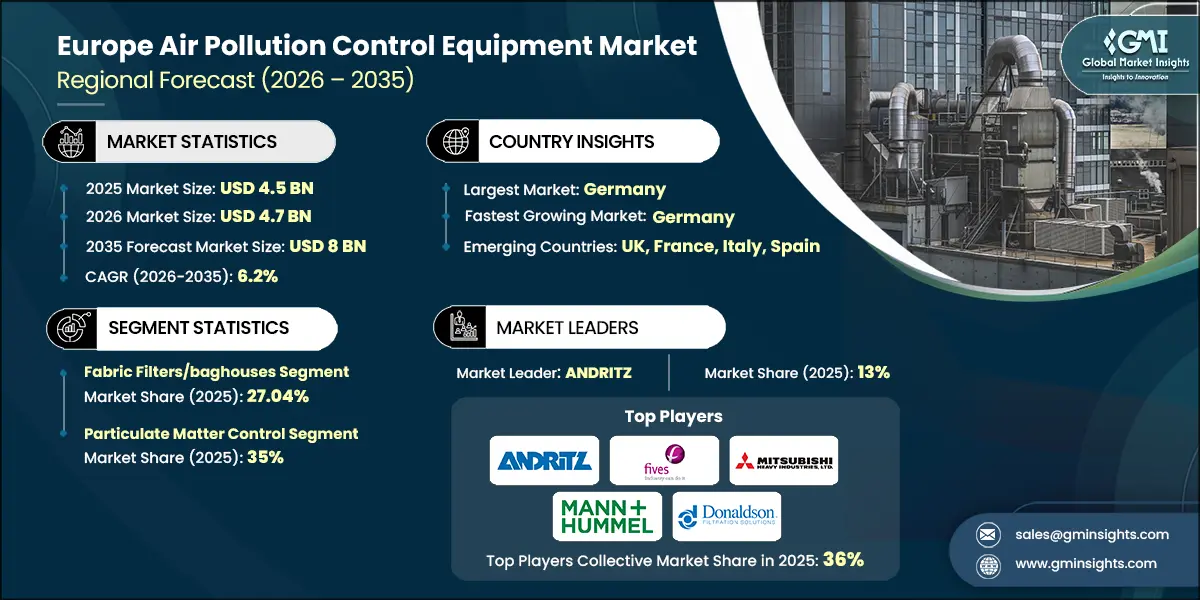
Europe air pollution control equipment market was estimated at USD 4.5 billion in 2025. The market is expected to grow from USD 4.7 billion in 2026 to USD 8 billion in 2035, at a CAGR of 6.2% according to latest report published by Global Market Insights Inc.
Europe Air Pollution Control Equipment Market Key Takeaways
Market Size & Growth
- 2025 Market Size: USD 4.5 Billion
- 2026 Market Size: USD 4.7 Billion
- 2035 Forecast Market Size: USD 8 Billion
- CAGR (2026–2035): 6.2%
Regional Dominance
- Largest Market: Germany
- Fastest Growing Country: Germany
Key Market Drivers
- Stringent environmental regulations & emission standards.
- Industrial modernization & retrofitting demand.
- Public health awareness & urban air quality management.
Challenges
- high capital investment & operational costs.
- System Integration & Technical Complexity.
Opportunity
- AI-enabled emission monitoring & predictive maintenance.
- Growth of service-based & compliance-as-a-service models.
Key Players
- Market Leader: ANDRITZ led with over 13% market share in 2025.
- Leading Players: Top 5 players in this market include ANDRITZ, Fives Group, Mitsubishi Heavy Ind., MANN+HUMMEL, Donaldson, which collectively held a market share of 36% in 2025.
Get Market Insights & Growth Opportunities
Awareness of environmental sustainability, as well as stringent air quality norms in Europe, is fuelling the ongoing demand for air pollution control equipment again. This is also because of an increasing trend in mergers, acquisitions, and partnerships among the major players of this business domain. When companies such as Siemens, ANDRITZ, Babcock & Wilcox, and Duerr Group compete in partnerships and business acquisitions, the market is helped by the increased levels of innovation and geographical footprint of these companies in the market. Traditional air pollution control is giving way to innovative technologies, such as continuous emission monitoring and filtration methods.
Air pollution control systems provide a better solution because these systems can be used for accurate removal of a set of pollutants, including particulate matter, sulfur oxides, nitrogen oxides, volatile organic compounds, and hazardous air pollutants from the gases used in industries. Technologies employed include electrostatic precipitators, fabric filters, scrubbers, and catalytic converters to ensure minimum emissions and adherence to directives such as the Industrial Emissions Directive in the European Union.
This establishes a strong case for the commercial viability of air pollution control equipment, especially with the European focus on carbon neutrality, industrial decarbonisation, and green urbanism. The government incentives, strict limits, and non-compliance fines continue to drive industries toward modernised pollution control technologies.
The rise in industrial operations in various sectors like power generation, cement production, chemicals production, pharmaceuticals production, and metals production is creating a requirement for efficient and improved air pollution control solutions. At the same time, aging industrial infrastructure in many countries in Europe is creating a need for retrofitting these existing industrial facilities with modern technologies for reduced emissions. Modern industrial facilities are now turning their back on traditional systems requiring frequent maintenance and manual operations and are opting instead for more reliable and digitally controlled systems for increased efficiency and cost-effectiveness. Among various control techniques employed in air pollution control technology, source control is considered more reliable and scientifically correct compared to downstream measures, as pollutants are removed at the point of emission. Air quality control technologies are also gaining traction in view of the importance being given to real-time monitoring and minimal environmental upsets.
Known benefits include increased benefits in terms of compliance assurance, health risks minimization, optimal energy consumption, and the prevention of long-term environmental deterioration, such as acid rain and urban smogs. The benefits seem to align well with the wider drive in Europe for sustainable industries and the circular economy in Europe.
The market landscape is being significantly affected and impacted by the various technological changes. For instance, recent technologies and advancements in different technologies, such as sensors, automation, and control technologies, are significantly improving the efficiency and reliability of air pollution control technologies. Relatedly, latest technologies and advancements in information and data technologies, such as IoT, are helping decision-makers in improving the reliability and efficiency of data and information generated in the market.
Innovation in filtration media, catalyst formulations, and modular system configurations continues to be the driving force behind market growth. Air pollution control systems have been advancing from simple to integrated systems that can address the complex requirements of industrial exhaust gases. The market is also seeing a transition toward connected systems that facilitate the control and monitoring of the equipment from a distance, especially for industrial systems dispersed over a number of places.
Another key area for development centers on integrating air pollution control systems and continuous emission monitoring systems (CEMS). This approach facilitates tracking and monitoring for compliance, while also opening doors for hybrid systems integrating on-site equipment and a centralized, overarching system designed for environmental management—technology which is greatly needed within European markets, where detailed emission reports are a required task for various regulating bodies.
The major driver for the air pollution control equipment market in Europe is the rise in the implementation of environmental regulations, along with the region’s pursuit of a goal that sees emissions cut down to zero. This contrasts greatly with traditional systems used in pollution management, where inspections were conducted at regular intervals. However, nowadays, air pollution control systems are capable of continuously providing information pertaining to pollution levels, making them favorably received by industries seeking efficiency in pollution control as well as government agencies looking to implement effective systems in air pollution.
To get key market trends
Europe Air Pollution Control Equipment Market Trends
The air pollution control equipment market in the region of Europe has been experiencing steady transformation and growth over the years due to ongoing technological developments, changes in regulations, and increasing investments from key industry players. These key air pollution control equipment players are diligently introducing advanced air pollution control technologies that include equipment such as high-efficiency media for filtration and monitoring technologies, and automation technologies. This reflects an increased level of industry dedication to modernization and technology as far as sustainability and green business approaches are concerned.
- Technology development and product innovation: In the present market, a prominent trend is the increasing scope for the development of advanced, automated, and integrated air pollution control systems by the original equipment manufacturers. In the field of electrostatic precipitators, fabric filters, wet and dry scrubbers, NOx, SOx, and volatile catalysts, there are high-performance equipment in the offing for the removal efficiency of particulate matter 2.5, NOx, SOx, and volatile organic compounds, integrating IoT sensors, CEMS, and edge computing for analysis and optimization of the systems to automatically respond to changes in emissions.
- Modernization of industrial emission control infrastructure: Some of the key trends in the market include growth in industrial modernization and plant retrofitting across Europe. Due to aging power plants, cement kilns, metal processing units, and chemical manufacturing facilities, the need to upgrade outdated emission control equipment to existing IED and NEC standards is also rising. This is further strengthened by demand for modular and scalable systems that allow upgrading in phases, without extended shutdowns of operations to make compliance more feasible in terms of cost for industrial operators.
- Sustainability initiatives and decarbonization alignment: Europe's focus on sustainability, climate neutrality, and decarbonization through initiatives like the EU Green Deal and Fit for 55 accelerates the deployment of advanced air pollution control technologies. Although these systems directly target regulated air pollutants, they indirectly help carbon reduction strategies by enhancing energy efficiency and providing support for cleaner industrial processes. Growing emphasis on ESG reporting also promotes the use of more transparent, auditable solutions for emission controls among industries.
- Rising impact of air quality and public health concerns: The rising awareness about health hazards caused or related to air pollution, such as respiratory and cardiovascular diseases, fuels public demand for technology that can reduce emissions. Growing focus on air pollution management from various sectors, including urban, waste-to-energy, and district heating plants, and industrial areas, puts a strong emphasis on the use and application of pollution abatement equipment and technology. Governments and various regional entities are becoming increasingly focused on active pollution abatement and mitigation strategies.
- Integration with concepts of digital platforms and smart industry: The implementation and usage of Industry 4.0 and smart manufacturing concepts are impacting the air pollution control system installation and design. Equipment is connected to digital control systems, cloud-based monitoring solutions, and environmental management systems. Due to these changes, maintenance prediction and reporting of compliance are becoming integral features, considering the government regulations and control environment in European countries.
- Expansion of Municipal and Infrastructure-Based Applications: Beyond heavy industry, the market is witnessing growing adoption of air pollution control equipment in municipal infrastructure projects, including waste incineration facilities, wastewater treatment plants, and district energy systems. As European cities pursue “smart city” and sustainable urban development initiatives, consistent demand is emerging for compact, high-efficiency emission control systems that operate reliably in densely populated areas.
Europe Air Pollution Control Equipment Market Analysis
Learn more about the key segments shaping this market
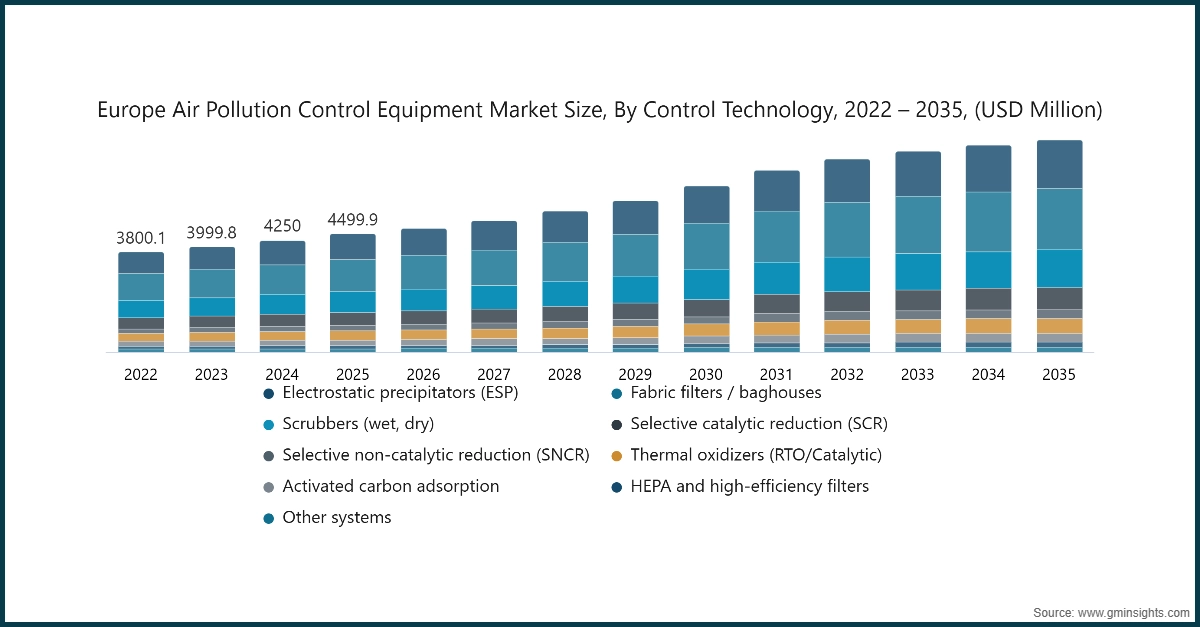
Based on control technology, the market is segmented into electrostatic precipitators (ESP), fabric filters/baghouses, scrubbers, SCR, SNCR, thermal oxidizers, activated carbon systems, HEPA/high-efficiency filters, and other systems. In 2025, Fabric filters / baghouses accounted for the largest market share of 27.04% with revenue of USD 1.2 billion , driven by their widespread application in particulate-heavy industries.
- Fabric filters and baghouses represent the largest technology segment, supported by their high removal efficiency for fine particulate matter (PM2.5 and PM10). Their flexibility across cement, metals, and power generation facilities makes them a preferred solution as emission limits tighten.
- Electrostatic precipitators (ESP) maintain a strong market position, particularly in large-scale power plants and industrial boilers, where high-volume flue gas handling and long operational life are critical.
- Scrubbers (wet and dry) hold a significant share due to their effectiveness in controlling sulfur oxides and acid gases, especially in fossil fuel-based power generation and chemical processing.
- Selective Catalytic Reduction (SCR) and Selective Non-Catalytic Reduction (SNCR) technologies show steady growth, driven by stringent NOx emission regulations under EU directives.
Learn more about the key segments shaping this market
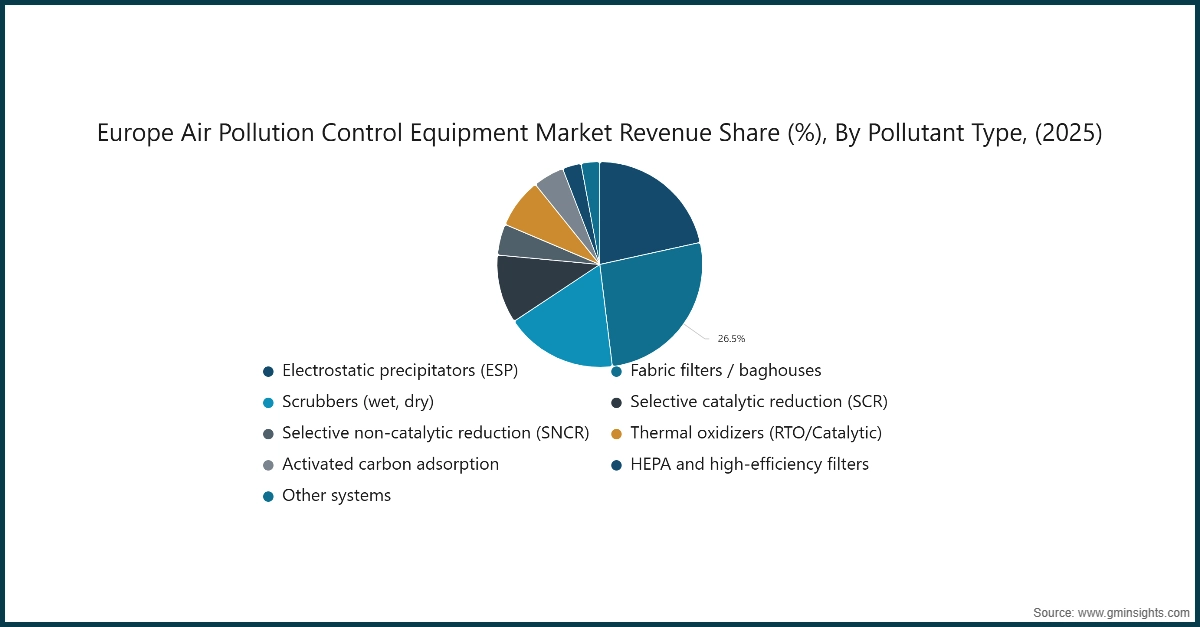
- Particulate matter (PM2.5 and PM10) dominates the market due to its strong association with respiratory and cardiovascular diseases, driving strict enforcement across Europe.
- Nitrogen oxides (NOx) represent a major segment, supported by extensive deployment of SCR and SNCR systems in power generation and industrial combustion processes.
- Sulfur oxides (SOx) continue to generate demand for scrubbers, particularly in coal-based power plants, refineries, and marine-adjacent industrial zones.
- VOCs and hazardous air pollutants, including heavy metals such as mercury and lead, are gaining attention due to tightening environmental and occupational health standards, especially in chemicals, metals, and waste incineration facilities.
Based on end-user industry, the Europe air pollution control equipment market is segmented into power generation, cement & aggregates, metals & mining, chemicals & petrochemicals, glass manufacturing, pulp & paper, and others. In 2025, power generation accounted for the largest market share, reflecting its high emission intensity and strict regulatory oversight.
- Power generation represents the largest and fastest-growing end-user segment. This dominance is driven by continuous upgrades of emission control systems in fossil fuel and biomass-based plants to comply with EU emission ceilings and decarbonization pathways.
- Cement and aggregates form a significant segment due to dust-intensive operations and increasing pressure to reduce particulate and NOx emissions from kilns.
- Metals and mining maintain strong demand for advanced filtration and gas treatment systems, particularly for heavy metal and particulate control.
- Chemicals and petrochemicals rely heavily on VOC abatement technologies and catalytic systems, supporting consistent market growth.
- Glass manufacturing and pulp & paper represent stable demand segments, driven by furnace emissions and combustion-based processes
 Looking for region specific data?
Looking for region specific data?
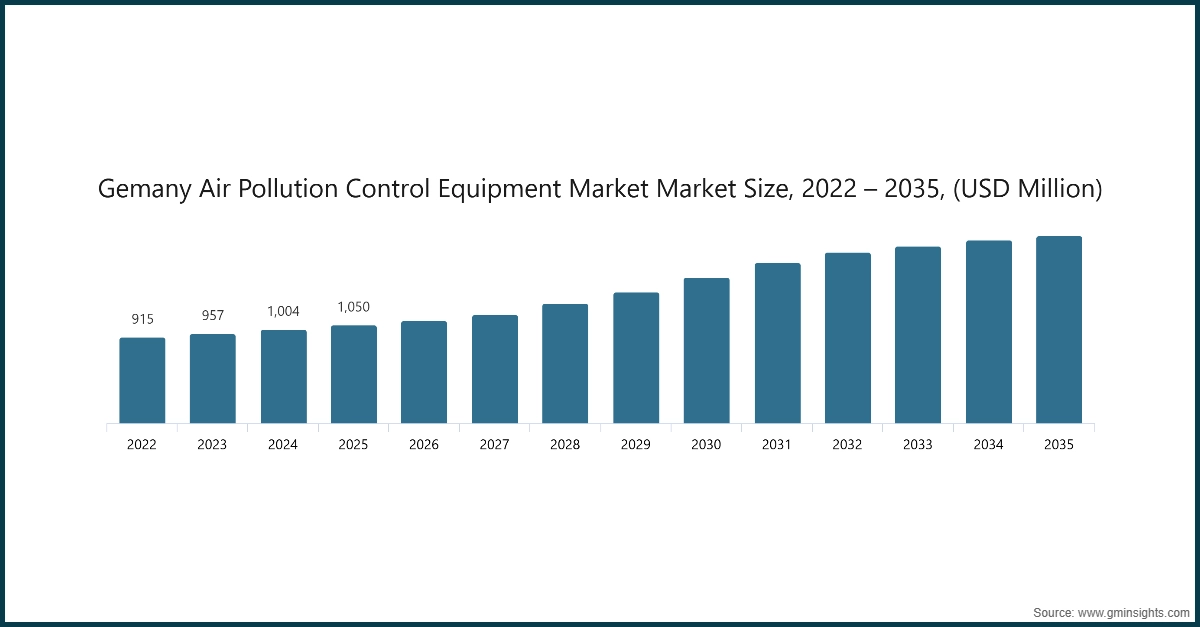
Europe represents one of the most mature and regulation‑driven markets for air pollution control equipment, valued at USD 4.5 billion in 2025 and projected to grow at a CAGR of 6.2% through 2035. Germany leads the regional market, reaching USD 1.05 billion in 2025, driven by its strong industrial base, early adoption of advanced emission control technologies, and strict enforcement of air quality regulations.
- The European market benefits from stringent environmental policies under frameworks such as the EU Industrial Emissions Directive (IED) and national clean air acts, which mandate continuous monitoring and reduction of particulate matter, NOx, SOx, and hazardous air pollutants across industrial sectors.
- The region also gains from Industry 4.0 adoption, which enhances digital connectivity, enables intelligent emission monitoring, and supports automation in air pollution control systems. These developments reduce operational inefficiencies while ensuring regulatory compliance across complex industrial environments.
- Europe remains a highly competitive and innovation‑led landscape, driving continuous upgrades in filtration efficiency, catalytic performance, and system modularity. Countries such as France and Italy demonstrate steady growth supported by emission reduction requirements in cement production, power generation, and chemical processing industries.
- The integration of IoT‑enabled sensors, continuous emission monitoring systems (CEMS), and AI‑driven analytics is helping minimize the environmental footprint of industrial operations, reinforcing Europe’s leadership in sustainable manufacturing and climate‑resilient industrial practices
Europe Air Pollution Control Equipment Market Share
ANDRITZ is leading with 13% market share ANDRITZ, Fives Group, Mitsubishi Heavy Ind., MANN+HUMMEL and Donaldson collectively hold around 36%, indicating moderately fragmented market concentration. These prominent players are proactively involved in strategic endeavors, such as mergers & acquisitions, facility expansions & collaborations, to expand their product portfolios, extend their reach to a broad customer base, and strengthen their market position.
- In 2024, John Cockerill continued to expand its presence in industrial flue gas treatment and air pollution control projects across Europe, particularly in energy, metals, and waste‑to‑energy applications. The company focused on integrated solutions combining dust removal, gas cleaning, and heat recovery to support compliance with EU emission limits and decarbonization initiatives
Europe Air Pollution Control Equipment Market Companies
Major players operating in the Europe air pollution control equipment industry are:
- ANDRITZ
- Babcock & Wilcox
- Five Group
- GEA Group
- John Cockerill
- Mitsubishi Heavy Ind.
- AAF International
- Anguil Environmental
- Camfil Group
- Donaldson Company
- Freudenberg Filtration
- Hamon Corporation
- MANN+HUMMEL
- Thermax Limited
- Bernd Munstermann GmbH & Co. KG
- CTP Air Pollution Control
- Ecospray Technologies
- Socrematic
In 2024, Donaldson Company expanded its industrial dust and fume collection solutions portfolio in Europe, targeting metalworking, food processing, and chemical manufacturing facilities. The company focused on high‑efficiency cartridge filters and modular dust collectors designed to meet tightening EU workplace air quality and outdoor emission standards.
MANN+HUMMEL strengthened its industrial air filtration business in Europe by advancing high‑efficiency particulate and molecular filtration technologies for heavy industrial applications. The company emphasized energy‑efficient filter media and extended service life solutions to help customers reduce operating costs while maintaining regulatory compliance.
Europe Air Pollution Control Equipment Market Report Attributes
| Key Takeaway | Details |
|---|---|
| Market Size & Growth | |
| Base Year | 2025 |
| Market Size in 2025 | USD 4.5 Billion |
| Market Size in 2026 | USD 4.7 Billion |
| Forecast Period 2026-2035 CAGR | 6.2% |
| Market Size in 2035 | USD 8 Billion |
| Key Market Trends | |
| Drivers | Impact |
| Stringent environmental regulations & emission standards | The enforcement of rigorous European Union regulations—such as the Industrial Emissions Directive (IED), National Emissions Reduction Commitments (NEC), and country-specific air quality standards—requires continuous monitoring and reduction of particulate matter, NOx, SOx, and VOC emissions |
| Industrial modernization & retrofitting demand | Aging industrial infrastructure across Europe, particularly in power generation, cement, metals, and chemical manufacturing, necessitates upgrades to meet modern emissions compliance standards. |
| Public health awareness & urban air quality management | Rising public awareness of the health impacts of air pollution—especially fine particulate matter (PM2.5) and nitrogen oxides—has prompted governments and municipalities to invest in air quality management solutions. |
| Pitfalls & Challenges | Impact |
| high capital investment & operational costs | The deployment of advanced air pollution control equipment involves substantial upfront capital expenditure for hardware, installation, plant integration, and commissioning. |
| System Integration & Technical Complexity | Modern air pollution control systems often need to be integrated with existing plant infrastructure, continuous emission monitoring systems (CEMS), and digital control platforms. |
| Opportunities: | Impact |
| AI-enabled emission monitoring & predictive maintenance | The integration of AI and machine learning into air pollution control systems enables real-time emissions optimization, fault detection, and predictive maintenance. |
| Growth of service-based & compliance-as-a-service models | Service-driven business models—such as emissions management contracts, remote system monitoring, and subscription-based compliance solutions—allow industrial operators to access advanced air pollution control technologies without heavy upfront capital investment. |
| Market Leaders (2025) | |
| Market Leader |
13% market share |
| Top Players |
Consolidate share of 36% |
| Competitive Edge |
|
| Regional Insights | |
| Largest Market | Germany |
| Fastest growing market | Germany |
| Emerging countries | UK, France, Italy, Spain |
| Future outlook |
|
What are the growth opportunities in this market?
Europe Air Pollution Control Equipment Industry News
In June 2025, ANDRITZ was selected by Technische Betriebe Solingen (TBS) to upgrade the flue gas cleaning system at the Solingen waste‑to‑energy plant in Germany using its TurboSorp multi‑pollutant emission control technology. The project aims to significantly reduce sulfur oxides, dioxins, hydrogen chloride, and heavy metal emissions, ensuring compliance with Germany’s stringent air quality regulations while extending the operational life of the facility.
- In April 2025, Camfil Group released its 2024 Sustainability Report, highlighting the expanded deployment of high‑efficiency particulate and molecular filtration solutions across European industrial facilities. The report underscores Camfil’s continued focus on energy‑efficient air pollution control systems that support regulatory compliance and long‑term sustainability goals.
- In 2025, Thermax Limited reported strong performance from its Air Pollution Control (Enviro) division, which was recognized internally as the company’s Best Strategic Business Unit. Thermax continues to expand its footprint in Europe by supplying advanced baghouses, scrubbers, and integrated emission control systems for compliance‑driven upgrades in cement, power generation, and industrial processing facilities.
- In June 2024, Babcock & Wilcox (B&W) secured contracts valued at over USD 18 million to design and supply wet and dry electrostatic precipitator (ESP) rebuilds for industrial and utility facilities across Europe. These projects strengthen B&W’s position in particulate emissions control for power generation, cement, metals, and waste‑to‑energy plants facing tighter EU emission standards.
The Europe Air Pollution Control Equipment Market research report includes in-depth coverage of the industry with estimates & forecasts in terms of revenue (USD Million) and volume (Thousand Units) from 2022 to 2035, for the following segments:
Market, By Control Technology
- Electrostatic precipitators (ESP)
- Fabric filters / baghouses
- Scrubbers (wet, dry)
- Selective catalytic reduction (SCR)
- Selective non-catalytic reduction (SNCR)
- Thermal oxidizers (RTO/Catalytic)
- Activated carbon adsorption
- HEPA and high‑efficiency filters
- Other systems
Market, By Pollutant Type
- Particulate Matter
- Nitrogen Oxides
- Sulfur Oxides
- Volatile Organic Compounds (VOCs)
- Carbon Monoxide (CO)
- Metals and Heavy Metals
- Other pollutants
Market, By End-User
- Power generation
- Cement and aggregates
- Metals and mining
- Chemicals and petrochemicals
- Glass manufacturing
- Pulp and paper
- Others
The above information is provided for the following regions and countries:
Germany
- UK
- France
- Italy
- Spain
- Netherlands
- Sweden
- Poland
Frequently Asked Question(FAQ) :
What is the market size of the Europe air pollution control equipment industry in 2025?
The Europe market size for air pollution control equipment is valued at USD 4.5 billion in 2025. The market's growth is driven by stringent environmental regulations, industrial modernization, and increasing public health awareness.
What is the market size of the Europe air pollution control equipment market in 2026?
The market size for Europe air pollution control equipment reached USD 4.7 billion in 2026, reflecting steady growth supported by regulatory compliance and technological advancements.
What is the projected value of the Europe air pollution control equipment market by 2035?
The market size for Europe air pollution control equipment is expected to reach USD 8 billion by 2035, growing at a CAGR of 6.2%. This growth is fueled by the adoption of advanced emission control technologies and service-based business models.
What was the revenue generated by fabric filters/baghouses in 2025?
Fabric filters/baghouses accounted for 27.04% of the market in 2025, generating USD 1.2 billion in revenue. Their widespread application in particulate-heavy industries supports their market leadership.
What was the valuation of the particulate matter control segment in 2025?
The particulate matter control segment captured 35% of the market in 2025, making it the largest pollutant type category. Its dominance is driven by regulatory priorities and its significant health impact.
Which country leads the Europe air pollution control equipment market?
Germany leads the market, reaching USD 1.05 billion in 2025. Its leadership is driven by a strong industrial base, early adoption of advanced emission control technologies, and strict enforcement of air quality regulations.
What are the upcoming trends in the Europe air pollution control equipment industry?
Key trends include the integration of AI and machine learning for real-time emissions optimization, the rise of service-based compliance models, and the adoption of advanced technologies like activated carbon systems and HEPA filters.
Who are the key players in the Europe air pollution control equipment market?
Key players include ANDRITZ, Babcock & Wilcox, Fives Group, GEA Group, John Cockerill, Mitsubishi Heavy Industries, AAF International, Anguil Environmental, Camfil Group, and Donaldson Company.
Europe Air Pollution Control Equipment Market Scope
Related Reports