Summary
Table of Content

Europe Adult Disposable Incontinence Products Market
Get a free sample of this report
Form submitted successfully!
Error submitting form. Please try again.
Thank you!
Your inquiry has been received. Our team will reach out to you with the required details via email. To ensure that you don't miss their response, kindly remember to check your spam folder as well!
Request Sectional Data
Thank you!
Your inquiry has been received. Our team will reach out to you with the required details via email. To ensure that you don't miss their response, kindly remember to check your spam folder as well!
Form submitted successfully!
Error submitting form. Please try again.
Europe Adult Disposable Incontinence Products Market Size
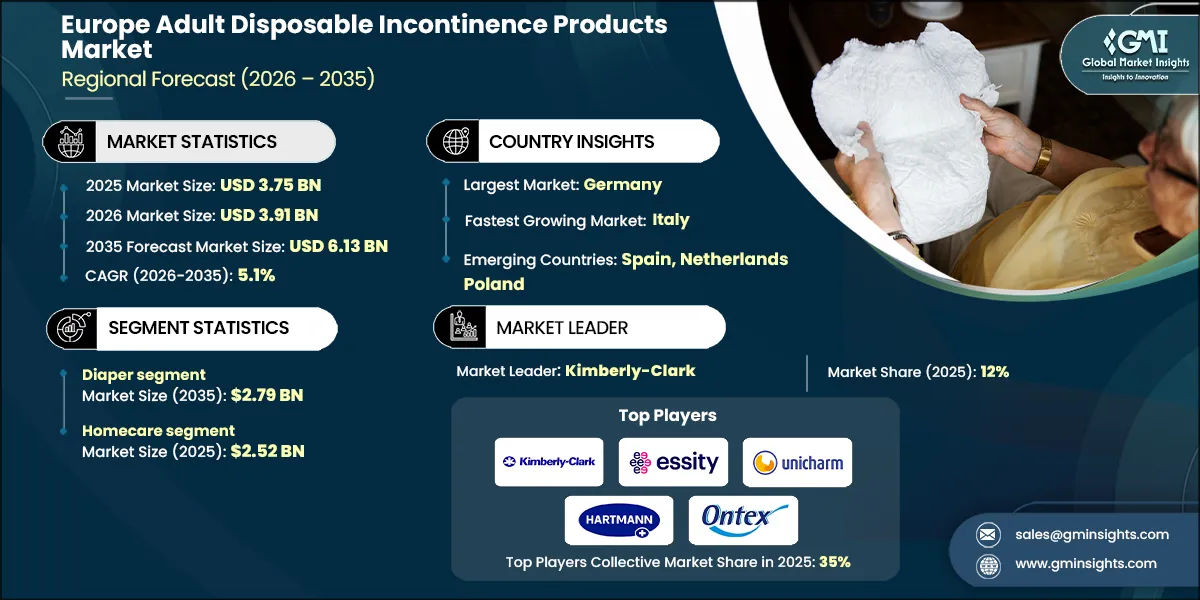
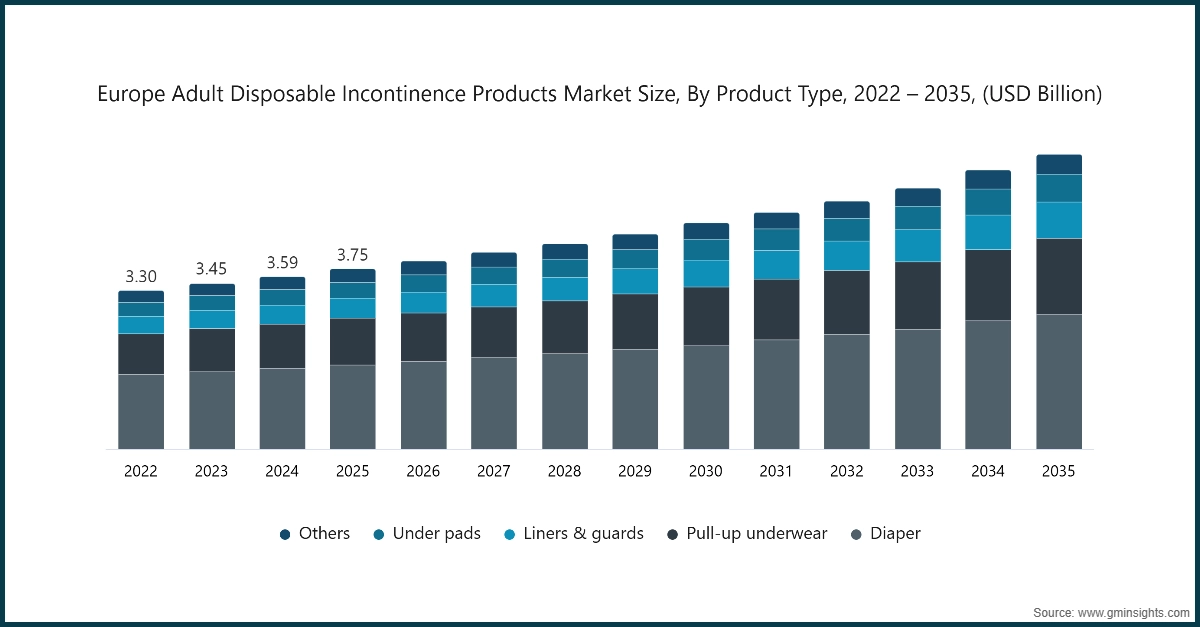
The Europe adult disposable incontinence products market was estimated at USD 3.75 billion in 2025. The market is expected to grow from USD 3.91 billion in 2026 to USD 6.13 billion in 2035, at a CAGR of 5.1% according to latest report published by Global Market Insights Inc.
Europe Adult Disposable Incontinence Products Market Key Takeaways
Market Size & Growth
- 2025 Market Size: USD 3.75 Billion
- 2026 Market Size: USD 3.91 Billion
- 2035 Forecast Market Size: USD 6.13 Billion
- CAGR (2026–2035): 5.1%
Regional Dominance
- Largest Market: Germany
- Fastest Growing Country: Italy
Key Market Drivers
- Rapidly aging population.
- Increasing healthcare expenditure & assistive technology uptake.
- Greater social acceptance & awareness.
Challenges
- Reimbursement variability across Europe.
- Persistent social stigma & underreporting.
Opportunity
- Integration of smart and sustainable materials.
- Expansion into home healthcare & e-commerce channels.
Key Players
- Market Leader: Kimberly-Clark led with over 12% market share in 2025.
- Leading Players: Top 5 players in this market include Kimberly-Clark, Essity AB, Unicharm, Paul Hartmann AG, Ontex BV, which collectively held a market share of 35% in 2025.
Get Market Insights & Growth Opportunities
In Europe, the adult disposable incontinence product market is being impacted by the region’s rapidly growing number of older adults. With increasing longevity and decreasing fertility rates, more people will live into the older age groups where the rate of developing urinary incontinence is much higher and rising. This demographic shift is also expected to lead to a sustained demand for quality disposable incontinence products that are comfortable, effective, and discreet. Therefore, product development is underway, improving products with advanced absorbent technology, skin-friendly materials, and odor control to satisfy the functional and dignified needs of older people.
As a result, medical professionals and institutions (e.g., assisted living), are adapting to the growing number of older adults through modification of the incontinence management care procedures that have been standard throughout their businesses. The increased emphasis on home health care, as well as personal hygiene among seniors, is further contributing to the growth of retail and marketplace development as families seek to find accessible options for their aging relatives. As the aging consumer base continues to expand, so will the volume of incontinence product innovation and distribution on a global scale. Companies wishing to provide compassionate and effective solutions for age-related health needs will find Europe to be an integral market for their business.
The increasing number of European countries implementing healthcare investment programs is a major factor driving the growth of adult disposable incontinence products. With increasing resources from government and private sector healthcare providers, there is greater focus on improving the quality of life for older individuals and the management of long-term chronic health conditions and providing complete solutions for incontinence issues. This investment allows hospitals, nursing homes, and Home Health Agencies (HHA) to purchase better quality incontinence products for their customers that provide enhanced comfort, skin care, and absorption abilities. In addition, the resources also assist in educating caregivers through awareness campaigns and training materials to help integrate incontinence management into patient care, as opposed to being regarded as a secondary issue.
In addition to this, there has been a dramatic increase in the demand for Assistive Technology devices that are now commonly used by those receiving incontinence care. Using Innovations like smart sensors, wearable monitors, and Automatic Messaging Alerts, caregivers have accepted new conveniences when using disposable incontinence products. Caregivers can now coordinate when to replace the disposable devices based on their customers' current conditions. This process has led to decreased risk of developing infections and increased patient dignity. As healthcare systems utilize digital health solutions and connected health models, the confluence of assistive technologies with disposable incontinence products will provide manufacturers with new opportunities to differentiate their product offerings and address the diverse needs of an aging population across Europe.
To get key market trends
Europe Adult Disposable Incontinence Products Market Trends
The Europe market for disposable incontinence products for adults has quickly changed due to the changing needs of its customers as well as advances in technology. To respond to customer demands for products that function both better for them personally and are easier to use, a number of manufacturers are focusing on creating more sustainable products, integrating digital technology into their operations, creating products that they believe will provide or serve them with the desired level of comfort and dignity in their caregiving experience, and taking a more sustainable approach to product development and manufacturing.
- As a result of this increased competition for customer loyalty, many manufacturers have made significant investments in their research, development, and marketing efforts to create products that serve more than just a basic purpose. Today's adult disposable incontinence products feature multiple absorbent layers for quicker liquid absorption; breathable fabrics that reduce skin irritation; and ergonomic shapes that enable them to easily fit underneath most clothing styles. Manufacturers have placed an emphasis on comfort, and therefore have developed products that allow users to maintain active lifestyles free from embarrassment. They have also developed gender-specific products for men and women, as well as products designed for different levels of incontinence.
- Organizations are now utilizing cloud technology to assist with their organization of credentials when issuing identity documents. Companies no longer depend on standalone printers or local databases to manage their credential issuance. Rather, companies are utilizing centralized, cloud-based platforms for the complete remote design, printing, and management of all credentials. The advantage of a cloud-based solution is its scalability, real-time updates, and seamless integration with mobile applications, thereby allowing for numerous locations to issue credentials without jeopardizing the security of the credentials.
- Environmental responsibility is increasingly a key consideration in the way products are designed. In response to Europe’s stringent environmental requirements and consumer demand for environmentally responsible products, manufacturers are utilizing biodegradable materials, decreasing their plastic usage and utilizing sustainable production methods to manufacture products.
Other emerging technologies include the use of plant-based absorbent materials and recyclable packaging for the purpose of reducing the ecological footprint of their products. This trend is motivated both by manufacturers’ desires to comply with regulatory mandates, and by the increasing awareness of consumers of the benefits of sustainable products. Thus, sustainability has become a significant differentiating factor among competing products in the marketplace. - The use of technology in incontinence care is changing the way in which the market operates. The integration of smart sensors into either incontinence products or wearables provides the ability to monitor moisture content, hence allowing caregiver notification to reduce unnecessary product changes and increase patient comfort. This type of technological innovation is particularly beneficial in the institutional environment, where prompt intervention is essential to avoid unnecessary health complications, i.e., urinary tract infections (UTI) or skin breakdown due to prevented care.
- Digital health applications facilitate the recording of patient data needed to enact a personalized care plan for each patient, thus providing a connection point between those utilizing traditional disposable products and the modern healthcare systems utilizing connected devices. This trend is resulting in rapid growth in retail and online channels as consumers shift more towards home based care and purchasing based on convenience. While pharmacies continue to be a major channel for distribution there is an increase in demand through E-Commerce platforms because of E-Commerce platforms' ability to offer disposable delivery options and subscription models which guarantee the continuous supply of products.
Europe Adult Disposable Incontinence Products Market Analysis
Learn more about the key segments shaping this market
Based on product type, the adult disposable incontinence products market is segmented into diaper, pull-up underwear, liners & guards, under pads, and others. The diaper segment leads the market and was valued at USD 1.75 billion in 2025 and is projected to reach USD 2.79 billion by 2035.
- Diapers will continue to establish their position as the leading product category in the disposable adult incontinence market due to the combination of their higher absorbency and higher level of protection than other types of consumer incontinence products. The combination of these product features makes them the product of choice for people who have moderate to severe incontinence. Diapers provide full coverage and secure fit, which help prevent leakage and provide comfort for individuals who are bedridden or who have limited mobility. This is particularly important in the institutional environment where patients in hospitals and nursing homes must have access to products that provide very high standards of patient care.
- In addition, diapers typically include additional product features, including odor control, breathable materials, and skin-friendly material, which provide both hygiene and dermatological benefits. Collectively, these features make diapers the best choice for incontinence products for long-term care scenarios and their continued growth across Europe can be attributed to this.
- Diapers provide consumers with convenience and ease of use, meaning caregivers can care for patients suffering from chronic illness or elderly (incontinent) patients without any worry. They are also more versatile: they can be worn by both males and females, thus allowing greater penetration into the market when compared to niche products such as liners and under pads. The combination of superior functionality, versatility, and innovative designs make diapers the most popular product category, taking the largest amount of total demand in the adult disposable incontinence category.
- The diaper category not only has the product benefits described above, but it also benefits from strong institutional and insurance support throughout most of Europe. Institutions such as hospitals and eldercare facilities also buy bulk quantities of diapers because they reduce the burden on caregivers and reduce the likelihood of developing complications due to prolonged exposure to the elements such as skin breakdown, bedsores and other problems related to incontinence. As a result, there is a strong support system for diapers, resulting in bulk purchases for this type of product. Additionally, all types of diapers address the full continuum of severity of incontinence and offer a greater variety than other types of incontinence products like pads and liners.
Learn more about the key segments shaping this market
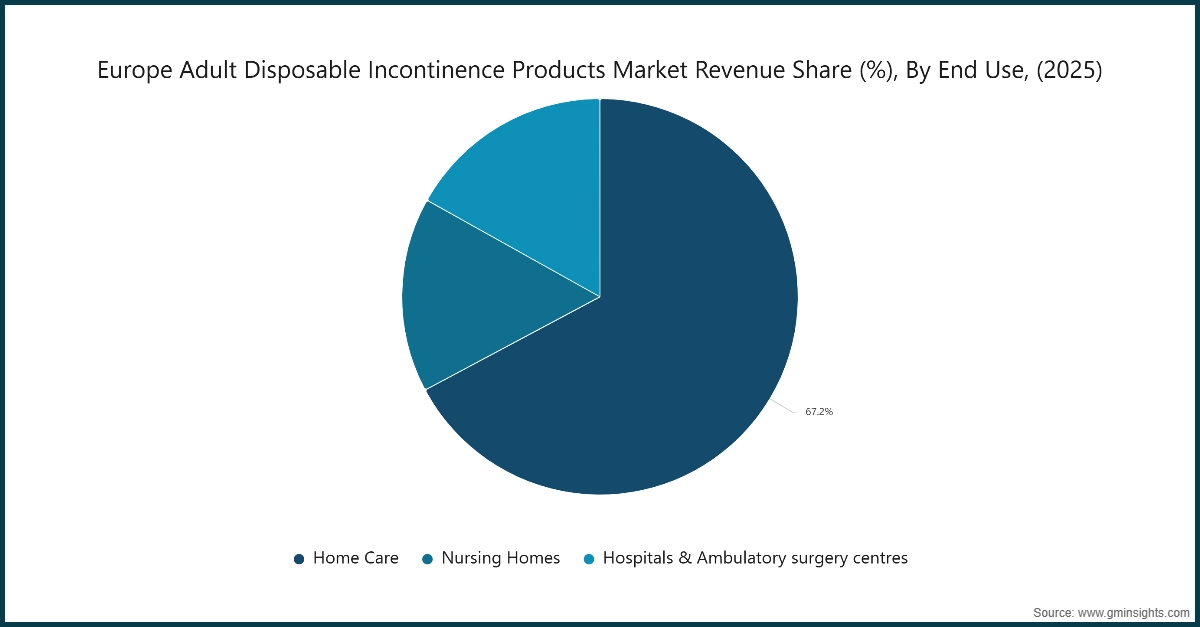
Based on end use, the Europe adult disposable incontinence products market is segmented into home care, nursing homes, and hospitals & ambulatory surgery center. The homecare segment was the leading segment in this market in 2025 with a revenue of USD 2.52 billion and has a market share of around 67.2%.
- Incontinence products designed to be used in the home are gaining popularity in Europe as more senior citizens choose to remain at home instead of moving into an assisted living facility. This trend is due to cultural and policy changes within Europe, resulting in a stay-at-home lifestyle for many seniors. As a result, there is a wide variety of convenient, easy-to-use incontinence products available for use at home by caregivers and home health aides. Products designed for use at home have been adopted more readily than products meant for institutional use.
- The ability for patients to receive home care rather than being cared for in an institution is much more cost effective for families and healthcare systems. By caring for your loved one with incontinence at home, you can avoid the high costs associated with hospitalization. It also aligns with government initiatives that promote community care, which helps alleviate financial strains on public health budgets. These initiatives will help families provide better care to their loved ones, ultimately helping patients feel more comfortable and maintain dignity in their own home. Because of this, the demand for quality disposable products, medicated and non-medicated, to keep patients clean, dry and hygienic and lessen the burden that caregivers endure, will continue to grow. This financial and emotional support continues to support home care as being the number one end use segment.
- The growth of e-commerce and digital health have made the homecare sector even stronger. Adult incontinence products can be purchased online and will always be available due to subscription service delivery. Homecare also includes telehealth consultations and personalized product recommendations. The demographic, cost, and technology factors combined with telehealth and homecare management have allowed homecare to be the fastest growing and easily scaled.
Based on distribution channel, the Europe adult disposable incontinence products market is segmented in offline and online. In 2025, offline segment held the largest market share.
- Physical retail stores continue to be the main way people purchase products in Europe because most people trust physical retail stores more than online retailers, are more comfortable going in person to purchase products, and can see and touch the products that they buy; most purchase habits remain the same. Pharmacies, supermarkets, and medical supply stores are just a few examples of key places where consumers go to buy their items. Consumers can inspect products, get professional advice, and verify the authenticity of products at these locations. This is particularly important for senior citizens who want to see the product before making a purchase and can get their product immediately.
- Offline sales channels have strong brand awareness and establish relationships between healthcare professionals and consumer. This relationship impacts how consumers make purchasing decisions. Promotions and demonstrations in-store help consumers understand how to use them and what the product offers, as well as increase sales and encourage them to buy the product. Although online sales are becoming increasingly popular, offline sales continue to dominate due to the convenience, customer service, and trust factors associated with purchasing healthcare related items through physical retail stores. Seniors, especially end users, care more about trust and convenience than anything else when purchasing healthcare-related items.
Looking for region specific data?
Germany Adult Disposable Incontinence Products Market
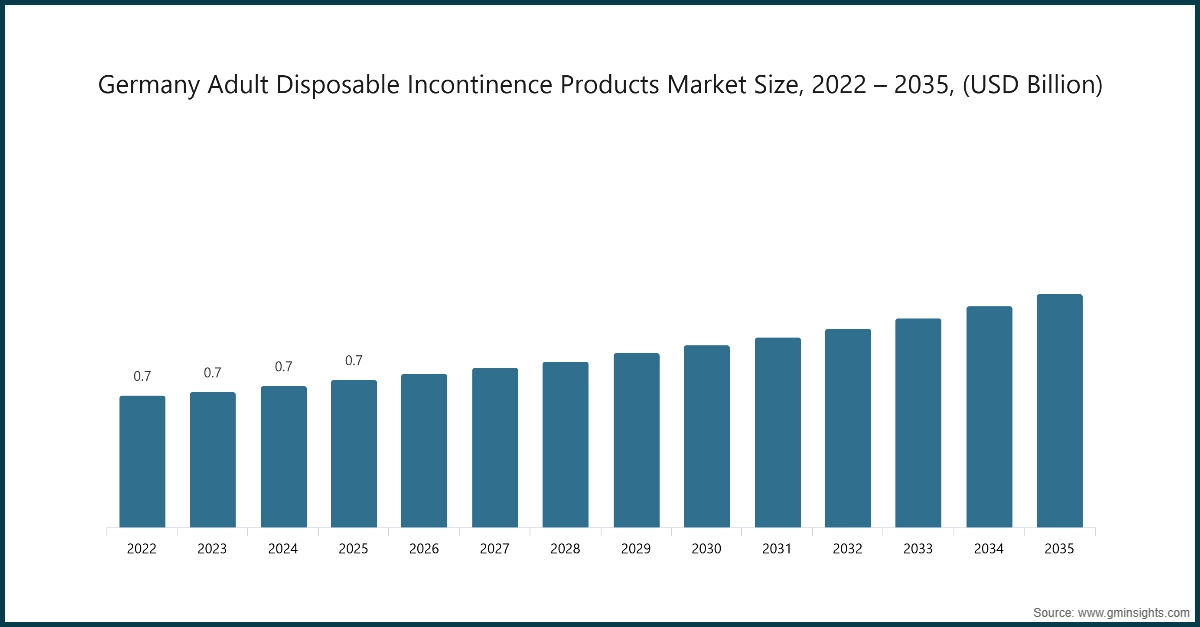
The Germany market was valued at around USD 0.7 billion in 2025 and is anticipated to register a CAGR of 4.7% between 2026 and 2035.
Germany has one of the largest elderly populations of any European country and a very large percentage of this population is aged 65 years and over. With increasing age, there is a higher incidence of both urinary and fecal incontinence, therefore, there will be a continuing need for adult disposable incontinence products. Given the vast size of this consumer group, Germany continues to be the largest market globally in terms of volume and variety of adult disposable incontinence products.Germany's comprehensive healthcare system provides patients with structured reimbursement of necessary medical supplies, including disposable incontinence products.
In addition, this policy has helped remove any financial disincentives for patients, promoting the use of high-quality disposable products among patients. Furthermore, the presence of a number of advanced eldercare facilities and home-care programs only serves to further enhance records from both institutional as well as at-home demand. German companies lead in developing new products using technology to offer products with features like odor control, breathable fabrics, and skin-friendly materials, as well as providing strong distribution channels through hospitals, pharmacies, and online sellers, which makes it easy for caregivers and patients to obtain these products. Both the technology and supply chain efficiencies create a competitive advantage for Germany.
Europe Adult Disposable Incontinence Products Market Share
Kimberly Clark is leading with 12% market share. Kimberly Clark, Essity AB, Unicharm, Paul Hartmann, Ontex BV collectively hold around 35%, indicating moderately fragmented market concentration. These prominent players are proactively involved in strategic endeavors, such as mergers & acquisitions, facility expansions & collaborations, to expand their product portfolios, extend their reach to a broad customer base, and strengthen their market position.
Kimberly-Clark continues to be competitive through an innovative and sustainable business model that has earned their consumers' trust in a broad variety of products. An example of this model can be seen in Kimberly-Clark's facility in Koblenz, Germany, which is working towards being fully powered by renewable energy while also utilizing their RightCycle recycling program. Both efforts will help reduce Kimberly-Clark's carbon footprint and provide additional corporate responsibility for its consumers. This level of commitment towards improving its community and producing environmentally friendly products will create stronger loyalty from Kimberly-Clark's environmentally conscious customers and caregivers.
Essity continues to assert its leadership as a company in the field of incontinence care through its flagship brand, TENA. Essity combines a full range of product and service offerings (which include training tools for nursing homes and professional analysis of their processes) to provide additional value for customers. The TENA Solutions program demonstrates Essity’s commitment to improving care quality in nursing homes while increasing customer loyalty and establishing long-lasting partnerships between Essity and its customers.
Europe Adult Disposable Incontinence Products Market Companies
Major players operating in Europe adult disposable incontinence products industry are:
- ABENA
- Advanced Absorbent Technologies
- Attends / Attindas
- Cardinal Health
- Caroli
- Drylock Technologies
- Essity AB
- First Quality Enterprises
- Indas
- Kimberly-Clark
- KNH
- Medline
- Ontex BV
- Paul Hartmann AG
- Unicharm
Unicharm has built a strong presence in Europe through its expert knowledge of absorption technologies and aggressive international expansion strategy. With decades of experience in feminine/hygiene and baby care products, Unicharm expanded into the European market with products that complemented their existing product lines. Through this approach, Unicharm was able to quickly expand into more than 80 different markets throughout Europe. Through the development of programs such as ReF (Recycle for the Future), Unicharm demonstrates its commitment to circular economy principles by recycling used disposable diapers into new disposable diapers, meeting the needs of environmentally conscious European consumers while positioning Unicharm ahead of its competitors, many of whom are still in the process of transitioning to green product models.
Paul Hartmann AG attributes its competitiveness to the MoliCare brand by offering a more complete solution for incontinence by utilizing both their absorbent products, and healthcare-specific skin care to alleviate irritation and protect patients’ skin. Technological advancements such as the MoliCare Premium Form, which offer faster absorption, neutralization of odor, and environmentally conscious packaging, all illustrate a strong commitment to caregivers and the environment. The holistic nature of MoliCare is an asset when partnering with institutions that also require efficient caregiver-friendly products and as such provides MoliCare with a unique positioning for sustainability within a highly competitive market.
Europe Adult Disposable Incontinence Products Market Report Attributes
| Key Takeaway | Details |
|---|---|
| Market Size & Growth | |
| Base Year | 2025 |
| Market Size in 2025 | USD 3.75 Billion |
| Market Size in 2026 | USD 3.91 Billion |
| Forecast Period 2026-2035 CAGR | 5.1% |
| Market Size in 2035 | USD 6.13 Billion |
| Key Market Trends | |
| Drivers | Impact |
| Rapidly aging population | The growing elderly population worldwide is increasing the need for disposable adult incontinence supplies, providing opportunities for continuous growth throughout the world. |
| Increasing healthcare expenditure & assistive technology uptake | Increased healthcare spending around the world and the increased use of assistive devices such as incontinence products will increase the number of people who can afford to buy these products in both developed and developing countries. |
| Greater social acceptance & awareness | Education and destigmatization will increase early diagnosis and treatment of incontinence and promote widespread market adoption of the products. |
| Pitfalls & Challenges | Impact |
| Reimbursement variability across Europe | Regional inconsistencies in coverage and pricing create a fragmented market with inconsistent adoption of the product and slow growth in the overall market. |
| Persistent social stigma & underreporting | The continued embarrassment of having incontinence and not telling anyone is resulting in low diagnosis rates and low usage of the products, thus limiting the extent to which the market is penetrated worldwide. |
| Opportunities: | Impact |
| Integration of smart and sustainable materials | Using biodegradable or environmentally friendly materials in conjunction with smart sensors on incontinence products offers significant opportunities for brands looking to stand out in an increasingly competitive marketplace. |
| Expansion into home healthcare & e-commerce channels | The trend toward in-home care continues to grow across Europe, combined with the rise of digital purchasing habits, manufacturers now have an opportunity to build scale via DTC sales and subscription-based services. |
| Market Leaders (2025) | |
| Market Leader |
12% market share |
| Top Players |
The collective market share in 2025 is 35% |
| Competitive Edge |
|
| Regional Insights | |
| Largest market | Germany |
| Fastest growing market | Italy |
| Emerging countries | Spain, Netherlands, Poland |
| Future Outlook |
|
What are the growth opportunities in this market?
Europe Adult Disposable Incontinence Products Industry News
- In January 2026, Attindas completed the acquisition of SILC S.p.A. SILC is a manufacturer of absorbent hygiene and skin care products based in Italy. This acquisition will provide Attindas an increased presence in Southern Europe and will enhance their product portfolio concerning adult incontinence care, offering more options for the customer base in the southern region of Europe while creating greater efficiency for Attindas' distribution efforts in the area.
- In June 2025, Ontex launched a new range of iD Discreet products. The products included in this range are breathable absorbent pants featuring a channeled core to provide quick drying as well as extended pad back coverage for additional overnight protection. Both men's and women's options will be available within this product range. The company distributes its products to pharmacies, health care facilities, and healthcare providers across Europe.
- In 2025, Drylock Technologies also introduced the Dailee Thin line in 2025. The Dailee Thin line includes products that are up to 50% thinner than standard products but still have excellent absorbency. The Dailee Thin combines state-of-the-art polymer distribution with a reduction in cellulose content to enhance sustainability and comfort. All Dailee Thin products are manufactured in CO?-neutral facilities, which further supports Drylock's goal of providing environmentally friendly solutions.
- In November 2024, Essity completed the installation of a dedicated high-speed production line for incontinence pads under its leading brand at its Tarragona, Spain plant. The addition of this new line to the Tarragona facility will enhance overall production capacity dramatically due to the increasing demand for premium hygiene products within the European market.
The Europe adult disposable incontinence products market research report includes in-depth coverage of the industry with estimates & forecasts in terms of revenue (USD Billion) & volume (Thousand Units) from 2022 to 2035, for the following segments:
Market, By Product Type
- Diaper
- Pull-up underwear
- Liners & guards
- Under pads
- Others
Market, By End Use
- Home care
- Nursing homes
- Hospitals & ambulatory surgery center
Market, By Size
- Small
- Medium
- Large
- Extra large
Market, By Absorbency Level
- Light
- Moderate
- Heavy
- Overnight
Market, By Age Group
- Early adulthood (20-39)
- Middle adulthood (40-59)
- Young old age (60-75)
- Old age (75+)
Market, By Price Range
- Low (<25$)
- Mid (25$-50$)
- High (>50$)
Market, By Consumer Group
- Male
- Female
Market, By Distribution Channel
- Offline
- Specialty stores
- Pharmaceutical stores
- Others
- Online
- E-commerce website
- Company owned website
The above information is provided for the following countries:
- Germany
- UK
- France
- Italy
- Spain
- Netherlands
- Switzerland
- Poland
- Sweden
- Russia
- Rest of Europe
Frequently Asked Question(FAQ) :
What was the market size of the Europe adult disposable incontinence products market in 2025?
The market size was USD 3.75 billion in 2025, with a CAGR of 5.1% expected through 2035, driven by shifting consumer needs and advancements in technology.
What is the projected value of the Europe adult disposable incontinence products market by 2035?
The market is expected to reach USD 6.13 billion by 2035, fueled by the development of sustainable products, digital integration, and enhanced comfort features.
What is the projected size of the Europe adult disposable incontinence products industry in 2026?
The market is expected to reach USD 3.91 billion in 2026.
How much revenue did the diaper segment generate in 2025?
The diaper segment generated USD 1.75 billion in 2025, leading the market and is projected to reach USD 2.79 billion by 2035.
What was the valuation of the homecare segment in 2025?
The homecare segment held a 67.2% market share and generated USD 2.52 billion in 2025, making it the leading end-use segment.
Which country leads the Europe adult disposable incontinence products market?
Germany led the market with a valuation of approximately USD 0.7 billion in 2025 and is anticipated to register a CAGR of 4.7% between 2026 and 2035.
What are the upcoming trends in the Europe adult disposable incontinence products industry?
Key trends include the development of sustainable products, integration of digital technologies, gender-specific designs, and products tailored for varying levels of incontinence.
Who are the key players in the Europe adult disposable incontinence products market?
Key players include ABENA, Advanced Absorbent Technologies, Attends / Attindas, Cardinal Health, Caroli, Drylock Technologies, Essity AB, and First Quality Enterprises.
Europe Adult Disposable Incontinence Products Market Scope
Related Reports