Summary
Table of Content

Ethyl Cyanoacetate Market
Get a free sample of this report
Form submitted successfully!
Error submitting form. Please try again.
Thank you!
Your inquiry has been received. Our team will reach out to you with the required details via email. To ensure that you don't miss their response, kindly remember to check your spam folder as well!
Request Sectional Data
Thank you!
Your inquiry has been received. Our team will reach out to you with the required details via email. To ensure that you don't miss their response, kindly remember to check your spam folder as well!
Form submitted successfully!
Error submitting form. Please try again.
Ethyl Cyanoacetate Market Size
- Ethyl cyanoacetate is an organic compound which chemical industries recognize as a key chemical compound for producing various chemical products. The compound exists as a cyanoacetate ester which contains a reactive methylene group that enables it to undergo multiple condensation and substitution chemical reactions. The compound functions as a vital component in producing medicines and agricultural products and specialty chemical substances.
- The chemical compound ethyl cyanoacetate serves as an essential building block for the production of complex chemical structures in industrial settings. The compound enables the production of multiple chemical substances through its capability to facilitate multi-step synthesis processes. The compound maintains its industrial importance because its chemical properties enable it to function in various reaction methods which different sectors require.
- The ethyl cyanoacetate market develops through its essential role in pharmaceutical and agricultural and fine chemical industries. The pharmaceutical and crop protection sectors depend on this substance as their main resource for producing critical chemical intermediates. The market environment progresses according to research development and chemical production capacity and regional manufacturing strength instead of raw material supply fluctuations.
- The market for specialized chemical intermediates creates ongoing demand for ethyl cyanoacetate. The compound gets used in industrial processes which require precise and stable conditions because companies today focus on maintaining high standards through regulated production methods. The supply of chemicals depends on two main factors which include the production capabilities of chemical companies and the availability of essential raw materials and the ongoing growth of customer needs in various market sectors.
- The method of producing ethyl cyanoacetate originates from technological improvements which drive better chemical synthesis and process optimization. The system enables chemical manufacturing to operate more effectively through its design which combines improved catalytic systems and enhanced production methods and complete process automation. The new developments enhance production systems through better scalability and product purity maintenance and connecting lines with current manufacturing systems production methods.
The global ethyl cyanoacetate market was valued at USD 158.9 million in 2025. The market is expected to grow from USD 165.8 million in 2026 to USD 253.1 million in 2035, at a CAGR of 4.8% according to the latest report published by Global Market Insights Inc.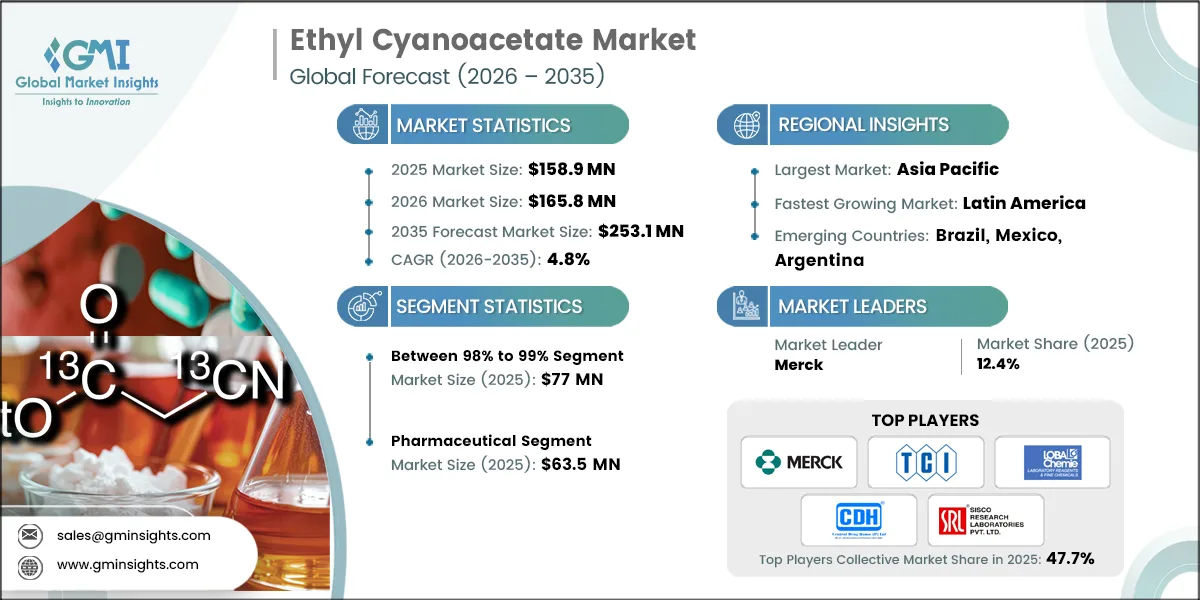
Ethyl Cyanoacetate Market Key Takeaways
Market Size & Growth
- 2025 Market Size: USD 158.9 Million
- 2026 Market Size: USD 165.8 Million
- 2035 Forecast Market Size: USD 253.1 Million
- CAGR (2026–2035): 4.8%
Regional Dominance
- Largest Market: Asia Pacific
- Fastest Growing Region: Latin America
Key Market Drivers
- Rising need for intermediates supporting advanced pharmaceutical synthesis.
- Steady usage in agrochemical formulations across multiple applications.
- Increasing relevance in specialty chemical and fine chemical production.
Challenges
- Variability in raw materials affecting production consistency globally.
- Strict handling requirements increasing operational and compliance efforts.
Opportunity
- Growing preference for high purity intermediates in complex reactions.
- Expansion of fine chemical manufacturing across emerging industrial regions.
Key Players
- Market Leader: Merck led with over 12.4% market share in 2025.
- Leading Players: Top 5 players in this market include Merck, Tokyo Chemical Industry (TCI), Loba Chemie, Central Drug House (CDH), Sisco Research Laboratories (SRL), which collectively held a market share of 47.7% in 2025.
Get Market Insights & Growth Opportunities
To get key market trends
Ethyl Cyanoacetate Market Trends
- The market is moving toward established synthesis pathways which use reliable intermediates that work across multiple chemical processes. The technology supports wider usage by industries which require industrial processes to produce predictable chemical reactions that result in known outcomes for their multi‑step production processes.
- The distinct trend shows that various sectors are shifting toward enhanced purity standards to meet their stricter quality requirements which apply to both research activities and manufacturing processes. The industry maintains ongoing interest in intermediates which help achieve accurate formulations because process efficiency depends on consistent performance combined with minimal impurity levels.
- The industry sees rising demand for sustainable production methods and users prefer compounds which function perfectly with optimized reaction systems. Industries that want to decrease waste and improve workplace safety now show increasing interest in intermediates which match these industry needs.
- The market experiences geographical changes as new regions develop their fine chemical operations while building their local chemical production systems. The market shift results in consumer patterns which distribute consumption across different regions while creating a need for reliable intermediate materials which support various downstream applications.
- The pharmaceutical and materials sectors and specialty chemical segments currently conduct formulation development activities to increase their demand for intermediates which offer multiple reactivity options. The market demand for adaptable building blocks shows how essential they have become because product designers use them to create different end‑use products through various synthetic methods.
Ethyl Cyanoacetate Market Analysis
Learn more about the key segments shaping this market
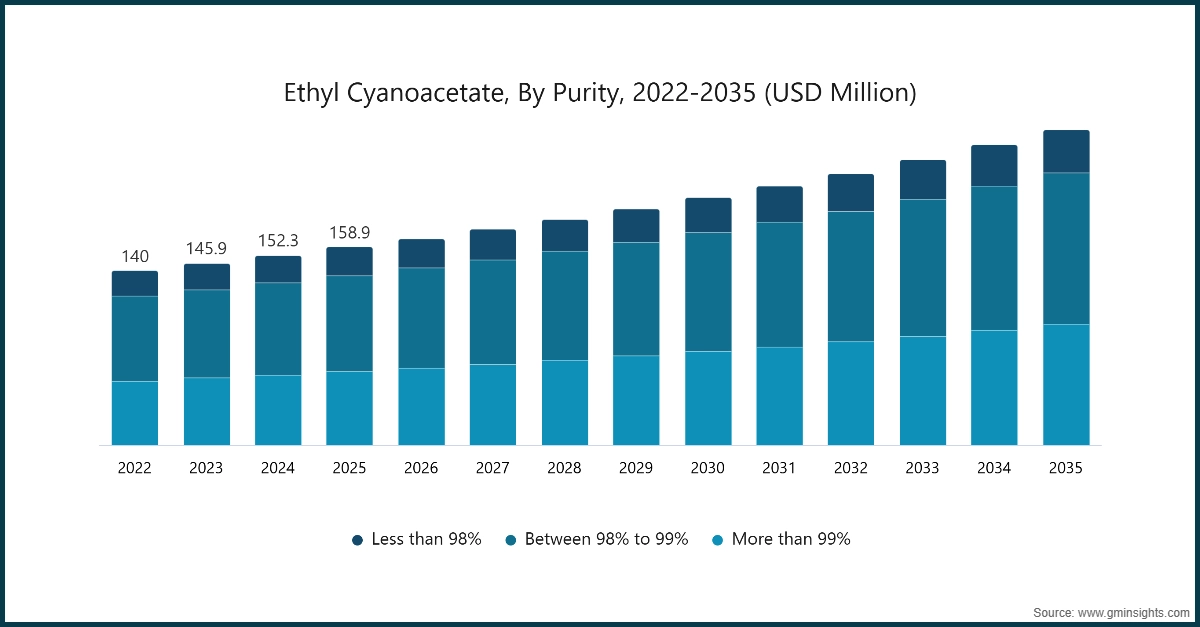
- The segment below 98% purity continues to follow a trend of usage in applications where broad functional performance is sufficient and precise impurity control is not critical. The range provides cost-sensitive processes with suitable material which enables standard synthesis operations to proceed without the need for advanced refinement. The category remains relevant as industries implement lower-precision workflows which require basic functions and accessible operations instead of specialized technical requirements.
- The industry trends show increased preference for 98% to 99% and above 99% purity levels because these levels provide sectors with stable reaction performance and minimized process variation. The higher-purity segments enable pharmaceutical and agrochemical and specialty chemical development processes to achieve dependable results through their controlled synthesis routes. The demand for stable high-grade intermediates will increase as production methods improve which makes the refined purity brackets essential for production processes.
Learn more about the key segments shaping this market
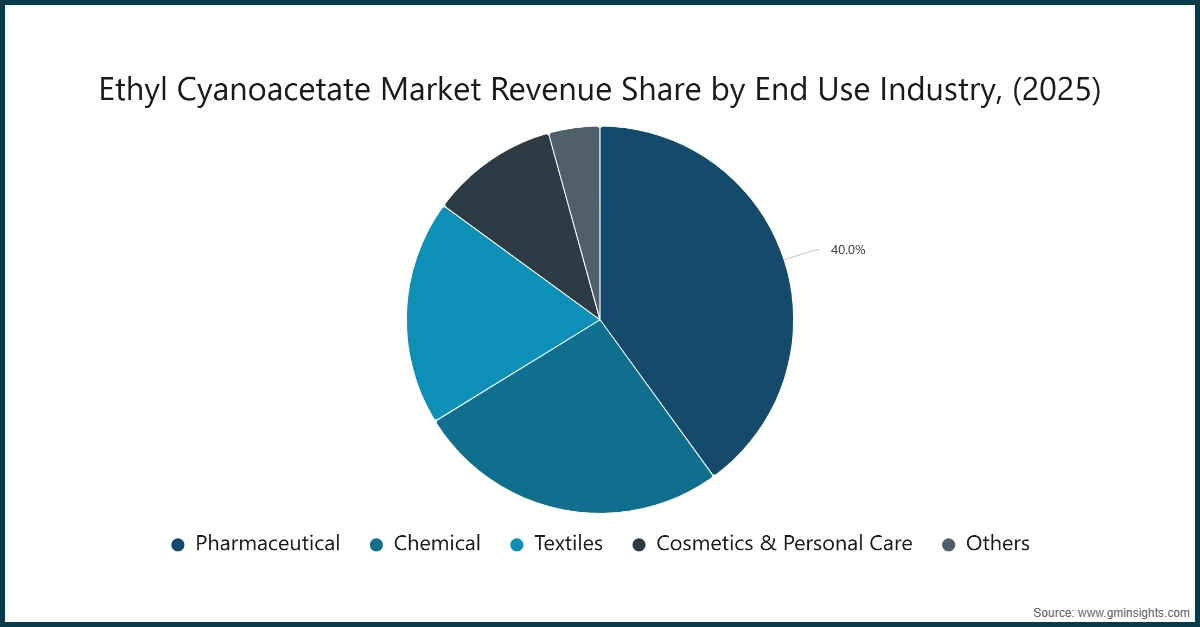
The ethyl cyanoacetate market by end use industry is segmented into pharmaceutical, chemical, textiles, cosmetics & personal care and others. Pharmaceutical holds the largest market value of USD 63.5 million in 2025.
- The end-use landscape displays a continuous movement toward more structured production requirements which extend across the various fields of pharmaceuticals, chemicals, textiles, cosmetics, and related applications. The chemical industry now relies on intermediates which provide both predictable reactivity and predictable integration into complex synthesis processes. The current trend shows an increasing demand for materials which help businesses establish quality-based operational processes while maintaining precise processing standards and producing uniform results across all their product variations.
- The pharmaceutical segment shows persistent demand for intermediates which enable controlled multi‑step synthesis and provide reliable reaction behavior. The chemical segment keeps using versatile intermediates which maintain their stability under different processing conditions. The textiles segment concentrates on materials which enable equal treatment processes and maintain consistent finishing results across new fabric processing methods.
- The cosmetics and personal care segment trends toward intermediates which provide stable integration into mild-condition formulations and multiple product types. The "others" segment which includes coatings and adhesives needs adaptable intermediates which match different reaction pathways and enable the creation of unique formulations.
Looking for region specific data?
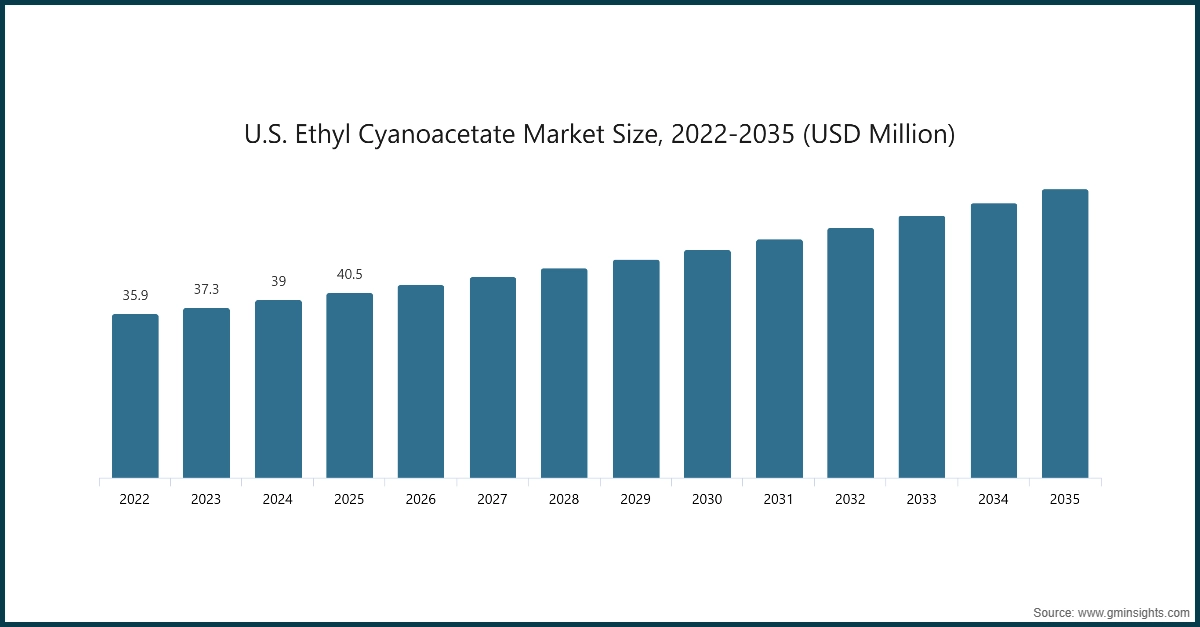
The market in the North America is expected to experience significant and promising growth from USD 47.6 million in 2025 to USD 74.5 million in 2035. The U.S. ethyl cyanoacetate market accounted for USD 40.5 million in 2025.
- The North American market displays continuous interest in pharmaceutical and coating and specialty chemical intermediates because both research activities and industrial infrastructure remain steady. The United States maintains demand through continuous investment in formulation development and advanced synthesis methods which enabling the use of reliable intermediates suited for controlled multi‑step processing needs.
The market in the Europe is expected to experience significant and promising growth from USD 38.8 million in 2025 to USD 60.1 million in 2035.
- European chemical processes follow organized workflows which concentrate on materials that match both quality manufacturing standards and changing regulatory demands. The German chemical industry uses intermediates to maintain operational precision and process efficiency which supports ongoing production and synthesis method improvements.
The ethyl cyanoacetate market in Asia Pacific is expected to experience increasing growth from USD 55.3 million in 2025 to USD 90.3 million in 2035.
- Asia-Pacific regions continue to develop their fine-chemical and specialty-chemical sectors because industrialization has expanded and multiple industries now need more formulation capacity. Chinese manufacturers increase their production capacity while research teams continue to explore new methods which strengthens the use of intermediates that fit well within multi-stage reaction routes and support diverse downstream industries seeking dependable synthesis materials.
Middle East & Africa market is expected to experience significant and promising growth from USD 8.3 million in 2025 to USD 13.4 million in 2035.
- The chemical sector in the Middle East and Africa is developing its capabilities through increasing demand for intermediates which will support new specialty chemical markets. The United Arab Emirates distribution network expansion together with its industrial development enables manufacturers to choose intermediates which will help them maintain product quality across their different production processes.
Latin America is expected to experience significant and increasing growth from USD 8.8 million to USD 14.8 million in 2035.
- Latin America shows gradual growth as regional industries adopt more refined production practices which leads to interest in intermediates that provide stable performance in varied processing conditions. The Brazilian pharmaceutical industry and agro-industrial sector growth create demand for intermediates which enable precise reactions that produce predictable outcomes while establishing links to upcoming formulation approaches.
Ethyl Cyanoacetate Market Share
- Ethyl Cyanoacetate industries are moderately consolidated with players like Merck, Tokyo Chemical Industry (TCI), Loba Chemie, Central Drug House (CDH) and Sisco Research Laboratories (SRL) holding 47.7% market share and Merck being the market leader holding the market share of 12.1% in 2025.
- The ethyl cyanoacetate market requires companies to deliver products which meet all purity requirements and packaging specifications to remain competitive. Users can maintain production schedules without interruptions through dependable supply systems which manufacturers consider essential for their ongoing business operations.
- Producers who execute their operations with strict quality standards and complete documentation procedures through safety sheets and certificates of analysis and batch traceability systems gain stronger market positions. Customers develop trust in the product through its predictable performance which helps them maintain required reaction control in their operations.
- Companies need to improve their production methods through gradual advancements which include synthesizing processes that boost efficiency while decreasing waste and maintaining equal production levels. The processing system which has undergone optimization now delivers lower variability results while enabling operation in current industrial processes.
- The technical support team provides various application services which help the company achieve its competitive edge because customers who receive detailed information on proper material usage can better handle their multi‑step chemical processes. The company develops value through more than its products because it uses this method to create enduring customer ties with its end-user base.
- Suppliers who operate in different end-use markets can deliver better customer service because they use their product range to meet various customer needs while handling market demand changes. The broad applicability of this solution enables companies to stay relevant as their industries grow or adopt new manufacturing methods.
Ethyl Cyanoacetate Market Companies
Major players operating in the ethyl cyanoacetate industry are:
- Pravin Dychem
- SimSon Pharma
- Central Drug House
- Tokyo Chemical Industry
- Emco Dyestuff
- Merck
- Shandong Xinhua Pharma
- Loba Chemie
- Tiande Chemical
- Sisco Research Laboratories
- HeBei ChengXin
Merck provide chemical products and life science technologies and healthcare services. The company operates more than 100 production facilities throughout the world as part of its extensive manufacturing network to produce laboratory materials and specialty chemicals and life science products.
Tokyo Chemical Industry (TCI) specializes in producing high‑purity organic chemicals which serve research needs and industrial applications. The company delivers product information to customers through global distribution from its regional warehouses while providing a complete product catalog for laboratory synthesis and advanced materials development and specialty chemical research.
Loba Chemie serves as a primary laboratory which provides customers a wide range of products that include precise specifications and purity standards and COA/SDS documentation. The catalog provides support for both standard research activities and specialized research work, while the company ensures ongoing product quality and product accessibility and distribution to research markets.
Central Drug House (CDH) has operated for many years as a manufacturer and distributor of laboratory fine chemicals and reagents and culture media products. The company operates a distribution network which spans throughout the country and across international borders to support its production facilities and quality control processes which handle more than 9000 items.
Sisco Research Laboratories (SRL) provides laboratory reagents and biochemicals and specialty fine chemical products which include specific product details and authorized purity specifications and different packaging sizes. The distribution network provides support for the distribution of general laboratory chemicals and advanced research-grade materials which the quality management systems supervise.
Ethyl Cyanoacetate Market Report Attributes
| Key Takeaway | Details |
|---|---|
| Market Size & Growth | |
| Base Year | 2025 |
| Market Size in 2025 | USD 158.9 Million |
| Market Size in 2026 | USD 165.8 Million |
| Forecast Period 2026-2035 CAGR | 4.8% |
| Market Size in 2035 | USD 253.1 Million |
| Key Market Trends | |
| Drivers | Impact |
| Rising need for intermediates supporting advanced pharmaceutical synthesis | Pharmaceutical research requires reliable intermediates, and ethyl cyanoacetate meets this need through its chemical flexibility. Its role in multi step reactions supports growing formulation activities and contributes to stable demand across production lines. |
| Steady usage in agrochemical formulations across multiple applications | Agrochemical manufacturers use this compound to create essential active materials. Its reactivity allows consistent integration into crop protection products, supporting long term consumption within agricultural input development and formulation workflows. |
| Increasing relevance in specialty chemical and fine chemical production | Specialty chemical producers rely on controlled intermediates for tailored products. Ethyl cyanoacetate aligns with these needs, allowing efficient synthesis routes that match varying technical requirements and industry specific performance expectations. |
| Pitfalls & Challenges | Impact |
| Variability in raw materials affecting production consistency globally | Dependence on specific raw materials can create fluctuations in manufacturing stability. Periodic supply inconsistencies may influence operational schedules, inventory planning, and overall process reliability for producers and downstream users. |
| Strict handling requirements increasing operational and compliance efforts | Facilities must follow controlled handling practices due to chemical sensitivity. Additional safety steps increase process complexity, requiring trained personnel, regulated storage, and stable infrastructure to maintain quality standards and minimize risks. |
| Opportunities: | Impact |
| Growing preference for high purity intermediates in complex reactions | Advanced formulations require precise intermediates with controlled purity. Producers offering refined grades of ethyl cyanoacetate can meet these demands, supporting its adoption in sensitive chemical and pharmaceutical production environments. |
| Expansion of fine chemical manufacturing across emerging industrial regions | Developing regions are increasing investment in fine chemical capabilities. This strengthens market access for raw materials like ethyl cyanoacetate, enabling more localized production and reducing distance based supply dependencies. |
| Market Leaders (2025) | |
| Market Leader |
Market share 12.4% |
| Top Players |
Collective market share of 47.7% in 2025 |
| Competitive Edge |
|
| Regional Insights | |
| Largest Market | Asia Pacific |
| Fastest growing market | Latin America |
| Emerging countries | Brazil, Mexico, Argentina |
| Future outlook |
|
What are the growth opportunities in this market?
Ethyl Cyanoacetate Industry News
- In December 2025 Indian specialty chemicals manufacturer Anupam Rasayan announced the acquisition of 100% stake in US‑based Jayhawk Fine Chemicals Corporation, marking a major step in its global expansion strategy.
- In March 2024 International Chemical Investors Group (ICIG) announced that it has acquired a majority stake in India‑based Vasant Chemicals, integrating the company into its WeylChem Group, the fine chemicals platform of ICIG.
The ethyl cyanoacetate market research report includes an in-depth coverage of the industry with estimates and forecast in terms of revenue in USD Million and volume in terms of kilo tons from 2022–2035 for the following segments:
Market, By Purity
- Less than 98%
- Between 98% to 99%
- More than 99%
Market, By End Use Industry
- Pharmaceutical
- Chemical
- Textiles
- Cosmetics & Personal Care
- Others
The above information is provided for the following regions and countries:
- North America
- U.S.
- Canada
- Europe
- Germany
- UK
- France
- Spain
- Italy
- Rest of Europe
- Asia Pacific
- China
- India
- Japan
- Australia
- South Korea
- Rest of Asia Pacific
- Latin America
- Brazil
- Mexico
- Argentina
- Rest of Latin America
- Middle East and Africa
- Saudi Arabia
- South Africa
- UAE
- Rest of Middle East & Africa
Frequently Asked Question(FAQ) :
What was the market size of the ethyl cyanoacetate in 2025?
The market size was USD 158.9 million in 2025, with a CAGR of 4.8% expected through 2035. The growth is driven by its extensive use in pharmaceuticals, agricultural products, and specialty chemicals.
What is the projected value of the ethyl cyanoacetate market by 2035?
The market is poised to reach USD 253.1 million by 2035, driven by its applications in pharmaceuticals, specialty chemicals, and textiles.
What is the expected size of the ethyl cyanoacetate industry in 2026?
The market size is projected to reach USD 165.8 million in 2026.
What was the market value of the 98%-99% concentration segment in 2025?
The 98%-99% concentration segment held a market value of USD 77 million in 2025.
How much revenue did the pharmaceutical segment generate in 2025?
The pharmaceutical segment generated USD 63.5 million in 2025, led by the demand for intermediates enabling controlled multi-step synthesis and reliable reaction behavior.
What is the growth outlook for the North American ethyl cyanoacetate sector?
The North American market reached USD 47.6 million in 2025 to USD 74.5 million by 2035, supported by steady research activities and industrial infrastructure.
What are the key applications driving the ethyl cyanoacetate market?
Key applications include its use in pharmaceuticals, agricultural products, specialty chemicals, and textiles, where it ensures consistent processing and finishing results.
Who are the key players in the ethyl cyanoacetate industry?
Key players include Pravin Dychem, SimSon Pharma, Central Drug House, Tokyo Chemical Industry, Emco Dyestuff, Merck, Shandong Xinhua Pharma, Loba Chemie, and Tiande Chemical.
Ethyl Cyanoacetate Market Scope
Related Reports