Summary
Table of Content

Essential Oils Market
Get a free sample of this report
Form submitted successfully!
Error submitting form. Please try again.
Thank you!
Your inquiry has been received. Our team will reach out to you with the required details via email. To ensure that you don't miss their response, kindly remember to check your spam folder as well!
Request Sectional Data
Thank you!
Your inquiry has been received. Our team will reach out to you with the required details via email. To ensure that you don't miss their response, kindly remember to check your spam folder as well!
Form submitted successfully!
Error submitting form. Please try again.
Essential Oils Market Size
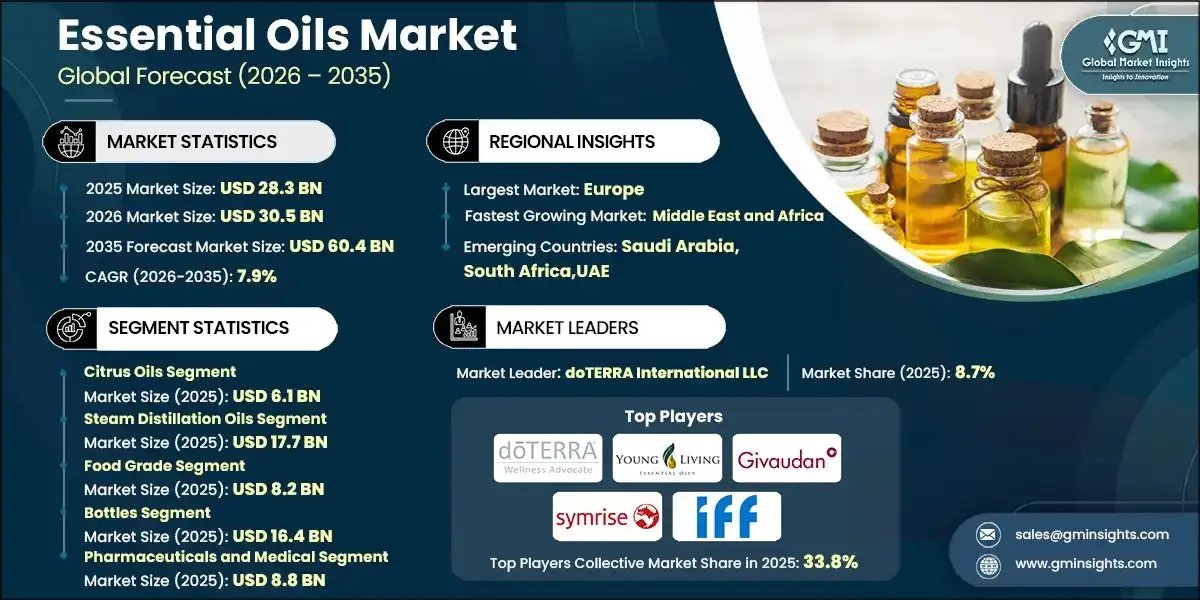
The global essential oils market was valued at USD 28.3 billion in 2025. The market is expected to grow from USD 30.5 billion in 2026 to USD 60.4 billion in 2035, at a CAGR of 7.9% according to the latest report published by Global Market Insights Inc.
Essential Oils Market Key Takeaways
Market Size & Growth
- 2025 Market Size: USD 28.3 Billion
- 2026 Market Size: USD 30.5 Billion
- 2035 Forecast Market Size: USD 60.4 Billion
- CAGR (2026–2035): 7.9%
Key Market Drivers
- Rising demand for natural and organic products.
- Health and wellness trends.
- Expansion of the beauty and personal care industry.
Challenges
- Allergic reactions or skin sensitivity.
- High production costs.
Opportunity
- Sustainable and eco-friendly packaging.
- Expansion into new markets.
- Technological advancements.
Key Players
- Leading Players: Top 5 players in this market include doTERRA International LLC, Young Living Essential Oils, Givaudan SA, Symrise AG, IFF (International Flavors & Fragrances), which collectively held a market share of 33.8% in 2025.
Get Market Insights & Growth Opportunities
- Essential oils are highly concentrated, volatile liquids extracted by various parts of the plant such as flower, leaf, bark, stem, and root, and capture the natural scent, flavor, and therapeutic effects of the plant. These active compounds are obtained from various parts of a plant. These are used from centuries as medicine, among other functions such as aromatherapy, cosmetics, and food flavoring. These oils also possess antibacterial, antifungal, and soothing properties.
- The manufacture and application of essential oils have changed because of advancements in technology. Steam distillation and cold pressing have been revamped while newer techniques have already emerged such as supercritical CO2 extraction and ultrasound-assisted extraction. Under these modern methods, yields obtained were reported to be higher, purer, and included more delicate compounds that could have been adversely affected by heat. The technology has expanded the scope of commercial production, quality testing, and standardization, thus making these oils more accessible and comparable for consumption by the public and various industries.
- There are various applications for essential oils in diverse fields such as health, cosmetics, and foods. Stress-relieving oils as lavender and peppermint are used in aromatherapy, or in cases of sleeplessness or lifting one's spirits. In skin care, tea tree and rosehip oils help in the treatment of acne, alleviation of inflammation, and facilitation of healthy skin. Essential oils have much more application in personal care products as they are also added to cleaning products and perfumes. These oils are also used as dietary supplements because they are considered antimicrobial and antioxidant. The versatility of essential oils makes them an important part of modern wellness practices.
To get key market trends
Essential Oils Market Trends
- Essential oils have improved substantially in recent years for an increased customer recognition of natural or organic items. These oils are increasingly popular among consumers for aromatherapy, personal care, flavouring in food, and healthcare items. Hence, they are regarded as one of the vital segment warrants in the wellness industry. There is an increase in preference among customers for high-quality sustainably sourced-essential oils as they consider health and environmental impacts along with the authenticity of the product the customers use.
- Increasing demand for natural products is one of the major trends that has an inclination in preference for natural or chemical-free substitutes. Most consumers replace synthetic fragrances and chemicals-based remedies with essential oils due to therapy and holistic benefits.
- Technological innovations are transforming the trends in the essential oils market as far as the extraction, quality, and shelf-life improvements in oils are concerned. The current extraction techniques such as the supercritical CO2 extraction, microwave-assisted extraction, and advanced distillation methods allow producers of essential oils to produce oils purer and more consistent. Besides that, there are ever-advanced technologies for authentic testing of oils usability by consumers on their respective products.
- Essential oils are now used in more diverse fields beyond aromatherapy and personal care. The properties such as antimicrobial, antioxidant, and flavor-enhancing properties have increased their use in natural cleaning products, dietary supplements, and functional foods. Such diversification expands the market, and at the same time, it promotes innovation in product development.
- Sustainability is currently emerging as a key driving force in the essential oils market. Consumers expect companies to adopt sustainable practices such as eco-friendly cultivation, ethical sourcing, and organic certification.
Essential Oils Market Analysis
Learn more about the key segments shaping this market
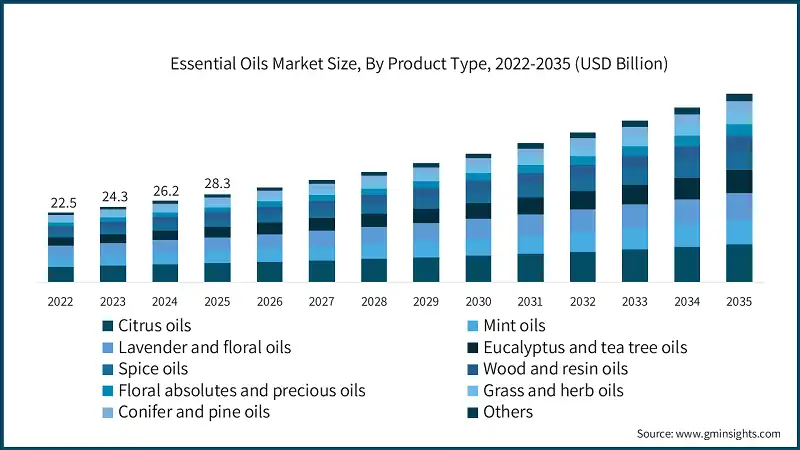
The market by product type is segmented citrus oils, mint oils, lavender and floral oils, eucalyptus and tea tree oils, spice oils, wood and resin oils, floral absolutes and precious oils, grass and herb oils, conifer and pine oils and others. Citrus oils hold the largest market value of USD 6.1 billion in 2025.
- The citrus oil found in Lemon, Orange, and Bergamot have been gaining popularity due to their fresh smell and use in aromatherapy, drinks, and cleaning products, while the mint oils, including peppermint and spearmint are in demand because of their cool minty effect, digestion benefits, and oral care applications. Lavender and other floral oils tend to be either calming or being used in skincare and wellness. Eucalyptus and tea tree have properties like antiseptics that help in providing respiratory relief, hence are adding aromatics into health or personal care products. Spice oils are now considered worthy options for flavouring and treatment with spices like cinnamon, clove, or cardamom.
- Wood and resin oils are popularly known for their enduring fragrance and mostly used in perfumes or rituals. Floral absolutes and precious oils such as roses and jasmines are used for luxury perfume applications or premium skincare. Grass and herb oils, e.g., lemongrass and rosemary, are scented oils which are trying to establish themselves as cleaning, cosmetics, and wellness products. Conifers and Pines are in demand for their duration of use as fresh fragrances in households and wellness application. Some other necessary oils from various exotic or niche plants are on account of current curiosity from consumers for unusual smells and specific benefits related to health.
The essential oils market by extraction method is segmented into steam distillation, cold pressing (expression), solvent extraction, co2 extraction (supercritical and subcritical) and others. Steam distillation oils hold the largest market value of USD 17.7 billion in 2025.
- Steam distillation is an age-old method for extracting essential oils from flowers, leaves, and wood, and its popularity is because it preserves the aroma and therapeutic properties of the oils. Cold pressing is considered mainly for citrus oils and is chosen because of its ability to maintain its fresh scent and the associated bioactive compounds, as a result it is used for flavoring and skincare products. Solvent extraction is used for delicate flowers like jasmine and tuberose as it captures naturally occurring compounds that are sensitive to heat, increasing demand in luxury perfume and cosmetic applications.
- Supercritical CO2 extraction is gaining importance in producing pure oils without heat or chemical solvents, either therapeutic or industrial. Among the other extraction methods are enfleurage and maceration, which bear continued use for niche or rare oils that cannot preserve their descriptive fragrance by any other traditional technique. Latest technology has helped improve efficiency, consistency, and quality in all extraction methods, hence propelling the growth and potential for essential oils across personal care, wellness, and even industrial segments.
The essential oils market by grade is segmented into therapeutic grade, food grade, cosmetic and perfume grade, industrial grade and pharmaceutical grade. Food grade holds the largest market value of USD 8.2 billion in 2025.
- Essential oils are assigned to different grades, depending on the intended use and standard of purity. Therapeutic grade oils are those highly purified and are used in aromatherapy and naturalistic healing. Food grade essential oils are considered for consumption and are commonly used as flavouring agents in beverages, candies, and other edible products. Cosmetic and perfume grade oils meet the quality standards deemed suitable for personal care products, that is, skincare and fragrances, while aroma and skin compatibility are paramount.
- Industrial grade oils are normally used in industries during the manufacturing processes where the focus is more on the function rather than purity, for example cleaning products, detergents etc. Pharmaceutical grade essential oils have the same strict regulatory standards and are used in medicines and therapeutic formulations for patients, making sure that there is constant quality and safety in the therapy applications. The demand for each grade is not constant, as trends in the respective categories change. Currently, there is increasing interest in the higher quality oils for wellness and personal care, creating growth concerning therapeutic, cosmetic, and pharmaceutical.
The essential oils market by packaging type is segmented into bottles, bulk containers, canisters and others. Bottles hold the largest market value of USD 16.4 billion in 2025.
- Essential oils are very versatile and could be packaged in different forms to cater for the needs of diverse consumers and industries. Retail consumers and small-scale users the most common form of packaging is in bottles, as these provide convenience for clients while securing oils in small quantities. Normally, dark glass bottles are used in bottling to protect and preserve oil quality from the effects of light and air.
- Bulk containers and canisters have much more appeal and usability for the larger commercial and industrial buyers such as manufacturers of cosmetics, food products, and cleaning products. They allow efficient bulk storage and transportation of essential oils. Other types of packaging would include sachets and ampoules specially for applications that are niche or single dose. Otherwise, innovations in the field of packaging continue to focus primarily on ensuring the quality of oils and further convenience.
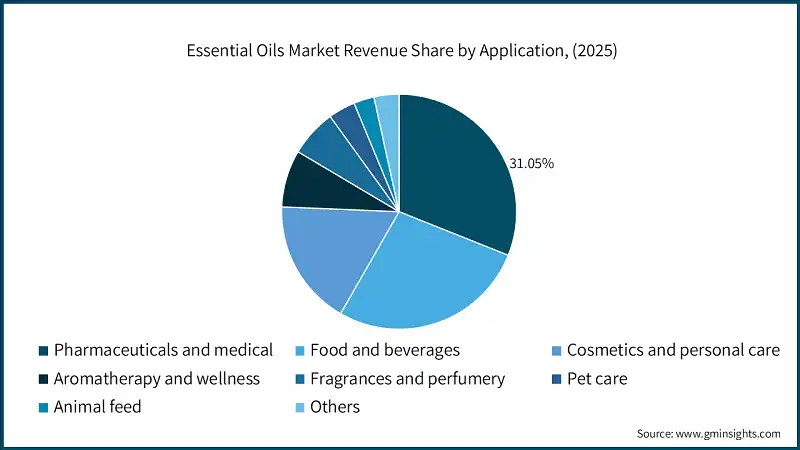
The essential oils market by distribution channel is segmented into pharmaceuticals and medical, food and beverages, cosmetics and personal care, aromatherapy and wellness, fragrances and perfumery, pet care, animal feed and others. Pharmaceuticals and medical holds the largest market value of USD 8.8 billion in 2025.
- Essential oils have diverse applications across various industries. In the field of pharmaceuticals and medicine, oils in demand due to their therapeutic and other natural medicinal properties in natural therapies or formulations. In the case of food and beverages, essential oils are incorporated as natural flavoring agents, enriching the product again in taste as well as aroma. The cosmetics and personal care industry also enjoys a great deal of usage in the incorporation of oils in such products for their fragrance and beneficial effects in skin, hair, and beauty care. Thus, their reliance is purely on aromatherapy and wellness space to promote relaxation, relieve stress, and generally enhance the quality of life.
- Perfumeries and fragrances use essential oils to develop unique scents for perfumes, deodorants, and other fragrance products. Pet care products include essential oils due to their natural insect-repellent and soothing properties. Sometimes, essential oil extracts are added into livestock feeds as health and digestion improvers. The category other accounts for emergent or niche applications in which essential oils are innovatively employed, for example, household cleaning, natural pesticides, etc.
Learn more about the key segments shaping this market
The essential oils market by distribution channel is segmented into supermarkets/ hypermarkets, specialty stores, professional salon, online/e-commerce, pharmacy stores and others. Online/e-commerce holds the largest market value of USD 7 billion in 2025.
- Essential oils have diverse applications across various industries. In the field of pharmaceuticals and medicine, oils in demand due to their therapeutic and other natural medicinal properties in natural therapies or formulations. In the case of food and beverages, essential oils are incorporated as natural flavoring agents, enriching the product again in taste as well as aroma. The cosmetics and personal care industry also enjoys a great deal of usage in the incorporation of oils in such products for their fragrance and beneficial effects in skin, hair, and beauty care. Thus, their reliance is purely on aromatherapy and wellness space to promote relaxation, relieve stress, and generally enhance the quality of life.
- The growth of Supermarkets and hypermarkets is catered by the increase in the sale of essential oils because of their wide reach, convenience, and ability to sell multiple brands at one place. Specialty stores are growing as shoppers are looking for expert recommendations and a more niche assortment of beauty and personal care products. Pharmacy stores are also expanding in their essential oil offerings, buoyed by consumer trust on safety, quality, and doctor-recommended products.
- Professional salons are growing as essential oils are being embraced more for hair-and-skin treatments and high-end care services. Online-and-e-commerce setups are thriving due to their accessibility, home delivery, and use of digital platforms for product discovery. Other channels of distribution are gradually growing, owing to local demand, niche products, and customized retail approaches.
Looking for region specific data?
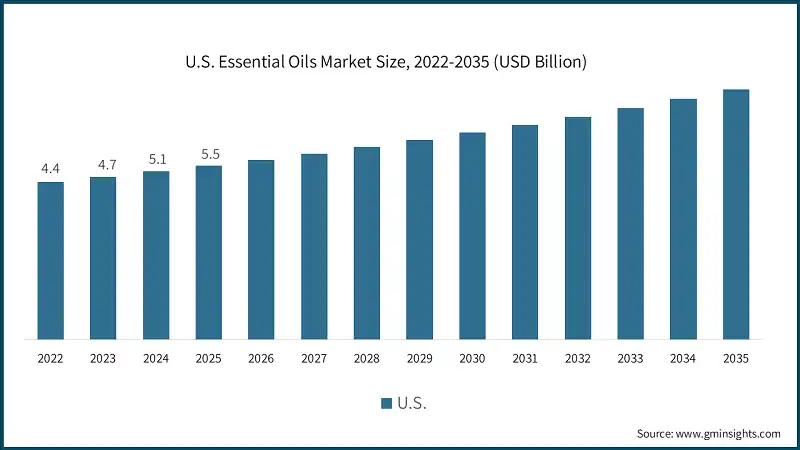
The market in the North America is expected to experience significant and promising growth from USD 6.4 billion in 2025 to USD 12.7 billion in 2035. The U.S. essential oils market accounted for USD 5.5 billion in 2025.
- The essential oils market in North America is steadily growing due to rising consumer interest in natural health products and aromatherapy. The region's well-developed wellness and cosmetic industries extensively use essential oils, with technological advancements allowing for high-quality production. Sustainability and organic certification are the important trends, with consumers increasingly preferring ethically sourced and pure oils. Regulatory frameworks are another aspect supporting product safety and quality standards.
- Some of the factors fuelling essential oils demand in US include the growth of aromatherapy, natural skincare, and holistic health. The consumer shifts towards chemical-free personal-care and household products complement the growth of the market. The U.S. also has significant amounts of R&D being conducted whereby many companies are innovating extraction technologies and product formulations to meet increasingly diverse consumer needs.
The market in the Europe is expected to experience significant and promising growth from USD 11.6 billion in 2025 to USD 22.4 billion in 2035.
- The essential oils markets in Europe are propelled by a long history of herbal medicine and natural wellness systems. Consumers are aware product provenance, quality, and environmental impact. Each country in the region has set strict regulations in place to uphold high standards for essential oil purity, creating more demand for therapeutic-grade and cosmetic-grade oils. The wellness industry, including spa centers and aromatherapy, also plays a key role in market growth.
- Germany is one major player in the essential oils market in Europe owing to its strong herbal medicine industry, combined with demand for organic products. German consumers are increasingly using essential oils as part of alternative therapies and in personal care, which supports the growth of the therapeutic and cosmetic segments. Investment in scientific research on the health effects of essential oils is also undertaken by Germany, which in turn affects product innovation and quality control.
The essential oils market in Asia Pacific is expected to experience increasing growth from USD 7.9 billion in 2025 to USD 18.7 billion in 2035.
- Rapid growth in the market in the Asia-Pacific region can be attributed to rising disposable incomes and growing urbanization, with increased awareness of natural health products as another contributory factor. Ayurveda and Traditional Chinese Medicine (TCM) cater demand for essential oils. The growing cosmetics and personal care sector in China, India, and Japan also contribute toward the demand for essential oils.
- India is recognized most in the Asia-Pacific region owing to its rich history of using essential oils in Ayurvedic treatment and natural healing. The country produces a wide variety of essential oils equally of import both locally and internationally. Factors supporting the demand for therapeutic and cosmetic-grade oils are increasing health consciousness and the popularity of organic personal care products.
Middle East & Africa essential oils market is expected to experience significant and promising growth from USD 840 million in 2025 to USD 2.6 billion in 2035.
- Increasing demand for essential oils in MEA seems to be driven largely by increasing awareness regarding natural wellness products and the growing personal care industry. Conventional use of aromatic oils in cultural and religious practices would also support the market. Investments in organic agriculture and sustainable sourcing, though rather unheard of, are slowly picking up steam across the region.
- Gulf countries like the UAE and Saudi Arabia result in growing the market for both personal and luxury beauty products. South Africa is one of the countries in Africa that has exhibited growth in demand owing to urbanization and widening retail networks. Consumption of traditional and natural oils caters to the market growth.
Latin America is expected to experience significant and increasing growth from USD 1.5 billion in 2025 to USD 4.1 billion in 2035.
- Latin American essential oils markets are increasing with rising attention towards appreciating personal appearance and grooming. Natural and plant-based oils are the general formulations used considering the favourable climatic conditions and availability of raw materials. Urbanization is also leading to an increasing probability of use of such cosmetic products.
- As the largest beauty and personal care market in the region, with strong demand for hair care oils, Brazil leads the regional market. The use of essential oils is growing in Mexico and Argentina through greater access to retail and increasing consumer awareness. The growth in this beauty and wellness market sector is also a push for innovation and increasing consumption of essential oils in Brazil across many applications.
Essential Oils Market Share
- Essential Oil markets are moderately consolidated with players like doTERRA International LLC, Young Living Essential Oils, Givaudan SA, Symrise AG, IFF (International Flavors & Fragrances) holding 33.8 % market share and doTERRA International LLC being the market leader holding the market share of 8.7% in 2025.
- Innovating and improving product designs helps the cosmetics oil industry to maintain their position. Most of these companies heavily invest in research and development, especially new formulations, advanced extraction techniques, and multiple functions, to help launch oils that will align with the shifting needs of consumers. Through innovations, brands can distinguish themselves in a crowded market and keep the customer's attention.
- Strong branding and marketing strategies are another crucial factor. By advertising to target audiences, collaborating with influencers, and conducting digital campaigns, companies generate brand recognition and loyalty. Product benefits, natural ingredients, and sustainable practices must be communicated effectively such that retained customers are also kept coming to new ones.
- Companies strengthen their market presence through strategic partnerships and collaborations. For example, collaborating with salons, spas, wellness centers, and e-commerce platforms expand and multiply a company's credibility in various distribution channels. Partnerships with raw-material suppliers then ensure consistent quality and availability of essential oils meant for production.
- Ethical sourcing and sustainability drive the demand for eco-conscious consumers. With responsibly sourced ingredients and eco-friendly packaging and a transparent supply chain such as those used by brands, such brands prove to be part of the current global trend in clean and sustainable beauty.
- These companies are diversified and expand globally to sustain their position. The wider the range of skin care, hair care, and specialty applications that the company offers, the more different market segments of consumers it can cater to. When entering newer geographical markets, companies capture emerging new demand and grow steadily despite overwhelming competitive pressure.
Essential Oils Market Companies
Major players operating in the essential oils industry are:
- AOS Products Private Limited (Aromatic and Allied Chemicals)
- doTERRA International LLC
- Eden Botanicals
- Floracopeia Inc.
- Givaudan SA
- DSM-Firmenich
- Kush Aroma Exports Private Limited
- Mane SA
- Mountain Rose Herbs
- Plant Therapy Essential Oils
- Pranarom International
- Robertet Group
- Symrise AG
- Takasago International Corporation
- Young Living Essential Oils LC
- International Flavors and Fragrances Inc. (IFF)
doTERRA International LLC is a wellness company that is best known for its very high-quality-grade essential oils, using direct-selling as a business model placed upon the pillars of their product purity, ethical sourcing, and a robust global distribution network focusing on wellness.
Young Living Essential Oils is an international wellness company focusing on plant-based essential oils and holistic health products, integrating controlled sourcing, in-house distillation, and a member-driven direct sales model to promote the concept of natural living and preventive wellness.
Givaudan SA deals in flavors and fragrances for the food, beverage, consumer goods, and fine fragrance markets, with a strong emphasis on natural ingredients, sensory innovations, and collaborative partnerships with customers around the world.
Symrise AG deals in fragrance, flavor, cosmetic ingredients, and special solutions markets combining natural raw materials, biotechnology, and innovation for food, beverage, personal care, and pharmaceutical applications.
IFF (International Flavors & Fragrances) is a global company offering flavor, fragrance, and natural ingredients. This includes essential oils for foods, beverages, personal care products, and pharmaceuticals. IFF has a really strong B2B model reaching out more geographically and working so closely with manufacturers to develop customized solutions, thus having a really solid footprint in essential oils and naturals.
Essential Oils Market Report Attributes
| Key Takeaway | Details |
|---|---|
| Market Size & Growth | |
| Base Year | 2025 |
| Market Size in 2025 | USD 28.3 Billion |
| Market Size in 2026 | USD 30.5 Billion |
| Forecast Period 2026-2035 CAGR | 7.9% |
| Market Size in 2035 | USD 60.4 Billion |
| Key Market Trends | |
| Drivers | Impact |
| Rising demand for natural and organic products | Consumers are increasingly looking for skincare and haircare products made from plant-based and chemical-free ingredients. |
| Health and wellness trends | Increasing awareness of aromatherapy, stress relief, and holistic treatments drives usage in wellness, skincare, and dietary supplements. |
| Expansion of the beauty and personal care industry | The growing global beauty market, especially in Asia and the Middle East, fuels essential oil adoption. |
| Pitfalls & Challenges | Impact |
| Allergic reactions or skin sensitivity | Some oils may cause irritation or breakouts for certain skin types. |
| High production costs | Extracting high-quality essential oils requires large amounts of plant material and sophisticated technology, making them expensive. |
| Opportunities: | Impact |
| Sustainable and eco-friendly packaging | Environmentally friendly initiatives can appeal to eco-conscious buyers. |
| Expansion into new markets | Growing demand in emerging markets and integration into foods, beverages, and personal care products creates new revenue streams. |
| Technological advancements | Modern extraction and purification methods (like supercritical CO₂ extraction) improve quality and consistency, making oils more appealing and reliable for industrial and personal use. |
| Market Leaders (2025) | |
| Market Leaders |
8.7 % |
| Top Players |
|
| Competitive Edge |
|
| Regional Insights | |
| Largest Market | Europe |
| Fastest Growing Market | Middle East and Africa |
| Emerging Country | Saudi Arabia, South Africa,UAE |
| Future Outlook |
|
What are the growth opportunities in this market?
Essential Oil Industry News
- In December 2025, Natural Grocers announced its private label “Body Care” featured by the introduction of 10 essential oils that are organic. The oils consist of cinnamon, eucalyptus, frankincense, lavender, lemon, oregano, patchouli, peppermint, rosemary, and tea tree.
- In October 2025, Kohler Co. announced “Sprig Essential Oils” new product line in the wellness sector aimed at enhancing aromatherapy life experiences at home. The oils serve as a companion to Kohler's candles and bath bombs and body and linen mists as well as wellness technologies like the Invigoration Steam series and Stillness Bath Experience Tower.
The essential oils market research report includes an in-depth coverage of the industry with estimates and forecast in terms of revenue in USD Billion and volume in terms of kilo tons from 2022–2035 for the following segments:
Market, By Product Type
- Mineral oil
- Citrus oils
- Mint oils
- Lavender and floral oils
- Eucalyptus and tea tree oils
- Spice oils
- Wood and resin oils
- Floral absolutes and precious oils
- Grass and herb oils
- Conifer and pine oils
- Others
Market, By Extraction Method
- Steam distillation
- Cold pressing (expression)
- Solvent extraction
- CO2 extraction (supercritical and subcritical)
- Others
Market, By Grade
- Therapeutic grade
- Food grade
- Cosmetic and perfume grade
- Industrial grade
- Pharmaceutical grade
Market, By Packaging Type
- Bottles
- Bulk Containers
- Canisters
- Others
Market, By Distribution Channel
- Supermarkets/ Hypermarkets
- Specialty stores
- Professional salon
- Online/e-commerce
- Pharmacy stores
- Others
Market, By Application
- Pharmaceuticals and medical
- Food and beverages
- Cosmetics and personal care
- Aromatherapy and wellness
- Fragrances and perfumery
- Pet care
- Animal feed
- Others
The above information is provided for the following regions and countries:
- North America
- U.S.
- Canada
- Europe
- Germany
- UK
- France
- Spain
- Italy
- Rest of Europe
- Asia Pacific
- China
- India
- Japan
- Australia
- South Korea
- Rest of Asia Pacific
- Latin America
- Brazil
- Mexico
- Argentina
- Rest of Latin America
- Middle East and Africa
- Saudi Arabia
- South Africa
- UAE
- Rest of Middle East & Africa
Frequently Asked Question(FAQ) :
What was the market size of the essential oils market in 2025?
The market size was valued at USD 28.3 billion in 2025, with a CAGR of 7.9% projected through 2035, driven by increasing consumer preference for natural and organic products.
What is the projected value of the essential oils market by 2035?
The market is expected to reach USD 60.4 billion by 2035, fueled by rising demand for aromatherapy, personal care, and sustainably sourced products.
What was the largest product type segment in the essential oils industry in 2025?
Citrus oils held the largest market value, generating USD 6.1 billion in 2025.
Which grade segment dominated the essential oils market in 2025?
The food grade segment led the market with a valuation of USD 8.2 billion in 2025.
What was the leading packaging type in the essential oils market in 2025?
Bottles were the dominant packaging type, accounting for USD 16.4 billion in 2025.
Which distribution channel generated the highest revenue in 2025?
The online/e-commerce segment led the market with a value of USD 7 billion in 2025.
Which region is expected to experience significant growth in the essential oils market?
North America is projected to grow significantly, with the market increasing from USD 6.4 billion in 2025 to USD 12.7 billion by 2035. The U.S. market alone accounted for USD 5.5 billion in 2025.
What are the key trends in the essential oils market?
Key trends include increasing consumer preference for natural and chemical-free products, growing demand for sustainably sourced essential oils, and the rising popularity of aromatherapy and holistic wellness.
Who are the major players in the essential oils market?
Key players include AOS Products Private Limited (Aromatic and Allied Chemicals), doTERRA International LLC, Eden Botanicals, Floracopeia Inc., Givaudan SA, DSM-Firmenich, Kush Aroma Exports Private Limited, Mane SA, Mountain Rose Herbs, and Plant Therapy Essential Oils.
Essential Oils Market Scope
Related Reports