Summary
Table of Content

Epoxy Active Diluent Market
Get a free sample of this report
Form submitted successfully!
Error submitting form. Please try again.
Thank you!
Your inquiry has been received. Our team will reach out to you with the required details via email. To ensure that you don't miss their response, kindly remember to check your spam folder as well!
Request Sectional Data
Thank you!
Your inquiry has been received. Our team will reach out to you with the required details via email. To ensure that you don't miss their response, kindly remember to check your spam folder as well!
Form submitted successfully!
Error submitting form. Please try again.
Epoxy Active Diluent Market Size
- The market is experiencing steady growth, primarily driven by its increasing use in various industrial applications such as coatings, adhesives, and composites. These diluents are used to reduce the viscosity of epoxy resins, improving their processing and application properties, which makes them highly sought after in industries such as automotive, construction, and electronics. The growing demand for high-performance coatings that provide durability, resistance, and aesthetic appeal is further propelling market growth.
- An important trend in the market is the shift toward more environmentally friendly products. Epoxy active diluents, with their lower volatile organic compound (VOC) emissions compared to traditional solvents, are gaining favor as industries adopt greener alternatives to meet regulatory and environmental standards. Additionally, innovations in bio-based diluents are emerging as a solution to address sustainability concerns.
- The market is expected to continue expanding, driven by technological advancements in diluent formulations and the growing preference for epoxy systems in specialized applications. As industries increasingly prioritize product performance and sustainability, the demand for epoxy active diluents is anticipated to grow at a steady pace.
The global epoxy active diluent market was valued at USD 1.01 billion in 2025. It is projected to grow from USD 1.04 billion in 2026 to USD 1.45 billion by 2035, representing 3.8% CAGR from 2026 to 2035, according to latest report published by Global Market Insights Inc.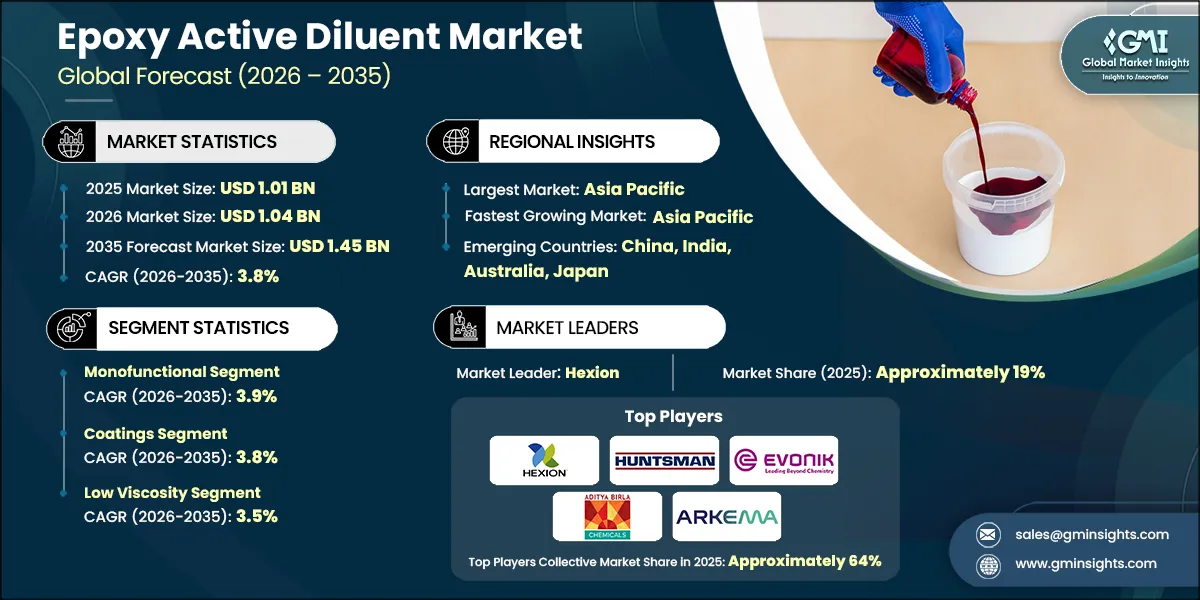
Epoxy Active Diluent Market Key Takeaways
Market Size & Growth
- 2025 Market Size: USD 1.01 Billion
- 2026 Market Size: USD 1.04 Billion
- 2035 Forecast Market Size: USD 1.45 Billion
- CAGR (2026–2035): 3.8%
Regional Dominance
- Largest Market: Asia Pacific
- Fastest Growing Region: Asia Pacific
Key Market Drivers
- Rising shift toward low‑VOC and high‑solids coatings.
- Expanding use of epoxy systems in construction and flooring.
- Increasing adoption of composites across wind energy and automotive.
- Growth in electronics encapsulation and PCB manufacturing.
Challenges
- Raw material price volatility impacting cost structures.
- Regulatory tightening on chemical handling and VOC limits.
- Competition from alternative resin chemistries in cost‑sensitive markets.
Opportunity
- Development of bio‑based and renewable diluent chemistries.
- Tailored diluents for fast‑curing and high‑temperature applications.
- Expanding epoxy usage in emerging economies.
- Formulator partnerships for application‑specific performance.
Key Players
- Market Leader: Hexion led with over 19% market share in 2025.
- Leading Players: Top 5 players in this market include Hexion, Huntsman Corporation, Evonik, Aditya Birla Chemicals, Arkema, which collectively held a market share of 64% in 2025.
Get Market Insights & Growth Opportunities
To get key market trends
Epoxy Active Diluent Market Trends
- Current trends in the epoxy active diluent industry highlight a shift toward environmentally friendly and sustainable solutions. The demand for low-VOC (volatile organic compound) epoxy diluents is increasing as industries strive to meet stringent environmental regulations. Additionally, there is a growing interest in bio-based diluents, which offer renewable alternatives to traditional petrochemical-based products.
- Technological innovations are also playing a key role, with improvements in diluent formulations to enhance performance, processing ease, and end-product quality. In sectors like automotive, construction, and electronics, the demand for high-performance coatings and adhesives continues to drive the adoption of epoxy active diluents. This trend reflects a broader focus on sustainability, efficiency, and product durability in manufacturing and industrial applications.
- The Epoxy active diluent market is poised for growth, driven by increasing demand for high-performance coatings, adhesives, and composites. Upcoming opportunities include the rising preference for eco-friendly and low-VOC solutions, as industries face stricter environmental regulations. Bio-based diluents are gaining traction, presenting a potential area for innovation and differentiation. As manufacturing sectors continue to focus on sustainability, the demand for diluents derived from renewable resources is expected to rise.
- Future trends indicate a shift toward enhancing product functionality through technological advancements in diluent formulations. These innovations aim to improve the efficiency, durability, and performance of epoxy systems. Additionally, the growing need for lightweight, high-strength materials in automotive and aerospace industries will further fuel the demand for epoxy active diluents, offering significant growth potential in specialized applications.
Epoxy Active Diluent Market Analysis
Learn more about the key segments shaping this market
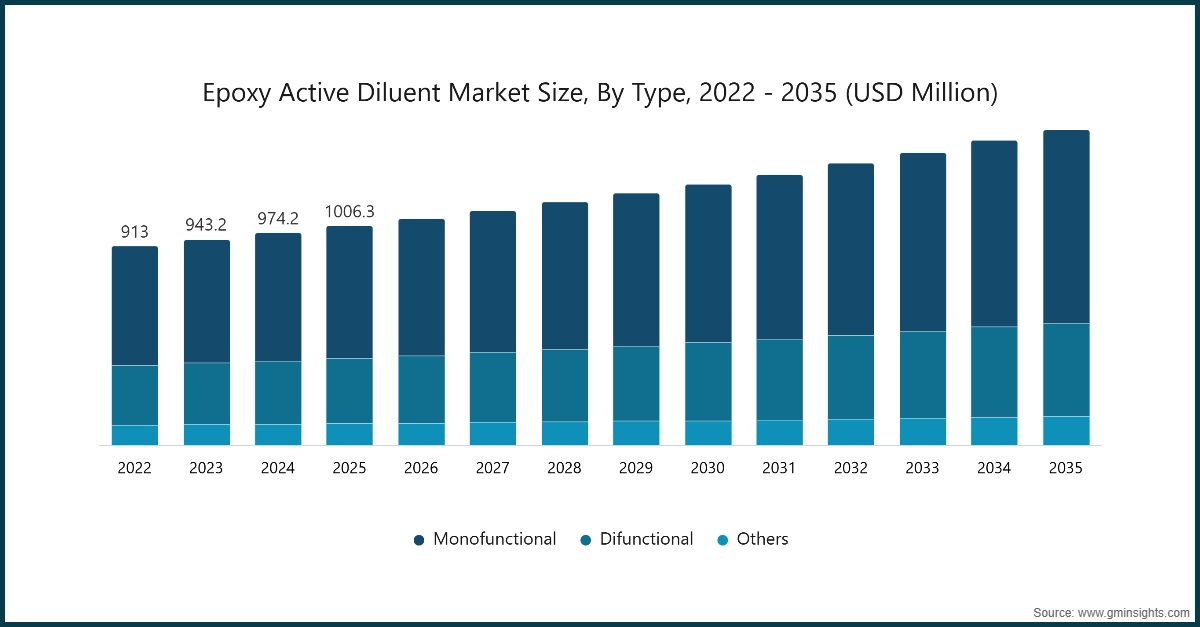
- The monofunctional segment dominates the market due to its versatility and superior performance in various industrial applications. Monofunctional diluents are widely used in coatings, adhesives, and composites because they provide excellent curing properties, high chemical resistance, and enhanced adhesion. This segment is particularly favored for applications requiring precise control over the resin’s viscosity and ease of processing, ensuring better performance in products like automotive coatings, electronics, and construction materials.
- Monofunctional diluents allow for more predictable and reliable end-product properties, making them the preferred choice for high-performance and specialized coatings. As industries continue to demand more durable, efficient, and sustainable solutions, the monofunctional segment is expected to maintain its dominance in the market, with ongoing innovations further enhancing its applications.
Epoxy active diluent market based on application is segmented into coatings, adhesives and sealants, composite material, electrical and electronics, construction, and others. The coatings segment was valued at USD 0.38 billion in 2025, and it is anticipated to expand to 3.8% of CAGR till 2035.
- Coatings dominate the market due to their widespread use in various industries, such as automotive, construction, and electronics. Epoxy resins, when combined with active diluents, offer superior properties like excellent adhesion, durability, and resistance to corrosion, making them ideal for protective and decorative coatings. In the automotive sector, epoxy-based coatings are crucial for enhancing vehicle durability and aesthetics.
- In construction, these coatings provide long-lasting protection against environmental elements, increasing the lifespan of structures. Additionally, the demand for high-performance coatings in the electronics industry, particularly for circuit boards and components, further drives the dominance of coatings in the market. As industries focus on improving product performance and sustainability, the coatings application remains the largest and most influential segment.
Learn more about the key segments shaping this market
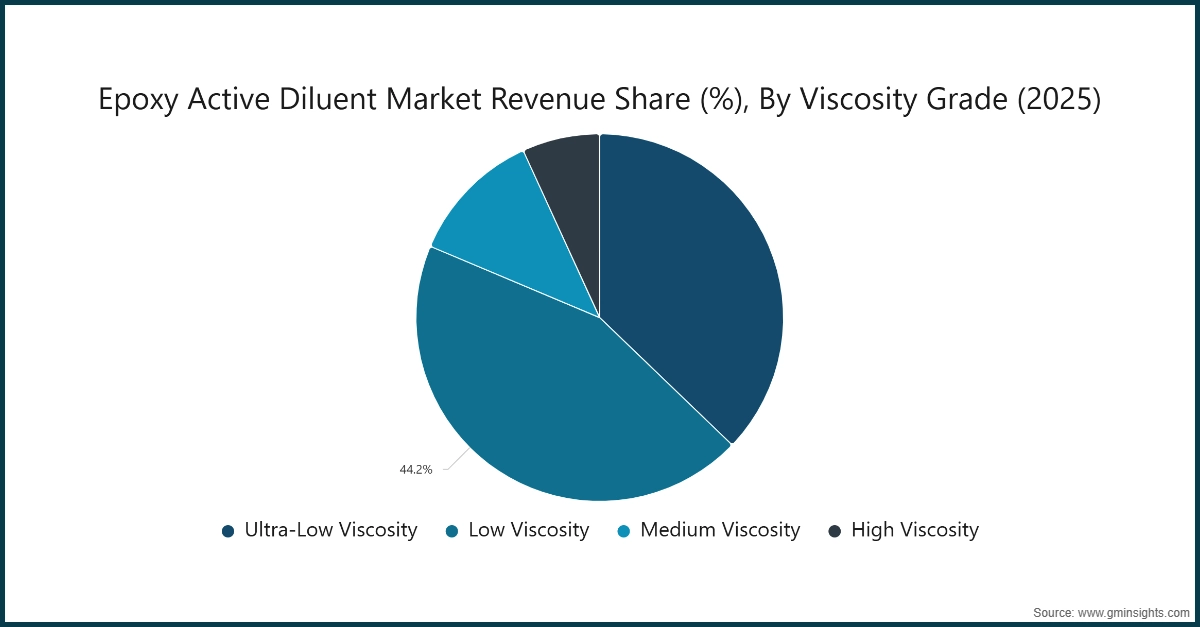
Epoxy active diluent market based on viscosity grade is segmented into ultra-low viscosity, low viscosity, medium viscosity, and high viscosity. The low viscosity segment was valued at USD 0.41 billion in 2025, and it is anticipated to expand to 3.5% of CAGR up to 2035.
- The market shows a clear concentration toward low‑viscosity grades, driven by their compatibility with high‑volume applications such as industrial coatings, adhesives, and composite resins. These grades offer strong viscosity reduction with limited impact on mechanical properties, making them suitable for solvent‑free and high‑solids systems that continue to gain adoption globally. Ultra‑low‑viscosity diluents follow closely, supported by demand in flooring, self‑leveling coatings, casting, and infusion processes where exceptional flow and fast substrate wet‑out are essential. Their higher reactivity and ease of processing position them well in segments shifting toward faster cycle times and improved workability.
- Medium‑viscosity grades maintain a steady share due to roles in structural, electrical, and chemical‑resistant formulations where balance between flow, strength, and thermal stability is required. Although they do not achieve the same penetration as low‑viscosity grades, they remain important for performance‑driven applications. High‑viscosity diluents represent a smaller niche, used primarily where enhanced crosslink density, elevated heat resistance, or chemical durability is critical. Their limited adoption is tied to their minimal effect on viscosity reduction, making them more suitable for specialty systems rather than general‑purpose epoxy modification.
Looking for region specific data?
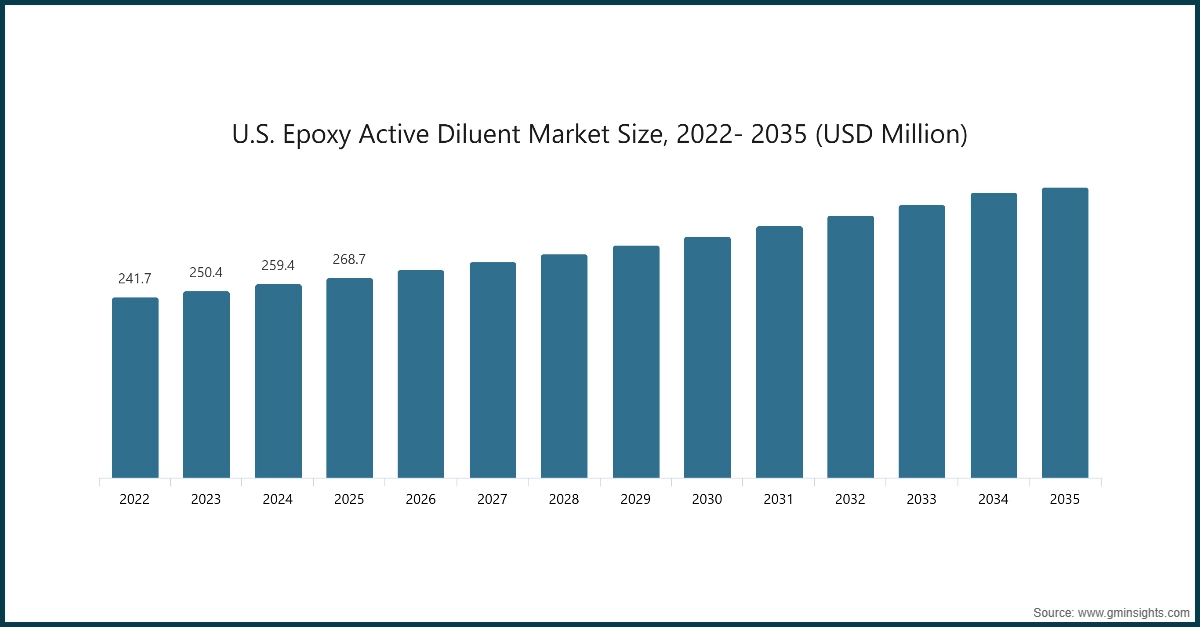
The North America epoxy active diluent market accounted for USD 0.31 billion in 2025 and is anticipated to show lucrative growth over the forecast period.
North America benefits from consistent consumption across construction chemicals, industrial maintenance coatings, aerospace composites, and electrical applications. The market leans toward low‑viscosity grades for floor coatings, adhesives, and protective coatings, while advanced manufacturing and electronics continue to drive niche demand for medium‑ and high‑viscosity diluents. Renovation activity and rising investment in wind blade and composite manufacturing add incremental support.
The Europe epoxy active diluent market accounted for USD 0.22 billion in 2025 and is anticipated to show lucrative growth over the forecast period.
Europe shows stable, value‑driven demand with strong emphasis on regulatory compliance, sustainability, and high‑performance epoxy formulations. The region favors diluents that support low‑emission coatings, electrical insulation materials, and advanced composite systems used in automotive light‑weighting and renewable energy. Preference for higher‑quality products sustains demand for medium‑viscosity and specialty multifunctional diluents despite moderate overall volume growth.
Asia Pacific epoxy active diluent market accounted for 35.3% market share in 2025 and is anticipated to show lucrative growth over the forecast period.
Asia Pacific holds the largest share of market, driven by strong demand from construction, electronics, wind energy, and industrial manufacturing. Rapid infrastructure development, expansion of electronics production hubs, and the rise of solvent‑free and low‑VOC epoxy systems continue to support higher usage of low‑ and ultra‑low‑viscosity grades. China, India, South Korea, and Southeast Asia collectively boost volume, with sustained investments in composites and protective coatings keeping the region structurally dominant.
Latin America epoxy active diluent market is anticipated to grow at a CAGR of 2.9% during the analysis timeframe.
Latin America experiences steady, application‑driven demand led by construction, marine coatings, and general industrial maintenance. The region primarily relies on cost‑effective low‑viscosity and ultra‑low‑viscosity diluents due to formulators’ focus on reducing system costs while achieving workable flow and cure properties. Brazil and Mexico form the largest consumption centers, with localized industrial expansion offering modest growth opportunities.
Middle East & Africa epoxy active diluent market is expected to grow at a CAGR of 1.9% during the analysis timeframe.
MEA demand is tied to protective coatings, infrastructure, and oil‑and‑gas maintenance applications, which favor low‑viscosity diluents for high‑solids and corrosion‑resistant epoxy systems. Growth is supported by ongoing construction megaprojects, marine activity, and industrial expansion in the GCC. Although overall volumes are smaller, the region steadily adopts high‑performance coatings, gradually creating opportunities for medium‑viscosity and specialized reactive diluents.
Epoxy Active Diluent Market Share
- Hexion, Huntsman Corporation, Evonik, Aditya Birla Chemicals, Arkema are a significant part of the global epoxy active diluent industry and with further standing of being highly consolidated with the top five players steadily holding 64% market share in the year 2025.
- The market is anchored by global leaders with broad epoxy portfolios and established supply chains, creating high entry barriers through scale, application know‑how, and long‑term customer qualifications.
- Innovation is concentrated on low‑VOC and bio‑based reactive diluents, as suppliers differentiate with greener chemistries that meet tightening regulatory and EHS expectations across North America, Europe, and Asia.
- Asia Pacific is the volume center due to construction, electronics, and composites manufacturing hubs; proximity to raw materials and customers supports cost competitiveness and faster application development cycles.
- North America and Europe act as technology hubs where competitors emphasize R&D, regulatory compliance, and specialty grades for high‑spec coatings, electrical encapsulation, and structural adhesives.
- Integrated players with epoxy resins plus diluents enjoy portfolio synergy, enabling tailored formulations, consistent quality across sites, and resilience during feedstock disruptions.
- Feedstock volatility (e.g., epichlorohydrin and aromatics) shapes pricing power; firms with multi‑sourcing, backward integration, or bio‑routes manage margins more effectively across cycles.
- End‑market collaboration is a core strategy: suppliers co‑develop application‑specific diluents for wind blades, flooring, electronics packaging, and automotive composites to secure sticky, multi‑year positions.
- Multifunctional and specialty diluents gain traction for performance tuning balancing viscosity reduction with heat resistance, flexibility, chemical durability, and cure speed to win niche, value‑added segments.
- M&A and regional capacity debottlenecking continue as competitors seek footprint optimization, logistics advantages, and faster service levels, especially in China, India, and Southeast Asia.
Epoxy Active Diluent Market Companies
The major players operating in epoxy active diluent industry include:
- Hexion
- Huntsman Corporation
- Evonik
- Aditya Birla Chemicals
- Arkema
- Others
- Hexion plays a central role in the epoxy active diluents market due to its deep expertise in thermoset chemistry and long–established relationships across coatings, adhesives, and composites. Its broad diluent portfolio supports low‑VOC, high‑performance systems that align with global regulatory trends. Strong integration with epoxy resins allows consistent quality and tailored formulations that strengthen customer stickiness. The company’s scale and technical service capabilities position it as a benchmark competitor in this space.
- Huntsman contributes to competitive intensity through its diversified reactive diluent range spanning aliphatic, aromatic, and specialty chemistries. The company’s strong presence in advanced materials especially aerospace, electronics, and protective coatings reinforces its influence across high‑value segments. Its focus on processability, durability, and sustainability helps it compete in performance‑driven applications. Huntsman’s broad global footprint further supports supply reliability and customer collaboration.
- Evonik strengthens the competitive landscape with specialty diluent technologies and additives that enhance formulation efficiency, cure behavior, and end‑use performance. Its emphasis on sustainable and low‑VOC chemistry aligns with evolving industry needs, giving it a strategic edge in regulated markets. The company competes strongly through technical innovation and close engagement with formulators in coatings, adhesives, and composites. Its portfolio breadth makes it a key specialty supplier in this market.
- Aditya Birla Chemicals brings strong manufacturing scale and integrated epoxy capabilities that make it influential, especially in Asia‑centric supply chains. Its active diluent range supports construction, industrial coatings, and composites, where cost‑efficiency and performance balance are critical. The company’s regional production strength enhances competitiveness through dependable sourcing and rapid delivery. Its expanding product development efforts reinforce its presence in medium‑ to large‑volume applications.
- Arkema contributes to competitive dynamics through specialty epoxy modifiers and reactive diluents designed for improved workability, flexibility, and curing behavior. Its strong footprint in performance additives supports differentiated solutions for coatings, flooring, and composite systems. Innovation around sustainability and formulation efficiency helps Arkema compete in segments demanding environmental compliance. The company’s global reach and specialty focus position as an important challenger across premium and mid‑range market tiers.
Epoxy Active Diluent Market Report Attributes
| Key Takeaway | Details |
|---|---|
| Market Size & Growth | |
| Base Year | 2025 |
| Market Size in 2025 | USD 1.01 Billion |
| Market Size in 2026 | USD 1.04 Billion |
| Forecast Period 2026-2035 CAGR | 3.8% |
| Market Size in 2035 | USD 1.45 Billion |
| Key Market Trends | |
| Drivers | Impact |
| Rising shift toward low‑VOC and high‑solids coatings | Accelerates demand for reactive diluents supporting environmental compliance. |
| Expanding use of epoxy systems in construction and flooring | Boosts volume consumption in large‑scale civil and industrial projects. |
| Increasing adoption of composites across wind energy and automotive | Strengthens need for flow‑enhancing diluents in high‑performance resin systems. |
| Growth in electronics encapsulation and PCB manufacturing | Drives demand for low‑viscosity diluents enabling precision formulation. |
| Pitfalls & Challenges | Impact |
| Raw material price volatility impacting cost structures | Compresses margins and challenges pricing stability for suppliers. |
| Regulatory tightening on chemical handling and VOC limits | Requires continuous reformulation and compliance investment. |
| Competition from alternative resin chemistries in cost‑sensitive markets | Creates pressure on epoxy diluent adoption where substitutes offer price advantage. |
| Opportunities: | Impact |
| Development of bio‑based and renewable diluent chemistries | Enables differentiation and access to sustainability‑driven customer segments. |
| Tailored diluents for fast‑curing and high‑temperature applications | Opens new scope in aerospace, EV, and high‑end industrial coatings. |
| Expanding epoxy usage in emerging economies | Offers long‑term growth via infrastructure, manufacturing, and energy investments. |
| Formulator partnerships for application‑specific performance | Creates sticky business through co‑developed, specification‑locked products. |
| Market Leaders (2025) | |
| Market Leader |
Market Share Approximately 19% |
| Top Players |
Collective Market Share Approximately 64% |
| Competitive Edge |
|
| Regional Insights | |
| Largest Market | Asia Pacific |
| Fastest growing market | Asia Pacific |
| Emerging countries | China, India, Australia, Japan |
| Future outlook |
|
What are the growth opportunities in this market?
Epoxy Active Diluent Industry News
- On May 2024 Cardolite (US) Unveils Bio-primarily based Epoxy Active Diluent Series: Cardolite, a leading producer of solid point chemical compounds, delivered a new collection of bio-primarily based epoxy energetic diluents derived from renewable sources. This improvement highlights the industry's attention on sustainability and lowering reliance on fossil fuels.
- In April 2023, Royce introduced its new line of epoxy products called ReOxy, expanding its range of offerings in the market.
The epoxy active diluent market research report includes in-depth coverage of the industry with estimates & forecasts in terms of revenue (USD Billion) & (Kilo Tons) from 2022 to 2035, for the following segments:
Market, By Types
- Monofunctional
- Difunctional
- Others
Market, By Application
- Coatings
- Industrial coatings
- Marine coatings
- Protective coatings
- Adhesives and sealants
- Structural adhesives
- Non-structural adhesives
- Composite material
- Electrical and electronics
- Construction
- Others
Market, By Viscosity Grade
- Ultra-Low Viscosity
- Low Viscosity
- Medium Viscosity
- High Viscosity
The above information is provided for the following regions and countries:
- North America
- U.S.
- Canada
- Europe
- UK
- Germany
- France
- Italy
- Spain
- Rest of Europe
- Asia Pacific
- China
- India
- Japan
- South Korea
- Australia
- Rest of Asia Pacific
- Latin America
- Brazil
- Mexico
- Argentina
- Rest of Latin America
- MEA
- UAE
- Saudi Arabia
- South Africa
- Rest of Middle East and Africa
Frequently Asked Question(FAQ) :
What was the market size of the epoxy active diluent in 2025?
The market was valued at USD 1.01 billion in 2025, growing at a CAGR of 3.8% from 2026 to 2035. The market is driven by its extensive use in coatings, adhesives, and composites across various industries.
What is the projected value of the epoxy active diluent market by 2035?
The market is projected to reach USD 1.45 billion by 2035, fueled by increasing demand for high-performance coatings and adhesives.
What is the expected size of the epoxy active diluent industry in 2026?
The market size is projected to reach USD 1.04 billion in 2026.
How much revenue did the monofunctional segment generate in 2025?
The monofunctional segment was valued at USD 0.61 billion in 2025 and is expected to grow at a CAGR of 3.9% from 2026 to 2035.
What was the valuation of the coatings segment in 2025?
The coatings segment was valued at USD 0.38 billion in 2025 and is anticipated to witness 3.8% CAGR through 2035.
What is the growth outlook for the low viscosity segment through 2035?
The low viscosity segment, valued at USD 0.41 billion in 2025, is set to expand at a CAGR of 3.5% till 2035.
Which region leads the epoxy active diluent sector?
North America led the market with a valuation of USD 0.31 billion in 2025, supported by consistent demand across construction chemicals, industrial maintenance coatings, aerospace composites, and electrical applications.
What are the upcoming trends in the epoxy active diluent market?
Trends include growing use of eco-friendly and bio-based diluents, formulation advancements for better performance, and rising demand for lightweight, high-strength materials in automotive and aerospace sectors.
Who are the key players in the epoxy active diluent industry?
Key players include Hexion, Huntsman Corporation, Evonik, Aditya Birla Chemicals, and Arkema.
Epoxy Active Diluent Market Scope
Related Reports