Summary
Table of Content

Environmental Management System Market
Get a free sample of this report
Form submitted successfully!
Error submitting form. Please try again.
Thank you!
Your inquiry has been received. Our team will reach out to you with the required details via email. To ensure that you don't miss their response, kindly remember to check your spam folder as well!
Request Sectional Data
Thank you!
Your inquiry has been received. Our team will reach out to you with the required details via email. To ensure that you don't miss their response, kindly remember to check your spam folder as well!
Form submitted successfully!
Error submitting form. Please try again.
Environmental Management System Market Size
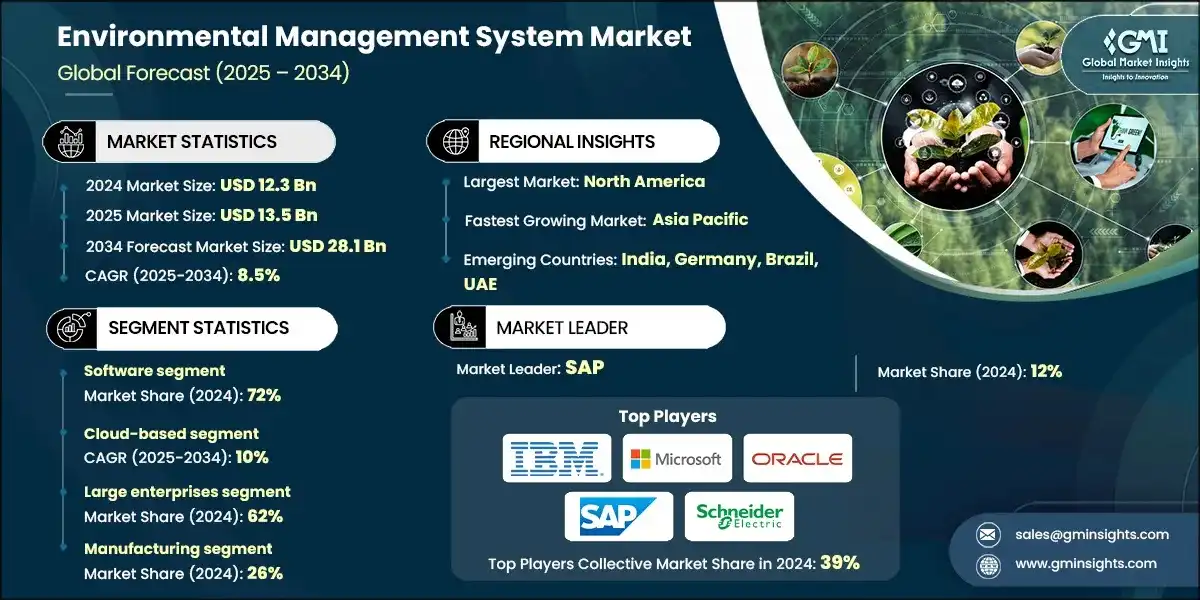
The global environmental management system market size was estimated at USD 12.3 billion in 2024. The market is expected to grow from USD 13.5 billion in 2025 to USD 28.1 billion in 2034, at a CAGR of 8.5%, according to latest report published by Global Market Insights Inc.
To get key market trends
The environmental management system (EMS) includes more structured frameworks and software to manage environmental responsibilities through a systematic process. The second group is based on international norms such as ISO 14001 and the European Community (EC) Eco-Management Audit Scheme (EMAS).
EMS systems involve elements such as environmental policy, planning, implementation of controls, operations management, monitoring and measurements (including training), corrective action processes and management review processes to ensure that the requirements of applicable regulations are met.
Implementing an EMS helps companies use resources such as energy, water, and materials more efficiently, which cuts operating costs. One study of high-polluting manufacturing firms in South Korea found that ISO 14001 certification resulted in a 2.7% average increase in technical efficiency.
The market growth is creating the demand for regulatory mandates, compliance across electronic software applications and corporate sustainability goals that necessitate systematic management of environmental impacts. Companies in diverse sectors are implementing EMS to record and prove compliance with environmental legislation, reduce operational risks and fit within the Environmental, Social and Governance (ESG) goals. Reputable regulatory agencies and industry groups now want to see evidence.
EMS implementation covers sectors such as manufacturing, energy, transportation, construction, and the public sector, where it is applied to coordinate environmental effects across multiple operational processes. Operational benefits have been documented in extensive building and infrastructure management.
Environmental Management System Market Report Attributes
| Key Takeaway | Details |
|---|---|
| Market Size & Growth | |
| Base Year | 2024 |
| Market Size in 2024 | USD 12.3 Billion |
| Market Size in 2025 | USD 13.5 Billion |
| Forecast Period 2025 - 2034 CAGR | 8.5% |
| Market Size in 2034 | USD 28.1 Billion |
| Key Market Trends | |
| Drivers | Impact |
| Increasing regulatory compliance requirements | Drives adoption of standardized EMS frameworks across industries |
| Expansion of corporate sustainability and ESG programs | Encourages integration of EMS into broader organizational governance |
| Rising use of digital platforms for environmental data management | Enhances efficiency in monitoring, reporting, and auditing activities |
| Growth in public sector environmental oversight systems | Boosts demand for centralized EMS solutions in government agencies |
| Adoption of international standards like ISO 14001 and EMAS | Establishes common operational frameworks and accelerates certification uptake |
| Pitfalls & Challenges | Impact |
| Complex integration with existing enterprise systems | Increases implementation timelines and costs |
| Lack of specialized expertise within organizations | Slows effective deployment and operation of EMS frameworks |
| Opportunities: | Impact |
| Integration with IoT, cloud, and analytics platforms | Expands EMS capabilities and real-time monitoring functions |
| Rising focus on lifecycle resource efficiency | Drives demand for EMS adoption in manufacturing, energy, and construction sectors |
| Market Leaders (2024) | |
| Market Leaders |
12% market share |
| Top Players |
Collective market share in 2024 is 39% |
| Competitive Edge |
|
| Regional Insights | |
| Largest Market | North America |
| Fastest Growing Market | Asia-Pacific |
| Emerging Country | India, Germany, Brazil, UAE |
| Future Outlook |
|
What are the growth opportunities in this market?
Environmental Management System Market Trends
The US Environmental Protection Agency (EPA) provides compliance with major environmental statutes, for example, the Clean Air Act and the Clean Water Act, through coordinated systems and national programs of enforcement. These systems require facilities to monitor discharges, control waste streams, and install operation controls, which ensure steady compliance with regulatory standards across different industries and reduce environmental compliance.
The General Services Administration (GSA) conducted a comprehensive evaluation of 22 sustainably designed federal buildings and found that these buildings consumed 25 percent less energy, used less water, and required lower maintenance. The study also mentioned that occupant satisfaction and indoor environmental quality were improved, demonstrating measurable operational improvements through systematic environmental management practices.
Municipal authorities across the United States have documented that organizations possessing ISO 14001 certification experience noteworthy operational enhancements. These improvements encompass a decrease of up to 45% in environmental contingencies and average annual cost reductions approximating $16,000. These favorable outcomes are attributed to the employment of standardized procedures, periodic evaluations, and centralized environmental surveillance, illustrating the tangible merits of formal Environmental Management System (EMS) adoption within both governmental and private domains.
The integration of advanced technologies such as artificial intelligence, Internet of Things (IoT) sensors, and cloud computing into EMS platforms facilitates real-time oversight, prognostic analytics, and automated reporting pertaining to environmental performance. Industrial operations can continuously monitor energy utilization, emissions output, and resource depletion. This functionality empowers organizations to refine processes, curtail waste production, and adhere to environmental mandates with heightened efficacy.
Environmental Management System Market Analysis
Learn more about the key segments shaping this market
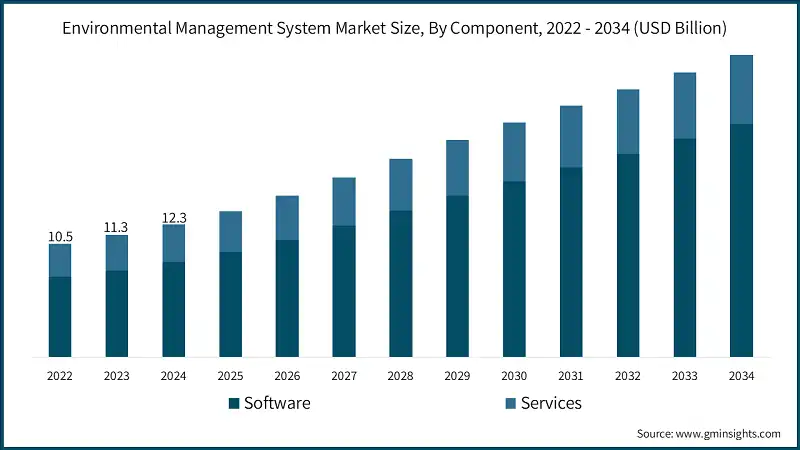
Based on component, the environmental management system market is divided into software and services. Software segment dominated the market in 2024, accounting for 72% of total revenue.
- The software part of the EMS market includes platforms for environmental monitoring, compliance tracking, data collection, and reporting. These solutions help organizations centralize environmental data, automate reporting, and ensure they meet regulatory standards. Software platforms often work with ERP, IoT, and cloud-based systems to give real-time performance insights.
- EMS software can predict incidents, track problems, and manage workflow across sites. Organizations, they follow ISO 14001, EMAS, plus other frameworks, making sustainability reporting possible. ESG measurements become easier with these tools. Digital EMS platforms organizations use to reduce emissions, manage resources better and make decisions environmentally smarter.
- The service segment includes consulting, implementation, auditing, training, and certification support. Consulting helps design EMS, integrate processes, assess risks, and plan compliance strategy. Audits and certifications provide proof of reliability in environmental performance. Helps organizations spot improvements and increase operational efficiency sometimes faster than internal teams.
- EMS services provide technical support, updates to systems, and employee training to maintain compliance. They assist in continuous improvement cycles, environmental risk management, and aligning operations to sustainability goals. Services support software solutions also, allows EMS frameworks deployment full-scale across industrial sectors.

Learn more about the key segments shaping this market
Based on deployment, the environmental management system market is segmented into on-premises and cloud-based. The cloud-based segment led the market in 2024 and is expected to grow at a CAGR of 10% from 2025 to 2034.
- The on-premises deployment segment lets organizations host EMS software inside their own IT systems. It gives more control of sensitive data and allows custom settings. Many firms prefer this model when data security and internal rules are strict. Integration with existing systems is possible but sometimes complex.
- On-premises EMS requires IT team to install, maintain, and do updates. Offers control over performance, configuration too, but upfront cost and hardware needs are high. Organizations can customize features more, manage workflows inside the company, and access environmental data directly, without depending on outside providers.
- Cloud-based EMS runs over internet-hosted services, giving scalability and remote access. Lower initial cost, easy to deploy modules and connect IoT sensors fast. Subscriptions reduce capital expenses, also supports multiple locations. Teams can monitor environmental data in real-time, analyze metrics, and work together from different offices.
- Cloud EMS platforms provide updates, backups, and maintenance by provider. Allows collaboration across locations, analytics in real-time, and disaster recovery faster. Organizations achieve implementation quicker, easier, and comply with reporting rules. Sustainability tracking works across frameworks. The solution reduces dependency on internal IT sometimes.
Based on enterprise size, the environmental management system market is segmented into large enterprises and small and medium enterprises. The large enterprises segment dominated the market, accounting for share of 62% in 2024.
- Large organizations generally maintain dedicated Environment, Health, and Safety (EHS) departments, specialized IT infrastructure, and allocated funds for the maintenance and auditing of their EMS. They leverage real-time monitoring technologies, predictive analytics, and automated workflow tools to minimize emissions, conserve resources, and harmonize their environmental strategies with overarching corporate sustainability initiatives. This results in optimized operational efficiency across their extensive network of locations.
- The small and medium enterprise (SME) segment includes companies with simpler operations and limited resources. They adopt scalable EMS tools, often cloud-based or modular, to follow regulations and improve environmental performance. These platforms let SMEs track emissions, manage waste, and maintain records without heavy IT or big investments.
- SMEs gain from cost-efficient, easy-to-install EMS platforms needing minimal support. Subscription or cloud models cut upfront costs and allow remote access. Using EMS helps SMEs improve efficiency, show sustainability efforts, and build reputation while gradually growing their environmental management practices.
Based on end-use, the environmental management system market is segmented into manufacturing, construction, energy and utilities, chemicals, automotive, pharmaceuticals, food and beverage, government & public sector, and others. The manufacturing segment dominated the market, accounting for share of 26% in 2024.
- The manufacturing segment uses EMS to track emissions, handle waste, and manage resources across big factories. These tools help manufacturers follow ISO 14001 and other rules, connect with ERP systems, and track environmental performance in real-time, making sustainability reporting easier. Some organizations still manually check data occasionally.
- Construction sector EMS platforms help projects reduce waste, save water, and follow local rules. Contractors rely on these systems to improve energy efficiency and report sustainability results. Documents created often show compliance to regulators and stakeholders. Footprints of building works reduce when EMS is used consistently across sites.
- Energy and utilities apply EMS for emissions monitoring, impact tracking, and environmental data collection over power plants and infrastructure. Utility firms integrate IoT sensors for predictive maintenance and continuous monitoring. Systems also support reporting requirements, efficiency improvements, and better decision-making for operational sustainability at multiple locations.
- Chemicals, automotive, and pharmaceuticals, they depend on EMS for safe material handling, emission control, and regulatory adherence. Food and beverage firms also use these platforms to manage water, waste, and energy. Government and public sector agencies implement EMS to track compliance, report sustainability, and maintain policy alignment across departments.
Looking for region specific data?
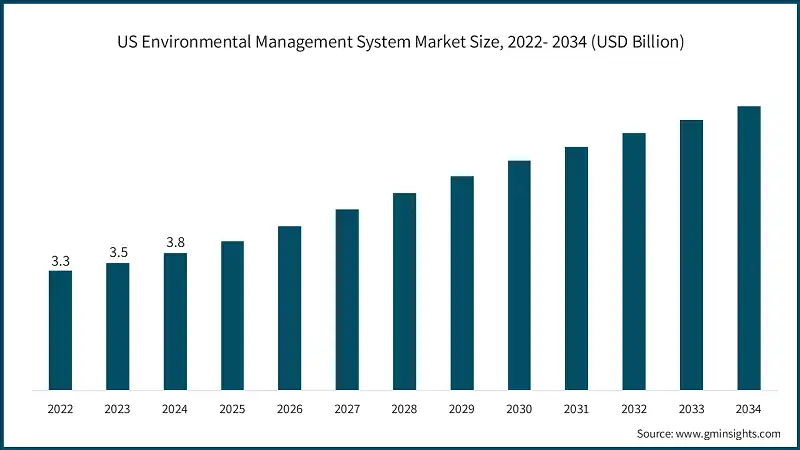
The US dominates the North American environmental management system market, generating USD 3.8 billion revenue in 2024.
- The use of EMS solutions in the US is shaped by federal rules and state programs that encourage reducing environmental impacts. The EPA identifies climate change mitigation and environmental justice as key priorities. This indicates that organizations require good environmental management, yet oversight often lacks consistency.
- Industries like manufacturing, energy, and utilities, start using EMS more often to track emissions, control waste, and manage resources. Systems help companies follow regulations and also make operations more efficient. In turn, these practices support wider sustainability goals for the nation even across multiple sectors.
- EPA keeps facing challenges enforcing environmental rules. Fiscal Year 2023 report says problems like lack of resources, old infrastructure, and weak data systems slow effective governance. Agencies struggle sometimes to collect correct information, which can delay compliance and environmental protection initiatives.
- US EMS market benefits from technological advances. AI and machine learning are now part of EMS platforms. These tools can predict compliance issues, helping organizations tackle risks before they become problems and improve sustainability performance. Companies can respond faster, evaluate data more effectively, and reduce environmental errors more efficiently.
The environmental management system market in the Germany is expected to experience robust growth of 8.8% CAGR from 2025 to 2034.
- Germany builds its system on rules that are very strict, and national targets push companies to act cleaner. Federal laws talk a lot about cutting emissions, handling trash, and moving faster into renewable energy. Firms there often go with ISO 14001 plans, so they do not fall out with regulators.
- Factories in Germany incorporate EMS into daily operations. They monitor smoke and waste, save materials, and keep their supply chains in check. Since the country produces more goods than any other in Europe, they rely heavily on digital monitoring tools. This helps companies comply with both EU and local regulations.
- Energy groups plus utilities use EMS tools when moving from coal and gas toward greener power. Systems help manage risks that old power plants make while checking wind and solar are doing right. These programs also give more clear reports and add strength to Germany’s goal for carbon cut.
- Public offices also integrate EMS into projects related to roads, cities, and services. Town councils and ministries monitor waste collection, river conditions, and local air quality. Implementing these controls shows Germany's commitment to maintaining a leading position in Europe for organized and effective environmental management.
The environmental management system market in China is expected to experience strong growth from 2025 to 2034.
- China puts heavy focus on using environmental management systems because of strict rules from government and big climate goals. Ministry of Ecology and Environment makes sure companies follow laws in factories, energy plants, and other industries. National programs like “Dual Carbon” push firms to cut emissions and adopt greener habits.
- Factories in China use EMS more than any other industry since pollution control and saving resources is always a main pressure. These tools track water waste, air discharge, and dangerous materials handling. Adoption of such systems also keeps exporters inside international rules and helps them fit domestic environmental standards together.
- Energy companies and utility groups lean on EMS for managing shifts into clean energy like wind and solar. At same time, it keeps risks under watch from coal stations. By using AI systems and IoT sensors, emissions stay visible in real-time, and reporting becomes more accurate for the state.
- Cities and government offices adopt EMS too, using them to plan urban growth, handle garbage, and deal with water shortages. Local programs follow green national policies while trying to lower pollution in fast-growing urban areas. Such adoption makes China look stronger in the world as leader in environmental rules.
The environmental management system market in UAE is expected to experience stable growth from 2025 to 2034.
- UAE builds environmental management systems into its strategy because national vision plans put sustainability at the center. Authorities push laws on waste, clean energy projects, and tougher compliance audits. Firms in many sectors begin taking EMS as they try to keep both local requirements and global environmental rules in place.
- Large industries like building and factory work in Emirates pick EMS tools for checking waste streams, water usage, and pollution data. These systems let managers see efficiency better and hold control of processes. Companies keep close watch since breaking rules here often bring high penalties or permit delays.
- Energy field in UAE mix EMS into both oil operations and clean energy rollout. Solar farms in Dubai and nuclear reactors near Abu Dhabi also use monitoring systems. Tools follow carbon numbers, spot risks early, and build reports that match national clean transition strategies already being pushed forward.
- Public offices and city councils adopt EMS for planning cities, handling garbage systems, and running smart projects. Tools help balance water shortage issues, recycling programs, and pollution tracking inside urban spaces. This makes UAE keep strong image in region as leader with green direction and firm sustainability control policies.
The environmental management system market in Brazil is expected to experience significant and promising growth from 2025 to 2034.
- Brazil put environmental management systems inside national plans because policies give weight to conservation and climate targets. IBAMA agencies keep hard checks on pollution and waste practices. Demand for EMS grows as firms try to meet government law and global rules connected with exports that expect sustainability evidence before shipment.
- Factories in São Paulo and other industrial places bring EMS tools to watch power use, test air emissions, and cut material loss. Companies use these systems for smoother reports and efficiency gains. Adoption also makes exporters ready when foreign partners ask for clear proof of sustainable production before trade.
- Energy utilities in Brazil bring EMS for managing hydropower while balancing environment safeguards and risks of oil operations. Wind and solar projects also rely on EMS linking with smart tech. These platforms keep watch on compliance, improve generation planning, and make transparency stronger inside national energy grids.
- Public offices and municipalities roll EMS programs for city growth, waste control, and water supply in urban zones. Such tools assist with handling deforestation effects, pollution issues, and sanitation needs. Broader adoption builds stronger monitoring capacity and makes Brazil governance firmer, keeping it in line with climate goals and trade duties.
Environmental Management System Market Share
- The top 7 companies in the environmental management system industry are SAP, Oracle, IBM, Microsoft, Schneider electric, Emerson Electric, Honeywell international, contributing around 44% of the market in 2024.
- SAP keeps strong position in EMS because its enterprise systems are already linked deep into company operations. Many industries depend on SAP to bring environmental data inside ERP, and ISO 14001 support makes compliance smoother across global supply chains.
- Oracle pushes EMS growth by using cloud and database power. Firms adopt their tools for compliance tracking and fast analytics. IoT links built in allow better reporting and decision. This combination helps organizations cut risks while meeting sustainability rules.
- IBM rely on AI and data tools to grow EMS usage. Watson modules handle predictive checks, risk monitoring, and reporting across sites. With these functions IBM gain edge in high-tech sustainability programs serving different industries and clients worldwide.
- Microsoft brings EMS through Azure cloud platform, linking analytics and machine learning to regulatory tasks. Its brand strength in digital transformation and commitment to compliance attract firms. Enterprises trust Microsoft for scalable EMS that deliver efficiency and governance together.
- Schneider Electric shape EMS market by joining energy management with automation. Its platforms track carbon, watch resource flow, and file compliance reports. Customers adopt these systems to stay aligned with rules globally and reach sustainability benchmarks more accurately.
- Emerson Electric give EMS aimed at factories and plants. Its solutions focus on controlling emissions, managing energy, and improving processes. Many manufacturers use Emerson because it allows customization, saving resources while staying compliant under strict environmental regulatory environments.
- Honeywell EMS blend IoT, automation, and analytics for large industries. Energy, aerospace, and chemicals are major users. Honeywell strength is on improving performance, maintaining transparency, and keeping organizations inside sustainability frameworks while reducing risks across complex operations globally.
Environmental Management System Market Companies
Major players operating in the environmental management system industry are:
- Emerson Electric
- Honeywell International
- IBM
- Microsoft
- Oracle
- SAP
- Schneider Electric
- Siemens
- Thermo Fisher Scientific
- Veolia Environnement
- The top seven players in environmental management system market—SAP SE, Oracle, IBM, Microsoft, Schneider Electric, Emerson Electric, Honeywell International—keep strong positions using cloud tools, software platforms, and automation. SAP push ERP to centralize environmental data, Oracle grows EMS via cloud and IoT, IBM uses AI for monitoring and risk, Microsoft scale EMS with Azure, Schneider mix energy management with automation, Emerson track emissions and optimize process, Honeywell link analytics with IoT for big industrial setups.
- These firms stand out by tech, global reach, and rules compliance. SAP, Oracle, Microsoft get clients via cloud and platform ease, IBM and Honeywell lean on AI and automation. Schneider and Emerson give sector-specific solutions for manufacturing, utilities, and energy. Together they push EMS adoption globally, provide real-time monitoring, reporting, and governance tools for operational and sustainability goals.
Environmental Management System Industry News
- In September 2025, Schneider Electric launched EcoCare Advanced+ for Electrical Distribution to deliver new levels of support, improve operational efficiency, and enhance safety, reinforcing its commitment to sustainable energy management solutions.
- In May 2025, Schneider Electric launched a multi-year AI-native initiative focused on sustainability and energy management. The platform uses Agentic AI to autonomously optimize energy consumption, reduce carbon emissions, and support regulatory compliance, enabling businesses to improve operational efficiency and accelerate decarbonization across industries.
- In July 2025, SAP announced a strategic update for its S/4HANA EHS suite, transforming it from a reactive, centralized compliance management system into a modular, connected platform. The update aims to address evolving regulatory requirements, improve operational compliance, and enable proactive environmental, health, and safety management across enterprises.
- In March 2025, Schneider Electric announced plans to invest over $700 million in the U.S. by 2027 to enhance energy infrastructure crucial for AI advancement, increase domestic manufacturing, and improve energy security.
The environmental management system market research report includes in-depth coverage of the industry with estimates & forecasts in terms of revenue ($ Mn/Bn) from 2021 to 2034, for the following segments:
Market, By Component
- Software
- Services
Market, By Deployment
- On-Premises
- Cloud-Based
Market, By Enterprise Size
- Large Enterprises
- Small and Medium Enterprises
Market, By End Use
- Manufacturing
- Construction
- Energy and Utilities
- Chemicals
- Automotive
- Pharmaceuticals
- Food and Beverage
- Government & Public Sector
- Others
The above information is provided for the following regions and countries:
- North America
- US
- Canada
- Europe
- Germany
- UK
- France
- Italy
- Spain
- Russia
- Nordics
- Asia Pacific
- China
- India
- Japan
- Australia
- South Korea
- Southeast Asia
- Latin America
- Brazil
- Mexico
- Argentina
- MEA
- South Africa
- Saudi Arabia
- UAE
Frequently Asked Question(FAQ) :
What is the market size of the environmental management system in 2024?
The market size was USD 12.3 billion in 2024, with a CAGR of 8.5% expected through 2034. The growth is driven by increasing regulatory compliance requirements, adoption of ISO 14001 standards.
What is the projected value of the environmental management system market by 2034?
The market is poised to reach USD 28.1 billion by 2034, fueled by the integration of AI, IoT, and cloud computing into EMS platforms, along with growing corporate sustainability initiatives.
What is the expected size of the environmental management system market in 2025?
The market size is projected to reach USD 13.5 billion in 2025.
How much revenue did the software segment generate in 2024?
The software segment generated approximately 72% of the total revenue in 2024, led by platforms for environmental monitoring, compliance tracking, and real-time performance insights.
What was the valuation of the cloud-based deployment segment in 2024?
The cloud-based deployment segment is set to expand at a CAGR of 10% till 2034, owing to its scalability, integration capabilities, and remote accessibility.
Which segment dominated the environmental management system market in 2024?
The large enterprises segment dominated the market, accounting for 62% of the share in 2024.
Which region leads the environmental management system sector?
The United States leads the North American market, generating USD 3.8 billion in revenue in 2024.
What are the upcoming trends in the environmental management system market?
Trends include AI, IoT, and cloud integration for real-time monitoring, wider ISO 14001 adoption, and advanced tools for automated reporting and compliance.
Who are the key players in the environmental management system industry?
Key players include Emerson Electric, Honeywell International, IBM, Microsoft, Oracle, SAP, Schneider Electric, Siemens, Thermo Fisher Scientific, and Veolia Environnement.
Environmental Management System Market Scope
Related Reports