Summary
Table of Content

Energy Harvesting Transducer Market
Get a free sample of this report
Form submitted successfully!
Error submitting form. Please try again.
Thank you!
Your inquiry has been received. Our team will reach out to you with the required details via email. To ensure that you don't miss their response, kindly remember to check your spam folder as well!
Request Sectional Data
Thank you!
Your inquiry has been received. Our team will reach out to you with the required details via email. To ensure that you don't miss their response, kindly remember to check your spam folder as well!
Form submitted successfully!
Error submitting form. Please try again.
Energy Harvesting Transducer Market Size
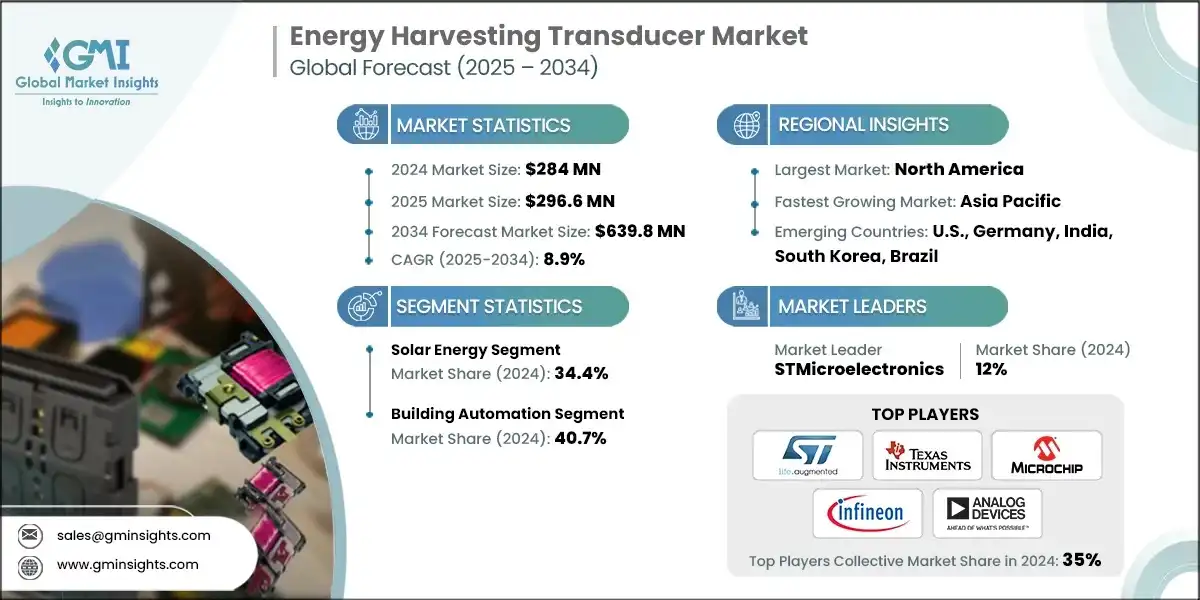
The global energy harvesting transducer market was valued at USD 284 million in 2024. The market is expected to grow from USD 296.6 million in 2025 to USD 639.8 million by 2034, at a CAGR of 8.9%, according to Global Market Insights Inc.
Energy Harvesting Transducer Market Key Takeaways
Market Size & Growth
- 2024 Market Size: USD 284 Million
- 2025 Market Size: USD 296.6 Million
- 2034 Forecast Market Size: USD 639.8 million
- CAGR (2025–2034): 8.9%
Key Market Drivers
- IoT Expansion.
- Concern towards sustainability push.
Challenges
- Low Power Output.
Opportunity
- Growing smart cities initiatives.
- Rising adoption of wearable tech.
Key Players
- Market Leader: STMicroelectronics led with over 12% market share in 2024.
- Leading Players: Top 5 players in this market include STMicroelectronics, Texas Instruments, Microchip Technology Inc., Infineon Technologies, Analog Devices, Inc., which collectively held a market share of 35% in 2024.
Get Market Insights & Growth Opportunities
- The proliferation of Internet of Things (IoT) devices and smart infrastructure is significantly influencing the adoption of energy harvesting transducers. These transducers are increasingly being integrated into wireless sensor networks, enabling autonomous operation without the need for battery replacements, which in turn is augmenting their demand.
- For instance, in April 2025, IBM announced plans to invest around USD 150 billion in U.S. including USD 30 billion in R&D over the next five years to fuel the economy and to accelerate the global computing growth. This will further enhance the growth as the product is particularly valuable in remote or hard-to-access environments including industrial plants, bridges, and smart cities, where high computation is needed.
- The ability of energy harvesting systems to provide continuous, maintenance-free power aligns well with the operational needs of distributed IoT ecosystems. As industries move toward automation and real-time data analytics through various private & public investments, energy harvesting transducers will become a foundational component in enabling scalable, self-sufficient systems.
- For reference, in January 2025, the government of Canada announced for an investment of over USD 11 million in projects that will advance the technologies needed to further strengthen Canada's clean and alternative fuels sectors. The investment will also accelerate the country’s efforts to develop high-potential non-traditional energy sources that will require the adoption of transducers down the line.
- Rapid technological advancements in materials & miniaturization have led to the development of more efficient and compact energy harvesting transducers. These advancements include the use of flexible piezoelectric materials, thin-film photovoltaic cells, and high-efficiency thermoelectric generators. For instance, ZnO nanowire-based piezoelectric nanogenerators (PENGs) have been successfully embedded into textile platforms to power sensors for motion tracking and health monitoring.
- The trend toward miniaturization is not only enhancing device performance but also expanding the application scope of energy harvesting systems. These developments are enabling manufacturers to meet the growing demand for lightweight, durable, and high-performance energy solutions across diverse sectors.
- Energy harvesting transducers are witnessing growing adoption across a wide range of industries, including healthcare, automotive, building automation, and consumer electronics. In healthcare, they are used to power implantable medical devices and remote monitoring systems and the investments in the same will add to industry growth.
- For instance, in March 2025, the World Bank has approved financing of around USD 11.4 million to aid the Kyrgyz Republic’s efforts to improve the quality of primary health care services across the country. This funding will complement the ongoing Primary Health Care Quality Improvement Program along with an aim to contribute to the government’s goal of strengthening the healthcare system.
To get key market trends
Energy Harvesting Transducer Market Trends
- The energy harvesting transducer industry is experiencing robust growth due to the widespread adoption of smart infrastructure and IoT technologies. Recent innovations in materials science and nanotechnology have significantly improved the efficiency and versatility of energy harvesting transducers. Developments in piezoelectric, thermoelectric, and photovoltaic materials have enabled the capture of energy from diverse sources such as vibrations, heat, and light.
- For instance, in July 2024, researchers from Germany, Italy, and the UK developed a thermoelectric alloy combining silicon, germanium, and tin, capable of converting waste heat from computer processors into electricity. This breakthrough supports the miniaturization of transducers and their integration into compact electronics, wearables, and biomedical devices, expanding the market’s application scope and enhancing product performance.
- The integration of artificial intelligence (AI) into energy harvesting systems is transforming operational efficiency and reliability. AI algorithms enable real-time monitoring, adaptive energy management, and predictive maintenance, allowing transducers to dynamically adjust to environmental conditions.
- For reference, in April 2025, a smart insole combining solar energy harvesting, pressure sensors, and AI was introduced to monitor health conditions such as plantar fasciitis and Parkinson’s disease. This innovation demonstrates the use of energy harvesting transducers being miniaturized and embedded into consumer health devices, which in turn is influencing the industry landscape.
- Exponential emergence of wireless power platforms along with the associated technologies that utilize wireless energy ecosystem is complementing the business landscape. For instance, in June 2025, Energous Corporation launched the e-Sense Tag, a battery-free solution powered by ambient energy harvested from its wireless power transmission network.
- Increasing technology integration into wearable & biomedical devices along with its expansion into infrastructure-embedded application is further bolstering the industry growth. For instance, WePower Technologies announced the launch of its Gemns Energy Harvesting Generator at CES 2025, targeting IoT devices embedded in infrastructure. This generator captures ambient energy from vibrations and thermal gradients in roads, bridges, and buildings.
- Additionally, these products are designed to support smart infrastructure by powering sensors used for structural health monitoring and traffic management. This marks a significant expansion of energy harvesting transducers into civil engineering and urban planning, where sustainability and real-time data are critical for operational efficiency and public safety.
- Rising focus on sustainability and adoption of battery-free designs has further infused growth into the industry. Companies like E-peas and Nexperia have introduced power management ICs optimized for dual-source energy harvesting, enabling devices to draw energy from combinations of solar, RF, and kinetic sources.
- These innovations support the growing demand for battery-free electronics, particularly in remote and inaccessible locations. In 2024, E-peas launched PMICs capable of powering smart building sensors and industrial IoT devices without relying on traditional batteries. This trend aligns with global sustainability goals, reducing electronic waste and promoting long-term energy autonomy in connected systems.
Energy Harvesting Transducer Market Analysis
Learn more about the key segments shaping this market
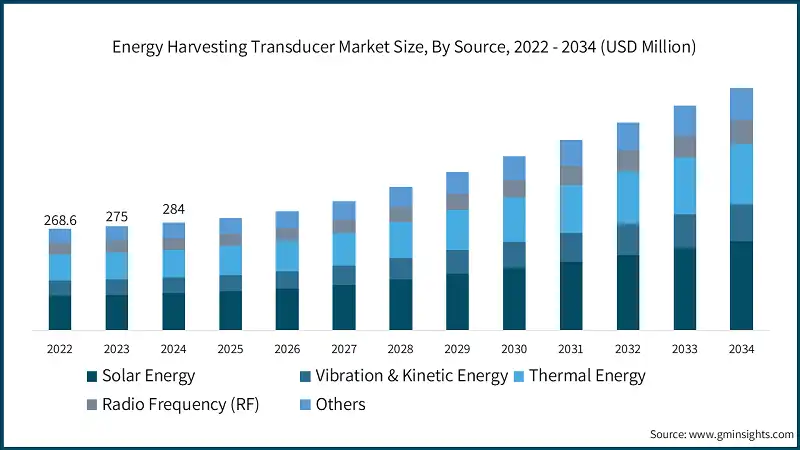
- Based on source, the market is segmented into solar energy, vibration & kinetic energy, thermal energy, radio frequency (RF), and others. The solar energy source market holds a share of 34.4% in 2024 and will grow at a CAGR of 9.6% through 2034. Solar energy harvesting transducers continue to dominate the energy harvesting landscape due to their scalability, reliability, and compatibility with diverse applications.
- The energy harvesting transducer market growth is driven by declining costs of photovoltaic modules and enhanced efficiency in perovskite solar cells. Furthermore, the integration of solar harvesting systems into microgrids and smart infrastructure has enabled decentralized power generation, particularly in regions with unreliable grid access, which is augmenting industry growth.
- Solar transducers are increasingly embedded in wearables, agricultural sensors, and autonomous vehicles, reflecting their versatility. The trend toward combining solar harvesting with AI-based energy management systems is further enhancing operational efficiency and predictive maintenance capabilities, positioning solar energy transducers as a cornerstone of sustainable electronics.
- The vibration & kinetic energy source industry will grow at a CAGR of 9.2% till 2034. Companies including Analog Devices and Microchip Technology are integrating vibration harvesting modules into industrial IoT platforms, supporting predictive maintenance and real-time analytics. In addition, the rise of smart cities and autonomous infrastructure is also driving demand for vibration-powered sensors embedded in roads, bridges, and railways.
- Thermal energy harvesting transducers industry will register at 8.6% CAGR till 2034. The market is increasingly being adopted to capture waste heat from industrial processes, electronic devices, and natural sources. These transducers utilize thermoelectric materials to convert temperature differentials into electrical energy, offering a sustainable solution for powering sensors and microcontrollers in high-temperature environments.
- The radio frequency transducer market will grow at a CAGR of 7.7% till 2034. The industry is emerging as a transformative solution for powering low-energy devices using ambient electromagnetic signals from Wi-Fi, cellular networks, and broadcasting stations. Innovations in metamaterial-based designs have further enhanced signal focusing and amplification, enabling more effective energy capture in urban environments.
- For instance, in June 2025, Vodafone in the UK will bring Three’s mobile broadband (Fixed Wireless Access) together with Vodafone’s Full Fiber into one home broadband portfolio, under the Vodafone brand with an investment of around USD 11 billion. In addition, the integration of RF harvesting with 5G and emerging 6G networks is opening new possibilities for simultaneous wireless information and power transfer (SWIPT), enabling devices to receive both data and energy over the same channel.
Learn more about the key segments shaping this market
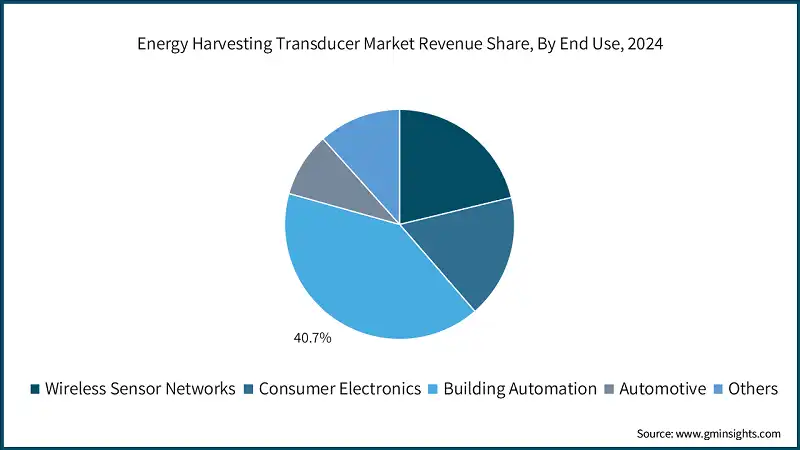
- Based on type, the energy harvesting transducer market is segmented into wireless sensor networks, consumer electronics, building automation, automotive, & others. Building automation end use market showcased a 40.7% market share in 2024 and stood at USD 115 million, driven by the need for sustainable, low-maintenance power solutions that reduce reliance on conventional batteries.
- The ability to harness ambient energy sources including light, heat, and vibration makes these transducers highly versatile. In addition, manufacturers are developing modular transducer solutions that integrate seamlessly with building management systems, allowing for scalable deployment. Their adoption is expected to accelerate as urban planners and facility managers prioritize sustainability, resilience, and cost-effective automation.
- The wireless sensor network end use industry will cross USD 137 million by 2034, driven by the increase in product deployment across industrial automation, environmental monitoring, and smart agriculture. In addition, the convergence of energy harvesting with edge computing and AI have further enhanced WSNs by enabling real-time data processing and predictive analytics.
- The consumer electronics end use industry will grow at a CAGR of 9.1% through 2034. Consumer electronics are increasingly incorporating energy harvesting transducers to support battery-free or extended-life operation. Wearables, fitness trackers, and smartwatches are leading this trend, with manufacturers embedding solar cells, piezoelectric materials, and thermoelectric modules to capture ambient energy from light, motion, and body heat.
- For instance, in May 2025, various companies at the 2025 Consumer Electronics Show in Las Vegas, showcased practical applications of energy harvesting, signaling the shift toward sustainable, maintenance-free electronics. Additionally, energy harvesting is being explored in smart home devices such as remote controls, thermostats, and door sensors, enabling continuous operation without battery replacements.
- The integration of energy harvesting with low-power electronics and advanced power management ICs is expanding the design possibilities for compact, lightweight, and durable consumer products. As the market shifts toward eco-friendly and user-centric technologies, energy harvesting transducers will become a key differentiator in next-generation consumer electronics.
- The automotive industry will grow at a CAGR of 9% till 2034. The automotive sector is embracing energy harvesting transducers to support the growing demand for smart, connected, and electrified vehicles. These transducers are used to power tire pressure monitoring systems (TPMS), seat occupancy sensors, and ambient lighting controls without relying on the vehicle’s main battery.
- In addition, exponential use of robotics in automotive industries to pace vehicle production, especially electric vehicles, is augmenting the industry scenario. For instance, electric vehicle (EV) manufacturers have begun integrating thermoelectric generators to recover waste heat from powertrains and convert it into usable energy for auxiliary systems.
Looking for region specific data?
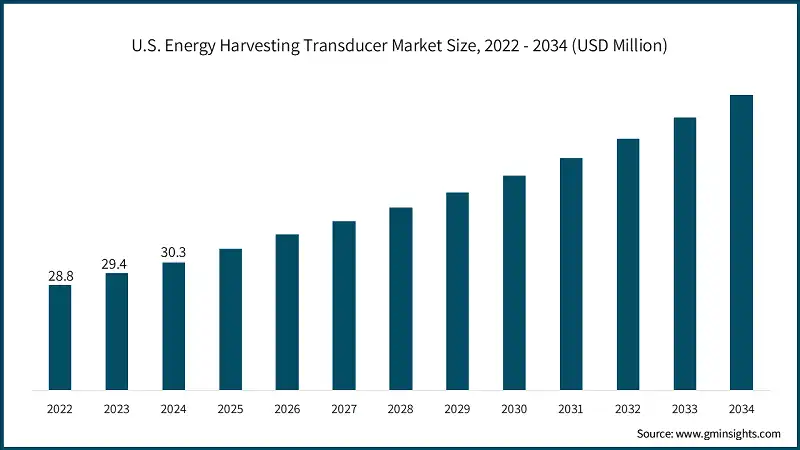
- The U.S. dominated the energy harvesting transducer market in North America with 72% share in 2024 and generated USD 30.3 million in revenue, driven by federal clean energy incentives, widespread IoT adoption, and integration of product across robotics for automotive applications.
- For instance, as per the Association for Advancing Automation (A3), North American companies ordered 17,635 robots valued at USD 1.094 billion in the first six months of 2025. This was dominated by the automotive OEM industry to increase the manufacturing productivity.
- The Europe market will grow at a CAGR of 8.7% till 2034, shaped by the EU’s climate neutrality goals and robust R&D funding under Horizon Europe. The region is witnessing increased adoption of transducers in building automation, industrial IoT, and smart infrastructure. Innovations in piezoelectric and thermoelectric materials are enhancing efficiency, while projects like SELECT and NANO-EH are promoting biodegradable, battery-free solutions.
- Countries including Germany, France, and Spain are integrating energy harvesting into solar and wind projects, supported by national sustainability programs. The region remains committed to expanding its renewable energy footprint, with transducers playing a pivotal role in decentralized energy systems, thereby adding to industry growth.
- Asia-Pacific is the fastest-growing region in the energy harvesting transducer market and will grow at a CAGR of 10.2% till 2034, fueled by rapid industrialization, smart city initiatives, and rising energy costs. Countries like China, India, and Japan are investing heavily in piezoelectric and thermoelectric technologies to power sensors in manufacturing, transportation, and consumer electronics.
- In the Middle East and Africa, the energy harvesting transducer market is evolving slowly but steadily, supported by smart city developments and sustainability initiatives5. Governments in the UAE, Saudi Arabia, and South Africa are investing in solar and RF-based transducers for building automation and logistics.
- Latin America’s energy harvesting transducer market is gaining traction through smart infrastructure projects and renewable energy integration. Countries including Brazil and Argentina are exploring solar and vibration-based transducers for powering remote sensors in agriculture, transportation, and environmental monitoring.
Energy Harvesting Transducer Market Share
- The top 5 companies in the energy harvesting transducer industry are STMicroelectronics, Texas Instruments, Microchip Technology Inc., Infineon Technologies, and Analog Devices, Inc., that collectively contribute around 35% of the market in 2024. STMicroelectronics is known for its innovation in ultra-low-power electronics and integration of energy harvesting into IoT, automotive, and industrial applications. It holds a significant patent portfolio and invests heavily in sustainability and smart energy systems.
- Texas Instruments emphasizes reliability, scalability, and integration with wireless communication protocols, making it a preferred choice for developers of autonomous systems, whereas Microchip’s products are widely adopted in consumer electronics, medical devices, and remote sensing applications.
Energy Harvesting Transducer Market Companies
Major players operating in the energy harvesting transducer industry are:
- ABB
- Analog Devices, Inc.
- Cymbet Corporation
- EnOcean GmbH
- E-peas
- GreenTEG AG
- Honeywell International Inc.
- Infineon Technologies AG
- Microchip Technology Inc.
- Murata Manufacturing Co., Ltd.
- Nowi Energy
- Powercast Corporation
- Qorvo, Inc.
- Renesas Electronics Corporation
- Silicon Labs
- STMicroelectronics
- Texas Instruments
- Thermo Life Energy Corp.
- Voltree Power
- VTT Technical Research Centre
- WePower
- Zarlink Semiconductor
- STMicroelectronics, headquartered in Switzerland is one of the major semiconductor solution providers, offering a wide range of energy harvesting technologies including solar charging ICs, battery management systems, and GaN power ICs. The company has a strong presence in Europe, Asia, and North America, with dedicated R&D centers and foundries.
- Analog Devices is renowned for its high-performance analog, mixed-signal, and digital signal processing technologies. In the energy harvesting space, ADI provides piezoelectric and thermoelectric transducers, precision power management ICs, and sensor integration platforms.
- Infineon Technologies offers a broad portfolio of semiconductors for power management, sensors, and connectivity. Its energy harvesting solutions are embedded in smart homes, automotive systems, and industrial IoT. Infineon’s Power & Sensor Systems division focuses on thermoelectric and RF harvesting technologies, supporting energy-efficient and secure operations.
Energy Harvesting Transducer Market Report Attributes
| Key Takeaway | Details |
|---|---|
| Market Size & Growth | |
| Base Year | 2024 |
| Market Size in 2024 | USD 284 Million |
| Market Size in 2025 | USD 296.6 Million |
| Forecast Period 2025 - 2034 CAGR | 8.9% |
| Market Size in 2034 | USD 639.8 million |
| Key Market Trends | |
| Drivers | Impact |
| IoT Expansion | Rising demand for self-powered sensors in IoT networks boosts transducer adoption. |
| Concern towards sustainability push | Global emphasis on renewable energy and low-power electronics drives innovation. |
| Pitfalls & Challenges | Impact |
| Low Power Output | Limited energy generation capacity restricts use in high-power applications. |
| Opportunities: | Impact |
| Growing smart cities initiatives | Integration into smart infrastructure opens new deployment avenues. |
| Rising adoption of wearable tech | Growth in health-monitoring wearables creates demand for compact harvesters. |
| Market Leaders (2024) | |
| Market Leaders |
12% market share |
| Top Players |
Collective market share in 2024 is 35% |
| Competitive Edge |
|
| Regional Insights | |
| Largest Market | North America |
| Fastest Growing Market | Asia Pacific |
| Emerging Country | U.S., Germany, India, South Korea, Brazil |
| Future Outlook |
|
What are the growth opportunities in this market?
Energy Harvesting Transducer Industry News
- In August 2025, ABB announced to invest more than USD 100 million in Canadian R&D and manufacturing to expand the R&D and production capacity of its advanced power protection and grid resilience technologies in Canada. This in turn will aid in the production of energy harvesting components, thereby adding to the market growth.
- In March 2025, WePower developed energy harvesting solutions for wireless data transmitter applications in IoT devices for industrial, automotive, smart home, smart buildings, and aerospace applications. This will enable sustainable energy harvesting solutions that power the IoT all while improving product design, performance, and weight, and eliminating wasteful batteries.
- In January 2024, Infineon Technologies AG came into a strategic collaboration with e-peas to validate and prototype the design of an ambient-powered Bluetooth remote control, thereby promoting the consumer electronic industry.
This energy harvesting transducer market research report includes in-depth coverage of the industry with estimates & forecasts in terms of revenue (USD Million) from 2021 to 2034, for the following segments:
Market, By Source
- Solar energy
- Vibration & kinetic energy
- Thermal energy
- Radio frequency (RF)
- Others
Market, By End Use
- Wireless sensor networks
- Consumer electronics
- Building automation
- Automotive
- Others
The above information has been provided for the following regions:
- North America
- U.S.
- Canada
- Europe
- Germany
- France
- UK
- Spain
- Italy
- Asia Pacific
- China
- India
- Japan
- Australia
- South Korea
- Middle East & Africa
- Saudi Arabia
- UAE
- South Africa
- Latin America
- Brazil
- Argentina
Frequently Asked Question(FAQ) :
What is the market size of the energy harvesting transducer in 2024?
The market size was USD 284 million in 2024, with a CAGR of 8.9% expected through 2034 driven by IoT expansion, smart infrastructure adoption, and sustainability initiatives.
What is the projected value of the energy harvesting transducer market by 2034?
The energy harvesting transducer market is expected to reach USD 639.8 million by 2034, propelled by technological advancements in materials, miniaturization, and AI integration.
What is the current energy harvesting transducer market size in 2025?
The market size is projected to reach USD 296.6 million in 2025.
Which energy source segment dominates the market in 2024?
Solar energy source holds 34.4% market share in 2024, supported by declining photovoltaic costs and enhanced efficiency.
What was the valuation of the building automation end-use segment in 2024?
Building automation held 40.7% market share and generated USD 115 million in 2024, fueled by sustainable, low-maintenance power solutions.
What is the growth outlook for the consumer electronics segment from 2025 to 2034?
Consumer electronics segment is projected to grow at a 9.1% CAGR till 2034, due to increased adoption in wearables, fitness trackers, and smart home devices.
Which region leads the energy harvesting transducer market?
The U.S. dominated the energy harvesting transducer industry in North America with 72% share in 2024 and generated USD 30.3 million in revenue.
What are the upcoming trends in the energy harvesting transducer market?
Key trends include AI-powered energy management systems, advances in flexible electronics for textiles, multi-source harvesting combinations, and integration with 5G/6G networks for wireless power transfer.
Who are the key players in the energy harvesting transducer market?
Key players include ABB, Analog Devices, Inc., Cymbet Corporation, EnOcean GmbH, E-peas, GreenTEG AG, Honeywell International Inc., Infineon Technologies AG, Microchip Technology Inc., Murata Manufacturing Co., Ltd., Nowi Energy, Powercast Corporation, Qorvo, Inc., Renesas Electronics Corporation, Silicon Labs, STMicroelectronics, Texas Instruments.
Energy Harvesting Transducer Market Scope
Related Reports