Summary
Table of Content

Endodontics Market
Get a free sample of this report
Form submitted successfully!
Error submitting form. Please try again.
Thank you!
Your inquiry has been received. Our team will reach out to you with the required details via email. To ensure that you don't miss their response, kindly remember to check your spam folder as well!
Request Sectional Data
Thank you!
Your inquiry has been received. Our team will reach out to you with the required details via email. To ensure that you don't miss their response, kindly remember to check your spam folder as well!
Form submitted successfully!
Error submitting form. Please try again.
Endodontics Market Size
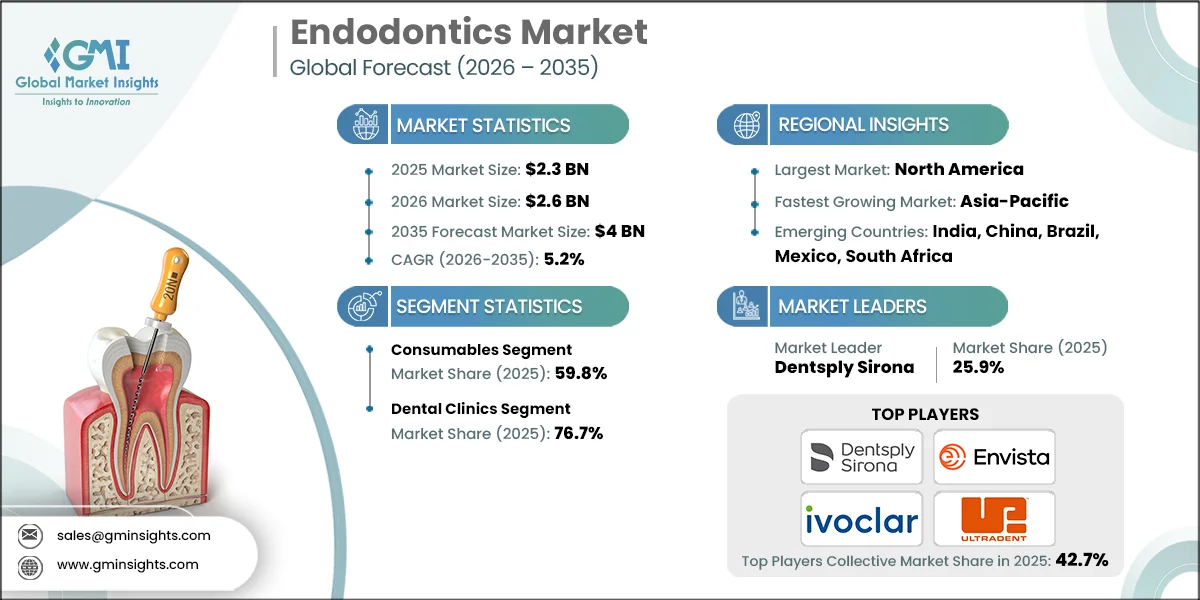
The global endodontics market was valued at USD 2.3 billion in 2025. The market is expected to reach from USD 2.6 billion in 2026 to USD 4 billion in 2035, growing at a CAGR of 5.2% during the forecast period, according to the latest report published by Global Market Insights Inc. The high market growth is attributed to the technological advancements in endodontic equipment, growing awareness of dental health, rising prevalence of dental diseases, and rising number of dental professionals and clinics, among other contributing factors.
Endodontics Market Key Takeaways
Market Size & Growth
- 2025 Market Size: USD 2.3 Billion
- 2026 Market Size: USD 2.6 Billion
- 2035 Forecast Market Size: USD 4 Billion
- CAGR (2026–2035): 5.2%
Regional Dominance
- Largest Market: North America
- Fastest Growing Region: Asia Pacific
Key Market Drivers
- Rising prevalence of dental disorders.
- Increasing awareness and importance of oral health.
- Technological advancements.
Challenges
- Limited access to advanced endodontic care in developing or rural regions.
Opportunity
- Expansion into emerging and underserved markets.
- Growing demand for painless, minimally invasive and patient‑centric treatments.
Key Players
- Market Leader: Dentsply Sirona led with over 25.9% market share in 2025.
- Leading Players: Top 4 players in this market include ULTRADENT, Ivoclar, Envista, Dentsply Sirona, which collectively held a market share of 42.7% in 2025.
Get Market Insights & Growth Opportunities
Endodontics is a dental specialty that deals with the detection and treatment of diseases of the dental pulp and tissues around the tooth. It mainly includes the practice of root canal therapy to save a patient's natural teeth. The goal of the specialty is to remove the infection, alleviate the pain, and keep the tooth functional for a long time.
The major players in the global endodontics market are Dentsply Sirona, Envista, Ivoclar, and Ultradent Products. These firms keep their competitive position through continuous product innovation, worldwide market presence, and hefty investment in research and development.
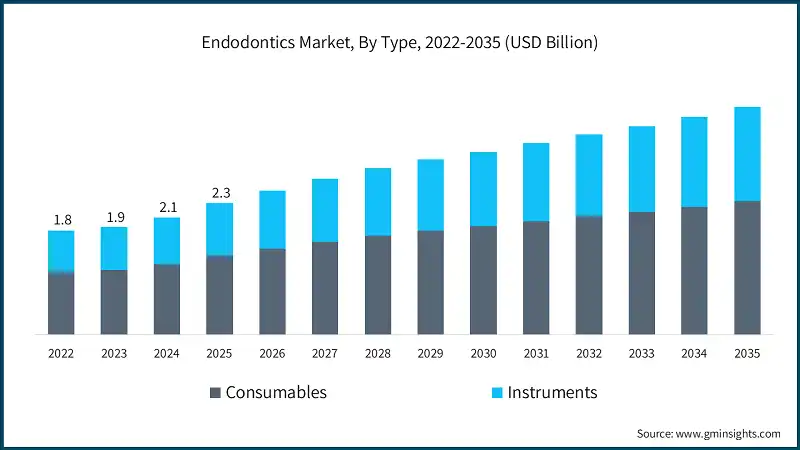
The market has increased from USD 1.8 billion in 2022 and reached USD 2.1 billion in 2024, with the historic growth rate of 6.1%. The market growth was driven by increasing dental expenditure and higher disposable incomes, growing demand for minimally invasive and patient-friendly endodontic procedures, and the expansion of dental practices and clinics in emerging regions.
Globally, rising cases of dental caries, pulpitis, and other endodontic issues are fuelling the demand for root canal treatments and associated procedures. For instance, according to the World Health Organization (WHO), in 2022, nearly 2.3 billion people suffered from dental caries in permanent teeth, highlighting the widespread prevalence of oral health issues.
Additionally, the Centers for Disease Control and Prevention (CDC) reported in 2021 that approximately 26% of adults in the U.S. had untreated tooth decay. Factors such as inadequate oral hygiene, dietary choices, and an aging demographic are leading to increased tooth decay, thereby ensuring a consistent demand for endodontic care.
Furthermore, innovations such as rotary endodontic instruments, apex locators, 3D imaging systems, and laser-assisted procedures have enhanced precision, safety, and patient comfort. These advancements encourage dental practitioners to adopt modern techniques, thereby boosting the overall market growth.
To get key market trends
Endodontics Market Trends
The market is growing considerably with the shift toward nickel-titanium (NiTi) rotary instruments, integration of cone beam computed tomography (CBCT), and growing adoption of minimally invasive and single-visit endodontics, among other factors collectively driving industry growth.
- There is a strong market movement toward NiTi rotary and reciprocating file systems, driven by their superior flexibility, procedural efficiency, and reduced risk of file separation. Manufacturers are launching heat-treated and controlled-memory NiTi systems for enhanced performance. This trend is improving treatment outcomes and accelerating adoption among general dentists.
- The practice of performing root canal therapy in a single visit is becoming popular, as a result of improvements in instrumentation, irrigation, and obturation techniques. Patients are looking for shorter chair-time and fewer visits to the clinic, which in turn increases the demand for efficient systems. This is in line with the general healthcare trend that favours minimally invasive and time-efficient treatments.
- Additionally, dental service organizations are scaling rapidly in the U.S., Europe, and parts of Asia, consolidating specialty services including endodontics. Their standardized protocols and large procurement volumes accelerate adoption of advanced tools and consumables. This trend strengthens the market for premium endodontic products, thereby sustaining market growth.
Endodontics Market Analysis
Learn more about the key segments shaping this market
Based on the type, the endodontics market is segmented into consumables and instruments. The consumables segment has asserted its dominance in the market by securing a significant market share of 59.8% in 2025 owing to their high usage frequency, recurring replacement needs, and the essential role of files, sealers, obturation materials, and related consumables in every endodontic procedure. The segment is expected to exceed USD 2.4 billion by 2035, growing at a CAGR of 5% during the forecast period.
On the other hand, the instruments segment is expected to grow with a CAGR of 5.6%. The growth of this segment is driven by increasing adoption of advanced motor systems, NiTi rotary technologies, and digital imaging tools that enhance procedural efficiency, precision, and treatment outcomes.
- The consumables segment continues to dominate the market. Consumables such as files, obturation materials, sealers, and irrigants are necessities in every root canal procedure, thus a steady recurring demand is driven. Globally, as RCT volumes continue to rise due to the increase in dental caries and pulp infections, consumables remain the most purchased category.
- Further, as more general dentists perform root canal treatments instead of referring cases to specialists, the need for easy-to-use, reliable consumables increases. This broadens the customer base for files, sealers, irrigants, and obturation materials in everyday dental practice.
- The instruments segment held a revenue of USD 940.7 million in 2025, with projections indicating a steady expansion at 5.6% CAGR from 2026 to 2035. The segment is driven by the rising demand for ergonomic, dentist-friendly devices that reduce procedure time, along with the growing shift toward automated and torque-controlled systems that improve consistency and safety during root canal treatments.
- Additionally, increasing investments in clinic modernization and the integration of real-time measurement and sensor-enabled instruments are further accelerating adoption.
Learn more about the key segments shaping this market
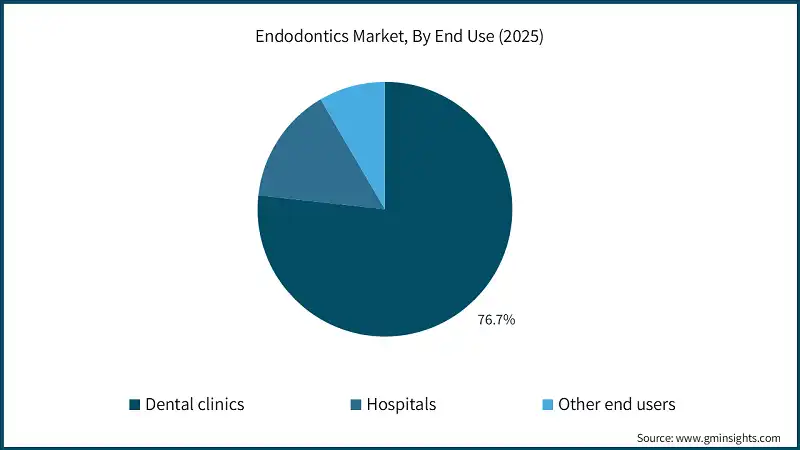
Based on end use, the endodontics market is classified into dental clinics, hospitals, and other end users. The dental clinics segment dominated the market with a revenue share of 76.7% in 2025 and is expected to reach USD 3.2 billion within the forecast period.
- Dental clinics are the major facilities that manage most routine dental visits and hence are the first point of care for root canal procedures. The rising burden of caries and pulp infections escalates patient volumes, which, in turn, is directly increasing the demand for endodontic services in clinics.
- Patients usually choose clinics that provide fast, minimally invasive treatments with fewer visits. Dental clinics which efficiently use instrumentation and irrigation solutions are able to attract more patients, thus creating a higher demand for the utilization of endodontic consumables and instruments.
- The hospitals segment accounted for significant revenue in 2025 and is anticipated to grow at a CAGR of 4.8% over the forecast period. Hospitals are witnessing growing demand for endodontic services due to the rising volume of trauma-related dental cases and complex infections that require advanced, multidisciplinary care.
- Additionally, increasing hospital investments in modern dental units and integration of specialized endodontic departments are further strengthening this segment’s growth.
Looking for region specific data?
North America Endodontics Market
North America dominated the market with the highest market share of 37.7% in 2025.
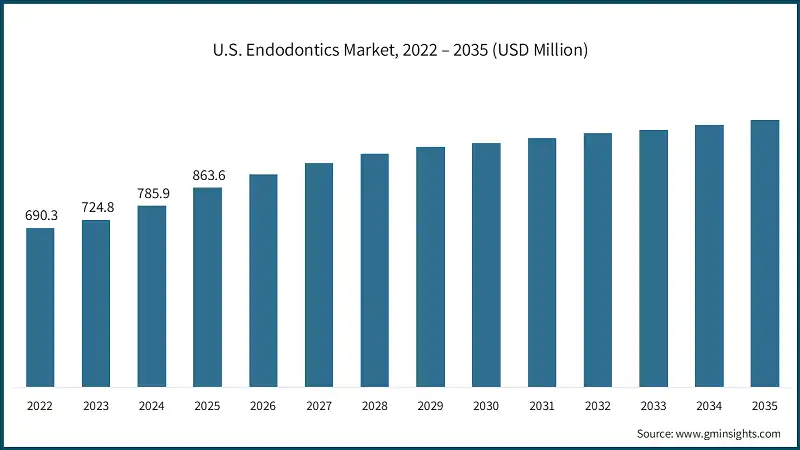
- The U.S. endodontics market was valued at USD 690.3 million and USD 724.8 million in 2022 and 2023, respectively. The market size reached USD 863.6 million in 2025, growing from USD 785.9 million in 2024, and is anticipated to grow at a CAGR of 2.6% between 2026 to 2035.
- North America is home to a significant number of dental caries, pulpitis, and periodontal complications cases, which are mainly caused by lifestyle patterns, high sugar consumption, and aging demographics. Root canal treatments remain in high demand due to the situation. The large patient pool is the reason for the continuous utilization of endodontic consumables and instruments in different clinics.
- In addition, the region has a dense network of private dental clinics, DSOs, and endodontic specialty centers with advanced treatment facilities. The region also has a high number of trained endodontists, supported by robust dental education systems. This strong infrastructure increases procedural volume and supports premium product consumption.
Europe Endodontics Market
Europe market accounted for USD 626.7 million in 2025 and is anticipated to show lucrative growth over the forecast period.
- European dental systems strongly focus on tooth preservation rather than extraction, increasing preference for root canal treatments over alternatives. National oral health programs promote early intervention and preventive care. This cultural and clinical emphasis drives consistent demand for endodontic procedures.
- Several European nations (e.g. Germany, France, Nordics) offer a partial or full reimbursement for the necessary dental treatments, thereby making RCTs affordable to patients. Better insurance coverage is an incentive for the procedure to be done more frequently. The stability of public funding is a guarantee for the continuous supply of endodontic services.
Asia Pacific Endodontics Market
The Asia Pacific market is anticipated to grow at the highest CAGR of 8.3% during the analysis timeframe.
- Asia Pacific (APAC) is experiencing significant growth in private dental clinics, chains, and specialty centers due to rising healthcare investments. Countries like India, China, Vietnam, and Indonesia are modernizing dental facilities at a fast pace. This infrastructure expansion increases accessibility and drives higher procedural volumes for root canal treatments.
- Moreover, the rising disposable incomes and a growing urban middle class are leading to greater willingness to pay for advanced dental services. Patients increasingly seek tooth-retaining procedures such as RCTs instead of extractions. This shift widens the patient base for endodontics across emerging APAC economies.
Latin America Endodontics Market
The Latin America market is experiencing robust growth over the analysis timeframe.
- In Latin America, the endodontics market is primarily driven by increasing dental awareness and a growing focus on tooth preservation among urban populations. Expansion of private dental clinics and chains, coupled with rising disposable incomes, is improving access to root canal treatments.
- Additionally, government initiatives and insurance programs in countries like Brazil and Mexico are gradually enhancing affordability for endodontic procedures. The adoption of modern endodontic technologies and training programs is further boosting procedural efficiency and treatment uptake across the region.
Middle East & Africa Endodontics Market
The Middle East & Africa (MEA) market is experiencing robust growth over the analysis timeframe.
- The regional growth is driven by increasing investments in modern dental infrastructure and the rapid expansion of private clinics in urban centers. Rising awareness of oral health, coupled with government-led initiatives and improving healthcare coverage, is encouraging patients to seek tooth-preserving treatments.
- The region is also witnessing growing adoption of advanced endodontic equipment and consumables, supported by dental training programs and workshops. Additionally, the influx of expatriate populations and medical tourism in countries like the UAE and Saudi Arabia is contributing to higher demand for specialized endodontic procedures.
Endodontics Market Share
The global market is highly competitive, characterized by the presence of several global and regional players offering a wide range of instruments, consumables, and digital solutions. Companies are focusing on product innovation, technological advancements, and portfolio expansion to strengthen their market position, with a particular emphasis on rotary systems, bioceramic materials, and digital imaging solutions.
Key players include Dentsply Sirona, Envista, Ivoclar, and Ultradent Products, collectively accounting for 42.7% of the total market share. Strategic collaborations, mergers and acquisitions, and expanding distribution networks are also common approaches adopted to enhance market reach and cater to both developed and emerging markets.
Competition is further intensified by new entrants focusing on niche technologies, cost-effective alternatives, and region-specific solutions, which compels established players to continuously innovate and optimize pricing strategies to maintain their market dominance.
Endodontics Market Companies
A few of the prominent players operating in the endodontics industry include:
- BRASSELER
- COLTENE
- Dentsply Sirona
- DiaDent
- EdgeEndo
- Envista
- Essential Dental Systems
- FKG
- Ivoclar
- Kerr
- MANI
- Pac-Dent
- Septodent
- Shenzhen Perfect
- ULTRADENT
- Dentsply Sirona
Offers a comprehensive endodontic portfolio combining rotary systems, obturation materials, and digital imaging, backed by strong R&D and global distribution, ensuring consistent quality and innovation. Its evidence-based solutions enhance procedural efficiency and treatment outcomes for dental professionals worldwide.
Leverages a diversified dental-brand ecosystem and global presence to provide integrated endodontic solutions, from instruments to imaging and practice management. Its operational efficiency and bundled offerings help clinics streamline workflows and improve patient care.
Focuses on high-quality endodontic materials and restorative solutions, including bioceramic-based sealers and obturation systems, emphasizing reliability and clinical performance. Its innovations support minimally invasive procedures and improved long-term treatment success.
Endodontics Market Report Attributes
| Key Takeaway | Details |
|---|---|
| Market Size & Growth | |
| Base Year | 2025 |
| Market Size in 2025 | USD 2.3 Billion |
| Market Size in 2026 | USD 2.6 Billion |
| Forecast Period 2026 - 2035 CAGR | 5.2% |
| Market Size in 2035 | USD 4 Billion |
| Key Market Trends | |
| Drivers | Impact |
| Rising prevalence of dental disorders | The increasing incidence of dental caries, pulpitis, and periapical diseases has directly boosted the demand for root canal treatments and endodontic procedures globally. |
| Increasing awareness and importance of oral health | Greater patient awareness and preventive care initiatives have led to higher treatment uptake, expanding the overall endodontics market. |
| Technological advancements | Innovations such as rotary instruments, NiTi files, and bioceramic materials have improved treatment efficiency and outcomes, driving market growth. |
| Pitfalls & Challenges | Impact |
| Limited access to advanced endodontic care in developing or rural regions | Infrastructural gaps and scarcity of skilled professionals restrict market penetration and slow adoption of advanced endodontic procedures in these areas. |
| Opportunities: | Impact |
| Expansion into emerging and underserved markets | Growing dental infrastructure and rising treatment affordability in developing regions will unlock significant new patient volumes, accelerating market penetration and long-term revenue growth. |
| Growing demand for painless, minimally invasive and patient‑centric treatments | Adoption of advanced instruments, improved materials, and digital dentistry will strengthen patient acceptance and drive premium procedure uptake, supporting sustained market expansion. |
| Market Leaders (2025) | |
| Market Leaders |
25.9% Market Share |
| Top Players |
|
| Competitive Edge |
|
| Regional Insights | |
| Largest Market | North America |
| Fastest growing market | Asia Pacific |
| Emerging countries | India, China, Brazil, Mexico, South Africa |
| Future outlook |
|
What are the growth opportunities in this market?
Endodontics Industry News:
- In September 2025, Kerr, part of Envista, introduced SimpliCore, a carrier-based obturation system designed to simplify root canal filling and streamline clinical workflows. This launch is expected to strengthen the company’s market position by enhancing procedural efficiency and expanding advanced obturation options for endodontic treatments.
- In July 2025, Brasseler USA announced a partnership with BIOLASE MG as the exclusive U.S. distributor of the BIOLASE YSGG laser. The collaboration enhanced clinician access to advanced laser solutions and support. This strengthened the endodontics market by improving treatment efficiency and promoting adoption of innovative laser technologies.
- In June 2023, EdgeEndo entered into a strategic collaboration with the European Society of Endodontology (ESE) to strengthen service delivery and advance educational initiatives. This partnership supported best practices and promoted professional development, boosting adoption of advanced endodontic techniques in the global market.
The endodontics market research report includes an in-depth coverage of the industry with estimates and forecast in terms of revenue in USD Million from 2022 – 2035 for the following segments:
Market, By Type
- Consumables
- Files and shaper
- Obturation materials
- Solutions and lubricants
- Other consumables
- Instruments
- Motors
- Apex locator
- Endodontic scalers
- Machine assisted obturation system
- Other instruments
Market, By End Use
- Dental clinics
- Hospitals
- Other end use
The above information is provided for the following regions and countries:
- North America
- U.S.
- Canada
- Europe
- Germany
- UK
- France
- Spain
- Italy
- Netherlands
- Asia Pacific
- China
- Japan
- India
- Australia
- South Korea
- Latin America
- Brazil
- Mexico
- Argentina
- Middle East and Africa
- South Africa
- Saudi Arabia
- UAE
Frequently Asked Question(FAQ) :
What was the market size of the endodontics market in 2025?
The market was valued at USD 2.3 billion in 2025, driven by technological advancements, increasing dental health awareness, and a rising prevalence of dental diseases.
What is the projected value of the global endodontics market by 2035?
The market is expected to reach USD 4 billion by 2035, growing at a CAGR of 5.2% during the forecast period, fueled by innovations in endodontic equipment and the growing number of dental professionals and clinics.
What was the market size of the consumables segment in 2025?
The consumables segment held a significant market share of 59.8% in 2025 and is projected to exceed USD 2.4 billion by 2035, growing at a CAGR of 5% during the forecast period.
What was the revenue share of the dental clinics segment in 2025?
The dental clinics segment dominated the market with a revenue share of 76.7% in 2025 and is expected to reach USD 3.2 billion by 2035.
What was the valuation of the U.S. endodontics market in 2025?
The U.S. market was valued at USD 863.6 million in 2025, growing from USD 785.9 million in 2024, with a projected CAGR of 2.6% from 2026 to 2035.
What are the key trends driving the global endodontics market?
Key trends include the adoption of nickel-titanium (NiTi) rotary instruments, integration of cone beam computed tomography (CBCT), and the growing preference for minimally invasive and single-visit endodontic procedures.
Who are the prominent players in the global endodontics market?
Key players include BRASSELER, COLTENE, Dentsply Sirona, DiaDent, EdgeEndo, Envista, Essential Dental Systems, FKG, Ivoclar, Kerr, MANI, and Pac-Dent.
Endodontics Market Scope
Related Reports