Summary
Table of Content

Encapsulated Flavors and Fragrances Market
Get a free sample of this report
Form submitted successfully!
Error submitting form. Please try again.
Thank you!
Your inquiry has been received. Our team will reach out to you with the required details via email. To ensure that you don't miss their response, kindly remember to check your spam folder as well!
Request Sectional Data
Thank you!
Your inquiry has been received. Our team will reach out to you with the required details via email. To ensure that you don't miss their response, kindly remember to check your spam folder as well!
Form submitted successfully!
Error submitting form. Please try again.
Encapsulated Flavors and Fragrances Market Size
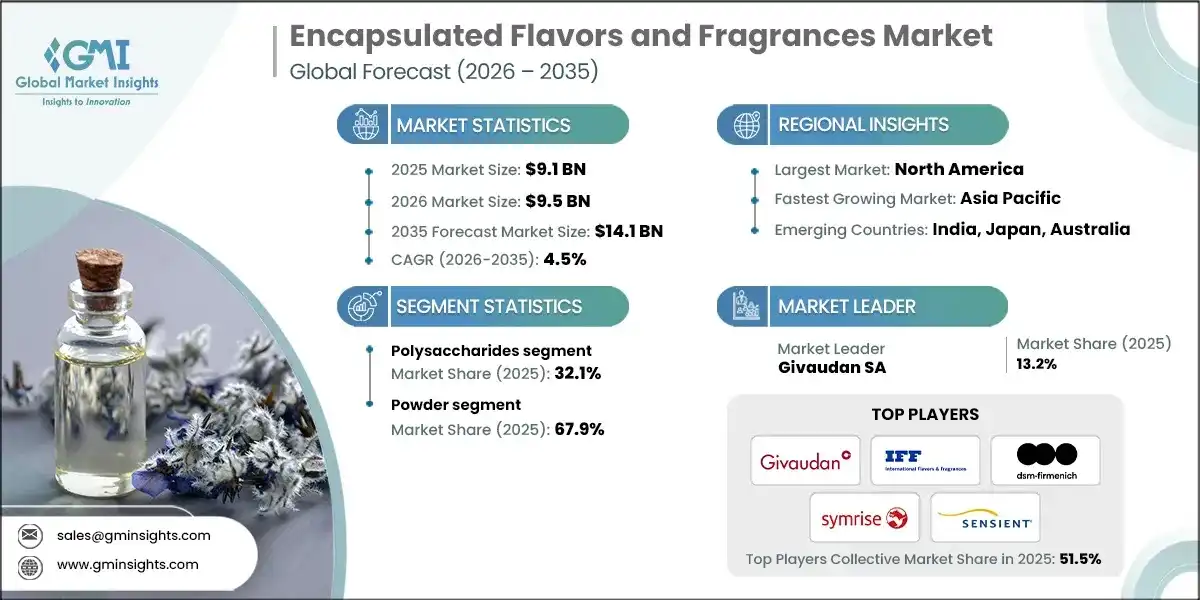
The global encapsulated flavors and fragrances market was valued at USD 9.1 billion in 2025. The market is expected to grow from USD 9.5 billion in 2026 to USD 14.1 billion in 2035, at a CAGR of 4.5% according to latest report published by Global Market Insights Inc.
Encapsulated Flavors and Fragrances Market Key Takeaways
Market Size & Growth
- 2025 Market Size: USD 9.1 Billion
- 2026 Market Size: USD 9.5 Billion
- 2035 Forecast Market Size: USD 14.1 Billion
- CAGR (2026–2035): 4.5%
Regional Dominance
- Largest Market: North America
- Fastest Growing Region: Asia Pacific
Key Market Drivers
- Rising consumer demand for long-lasting fragrance experiences.
- Regulatory push toward biodegradable & sustainable encapsulation.
- Growth in functional foods & nutraceuticals requiring taste masking.
Challenges
- High cost of advanced encapsulation technologies.
- Technical challenges in wash durability for textile applications.
Opportunity
- Development of bio-based & natural shell materials.
- Customization & personalization in fine fragrance.
Key Players
- Market Leader: Givaudan SA led with over 13.2% market share in 2025.
- Leading Players: Top 5 players in this market include Givaudan SA, International Flavors & Fragrances (IFF), DSM-Firmenich, Symrise AG, Sensient Technologies Corp., which collectively held a market share of 51.5% in 2025.
Get Market Insights & Growth Opportunities
- Microencapsulated flavors and fragrances are microcapsules that fulfill classical functions of aromatic or flavor actives like controlled release, stability enhancement, and sensory improvement in applications such as food, beverages, personal care, and household products. Ever-surging consumer demand for prolonged fragrance experiences has greatly shaped preferences in the market, with buyers requesting more products that hold aroma over extended days.
- This trend is more pronounced in the personal care and household sectors, where encapsulation technology allows for slow release of fragrances, thereby improving product efficiency and consumer satisfaction. North America region is the most adopted for the market currently due to its advanced manufacturing and conducive regulatory environment in driving innovation and safety standards. In contrast, Asia-Pacific is dubbed the fastest-growing market for such technologies amid heightened demand from consumers for premium and fast-moving products and growing influxes toward technological innovations.
- The other factor driving manufacturers in sustainable development is the regulatory push toward biodegradable and sustainable encapsulation solutions, which align with enforcement on policies to curb the adverse effects on the environment. At the same time, the governments across the globe, including North America and Europe, are pursuing sustainability initiatives by means of policies promoting biodegradable packaging and environment-friendly manufacturing practices; thereby hastening the spread of sustainable encapsulation technology.
To get key market trends
Encapsulated Flavors and Fragrances Market Trends
- The market for the encapsulated flavor and fragrances is transiting with the adoption of biodegradable and bio-derived encapsulation materials due to pressure from regulations and growing consumer's interest in sustainable products. That is why companies invest in eco-friendly ideas that have less environmental burden while maintaining efficacy in products as in alignment with global sustainability goals.
- Artificial intelligence integrated with digital devices can contribute efficiency and precision, together with rapid personalization in formulating encapsulated solutions. AI-based data aids in intelligent material selection and superior formulation performance prediction on stability pursuits, thereby cutting short time to market and minimizing costs involved in bringing the products to the shelf. On the other hand, digital systems have enabled the real-time of monitoring and simulation of encapsulation processes, thereby significantly improving consignment consistency while facilitating product innovation and, thus, providing companies with a competitive advantage in this rapidly changing market.
- Controlled-release and triggered-release mechanisms is the key trend defining the future of the encapsulated flavors and fragrances giving an edge to the technologically backed systems that allow timed and triggered releases of active compounds, ensuring improved product longevity and sensory experience. Triggered release systems yield specific environmental stimulus responses, such as pH, temperature, or moisture, hence harnessing the functionalities of different application area products such as functional foods, nutraceuticals, and personal care products. Thus, the new technology will create new opportunities for differentiation of products and it will also satisfy the consumer demand for smarter delivery systems, with a heightened efficacy.
Encapsulated Flavors and Fragrances Market Analysis
Learn more about the key segments shaping this market
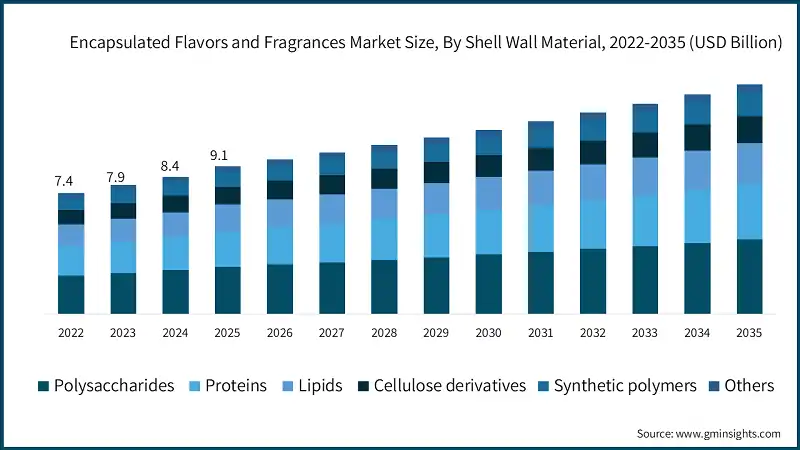
Based on shell wall material, the market is segmented into polysaccharides, proteins, lipids, cellulose derivatives, synthetic polymers and others. The polysaccharides dominated approximate 32.1% of the market share in 2025 and is expected to grow with a CAGR of 4.6% by 2035.
- Due to their natural, biodegradable, and inexpensive nature, polysaccharides dominate the shell wall material segment in various applications. Because of their excellent ability to form films and also encapsulate various compounds, they are widely used in applications ranging from those in food to beverages to personal care. Consumer preference for eco-friendly materials has continued to boost their leadership position in the market.
- Proteins hold a considerable market for developing good film-forming and nutritionally beneficial applications within functional foods and nutraceuticals. Their higher production costs, along with stability problems restrains them.
- Lipids are incorporated whenever control of clear moisture barriers or unique release profiles is required. Synthetic polymers are used in specialized applications where a defined mechanism of release and durability is needed. They have functional efficiencies, but the environmental hazards and regulatory pressures favor the use of natural materials, thereby limiting their growth.
Learn more about the key segments shaping this market
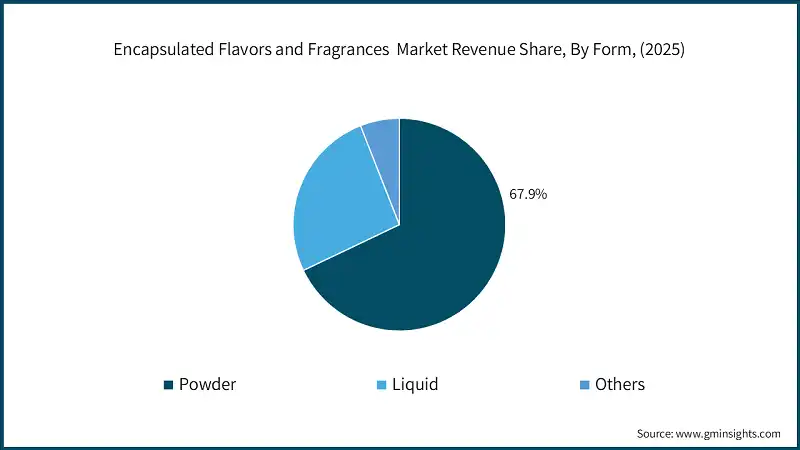
Based on form, the market is segmented into powder, liquid and others. The powder segment held the largest market share of 67.9% in 2025.
- Powder form dominates encapsulated flavors and fragrances because of easy manipulation, long shelf life, and storage and transport stability. The array of powder applications also drives demand, including flavoring in dry foods, instant beverages, and nutraceuticals. Established manufacturing processes for powders can also deliver bulk availability and consistency in quality. The incorporation of powders in formulations is easier due to the absence of leakage and degradation risk, thus making powders acceptable in many end-use industries. Liquid encapsulates aim for rapid release properties applied to many formulations, particularly in beverages, personal care, and functional foods.
Based on encapsulation technology, the market is segmented into spray drying, coacervation, fluid bed coating, extrusion, freeze drying and others.
- Spray drying led market largely because it scales efficiently and converts volatile oils to stable, free flowing powders that travel well through supply chains. Encapsulation efficiency depends on wall selection and dryer settings, but the method remains the default for high throughput operations and broad food applications. Coacervation is growing faster due to superior protection at lower temperatures and high efficiencies, often 70–90%+ for essential oils when protein polysaccharide pairs and crosslink strategies are tuned.
- Fluid bed coating supports larger cores and multi layer architectures, valuable for acids, leavening agents and probiotics where precise layer thickness controls release. Extrusion produces glassy carbohydrate matrices and shaped particles for confectionery and instant drinks with strong oxygen barriers, while freeze drying preserves heat sensitive volatiles and yields porous structures amenable to delayed release.
Based on application, the market is segmented into food & beverages, personal care & cosmetics, home care & household products, pharmaceuticals and others.
- Food & beverages dominates as encapsulation stabilizes aromas, masks bitterness, converts liquids to powders, and extends shelf life across instant beverages, soups, bakery, seasoning and confectionery.
- Personal care & cosmetics works on longevity and oxidative protection needs, aided by biodegradable capsule platforms now extended to hair and body care. Home care & household products is the fastest growing on premium fabric care benefits from wash durable, friction triggered release systems. Pharma captures market on taste masking and GI targeting, with cyclodextrins and pH responsive polymers improving solubility and bioavailability.
Looking for region specific data?
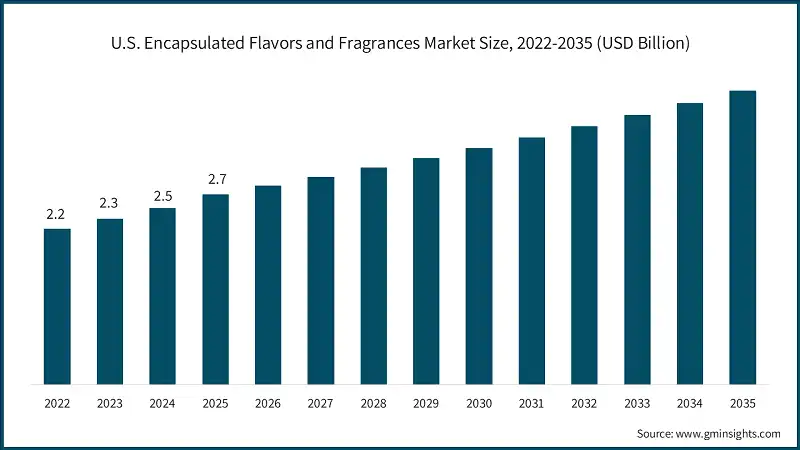
The encapsulated flavors and fragrances market in North America will grow at a CAGR from approximately 4.5% between 2026 and 2035 with U.S. occupying a revenue share of USD 2.7 billion in 2025.
- Rising consumer realizations about health, wellness, and sustainability are spurring demand for natural, clean-label, and eco-friendly flavors and fragrances. The trend drives the manufacturers toward the use of biodegradable and bio-sourced encapsulation materials, following the shifts in product architecture toward more environmentally responsible products.
- Innovations in biodegradable and bio-sourced encapsulation materials adhere to some of the above trends, but they are also supported increasingly through advances in eco-friendly packaging, processing, and waste management. Moreover, the emphasis to reduce carbon footprints and have a true circular economy is blurring the lines of research toward greener formulations and delivery systems.
The encapsulated flavors and fragrances markets in Europe, especially in a few countries like Germany, are expected to grow with a rapid pace in the coming years.
- Stringent environmental legislation and a strong push toward sustainable production have both encouraged the use of bio-based, eco-friendly encapsulation approaches. With Germany's emphasis on circular economy practices, innovations in natural extracts and biodegradable delivery systems for flavors and fragrances are gaining pace in the country.
- Ongoing investment in research to enhance eco-friendly encapsulation techniques such as plant-based carriers and biodegradable polymers, which are likely to open up new applications in different sectors, including pharmaceuticals, organic foods, and cosmetics, part of the industry trend switching toward sustainability.
The encapsulated flavors and fragrances market in China and India is expected to have lucrative growth between 2026 and 2035, with CAGR 4.6% in the Asia Pacific region.
- Rapid urbanization, rising disposable incomes, and increasing consumer demand for superior quality organic and natural products are heightening needs for improved encapsulation technologies that can maintain flavor and fragrance integrity while being environmentally sustainable.
- Consumer awareness is also pushing towards bio-based flavor and fragrance encapsulation innovations as natural and organic personal care and food products are becoming more popular nowadays, along with the flourishing healthcare and wellness sectors.
Between 2026 and 2035, the market for encapsulated flavors and fragrances in the Middle East is projected to grow significantly during this period.
- Increased demand for high-quality, eco-friendly flavor and fragrance solutions in sectors such as tourism, hospitality, and wellness would mostly be coming from luxury food, cosmetics, and dietary supplements.
- The region's health trends are being supplemented through bio-based and biodegradable encapsulation technologies; that means every company will have practices that suit these trends, while contributing to the reduction of environmental impact.
Between 2025 and 2034, a promising expansion of the encapsulated flavors and fragrances sector is foreseen in the Latin America.
- The policy framework for sustainable agriculture and green extraction has propelled the development of bio-based ingredients on such that favorable legislation is bringing about the enhancement in eco-friendly encapsulation techniques in food, cosmetics, and wellness products.
- Rising disposable incomes coupled with increased scientific research on natural extracts are helping in generating newer innovations in eco-conscious flavor and fragrance encapsulation promoting sustainable practices across industries in the region.
Encapsulated Flavors and Fragrances Market Share
Encapsulated flavors and fragrances industry is moderately consolidated with players like Givaudan SA, International Flavors & Fragrances (IFF), DSM-Firmenich, Symrise AG and Sensient Technologies Corp. accounts for 51.5% market share in 2025.
The encapsulated flavors and fragrances market consists of such leading companies operating mostly in their regional areas. Their long years of experience with encapsulated flavors and fragrances allow these companies to maintain a strong market position worldwide. Their product offerings are diverse and majorly supported by production capacities and distribution networks, which can serve the increasing demand for encapsulated flavors and fragrances in various regions.
Encapsulated Flavors and Fragrances Market Companies
Major players operating in the encapsulated flavors and fragrances industry includes:
- Balchem Corporation
- DSM-Firmenich
- Encapsys
- Givaudan SA
- Ingredion Incorporated
- International Flavors & Fragrances Inc. (IFF)
- Mane SA
- Matrix Flavours and Fragrances
- Robertet Group
- Sensient Technologies Corporation
- Symrise AG
- Takasago International Corporation
Givaudan, being a leader in the encapsulated flavors and fragrances arena, is standing on its R&D strength to come up with innovative solvent-based on encapsulation applying sustainability side to the product stability and sensory experience across various applications.
International Flavors & Fragrances Inc. (IFF) is an expert in providing engineered encapsulation for increased delivery of flavors and fragrance in an environmentally friendly and natural way. This way, they will be a push in design for long-lasting functional goods in a variety of markets.
DSM-Firmenich is known for its innovation in the encapsulation, using environmentally friendly materials and techniques to enhance flavor and fragrance stability due to an increased emphasis on natural extracts and sustainable processes based on evolving consumer preferences.
Symrise AG is developing natural and environmentally friendly encapsulation solutions to support clean-label and organic product formulations, targeting to produce extremely high quality and stable flavor and fragrance with minimal environmental impact.
Sensient technologies Corp.'s specialty is advanced encapsulation technologies that extend the lifespan and sensory quality of flavors and fragrances. All their targets thus far are the innovations on sustainable encapsulation systems that are completely free of allergens and biological, for various end-use industries.
Encapsulated Flavors and Fragrances Market Report Attributes
| Key Takeaway | Details |
|---|---|
| Market Size & Growth | |
| Base Year | 2025 |
| Market Size in 2025 | USD 9.1 Billion |
| Market Size in 2026 | USD 9.5 Billion |
| Forecast Period 2026-2035 CAGR | 4.5% |
| Market Size in 2035 | USD 14.1 Billion |
| Key Market Trends | |
| Drivers | Impact |
| Rising consumer demand for long-lasting fragrance experiences | Driving increased adoption of advanced encapsulation solutions, expanding market growth |
| Regulatory push toward biodegradable & sustainable encapsulation | Encouraging innovation in eco-friendly materials, opening new opportunities for market players. |
| Growth in functional foods & nutraceuticals requiring taste masking | Boosting demand for specialized encapsulation techniques, fueling market expansion |
| Pitfalls & Challenges | Impact |
| High cost of advanced encapsulation technologies | May hinder widespread adoption, potentially limiting market penetration and growth |
| Technical challenges in wash durability for textile applications | Could restrict the use of encapsulated fragrances in certain sectors, impacting overall market potential |
| Opportunities: | Impact |
| Development of bio-based & natural shell materials | Presents opportunities for market differentiation and growth aligned with sustainability trends |
| Customization & personalization in fine fragrance | Offer avenues for premium product development, enhancing market competitiveness and consumer appeal |
| Market Leaders (2025) | |
| Market Leaders |
13.2% market share |
| Top Players |
|
| Competitive Edge |
|
| Regional Insights | |
| Largest Market | North America |
| Fastest growing market | Asia Pacific |
| Emerging countries | India, Japan, Australia |
| Future outlook |
|
What are the growth opportunities in this market?
Encapsulated Flavors and Fragrances Industry News
- November 2025, The Givaudan extended PlanetCaps for personal care, providing fragrance encapsulation that could fully comply with ECHA standards and represent a biodegradable microplastic-free option. The company has launched the innovative IRRESISTIBLE Laundry Serum for scent enhancement, promised long-lasting freshness, and uses advanced biodegradable microcapsules.
- In July 2025, IFF launched ENVIROCAP, an innovative technology for fragrance delivery into fabrics that is entirely sustainable. This exposition is, in its own right, fully compliant with ECHA, biodegradable and also suitable for vegans. This proprietary biopolymer is used for a long-lasting scent and will set new marks in the field of eco-fond and high-performance encapsulation solutions for the washing industry.
This encapsulated flavors and fragrances market research report includes in-depth coverage of the industry, with estimates & forecasts in terms of revenue (USD Billion) and volume (Kilo Tons) from 2022 to 2035, for the following segments:
Market, By Shell Wall Materials
- Polysaccharides
- Proteins
- Lipids
- Cellulose derivatives
- Synthetic polymers
- Others
Market, By Form
- Powder
- Liquid
- Others
Market, By Encapsulation Technology
- Spray drying
- Coacervation
- Fluid bed coating
- Extrusion
- Freeze drying
- Others
Market, By Application
- Food & beverages
- Bakery & confectionery
- Beverages
- Dairy products
- Savory foods
- Dietary supplements & nutraceuticals
- Others
- Personal care & cosmetics
- Skin care
- Hair care
- Color cosmetics
- Fine fragrance
- Deodorants & antiperspirants
- Others
- Home care & household products
- Fabric care
- Air care
- Surface cleaners
- Others
- Pharmaceuticals
- Others
The above information is provided for the following regions and countries:
- North America
- U.S.
- Canada
- Europe
- Germany
- UK
- France
- Spain
- Italy
- Rest of Europe
- Asia Pacific
- China
- India
- Japan
- Australia
- South Korea
- Rest of Asia Pacific
- Latin America
- Brazil
- Mexico
- Argentina
- Rest of Latin America
- Middle East and Africa
- Saudi Arabia
- South Africa
- UAE
- Rest of Middle East and Africa
Frequently Asked Question(FAQ) :
What is the market size of the encapsulated flavors and fragrances in 2025?
The market size was USD 9.1 billion in 2025, with a CAGR of 4.5% expected through 2035 driven by rising consumer demand for long-lasting fragrance experiences and growth in functional foods requiring taste masking.
What is the projected value of the encapsulated flavors and fragrances market by 2035?
The encapsulated flavors and fragrances market is expected to reach USD 14.1 billion by 2035, propelled by innovation in biodegradable materials, technological advancements, and expanding applications across multiple industries.
What is the current encapsulated flavors and fragrances market size in 2026?
The market size is projected to reach USD 9.5 billion in 2026.
How much market share did the polysaccharides segment hold in 2025?
Polysaccharides dominated with approximately 32.1% market share in 2025 and is expected to grow at a CAGR of 4.6% through 2035.
What was the market share of the powder form segment in 2025?
The powder segment held the largest market share of 67.9% in 2025, driven by easy handling, long shelf life, and storage stability.
What is the growth outlook for the Asia Pacific encapsulated flavors and fragrances market from 2026 to 2035?
Asia Pacific is the fastest-growing market with a CAGR of 4.6% during the forecast period, driven by rapid urbanization, rising disposable incomes, and increasing consumer demand for premium and natural products.
Which region leads the encapsulated flavors and fragrances market?
North America leads the U.S. market with USD 2.7 billion revenue in 2025. The region's advanced manufacturing capabilities and conducive regulatory environment drive innovation and safety standards.
What are the upcoming trends in the encapsulated flavors and fragrances market?
Key trends include adoption of biodegradable and bio-derived materials, AI-integrated digital formulation systems, controlled-release and triggered-release mechanisms, and development of natural shell materials aligned with sustainability goals.
Who are the key players in the encapsulated flavors and fragrances market?
Key players include Givaudan SA, International Flavors & Fragrances Inc. (IFF), DSM-Firmenich, Symrise AG, Sensient Technologies Corporation, Balchem Corporation, Encapsys, Ingredion Incorporated, Mane SA, Matrix Flavours and Fragrances, Robertet Group, and Takasago International Corporation.
Encapsulated Flavors and Fragrances Market Scope
Related Reports