Summary
Table of Content

Emotion AI for Personalized Products Market
Get a free sample of this report
Form submitted successfully!
Error submitting form. Please try again.
Thank you!
Your inquiry has been received. Our team will reach out to you with the required details via email. To ensure that you don't miss their response, kindly remember to check your spam folder as well!
Request Sectional Data
Thank you!
Your inquiry has been received. Our team will reach out to you with the required details via email. To ensure that you don't miss their response, kindly remember to check your spam folder as well!
Form submitted successfully!
Error submitting form. Please try again.
Emotion AI for Personalized Products Market Size
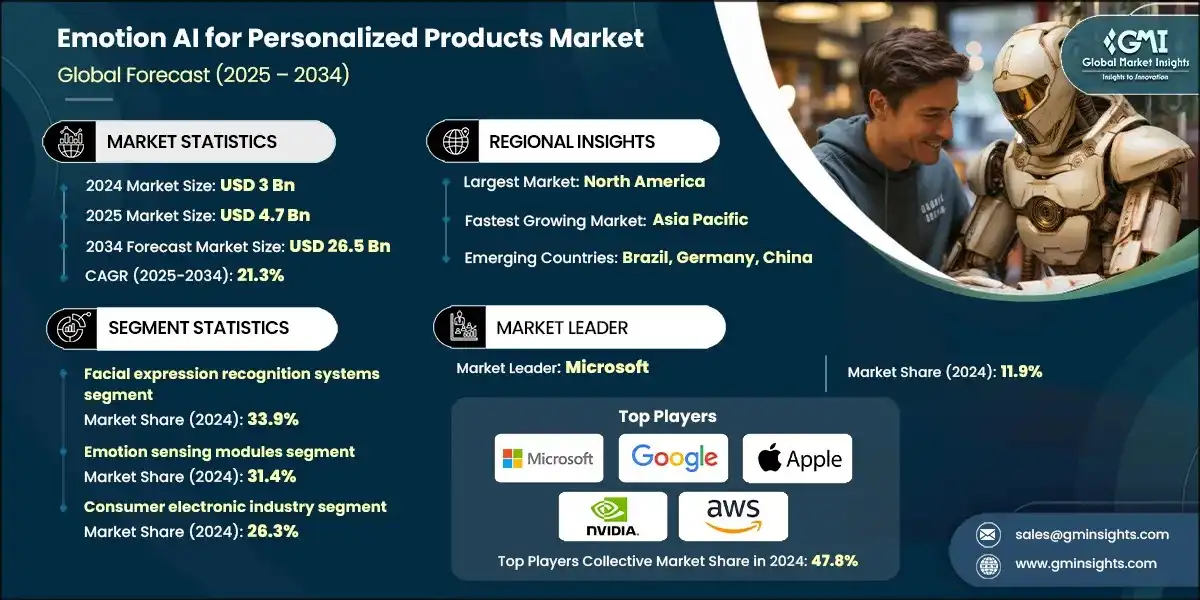
The global emotion AI for personalized products market size was estimated at USD 3 billion in 2024. The market is expected to grow from USD 4.7 billion in 2025 to USD 26.5 billion in 2034, at a CAGR of 21.3% according to the latest report published by Global Market Insights Inc.
To get key market trends
Market expansion is a consequence of robust technological innovations in multimodal AI systems combining facial expression recognition, voice analysis, and physiological sensing. The combined approaches have an 85-95% accuracy over single-modal isolated approaches at 60-75%, allowing commercialization. Increased reliability has encouraged enterprise applications in customer service, healthcare, automotive, and consumer electronics markets.
North America is the biggest geographic region, holding 39.3% of global revenues in 2024 due to early technology adoption by businesses and heavy R&D spending by big tech firms. The region has supporting regulatory systems compared to other markets and robust venture capital support for AI firms. Yet, Asia Pacific is seen to be the fastest-growing region with a forecasted CAGR of 23.2% driven by strong government investments in AI infrastructure and high-digitization rates in China, India, and Southeast Asian economies.
The long-term forecast has the market reaching USD 26.5 billion in 2034 at a compound annual growth rate of 21.3% for the period of the forecast. This trend is towards the increasing application scope beyond conventional use cases to mental health monitoring, adaptive learning, autonomous vehicle safety systems, and next-generation human-machine interfaces. Emotion AI integration with Internet of Things devices and edge computing platforms is likely to generate new revenue sources and market opportunities during the forecast period.
Emotion AI for Personalized Products Market Report Attributes
| Key Takeaway | Details |
|---|---|
| Market Size & Growth | |
| Base Year | 2024 |
| Market Size in 2024 | USD 3 Billion |
| Market Size in 2025 | USD 4.7 Billion |
| Forecast Period 2025 - 2034 CAGR | 21.3% |
| Market Size in 2034 | USD 26.5 Billion |
| Key Market Trends | |
| Drivers | Impact |
| Enterprise ai adoption acceleration & digital transformation | Driving integration of emotion AI into business workflows for enhanced customer engagement. |
| Multimodal ai advancement & technical capability enhancement | Leveraging voice, facial, and physiological data to improve emotional accuracy. |
| Automotive safety regulations & driver monitoring requirements | Growing adoption in vehicles for fatigue and distraction detection. |
| Pitfalls & Challenges | Impact |
| Privacy concerns & regulatory compliance complexity | Data handling challenges due to emotional data sensitivity. |
| Technical & Cultural Bias in Emotion Recognition Systems | Risk of inaccurate outcomes from limited or biased training datasets. |
| Opportunities: | Impact |
| Expansion of Emotion AI into Consumer Products | Increasing use in wearables, toys, and smart devices for emotion-driven personalization. |
| Real-time personalized experience platforms | Enabling adaptive responses in marketing, entertainment, and retail environments. |
| Market Leaders (2024) | |
| Market Leaders |
Market share 11.9% |
| Top Players |
Collective market shares in 2024 is 47.8% |
| Competitive Edge |
|
| Regional Insights | |
| Largest Market | North America |
| Fastest Growing Market | Asia Pacific |
| Emerging Country | Brazil, Germany, China |
| Future Outlook |
|
What are the growth opportunities in this market?
Emotion AI for Personalized Products Market Trends
The market is experiencing transformative trends that are reshaping how organizations interact with customers, employees, and end-users. These trends reflect the convergence of advanced AI technologies, evolving user expectations, and regulatory developments that are driving market evolution.
Multimodal Emotional Sensing Integration
- The rise of multimodal sensing which includes facial expression recognition, voice analytics and physiological monitoring as well as contextual information processing. Classical unimodal methods have been substituted with more complex systems capable of recognizing concurrent micro-expressions, vocal tones, hr. changes and ambient conditions. Multimodal approaches have been shown to be 85-95% accurate according to IEEE, compared with 60-75% for most single modal techniques. Its’ enhanced reliability is pushing adoption through mission critical use-cases like health care patient monitoring, automotive driver safety assistance systems and customer service high-value interactions.
- Largest technology companies are also making big bets on multimodal fusion algorithms capable of real-time processing of heterogeneous data feeds. Azure Cognitive Services from Microsoft now includes facial recognition, speech analysis, and text sentiment analysis in combined emotion detection APIs. And AI-based Google platform also brings computer vision and natural language processing to deliver full spectrum emotional intelligence capabilities for enterprise applications.
Edge Computing and Privacy-Preserving Processing
- The second major trend involves the migration of emotion processing from cloud-based systems to edge devices and on-premises infrastructure. This shift addresses growing privacy concerns and regulatory requirements while reducing latency for real-time applications. The European Union's AI Act specifically restricts emotion recognition in workplace and educational contexts, driving demand for privacy-preserving alternatives. Organizations are responding by implementing federated learning, differential privacy, and on-device processing to maintain compliance while preserving functionality.
- Apple's approach to emotion detection through wearable devices exemplifies this trend, processing biometric data locally on devices without transmitting sensitive information to cloud servers. Automotive manufacturers are similarly implementing edge-based driver monitoring systems that can detect fatigue and distraction without compromising driver privacy. This trend is creating new market opportunities for specialized hardware providers and software companies that can deliver high-performance emotion AI capabilities within the constraints of edge computing environments.
Real-Time Personalization and Adaptive Interfaces
- The third important trend is the development of real-time personalization platforms able to transform user experiences in accordance with sensed emotional states. Platforms transcend static personalization from history to offer dynamic responses, which transform based on present emotional context. Retail uses can customize product offerings and prices according to emotional customer interest, while learning platforms can transform difficulty level and presentation approach according to students' stress levels and understanding cues.
- Customer service solutions are driving the change, with contact centers deploying emotion AI to identify frustration, satisfaction, or confusion from customers in real time. Cogito's conversational AI platform interprets vocal patterns on customer calls and gives real-time guidance to agents, leading to better customer satisfaction ratings and lower call resolution time. The feature is extending from voice interaction to video conferencing, chat interfaces, and mobile applications that can personalize their behavior based on user emotional state.
Healthcare and Mental Health Applications
- The healthcare industry is experiencing faster-than-previously-seen adoption of emotion AI to monitor mental health, treat patients, and for therapy. The World Health Organization's reports of rising anxiety and depression levels in 2020 have fast-tracked demand for digital mental well-being. Telehealth firms are integrating emotion AI platforms to measure patient emotional state during remote consultations, track treatment outcomes, and detect signs of deteriorating mental health.
- Wearable technology is bringing emotion detection capability with heart rate variability assessment, sleep pattern tracking, and activity level monitoring. The platforms are suitable for continuous monitoring of mental health and can alert healthcare professionals regarding developing issues before they become serious. Emotion AI integration into electronic health records is facilitating enhanced patient evaluation and personalized treatment planning, fueling adoption in healthcare systems worldwide.
Regulatory Compliance and Ethical AI Development
- The last significant trend is the creation of affective AI solutions focused on regulatory compliance, ethics, and minimizing bias. The creation of the EU AI Act and comparable regulations globally is encouraging organizations to implement responsible AI practices addressing problems with privacy, fairness, and transparency. Such examples are the production of explainable AI systems offering clear reasons for emotional ratings and bias detection systems that provide balanced performance across demographic groups.
- Companies are investing in diverse sets of training data, algorithmic fairness testing, and ongoing monitoring systems to make their emotion AI deployments compliant with changing regulatory expectations. This is generating new business opportunities for companies offering AI governance, bias detection, and regulatory compliance solutions. Prioritization of ethical AI is also generating demand for third-party audit services and certification schemes that can confirm the fairness and trustworthiness of emotion AI deployments.
Emotion AI for Personalized Products Market Analysis
Learn more about the key segments shaping this market
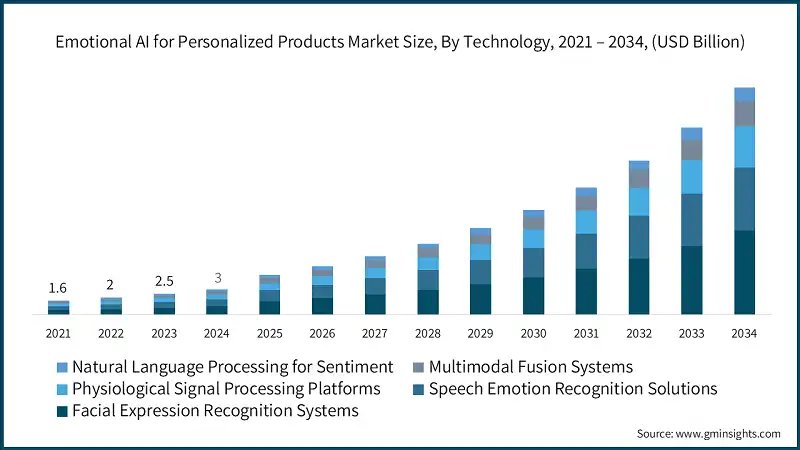
Based on technology, the market is segmented into facial expression recognition systems, speech emotion recognition solutions, physiological signal processing platforms, multimodal fusion systems, natural language processing for sentiment. The facial expression recognition systems segment accounted for market share of approximately 33.9% market share in 2024 and is estimated to grow at a CAGR of around 35.1% from 2025 to 2034.
- Facial expression recognition systems are the largest emotion AI market segment with a value share of 33.9% of the total market size in 2024 and a forecast CAGR of 22.3% over the forecast period from 2024 to 2034. The technology leverages computer vision and deep learning-based algorithms to detect facial micro-expressions, facial muscle activity, and face geometry to deduce emotional states. The market leadership of the segment is based on the non-intrusive nature of facial analysis and the pervasiveness of camera-enabled devices in consumer goods, automotive applications, and security devices.
- Convolutional neural networks and transformer architecture have continually improved real-world performance throughout the last few years, breaking through previously problematic areas of lighting, head pose, and occlusion variability. Top tech giants like Microsoft, Google, and Amazon have provided facial emotion recognition using cloud-based solutions so that companies can utilize the technology without any need to have AI expertise. The transport sector is one of the most robust emerging sectors where car manufacturers create automobiles with driver monitoring systems that can detect driver drowsiness, distraction, and emotional condition to enhance vehicle safety systems.
- Speech emotion recognition solutions hold 27.2% of the market share with a 21.6% CAGR, driven by the rate of usage of voice-enabled devices and conversational AI systems. Technology interprets vocal patterns, pitch, speech rate, and the language content to determine the emotional state and is finding itself a significant requirement in customer service applications, mental health monitoring, and human-computer interaction systems. The trend is being driven by the pervasiveness of microphones on smart speakers, smartphones, and communication platforms.
- Natural language processing made advanced emotion recognition from what is said and speech style available. Speech emotion recognition is gaining traction for incorporation into next generation contact center solutions to support real-time coaching of agents and enhanced customer satisfaction scores. Healthcare solutions are booming with voice analysis on telemedicine platforms to monitor the progress of patient treatment and psychological status. The industry is also expanding with the growing edge computing, which permits real-time voice processing at the cost of none in privacy terms.
- Physiological signal processing platforms are 18% of the market with 21.3% CAGR, the highest-growing technology segment with wearable technology and IoT sensors becoming increasingly employed. Technology measures the digitization of biometric signals like heart rate variability, skin conductance, body temperature, and brain activity to infer emotional and stress states. The segment is most typically incorporated in healthcare apps, corporate wellness initiatives, and consumer fitness wearables.
- Where AI analysis meets physiological monitoring, continuous tracking of emotions is becoming a reality that supplements visual and auditory techniques. Producers of wearable technology such as Apple, Fitbit, and makers of specialized medical equipment are adding emotion sensing to their offerings. Consumers' concern with mental well-being and health is driving the need for products offering consumers feedback on emotional well-being and stress levels. Enterprise applications are surfacing in workplace productivity and safety surveillance, but regulatory controls restrain deployments in certain regions.
Learn more about the key segments shaping this market
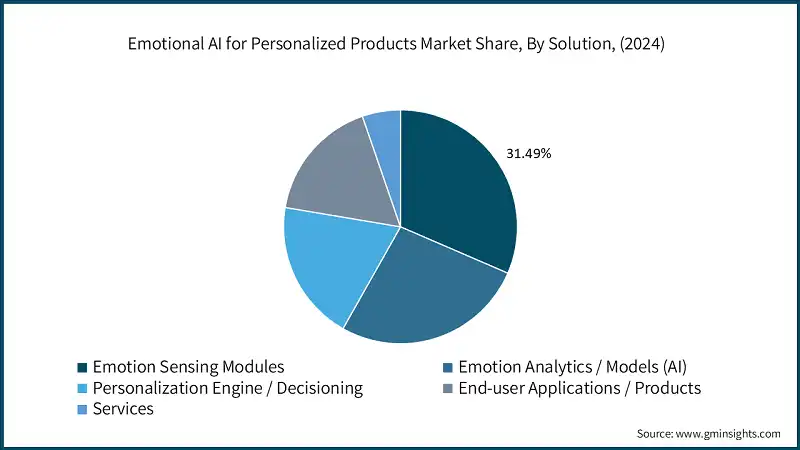
Based on the solution, the global emotion AI for personalized products market is categorized into emotion sensing modules, emotion analytics/models (AI), personalization engine/decisioning, end-user applications/products, and services. The emotion sensing modules segment held around 31.4% of the total market share in 2024 and is anticipated to grow at a CAGR of 33.2% from 2025 to 2034.
- Emotion sensing modules cover 31.4% of the solution market and 20.6% CAGR and are the hardware and software parts that sense and process emotional data. It consists of cameras, microphones, biometric sensors, and specialty processing hardware to be utilized in emotion-detection devices. It's the source of all emotion AI deployments and encompasses data capturing functions vital to emotional analysis.
- Edge computing phenomenon is driving the growth in demand for emotion sensing modules that do not have to be tied to the cloud for processing. Automakers are installing modules inside cars to detect passengers and drivers, while consumer electronics firms are installing them in smartphones, tablets, and smart home devices. The segment is experiencing higher miniaturization in sensors and improved processing efficiency that supports affordable deployment across various applications.
- Emotion models/analytics comprise 26.9% of the solutions market with the highest CAGR of 22.3%, reflecting the crucial position AI algorithms hold to ensure consistency and accuracy of emotion identification. The sub-segment includes neural networks, machine learning models, and AI platforms that operate on raw sensor signals to process and obtain emotional intelligence. It is driven by ongoing improvement in AI accuracy as well as specialized model development for various uses and populations.
- Microsoft, Google, Amazon, and IBM cloud-based AI platforms are offering sophisticated emotion analysis to businesses short of in-birth AI capabilities. Demand is fueled by the progress in transformer models, multimodal fusion algorithms, and transfer learning that drive model performance at lower training requirements. Industry-specific AI companies are crafting industry-specific models for benefits for healthcare, automotive, retail, and other vertical use cases, which form additional avenues for growth.
- Decisioning solutions/personalization engine constitute 19.6% of the market with a growth rate of 22.2%, capturing the application layer that exploits emotional insight in facilitating adaptive experience and auto-decisioning. Recommendation engines, adaptive interfaces, and decision support systems that adapt by observed emotional state are counted. The segment is the value-creation layer of emotion AI deployment with direct effects on user experience and business outcomes.
- Web-based retailing websites are the most sophisticated to implement emotion-based personalization to drive conversion and improve customer satisfaction. Customer service software uses emotional intelligence to manage calls, modify agent behavior, and customize interaction methods. The market is benefiting from greater recognition that emotional intelligence can play a major role in business performance for sales, marketing, and customer service roles. Integration with existing business systems such as CRM, ERP, and marketing automation systems is providing more opportunities for growth.
Based on the end-use industry, the global emotion ai for personalized products market is categorized as consumer electronics industry, healthcare & life sciences sector, automotive & transportation industry, retail & consumer goods sector, media & entertainment industry and financial services sector. The consumer electronic industry segment held around 26.3% of the total market share in 2024.
- Consumer electronics has 26.3% market share in the emotion AI market with 20.2% CAGR growth due to the integration of emotion-sensing technology in smartphones, tablets, smart TVs, and gaming consoles. The sector is invested in user experience innovation by making content suggestions more personalized, user interface more adaptive, and through emotion-sensing apps. Key consumer electronics companies are adopting emotion AI to innovate and improve the user experience.
- The most lucrative growth soil is gaming applications, wherein emotional detection is being used in game companies to control game levels of difficulty, stories, and images based on the mood of players. Smart homes are adding emotion AI to the package to make smart environments that can adjust lighting, heating, and sound based on the mood of the occupants. It's enabled by cutting-edge hardware advancements making on-device emotion control feasible, taking care of privacy matters without compromising on functionality. Virtual reality and augmented reality technologies are emerging as growth drivers with emotion sensing contributing towards making more realistic and immersive virtual experiences.
- Healthcare & life sciences comprised with 20.4% of the market with a huge CAGR of 22.1%, citing the demand for patient care and mental health tracking solutions in dire times. Telehealth software, mental wellness apps, patient monitoring solutions, and therapy sessions with emotion AI to improve care quality and give patients a sense of belonging are part of the segment. Growth in digital health solutions was fueled by the COVID-19 pandemic, driving long-term demand for emotion-aware healthcare solutions.
- Mental well-being solutions are the fastest-rising high-utility subsegment of AI therapy chatbots and mood-monitoring apps. Hospital chains utilize Emotion AI for patient monitoring, pain management tracking, and tracking treatment adherence. The segment gains momentum with regulation favoring digital health technologies and rising awareness of mental health as a part of total care. Pharma’s employ affective AI in clinical tests to measure the efficacy of drugs and track patient well-being while drug development programs are conducted.
- Transportation & automobiles represent 15.3% of the market with 21.9% CAGR due to autonomous vehicle and safety regulation technology. Driver monitoring solutions are of interest to the market, and the ability to monitor for fatigue, distraction, emotional stress, and impairment to prevent accidents and improve car safety. Regulators such as NHTSA are mandating driver monitoring in semi-autonomous vehicles, i.e., mandated demand for emotion AI solutions.
- Driver-assistance technologies are embracing emotion sensing to offer individualized safety interventions and adaptive vehicle responses. Transportation and ride-sharing companies are finding the potential of emotion AI in passenger safety monitoring and service excellence measurement. The sector is endowed with the automotive industry's giant R&D expenditure and the shift towards networked and autonomous cars. Public transportation systems are using emotion AI to filter for safety and improve transport experience, adding more scope for growth beyond individual vehicles.
Looking for region specific data?
North America Emotion AI for Personalized Products Market
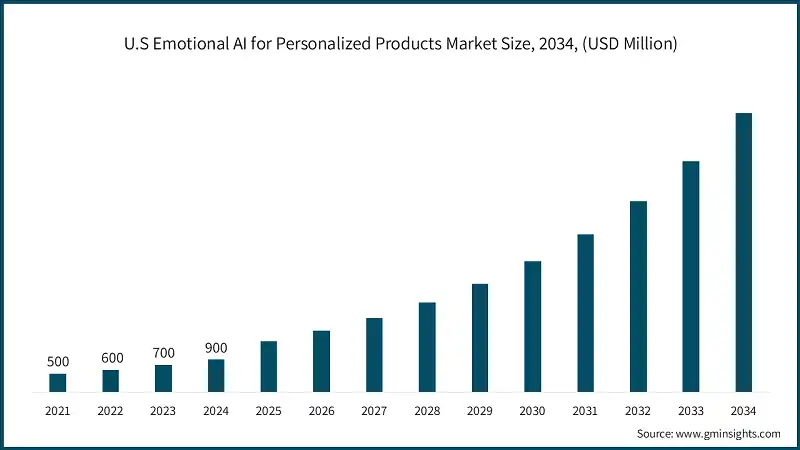
- The most significant regional market is North America, with 39.3% and a CAGR of 20.5%, led by early enterprise adoption of AI, high R&D spending, and favorable regulatory climates. The U.S. generates close to 85% of North American revenues, with top technology leaders such as Microsoft, Google, Amazon, and Apple leading global emotion AI innovation. The area is supported by robust venture capital support of AI companies as well as established ties among technology companies and business buyers.
- The health care sector in North America is a very robust growth engine, with telemedicine software and mental health apps evidencing fast take-up post-COVID-19 pandemic. Car manufacturers in the area are rolling out driver monitoring systems to meet new safety regulations and get ready for autonomous car launch. The regional regulatory environment is slightly more favorable than that in Europe to enable wider deployment of emotion AI in office and educational applications with ongoing focus on protecting privacy and responsible development of AI.
Asia Pacific Emotion AI for Personalized Products Market
- Asia Pacific dominates 21.1% of the highest regional market CAGR of 23.2% supported by high digitization, AI policymaking, and enormous investments in technologies in China, India, Japan, and Southeast Asian countries. China is the regional leader in AI adoption with clear government support for AI adoption and use for surveillance, e-commerce, and smart city development. The region is powered by massive populations, growing middle classes, and increasing smartphone and internet penetration that offer vast addressable markets for emotion AI solutions.
- The fastest-growing nation in the region is India, with Digital India projects and the burgeoning IT services sector fueling emotion AI solution growth. Japan and South Korea focus on emotion AI solutions in the areas of aged care, robotics, and consumer electronics as they leverage their high manufacturing capacity and aging population. Southeast Asian nations like Singapore, Malaysia, and Thailand are implementing emotion AI for smart city applications and customer service systems, thus creating more growth opportunities in the forecast period.
Europe Emotion AI for Personalized Products Market
- Europe holds 30.07% market share with 21.4% CAGR and is characterized by greatest concern about protection of privacy, ethics-based AI R&D, and compliant demands. The European Union AI Act is significantly impacting emotion AI deployment by prohibiting use in workplace and school environment for only medical and security reasons. This regulatory environment is driving innovation in privacy-save technology and requiring compliant emotion AI solutions.
- Germany leads the pack in Europe in investing in across-car use cases and Industry 4.0 initiatives that cover emotion AI workforce productivity monitoring and worker safety in regulatory environments.
Emotion AI for Personalized Products Market Share
- The market exhibits a moderately fragmented competitive landscape with the top five players collectively holding 47.8% of the total market share in 2024. Microsoft Corporation leads the market with an 11.9% share, leveraging its comprehensive Azure Cognitive Services platform and extensive enterprise customer base to maintain its dominant position.
Market Leadership Analysis
- The market leadership of Microsoft Corporation results from its end-to-end emotion AI solution through Azure Cognitive Services, which integrates facial recognition, speech analysis, and text sentiment analysis into a single set of APIs accessible to enterprise customers. Natural distribution channels exist through the company's current positions in enterprise software markets, and its massive R&D expenditure on AI research propels technology innovation further. Microsoft partnerships with medical firms, auto firms, and consumer services agencies have positioned the firm as a one-stop-shop provider of mission-critical emotion AI solutions.
- Second-largest market share is controlled by Meta Platforms Inc. based on its enormous social media data set and cutting-edge computer vision technologies fine-tuned for user experience improvement and content moderation. Emotion AI use in virtual reality and augmented reality environments is an area being developed by Meta's Reality Labs division, opening new market niches and uses. Meta's enormous user base is providing opportunities for emotion AI development and proof-of-concept testing across cultures and different demographic groups.
- International Business Machines Corporation enjoys a strong market position with Watson AI offering an enterprise app emphasis on the financial services, customer service, and healthcare markets. IBM emphasis on explainable AI and regulation compliance has positioned the company well in markets having good privacy and ethical regulations. Its consulting strength and domain know-how facilitate complex emotion AI deployments with high domain know-how requirements and interoperation with existing installed enterprise infrastructures.
Competitive Strategies and Market Concentration
- Google LLC (Alphabet Inc.) uses cloud computing leadership and AI research leadership to compete vastly in the emotion AI space through Google Cloud AI and Vertex AI platforms. The firm's vision and natural language processing leadership offer technological superiority to multimodal emotion detection applications. Google developer ecosystem size and API-first development support fast adoption of emotion AI capability across many applications and industries.
- Amazon Web Services Inc. competes through the strength of its cloud infrastructure and AI services such as Amazon Recognition and Amazon Transcribe, which offer emotion detection as part of larger AI service packages. The firm's cloud computing skills and enterprise relationships create a platform for emotion AI uptake as part of digital business transformation initiatives. The AWS emphasis on developer tools and simplicity of implementation attracts organizations wanting to implement emotion AI without substantial in-house AI skills.
- The remaining market players, such as Apple Inc., NVIDIA Corporation, Affectiva Inc., Realeyes Data Services, audEERING GmbH, Eyesight Technologies Ltd, Kairos AR Inc., SoftBank Robotics Group Corp, Element Human Ltd, and Nemesysco Ltd, collectively hold 52.2% of the market share. This fragmentation is a result of the diversified areas of applications and niche demands across various industry sectors, with room for niche solution providers to perform well compared to leaders in technology.
Merger and Acquisition Activity
- Apple's prior purchase of Emotient gave the company facial expression recognition that has been incorporated into consumer devices and health monitoring applications. The move indicates Apple's path of augmenting on-device AI capabilities that are user-privacy-respecting but intelligent-capability-providing. This level of acquisition speed is sure to persist as established tech companies move heaven and earth to augment their emotion AI capabilities and reach new market spaces.
- Strategic collaborations and technology licensing agreements that allow businesses to tap specialty competencies without acquisition also characterize the competitive landscape. Microsoft collaborations with health care organizations and car manufacturers offer market presence and domain experience, whereas specialty small businesses get to leverage enterprise distribution channels and cloud infrastructure. These collaborative approaches are becoming increasingly important as emotion AI applications require integration of multiple technologies and deep industry knowledge.
Emotion AI for Personalized Products Market Companies
Major players operating in the emotion AI for personalized products industry are:
- Affectiva
- Amazon Web Services
- Apple
- audEERING
- Element Human
- Eyesight Technologies
- Google (Alphabet)
- International Business Machines
- Kairos AR
- Meta Platforms
- Microsoft
- Nemesysco
- NVIDIA
- Realeyes Data Services
- SoftBank Robotics Group
Major players operating in the market include Microsoft Corporation, Meta Platforms Inc., International Business Machines Corporation, Google LLC (Alphabet Inc.), Amazon Web Services Inc, Apple Inc., NVIDIA Corporation, Affectiva Inc., Realeyes Data Services, audEERING GmbH, Eyesight Technologies Ltd, Kairos AR Inc., SoftBank Robotics Group Corp, Element Human Ltd, and Nemesysco Ltd. These companies represent a diverse ecosystem of technology providers ranging from global cloud computing giants to specialized AI startups focused on specific emotion detection modalities and applications.
Global Technology Leaders
- Microsoft Corporation has the largest market share with end-to-end Azure Cognitive Services platform, integrating facial recognition and speech. analysis, and text sentiment analysis capabilities in enterprise-level APIs. The company. emotion AI solutions are utilized by. healthcare providers to monitor patients, customer service departments to train agents in real time, and. car. manufacturers to provide driver safety systems. It’s worth is in its capacity to introduce emotional AI capabilities with current enterprise software platforms such as Office 365, Dynamics 365, and Teams to deliver end-user ease of use without implementation complexity.
- Meta Platforms Inc. uses its extensive social media data and top computer vision research to develop emotion AI products for application in content moderation, user engagement optimization, and virtual reality. Its Reality Labs division is leading emotion AI applications in metaverse environments, establishing new market spaces for affective immersive experiences. The large user population of Meta presents unprecedented opportunity for training and testing emotion AI models on a large base of demographic populations and cultural environments that will produce more accuracy and less bias in emotion detection systems.
Cloud Computing and AI Infrastructure Providers
- Google LLC (Alphabet Inc.) competes by offering its Google Cloud AI and Vertex AI platforms with emotion detection features in broad machine learning and AI services offerings. The computer vision and natural language processing technology of the company powers advanced multimodal emotion detection through facial analysis, speech recognition, and text sentiment analysis. Developer-friendly APIs and comprehensive documentation in Google enable simple adoption of emotion AI features in web apps, mobile apps, and corporate platforms.
- Emotion AI capability is offered by Amazon Web Services Inc. As Amazon Rekognition for facial analysis and Amazon Transcribe for speech emotion detection in the entire cloud computing platform of the company. AWS is strong in its scalable cloud platform and enterprise partnerships, which allow companies to implement emotion AI solutions without a large investment in initial infrastructure. The company's emphasis on developer-friendly tools and simplicity attracts organizations that want to add emotion AI capability into existing applications and processes.
Specialized Emotion AI Companies
- Affectiva Inc., now part of Smart Eye AB, specializes in facial expression recognition and automotive emotion AI applications, providing solutions for driver monitoring, passenger experience optimization, and advertising effectiveness measurement. The company's technology is deployed in vehicles from major automotive manufacturers and used by advertising agencies to evaluate emotional response to marketing content. Affectiva's strength lies in its large, diverse dataset of facial expressions and its focus on real-world applications that require high accuracy and reliability.
- Realeyes Data Services focuses on emotion AI applications for media and advertising, providing solutions that measure emotional engagement with video content, advertisements, and digital experiences. The company's technology enables marketers to optimize content for emotional impact and measure the effectiveness of advertising campaigns across different demographic groups. Realeyes' computer vision algorithms analyze facial expressions captured through webcams and mobile device cameras to provide real-time emotional feedback.
- audEERING GmbH specializes in speech emotion recognition and audio analysis, providing solutions for customer service optimization, healthcare monitoring, and human-computer interaction applications. The company's technology analyzes vocal patterns, intonation, and acoustic features to determine emotional state and stress levels. audEERING's solutions are particularly valuable for contact centers seeking to improve customer satisfaction and for healthcare applications requiring remote patient monitoring capabilities.
Smart Textiles with Integrated Electronics Industry News
- In March 2025, Alibaba launched R1-Omni multimodal AI model with deep emotion recognition for video content analysis and real-time emotional analysis. The model has superb performance in identifying advanced emotional states from visual and audio inputs.
- In Jan 2025, Microsoft Corporation made strategic alliance with HCLTech to create Copilot-first contact center solutions with high-end emotion AI features for real-time sentiment analysis of customer feelings and agent coaching. The partnership will revolutionize the customer service business by offering AI-powered emotional intelligence that can identify customer frustration, satisfaction, and engagement levels while interacting.
- In December 2024, Google launched PaliGemma 2 model series that added enhanced scene-level emotion understanding capability to detect higher-order emotional context of vision content. The models demonstrate improved accuracy in detecting slight emotional cues and contextual emotional knowledge from image and video content.
- Uniphore has formed a strategic alliance with Konecta in November 2024 with a five-year $500 million revenue goal for customer experience improvement and real-time emotion detection from contact center operations. The partnership combines Uniphore's conversational AI platform with Konecta's customer service solution to deliver emotion-based customer interactions.
- In October 2024, Affectiva fortified alliance with Kantar to rival code ad and media research solutions, enhancing ability to quantify emotional response to advertising content in international markets. Advertisers, through collaboration, can make content as a means of capturing hearts of an emotional connection and track campaign performance by demographic groups.
The emotion ai for personalized products market research report includes in-depth coverage of the industry with estimates & forecasts in terms of revenue ($ Bn/Mn) and volume (Thousand Units) from 2021 to 2034, for the following segments:
Market, By Technology
- Facial expression recognition systems
- Speech emotion recognition solutions
- Physiological signal processing platforms
- Multimodal fusion systems
- Natural language processing for sentiment
Market, By Deployment Mode
- Cloud-based (SaaS / API)
- On-device / edge
- Hybrid
Market, By Solution
- Emotion sensing modules
- Emotion analytics/models (AI)
- Personalization engine/decisioning
- End use applications/products
- Services
Market, By Prioritization Matrix
- High priority
- Medium priority
- Selective
Market, By Application
- Healthcare & wellness applications
- Automotive & transportation solutions
- Retail & e-commerce personalization
- Education & training applications
- Entertainment & gaming solutions
- Customer service & support enhancement
Market, By End Use Industry
- Consumer electronics industry
- Healthcare & life sciences sector
- Automotive & transportation industry
- Retail & consumer goods sector
- Media & entertainment industry
- Financial services sector
The above information is provided for the following regions:
- North America
- U.S.
- Canada
- Europe
- UK
- Germany
- France
- Italy
- Spain
- Russia
- Asia Pacific
- China
- India
- Japan
- Australia
- South Korea
- Latin America
- Brazil
- Mexico
- Argentina
- MEA
- UAE
- South Africa
- Saudi Arabia
Frequently Asked Question(FAQ) :
Which region leads the emotion AI for personalized products industry?
North America dominated the global market with a 39.3% share in 2024, supported by strong R&D investment, early AI adoption, and favorable regulatory conditions for enterprise deployment.
Who are the leading companies in the emotion AI for personalized products market?
Key players include Microsoft, Google, Apple, NVIDIA, Amazon Web Services, Meta Platforms, IBM, Affectiva, Realeyes Data Services, audEERING, and SoftBank Robotics Group, focusing on multimodal AI innovation and responsible emotion detection.
Which region is expected to grow the fastest through 2034?
Asia Pacific is forecast to grow at a CAGR of 23.2%, driven by large-scale digitization initiatives, government AI programs, and high adoption in consumer electronics and automotive sectors.
Which end-use industry held the largest market share in 2024?
The consumer electronics industry accounted for 26.3% of the total market share, driven by integration of emotion AI in smartphones, gaming systems, and smart home devices for personalized user experiences.
Which solution segment dominated the market in 2024?
The emotion sensing modules segment held 31.4% market share in 2024, supported by rising adoption of cameras, biometric sensors, and edge-based emotion detection hardware across devices.
Which technology segment led the emotion AI market in 2024?
The facial expression recognition systems segment led with a 33.9% market share in 2024, due to widespread use in consumer electronics, automotive, and customer service applications.
What is the market valuation for 2025?
The emotion AI for personalized products market is expected to reach USD 4.7 billion in 2025, reflecting rapid enterprise adoption and increasing integration into consumer electronics and digital platforms.
What is the projected value of the emotion AI for personalized products market by 2034?
The market is projected to reach USD 26.5 billion by 2034, growing at a CAGR of 21.3% from 2025 to 2034, fueled by applications in healthcare, automotive safety, personalized marketing, and smart devices.
What is the market size of the emotion AI for personalized products market in 2024?
The global market was valued at USD 3 billion in 2024, driven by advances in multimodal AI systems that integrate facial recognition, voice analysis, and physiological sensing for enhanced emotional accuracy.
Emotion AI for Personalized Products Market Scope
Related Reports