Summary
Table of Content

EMEA & India Indoor Pool Dehumidification Market
Get a free sample of this report
Form submitted successfully!
Error submitting form. Please try again.
Thank you!
Your inquiry has been received. Our team will reach out to you with the required details via email. To ensure that you don't miss their response, kindly remember to check your spam folder as well!
Request Sectional Data
Thank you!
Your inquiry has been received. Our team will reach out to you with the required details via email. To ensure that you don't miss their response, kindly remember to check your spam folder as well!
Form submitted successfully!
Error submitting form. Please try again.
EMEA & India Indoor Pool Dehumidification Market Size
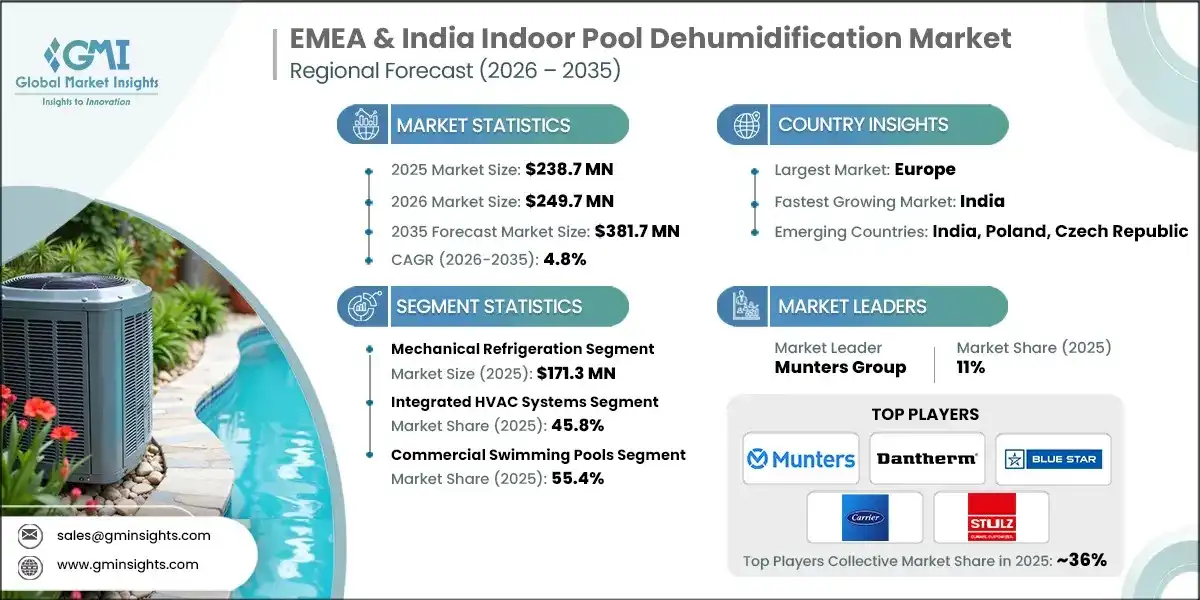
The EMEA & India indoor pool dehumidification market was estimated at USD 238.7 million in 2025. The market is expected to grow from USD 249.7 million in 2026 to USD 381.7 million in 2035, at a CAGR of 4.8%, according to latest report published by Global Market Insights Inc.
EMEA & India Indoor Pool Dehumidification Market Key Takeaways
Market Size & Growth
- 2025 Market Size: USD 238.7 Million
- 2026 Market Size: USD 249.7 Million
- 2035 Forecast Market Size: USD 381.7 Million
- CAGR (2026–2035): 4.8%
Key Market Drivers
- Strong growth of hospitality and wellness projects.
- Strict moisture and condensation control regulations.
- Rising public investment in aquatic sports infrastructure.
Challenges
- High dependence on imported components in Middle East and Indian markets.
- Energy consumption concerns in regions with high electricity tariffs.
Opportunity
- Rising demand for energy-optimized systems aligned with European sustainability goals.
- Retrofit of aging indoor pools across Western and Northern Europe.
Key Players
- Market Leader: Munters Group led with over 11% market share in 2025.
- Leading Players: Top 5 players in this market include Munters Group, Dantherm Group, Blue Star Limited, Carrier India, STULZ GmbH, which collectively held a market share of 36% in 2025.
Get Market Insights & Growth Opportunities
- Strong growth of hospitality and wellness projects is driving demand in the EMEA and India indoor pool dehumidification market. Rising investments in hotels, resorts, and wellness centers are increasing the need for controlled indoor pool environments. In October?2025, Eurostat reported that tourist accommodation nights in the European Union rose to 1.3?billion in the first half of 2025, a 2.3?% increase compared with the first half of 2024. Facility operators are focusing on maintaining optimal humidity levels to protect building structures and ensure guest comfort. Indoor pools require efficient dehumidification systems to prevent corrosion, mold, and condensation issues.
- The growing tourism sector is encouraging the development of spa and recreational facilities with indoor pools. In August?2025, the Indian Ministry of Tourism reported that India’s travel and tourism sector is projected to contribute over USD 257.4?billion to GDP in 2025, with hotel occupancy rates and tourism demand on the rise. Renovation of existing hospitality and wellness properties is generating recurring demand for upgraded dehumidification solutions. Stakeholders are prioritizing equipment that balances performance, reliability, and long-term operational cost.
- Strict moisture and condensation control regulations in European building codes are driving growth in the EMEA and India indoor pool dehumidification market. Indoor pool facilities are required to maintain specific humidity levels to prevent structural damage and ensure safe, comfortable environments for users. The UK Pool Water Treatment Advisory Group Code of Practice recommends maintaining indoor pool hall relative humidity at approximately 60%, not less than 50% and not more than 70%, and provides guidance on ventilation rates to control moisture in indoor pool environments. Compliance with these regulations encourages the installation of high-performance dehumidification systems that efficiently control moisture. Facility managers are adopting advanced technologies that reduce condensation, mold, and corrosion risks in pool areas. Architects and engineers are specifying solutions that meet both regulatory standards and operational efficiency requirements. Regular inspections and adherence to building codes are prompting upgrades to outdated or underperforming systems. Energy-efficient dehumidifiers are preferred to maintain sustainability targets while complying with strict regulations. These standards are influencing purchasing decisions and operational planning, ensuring that indoor pool environments remain safe and durable.
- The mechanical refrigeration segment is dominating the market due to its high efficiency and reliable performance in maintaining optimal humidity levels. These systems effectively control condensation, mold growth, and corrosion in indoor pool environments, protecting building structures and equipment. Advanced compressors and heat exchange technologies enhance energy efficiency while ensuring consistent air quality and comfort for users. Growing construction of hotels, wellness centers, and residential pools in EMEA and India is driving demand. Strict regional regulations on moisture control and indoor air quality further reinforce adoption.
To get key market trends
EMEA & India Indoor Pool Dehumidification Market Trends
- The construction of indoor swimming pools is rising across EMEA and India, boosting dehumidifier demand. Hotels, sports complexes, and residential projects are adding indoor pools to attract visitors and residents. These facilities require advanced dehumidification systems to maintain air quality and prevent structural damage. Designers and builders are specifying efficient units to manage high humidity levels consistently. Manufacturers are innovating compact and energy-efficient solutions suitable for various pool sizes.
- Building codes in Europe and India are increasingly emphasizing moisture and condensation control. Indoor pools must meet standards that prevent structural deterioration and ensure occupant safety. Compliance requires installation of high-performance dehumidifiers capable of controlling humidity under varying conditions. Facility managers prioritize systems with accurate humidity monitoring and automated controls. Manufacturers are providing solutions certified to meet regional building regulations and safety requirements.
- Energy efficiency is becoming a critical factor in indoor pool dehumidification system selection. Pools require continuous operation, making energy consumption a significant operational cost. Manufacturers are introducing solutions that reduce electricity usage while maintaining precise humidity control. Heat recovery and variable-speed technologies are being integrated to improve overall efficiency. Buyers are evaluating long-term operational savings alongside initial installation costs. This trend drives demand for innovative, energy-efficient dehumidifiers across hospitality and commercial projects.
- Smart dehumidification systems are being adopted to improve operational efficiency and user comfort. Sensors and automated controls maintain precise humidity levels while optimizing energy use. Facility managers can monitor system performance remotely and schedule maintenance proactively. Advanced controls allow coordination with heating, ventilation, and pool water treatment systems. Manufacturers are developing connected solutions that integrate seamlessly with building management platforms.
- Hospitality and wellness projects are expanding rapidly across EMEA and India, increasing indoor pool installations. Spas, hotels, and fitness centers require effective humidity control to ensure guest comfort and equipment longevity. Dehumidifiers help prevent condensation on walls, ceilings, and sensitive electronic systems. Operators are investing in solutions that combine reliability, low maintenance, and energy efficiency. Suppliers are designing products that cater specifically to commercial and recreational pool environments.
EMEA & India Indoor Pool Dehumidification Market Analysis
Learn more about the key segments shaping this market
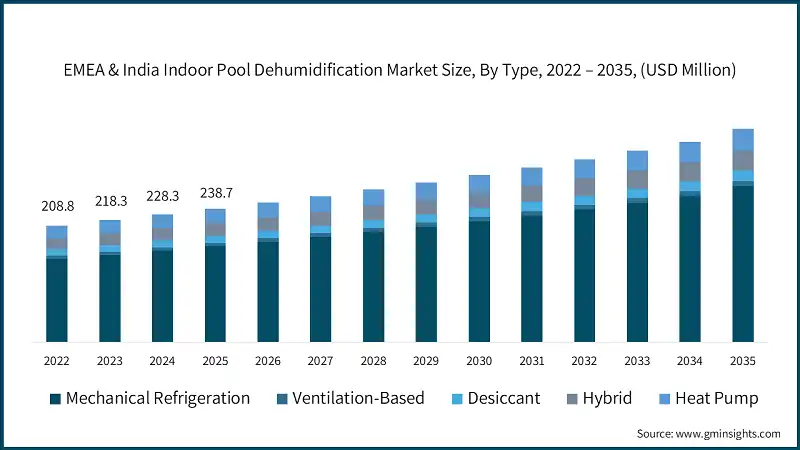
Based on type, the market is categorized into mechanical refrigeration, ventilation-based, desiccant, hybrid, and heat pump. The mechanical refrigeration segment accounted for revenue of around USD 171.3 million in 2025 and is anticipated to grow at a CAGR of 5% from 2026 to 2035.
- The mechanical refrigeration segment leads the EMEA and India indoor pool dehumidification market due to its ability to provide precise humidity and temperature control in large aquatic facilities. These systems efficiently remove excess moisture from the air, preventing structural damage and minimizing energy losses. Integration with advanced sensors and automated controls allows continuous monitoring and optimized operation, reducing maintenance requirements.
- Expansion of indoor pools in hotels, fitness centers, and residential complexes across EMEA and India is increasing adoption. Regulatory emphasis on indoor air quality and condensation management further drives preference. Strong performance, energy efficiency, and adaptability to different pool sizes position mechanical refrigeration systems as the preferred solution for indoor pool dehumidification in the region.
Based on installation configuration, the EMEA & India indoor pool dehumidification market consists of ceiling-mounted units, wall-mounted systems, freestanding/tower units, and integrated HVAC systems. The integrated HVAC systems emerged as leader and held 45.8% of the total market share in 2025 and is anticipated to grow at a CAGR of 5.1% from 2026 to 2035.
- The integrated HVAC systems segment is leading the EMEA and India indoor pool dehumidification market due to its ability to combine ventilation, heating, and dehumidification in a single solution. These systems maintain consistent indoor air quality, temperature, and humidity, ensuring comfort and safety for pool users. Centralized control and automation allow efficient energy management and reduce operational costs. Growing construction of hotels, wellness centers, and sports complexes in EMEA and India is driving adoption.
- Strict building codes on moisture control and indoor air quality further increase preference. The combination of operational efficiency, space optimization, and regulatory compliance positions integrated HVAC systems as the dominant installation configuration in the indoor pool dehumidification market.
Learn more about the key segments shaping this market
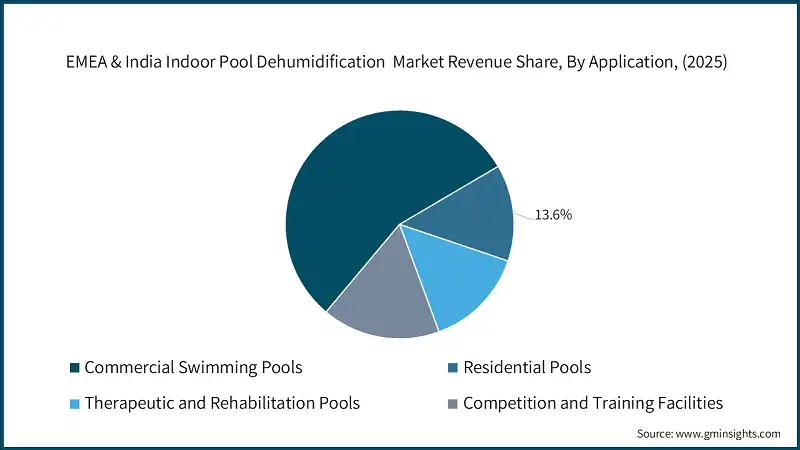
Based on application, EMEA & India indoor pool dehumidification market consists of commercial swimming pools, residential pools, therapeutic and rehabilitation pools, and competition and training facilities. The commercial swimming pools emerged as leader and held 55.4% of the total market share in 2025 and is anticipated to grow at a CAGR of 5.1% from 2026 to 2035.
- The commercial swimming pool segment is dominating the EMEA and India indoor pool dehumidification market due to continuous and intensive facility usage. Hotels, sports complexes, and recreational centers generate high moisture loads that require reliable humidity control solutions. Effective dehumidification systems prevent condensation, structural deterioration, and corrosion in large enclosed pool areas.
- Stable indoor air conditions improve visitors’ comfort and support long operating hours across seasons. Growing investments in hospitality infrastructure and public aquatic facilities are increasing system installations. Regulatory requirements for air quality, safety, and building protection further drive adoption, reinforcing the commercial swimming pool segment’s leading position in the market.
Looking for region specific data?
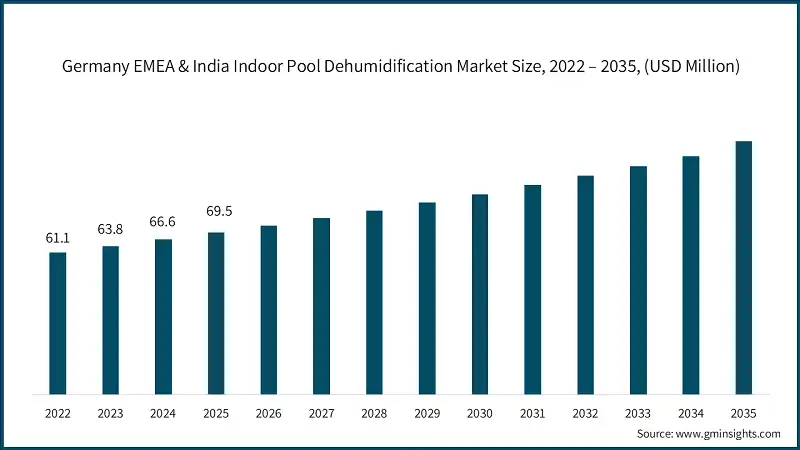
Germany dominates an overall Europe EMEA & India indoor pool dehumidification market and valued at USD 69.5 million in 2025 and is estimated to grow at a CAGR of 5.2% from 2026 to 2035.
- The Germany indoor pool dehumidification industry is well-developed, supported by strict building performance standards. Strong emphasis on indoor air quality and moisture control drives consistent demand across public facilities. Municipal swimming pools and sports complexes require reliable systems to protect building structures. High energy costs encourage adoption of efficient mechanical and heat recovery dehumidification solutions. Commercial wellness centers and hotels invest in advanced systems to ensure year-round operational comfort.
- Germany’s strong engineering base supports demand for technologically advanced and durable equipment. Renovation of aging pool infrastructure further supports replacement demand. Compliance with ventilation and condensation control regulations remains a key purchasing factor across projects.
India indoor pool dehumidification market held 7% market share in 2025 and is anticipated to grow at a CAGR of 5.5% from 2026 to 2035.
- The India indoor pool dehumidification market is developing steadily, supported by growing investments in hospitality and wellness infrastructure. Expansion of luxury hotels, resorts, and fitness clubs increases demand for reliable humidity control systems. Rising awareness of corrosion, mold prevention, and indoor air quality influences equipment selection. Commercial projects increasingly prefer compact and cost-efficient mechanical dehumidification solutions.
- Urban development and premium residential projects with private indoor pools contribute to emerging demand. Energy efficiency considerations influence purchasing decisions due to rising operational costs. Limited local expertise in pool climate control creates opportunities for established manufacturers offering integrated and service-supported solutions.
In the MEA indoor pool dehumidification market, UAE is expected to experience significant and promising growth from 2026 to 2035.
- The Middle East and Africa indoor pool dehumidification industry is expanding, supported by growth in hospitality and leisure infrastructure. Hotels, resorts, and sports complexes require effective humidity control to maintain indoor comfort. Harsh climatic conditions increase the risk of condensation and corrosion, driving demand for reliable systems. Gulf countries invest in advanced mechanical dehumidification solutions for large indoor pool facilities.
- Energy efficiency is gaining importance due to high cooling requirements and operational costs. Limited availability of specialized pool climate expertise influences preference for turnkey solutions. Ongoing tourism development and premium residential projects support steady market growth across the region.
EMEA & India Indoor Pool Dehumidification Market Share
- In 2025, the prominent manufacturers in EMEA & India indoor pool dehumidification industry are Munters Group, Dantherm Group, Blue Star Limited, Carrier India, and STULZ GmbH collectively held the market share of ~36%.
- Munters lead with energy?efficient desiccant and hybrid dehumidifiers tailored for indoor pools, wellness centers and commercial aquatic facilities. The company emphasizes smart control systems, modular designs and global service networks. Munters invests in R&D for energy reduction, IoT integration and customizable performance. Its strong European presence and global project footprint support adoption in EMEA and India.
- Dantherm drives competitive advantage through comprehensive indoor pool climate solutions that combine dehumidification, ventilation and energy?efficient heat recovery. Its modular products appeal to retrofit and new construction projects. Dantherm’s established distribution in Europe and partnerships with HVAC installers support regional growth. Continuous product innovation and customer support enhance long?term project wins.
EMEA & India Indoor Pool Dehumidification Market Companies
Major players operating in the EMEA & India indoor pool dehumidification industry include:
- Blue Star Limited
- Carrier India
- Dantherm Group
- Dectron
- Desiccant Rotors International
- Kirloskar Pneumatic Company Limited
- Klima Global
- Koch Applied Solutions
- Microwell
- Munters
- Seibu Giken
- STULZ GMBH
- Thermax Limited
- Vacker Group
- VENCO Havaland?rma
Blue Star leverages a strong Indian HVAC portfolio to serve indoor pool dehumidification needs in hospitality, institutional and residential segments. The company focuses on localized manufacturing, wide service networks and energy?efficient systems. Strategic emphasis on project consulting and service contracts strengthens customer relationships in India’s rapidly growing commercial pool infrastructure.
Carrier India extends its HVAC leadership into indoor pool dehumidification with scalable systems that integrate with building automation. The company emphasizes reliable performance, global engineering standards and dealer?supported installation across major Indian cities. Carrier’s focus on energy efficiency and tailored solutions positions it well for premium commercial and institutional aquatic facilities.
STULZ competes through durable, high?performance humidity control solutions suitable for indoor pool environments and other demanding commercial applications. The company emphasizes customizable designs, robust engineering and regional support across Europe and select EMEA markets. STULZ invests in after?sales service and installer training to enhance uptime and long?term customer satisfaction.
EMEA & India Indoor Pool Dehumidification Market Report Attributes
| Key Takeaway | Details |
|---|---|
| Market Size & Growth | |
| Base Year | 2025 |
| Market Size in 2025 | USD 238.7 Million |
| Market Size in 2026 | USD 249.7 Million |
| Forecast Period 2026-2035 CAGR | 4.8% |
| Market Size in 2035 | USD 381.7 Million |
| Key Market Trends | |
| Drivers | Impact |
| Strong growth of hospitality and wellness projects | New hotels, spas, and resorts require dedicated dehumidification to protect indoor pool structures. |
| Strict moisture and condensation control regulations | Compliance mandates drive consistent demand for certified indoor pool dehumidification systems. |
| Rising public investment in aquatic sports infrastructure | Municipal pools and training centers increase procurement of large-capacity dehumidifiers. |
| Pitfalls & Challenges | Impact |
| High dependence on imported components in Middle East and Indian markets | Import reliance increases costs and extends project timelines. |
| Energy consumption concerns in regions with high electricity tariffs | Operating cost sensitivity slows adoption of conventional dehumidification systems. |
| Opportunities: | Impact |
| Rising demand for energy-optimized systems aligned with European sustainability goals | Low-energy solutions gain preference in green-certified commercial buildings. |
| Retrofit of aging indoor pools across Western and Northern Europe | Replacement demand supports steady aftermarket and service revenues. |
| Market Leaders (2025) | |
| Market Leaders |
Market share of 11% |
| Top Players |
|
| Competitive Edge |
|
| Regional Insights | |
| Largest Market | Europe |
| Fastest Growing Market | India |
| Emerging Country | India, Poland, Czech Republic |
| Future Outlook |
|
What are the growth opportunities in this market?
EMEA & India Indoor Pool Dehumidification Industry News
- In 2025, Recotherm introduced the Aeris?25 fresh?air swimming pool dehumidifier system. The unit is designed for small indoor pools and spa areas with multiple installation orientations (horizontal, vertical, bespoke). It uses fresh?air intake and smart fan technology to manage humidity while enhancing energy efficiency and indoor comfort.
- In 2025, Microwell released updated DRY series dehumidifiers tailored for swimming pools, hotel pool halls, and spas. These units remove humid air from pool interiors and replace it with conditioned dry air, also offering heat recovery to improve energy performance. The updated product range is part of Microwell’s 2025 lineup for indoor aquatic environments.
- In 2025, Vacker Global released the DS?30 wall?mounted pool dehumidifier for smaller indoor pool environments. It features anti?corrosion construction and transforms extracted moisture into usable heat, improving energy efficiency. This model is positioned as an economical option for private or limited?space indoor pools.
- In 2024, Microwell expanded its indoor pool dehumidifier product range with new DRY 800/1200 METAL and DRY HORIZON models. These high-performance dehumidifiers are designed for ceiling and under-ceiling installations, fitting a wide range of indoor pool environments.
The EMEA & India indoor pool dehumidification market research report includes in-depth coverage of the industry, with estimates & forecast in terms of revenue (USD Million) and volume (Thousand Units) from 2022 to 2035, for the following segments:
Market, By Type
- Mechanical refrigeration
- Ventilation-based
- Desiccant
- Hybrid
- Heat pump
Market, By Capacity
- Small capacity: 20-100 L/day
- Medium capacity: 100-500 L/day
- Large capacity: 500-2,000 L/day
- Industrial capacity: 2,000+ L/day
Market, By Installation Configuration
- Ceiling-mounted units
- Wall-mounted systems
- Freestanding/tower units
- Integrated HVAC systems
Market, By Application
- Commercial swimming pools
- Residential pools
- Therapeutic and rehabilitation pools
- Competition and training facilities
Market, By Distribution Channel
- Direct
- Indirect
The above information is provided for the following regions and countries:
- Europe
- Germany
- UK
- France
- Italy
- Spain
- India
- MEA
- Saudi Arabia
- UAE
- South Africa
Frequently Asked Question(FAQ) :
What is the market size of the EMEA & India indoor pool dehumidification in 2025?
The market size was USD 238.7 million in 2025, with a CAGR of 4.8% expected through 2035 driven by rising investments in hotels, resorts, and wellness centers.
What is the projected value of the EMEA & India indoor pool dehumidification market by 2035?
The EMEA & India indoor pool dehumidification market is expected to reach USD 381.7 million by 2035, propelled by strict moisture control regulations, energy-optimized systems, and retrofit demand for aging indoor pools.
What is the current EMEA & India indoor pool dehumidification market size in 2026?
The market size is projected to reach USD 249.7 million in 2026.
How much revenue did the mechanical refrigeration segment generate in 2025?
Mechanical refrigeration generated USD 171.3 million in 2025 and is anticipated to grow at a CAGR of 5% from 2026 to 2035.
What was the valuation of the integrated HVAC systems installation configuration segment in 2025?
Integrated HVAC systems held 45.8% market share in 2025 and are anticipated to grow at a CAGR of 5.1% from 2026 to 2035.
What is the growth outlook for the commercial swimming pools application from 2025 to 2035?
Commercial swimming pools held 55.4% market share in 2025 and are anticipated to grow at a CAGR of 5.1% till 2035, driven by continuous facility usage in hotels, sports complexes, and recreational centers generating high moisture loads.
Which region leads the EMEA & India indoor pool dehumidification market?
Germany market size USD 69.5 million in 2025 and estimated to grow at a CAGR of 5.2% from 2026 to 2035, supported by strict building performance standards.
What are the upcoming trends in the EMEA & India indoor pool dehumidification market? Key
trends include include increased indoor pool construction, growing demand for energy-efficient heat-recovery systems, adoption of smart IoT-enabled dehumidifiers, and expanding hospitality and wellness infrastructure.
Who are the key players in the EMEA & India indoor pool dehumidification market?
Key players include Blue Star Limited, Carrier India, Dantherm Group, Dectron, Desiccant Rotors International, Kirloskar Pneumatic Company Limited, Klima Global, Koch Applied Solutions, Microwell, Munters, Seibu Giken, STULZ GmbH, Thermax Limited, Vacker Group, and VENCO Havalandırma.
EMEA & India Indoor Pool Dehumidification Market Scope
Related Reports