Summary
Table of Content

Electronic Security Market
Get a free sample of this report
Form submitted successfully!
Error submitting form. Please try again.
Thank you!
Your inquiry has been received. Our team will reach out to you with the required details via email. To ensure that you don't miss their response, kindly remember to check your spam folder as well!
Request Sectional Data
Thank you!
Your inquiry has been received. Our team will reach out to you with the required details via email. To ensure that you don't miss their response, kindly remember to check your spam folder as well!
Form submitted successfully!
Error submitting form. Please try again.
Electronic Security Market Size
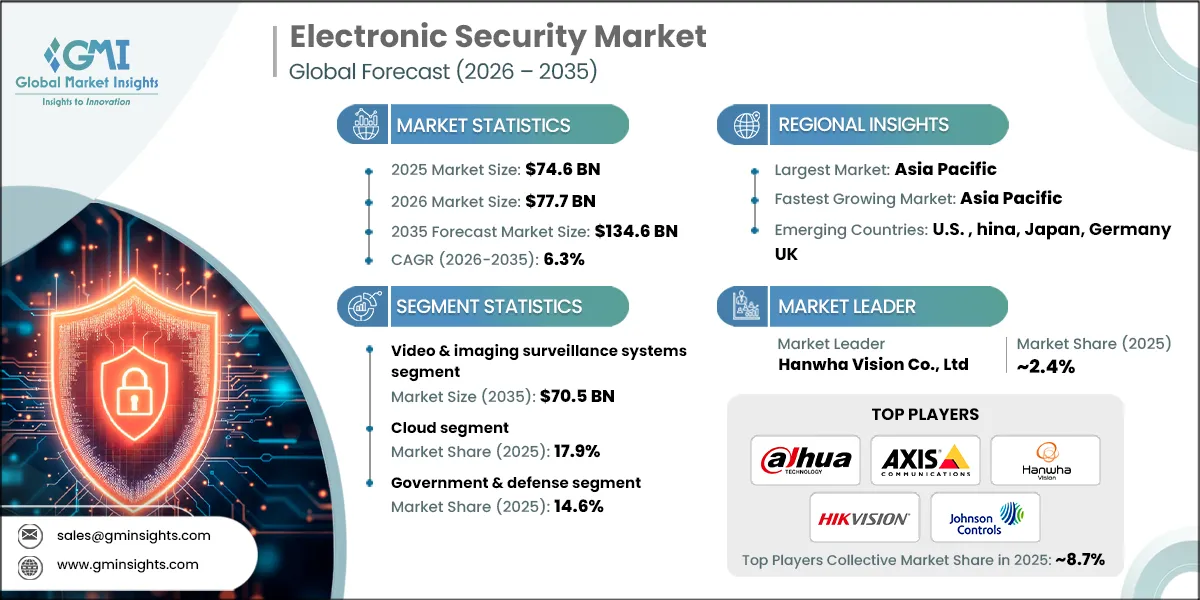
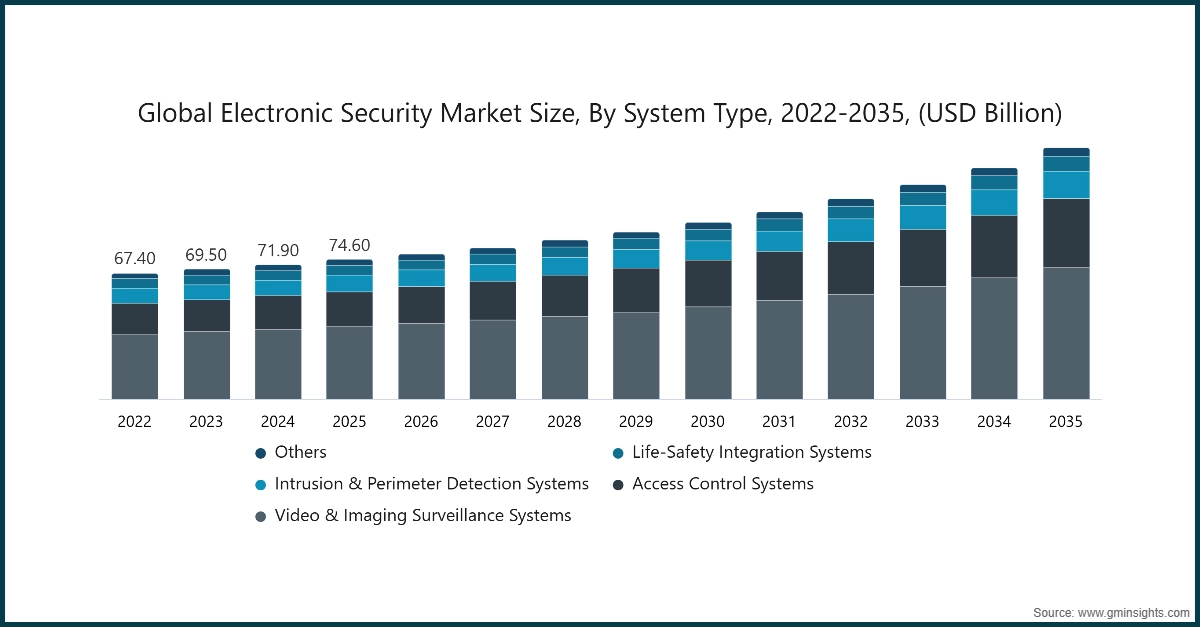
The global electronic security market was valued at USD 74.6 billion in 2025. The market is expected to grow from USD 77.7 billion in 2026 to USD 134.6 billion in 2035, at a CAGR of 6.3% during the forecast period according to the latest report published by Global Market Insights Inc. The market for electronic security is expanding, owing to the growth driven by rising global security concerns, technological innovation, and increasing regulatory requirements across sectors. In addition to this, there has been an increase in the availability of technology used to improve the reliability and cost-effectiveness of hardware, such as biometric technology, artificial intelligence (AI) and Internet of Things (IoT). Moreover, the population today is moving into smart cities and have the ability to monitor their homes and businesses remotely. Also, an increase in the trend of decreasing hardware costs and the creation of cloud-based hardware platforms provides companies with the opportunity to build scalable integrated hardware systems to support the increasing demand for electronic security worldwide.
To get key market trends
Electronic security refers to the use of electronic systems, devices, and technologies to protect people, property, assets, and information from unauthorized access, theft, damage, or threats. It includes solutions such as video surveillance, access control systems, intrusion and alarm systems, biometrics, and monitoring software, used across residential, commercial, industrial, and public infrastructure environments.
One of the significant trends in the electronic security industry is the integration of artificial intelligence (AI) and machine learning (ML) into security systems. AI-powered surveillance cameras and monitoring systems are capable of recognizing faces, detecting unusual activities, and predicting potential security breaches. which is reducing false alarms and enhancing the overall effectiveness of security measures. Thus, the trend is driving the development of smarter and more proactive security solutions.
The electronic security market is driven by the convergence of mobile-based security applications with dedicated hardware that enables affordable and easy-to-deploy DIY solutions. For instance, in July 2022, AlfredCamera’s launched its first physical security camera, expanding from a mobile home security app into hardware. The product features-rich 1080p Wi-Fi camera that are pre-orderable through its app in the U.S. The company aims to align with growing consumer demand for app-controlled, plug-and-play home security systems that integrate software intelligence with physical devices.
The increasing crime rates and public safety challenges are pushing governments and citizens to adopt electronic security systems over public infrastructure. For instance, 30% of Irish people reported using internet-connected home security solutions in the first half of 2024, up from 17% in 2022, according to official statistics from Ireland’s Central Statistics Office. Thus, reflecting growing public concern for homes and community safety, which in turn is driving demand for surveillance cameras, alarms, and smart monitoring systems.
Electronic Security Market Report Attributes
| Key Takeaway | Details |
|---|---|
| Market Size & Growth | |
| Base Year | 2025 |
| Market Size in 2025 | USD 74.6 Billion |
| Market Size in 2026 | USD 77.7 Billion |
| Forecast Period 2026-2035 CAGR | 6.3% |
| Market Size in 2035 | USD 134.6 Billion |
| Key Market Trends | |
| Drivers | Impact |
| Rising crime and public safety concerns | Police recorded property crimes in the EU rose ~4.8% for theft and ~4.2% for burglary in 2023, while the FBI reported over 14 million criminal offenses in the U.S. in 2024, underscoring persistent public safety threats that drive predictable electronic security system demand in Europe and North America. |
| Convergence of mobile applications and DIY smart home security | Government reporting shows ~94 million U.S. households use security systems, with over 50% having cameras in 2024, reflecting rising adoption of mobile integrated DIY systems; this mass consumer uptake in North America and Europe fosters predictable upgrade cycles for connected access control and surveillance solutions. |
| Demand for remote monitoring and cloud security | The rapid growth in cloud and IoT security challenges, driving demand for secure remote monitoring; national and public sector cloud adoption studies show governments and enterprises increasingly rely on cloud infrastructures, accelerating cloud enabled electronic security procurement in developed regions. |
| Expansion of commercial and industrial facilities | Public crime and internal security assessments by EU law enforcement note evolving organized crime threats, pushing infrastructure protection; this alongside robust economic activity in North America and Europe prompts systematic electronic security adoption in commercial/industrial sites, reinforcing long term procurement and installation schedules. |
| Growing advancement in wireless and mobile technologies | Advancements in wireless and mobile technologies enable seamless remote monitoring, real-time alerts, and centralized control of security systems. This enhances operational efficiency, reduces response times, and drives adoption across commercial, residential, and critical infrastructure sectors worldwide. |
| Pitfalls & Challenges | Impact |
| High initial installation and integration costs | Advanced electronic security systems incur substantial upfront costs, including hardware, software licensing, professional installation, and integration with legacy networks. These expenses often exceed budgets for SMEs and public agencies, delaying deployment decisions and constraining adoption cycles in Europe and North America. Integration complexity can add ~40-60% to total project costs. |
| Data privacy and surveillance regulation concerns | Stringent privacy laws like the EU’s GDPR impose rigorous compliance requirements and potential fines for mishandling personal data, complicating surveillance system deployment. Organizations must invest in legal safeguards, privacy by design measures, and data governance frameworks, slowing adoption timelines in Europe and influencing design choices globally. |
| Opportunities: | Impact |
| Security modernization in aging public infrastructure | Governments worldwide are modernizing critical infrastructure security to manage growing digital risks and ensure resilient services. OECD frameworks stress strengthening digital security across essential networks to support economic and social stability. This modernization drives predictable procurement of advanced physical and cyber security systems across transport, utilities, and public facilities in OECD countries. |
| Expansion of electronic security in healthcare facilities | Rising cybersecurity and physical threats in healthcare, illustrated by record levels of breaches affecting millions of patient records, are pushing hospitals to bolster integrated security systems. Secure networks and advanced access control are increasingly prioritized to protect sensitive data and critical services, particularly under national security and health policy frameworks in the U.S. and EU. |
| Market Leaders (2025) | |
| Market Leader |
~2.4% Market Share |
| Top Players |
Collective Market Share is ~8.7% |
| Competitive Edge |
|
| Regional Insights | |
| Largest Market | Asia Pacific |
| Fastest growing market | Asia Pacific |
| Emerging countries | U.S., China, Japan, Germany, UK |
| Future outlook |
|
What are the growth opportunities in this market?
Electronic Security Market Trends
- A significant trend in the electronic security industry is the growing trend toward AI-driven analytics, cloud integration, and IoT connectivity, enabling real-time monitoring, predictive threat detection, and centralized management. Growing adoption of smart buildings, regulatory compliance, and rising safety concerns are accelerating deployment. Vendors are increasingly offering unified platforms that combine surveillance, access control, and intrusion systems, supporting scalable, efficient, and proactive security solutions worldwide.
- AI is increasingly being integrated into electronic security systems to enable facial recognition, behavioral analysis, and real-time threat detection. This enhances accuracy, reduces false alarms, and allows proactive security management rather than reactive monitoring.
- In addition to AI-driven advances, cloud-enabled security solutions are gaining traction as they allow remote access, centralized monitoring, data storage, and easier scalability. Organizations prefer cloud platforms to reduce on-premises infrastructure and improve system flexibility.
- Complementing cloud adoption, smartphone-based control and monitoring have become standard features. Users can manage cameras, alarms, and access systems through mobile apps, driving demand for user-friendly, app-centric security solutions.
- Biometric technologies such as fingerprint, facial, and iris recognition are increasingly adopted to improve security and hygiene. Contactless access systems are especially popular in offices, airports, and healthcare facilities. ·
- End users are moving toward unified platforms that combine video surveillance, access control, intrusion detection, and analytics into a single interface. This trend improves operational efficiency and simplifies security management across facilities.
Electronic Security Market Analysis
Learn more about the key segments shaping this market
On the basis of system type, the market is segmented into video & imaging surveillance systems, access control systems, intrusion & perimeter detection systems, life-safety integration systems, and others.
- The video & imaging surveillance systems segment is anticipated to reach USD 70.5 billion by 2035. The trend in video surveillance is shifting toward AI-powered analytics, including facial recognition, object detection, and behavioral analysis, allowing real-time threat identification. There is also growing adoption of IP cameras and high-resolution 4K imaging, which provide clearer footage and better coverage. Cloud-based storage and remote access via mobile apps are becoming standard, enabling scalable and flexible monitoring solutions for homes, businesses, and public spaces.
- The access control systems segment was valued at USD 18.8 billion in 2025 and is anticipated to grow at a CAGR of 7.1% over the forecast years. Access control systems are increasingly moving toward biometric and contactless solutions, such as fingerprint, facial, and iris recognition, to improve security and hygiene. Mobile credentialing is another growing trend, allowing employees or residents to use smartphones instead of physical keycards. Integration with IoT and cloud platforms enables centralized control, remote monitoring, and real-time alerts, making access management more efficient for offices, healthcare facilities, and critical infrastructure.
Learn more about the key segments shaping this market
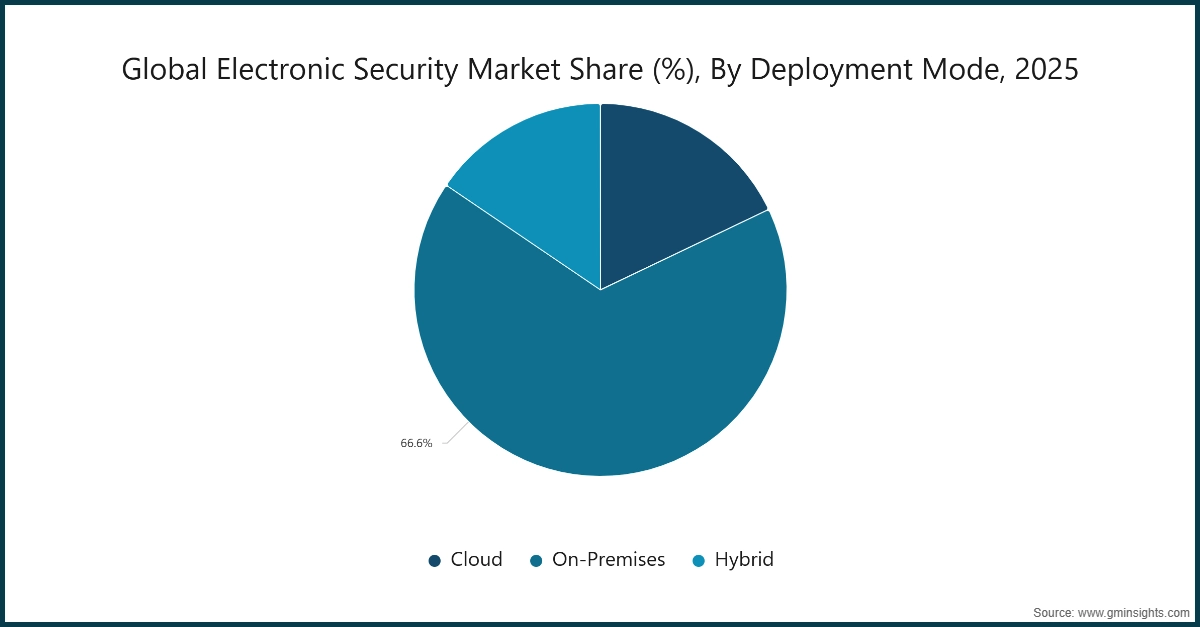
On the basis of deployment mode, the electronic security market is divided into cloud, on-premises, and hybrid.
- The cloud segment held a market share of 17.9% in 2025. Cloud-based electronic security systems are rapidly gaining popularity due to scalability, remote accessibility, and reduced infrastructure costs. Organizations can monitor multiple sites from a single platform, store large volumes of video data securely, and leverage AI-powered analytics without heavy on-premises hardware. Integration with mobile apps and IoT devices makes cloud solutions flexible and ideal for businesses, smart cities, and residential users.
- The on-premises segment is anticipated to grow at a CAGR of 6.9% during the forecast period 2026 - 2035. On-premises security systems remain relevant where data privacy, regulatory compliance, and high-security needs are critical. These setups provide full control over hardware and sensitive information, minimizing exposure to cyber threats. They are increasingly being enhanced with local AI analytics and edge computing, allowing real-time monitoring and faster response without relying on internet connectivity.
On the basis of end-user industry, the electronic security market is divided into government & defense, commercial & corporate, retail & consumer spaces, hospitality & entertainment, industrial & manufacturing, residential & housing, healthcare, education, and others.
- The government & defense segment held a market share of 14.6% in 2025. The government and defense sector is increasingly adopting advanced surveillance, access control, and perimeter security systems to safeguard critical infrastructure and public spaces. Trends include AI-powered analytics for threat detection, integration with cybersecurity frameworks, and deployment of drones and autonomous monitoring systems for large-area surveillance. Focus on national security and regulatory compliance drives continuous investment in state-of-the-art electronic security solutions.
- The commercial & corporate segment is anticipated to grow at a CAGR of 7.4% during the forecast period 2026 - 2035. Commercial and corporate spaces are shifting toward integrated security solutions that combine video surveillance, access control, and intrusion detection into a unified platform. Trends include smart office systems with mobile access, cloud-based monitoring for multi-site operations, and analytics for employee safety and operational efficiency. Increasing concerns over workplace safety and asset protection are accelerating adoption in corporate buildings and business complexes.
North America Electronic Security Market
Looking for region specific data?
The North America market holds a significant share in the global electronic security market with a market share of 26.9% in 2025.
- In North America, electronic security adoption is rising across residential, commercial, and public sectors, driven by integration of cloud platforms, AI analytics, and advanced access control technologies. Public safety initiatives increasingly incorporate video surveillance and automated monitoring, while private users embrace connected, smart security systems that offer remote access and real‑time alerts. Governments and local authorities continue to support surveillance infrastructure as part of broader safety and crime‑reduction strategies.
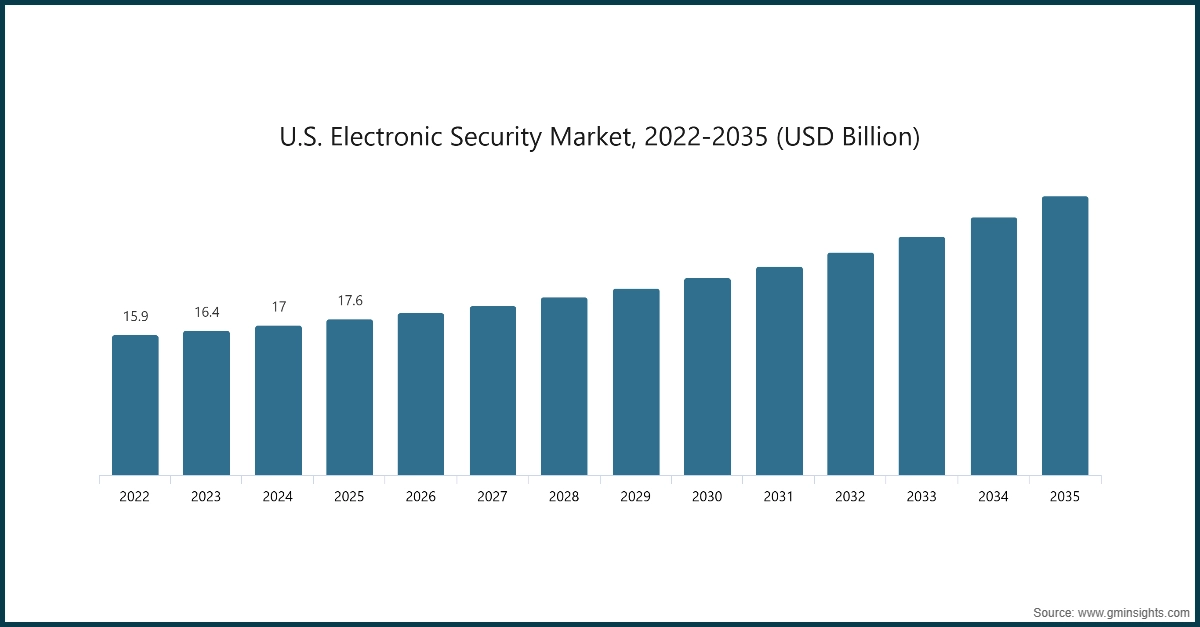
The U.S. electronic security market was valued at USD 15.9 billion and USD 16.4 billion in 2022 and 2023, respectively. The market size reached USD 17.6 billion in 2025, growing from USD 17 billion in 2024.
- Rising awareness of home safety and increasing concerns about burglary, theft, and property damage are driving the adoption of electronic security systems in U.S. households. Consumers are increasingly investing in smart cameras, alarms, and app-enabled monitoring solutions to protect their homes and families.
- According to Statista, in the U.S. security market, the number of active households is expected to amount to 136.1 million users by 2029. Household penetration will be 38.7% in 2025.
Europe Electronic Security Market
Europe market accounted for USD 15.2 billion in 2025 and is anticipated to show lucrative growth over the forecast period.
In Europe, the electronic security industry is evolving rapidly with increased adoption of networked and cloud‑ready security systems, AI‑enabled video surveillance, and integrated access control solutions. Countries across the EU are investing in smart infrastructure and digital safety platforms, pushing demand for intelligent monitoring and remote management tools. The security services landscape is also digitizing, with companies expanding their digital offerings and presence to meet rising expectations for real‑time, connected security solutions.
- Additionally, as legislative frameworks around privacy and data protection tighten, European electronic security providers are aligning products to comply with GDPR and related standards.
Germany dominates the Europe electronic security market, showcasing strong growth potential.
- In Germany, the electronic security market is witnessing steady growth driven by the adoption of advanced video surveillance, access control, and intrusion detection systems across commercial, industrial, and residential sectors. There is increasing integration of AI analytics and smart monitoring platforms to enhance real-time threat detection and operational efficiency. The market is also influenced by government initiatives for public safety, smart city projects, and regulatory compliance, encouraging both private and public organizations to invest in modern electronic security solutions.
Asia Pacific Electronic Security Market
The Asia Pacific market is anticipated to hold dominant share in the market and grow at the highest CAGR of 7% during the analysis timeframe.
The Asia Pacific electronic security industry is experiencing rapid growth due to urbanization, rising crime awareness, and increasing infrastructure development. Countries in the region are adopting AI-powered video surveillance, smart access control, and IoT-enabled security solutions to enhance public safety and protect commercial and residential assets. The region is also witnessing government-backed smart city initiatives and investments in transport, healthcare, and industrial facilities, driving demand for integrated and scalable electronic security systems. Additionally, growing disposable incomes and consumer awareness are boosting adoption of home security solutions in emerging markets.
China electronic security market is estimated to grow with a significant CAGR, in the Asia Pacific market.
- The electronic security market in China is being driven by innovations in remote and off-grid surveillance technologies. Rising demand for reliable monitoring in areas with limited connectivity or power access has encouraged companies to develop solutions that ensure continuous operation and enhanced coverage.
- In November 2025, Hikvision launched its new AOV (Always-On Video) 4G Solar Camera Series, providing reliable, remote surveillance. These cameras address gaps in traditional solar-powered solutions by offering continuous 24/7 recording in off-grid areas, helping businesses and government agencies maintain uninterrupted security even in challenging locations.
Latin American Electronic Security Market
Brazil leads the Latin American market, exhibiting remarkable growth during the analysis period.
In Brazil, the electronic security industry is growing due to rising urbanization, increasing crime rates, and heightened awareness of personal and public safety. Businesses and residential users are increasingly adopting CCTV surveillance, intrusion detection systems, and smart access control solutions to protect assets and communities. Government initiatives for public safety and smart city projects are further driving demand for integrated and scalable security solutions, while improving connectivity and mobile.
Middle East and Africa Electronic Security Market
South Africa market to experience substantial growth in the Middle East and Africa electronic security industry in 2025.
In South Africa, the market is expanding rapidly due to high crime rates, growing public safety concerns, and increasing urbanization. Both residential and commercial sectors are adopting CCTV surveillance, access control systems, and alarm solutions to protect people and property. The market is also influenced by government and municipal initiatives to enhance public safety, as well as the growing availability of smart security and mobile monitoring technologies that allow remote management and real-time alerts. Rising awareness of security solutions is driving wider adoption across homes, businesses, and critical infrastructure.
Electronic Security Market Share
- The electronic security industry is moderately consolidated, with leading companies such as Hikvision Digital Technology Co., Ltd., ASSA ABLOY, Dahua Technology, Motorola Solutions, Axis Communications, Hanwha Vision, Johnson Controls, Honeywell, Bosch Security, Allegion, Resideo, Secom, Siemens SI, TKH Group, and Milestone Systems collectively capturing a significant share of the global market. These players leverage strong global distribution networks, broad product portfolios spanning video surveillance, access control, intrusion detection, life-safety integration, and smart building solutions, as well as sustained R&D investments in AI, IoT, and cloud-enabled security platforms. Their scale allows compliance with regional regulations, rapid deployment for enterprise, industrial, and government clients, and long-term service contracts, making them preferred suppliers in large commercial and critical infrastructure projects worldwide.
- Despite these dominant vendors, a considerable portion of the market remains fragmented among regional and value-tier manufacturers. Smaller players compete by offering cost-effective systems, flexible integrations, localized support, and solutions tailored to specific regulatory or operational requirements. They often target SMEs, retrofits, and niche applications, emphasizing ease of deployment and proximity. This competitive environment encourages continuous innovation, price optimization, and customization, enabling both premium and budget-friendly electronic security solutions to coexist and drive overall market growth globally.
Electronic Security Market Companies
Prominent players operating in the electronic security industry are as mentioned below:
- Hikvision Digital Technology Co., Ltd.
- ASSA ABLOY
- Dahua Technology
- Motorola Solutions (Video & Access)
- Axis Communications
- Hanwha Vision
- Johnson Controls (Security)
- Honeywell (Security)
- Bosch Security (Product Biz)
- Allegion
- Resideo (Security)
- Secom
- Siemens SI (Security)
- TKH Group
- Milestone Systems
Hanwha Vision Co., Ltd holds a market share of around 2.4%. The company is recognized for its AI-enabled imaging and intelligent video analytics products, supporting enterprise, industrial, and public security applications. Hanwha Vision’s emphasis on high-resolution optics, deep learning algorithms, and cybersecurity compliance enables efficient, scalable deployments and seamless integration with third-party security platforms worldwide.
Dahua Technology Co., Ltd holds a market share of approximately 1.8% in the electronic security market. The company is recognized for its extensive portfolio of video surveillance, access control, and AI-enabled smart security solutions, coupled with strong R&D capabilities. Dahua’s innovations in edge AI, cloud integration, and IoT connectivity enhance interoperability across enterprise, commercial, and residential security systems, enabling scalable, efficient deployments worldwide.
Axis Communications AB commands a market share of about 1.5%. Known for its pioneering role in network video surveillance, Axis leverages open platform technologies and high-quality IP cameras to deliver interoperable, customizable security solutions. Its focus on cybersecurity, analytics, and cloud-based management strengthens system reliability, making it a preferred choice for enterprise, government, and critical infrastructure clients globally.
Electronic Security Industry News
In October 2024, Dahua Technology, a leading provider of video-centric AIoT security solutions, launched a new suite of intelligent solutions designed for small and medium-sized businesses (SMBs). The product includes systems for control centers, fire lane monitoring, overspeed detection, preventive fire measures, and EAS loss prevention. These AI-powered solutions aim to enhance security management across schools, apartments, industrial parks, factories, retail stores, warehouses, and other SMB environments. By providing centralized control and AI-driven insights, Dahua’s solutions improve operational efficiency, enable faster threat detection, and support more effective security management in SMB settings.
In April 2025, Axis Communications introduced the AXIS Camera Station S1228 Rack AI Optimized Server, designed to enhance AI-based video analytics applications, including free text search functionality. The server delivers high performance and efficiency in high-traffic or complex surveillance environments, enabling rapid retrieval of video footage and accurate detection of moving objects across multiple cameras. Equipped with advanced hardware, including an NVIDIA GPU, dual SSDs, and a high-performance processor, the system supports intensive analytics workloads and improves investigative capabilities. This launch reinforces Axis Communications’ focus on providing scalable, AI-optimized solutions that maximize the operational effectiveness of video surveillance systems in enterprise and critical infrastructure settings.
In March 2025, Johnson Controls, a global leader in smart and sustainable building solutions, announced upgrades to its access control and video surveillance (ACVS) offerings. The enhancements are designed to integrate with existing security architectures, improving management of critical security functions and protection of people, assets, and facilities. By strengthening operational efficiency and cost-effectiveness, these updates aim to enhance overall security performance and support more agile, resilient security operations for enterprise and commercial customers.
The electronic security market research report includes in-depth coverage of the industry with estimates and forecast in terms of revenue in USD Million from 2022 – 2035 for the following segments:
Market, By System Type
- Video & Imaging Surveillance Systems
- Access Control Systems
- Intrusion & Perimeter Detection Systems
- Life‑Safety Integration System
- Others
Market, By Deployment Model
- On-Premises
- Cloud-Based
- Hybrid
Market, By End-User Industry
- Government & Defense
- Commercial & Corporate
- Retail & Consumer Spaces
- Hospitality & Entertainment
- Industrial & Manufacturing
- Residential & Housing
- Healthcare
- Education
- Others
The above information is provided for the following regions and countries:
- North America
- U.S.
- Canada
- Europe
- Germany
- UK
- France
- Spain
- Italy
- Netherlands
- Asia Pacific
- China
- India
- Japan
- Australia
- South Korea
- Latin America
- Brazil
- Mexico
- Argentina
- Middle East and Africa
- South Africa
- Saudi Arabia
- UAE
Frequently Asked Question(FAQ) :
What are the upcoming trends in the electronic security industry?
Key trends include the adoption of AI-powered analytics, cloud-based storage, IoT integration, and advancements in wireless and mobile technologies. The rise of real-time monitoring, 4K imaging, and scalable cloud solutions is enhancing operational efficiency across sectors.
Who are the key players in the electronic security market?
Key players include Hikvision Digital Technology Co., Ltd., ASSA ABLOY, Dahua Technology, Motorola Solutions (Video & Access), Axis Communications, Hanwha Vision, Johnson Controls (Security), Honeywell (Security), Bosch Security (Product Biz), and Allegion.
What was the market share of the government & defense segment in 2025?
The government & defense segment held a market share of 14.6% in 2025. This segment is driven by the adoption of advanced surveillance, access control, and perimeter security systems to safeguard critical infrastructure and public spaces.
Which region leads the electronic security market?
North America led the global market with a 26.9% share in 2025. The region's dominance is attributed to robust economic activity, organized crime prevention, and systematic adoption of electronic security systems in commercial and industrial sites.
What was the market share of the cloud segment in 2025?
The cloud segment held a market share of 17.9% in 2025. Its popularity stems from scalability, remote accessibility, and reduced infrastructure costs, making it ideal for businesses, smart cities, and residential users.
How much revenue did the video & imaging surveillance systems segment generate in 2025?
The video & imaging surveillance systems segment accounted for USD 70.5 billion by 2035. The segment is driven by AI-powered analytics, including facial recognition, object detection, and behavioral analysis, alongside the adoption of IP cameras and 4K imaging.
What is the projected value of the electronic security market by 2035?
The market size for electronic security is expected to reach USD 134.6 billion by 2035, growing at a CAGR of 6.3%. This growth is fueled by the adoption of cloud-based platforms, smart city initiatives, and scalable integrated systems.
What is the electronic security market size in 2025?
The market size for electronic security was valued at USD 74.6 billion in 2025. Growth is driven by rising global security concerns, technological advancements, and increasing regulatory requirements across sectors.
What is the market size of the electronic security industry in 2026?
The market size for electronic security reached USD 77.7 billion in 2026, reflecting steady growth supported by advancements in biometric technology, AI, and IoT integration.
Electronic Security Market Scope
Related Reports