Summary
Table of Content

Electrochromic Materials for Automotive Glass Market
Get a free sample of this report
Form submitted successfully!
Error submitting form. Please try again.
Thank you!
Your inquiry has been received. Our team will reach out to you with the required details via email. To ensure that you don't miss their response, kindly remember to check your spam folder as well!
Request Sectional Data
Thank you!
Your inquiry has been received. Our team will reach out to you with the required details via email. To ensure that you don't miss their response, kindly remember to check your spam folder as well!
Form submitted successfully!
Error submitting form. Please try again.
Electrochromic Materials for Automotive Glass Market Size
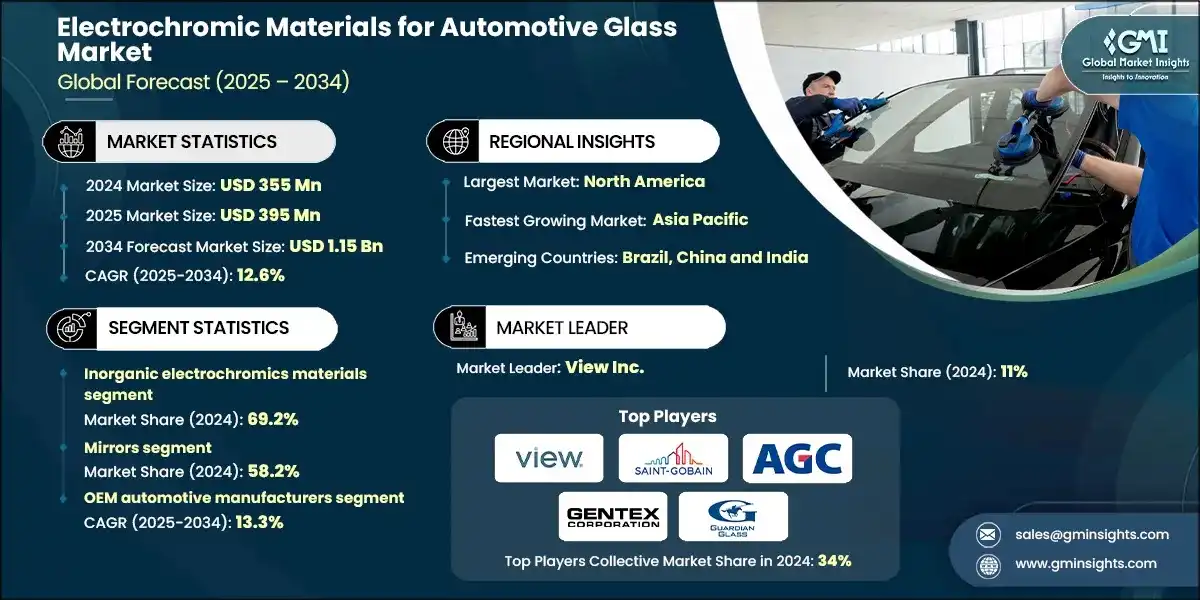
The global electrochromic materials for automotive glass market size was estimated at USD 355 million in 2024. The market is expected to grow from USD 395 million in 2025 to USD 1.15 billion in 2034, at a CAGR of 12.6% according to latest report published by Global Market Insights Inc.
To get key market trends
- The electrochromic materials for automotive glass market is experiencing a paradigm shift, driven by the automobile industry's focus on smart, energy-efficient, and user-friendly technologies. The operation is on the principle of blocking light and heat transmission, considering passenger discomfort with glare, and resorting to thermal efficiency.
- Considering sustainability is now a strategic imperative for automobile manufacturers, the electrochromic materials find acceptance due to their contributions toward energy savings by lessening air-conditioning demand, thus supporting further enhancement of fuel economy in internal combustion engine vehicles or extended range in the case of electric vehicles.
- From a regional perspective, North America ranks current leader, aided by a mature automotive innovation ecosystem, early acceptance of smart glass technologies, and a stronghold of luxury and electric vehicle manufacturers. R&D investments benefit from the strategic partnership of OEMs together with companies of material sciences; this is viewed as a bastion within the said continent.
- Asia-Pacific, in the second position concerning size and growth, is mostly driven by rapid urbanization, higher disposable income, and increasing demand for electric vehicles.
- The diversification of portfolios appears to be gaining steam as manufacturers innovate in multi-zone tinting, color-changing functionality, and integration with infotainment systems. Despite a favorable outlook, massive initial expenditure, durability issues, and standardization of performance hold sway as the major challenges against market development presently. Consumer preferences are now promoting a demand for comfort/status personalization, and it is these very forces that are beginning to initiate the template for a more universal incorporation of electrochromic materials.
Electrochromic Materials for Automotive Glass Market Report Attributes
| Key Takeaway | Details |
|---|---|
| Market Size & Growth | |
| Base Year | 2024 |
| Market Size in 2024 | USD 355 Million |
| Market Size in 2025 | USD 395 Million |
| Forecast Period 2025 to 2034 CAGR | 12.6 % |
| Market Size in 2034 | USD 1.15 Billion |
| Key Market Trends | |
| Drivers | Impact |
| FMVSS 205 compliance requirements | The regulatory pressure does not compromise the safety and visibility standards, but it practically converts operations of an OEM to adopt electrochromic glass solutions faster and in adherence to compliance standards |
| Electric vehicle market growth | Introduction of smart glass for energy efficiency within EV being promoted as well as cabin comfort being enhanced in vehicles |
| Energy efficiency mandates | Reduced energy consumption drives the use of electrochromic glass, which minimizes HVAC loads |
| Pitfalls & Challenges | Impact |
| High manufacturing costs | Production costs determine the scalability and limit the adoption to high-end vehicles only |
| Switching speed limitations | Performance affected lag in tint transition will damage the entire user experience in dynamic driving |
| Opportunities: | Impact |
| Multi-zone dynamic control systems | Personalized shading in different vehicle zones enhances passenger comfort and differentiation for OEMs |
| Autonomous vehicle integration | Smart glass can optimize the sensor and adapt the light environment for use in creating mobility platforms of the future |
| Market Leaders (2024) | |
| Market Leaders |
Market Share 11% |
| Top Players |
Collective Market Share of 34% in 2024 |
| Competitive Edge |
|
| Regional Insights | |
| Largest Market | North America |
| Fastest growing market | Asia-Pacific |
| Emerging countries | Brazil, China and India |
| Future outlook |
|
What are the growth opportunities in this market?
Electrochromic Materials for Automotive Glass Market Trends
- Electrochromic materials for the automotive glass industry, bends and shapes according to how vehicle designs are prioritized nowadays, regulated, and expected by the consumer for comfort and sustainability. One among such trends include the urgent acceptance for dynamic glazing systems with real-time light modulation in support of energy efficiency and enhancing passenger experience. This trend, however, also reflects larger industry ambitions focused on lowering HVAC loads and battery performance in electric vehicles, along with aesthetic and functional customization of vehicle interiors.
- Current avenues of development in the research of electrochromic materials by manufacturers and suppliers include compliance with new contexts that involve curved surfaces, panoramic roofs with multi-zone control systems. The modifications are targeted specifically at electric, autonomous, and luxury vehicles, wherein adaptable glass offers sensor optimization, glare reduction, and thermal regulation functions. Another quite promising direction is combining electrochromic technologies with the electronics of the vehicle along with the smart cabin system for automatic responses towards environmental input and user preference.
- Electrochromic glass is also making its way into side windows, privacy screens, and heads-up displays. This maturing use is fostered by new thin-film deposition techniques, hybrid materials formulations, and mass producibility. Hence, there is an increasing interest in the application of electrochromic materials in commercial fleets, shared mobility, and next-gen autonomous vehicles; where comfort, energy efficiency, and adaptive functionality are paramount.
Electrochromic Materials for Automotive Glass Market Analysis
Learn more about the key segments shaping this market
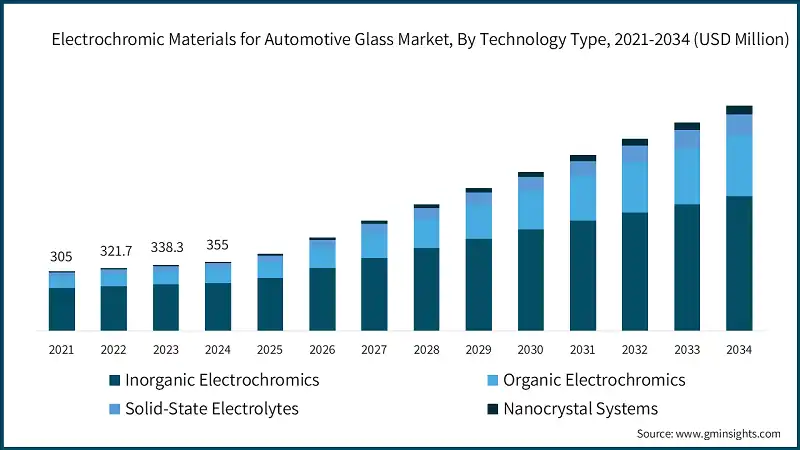
Based on technology type, the electrochromic materials for automotive glass market is segmented into inorganic electrochromics, organic electrochromics, solid-state electrolytes, nanocrystal systems. Inorganic electrochromics materials dominated the market with an approximate market share of 69.2% in 2024 and is expected to grow with a CAGR of 11% till 2034.
- Inorganic electrochromics, mainly based on metal oxides, are under refinement with respect to their durability and optical stability, which make them applicable large-area applications like sunroofs and side windows. These include push toward optimization for fast switching speeds and reduction of power consumption, which would suit the energy efficiency required by electric and hybrid vehicles.
- Organic electrochromics are fast coming to the forefront because of their flexible color diversity, producing favorable conditions for installing them in curved and complex glass geometries. These materials will be explored for lightweight cars of the future and interior applications where personal aesthetic customizing is a priority.
- Meanwhile, the solid-state electrolyte has emerged as a safe and more compact alternative to the conventional liquid-based systems. The integration of such technologies into modular smart glass units enables multi-zone control and automated tinting and complements the vision of connected and autonomous vehicles in improving vehicle functionality applications.
- Nanocrystal systems in electrochromic technology, where adjustable control over infrared and visible light transmission is provided. These advance materials are targeted toward use in cutting-edge applications ranging from heads-up displays to privacy-glass and sensor-shielding implementations. Their very rapid response time and versatility in terms of embedding in varied formats prepare them for the future world's mobility platforms. As each technology becomes mature, manufactures will launch the technologies in the market while keeping the following aspects in mind, viz., scalability, cost-effective solutions, and compliance to automotive safety standards.
Learn more about the key segments shaping this market
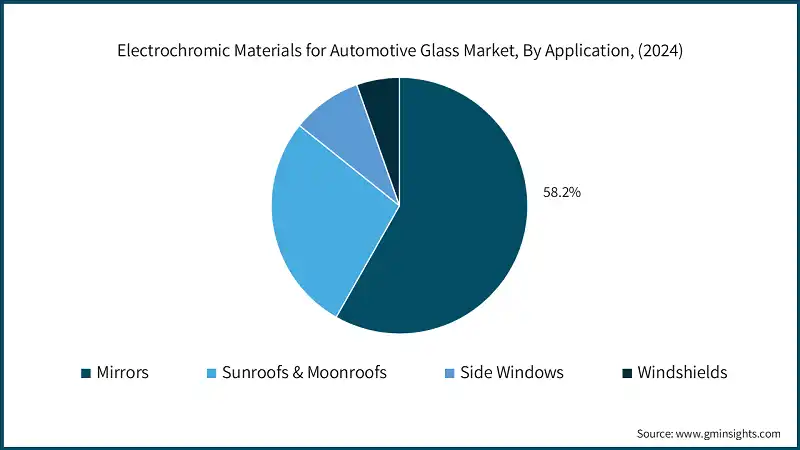
Based on application, the electrochromic materials for automotive glass market is segmented into mirrors, sunroofs & moonroofs, side windows, and windshields. Mirrors hold the largest market share of 58.2% in 2024 and are expected to grow at a CAGR of 9.7% from 2025 to 2034.
- The mirrors, especially rear-view and side mirrors are mature applications in which electrochromic technology is implemented for glare reduction and visibility enhancement. This ought to be due to the relatively low cost of such components compared to other car devices and their proven reliability, thus making them standard requirements in several mid-range to high-end automobile models.
- There is now drastic utilization of electrochromic glass in sunroofs and moonroofs to provide dynamic shading and thermal control. This particular segment is growing rapidly in either electric or luxury vehicles. Passenger comfort and energy efficiency are prioritized: modulating light transmission without mechanical shading systems adds value from the perspectives of design flexibility and system integration.
- Side windows are differentiated with their emerging growth area, especially in platforms related to mobility-automated and shared mobility, with concerns about privacy, rich information adaptive light, and passenger experiences all serving as competitive advantages.
- Windshields prove most difficult in this regard because of safety and visibility criteria, so research is still ongoing in the field of selective tinting with integrated heads-up displays. Adoption is currently low, however, advanced nanocrystal and solid-state electrochromic technologies are likely to bring advances in future applications.
Based on end user, the electrochromic materials for automotive glass market is segmented into OEM automotive manufacturers, aftermarket suppliers, specialty vehicle manufacturers. OEM automotive manufacturers hold the largest market size of USD 307.1 million in 2024 and is expected to grow at a CAGR of 13.3% from 2025 to 2034.
- OEM automotive manufacturers constitute the largest end user segment, as they relate to the incorporation of electrochromic glass into vehicle platforms in the design and production timeline. Their demand is truly from the standpoint of needing smart glass solutions for scalability, compliance, and customization that are in sync with its wider energy-efficiency goals with regard to passenger comfort and advanced mobility features.
- For aftermarket suppliers, retrofit and replacement applications supply the electrochromic glass components in vehicles already manufactured. This segment is steadily growing, especially for premium and electric vehicle segments where the consumer wants upgrades in comfort and aesthetics. Demand from the aftermarket is decided by factors like the ease of installation, compatibility with the electronics of the vehicle, and general cost of installation.
- Specialty vehicle manufacturers, including producers of luxury, autonomous, and commercial fleet vehicles, are exploring uses for electrochromic materials in areas of privacy partitions, adaptive cabin environments, and sensor-integrated glazing.
Looking for region specific data?
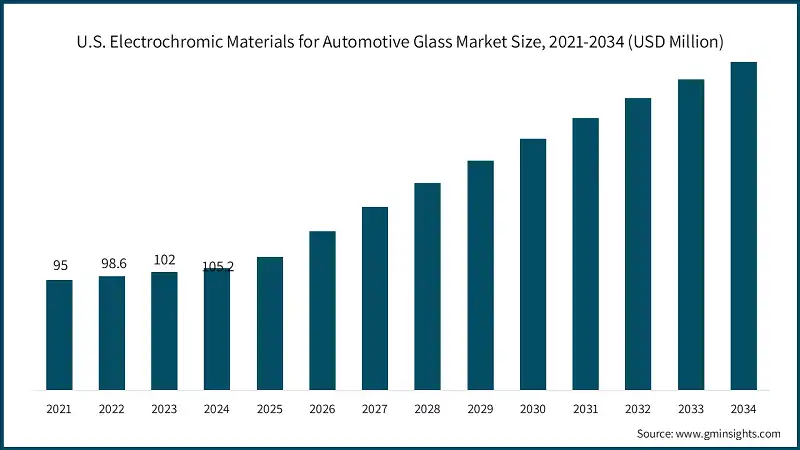
The North America electrochromic materials for automotive glass market dominated with a market share of 36.1% in 2024.
- North America is experiencing the steady growth of the electrochromic materials for automotive glass market, as rising consumer interest in smart mobility, energy-efficient vehicle features, and technologies for enhancing comfort drive this expansion. Automotive OEMs in the region have gallantly crossed paths with the development of electrochromic glass into vehicle platforms as technological evolution aligns with design and sustainability. The materials-science companies and automotive suppliers' alliances support the themselves market-wide development of scalable, safety-compliant electrochromic systems that meet regulatory requirements and consumers-expectations.
U.S. dominates the North America electrochromic materials for automotive glass market, showcasing strong growth potential.
- The U.S. has the largest share of the market, which is commercial traction for electric and luxury vehicle platforms. The demand for electrochromic glass is rising in uses such as mirrors, sunroofs, and side windows due to the dynamic tinting minimizes glare, provides thermal comfort, and adds to the aesthetic appeal. The manufacturers and technology providers in the U.S. are investing in R&D towards improving switching speed, durability, and integration with vehicle electronics, thus positioning electrochromic materials at the forefront of next-gen automotive design.
Europe electrochromic materials for automotive glass accounted for USD 83.3 million in 2024 and is anticipated to show lucrative growth over the forecast period.
- The growing consumer interest in sustainable mobility along with energy-efficient vehicle features and smart interior technologies boosts the Electrochromic Materials for Automotive Glass market in Europe. Over the years, auto manufacturers in Europe have been installing electrochromic glass in vehicles to comply with evolving legislative standards and to improve consumer comfort. Digital platforms and B2B e-commerce channels are becoming more popular for direct purchasing, customizing, or aligning specifications for electrochromic components - especially among OEMs and specialty vehicle manufacturers.
Germany dominates the European electrochromic materials for automotive glass market, showcasing strong growth potential.
- Germany holds the most significant share of this market. German OEMs adopt electrochromic materials mainly for sunroofs, side windows and mirrors for purposes such as better thermal regulation, glare reduction and design flexibility. Development of electric and autonomous vehicles caught the attention of the country, and thus boosts quite much demand for smart glass, which can integrate with onboard electronics and sensor networks.
The Asia Pacific electrochromic materials for automotive glass is anticipated to grow at the CAGR of 14.9% during 2025-2034.
- Asia-Pacific's urbanization, rising disposable income, and healthy disposition towards advanced vehicle technology rose production for the Electrochromic Materials for Automotive Glass market. Hence, the automotive manufacturers of this region have been inclined towards integrating smart glass solutions in the name of energy efficiency, passenger comfort, and design flexibility. The demand for electrochromic materials also rides high on the rearing reputation of electric vehicles and connected mobility platforms, with local suppliers and OEMs pouring in investments in scalable production and localized innovation.
China electrochromic materials for automotive glass market is estimated to grow with a significant CAGR, in the Asia Pacific electrochromic materials for automotive glass.
- The immense industrial clout, government-backed sustainability initiatives, and upward trends of the EV market are putting China firmly on the map as a growth center in Asia-Pacific. Electrochromic technologies-sunroof, sidewindow, to panoramic applications-are being actively explored by automotive glass manufacturers as well as several leading research institutes in China. Development work is mainly focused on cost-effective, durable, and responsive materials that could serve the domestic and export vehicle platforms. With a digital infrastructure in China, fast and easy distribution and customization of electrochromic components via B2B platforms and OEM supply chains are also possible.
Latin America electrochromic materials for automotive glass market accounted for 3.9% in 2024 and is anticipated to show lucrative growth over the forecast period.
- Electrochromic materials for automotive glass are providing an emerging trend in Latin America, due to the increased urbanization, growing vehicle ownerships, and rising curiosity toward energy-efficient automotive technologies in the region. The rising awareness on smart mobility solutions among regional consumers and manufacturers is driving demand for these products in the passenger and commercial markets. Automotive OEMs and aftermarket suppliers are increasingly considering electrochromic applications for sunroofs, mirrors, and side windows, especially in urban centers where climate control and comfort are core issues.
Brazil leads the Latin American electrochromic materials for automotive glass market, exhibiting remarkable growth during the analysis period.
- The country leading the Latin American market is Brazil, with a strong base in automotive manufacturing, in addition to an increasing adoption of advanced vehicle features. Currently, Brazilian manufacturers are evaluating electrochromic materials and integrating them into electric and hybrid vehicles with the aim of enhancing the cabin experience while minimizing energy consumption.
Middle East & Africa electrochromic materials for automotive glass market accounted for 2% in 2024 and is anticipated to show lucrative growth over the forecast period.
- The Middle East and Africa electrochromic materials for automotive glass industry has witnessing growth from the effects of urbanization. Regional automotive manufacturers and suppliers have begun to adopt the smart glass technology to enhance comforts in vehicles, cut down on energy consumption, and catch up to new design trends worldwide. The use of electrochromic materials is considered for sunroof, mirror, and side window applications, especially on high-end and electric vehicle categories, where climate control and glare reduction becomes crucial.
Saudi Arabia electrochromic materials for automotive glass market to experience substantial growth in the Middle East and Africa market in 2024.
- Saudi Arabia, with its potential in the modernization of automotive and smart infrastructure, is expected to provide significant impetus to the growth of electrochromics in the region.
Electrochromic Materials for Automotive Glass Market Share
The top 5 companies in electrochromic materials for automotive glass industry include View Inc., Saint-Gobain, AGC Inc., Gentex Corporation, Guardian Glass. These are prominent companies operating in their respective regions covering 34% of the market share. These companies hold strong positions due to their extensive experience in electrochromic materials for automotive glass market. Their diverse product portfolios, backed by robust production capabilities and distribution networks, enable them to meet the rising demand across various regions.
- View Inc. develops electrochromic glass systems with integrated electronics for adaptive tinting in automotive applications. Their focus includes modular smart glass units designed for real-time light modulation, supporting energy efficiency and passenger comfort. The company is working on scalable solutions that align with connected vehicle ecosystems and multi-zone control capabilities.
- Saint-Gobain engages in the development of thin-film electrochromic coatings for automotive glazing, emphasizing compliance with safety standards and integration into electric and autonomous vehicle platforms. Their material research includes inorganic and hybrid formulations aimed at improving switching speed, durability, and optical clarity across varied environmental conditions.
- AGC Inc. applies its expertise in glass and material science to produce electrochromic automotive glass compatible with curved and panoramic surfaces. Their development activities focus on enhancing the performance of solid-state and nanocrystal systems, enabling advanced applications such as heads-up displays and sensor-integrated glazing.
- Gentex Corporation specializes in electrochromic mirror and glass technologies for automotive interiors and exteriors. Their materials are designed for integration with driver-assistance systems and sensor networks, supporting auto-dimming functionality and adaptive shading in rear-view and side mirror applications.
- Guardian Glass is expanding its automotive portfolio to include electrochromic materials adapted from architectural smart glass technologies. Their research centers on scalable manufacturing processes and compatibility with OEM specifications, targeting applications in sunroofs, side windows, and privacy glass systems.
Electrochromic Materials for Automotive Glass Market Companies
Major players operating in the electrochromic materials for automotive glass industry include:
- View Inc.
- Saint-Gobain
- AGC Inc.
- Gentex Corporation
- Guardian Glass
- NSG Group (Pilkington)
- Guardian Glass
- Vitro Architectural Glass
- SAGE Electrochromics Inc.
- ChromoGenics AB
- Pleotint LLC
- Smart Glass Country
- Kinestral Technologies
- Research Frontiers Inc.
Electrochromic Materials for Automotive Glass Industry News
- In August 2025, Ambilight a global player in smart glass technology successfully partnered with NIO, the premium smart electric vehicle manufacturer. Unveiled with rose flesh, the all-new NIO ES8 is a full-size, all-scenario flagship SUV that showcases the Electrochromic (EC) Smart Dimming Side Windows by Ambilight as part of its car avant-garde design.
- In July 2025, Gauzy Ltd. is a global enterprise in light and vision control technologies, which rolled out a solution that maximizes manufacturing efficiency, speeds up smart glass adoption, and is the first prefabricated stack of smart glass used in the automotive sector. The fully industrialized product is intended to enable scalable integration across vehicle platforms, driving a compelling case for investors.
- In March 2025, Miru Smart Technologies, a maker of smart window technology, has one-upped itself with the introduction of one of the largest electrochromic sunroof window systems for the automotive industry. Which has been facilitated by Argotec TPU interlayer films, known for their innovative thermoplastic polyurethane.
This electrochromic materials for automotive glass market research report includes in-depth coverage of the industry, with estimates & forecasts in terms of revenue (USD Million) from 2025 to 2034, for the following segments:
Market, By Technology Type
- Inorganic electrochromics
- Organic electrochromics
- Solid-state electrolytes
- Nanocrystal systems
Market, By Application
- Mirrors
- Sunroofs & moonroofs
- Side windows
- Windshields
Market, By End Use
- OEM automotive manufacturers
- Aftermarket suppliers
- Specialty vehicle manufacturers
The above information is provided for the following regions and countries:
- North America
- U.S.
- Canada
- Europe
- Germany
- UK
- France
- Spain
- Italy
- Rest of Europe
- Asia Pacific
- China
- India
- Japan
- Australia
- South Korea
- Rest of Asia Pacific
- Latin America
- Brazil
- Mexico
- Argentina
- Rest of Latin America
- Middle East and Africa
- Saudi Arabia
- South Africa
- UAE
- Rest of Middle East and Africa
Frequently Asked Question(FAQ) :
Who are the key players in the electrochromic materials for automotive glass industry?
Key players include View Inc., Saint-Gobain, AGC Inc., Gentex Corporation, Guardian Glass, NSG Group (Pilkington), Vitro Architectural Glass, and SAGE Electrochromics Inc.
What are the upcoming trends in the electrochromic materials for automotive glass market?
Key players include View Inc., Saint-Gobain, AGC Inc., Gentex Corporation, Guardian Glass, NSG Group (Pilkington), Vitro Architectural Glass, and SAGE Electrochromics Inc.
What is the growth outlook for OEM automotive manufacturers from 2025 to 2034?
OEM automotive manufacturers, which held a market size of USD 307.1 million in 2024, are anticipated to observe around 13.3% CAGR up to 2034.
What was the market share of mirrors in 2024?
Mirrors held the largest market share of 58.2% in 2024 and are set to expand at a CAGR of 9.7% till 2034.
What was the market share of inorganic electrochromic materials in 2024?
Inorganic electrochromic materials dominated the market with a 69.2% share in 2024 and are expected to witness over 11% CAGR through 2034.
What is the market size of the electrochromic materials for automotive glass in 2024?
The market size was estimated at USD 355 million in 2024, with a CAGR of 12.6% expected through 2034. The growth is driven by the automotive industry's focus on smart, energy-efficient, and user-friendly technologies.
What is the expected size of the electrochromic materials for automotive glass market in 2025?
The market size is projected to reach USD 395 million in 2025.
What is the projected value of the electrochromic materials for automotive glass market by 2034?
The market is poised to reach USD 1.15 billion by 2034, fueled by advancements in light and heat-blocking technologies and increasing demand for thermal efficiency in vehicles.
Which region leads the electrochromic materials for automotive glass sector?
North America leads the market with a 36.1% share in 2024, driven by rising consumer interest in smart mobility, energy-efficient vehicle features.
Electrochromic Materials for Automotive Glass Market Scope
Related Reports