Summary
Table of Content

Electric Vehicle Range Extender Market
Get a free sample of this report
Form submitted successfully!
Error submitting form. Please try again.
Thank you!
Your inquiry has been received. Our team will reach out to you with the required details via email. To ensure that you don't miss their response, kindly remember to check your spam folder as well!
Request Sectional Data
Thank you!
Your inquiry has been received. Our team will reach out to you with the required details via email. To ensure that you don't miss their response, kindly remember to check your spam folder as well!
Form submitted successfully!
Error submitting form. Please try again.
Electric Vehicle Range Extender Market Size
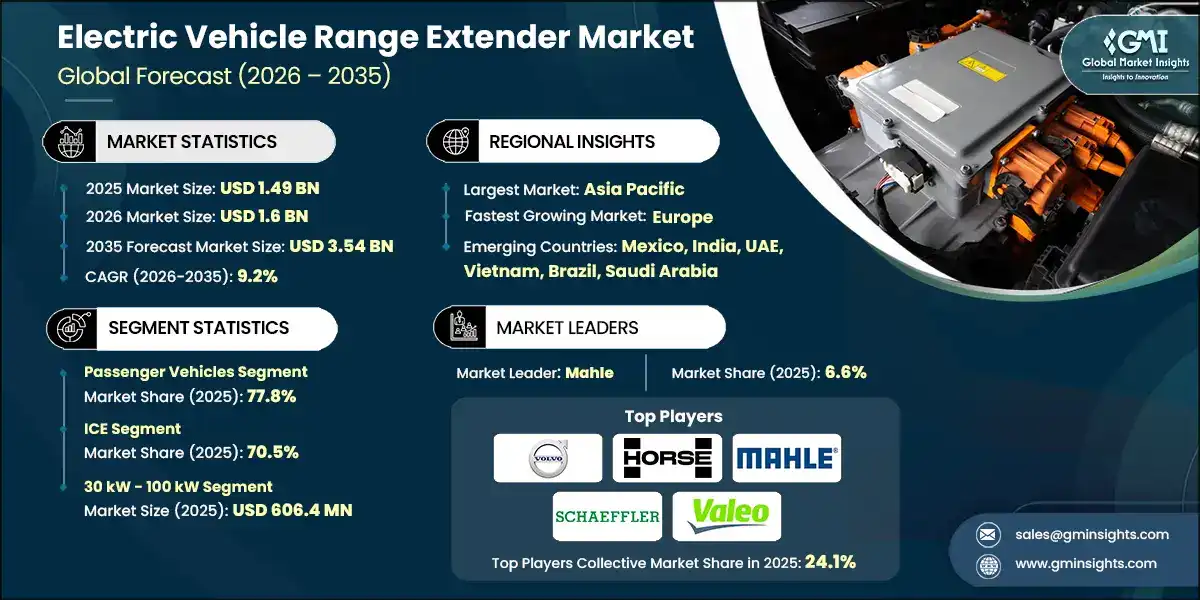
The global electric vehicle range extender market was valued at USD 1.49 billion in 2025. The market is expected to grow from USD 1.6 billion in 2026 to USD 3.54 billion in 2035 at a CAGR of 9.2%, according to latest report published by Global Market Insights Inc.
Electric Vehicle Range Extender Market Key Takeaways
Market Size & Growth
- 2025 Market Size: USD 1.49 Billion
- 2026 Market Size: USD 1.6 Billion
- 2035 Forecast Market Size: USD 3.54 Billion
- CAGR (2026–2035): 9.2%
Regional Dominance
- Largest Market: Asia Pacific
- Fastest Growing Region: Europe
Key Market Drivers
- Rising Consumer Range Anxiety.
- Growth in Electric Commercial and Fleet Vehicles.
- Expansion of EV Adoption in Emerging Markets.
- Limited Charging Infrastructure in Rural and Highway Areas.
Challenges
- Rapid Expansion of Fast-Charging Infrastructure.
- Increasing Battery Energy Density and Cost Decline.
Opportunity
- Range Extenders for Electric Trucks and Vans.
- Retrofitting Solutions for Existing EV Platforms.
- Emerging Markets with Infrastructure Gaps.
- Hydrogen and E-Fuel-Based Range Extender Systems.
Key Players
- Market Leader: Mahle led with over 6.6% market share in 2025.
- Leading Players: Top 5 players in this market include AB Volvo, Horse Powertrain, Mahle, Schaeffler, Valeo, which collectively held a market share of 24.1% in 2025.
Get Market Insights & Growth Opportunities
The worldwide push for EV adoption plays a major role in the expansion of the EV range extender market. As more EVs are being sold year on year, it will create opportunities for EV range extenders, mainly where there is still a lack of charging infrastructure.
As per IEA, in 2024, electric car sales exceeded 17 million globally, up 21% from 2023. IEA estimates that the year 2025 will reflect another record in total electric car sales, which are expected to exceed 20 million worldwide. It clearly indicates that range extenders will simultaneously grow with the EV market.
On the other hand, emerging EV markets such as India, Mexico, and the UAE show potential opportunities for EV range extenders due to the lack of charging stations available in these countries. For example, India's tier-1 city areas have around 10-20 charging stations per 100 kilometers, but in tier-2 and tier-3 cities there are a smaller number of stations available.
Mexico has less than 5 public charging stations available per 100 kilometers. The EV range extenders will see a significant increase in these countries as well as in other countries where fleet operators are shifting towards electric vehicles. As fleet operators majorly work in a time-constrained ecosystem, these range extenders will also see a major adoption from them.
The dominance of China in the EV market led to the Asia Pacific region’s dominance in the worldwide market for EV range extenders. However, the EU’s plan to achieve 90% EV by 2035 reflects the fastest-growing region in the forecast period between 2026 and 2035.
To get key market trends
Electric Vehicle Range Extender Market Trends
Micro fuel cells and micro turbines are now making range extender technology cheaper and more appealing. These fuel cells use hydrogen to produce electricity in a clean and sustainable way, with no pollution. Micro turbines, unlike traditional engines, are small, lightweight, and efficient, which helps lower production costs.
These improvements-lower fuel use, fewer greenhouse gas emissions, and longer travel range-make commercial electric vehicles more attractive. Range extenders help solve the problem of long-distance travel and support the growth of the commercial EV market.
Companies in the market are working on better range extender technologies. For example, in October 2025, XPeng Motors launched the new XPeng X9 Super Range-Extender version, which boasts specifications of a 450 km pure electric range and a 1602 km comprehensive range. This allows drivers to travel long distances and easily enter low-emission zones.
Advances in battery technology are creating challenges for the range extenders market. With better energy density in EV batteries, vehicles can now travel longer distances on a single charge, reducing the need for range extenders. New solid-state batteries and faster charging technologies make batteries more efficient, which may eliminate the need for range extenders in the future.
Also, the growing number of charging stations makes it easier to charge EVs more often, further reducing the need for range extenders. As a result, carmakers and buyers are moving towards fully electric vehicles with better batteries, leaving range extenders out of many EV designs.
Electric Vehicle Range Extender Market Analysis
Learn more about the key segments shaping this market
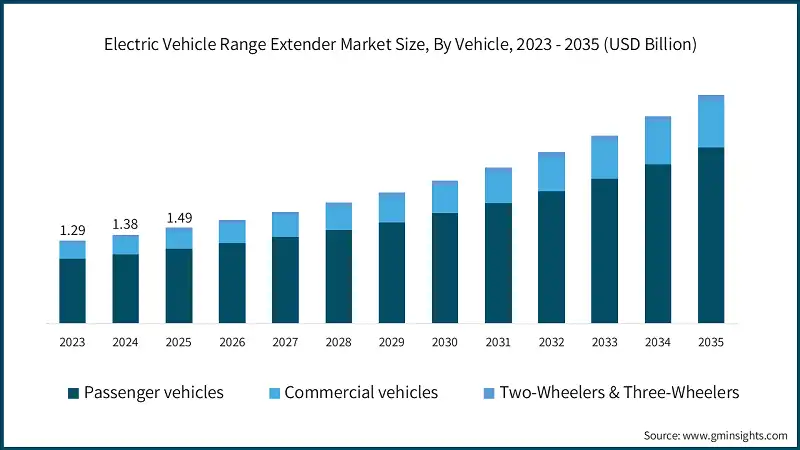
Based on vehicle, the market is divided into passenger vehicles, commercial vehicles and two-wheelers & three-wheelers. The passenger vehicles segment dominated the market with 77.8% share in 2025.
- The passenger vehicle segment is continuously expanding its dominance because EV buyers were primarily preventing themselves from buying an EV because of range constraints, but solutions like range extenders are solving the range issue, which was a bottleneck for the EV market to penetrate worldwide.
- Consumers want electric vehicles (EVs) with longer ranges for daily urban and suburban travel to avoid frequent charging. Range extenders help reduce range anxiety, especially in areas with less developed infrastructure, making family and luxury models like Scout Motors' 2025 Traveler more attractive. Government incentives for EV adoption have also made passenger EVs more practical for longer trips while keeping their environmental benefits.
- The passenger vehicle segment reached a value of USD 1.16 billion in 2025, fueled by massive EV sales volumes compared to commercial fleets, with OEMs like BMW and Nissan integrating range extenders for a competitive edge.
- Commercial vehicles are projected to grow at the fastest 10.4% CAGR from 2026 to 2035, as fleet operators demand uptime for long-haul routes where battery limitations hinder payload and charging. Regulations push heavy-duty electrification, with range extenders bridging battery density gaps for electric vans and trucks.
Learn more about the key segments shaping this market
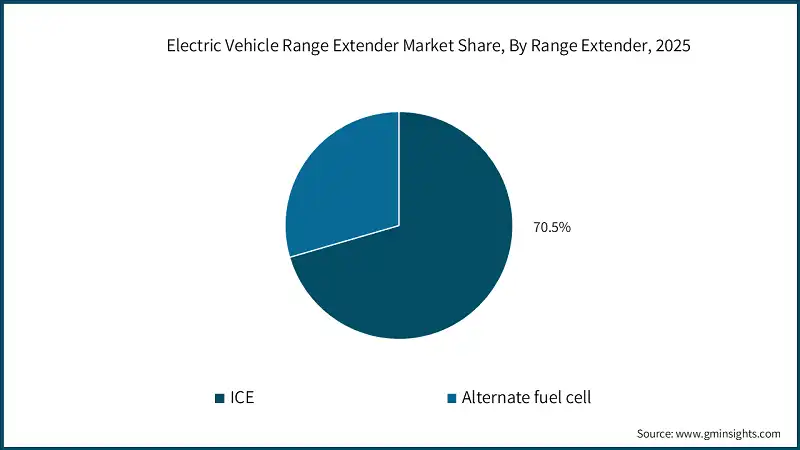
Based on range extender, the electric vehicle range extender market is divided into ICE and alternate fuel cell. The ICE segment accounts for 70.5% share in 2025 and is expected to grow at 9.6% CAGR between 2026 and 2035.
- Most of the OEMs in the range extender market offer ICE-based EV range extenders. For example, Volvo has been offering gasoline and ethanol propelled range extenders since its product inception.
- As an ICE range extender leverages mature engine technology and existing manufacturing lines, it is beneficial in reducing development and production expenses compared to emerging alternatives like fuel cells.
- These systems use widespread gasoline or diesel networks for instant refueling, enabling seamless long-distance travel without reliance on underdeveloped EV charging stations, which appeals to consumers and fleets.
- With the continuous advancements and research, OEMs like Stellantis and Mazda integrate ICE generators into hybrids for reliable power generation, shortening time-to-market and supporting high-volume adoption in passenger vehicles.
All of these instances suggest a mixed view of OEMs on EV range extenders, as players are testing niche propulsion technologies, this could add more market value to EV range extenders in coming years.
Based on power output, the electric vehicle range extender market is divided into Less than 30 kW, 30 kW - 100 kW and above 100 kW. The 30 kW - 100 kW segment led the market with USD 606.4 million in 2025.
- The majority of the market players are prioritizing EV range extenders with a power output between 30 kW and 100 kW. Thus, recent launches in the market have been seen with the power output of 30 kW - 100 kW.
- For instance, in September 2025, Mahle unveiled scalable range extender solutions for the transition to electric mobility. One of the most in-demand offerings, especially in China, is its new family of modular, scalable range extenders, delivering up to 1,350 km (WLTP) depending on vehicle model and battery size, an output of 85 kW, and a system voltage of 800 V.
- In coming years, above 100 kW EV range extenders will be used by commercial vehicles as the logistics companies and fleet operators are shifting towards EV trucks for long-haul services.
Looking for region specific data?
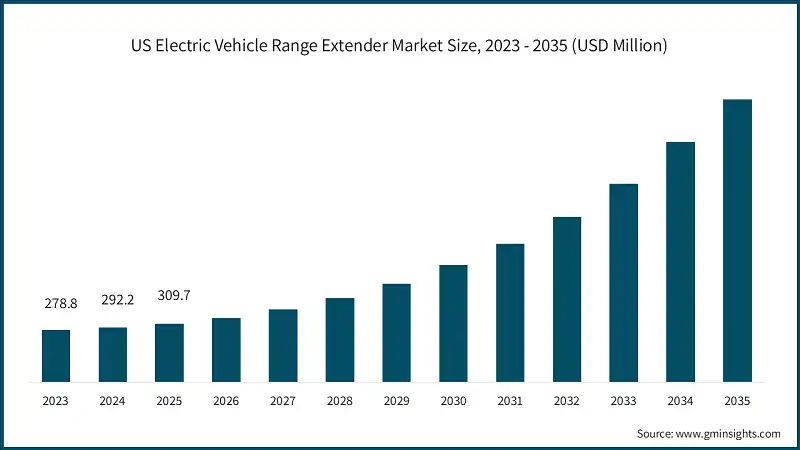
The U.S. electric vehicle range extender market reached USD 309.7 million in 2025, growing from USD 292.2 million in 2024.
- Policies that favor EV adoption across the U.S. states will add value in the EV range extender market. The majority of US states have specific policies in place to offer tax credits or purchase incentives for EVs.
- Additionally, the U.S. Department of Energy (DOE) Office of Manufacturing and Energy Supply Chains (MESC) provides grants of up to USD 500 million for the domestic production of hybrid, plug-in electric hybrid, plug-in electric drive, and hydrogen fuel cell electric vehicles and components through the Domestic Manufacturing Conversion Grants Program.
- Such supportive policies enable manufacturers of the EV range extenders to expand their production in the U.S. as they are increasingly being incentivized through such policies.
- For long-term success in the U.S., manufacturers have to focus on range extenders specifically designed for commercial vehicles. The U.S. is planning to replace many trucks with electric trucks under the Environmental Protection Agency GHG standards for HDVs for model years 2028-2032, which aim to reduce emissions from trucks and heavy buses by 25-60% in 2032 compared to 2026.
The North America region is estimated to reach USD 676.3 million by 2035 and is expected to grow at the CAGR of 6.8% between 2026 and 2035.
- In North America, government rules to lower emissions are encouraging the use of range extenders. These extenders help vehicles start cleaner and carry heavy loads, especially in medium-duty vehicles. Shared mobility services and fleets that are used often benefit from the extra power.
- For example, according to the U.S. Department of Transportation, as of June 2025, there were almost 580,000 active U.S. motor carriers registered with FMCSA that own or lease at least one tractor.
- The region’s dominance in freight operations uses range extenders to lower emissions on changing routes and to work with overnight charging. New designs heat up catalysts during electric driving, making them better than traditional hybrids. These features make range extenders an important step toward more electric vehicles as the market grows.
The Europe electric vehicle range extender market accounted for USD 451.1 million in 2025 and is anticipated to grow at the CAGR of 10.3% between 2026 and 2035.
- Under the European Commission's new plan, 90% of new cars sold from 2035 would have to be zero-emission. Such policies are indications for EV range extender manufacturers that Europe will boost the demand in the next coming years. Thus, the region is expected to grow at the fastest pace during the forecast period between 2026 and 2035.
- In the region, government incentives classify extenders as sustainable options, accelerating adoption alongside battery advancements. However, public charging stations are reducing range worries for intercity travel, increasing electric vehicle use in busy areas.
- Moreover, Europe is pouring significant resources into the hydrogen economy, with Germany and France spearheading the construction of hydrogen refueling stations. Fuel cells powered by hydrogen as a range extender provide a clean alternative to conventional fuels, adding them to the list of good options for zero emission vehicles that require more range.
Germany's electric vehicle range extender market is growing quickly in Europe, with a strong CAGR of 10.6% between 2026 and 2035.
- Germany's plan for electromobility includes range extenders (EREVs) along with BEVs and PHEVs to meet different travel needs. By separating the engine from direct driving, it can run more efficiently without sudden stress. Most trips rely on overnight home charging, while extenders handle longer or unexpected trips.
- OEMs, whether they are based in Germany or have their significant position in the country, are working together to improve extender standards, helping increase the use of E-plated vehicles.
- For instance, ZF Friedrichshafen is now introducing the new generation of Range Extender technology, which will go into volume production in 2026. Designed to meet increasing global demand, the longer-range and lower-emissions range extenders make electrified mobility attractive for a broad group of buyers.
- Moreover, freight and autonomous vehicles benefit from strong extenders that maintain load capacity and reduce downtime. Preheating the catalyst during electric operation helps lower emissions. These features make extenders important for sustainable city planning and transitioning vehicle fleets.
The Asia Pacific electric vehicle range extender market is estimated to reach USD 1.37 billion by 2035, by growing at a CAGR of 9.8% during the analysis timeframe.
- In Asia-Pacific, governments of China, Japan, and South Korea are actively promoting electric vehicle development through subsidies aimed at reducing pollution and fossil fuel consumption. Range extenders for hybrid vehicles are being used to make EV more acceptable in regions where there are vast distances between cities and few charging stations.
- Regional OEMs are introducing more models and labeling extenders as new energy vehicles to qualify for policy support. However, as cities grow quickly, more workplaces are adopting electric vehicles. Government incentives for improvement of the charging infrastructure and battery technology could hinder the growth.
China is estimated to grow with a CAGR of 9.2% in the projected period between 2026 and 2035, in the Asia Pacific electric vehicle range extender market.
- In China, range extenders are popular because they make electric vehicles more practical for daily use and help address gaps in charging infrastructure. Instead of needing frequent or long charging sessions, these vehicles can use regular fuel. This fuel powers a modified combustion engine that works as a generator to produce electricity for the electric motor while driving.
- For example, ZF shared in a press release that China is focusing heavily on "Range Extended Electric Vehicles" (REEV). With this technology, these vehicles can travel over 700 kilometers. This is one of the reasons why ZF's Chinese locations are leading the development efforts.
- Mahle is expanding its product range with transitional technologies. One of its most popular products in China is a new line of modular, scalable range extenders, offering power outputs from 30 kW to 120 kW.
Latin America electric vehicle range extender market is estimated to reach USD 73.5 million in 2025 and is anticipated to show lucrative growth over the forecast period.
- Brazil, Mexico, and Argentina have large distances between major cities. While charging stations are starting to appear in city centers, rural areas and highways still lack proper infrastructure. Range extenders help drivers cross these "charging deserts" without worrying about running out of power, making long-distance EV travel possible.
- In many parts of Latin America, the power grid is unstable and not strong enough to support widespread fast DC charging. Range extenders work like a small power plant inside the vehicle, reducing its need to rely on the local grid. This is especially important in areas with frequent power outages or in remote industrial locations without grid access.
Brazil is estimated to grow with a CAGR of 6.9% between 2026 and 2035, in the Latin America electric vehicle range extender market.
- Brazil has one of the most developed ethanol infrastructures in the world. Engineers in the country are designing range extenders to run on ethanol (flex-fuel) instead of just gasoline.
- Instead of creating a new fast-charging network, manufacturers can use the existing network of thousands of gas stations that already supply ethanol. Ethanol-powered range extenders often have a lower "well-to-wheel" carbon footprint compared to pure EVs that rely on coal-heavy grids.
- The Brazilian government’s Green Mobility and Innovation Program (MOVER) supports range-extended technologies with clear regulations. The program offers tax credits and incentives for vehicles that are energy-efficient and have low lifecycle emissions. These policies encourage global OEMs, like BYD and Great Wall Motors, to build local production lines for hybrid and range-extended systems instead of importing pure EVs, which face higher tariffs.
The Middle East and Africa accounted for USD 62.3 million in 2025 and is anticipated to show lucrative growth over the forecast period.
- The market for electric vehicle range extenders is expected to grow at a significant growth rate of 9.3% between 2026 and 2035. High temperatures in the MEA region affect the performance of battery electric vehicles (EVs). Heat speeds up the aging of lithium-ion batteries and requires constant use of cooling systems for the cabin and battery. Range extenders will be helpful in this scenario by providing extra power that allows these systems to keep running without draining the main battery.
- On the other hand, the region has strong logistics, mining, and defense industries. Heavy-duty vehicles in these sectors need to carry large loads across rough and hot terrains, which quickly uses up battery power. Range extenders help these vehicles switch to electric power while keeping the quick refueling and uptime needed for their operations.
UAE to experience substantial growth in the Middle East and Africa electric vehicle range extender market in 2025.
- The UAE people frequently travel from one city to another, such as Dubai, Abu Dhabi, and Al Ain. Fast desert driving is usually involved in these trips that aren't the best for electric motors. However, a range extender allows the cars to travel at full speed on the highway over a long distance without needing to stop for charging often, which is a normal situation for ordinary EVs, and even more so when carrying heavy loads or driving against strong winds.
- In spite of the rapid construction of urban charging stations in the UAE, some people still find it hard to use EVs. The ones living in detached houses or old high-rise buildings often do not have access to home charging. Range extenders make it possible for people to have electric vehicles and not totally depend on fast chargers in public places near their houses or workplaces.
- The UAE's strategy of investing heavily in becoming the global leader in Green and Blue Hydrogen has changed the energy scene by creating the possibility of Hydrogen Fuel Cell Range Extenders. The country is committing more to the hydrogen energy route in its planning, and these range extenders are projected as being the critical solution for heavy trucks and urban transportation that have long routes and cannot wait too long for a refill.
Electric Vehicle Range Extender Market Share
The top 7 companies in the electric vehicle range extender industry are Mahle, AB Volvo, Schaeffler, Horse Powertrain, Valeo, AVL and Hyundai Mobis, contributing 27.9% of the market in 2025.
- Mahle offers compact and efficient EV range extender solutions based on small combustion engines and generator systems. Its offerings focus on seamless integration with electric powertrains for passenger and light commercial vehicles.
- AB Volvo provides range extender solutions mainly for electric trucks and commercial vehicles. These systems support long-haul operations by ensuring extended driving range and consistent performance, especially for demanding logistics, construction, and regional transport applications.
- Schaeffler develops modular range extender systems combining electric motors, power electronics, and efficient generators. Its solutions emphasize lightweight design and smooth integration with EV architectures, supporting both passenger cars and commercial vehicle platforms.
- Horse Powertrain offers flexible range extender and hybrid powertrain solutions designed as transition technologies.
- Valeo provides compact electric range extender components including generators, inverters, and control systems.
- AVL offers complete range extender development solutions, including engines, generators, battery integration, and system calibration. Its offerings support OEMs from concept to production.
- Hyundai Mobis develops integrated range extender modules combining power electronics, motors, and control software. These solutions are designed for easy platform integration enhanced driving range across next-generation electric and hybrid vehicles.
Electric Vehicle Range Extender Market Companies
Major players operating in the electric vehicle range extender industry are:
- Mahle
- AB Volvo
- Schaeffler
- Horse Powertrain
- Valeo
- AVL
- Hyundai Mobis
- ZF Group
- Li Auto
- Mazda
- Mahle has its expertise in engine and thermal management technologies. The company designs compact and low-emission range extender systems that work well with electric vehicle powertrains for both passenger cars and light commercial vehicles.
- AB Volvo is known for its expertise in commercial vehicles and long-haul transport. It uses this experience to create reliable range extenders for electric trucks, focusing on durability and efficiency for fleet operations.
- Schaeffler focuses on powertrain systems and e-mobility technologies. Its range extenders are lightweight and modular, making them easy to use in both passenger and commercial electric vehicles.
- Horse Powertrain works on hybrid and range extender powertrains. It offers flexible and scalable solutions that help automakers balance battery-only range with extended driving distances, supporting the shift to full electrification.
- Valeo specializes in power electronics and electric drivetrains. For EV range extenders, it provides efficient generators, inverters, and control systems that improve energy use and extend vehicle range without needing major changes to the platform.
- AVL is experienced in powertrain development and calibration. It combines engines, generators, and battery systems to create EV range extenders that are efficient and perform well in real-world driving conditions.
- Hyundai Mobis focuses on modular vehicle electronics and integrated powertrain systems. Its range extenders combine motors, inverters, and control software to improve energy efficiency and extend range across different EV platforms.
Electric Vehicle Range Extender Market Report Attributes
| Key Takeaway | Details |
|---|---|
| Market Size & Growth | |
| Base Year | 2025 |
| Market Size in 2025 | USD 1.49 Billion |
| Market Size in 2026 | USD 1.6 Billion |
| Forecast Period 2026 - 2035 CAGR | 9.2% |
| Market Size in 2035 | USD 3.54 Billion |
| Key Market Trends | |
| Drivers | Impact |
| Rising Consumer Range Anxiety | Persistent fear of battery depletion increases demand for range extender systems, improving driving confidence and supporting wider EV adoption across passenger and commercial segments. |
| Growth in Electric Commercial and Fleet Vehicles | Fleet operators prioritize operational uptime and route flexibility, driving adoption of range extenders to minimize downtime and ensure consistent vehicle utilization. |
| Expansion of EV Adoption in Emerging Markets | Growing EV penetration in cost-sensitive markets with uneven infrastructure accelerates demand for range extenders as a practical transitional mobility solution. |
| Limited Charging Infrastructure in Rural and Highway Areas | Insufficient public charging coverage boosts reliance on range extenders, enabling long-distance travel and supporting EV usability beyond urban centers. |
| Pitfalls & Challenges | Impact |
| Rapid Expansion of Fast-Charging Infrastructure | Widespread fast-charger deployment reduces dependency on auxiliary power systems, limiting long-term demand growth for EV range extender solutions |
| Increasing Battery Energy Density and Cost Decline | Improved battery performance and affordability extend pure-electric driving range, gradually diminishing the functional necessity of range extender systems. |
| Opportunities: | Impact |
| Range Extenders for Electric Trucks and Vans | Heavy-duty electric trucks and vans benefit from range extenders by achieving longer operating cycles and reduced charging interruptions. |
| Retrofitting Solutions for Existing EV Platforms | Aftermarket range extender retrofits extend vehicle usability, creating new revenue streams and increasing adoption among early-generation EV owners. |
| Emerging Markets with Infrastructure Gaps | Infrastructure shortages in developing regions create strong opportunities for range extenders to enable reliable EV operation without complete charging networks. |
| Hydrogen and E-Fuel-Based Range Extender Systems | Low-emission hydrogen and e-fuel technologies enhance sustainability, positioning advanced range extenders as compliant solutions under tightening environmental regulations. |
| Market Leaders (2025) | |
| Market Leaders |
6.6% market share |
| Top Players |
|
| Competitive Edge |
|
| Regional Insights | |
| Largest Market | Asia Pacific |
| Fastest growing market | Europe |
| Emerging countries | Mexico, India, UAE, Vietnam, Brazil, Saudi Arabia |
| Future outlook |
|
What are the growth opportunities in this market?
Electric Vehicle Range Extender Industry News
- In November 2025, Xpeng Motors launched its first range-extended electric vehicle (REV), the X9 Super Range-Extender. This model uses a compact 9-in-1 rear axle, which creates more cabin space. Xpeng also plans to roll out fast-charging stations on a large scale by 2026.
- In August 2025, Mahle introduced its Scalable Range Extender Solutions to support the shift to electric mobility. Since the global move to electric vehicles (EVs) is slower than expected, Mahle is expanding its range of transitional technologies.
- In June 2025, Li Auto partnered with Shell to develop high-performance lubricants for Li Auto's range-extended electric vehicle (REEV) systems. They also agreed to set up operational systems together.
- In May 2025, Stellantis signed a deal with ABC to distribute Leapmotor in Mauritius. The C10, a family-friendly D-segment vehicle with a WLTP range of 420 km and a 5-star Euro NCAP rating, will be sold as both a BEV (battery electric vehicle) and an REEV (range extender electric vehicle).
- In April 2025, ZF announced it would launch a new generation of its technology, which will go into mass production in 2026. The technology will offer output ranges of 70 to 110 kW (eRE) and 70 to 150 kW (eRE+).
The electric vehicle range extender market research report includes in-depth coverage of the industry with estimates & forecasts in terms of revenue ($ Mn/Bn) and volume (units) from 2022 to 2035, for the following segments:
Market, By Range Extender
- ICE
- Diesel
- Gasoline
- Rotary
- Alternate fuel cell
- Natural gas
- Hydrogen
- Biofuel
Market, By Power Output
- Less than 30 kW
- 30 kW - 100 kW
- Above 100 kW
Market, By Component
- Battery Pack
- Power Converter
- Electric Motor
- Generator
- Others
Market, By Vehicle
- Passenger vehicles
- Sedan
- SUV
- Hatchback
- Commercial vehicles
- LCV
- MCV
- HCV
- Two-Wheelers & Three-Wheelers
Market, By Application
- Corporate/logistics fleet
- Ridesharing/taxi/rental services
- Personal vehicles
Market, By Sales Channel
- OEM
- Aftermarket
The above information is provided for the following regions and countries:
- North America
- US
- Canada
- Europe
- Germany
- UK
- France
- Italy
- Spain
- Russia
- Nordics
- Benelux
- Asia Pacific
- China
- India
- Japan
- South Korea
- ANZ
- Singapore
- Malaysia
- Indonesia
- Vietnam
- Thailand
- Latin America
- Brazil
- Mexico
- Argentina
- Colombia
- MEA
- South Africa
- Saudi Arabia
- UAE
Frequently Asked Question(FAQ) :
What is the market size of the electric vehicle range extender in 2025?
The market size exceeded USD 1.49 billion in 2025, with a CAGR of 9.2% expected through 2035 driven by the global push toward electric vehicle adoption and persistent range anxiety concerns.
What is the projected value of the electric vehicle range extender market by 2035?
The electric vehicle range extender market is expected to reach USD 3.54 billion by 2035, propelled by growth in electric commercial vehicles, expansion in emerging markets, and limited charging infrastructure in rural areas.
What is the current electric vehicle range extender market size in 2026?
The market size is projected to reach USD 1.6 billion in 2026.
How much market share did the passenger vehicles segment capture in 2025?
The passenger vehicles segment dominated the market with 77.8% share in 2025, reaching a value of USD 1.16 billion, driven by consumer demand for longer ranges and reduced range anxiety.
What was the market share of the ICE segment in 2025?
The ICE segment accounted for 70.5% share in 2025 and is expected to grow at 9.6% CAGR between 2026 and 2035, leveraging mature engine technology and existing refueling infrastructure.
What is the growth outlook for commercial vehicles from 2026 to 2035?
Commercial vehicles are projected to grow at the fastest 10.4% CAGR from 2026 to 2035, as fleet operators demand uptime for long-haul routes and regulations push heavy-duty electrification.
Which region leads the electric vehicle range extender market?
The U.S. electric vehicle range extender market size exceeded USD 309.7 million in 2025, supported by state-level EV policies, tax credits, and purchase incentives driving adoption.
What are the upcoming trends in the electric vehicle range extender market?
Key trends include adoption of micro fuel cells and micro turbines, hydrogen and e-fuel-based systems, modular scalable solutions with 30-100 kW power output, and retrofitting solutions for existing EV platforms.
Who are the key players in the electric vehicle range extender market?
Key players include Mahle, AB Volvo, Schaeffler, Horse Powertrain, Valeo, AVL, Hyundai Mobis, ZF Group, Li Auto, Mazda, Stellantis, BYD, Huawei, Leapmotor, Magna, Ballard, FEV Group, Plug Power, Scout Motors, Bosch Engineering, and XPeng Motors.
Electric Vehicle Range Extender Market Scope
Related Reports