Summary
Table of Content

Electric Vehicle Charging Cable Market
Get a free sample of this report
Form submitted successfully!
Error submitting form. Please try again.
Thank you!
Your inquiry has been received. Our team will reach out to you with the required details via email. To ensure that you don't miss their response, kindly remember to check your spam folder as well!
Request Sectional Data
Thank you!
Your inquiry has been received. Our team will reach out to you with the required details via email. To ensure that you don't miss their response, kindly remember to check your spam folder as well!
Form submitted successfully!
Error submitting form. Please try again.
Electric Vehicle Charging Cable Market Size
In terms of units, the year 2025 is accounting for around 29.8 million electric vehicle charging cable units sold. The electric vehicle charging cable units are projected to surpass 57.3 million units by 2035 at a CAGR of around 6.8% between 2026 and 2035.
Electric Vehicle Charging Cable Market Key Takeaways
Market Size & Growth
- 2025 Market Size: USD 1.9 Billion
- 2026 Market Size: USD 2.1 Billion
- 2035 Forecast Market Size: USD 5.1 Billion
- CAGR (2026–2035): 10.6%
Regional Dominance
- Largest Market: Asia Pacific
- Fastest Growing Region: Europe
Key Market Drivers
- Rapid Global EV Adoption & Electrification Mandates.
- Government Incentives & Charging Infrastructure Investments.
- Technological Advancements in Fast Charging & Liquid Cooling.
- Growing Consumer Demand for Convenient Charging Solutions.
Challenges
- Thermal Management & Heat Dissipation Challenges.
- Lack of Universal Connector Standardization.
Opportunity
- Expansion of Ultra-Fast Charging Networks (350kW+).
- Emerging Markets with Low EV Penetration Rates.
- Development of Lightweight & Sustainable Cable Materials.
Key Players
- Market Leader: Phoenix Contact led with over 13.1% market share in 2025.
- Leading Players: Top 5 players in this market include Aptiv, LEONI, Phoenix Contact, Prysmian, TE Connectivity, which collectively held a market share of 52.1% in 2025.
Get Market Insights & Growth Opportunities
Electric vehicle (EV) charging cables are growing as the electric vehicle market is growing. The EV market is very dynamic due to the imposition of tariffs, trade hurdles, regulations and battery material prices. These cables are playing an important part in the EV supply equipment (EVSE) industry. These cables connect charging stations to vehicles. They must follow strict international rules like IEC 62196 and IEC 61851 to ensure safe and compatible charging for AC and DC systems.
Government policies with respect to EVs are one of the major reasons for the market’s year-on-year growth. For example, in the U.S., the National Electric Vehicle Infrastructure (NEVI) standards require charging projects funded by the government to meet safety and quality rules. In the UK and EU, governments are also pushing for strong and standardized cables for public and home charging stations. These all regulations sometimes become hurdles and sometimes help the market grow.
Top companies like Phoenix Contact are improving cable technology to meet market needs. New cables include high-power connectors that can handle over 1 MW and designs that work with different vehicles. These new cables allow faster charging and prepare for future needs like connecting to the power grid.
The market is divided by power type (AC or DC), connector type (Type 1, Type 2, CCS), and cable length. Shorter AC cables are used for home charging, while longer DC cables are used for fast charging on highways and in public areas. The market is expected to grow as more people use EVs. Both private and public charging stations will help this growth.
In terms of dominance, China leads in the total EV ecosystem. About two-thirds of the growth in public chargers since 2020 has occurred in China, which now has about 65% of the charging and 60% of the electric light-duty vehicle stock globally.
Large companies that produce parts and connectors for cars are dominating the EV charging cable industry. New technologies are emerging to meet the growing demand of EV trends. Car manufacturers use standardized charging parts and charging station operators require good quality cables. Factors such as materials, controlling heat, and easy installation play an important role in buying decisions.
The global electric vehicle charging cable market was valued at USD 1.9 billion in 2025. The market is expected to grow from USD 2.1 billion in 2026 to USD 5.1 billion in 2035 at a CAGR of 10.6%, according to latest report published by Global Market Insights Inc.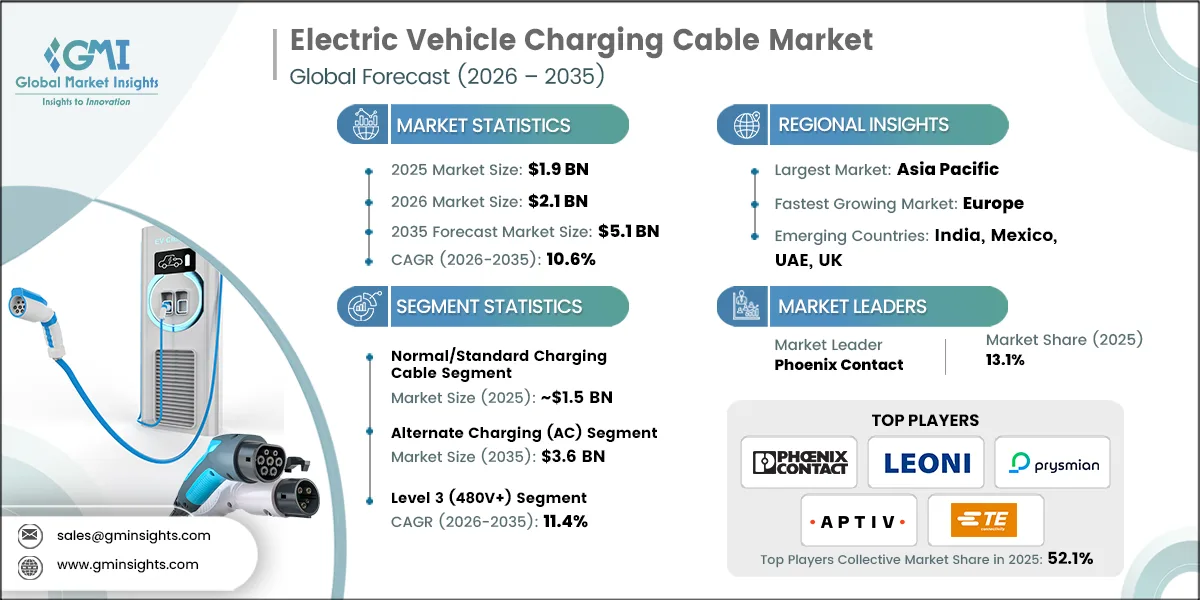
To get key market trends
Electric Vehicle Charging Cable Market Trends
Charging cable makers are working on new designs to meet changing needs. High-power DC fast charging needs better insulation, lighter cables, and improved heat management. Liquid-cooled cables are being used more to allow faster charging without making cables too heavy. Smart connectors with communication features are helping manage power loads and grids.
In terms of EV sales, the market is growing fast, which is creating more demand for charging stations. Thus, it is increasing the need for charging cables in both OEM and aftermarket markets. The European Automobile Manufacturers’ Association (ACEA) said battery-electric vehicle sales went up by 51% in December 2025 compared to the year before. More EV sales mean more demand for charging cables and home chargers. Also, old slow chargers are being replaced with faster AC and DC chargers, creating more demand in the aftermarket.
In developing countries, EV sales are also growing, giving charging cable manufacturers more opportunities. The International Energy Agency (IEA) said EV sales in Asia, Europe, Latin America, and Africa grew by over 60% in 2024 compared to 2023. This fast growth means more charging stations are needed, which increases the need for standardized charging cables. As new markets build charging stations, suppliers benefit from first-time sales and future replacements.
The electrification of buses, delivery vans, and heavy trucks is creating the need for strong charging cables. The cables have to carry high power and withstand the high rate of use. Liquid-cooled cables are required for the megawatt charging systems of heavy vehicles. The cables have to perform well under the high temperature. The need for zero-emitting vehicles is creating the demand for these cables.
Electric Vehicle Charging Cable Market Analysis
Learn more about the key segments shaping this market
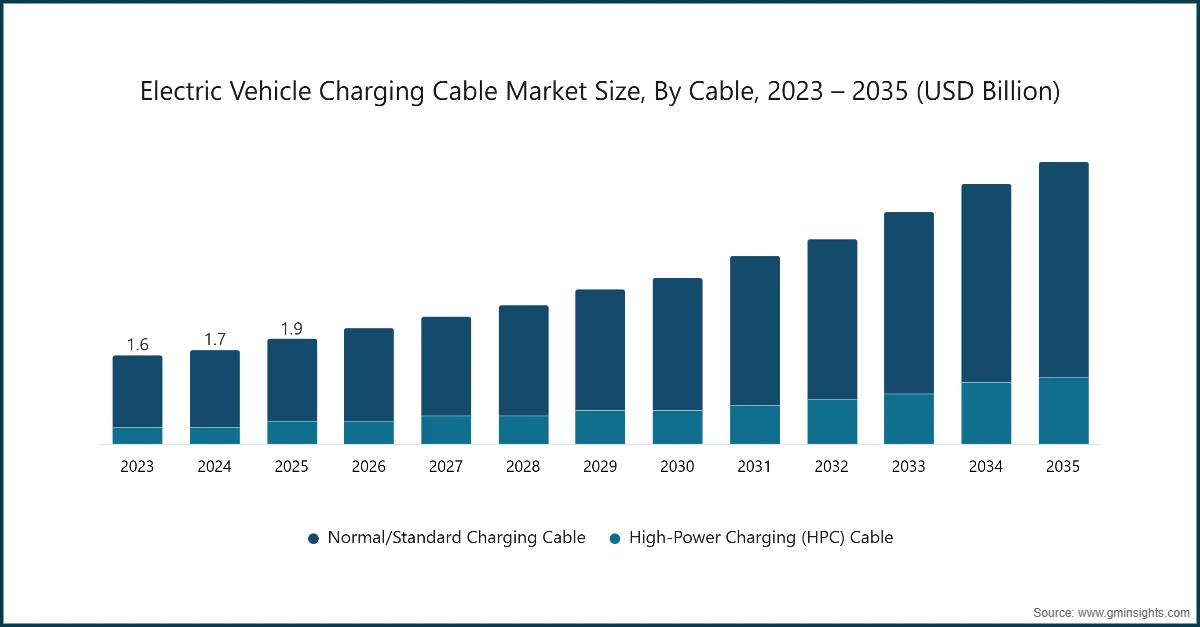
Based on cable, the electric vehicle charging cable market is divided into normal/standard charging cable and high-power charging (HPC) cable. The normal/standard charging cable segment dominated the market with market share of around 80.7% and generating revenue of around USD 1.5 billion in 2025.
- The majority of EV charging sessions happen at residential and work locations, which require sufficient and preferred AC charging infrastructure. The standard cables are fully compatible with the commonly deployed AC wall boxes and public AC chargers, which are the defaults with new vehicles and also the most commonly purchased cables separately.
- The widespread deployment of AC chargers compared to the deployment of DC fast chargers is the reason behind the dominance of the normal/standard charging cable segment. According to the International Energy Agency, the majority of publicly accessible chargers are AC units. Since the normal/standard charging cables are designed specifically for AC charging, the demand for these cables is directly proportional to the deployment of AC charging.
- Another factor is the cost efficiency and standardization of the normal/standard charging cable. This is because, for standard AC cables, the complexity level is lower compared to high-power charging cables, which require liquid cooling systems. This means that the overall cost will be lower, making it easier for the product to be manufactured on a large scale, while also being lighter for users. In addition, regulatory requirements for countries such as the European Union require the standardization of types of connectors, such as Type 2, which helps the product maintain its high market share.
Learn more about the key segments shaping this market
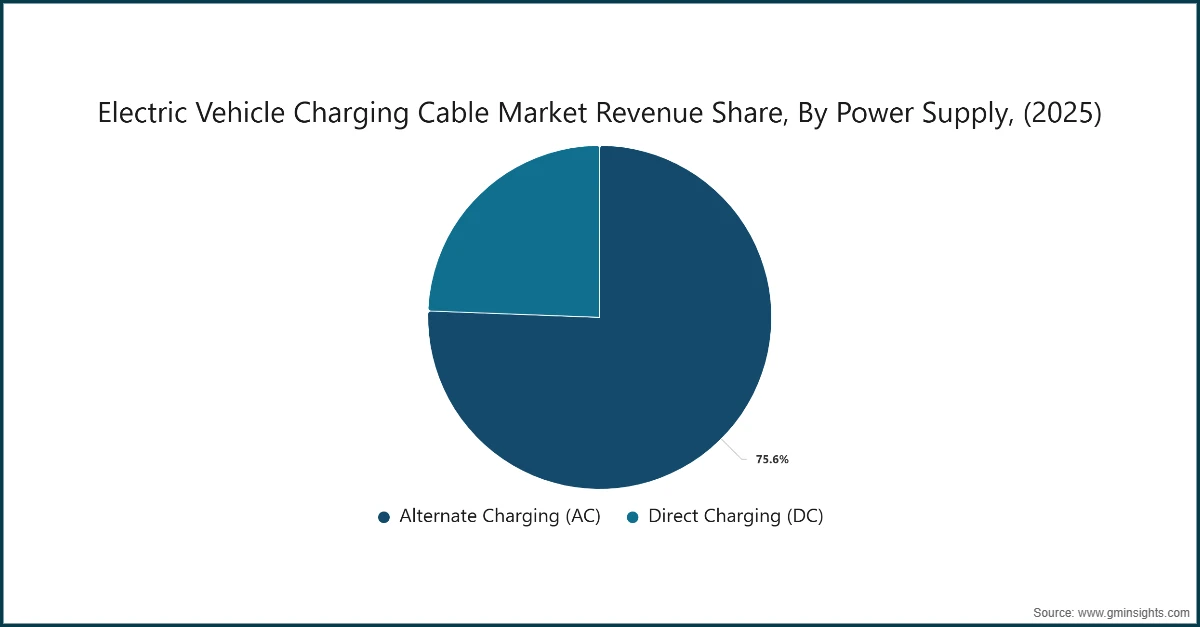
Based on power supply, the electric vehicle charging cable market is divided into alternate charging (AC) and direct charging (DC). The alternate charging (AC) segment accounts for 75.6% in 2025 and is expected to reach USD 3.6 billion by 2035.
- The dominance of the alternate current (AC) charging segment is largely due to the fact that most people charge their cars at home and in the workplace, and in most cases, people don’t require high-powered DC charging. Therefore, the AC cables are the most preferred and cost-effective solution for most people across the world.
- AC cables supports the high level of compatibility with the overall infrastructure. AC charging points, whether they are publicly or privately owned, far outnumber the availability of DC fast charge points, especially in emerging markets. The majority of electric vehicles sold are designed with compatibility with AC charging in mind, often including the charging cable as part of the initial purchase for home use.
- The segment of DC fast charging is seeing rapid growth as the demand for high-speed EV charging is on the rise, especially on highways or commercial areas. As the adoption of EVs is on the rise, people want minimum downtime, thus making the segment of DC fast charging essential for the accelerated adoption of EVs. Therefore, this segment is expected to grow at the fastest CAGR of 12.4% between 2026 and 2035. The investment in ultra-fast charging is further contributing to the accelerated adoption of DC high-power cables globally.
Based on charging level, the electric vehicle charging cable market is divided into Level 1 (120V), Level 2 (240V) and Level 3 (480V+). The Level 3 (480V+) segment is expected to grow at the fastest CAGR of 11.4% between 2026 and 2035.
- The Level 3 (480V+) segment is also expected to experience the highest growth rate mainly due to the increasing demand for ultra-fast charging stations. Level 3 charging stations, also known as DC Fast Charging, enable the batteries of EVs to be charged up to 80% in less than 30 minutes, which helps alleviate the "range anxiety" and "convenience" issues faced by EV users. This segment has the potential to provide considerable time savings for EV users, compared to Level 1 and Level 2 charging stations.
- The operations of logistics fleets, buses, as well as highway corridor EV charging stations, demand Level 3 cables to ensure operational efficiency. Since these services cannot wait for the lengthy periods associated with AC charging, EV cables rated for 480V+ fast charging are being specified for new builds.
- Manufacturers are investing heavily in developing better materials and ergonomic designs to improve the durability and minimize thermal stress while performing high current charge cycles repeatedly. Additionally, the worldwide move towards standardized connectors like CCS and CHAdeMO for fast-charging stations further enhances the growth prospects of this segment over the coming decade.
Based on application, the electric vehicle charging cable market is divided into private charging and public charging. The private charging segment is expected to grow at the fastest CAGR of 10.2% between 2026 and 2035.
- Public charging stations are vital for commuters, highway infrastructure, and businesses, especially for those who cannot charge privately at home. With governments and businesses investing heavily in public infrastructure, the need for quality, standardized EV charging cables for public infrastructure drives the segment's growth.
- Government-backed infrastructure development programs like the U.S.-based National Electric Vehicle Infrastructure program, or NEVI, and the EU-based Alternative Fuels Infrastructure Regulation, or AFIR, which require the development of accessible public charging points along highways and urban routes.
- These programs necessitate the use of standard AC and DC connectors, thus directly driving the need for certified charging cables. Public infrastructure development in Asia, Europe, and North America provides a strong base for future demand for durable, high-performance charging cables.
- As urban areas implement EV-friendly policies and emission-free zones, public charging points will be utilized by residents who lack private garages and commercial entities with high-capacity charging requirements. DC high-power fast chargers are typically deployed in public areas to accommodate high-rate charging demands, thus creating demand for high-capacity, heavy-duty cables.
Looking for region specific data?
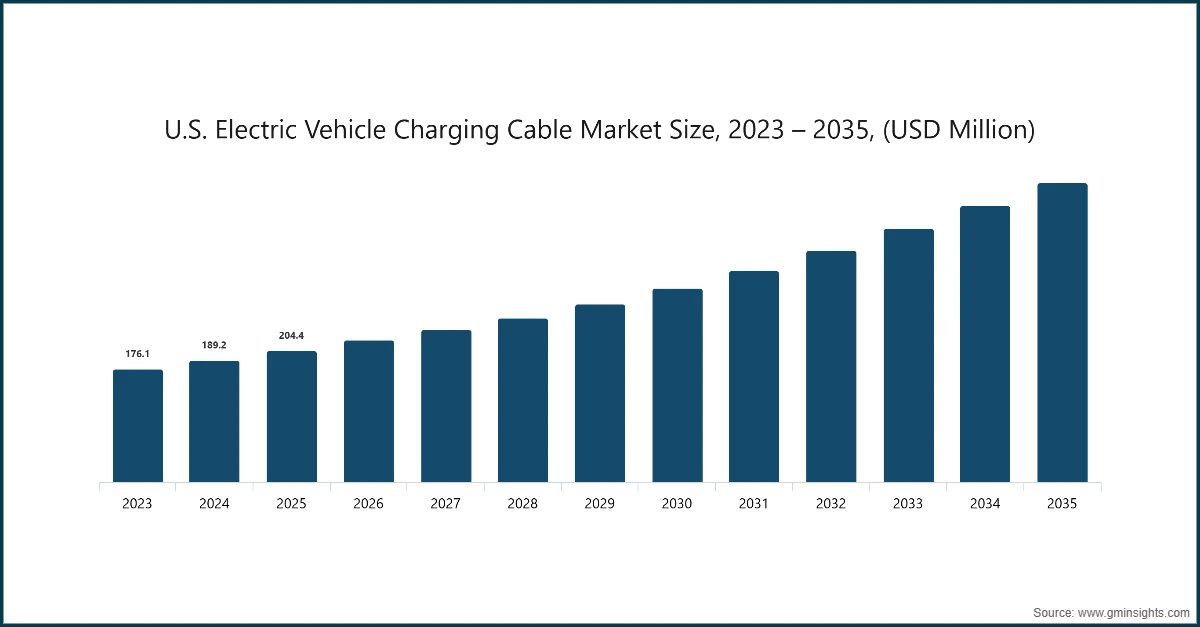
The US electric vehicle charging cable market reached USD 204.4 million in 2025 and growing at a CAGR of 8.6% between 2026-2035.
- In the country, local players are expanding their EV charging stations, which will increase the need for charging cables. Following sustainability and environment protection awareness supports EV sales. Programs like the NEVI Formula Program aim to build a nationwide public charging network. This includes DC fast charging along highways, which increases the need for high-power DC charging cables.
- The Bipartisan Infrastructure Law provided USD 7.5 billion to support EV charging, including public fast chargers. Some delays have happened due to legal and administrative issues, but charging infrastructure is still growing. Private companies like EVgo and Electrify America are also adding more fast-charging stations. In 2025, the U.S. added over 18,000 new DC fast-charging ports, bringing the total number of public fast chargers to over 70,000.
- Standardization is important for the charging cable market. The Combined Charging System (CCS) connector is widely used in public fast-charging stations, making it easier to expand networks and helping cable makers. Changes to Buy America rules for federally funded projects may also increase the use of locally made parts, boosting U.S. production and changing supply chains.
- Changes in government funding and legal issues have caused short-term uncertainty. This could affect how cable makers plan and buy materials. Still, the growth of charging infrastructure and private investments is creating strong demand for charging cables for both AC and DC fast chargers.
The North America region is valued at USD 227.6 million in 2025. In terms of volume, the EV charging cable market is estimated to exceed 3.8 million units in the same year.
- North America, led by the U.S. and Canada, is a big part of the market. This is because there are more charging stations, good policies, and more people using EVs. In the U.S., government programs and state support help install public fast chargers and home chargers. In Canada, places like Ontario and Quebec give support for home and public chargers, which increases the number of charging stations.
- A big trend in North America is building fast-charging stations on highways and in cities. These stations help with long trips and electric business vehicles. High-power chargers need stronger cables, so there is more demand for these cables at public stations. Power companies are also working with charging companies to use smart chargers. These chargers help manage energy and affect the design of cables, especially in places with many chargers.
The Europe region holds 23.2% of the electric vehicle charging cable market in 2025 and is expected to grow at the fastest CAGR of 11.9% between 2026 and 2035.
- European demand for EV charging cables is driven by strong public policies and targets for a zero-emission future. The European Union's Alternative Fuels Infrastructure Regulation (AFIR) provides a regulatory framework for deploying public EV charging points on major roads, including the requirement for fast-charge points at regular intervals on these roads supporting cable demand for AC as well as DC stations.
- According to IEA, a substantial increase in the number of public charging points was achieved in all EU member states, reaching a total of more than 1 million charging points in the EU, representing a year-over-year increase of more than 35% in 2024. Such a strong increase in charging points directly translates to the need for standardized and ruggedized cables in line with European connectivity and safety standards.
- Regional trends indicate that urban centres and highways are the main areas of focus. The EU is also focused on ultra-fast charging rollout, with power output set to reach a minimum by 2027, which will enable the transition to high-performance cables with good thermal and electrical properties.
Germany's EV charging cable market is growing quickly in Europe, with a CAGR of 11.4% between 2026 and 2035.
- Germany is the largest EV charging infrastructure market in Europe and an important testing ground for the market. It has made considerable progress in the deployment of EV charging infrastructure across the country. The country has over 172,000 publicly accessible charging points by 2025, including over 40,000 fast charging points.
- The “Masterplan Ladeinfrastruktur 2030” by the German government outlines the strategic direction for the deployment of public and non-public charging points across the country. This would include initiatives to boost demand, streamline the planning process, and facilitate the integration of charging infrastructure into the grid.
- Germany’s aggressive climate targets and zero-emission mobility strategies are seen in the country’s goal to install 1 million public charging points by 2030. Although the current rate of rollout makes this goal difficult to achieve, the growth rate of public charging points continues to create opportunities for cable suppliers.
The Asia Pacific region is expected to grow the fastest at the CAGR of 10.5% between 2026 and 2035 in the electric vehicle charging cable market.
- In Asia Pacific, the development of EV infrastructure is complemented by the increasing adoption of electric vehicles in key countries in the Asia Pacific, including China, Japan, South Korea, and India. Asia Pacific holds a significant share of the market, with Asia Pacific representing 60.2% of the total global value in 2025.
- Significantly, government support is a major factor driving the development of electric vehicle charging infrastructure in Asia Pacific, including incentives for the purchase of electric vehicles, subsidies for installing charging infrastructure in public and private establishments, and ambitions to increase the share of electric vehicles in the national fleet of vehicles.
- In Asia Pacific, countries including Japan and South Korea are focusing on developing high-power charging infrastructure, including smart charging solutions, while in India, the government is working to increase the number of public charging points in the coming years, thus creating a competitive environment in Asia Pacific for cable technology and solutions.
China is estimated to grow with a CAGR of 10.2% in the projected period between 2026 and 2035, in the Asia Pacific electric vehicle charging cable market.
- China is the leader in EV charging infrastructure development on a global scale, as indicated by large-scale government planning and coordination of industrial activities. Chinese official statistics show that China has achieved a total of nearly 17.35 million units of EV charging infrastructure as of 2025.
- China has made significant policies towards developing a comprehensive EV charging infrastructure to cater to the world’s largest fleet of electric vehicles. According to the China Electric Vehicle Charging Infrastructure Promotion Alliance, the stock of public EV charging points is increasing rapidly, especially in urban areas.
- This is a large-scale development of EV charging infrastructure, which is a major driving force behind the market. The focus on developing a comprehensive EV charging infrastructure is a significant aspect of the Chinese market, as cable manufacturers are developing AC and high-power DC cables.
Mexico is estimated to grow with a CAGR of 8.1% between 2026 and 2035, in the Latin America electric vehicle charging cable market.
- In Mexico, the development of EV charging stations is still in its early stages but growing rapidly. The Mexican EV cable market has a smaller share in the region, which reflects the early development of public EV charging stations and the gradual growth of EV adoption. However, the development of EV charging networks along major urban and inter-city routes is gradually increasing the need for standard charging solutions.
- The key factors that contribute to the growth of the Mexican EV cable market include the growing sales of EVs, particularly with the availability of more affordable models and manufacturers’ efforts to market their EV versions. The Mexican government, although lagging behind its neighbors, has initiated the promotion of EV charging stations, mainly in urban areas. The collaboration between EV charging service providers and other stakeholders has also fueled the growth of EV charging stations, measured by the number of charging points.
- The geographical location of Mexico, which connects North America, indirectly contributes to the growth of the Mexican EV cable market, particularly with regard to international EV travel and the development of EV infrastructure.
UAE to experience substantial growth in the Middle East and Africa electric vehicle charging cable market in 2025.
- UAE government plans for sustainable development, such as the Green Mobility Vision for Dubai, aim to provide a cleaner environment and facilitate the development of green transport, which directly affects the development of EV charging infrastructure.
- Although the density of EV charging infrastructure development is lower compared to other countries, large-scale developments, especially public-private partnerships, are developing public EV charging infrastructure, especially in urban centers and along major highways.
- Some major growth drivers for the United Arab Emirates EV charging infrastructure market include the development of fast-charging stations for ride-hailing services and logistics, which can be attributed to the development of green transport. However, the United Arab Emirates faces some limitations, such as grid limitations and the unavailability of local manufacturers for EV components.
Electric Vehicle Charging Cable Market Share
The top 7 companies in the electric vehicle charging cable industry are Aptiv, Dyden, Huber+Suhner, LEONI, Phoenix Contact, Prysmian and TE Connectivity contributing 65.7% of the market in 2025.
- Aptiv makes EV charging cables and high-voltage assemblies for AC and DC charging. Their products include temperature control, safety features, and meet global standards for use in infrastructure and with car manufacturers.
- Dyden makes EV charging cables. They focus on strong conductor materials and reliable cable designs for AC and DC charging in public and private charging setups worldwide.
- Huber+Suhner makes high-power charging cables and connectors. Their products, like liquid-cooled HPC cables, are built for fast DC charging, handling high currents, and working well in tough conditions.
- LEONI offers EcoSense AC and DC cables in straight and coiled designs. These cables are approved internationally and are made for home, public, and fast charging, with easy handling and lightweight designs.
- Phoenix Contact provides EV charging connectors and cables for AC and DC stations. Their products are strong, meet global standards, and work in modular charging setups for homes and public areas.
- Prysmian’s PRYCHARGE EV cables are flexible and lightweight for AC and DC charging. They are durable, meet global standards, and can handle heavy use and tough environments.
- TE Connectivity makes EV charging cables and connectors for AC and DC stations. Their products handle high currents, work reliably, and support different charging speeds and setups worldwide.
Electric Vehicle Charging Cable Market Companies
Major players operating in the electric vehicle charging cable industry are:
- Aptiv
- BRUGG
- Coroplast
- Dyden
- Huber+Suhner
- LEONI
- Phoenix Contact
- Prysmian
- Sinbon Electronics
- TE Connectivity
- Aptiv designs EV charging cables that are powerful and work well with vehicles. They work with automakers to create fast-charging solutions for the future.
- LEONI makes high-quality EV charging cables, including ones that are cooled with liquid and can handle heat. The company works closely with automakers and has factories worldwide to meet growing demand.
- Dyden makes industrial-grade EV charging cables. These cables are strong and efficient, and the company offers customized solutions for new and special charging needs.
- Huber+Suhner makes high-performance EV charging cables, including liquid-cooled ones. Their cables are reliable and designed for fast-charging stations.
- Phoenix Contact makes advanced EV charging cables. These cables are powerful, safe, and work with many systems. The company works with charging networks to provide reliable and scalable solutions worldwide.
- Prysmian is one of the major global players in the EV cables. They use their expertise to create strong and customized EV charging cables for different needs in the market.
- TE Connectivity creates strong and durable EV charging cables. They use advanced materials and have a global team to support automakers and charging infrastructure projects.
Electric Vehicle Charging Cable Market Report Attributes
| Key Takeaway | Details |
|---|---|
| Market Size & Growth | |
| Base Year | 2025 |
| Market Size in 2025 | USD 1.9 Billion |
| Market Size in 2026 | USD 2.1 Billion |
| Forecast Period 2026-2035 CAGR | 10.6% |
| Market Size in 2035 | USD 5.1 Billion |
| Key Market Trends | |
| Drivers | Impact |
| Rapid Global EV Adoption & Electrification Mandates | Accelerates demand for high-performance charging cables, pushing manufacturers to scale production, enhance durability, and support higher power capacities across expanding public and private EV infrastructure. |
| Government Incentives & Charging Infrastructure Investments | Public funding and policy incentives stimulate large-scale charging station deployment, increasing demand for advanced, compliant, and cost-efficient charging cable systems across regions. |
| Technological Advancements in Fast Charging & Liquid Cooling | Innovations in ultra-fast charging and liquid-cooled cables enable higher power transfer, reduced overheating risks, improved safety standards, and enhanced user charging experiences. |
| Growing Consumer Demand for Convenient Charging Solutions | Rising EV ownership drives preference for reliable, easy-to-use home and public charging cables, encouraging ergonomic designs, portability, and smart connectivity integration. |
| Pitfalls & Challenges | Impact |
| Thermal Management & Heat Dissipation Challenges | High power transmission generates excessive heat, increasing engineering complexity, material costs, and safety risks, potentially slowing adoption of ultra-fast charging cable technologies. |
| Lack of Universal Connector Standardization | Fragmented connector standards across regions create compatibility issues, limit cross-border interoperability, increase manufacturing complexity, and slow widespread EV charging ecosystem integration. |
| Opportunities: | Impact |
| Expansion of Ultra-Fast Charging Networks (350kW+) | Deployment of 350kW+ networks creates strong demand for liquid-cooled, high-capacity cables capable of supporting faster charging cycles and reducing vehicle downtime significantly. |
| Emerging Markets with Low EV Penetration Rates | Untapped markets offer growth potential for affordable, scalable charging cable solutions as governments introduce electrification policies and infrastructure investments accelerate. |
| Development of Lightweight & Sustainable Cable Materials | Advancements in recyclable, lightweight materials reduce cable weight, improve flexibility, enhance user handling, and support sustainability goals within the expanding EV ecosystem. |
| Market Leaders (2025) | |
| Market Leader |
13.1% market share |
| Top Players |
Collective market share in 2025 is 52.1% |
| Competitive Edge |
|
| Regional Insights | |
| Largest Market | Asia Pacific |
| Fastest growing market | Europe |
| Emerging countries | India, Mexico, UAE, UK |
| Future outlook |
|
What are the growth opportunities in this market?
Electric Vehicle Charging Cable Industry News
In January 2026, Rolec launched its updated UltraCharge DC Charging Range with EVbee. The UltraCharge 180 is designed for busy areas like motorways and shopping centers. It can charge two vehicles at the same time using dual 5m cables with 350A peak and 250A nominal CCS2 charging.
In December 2025, Polycab India introduced AC/DC chargers, charging guns, and automotive cables at Auto EV Bharat 2025. This launch supports India’s move to sustainable mobility. The products include AC Type-2 and DC CCS-2 charging guns, made to meet global standards and work well in homes, businesses, and fast-charging stations.
- In November 2025, Cord launched EVIRA, a portable EV charger for workshops, Pre-Delivery Inspection (PDI) sites, and car dealerships. EVIRA works with any CEE Commando socket and charges up to 10 times faster than a standard 3-pin charger.
- In October 2025, InstaVolt partnered with Trackit247 to launch a GPS tracking system to stop EV charger cable theft. The system uses live GPS tracking to find and recover stolen cables.
The electric vehicle charging cable market research report includes in-depth coverage of the industry with estimates & forecasts in terms of revenue ($ Mn/Bn) and volume (thousand units) from 2022 to 2035, for the following segments:
Market, By Cable
- Normal/Standard Charging Cable
- High-Power Charging (HPC) Cable
- Standard/Uncooled High-Power Charging (HPC) Cable
- Liquid-Cooled High-Power Charging Cable
Market, By Power Supply
- Alternate Charging (AC)
- Direct Charging (DC)
Market, By Charging Level
- Level 1 (120V)
- Level 2 (240V)
- Level 3 (480V+)
Market, By Connector
- Type 1
- Type 2
- CCS 1
- CCS 2
- CHAdeMO
- GB/T
- NACS/Tesla
Market, By Mode
- Mode 1 & 2
- Mode 3
- Mode 4
Market, By Diameter
- 10 mm
- 10-20 mm
- Above 20 mm
Market, By Shape
- Straight
- Coiled
Market, By Length
- Below 5 meters
- 5-10 meters
- Above 10 meters
Market, By Application
- Private Charging
- Public Charging
- Shopping malls
- Airports
- Highways
- Commercial Parking
- Others
Market, By Sales Channel
- OEM
- Aftermarket
The above information is provided for the following regions and countries:
- North America
- US
- Canada
- Europe
- Germany
- UK
- France
- Italy
- Spain
- Belgium
- Russia
- Netherlands
- Asia Pacific
- China
- India
- Japan
- South Korea
- Australia
- Singapore
- Malaysia
- Vietnam
- Thailand
- Latin America
- Brazil
- Mexico
- Argentina
- Colombia
- MEA
- South Africa
- Saudi Arabia
- UAE
Frequently Asked Question(FAQ) :
What was the market size of the electric vehicle charging cable in 2025?
The market size was valued at USD 1.9 billion in 2025, growing at a CAGR of 10.6% till 2035. The market is driven by the growing electric vehicle market and advancements in charging cable technology.
What is the projected value of the electric vehicle charging cable market by 2035?
The market is poised to reach USD 5.1 billion by 2035, fueled by increasing EV adoption and demand for faster charging solutions.
What is the expected size of the electric vehicle charging cable industry in 2026?
The market size is expected to reach USD 2.1 billion in 2026.
How much revenue did the standard charging cable segment generate in 2025?
The standard charging cable segment generated approximately USD 1.5 billion in revenue, dominating the market with a share of around 80.7% in 2025.
What was the market share of the alternate charging (AC) segment in 2025?
The alternate charging (AC) segment accounted for 75.6% of the market in 2025 and is projected to reach USD 3.6 billion by 2035.
What is the growth outlook for the Level 3 (480V+) segment from 2026 to 2035?
The Level 3 (480V+) segment is expected to set at the fastest CAGR of 11.4% up to 2035, led by the rising demand for ultra-fast charging stations.
What was the valuation of the US electric vehicle charging cable sector in 2025?
The US market was valued at USD 204.4 million in 2025 and is projected to grow at a CAGR of 8.6% through 2035.
What are the upcoming trends in the electric vehicle charging cable market?
Trends include liquid-cooled cables for faster charging, smart connectors for power load management, robust cables for heavy vehicles, and the replacement of older chargers with faster AC and DC chargers.
Who are the key players in the electric vehicle charging cable industry?
Key players include Aptiv, BRUGG, Coroplast, Dyden, Huber+Suhner, LEONI, Phoenix Contact, Prysmian, Sinbon Electronics, and TE Connectivity.
Electric Vehicle Charging Cable Market Scope
Related Reports