Summary
Table of Content

Electric Vehicle Battery Testing Market
Get a free sample of this report
Form submitted successfully!
Error submitting form. Please try again.
Thank you!
Your inquiry has been received. Our team will reach out to you with the required details via email. To ensure that you don't miss their response, kindly remember to check your spam folder as well!
Request Sectional Data
Thank you!
Your inquiry has been received. Our team will reach out to you with the required details via email. To ensure that you don't miss their response, kindly remember to check your spam folder as well!
Form submitted successfully!
Error submitting form. Please try again.
Electric Vehicle Battery Testing Market Size
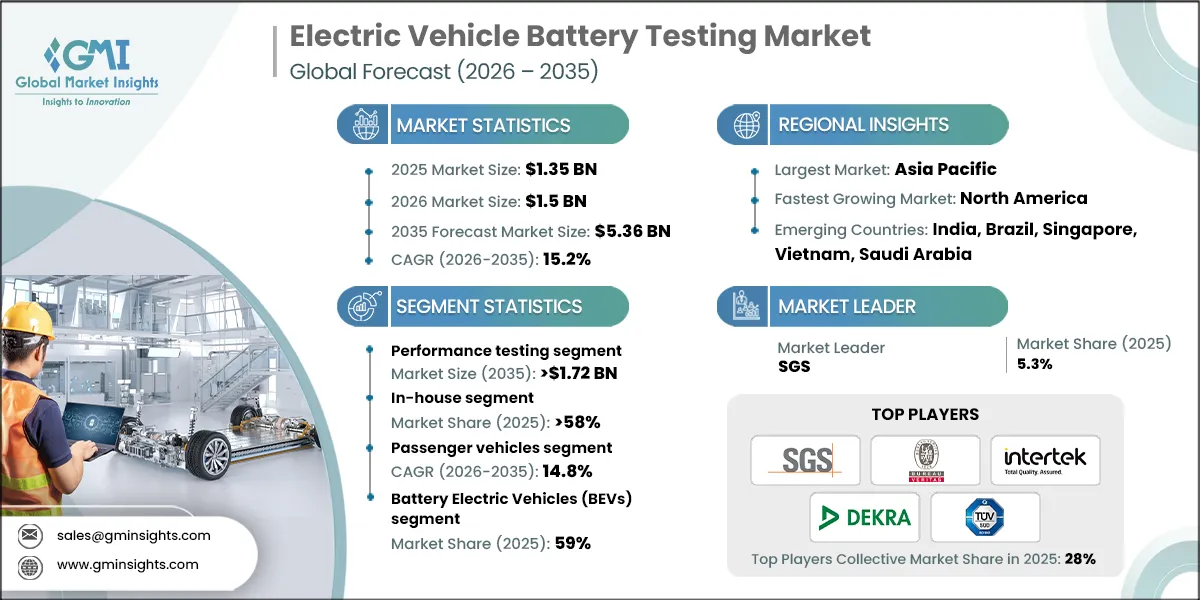
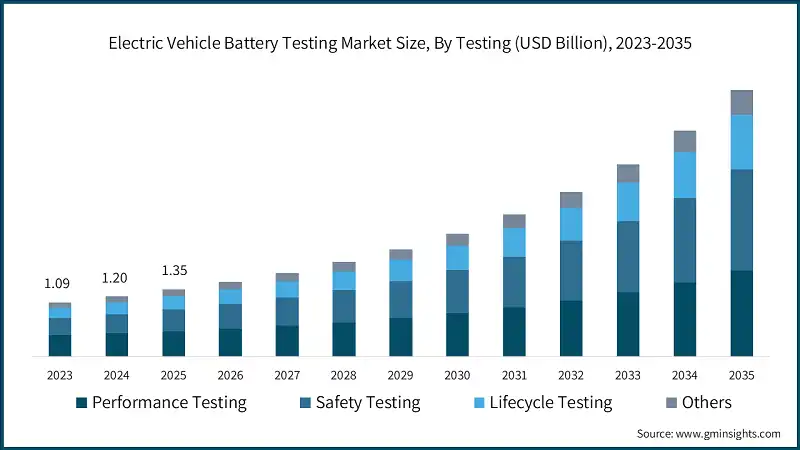
The global electric vehicle battery testing market size was estimated at USD 1.35 billion in 2025. The market is expected to grow from USD 1.5 billion in 2026 to USD 5.36 billion in 2035, at a CAGR of 15.2% according to latest report published by Global Market Insights Inc.
Electric Vehicle Battery Testing Market Key Takeaways
Market Size & Growth
- 2025 Market Size: USD 1.35 Billion
- 2026 Market Size: USD 1.5 Billion
- 2035 Forecast Market Size: USD 5.36 Billion
- CAGR (2026–2035): 15.2%
Regional Dominance
- Largest Market: Asia Pacific
- Fastest Growing Region: North America
Key Market Drivers
- Growth in global electric vehicle production.
- Stringent battery safety and regulatory standards.
- Increasing battery energy density and system complexity.
- OEM focus on quality assurance and warranty risk reduction.
- Expansion of global battery manufacturing capacity.
Challenges
- High capital cost of advanced testing infrastructure.
- Long testing cycles and time-to-market pressures.
Opportunity
- Growth of third-party battery testing services.
- Advancements in digital and automated testing technologies.
- Emergence of next-generation battery chemistries.
- Expansion of battery lifecycle and second-life applications.
Key Players
- Market Leader: SGS led with over 5.3% market share in 2025.
- Leading Players: Top 5 players in this market include SGS, Bureau Veritas, Intertek, DEKRA, TÜV SÜD, Collectively held market share of 28% in 2025, which collectively held a market share of 28% in 2025.
Get Market Insights & Growth Opportunities
The rising production of electric vehicles (EVs) globally, more battery manufacturers are seeking out comprehensive battery testing solutions to establish safety and performance via rigorous validation methods. Battery manufacturers (OEMs) and their suppliers require extensive, thorough validation methods to ensure safety, consistency, and compliance in high-volume manufacturing processes, as well as varying environmental conditions.
Regulatory authorities continually tighten battery safety and compliance standards, including internationally and nationally, such as the UN 38.3, IEC, ISO, SAE, and UL, testing for batteries has become increasingly expansive in terms of scope, time, and expense.
With the development of new battery chemistries, higher energy densities, and increasingly compact designs, safety risks and failure costs continue to rise. Therefore, interest in advanced testing techniques, which can evaluate thermal runaway events, degradation behavior, abuse resistance, as well as the long-term reliability of batteries at multiple integration levels, are growing rapidly.
Many automotive manufacturers (OEMs) are now investing significantly in battery testing to mitigate warranty claims, avoid recalls, and preserve their company image or brand name. Because of the high replacement cost of electric vehicle batteries, rigorous testing has changed from a regulatory requirement to a priority for quality and risk management.
The Indian Ministry of Road Transport and Highways (MoRTH) has developed major initiatives to solve battery safety problems in electric vehicles. MoRTH introduced battery safety standards through the AIS-038 Rev 2/AIS-156 updates to their regulations.
As there has been great investment into the establishment of large-scale battery production, or gigafactories in Asia-Pacific, South America, North America, and Europe, the need for advanced testing solutions has increased. These manufacturers require extensive end-of-line, quality control, and process validation testing to establish consistency, optimized yield and regulatory compliance of their batteries.
EA Elektro-Automatik, a manufacturer of programmable and bidirectional power supplies, launched its enhanced EA BTS 10300 Battery Test System in July 2024. The system requires only 6.5 square feet of factory space for a single 42U-high rack that provides a power density of 300 kW. A single-revolution automated battery testing solution has been created to solve efficiency problems in electric vehicle battery analysis.
To get key market trends
Electric Vehicle Battery Testing Market Trends
Emergence of new battery components (e.g., the Cell-to-Pack design), increased use of higher voltages, and the need for testing in a way that replicates real world vehicle operation and safety situations, most battery manufacturers (OEMs) and battery pack manufacturers (including systems manufacturers) will begin focusing on designing and building battery packs/systems rather than creating individual cell designs or manufacturing; therefore, OEMs and battery pack suppliers are shifting from primarily relying on in-house cell testing to pack/system validation of battery systems.
OEMs are outsourcing cell testing to external testing organizations in order to save money, expedite certification processes and meet complicated multi-regional regulatory testing requirements caused by an increasingly advanced and complex testing standard and rapidly growing testing needs, contracting testing organizations will become a growing trend.
Testing equipment manufacturers are beginning to embrace automation, Digital Twin technology, hardware-in-the-loop testing, and advanced data analytics as ways to increase efficiency and accuracy in the process of battery testing. As a result of these developments, manufacturers can speed up validation cycles, establish better repeatability, and provide greater testing capability for software-controlled battery management systems.
The opportunity for testing batteries is expanding from initial validation to include testing for aging, degradation, and second-life performance. Increased focus on this area is supporting sustainability initiatives, developing plans for future battery reuse, recycling, and compliance with laws related to environmental impact and circular economy goals.
In January 2024 Applus+ formed a partnership with Idiada automotive testing laboratory. The two organizations team up to create one testing system which will integrate 5G components to duplicate actual driving circumstances using their specialized knowledge. The joint efforts between Applus+ and Idiada automotive testing laboratory will guarantee comprehensive assessments of communication and cybersecurity and performance testing.
Electric Vehicle Battery Testing Market Analysis
Learn more about the key segments shaping this market
Based on testing, the electric vehicle battery testing market is divided into performance testing, safety testing, lifecycle testing, and others. In 2025, the performance testing segment accounted for over 38% of the market share and is expected to exceed USD 1.72 billion by 2035.
- Battery testing has become increasingly focused on evaluating battery’s ability to deliver energy as fast as possible. One major aspect of this evaluation is determining how well the battery can operate under different types of loads/operating environments.
- Growing interest in using EVs (Electric Vehicles) for longer periods of time, lifecycle testing has evolved from examining only cycle life to include accelerated aging tests, creating predictive degradation models, and creating assessments of battery health. The information gathered through these tests assists with estimating the battery's warranty and determining what the residual value of the battery will be at the end of the warranty period and during subsequent periods.
- Increased scrutiny from the government (state and national), OEMs (Original Equipment Manufacturers), and end-users, safety testing has moved toward more complex and rigorous testing procedures, particularly regarding the ability of a battery to protect against severe environmental conditions (e.g., heat, vibration) and to understand how an individual battery may respond when part of a larger battery system.
- As safety concerns around batteries grow, especially regarding fire hazards or battery failures, manufacturers are compelled to conduct rigorous performance testing to comply with these regulations.
- Additionally, stricter environmental policies are pushing for longer battery lifecycles and better energy efficiency, driving further demand for performance testing to ensure that batteries meet sustainability criteria.
Learn more about the key segments shaping this market
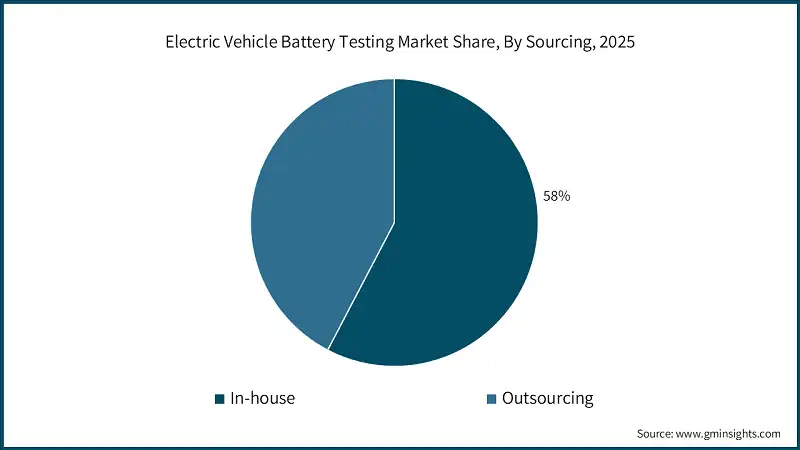
Based on sourcing, the electric vehicle battery testing market is categorized into in-house and outsourcing. In 2025, the in-house segment held a market share of over 58% and was valued at around USD 177.1 million.
- For automotive original equipment manufacturers (OEMs) and battery makers, in-house testing is an essential part of their business models. It gives them greater control over their intellectual property, allows for faster iteration during development and creates a closer relationship between testing and design/manufacturing, particularly for battery chemistries that are owned by the manufacturer and for performance requirements specific to their vehicles.
- Growing investments in automated and high throughput testing equipment. These high-tech tools allow for the reduction of each battery tested to a very low cost, to create a much higher level of consistency among the data produced and to enable large-scale production of batteries while still being able to adhere to an increasing number of stringent quality standards internally.
- Battery suppliers are now also using outsourcing to reduce their capital expense and to take advantage of the technical expertise provided by third-party testing suppliers. Examples of this type of outsourcing include companies that need to comply with regulations and safety certification and those that market to customers in multiple countries.
- Companies can quickly address any issues, optimize battery performance, and adjust testing parameters in real-time, improving product reliability. The control over testing also enables manufacturers to implement more stringent quality assurance processes, which can be crucial in a highly competitive market.
Based on vehicle, the electric vehicle battery testing market is segmented into passenger vehicles and commercial vehicles. The passenger vehicles segment led the market in 2025 and is expected to grow at a CAGR of 14.8% during the forecast period.
- The rapid growth in the adoption of electric passenger vehicles is a key driver for the expansion of the market. As more consumers shift to electric mobility due to environmental concerns, fuel efficiency, and government incentives, the demand for reliable, high-performance batteries increases.
- Battery testing is critical to ensure that batteries in passenger vehicles meet rigorous standards for range, charging speed, durability, and safety. Manufacturers require extensive testing to guarantee their batteries deliver optimal performance and meet consumer expectations.
- To meet the growing demands from consumers for longer ranges, faster charging, and improved safety for passenger vehicles, battery testing has become a focus of increased consumer expectations. Consequently, battery manufacturers conduct extensive performance-, safe-, and lifecycle-testing of their products, validating them under various real-world conditions and extreme environmental stressors.
- As electric buses, trucks, and delivery vehicles continue to see an increase in use across the industry, commercial vehicle battery testing has become significantly more comprehensive as a result of this trend. One key area of testing for these batteries is the high cycle and temperature-testing to confirm that they can endure heavy-duty cycle operation (high achievement) and operate for long periods (hour by hour) without overheating.
Based on propulsion, the electric vehicle battery testing market is divided into Battery Electric Vehicles (BEVs), Plug-in Hybrid Electric Vehicles (PHEVs), and Hybrid Electric Vehicles (HEVs). The Battery Electric Vehicles (BEVs) segment dominated the market with around 59% market share in 2025.
- The rapid development of electric vehicle charging infrastructure is a major driver for the growth of the market. As public and private sectors invest heavily in expanding fast-charging networks and ultra-fast charging stations, BEVs are becoming more convenient and accessible for consumers.
- Battery testing plays a critical role in ensuring that BEV batteries can handle frequent high-speed charging without significant degradation, heat buildup, or performance loss.
- As charging infrastructure evolves, manufacturers require robust testing solutions to validate their batteries’ ability to withstand rapid charge cycles while maintaining safety and performance over time.
- Battery electric vehicle battery testing is increasingly focused on high-voltage systems, fast-charging performance, and thermal management, as BEVs rely entirely on battery power, requiring extensive validation of safety, range, and durability under demanding real-world driving and charging conditions.
- Plug-in hybrid electric vehicle battery testing emphasizes both electric-only performance and seamless integration with internal combustion systems, requiring dual-mode testing to validate charge-discharge behavior, thermal stability, and reliability under frequent switching between propulsion sources.
- Hybrid electric vehicle battery testing remains centered on power delivery, rapid charge acceptance, and long cycle life, as HEVs rely on smaller batteries subjected to frequent charge-discharge events, requiring robust performance and endurance validation.
Looking for region specific data?
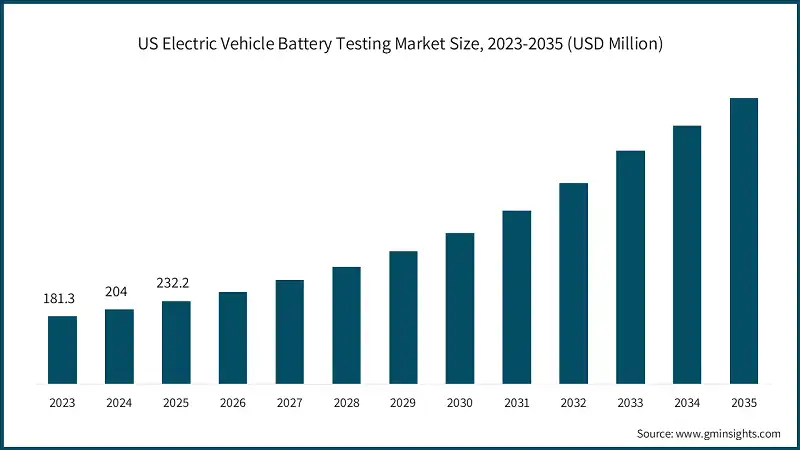
The US electric vehicle battery testing market is valued at USD 232.2 million in 2025 and is expected to experience significant and promising growth from 2026 to 2035.
- Safety and abuse testing demand is rising sharply in the US due to heightened regulatory scrutiny and growing consumer concern over battery fire incidents. OEMs and testing providers are expanding capabilities for thermal runaway, propagation, and crash-related battery testing to meet federal and state-level safety expectations.
- Third-party testing services are gaining traction as US manufacturers seek to accelerate time-to-market while managing rising compliance complexity. Independent laboratories are increasingly preferred for certification, homologation, and specialized testing, enabling OEMs to reduce capital investment while maintaining regulatory credibility.
- U.S. dominated the North America electric owing to the expansion of electric vehicle manufacturing and battery production in the U.S. is another key growth driver for the market.
- As major automakers enhance vehicle production, there is a growing need for high-quality, reliable battery systems that meet the performance and safety standards required for U.S. consumers.
- The U.S. government’s push to reduce dependence on foreign energy sources and its investments in the domestic electric vehicle and battery industries are creating a favorable environment for the market growth.
North America region in the electric vehicle battery testing market held a market revenue USD 283.8 million in 2025 and is anticipated to grow at a CAGR of 16.9% between 2026 and 2035.
- North America is experiencing significant expansion of battery gigafactories across the US, and Canada which is driving demand for high-volume production testing. Manufacturers require scalable, automated testing systems to support quality assurance, yield optimization, and regulatory compliance across multiple regional manufacturing hubs.
- Automation and digitalization of battery testing are accelerating across North America to address labor constraints and cost pressures. Advanced test cyclers, data analytics, and remote monitoring tools are increasingly deployed to improve testing efficiency, consistency, and throughput at large-scale facilities.
- Cross-border regulatory alignment within North America is increasing reliance on third-party testing providers. OEMs and suppliers prefer independent laboratories capable of supporting multi-country certification requirements, particularly for batteries integrated into vehicles manufactured and sold across different North American markets.
Europe electric vehicle battery testing market accounted for USD 386.7 billion in 2025 and is anticipated to show growth of 15.7% over the forecast period from 2026 to 2035.
- Stringent European Union regulations related to battery safety, sustainability, and carbon footprint are significantly expanding testing requirements. Compliance with evolving EU Battery Regulation mandates extensive performance, lifecycle, recyclability, and environmental impact testing throughout the battery value chain.
- Rapid growth in electric vehicle adoption across Europe is driving sustained demand for comprehensive battery testing services. OEMs and suppliers are increasing investments in performance, safety, and environmental testing to support diverse vehicle platforms and meet high consumer expectations for quality and reliability.
- Lifecycle testing is becoming a central focus in Europe due to strong circular economic policies. Testing increasingly covers aging behavior, second-life suitability, and recycling efficiency, supporting regulatory compliance and enabling manufacturers to demonstrate sustainability credentials to regulators and end customers.
Germany dominates the Europe electric vehicle battery testing market, showcasing strong growth potential, and held a market share of 21% in 2025.
- Germany’s strong automotive engineering base is driving advanced battery testing investments focused on precision, reliability, and performance. OEMs and suppliers emphasize rigorous validation processes aligned with premium vehicle standards, reinforcing demand for high-end testing equipment and specialized service providers.
- Safety and quality testing remain paramount in Germany, with extensive validation conducted to meet strict regulatory and customer expectations. German manufacturers prioritize comprehensive mechanical, thermal, and electrical testing to ensure long-term durability and safety of high-voltage battery systems.
- The transition to high-voltage architectures and fast-charging technologies is accelerating demand for advanced testing. German OEMs are investing heavily in testing capabilities to validate charging performance, thermal stability, and system integration for next-generation electric vehicle platforms.
Asia Pacific region leads the electric vehicle battery testing market, exhibiting remarkable growth with a CAGR of 14.4% during the forecast period of 2026 to 2035.
- Asia-Pacific dominates global battery manufacturing, driving sustained demand for large-scale, cost-efficient battery testing solutions. High production volumes require extensive end-of-line testing, quality control, and process validation to ensure consistency and reliability across mass-produced battery cells and packs.
- Automation and inline testing are widely adopted across APAC to support high-throughput manufacturing environments. Battery manufacturers increasingly deploy automated cyclers, robotic handling, and real-time data analytics to reduce testing time and improve operational efficiency.
- Rapid electric vehicle adoption across countries such as China, Japan, South Korea, and India is expanding regional testing infrastructure. Governments and private players are investing in new laboratories and testing centers to support growing domestic EV ecosystems.
China to experience substantial growth in the Asia Pacific electric vehicle battery testing market in 2025. The market in China is expected to reach USD 874 million by 2035.
- China’s massive electric vehicle production scale is driving unparalleled demand for battery testing across the entire value chain. OEMs and battery manufacturers require extensive testing to support rapid product launches, large production volumes, and strict domestic safety requirements.
- Government support for battery safety standards and industrial upgrading is strengthening testing infrastructure across China. Regulatory mandates encourage investment in advanced safety, environmental, and lifecycle testing to improve product quality and global competitiveness.
- China’s significant investment in battery technology innovation is driving the market growth. As the world’s largest producer of electric vehicle batteries, China is focused on developing next-generation battery technologies, including solid-state batteries, lithium iron phosphate (LFP) batteries, and advanced fast-charging systems.
- These innovations aim to increase battery energy density, enhance safety, and reduce costs, all of which are crucial for the widespread adoption of electric vehicles. However, with these technological advancements comes the need for more sophisticated testing methods to ensure these new batteries meet performance, durability, and safety standards.
- As manufacturers introduce new battery chemistries and designs, rigorous testing is necessary to validate their functionality under real-world conditions. China’s focus on battery innovation, coupled with its aim to dominate the global market, will continue to drive demand for cutting-edge battery testing services.
Latin America electric vehicle battery testing market is valued at USD 71 million in 2025 and is expected to experience substantial growth during the forecast period from 2026 to 2035.
- Electric vehicle adoption in Latin America is at an early stage, creating gradual but growing demand for battery testing services. Initial testing needs are primarily driven by vehicle imports, pilot electrification programs, and government-supported public transport initiatives.
- Limited local battery testing infrastructure in LATAM is increasing reliance on third-party and international testing providers. OEMs and fleet operators often depend on overseas laboratories for certification, safety validation, and compliance with global standards.
- Government-led electrification of buses and public fleets is emerging as a key driver of battery testing demand. These programs require durability, safety, and lifecycle testing to ensure batteries can withstand demanding operational environments and extended duty cycles.
MEA electric vehicle battery testing market is valued at USD 50 million in 2025 and is expected to experience substantial growth during the forecast period from 2026 to 2035.
- The EV battery testing market in the Middle East and Africa remains nascent, reflecting early-stage electric vehicle adoption. Testing demand is primarily linked to imported vehicles and compliance with international safety and certification requirements.
- Public transportation electrification initiatives in select Middle Eastern and African countries are supporting incremental growth in battery testing needs. Governments are exploring electric buses and fleet vehicles, requiring basic safety, performance, and durability validation.
- The region relies heavily on imported EVs and batteries, increasing demand for compliance and homologation testing. Independent testing providers play a key role in ensuring vehicles meet international standards before market entry.
Electric Vehicle Battery Testing Market Share
- The top 7 companies in the electric vehicle battery testing industry are SGS, Bureau Veritas, Intertek, DEKRA, TÜV SÜD, UL Solutions, Element Materials Technology contributed around 33.5% of the market in 2025.
- SGS is a global leader in EV battery testing, leveraging an extensive worldwide laboratory network, deep regulatory recognition, and integrated testing and certification services. Its strengths include comprehensive safety, performance, and lifecycle testing capabilities, long-standing OEM relationships, and sustained investment in advanced battery testing infrastructure.
- Bureau Veritas is a major EV battery testing provider with strong automotive industry roots and a strategic focus on electric mobility. The company offers end-to-end battery testing from cell to pack level, supported by global laboratories, functional safety expertise, and integrated services covering vehicle homologation and charging infrastructure certification.
- Intertek is a prominent EV battery testing player recognized for its strong safety and performance validation expertise. The company differentiates through advanced thermal runaway and abuse testing capabilities, a solid presence in key automotive markets, and integrated battery and electrical system testing supporting comprehensive powertrain validation.
- DEKRA is a leading automotive-focused testing and certification organization with strong capabilities in EV battery pack-level and system integration testing. Its European laboratory network supports OEMs and battery suppliers with safety, performance, and validation services, reinforced by deep expertise in vehicle systems, homologation, and regulatory compliance.
- TÜV SÜD is a globally recognized testing and certification provider specializing in battery safety and regulatory compliance across international standards. The company offers comprehensive battery testing services through specialized laboratories worldwide, combining strong regulatory credibility with advanced expertise in high-voltage systems and next-generation battery technologies.
- UL Solutions is a prominent battery testing and certification provider with strong recognition in North America. The company emphasizes safety certification, abuse testing, and compliance validation, supporting OEMs and battery manufacturers through well-established regulatory relationships and expanding global laboratory capabilities, particularly across Asia and emerging electric mobility markets.
- Element Materials Technology is a specialized testing provider focused on advanced materials and battery technologies. The company differentiates through expertise in failure analysis, materials characterization, and targeted battery testing services, supporting manufacturers with in-depth technical insights across development, validation, and post-failure investigation stages.
Electric Vehicle Battery Testing Market Companies
Major players operating in the electric vehicle battery testing industry are:
- Applus+
- Bureau Veritas
- DEKRA
- DNV
- Element
- Eurofins
- Intertek
- SGS
- TÜV SÜD
- UL Solutions
- SGS operates as the world’s leading testing, inspection, and certification organization, offering comprehensive EV battery testing across performance, safety, lifecycle, and regulatory compliance. Its strengths include a vast global laboratory network, deep automotive testing expertise, large specialist workforce, and continued investment in advanced infrastructure and AI-enabled validation platforms.
- Bureau Veritas is a global testing and certification leader with strong emphasis on electric mobility and battery systems. The company differentiates through functional safety, electromagnetic compatibility testing, dedicated EV battery divisions, and major investments in North American and European facilities supporting automotive OEMs and battery manufacturers.
- Intertek is a major assurance and testing provider specializing in battery safety, abuse testing, and accelerated lifecycle validation. Its competitive edge lies in advanced thermal runaway facilities, strong presence in key automotive hubs, integrated electrical systems testing, and innovations that significantly reduce battery validation timelines.
- DEKRA is a German-based automotive testing specialist with strong capabilities in battery pack-level and system integration testing. The organization leverages deep expertise in European regulatory frameworks, vehicle integration, and homologation, supported by dedicated battery testing centers combining validation, compliance, and applied research activities.
- Element Materials Technology operates as a specialized testing provider focused on advanced materials and battery technologies. The company differentiates through deep expertise in failure analysis, materials characterization, and niche testing services, complementing large certification bodies and supporting manufacturers during development, investigation, and performance optimization stages.
- Applus+ is a European testing and certification provider with strong automotive market presence. Its battery testing activities focus on integration, vehicle-level validation, and compliance testing, supporting OEMs through regional laboratories and applied expertise in automotive systems and regulatory alignment.
- DNV is a Norwegian-based certification and advisory organization extending its energy storage expertise into automotive battery testing. Leveraging strong roots in maritime and industrial safety, DNV provides battery validation focused on large-scale systems, safety assurance, and lifecycle performance across automotive and energy storage applications.
Electric Vehicle Battery Testing Market Report Attributes
| Key Takeaway | Details |
|---|---|
| Market Size & Growth | |
| Base Year | 2025 |
| Market Size in 2025 | USD 1.35 Billion |
| Market Size in 2026 | USD 1.5 Billion |
| Forecast Period 2026 - 2035 CAGR | 15.2% |
| Market Size in 2035 | USD 5.36 Billion |
| Key Market Trends | |
| Drivers | Impact |
| Growth in global electric vehicle production | Increases demand for extensive battery validation to ensure safety, reliability, and performance across high-volume electric vehicle manufacturing programs. |
| Stringent battery safety and regulatory standards | Expands mandatory testing requirements, raising testing frequency, complexity, and compliance-related spending across the electric vehicle battery value chain. |
| Increasing battery energy density and system complexity | Drives adoption of advanced testing solutions to mitigate safety risks and validate performance under extreme operating conditions. |
| OEM focus on quality assurance and warranty risk reduction | Encourages higher investment in battery testing to minimize recalls, warranty claims, and long-term brand reputation damage. |
| Expansion of global battery manufacturing capacity | Generates sustained demand for scalable, high-throughput testing systems supporting quality control and regulatory compliance. |
| Pitfalls & Challenges | Impact |
| High capital cost of advanced testing infrastructure | Limits adoption among smaller manufacturers and testing laboratories due to substantial upfront investment and operating expenses. |
| Long testing cycles and time-to-market pressures | Delays product launches and increases development costs, particularly for next-generation battery technologies. |
| Opportunities: | Impact |
| Growth of third-party battery testing services | Creates opportunities for independent providers to offer specialized, scalable testing and certification services globally. |
| Advancements in digital and automated testing technologies | Enables faster validation, improved accuracy, and reduced testing costs through automation and software-driven solutions. |
| Emergence of next-generation battery chemistries | Creates demand for new testing methodologies to evaluate safety, durability, and performance of advanced battery technologies. |
| Expansion of battery lifecycle and second-life applications | Drives testing demand for aging, reuse, and recycling assessments supporting sustainability and circular economy initiatives. |
| Market Leaders (2025) | |
| Market Leaders |
held 5.3% Market Share in 2025 |
| Top Players |
|
| Competitive Edge |
|
| Regional Insights | |
| Largest Market | Asia Pacific |
| Fastest growing market | North America |
| Emerging countries | India, Brazil, Singapore, Vietnam, Saudi Arabia |
| Future outlook |
|
What are the growth opportunities in this market?
Electric Vehicle Battery Testing Industry News
- In December 2024, SGS announced the completion of a major battery testing facility expansion in suburban Detroit, Michigan, adding 60,000 square feet of advanced testing infrastructure. The USD 45 million investment includes extreme-temperature environmental chambers and mechanical abuse testing, enabling simultaneous testing of up to 500 battery packs and compliance with UN Regulation 100.03.
- In November 2024, Bureau Veritas secured a five-year strategic partnership with a leading European automotive manufacturer to deliver end-to-end battery testing services. The agreement includes a dedicated on-site testing facility and embedded engineering teams, reflecting a growing shift toward long-term, integrated testing partnerships over transactional service models.
- In October 2024, UL Solutions introduced an advanced cybersecurity testing protocol for battery management systems, addressing emerging risks in connected vehicle battery architectures. The methodology evaluates resilience against firmware tampering, communication exploits, and denial-of-service attacks, aligning with increasing regulatory focus under standards such as UN Regulation 155.
- In September 2024, TÜV SÜD opened a new battery testing center in Suzhou, China, following a USD 30 million investment. The facility supports up to 1,000 simultaneous test channels and integrates AI-enabled analytics for accelerated lifecycle testing, reinforcing China’s role as a global hub for battery manufacturing and validation.
- In August 2024, The U.S. Department of Energy announced USD 75 million in grant funding under the Bipartisan Infrastructure Law to expand domestic battery testing infrastructure. The program targets regional capacity gaps and advanced testing technology development, with multiple testing organizations competing for funding support.
- In July 2024, Intertek launched a digital twin-based battery testing platform combining physical testing with advanced computational modeling. The solution enables virtual evaluation of extreme and unsafe scenarios, using machine learning validated against real test data, and is expected to reduce validation timelines by 30–40 percent.
- In June 2024, The European Union finalized updated battery safety and sustainability requirements under the EU Battery Regulation. The regulation mandates enhanced thermal runaway propagation testing, expanded lifecycle environmental reporting, and formal end-of-life battery management programs, prompting testing providers to develop new compliance-focused protocols.
The electric vehicle battery testing market research report includes in-depth coverage of the industry with estimates & forecasts in terms of revenue ($Bn) from 2022 to 2035, for the following segments:
Market, By Testing
- Performance testing
- Safety testing
- Lifecycle testing
- Others
Market, By Sourcing
- In-house
- Outsourcing
Market, By Vehicle
- Passenger vehicles
- Hatchback
- Sedan
- SUVs
- Commercial vehicles
- Light Commercial Vehicles (LCVs)
- Medium Commercial Vehicles (MCVs)
- Heavy Commercial Vehicles (HCVs)
Market, By Propulsion
- Battery Electric Vehicles (BEVs)
- Plug-in Hybrid Electric Vehicles (PHEVs)
- Hybrid Electric Vehicles (HEVs)
Market, By Component
- Battery Cells
- Battery Modules
- Battery Packs
- Battery Management Systems (BMS)
Market, By End Use
- Automotive OEMs
- Battery manufacturers
- Research and development institutes
- Third-party testing service providers
The above information is provided for the following regions and countries:
- North America
- US
- Canada
- Europe
- Germany
- UK
- France
- Italy
- Spain
- Russia
- Nordics
- Portugal
- Croatia
- Benelux
- Asia Pacific
- China
- India
- Japan
- Australia
- South Korea
- Singapore
- Thailand
- Indonesia
- Vietnam
- Latin America
- Brazil
- Mexico
- Argentina
- Colombia
- MEA
- South Africa
- Saudi Arabia
- UAE
- Turkey
Frequently Asked Question(FAQ) :
What was the market size of the electric vehicle battery testing in 2025?
The market size was USD 1.35 billion in 2025, with a CAGR of 15.2% expected through 2035. The growth is driven by the rising production of electric vehicles (EVs) and the increasing demand for comprehensive battery testing solutions.
What is the projected value of the electric vehicle battery testing market by 2035?
The market is projected to reach USD 5.36 billion by 2035, fueled by advancements in battery technologies, regulatory compliance needs, and the adoption of automated testing solutions.
What is the expected size of the electric vehicle battery testing industry in 2026?
The market size is projected to reach USD 1.5 billion in 2026.
How much revenue did the performance testing segment generate in 2025?
The performance testing segment accounted for over 38% of the market share in 2025 and is expected to exceed USD 1.72 billion by 2035.
What was the valuation of the in-house testing segment in 2025?
The in-house testing segment held a market share of over 58% in 2025, valued at approximately USD 177.1 million.
What is the growth outlook for the passenger vehicles segment during the forecast period?
The passenger vehicles segment is expected to grow at a CAGR of 14.8% during the forecast period, driven by the increasing adoption of electric passenger vehicles globally.
What was the valuation of the US electric vehicle battery testing sector in 2025?
The US market was valued at USD 232.2 million in 2025. The demand for safety and abuse testing is rising due to heightened regulatory scrutiny and growing consumer concerns over battery fire incidents.
What are the upcoming trends in the electric vehicle battery testing market?
Adoption of automation and digital twins, increased hardware-in-the-loop testing, advanced data analytics, focus on aging and second-life performance testing, and growing emphasis on sustainability and regulatory compliance.
Who are the key players in the electric vehicle battery testing industry?
Key players include Applus+, Bureau Veritas, DEKRA, DNV, Element, Eurofins, Intertek, SGS, TUV SUD, and UL Solutions.
Electric Vehicle Battery Testing Market Scope
Related Reports