Summary
Table of Content

Electric Van Conversion Kits Market
Get a free sample of this report
Form submitted successfully!
Error submitting form. Please try again.
Thank you!
Your inquiry has been received. Our team will reach out to you with the required details via email. To ensure that you don't miss their response, kindly remember to check your spam folder as well!
Request Sectional Data
Thank you!
Your inquiry has been received. Our team will reach out to you with the required details via email. To ensure that you don't miss their response, kindly remember to check your spam folder as well!
Form submitted successfully!
Error submitting form. Please try again.
Electric Van Conversion Kits Market Size
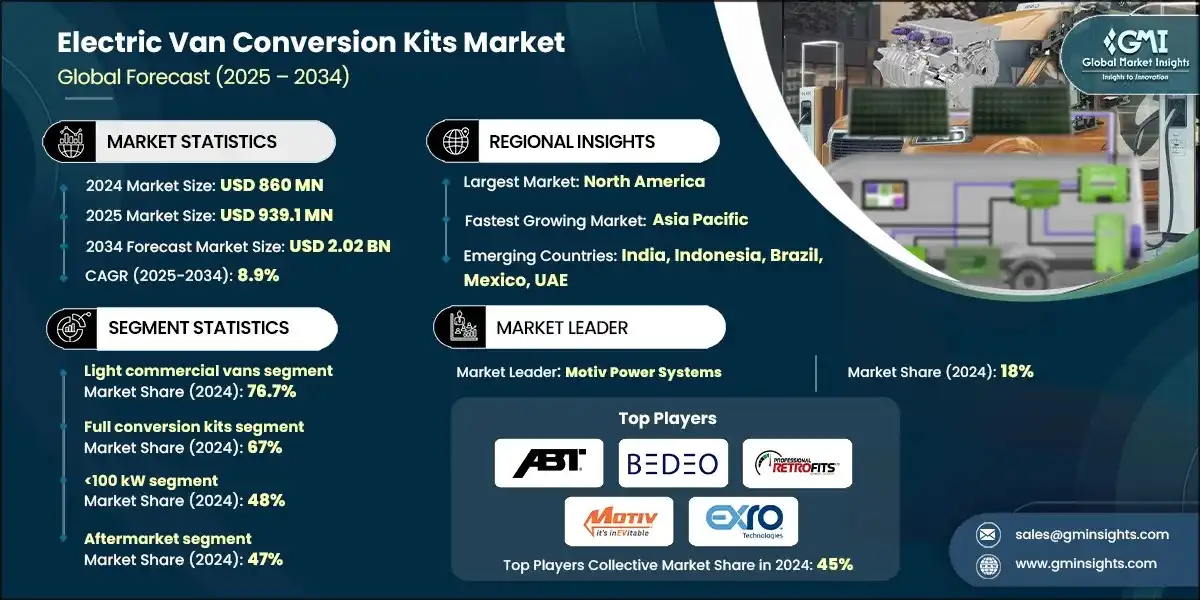
The global electric van conversion kits market size was valued at USD 860 million in 2024. The market is expected to grow from USD 939.1 million in 2025 to USD 2.02 billion in 2034 at a CAGR of 8.9%, according to latest report published by Global Market Insights Inc.
Electric Van Conversion Kits Market Key Takeaways
Market Size & Growth
- 2024 Market Size: USD 860 Million
- 2025 Market Size: USD 939.1 Million
- 2034 Forecast Market Size: USD 2.02 Billion
- CAGR (2025–2034): 8.9%
Regional Dominance
- Largest Market: North America
- Fastest Growing Region: Asia Pacific
Key Market Drivers
- Preference for flexible mobility over ownership.
- Growing EV adoption and fleet electrification.
- Rising corporate fleet demand.
- Connected vehicle and telematics advancements.
Challenges
- High capital investment.
- Regulatory and insurance challenges.
Opportunity
- Expansion in emerging urban markets.
- Opens new revenue channels where low-emission commercial mobility is prioritized..
- Travel & hospitality services.
- Regional market expansion (MEA & APAC).
Key Players
- Market Leader: Motiv Power Systems led with over 18% market share in 2024.
- Leading Players: Top 5 players in this market include Motiv Power Systems, Motiv Power Systems, E-Drive Retrofits, BEDEO, ABT e-Line, which collectively held a market share of 45% in 2024.
Get Market Insights & Growth Opportunities
The use of telematics, IoT and fleet management systems enables operators of electric vans to improve upon tracking, optimally planning routes, properly utilizing batteries and conducting preventative maintenance based upon the data collected through telematics software. In addition, electric vehicle conversion kits are becoming increasingly sophisticated due to advancements and innovations in their development.
To get key market trends
Electric Van Conversion Kits Market Trends
The fleet operator market continues to shift from simply buying kits to utilizing pay-per-use, and subscription-based services to reduce their initial investment and improve their financial flexibility. This is creating a situation where the ability for companies to convert their van fleets to electric is significantly improved through monthly payments on hardware, installation and service. This has created a predictable budgeting process for operators and helps to speed up the adoption of electric vehicles for small operators while allowing for easy scaling as a company’s fleet needs change.
Automotive manufacturers are actively entering into the conversion space with integrated mobility multi-user platforms. One way in which this has come about is through OEM'S supporting the development of kits that are factory approved to convert vehicles and the networks for installation and digital services that OEM'S can offer. This support of integrated mobility platforms by OEM's can allow fleets to have more confidence in their vehicles being reliable, being compliant, and having continuity of warranty on their vehicles.
These platforms allow for fleet owners to typically combine telematics, charging solutions, and a lifecycle of electrification program into one package and increase the standardization of these kits in the electric van conversion kit market.
Electric vans conversions are increasingly being driven by AI and IoT systems that monitor batteries, energy usage, route efficiency and overall vehicle health. The data received from real-time analytics helps fleet operators to use charging schedules, reduce downtime and increase battery life. Predictive maintenance helps fleet operators to reduce their operating costs while using data-driven insights to improve overall fleet productivity. These types of technologies greatly enhance the value proposition for commercial operators when considering conversion kits.
Sustainability efforts in logistics are hitting the ground running by providing fleets with access to more environmentally friendly ways to move goods and reduce emissions. Conversion kits allow fleets to convert their current ICE van fleets to electric while reducing the amount of manufacturing waste and carbon emissions throughout the life of the vehicle. Suppliers are providing ecofriendly services including recycled batteries, renewable energy charging partnerships and carbon tracking tools, making conversions more cost-effective and easier for companies to implement as a viable environmental strategy.
Electric Van Conversion Kits Market Analysis
Learn more about the key segments shaping this market
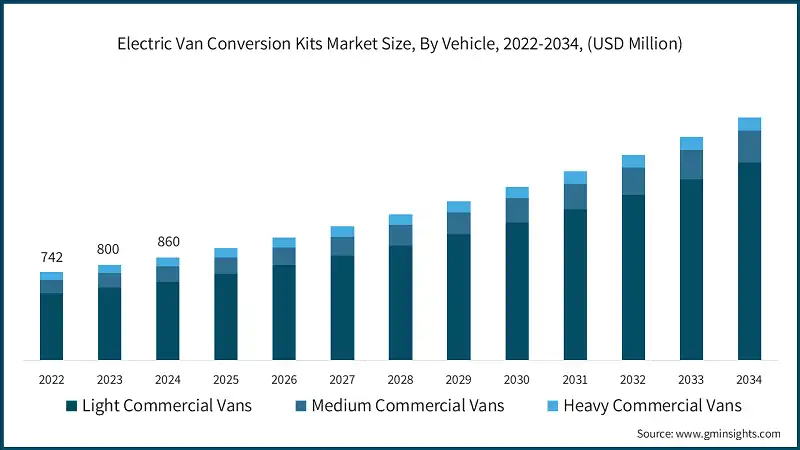
Based on vehicle, the electric van conversion kits market is divided into light commercial vans, medium commercial vans and heavy commercial vans. The light commercial vans segment dominated the market, accounting for 76.7% in 2024 and is expected to grow at a CAGR of 9.6% through 2025 to 2034.
- Light commercial vans are growing rapidly because their duty cycles align well with current BEV capabilities, typical urban and suburban routes fall within the 100–200-mile battery range, payload requirements match today’s electric platforms, and operators increasingly benefit from access to low-emission and green-freight zones. Add the cost dimension electric light commercial vehicles reach TCO parity or lower in several EU use cases and the segment’s outperformance makes sense.
- Compare this to medium van applications, where range and payload push power needs into the 100–200 kW class, but energy efficiency still favors BEV~55% more efficient than diesel in heavy duty contexts, with fuel costs ~33% lower in the EU/U.S. and ~70% lower in China for heavy trucks in 2024.
- Heavy commercial vans remain the smallest slice due to battery size and thermal management complexity; with battery packs accounting for roughly half of upfront costs in large packs and BEV prices 2–3x diesel for long range formats, operators tend to focus on return to base and regional routes first. Expect momentum to shift as energy density improves and kit architectures become more modular.
Learn more about the key segments shaping this market
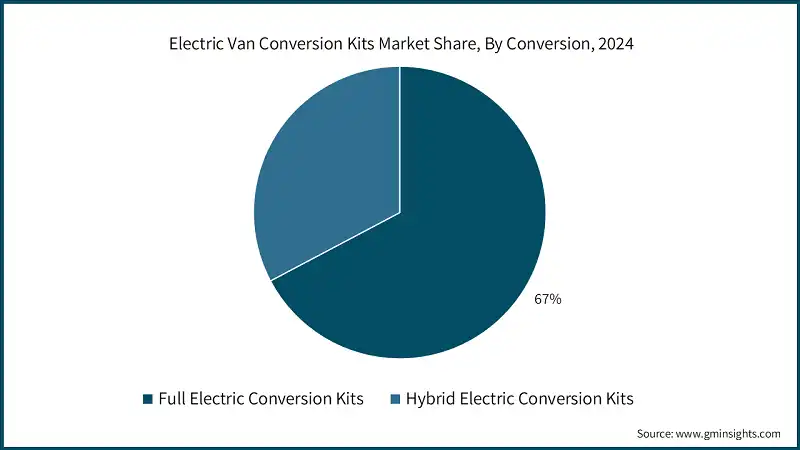
Based on conversion, the electric van conversion kits market is segmented by full conversion kits and hybrid conversion kits. Full conversion kits segment dominates the market with 67% share in 2024, and the segment is expected to grow at a CAGR of 10% from 2025 to 2034.
- Full electric conversion kits are propelled by zero emission mandates and operating cost advantages. US standards point plug in shares toward 31% by 2027 and 47% by 2032, while EU heavy duty rules target roughly 90% CO2 cuts by 2040 and 100% zero emission city buses by 2030 citied by (U.S. Environmental Protection Agency, epa.gov; International Energy Agency, iea.org).
- The fully electric conversion kits are shifting toward modular platform-agnostic designs to decrease the time needed for installation and increase compatibility with different types of vans. Integrated battery/motor systems that use standardized high-voltage components and offer telematics-enabled diagnostics are growing up the rate that fleets adopt electric technology, for last-mile, low-emission urban use cases.
- Hybrid conversion kits retain relevance for extended range and variable route applications growing more slowly as the market tilts toward full electrification. Sales channel dynamics aftermarket, OEM kits, and certified retrofitters shape pricing and support models, warranty expectations and compliance certainty.
Based on propulsion, the electric van conversion kits market is segmented by < 100 kW, 100–200 kW and >200 kW. The <100 kW segment dominates the market with 48% share in 2024, and the segment is expected to grow at a CAGR of 7.2% from 2025 to 2034.
- The affordable, lightweight conversion kits are for compact vans and small, local transportation delivery fleets that perform short-haul delivery in cities with an emphasis on affordability and short-range operations, together with energy-efficient city logistics and last-mile routes.
- The mid-range conversion kits are for the more comprehensive range of commercial vans that have a more even distribution of power, range and payload. They are designed for the more comprehensive range of delivery, service fleets, and regional operations with a moderate load and speed threshold.
- For the heavy-duty performance vehicles (high-powered vans), the high-power conversion kits create a strong acceleration, a higher payload capacity and a capability for long-distance application to support the freight and utility industries and specialized commercial operations that require high levels of logistics or service.
Based on sales channel, the electric van conversion kits market is segmented into OEM conversion kits, aftermarket conversion kits and certified retrofitters. The aftermarket conversion kits segment is expected to dominate the market with a share of 47% in 2024
- OEM conversion kits are products made and integrated by vehicle manufacturers, who have developed the kits as complete, factory-engineered systems for installation into their vehicles. OEM conversion kits come with a guarantee for high reliability and are integrated seamlessly into the vehicles for the fleets that will be using them. This makes OEM conversion kits the best choice for fleets looking for long-term compliance and standardization with electric van operations.
- Aftermarket kits are third-party solutions created to retrofit existing vans from various make and models. Aftermarket conversion kits offer fleets an opportunity to quickly and cost-effectively electrify older assets, rather than purchasing new vehicles. In addition, aftermarket retrofit kits provide a broad coating of customization and cost-effectiveness for fleets operating under tight budgets or mixed-vehicle environments.
- Certified retrofitters are specialty contractors who are permitted to install electrified conversion kits to vehicles according to safety and regulatory specifications. These licensed retrofitters guarantee that their work meets the established guidelines set forth by the manufacturers along with necessary homologation rules. All certified retrofitters utilize quality control procedures to ensure that their installations are of the highest quality, as well as ensuring the vehicles perform optimally.
Looking for region specific data?
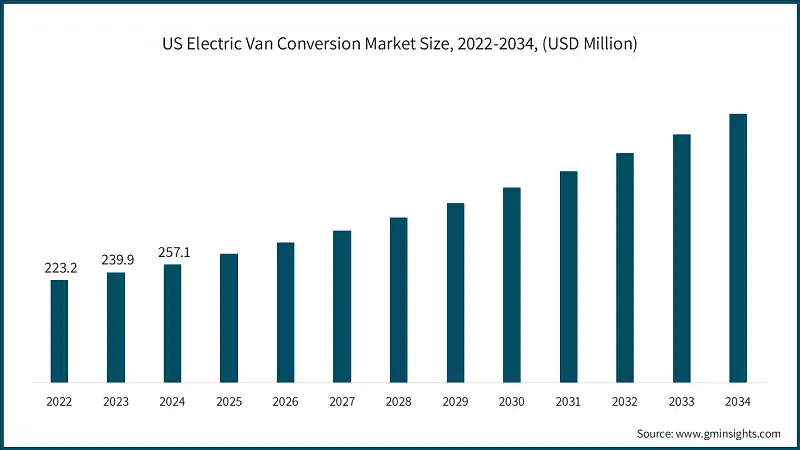
The US electric van conversion kits market reached USD 257.1 million in 2024, growing from USD 239.9 million in 2023.
- Corporate ESG commitments, in addition to federal and state emissions mandates, have led to increasing interest in conversion kits for EVs as a low-cost alternative to purchasing new EVs for many fleets in US. Municipalities, parcel shipping firms and last-mile logistics providers are all beginning to see that retrofitting is a faster way to comply with regulatory requirements. Tax credits and grant programs for EVs also have made it easier for many small and medium-sized fleets to adopt conversion kits.
- The aftermarket for EV conversions has developed a comprehensive ecosystem of certified installers, auto repair chains and dealerships. Through these partnerships, they provide nationwide access to scalable and quick service, while also ensuring compliance with warranty requirements. The U.S. has become home to an expanding array of standardized conversion kits, interoperability programs and technician training programs. These advances are restoring consumer confidence and eliminating barriers to the mass adoption of EVs.
- The US suppliers are now developing next-gen battery packs, fast swap modules, and advanced thermal regulating systems to increase the range and durability of vans that have been converted. New technologies are being developed to meet the challenges of extreme temperature conditions and the heavy use of commercial delivery companies. More firms are integrating AI-based diagnostic tools to maximize efficiency and maintain the safety of electric conversions for fleets with high amounts of use.
North America dominated the electric van conversion kits market with a market size of around USD 290 Million in 2024.
- North American companies are developing new products and technologies that provide insulation and heating for Batteries in Cold Weather applications and Energy-efficient Auxiliary Systems. Vendors of conversion kits are also working on developing vehicles that can operate reliably in areas where snowy conditions are common. Standardized products such as range predictions, grid-responsiveness for pre-conditioning, and improved charging equipment are quickly becoming the “norm.” These developments simplify the conversion of vehicles in Canada to be suitable for the harsh climate and long-distance logistics routes in Canada.
- Provinces in Canada are providing incentive programs that promote electric vehicle conversion and have initiated additional mandates for the adoption of zero-emission commercial vehicles and Green Fleet Programs. Public sector fleets and utility companies view retrofitting existing fleets as a Low-Risk, Cost-Effective alternative.
- In addition, the Postal Service views converting its fleet to electric vehicles as an opportunity to save money and reduce its carbon footprint.
The Corporations of Canada are beginning to align with the U.S. established supply chains to create an efficient and effective way for both countries to participate in battery recycling and refurbishment programs. - The market is seeing a trend in mergers between local kit manufacturers, installation facilities, and fleet service providers that are attempting to increase their service area across Canada and the northern United States. Through these types of consolidation, technical standardization will improve, costs will decrease, and supply chain management will increase in reliability. Large fleet operators will benefit from having access to single-source warranties and maintenance support at multiple locations, which should result in accelerated regional adoption rates.
Europe electric van conversion kits accounted for a share of 27.1% and generated revenue of USD 233.3 million in 2024 with an anticipated growth over the forecast period.
- EU emissions regulations, Clean Vehicle legislation, and Low Emission Mobility policies favor Electric Vehicle conversion into vans. Various countries provide incentives such as grants, VAT reductions, and supportive funding to convert fleets to electric vehicles. Operators of cross-border logistics frequently choose conversions due to their cost-effectiveness and practicality to meet regulatory requirements rather than purchasing new electric vans, thereby rapidly pushing the adoption of converted vans throughout Europe.
- The growth of e-commerce, urban areas that are congested and the development of micro-mobility business systems is creating demand for Electric Vehicle conversions specifically designed for last mile delivery and municipal services. Logistics operators are looking for solutions that are scalable and that can be deployed quickly and cheaply, hence retrofitting is appealing to those in the industry trying to maintain operational consistency. To avoid disruption in their supply chains, many cities work with vendors to convert their fleet of vehicles to electric vehicles.
- Europe is also leading the way in green retrofitting, through the strong commitment to a circular economy, which means Creating a way to reuse existing vehicles that run on Gasoline Concepts of Internal Combustion Engine (ICE) rather than getting scrap value or replacing them. Retrofitting kits contribute to extending the life of existing vehicles and reducing material waste and optimising the recycling of existing materials. Vendors are also focused on using recyclable battery modules, second life applications of these batteries, and carbon tracking systems for most of the converted vehicles coming out of Europe.
Germany dominates the electric vans conversion market, showcasing strong growth potential, with a CAGR of 7.3% from 2025 to 2034.
- Germany is seeing a growing demand for conversion kits that allow vehicles to become electric because of the increased number of low-emission zones that Germany is creating, the increasing fines for van operators of ICE, and the expected Euro 7 emissions standard. Municipal fleets, courier fleet operators, and craftsman vans are being retrofitted with conversion kits to extend the lifespan of their vehicles while also ensuring that the converted vehicles meet emissions standards. In addition, various municipalities in Germany are currently funding retrofit projects, so it is a more cost-effective option for vehicle fleets to retrofit rather than purchase brand new electric vehicles.
- Germany has always placed a high importance on the safety and engineering of all types of vehicles, resulting in increased demand for conversion kits that have received the approval of the Technical Inspection Agency (TÜV). Additionally, OEMs are starting to establish retrofit programs where conversions from OEMs will not void the warranty of the vehicle and will likely increase reliability. Partnerships between automotive suppliers and engineering schools have resulted in more specific, durable conversions and ensure that the conversions comply with Germany's stringent quality expectations, gaining a great deal of trust with commercial vehicle fleets.
- As Germany is expanding its solar and wind electric generation capabilities, converted electric vans can be charged using renewable charging stations. Fleet depots are implementing smart charging scheduling, vehicle-to-building (V2B) systems, and load-balancing systems to reduce operational costs. Conversion vendors have emphasized that converting a vehicle to an electric vehicle leads to the sustainability of the vehicle's entire lifecycle, in line with Germany's commitment to establishing a circular economy.
The Asia Pacific electric van conversion kits market is anticipated to grow at the highest CAGR of 10.4% from 2025 to 2034 with a revenue of USD 223.3 million in 2024.
- Governments within the Asia-Pacific region (APAC) are implementing subsidy models, including, Low emission mandates; preferential financing and providing incentives for electrifying fleets via subsidies. In India, delivery fleeces are completing conversions to reduce their operating costs. Japan and Korea have placed emphasis on utilizing retrofit systems that have been certified about safety. One area of focus in the APAC region is affordability and the need for conversion kits to serve as a basis for financially challenged commercial mobility.
- Countries within the APAC are creating networks of installers and establishing training programs for vocational skills needed to perform commercial vehicle retrofitting and are also establishing government-certified retrofitting centers. These will assist in providing a standard level of quality, safety and regional compliance. Local manufacturing of motors and controllers will help to lower costs and encourage faster adoption by small and medium sized enterprises and logistics operators.
- Conversion kits will focus primarily on lightweight components, smaller battery packs and optimized driving ranges since compact vans are more common in APAC markets. Vendors will develop solutions for thermal management systems that can operate in extremely hot climates. E-commerce companies, food delivery companies and urban logistical companies will drive growth and demand.
China electric van conversion kits market is estimated to grow with a CAGR of 10.8% from 2025 to 2034.
- The Chinese government's implementation of zero-emission policies with subsidies for electric vehicle fleets, and fleet electrification targets are pushing the development of alternative energy solutions at an accelerated pace. For small delivery businesses and ride-sharing service providers conversion kits are a fast and economical way to transition to an electric vehicle fleet. To move the mass production of conversion kits, the Chinese government has created an extensive network of specially designated industrial parks dedicated to retrofitting existing vehicles.
- China with its extensive battery supply chain and inexpensive production capabilities, can produce large quantities of conversion kits. These kits typically include Lithium Iron Phosphate (LFP) battery packs, integrated controllers, and modular chassis styles that keep the cost to the consumer lower. This has allowed China to become the largest exporter of low-cost conversion solutions in the world
- China is also in the forefront of developing connected-vehicle technology. It has combined a variety of different technologies, including telematics, battery management systems, and real-time fleet analytics into the conversion kits it manufactures. An additional factor that sets Chinese retrofit kits apart from others worldwide is AI-powered optimization, which aids the logistics operator in maximizing range, minimizing charging queue times, and reducing downtime.
Latin America electric van conversion kits market shows lucrative growth over the forecast period.
- Governments in Latin America are working to promote electric mobility, with a particular focus on public fleets, buses, and municipal vans, and one of the most cost-effective ways to make electric conversion possible for these fleets that might have limited budgets is through retrofit conversion kits. In Chile, the presence of a strong green energy grid has also aided in the rapid adoption of EVs, as have Colombia's incentives to end-users for EVs. Many retrofit programs usually begin with postal, waste collection, and utility service fleets.
- At the same time, the rise of e-commerce and congestion in city centers has also created demand for electric conversions in last-mile delivery, and some of these delivery operators are electing to retrofit, as opposed to acquire an EV, due to the high cost of new EVs. The emergence of local installation partners and regional kit distributors is increasing access and lowering barriers to the deployment of conversion kits.
- Latin American fleets are looking for durable conversions that will enable operation in mixed terrain, in hot climates, and for long daily duty cycles. Vendors are engineering reinforced suspension integration, developing dust-proof enclosures, and creating high-durability battery modules, thus providing reliable alternatives for commercial operators in retrofit solutions.
Brazil electric van conversion kits market is estimated to grow with a CAGR of 5.1% from 2025 to 2034 and reach USD 36 million in 2034.
- With the high price of new electric vans in Brazil, many logistics companies are providing retrofitting their existing fleets rather than purchasing new electric vehicles. Retrofitting enables logistics operators to convert their fleet to electric at a lower cost than purchasing new electric vans. Brazil has also implemented government incentives to promote sustainable mobility in Brazil. The incentives are beneficial to delivery service companies and other municipalities looking to become lower carbon-operating organizations.
- Local producers and workshops are producing components used to convert vans to electric which reduce the costs of imported products. With Brazil's extensive automotive aftermarket industry, retrofitting can be installed and serviced locally. By partnering with universities and research centres, technology localization occurs, increasing affordability and suitability to Brazil's road conditions.
- Brazil's growing solar energy infrastructure will provide low-cost charging for the converted vans. Businesses will use solar-power charging and battery storage at fleet depots to reduce their overhead. As a result, increasing solar energy production and fleet electrification will allow more businesses to take advantage of conversion kits as part of their sustainable logistics strategy.
The Middle East and Africa electric van conversion kits market accounted for USD 40.3 million in 2024 and is anticipated to show lucrative growth over the forecast period.
- Countries such as Saudi Arabia, South Africa, and Egypt are implementing national electrification strategies that focus on the establishment of sustainable transport. Fleet operators are implementing conversions as an interim solution to improve profitability. Retrofit vendors are partnering with governmental entities to electrify taxi, postal, and municipal fleets to align with similar carbon-reduction goals held by these agencies.
- The extreme heat in the Middle East and Africa requires advanced thermal management, battery cooling, and insulation systems in conversion kits. Vendors are incorporating heat-resistant components and advanced smart battery management systems (BMS) into the conversion kits to preserve range and safety. This engineering specialty has established a significant competitive advantage for retrofit vendors in the region.
- Training academies and service centers are appearing across the region to develop skilled service technicians, thereby reducing reliance on imports. These facilities are responsible for ensuring compliance with safety regulations as well as facilitating the ability to perform large-scale modifications to vehicles through local/regional retrofit vendors. Partnerships with original equipment manufacturers (OEM) and energy providers are increasing regional capacity and building confidence.
UAE market is expected to experience substantial growth in the Middle East and Africa rich communication services market, with a CAGR of 6% from 2025 to 2034.
- The UAE has made a commitment to be net carbon neutral by 2050. Due to that commitment, there is an increased interest in converting existing gas- or diesel-powered vans to electric using this opportunity to replace those vehicles with Electric Vans. This is especially true in the governmental, hospitality, and logistics industries.
- Companies now use the opportunity of going electric or retrofitting their vehicles to meet their sustainability goals in conjunction with the extended wait time to procure new Electric Vehicles (EV). Free charging stations and government incentives push companies toward retrofitting.
- Smart Mobility Ecosystems of Dubai & Abu Dhabi connect the converted Electric Vans into a fleet management software program that will use Telematics, Internet of Things (IoT) sensors, predictive maintenance tools, and more for the ability to manage energy use optimally, producing a seamless charging experience across both public and private charging locations.
- In the UAE, the marketplace prefers high-quality premium retrofit product offerings that include Advanced Battery Packs, Fast Charge, and safety features. Vendors will customize all prospective retrofitted vehicle products to ensure they are built for Temperature Range Resilience, Long Daily Duty Cycles, and High Performance, resulting in a niche market for Top-Tier Technologies.
Electric Van Conversion Kits Market Share
- The top 7 companies in the electric van conversion kits industry are Motiv Power Systems, SEA Electric (Exro), BEDEO, ABT e-Line, E-Drive Retrofits, EV West and Ricardo contributing 51% of the market in 2024.
- Motiv Power Systems designs and supplies a full range of electric powertrains specifically designed for the medium-duty truck, step van, shuttle bus, and box truck (box) markets, along with integrating innovative technology such as their CARB-certification through their EPIC chassis, utilizing advanced battery systems, telematics, and over-the-air software updates. With an emphasis on electric vehicles for fleet operators, Motiv offers a business model of increased vehicle/asset uptime, reduced maintenance costs, and cost-effective electrification for last mile delivery, utility worksites, and conversion of municipal vehicles across North America.
- SEA Electric utilizes Exro Technologies' expertise in developing scalable EV Powertrain & Retrofitting solutions for the entire range of Commercial Vehicle types. Their SEA-Drive system incorporates the most advanced motor and battery performance technologies; optimizing the electric drive by optimizing battery rates, loads and efficiency increases. By offering both OEMs and fleet upfitters the tools necessary to accelerate the electrification process, SEA Electric is providing affordable and efficient opportunities for these companies to convert their Vans/Trucks globally.
- BEDEO provides a vehicle/van conversion service after the vehicle has been purchased, converting standard conventionally powered vehicles into EVs with lightweight battery packs, In-Wheel Electric Motors, and a complete Drivetrain. Targeting European fleets specifically, BEDEO works with municipalities, delivery operators, and special purpose vehicles supporting conversion programs; BEDEO promotes sustainability through a Circular Economy model, enabling operators to adopt electric mobility without buying a completely new vehicle.
- ABT e-Line provides van conversion services to change combustion engine driven Volkswagen Transporter vans to electric. The conversion kits provide ranges of 105 to 138 km, 83 kW of performance and 200 Nm of torque. The conversion kits are also equipped with fast charge capabilities. ABT converts vans for different configurations, such as high top or Chassis Cab models primarily for small businesses.
- E-Drive Retrofits offers electric powertrain conversions primarily for commercial vans and utility vehicles. The company integrates the battery systems, motors and controllers required for electric conversion. This enables fleets to electrify their fleet of vehicles without having to purchase new electric vehicles and minimizes costs, and downtime for the fleet owner. Their solutions help fleet owners improve energy efficiency, range management and fleet sustainability.
- EV West is a company that sells custom electric vehicles and has developed expertise in converting commercial vans and utility trucks into electric vehicles. Their experience includes battery integration, drivetrain assembly and power electronics. EV West provides flexible small-scale conversion solutions that meet the needs of businesses looking for a cost-effective way to develop prototypes or retrofit existing vehicles to electric.
- Ricardo is a company that provides engineering and consultancy services for fleets converting their existing vehicles to electric vehicles. Ricardo works directly with powertrain manufacturers to enable fleet operators to efficiently and compliantly convert their existing fleet of vans to electric. Their services help to reduce the technical barriers and improve the performance of the fleet, so fleet operators can comply with regulatory requirements, achieve sustainability goals and support municipal, logistics, and corporate fleets.
Electric Van Conversion Kits Market Companies
Major players operating in the electric van conversion kits industry are:
- ABT e-Line
- BEDEO
- Contravans
- E-Drive Retrofits
- EV West
- Motiv Power Systems
- REE Automotive
- Ricardo
- SEA Electric (Exro)
- ABT e-Line and BEDEO are two companies that convert conventional vans to electric drives, and their focus is on different types of vehicles. ABT focuses on converting Volkswagen Transporters (VWs) to electric drive and will provide a compact retrofit kit that is of high quality. This fits into fleet / municipal vehicles. BEDEO will give a lightweight battery-powered solution for urban delivery fleets and extend the life of the vehicles by providing a sustainable solution for urban areas, in this case across the European market.
- Contravans and E-Drive Retrofits offer electric drive conversions for commercial vans and utility vehicles (traditionally) as opposed to other electric drive conversions for light duty vehicles. Contravans is focusing more on providing modular kits for the small-to-medium van fleet market. E-Drive Retrofits, on the other hand, is focused on providing an integrated system that combines an electric motor and a battery pack with all the necessary controllers to maximize range and energy efficiency to allow for commercial fleet conversions without requiring new trucks.
- EV West and Motiv Power Systems provide electric drive conversions for commercial and utility vehicles. EV West is more focused on retrofitting specialized vehicles with the appropriate battery integration and retrofitting them to electric. Motiv Power Systems offers complete electric drive systems for medium-sized trucks, step vans, and shuttle buses to medium-sized fleets within North America, whereby their fleets are looking for cost-effective, low-maintenance electrification solutions.
- REE Automotive and Ricardo focus on advanced vehicle electrification. REE focuses on modular, flexible electric drive systems for vans and commercial vehicles, thereby allowing for various electric drive options and retrofitting them to the electric drive. Likewise, Ricardo provides the engineering, integration, certification, and validation of electric drive systems, thereby supporting sustainable Fleets to operate within the regulations of municipal and commercial fleets.
- SEA Electric and its partner, Exro Technologies, provide scalable electric powertrains and SEA-Drive systems for vans and trucks, enabling improved range, load capacity and energy efficiency. SEA Electric’s products support OEMs as well as fleet upfitters worldwide. The combination of Contravans modular kits with SEA Electric's products will help increase commercial fleet electrification through retrofitting and can be a cost-effective option for fleets.
Electric Van Conversion Kits Market Report Attributes
| Key Takeaway | Details |
|---|---|
| Market Size & Growth | |
| Base Year | 2024 |
| Market Size in 2024 | USD 860 Million |
| Market Size in 2025 | USD 939.1 Million |
| Forecast Period 2025 – 2034 CAGR | 8.9% |
| Market Size in 2034 | USD 2.02 Billion |
| Key Market Trends | |
| Drivers | Impact |
| Preference for flexible mobility over ownership | Drives higher demand for conversion-ready EV fleets supporting short-term, low-commitment usage models. |
| Growing EV adoption and fleet electrification | Accelerates conversion kit demand as fleets seek cost-effective electrification pathways. |
| Rising corporate fleet demand | Boosts large-volume orders for electric van conversions, expanding market scale. |
| Connected vehicle and telematics advancements | Enhance performance monitoring, making converted EVs more efficient and attractive to fleets. |
| Pitfalls & Challenges | Impact |
| High capital investment | Slows adoption for small and mid-sized fleets lacking upfront electrification budgets. |
| Regulatory and insurance challenges | Complicate deployment and delay scaling of conversion-based EV fleets. |
| Opportunities: | Impact |
| Expansion in emerging urban markets | Opens new revenue channels where low-emission commercial mobility is prioritized. |
| Opens new revenue channels where low-emission commercial mobility is prioritized. | Positions conversion kits as enablers of interconnected, data-driven mobility systems. |
| Travel & hospitality services | Real-time updates, booking confirmations, and support via RCS enhance customer experience and retention |
| Regional market expansion (MEA & APAC) | Untapped markets with rising mobile penetration offer significant growth potential for RCS adoption. |
| Market Leaders (2024) | |
| Market Leaders |
18% market share |
| Top Players |
Collective market share in 2024 is 45% |
| Competitive Edge |
|
| Regional Insights | |
| Largest Market | North America |
| Fastest growing market | Asia Pacific |
| Emerging countries | India, Indonesia, Brazil, Mexico, UAE |
| Future outlook |
|
What are the growth opportunities in this market?
Electric Vans Conversion Kits Industry News
- In July 2025, Škoda introduced the Enyaq Cargo, the company's first electric commercial vehicle that has been developed with Strongs Plastic Products and is categorized as an LCV. According to National Grid, a fleet operator, they have secured an order of 70 vehicles. The Enyaq Cargo has a range between 332 and 359 miles, and it can charge quickly. This vehicle demonstrates the manufacturer's confidence in converting more fleet vehicles to electric.
- in June 2025, Revolv launched its new tool for Fleet Vehicle Selection, The EV Range Intelligence tool will provide users with real-world range information to help determine which vehicles to use as a fleet. The company collaborated with Ford Pro on their Brink's Fleet Electrification. This partnership strengthened Brusque's position in managing large-scale electric vehicle transition projects and allowed Revolv access to new pathways for fleet electrification and conversions.
- In May 2025, The EnergIIZE program reopened and is again offering project funding of up to $3.75 million and coverage of up to 100% of the costs associated with the development of new EV Infrastructure. This funding will further increase fleet electrification and make it financially feasible to further the transition of fleets to electric vehicles by lowering barriers for establishing the necessary infrastructure and accelerating the deployment and establishment of charging infrastructure.
- In April 2025, Garrett Motion and Shaanxi HanDe Axle announced a partnership between the two companies that will develop electric beam axles for medium and heavy-duty trucks. Targeting first production in 2027, the new system will combine Garrett's high-speed electric motor and inverter with their new beam axle technology. The partnership between Garrett and Shaanxi HanDe showcases the innovation being developed by suppliers to enhance future electric commercial vehicle platforms.
The electric van conversion kits market research report includes in-depth coverage of the industry with estimates & forecasts in terms of revenue ($ Mn/Bn) and shipments (units) from 2021 to 2034, for the following segments:
Market, By Vehicle
- Light commercial vans
- Medium commercial vans
- Heavy commercial vans
Market, By Conversion
- Full electric conversion kits
- Hybrid electric conversion kits
Market, By Propulsion
- < 100 kW
- 100–200 kW
- >200 kW
Market, By End Use
- Commercial fleet operators
- Logistics & delivery companies
- Municipal authorities
- Utility & service providers
- Small & medium enterprises
Market, By Sales Channel
- OEM conversion kits
- Aftermarket conversion kits
- Certified retrofitters
The above information is provided for the following regions and countries:
- North America
- US
- Canada
- Europe
- Germany
- UK
- France
- Italy
- Spain
- Russia
- Nordics
- Poland
- Romania
- Asia Pacific
- China
- India
- Japan
- South Korea
- ANZ
- Vietnam
- Indonesia
- Latin America
- Brazil
- Mexico
- Argentina
- MEA
- South Africa
- Saudi Arabia
- UAE
Frequently Asked Question(FAQ) :
What was the market size of the electric van conversion kits in 2024?
The market size was valued at USD 860 million in 2024, growing at a CAGR of 8.9% till 2034, driven by increasing adoption of pay-per-use models, sustainability efforts, and advancements in AI and IoT technologies.
What is the projected value of the electric van conversion kits market by 2034?
The market is poised to reach USD 2.02 billion by 2034, fueled by urbanization, environmental regulations, and the need to reduce total cost of ownership (TCO).
What is the expected size of the electric van conversion kits industry in 2025?
The market size is expected to reach USD 939.1 million in 2025.
What was the market share of the light commercial vans segment in 2024?
The light commercial vans segment dominated the market with a 76.7% share in 2024 and is expected to grow at a CAGR of 9.6% from 2025 to 2034.
What was the market share of the full conversion kits segment in 2024?
The full conversion kits segment held a 67% market share in 2024 and is set to expand at a CAGR of 10% up to 2034.
What was the market share of the <100 kW segment in 2024?
The <100 kW segment accounted for 48% of the market in 2024 and is expected to witness over 7.2% CAGR through 2034.
What was the valuation of the US electric van conversion kits sector?
The US market reached USD 257.1 million in 2024, led by corporate ESG commitments, federal and state emissions mandates, and tax credits for EV adoption.
What are the key trends in the electric van conversion kits market?
Trends include AI- and IoT-driven fleet optimization, sustainability via recycled batteries and renewable charging, and deeper telematics integration with full lifecycle electrification.
Who are the major players in the electric van conversion kits industry?
Major players include ABT e-Line, BEDEO, Contravans, E-Drive Retrofits, EV West, Motiv Power Systems, REE Automotive, Ricardo, and SEA Electric (Exro).
Electric Van Conversion Kits Market Scope
Related Reports