Summary
Table of Content

Electric Two-wheeler Market
Get a free sample of this report
Form submitted successfully!
Error submitting form. Please try again.
Thank you!
Your inquiry has been received. Our team will reach out to you with the required details via email. To ensure that you don't miss their response, kindly remember to check your spam folder as well!
Request Sectional Data
Thank you!
Your inquiry has been received. Our team will reach out to you with the required details via email. To ensure that you don't miss their response, kindly remember to check your spam folder as well!
Form submitted successfully!
Error submitting form. Please try again.
Electric Two-Wheeler Market Size
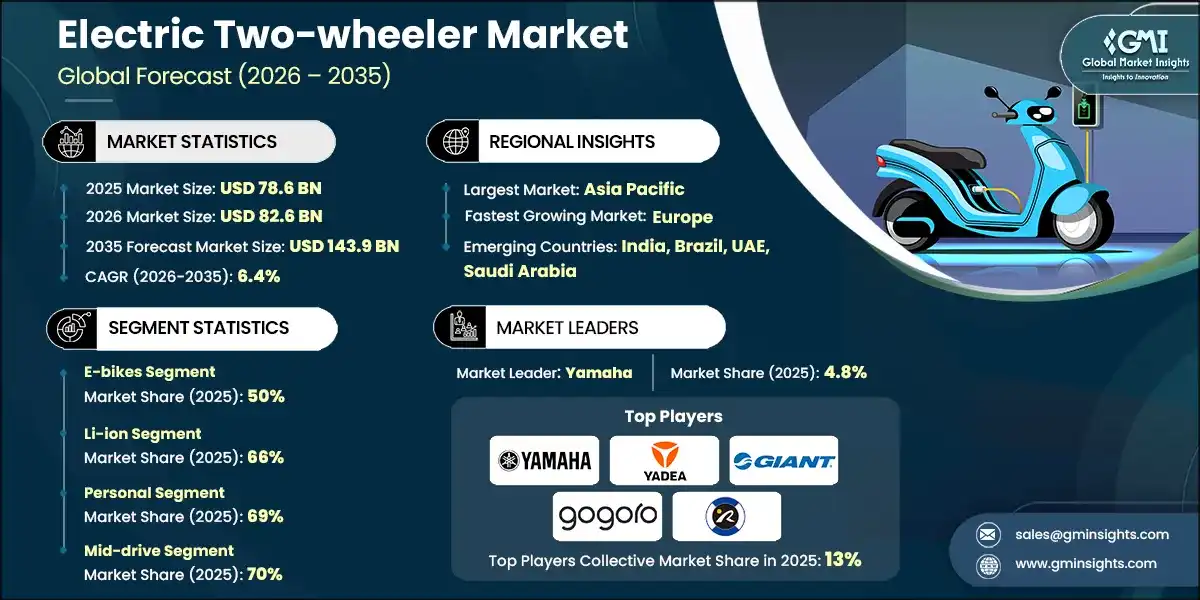
The global electric two-wheeler market size was estimated at USD 78.6 billion in 2025. The market is expected to grow from USD 82.6 billion in 2026 to USD 143.9 billion in 2035, at a CAGR of 6.4% according to latest report published by Global Market Insights Inc.
To get key market trends
With the increasing concern about air pollution and, more importantly, climate change, consumers are looking for eco-friendly transportation options. Electric two-wheelers with zero tailpipe emissions will reduce carbon footprints, hence making them very prospective alternatives to traditional gas-powered bikes. In this regard, the trend towards sustainability is driving market growth both in developed and developing regions.
The governments of various countries are providing subsidies, refunds, and other incentives for electric mobility. Many countries have initiated schemes that reduce the initial purchase price of electric two-wheelers to make them more affordable on account of purchase price. Overall, these supportive policies break down the cost barrier and accelerate the pace of market development in both mature and developing markets.
Advancements in the battery ensure better performance of the electric two-wheelers through increased energy density and faster charging. Other related innovations that help in improving the riding experience include regenerative braking and smart connectivity. In this way, all these improvements are making electric two-wheelers more feasible for a greater number of consumers and, therefore, increasing their market adoption.
In January 2025, Yadea launched an event to showcase the company’s newest electric two-wheeler, equipped with the company’s innovative sodium battery technology. This technology has innovative sodium battery technology and has been the biggest achievement for the company to date. When compared to the other lithium batteries, the sodium batteries are safer, environmentally friendly, and longer lasting and can therefore be considered best suited for repeated use in electric two-wheelers.
Urbanization at a rapid pace is resulting in traffic congestion on the road, making commutes less efficient. Electric two-wheelers offer an efficient alternative by providing speedy and agile transportation solutions that are specifically suited for short commutes and urban areas. As there is an increasing demand for efficient last-mile solutions, the electric two-wheeler industry is expected to gain momentum due to such demand trends.
The strict emission standards in Europe, including the European Union’s effort to have carbon-neutral transport, are a major contributor to the growing popularity of the electric two-wheeler market. The growing concern about lowering the emission levels of vehicles and meeting climate targets leads to the adaptation of electric two-wheelers, making the European market grow at a faster pace.
The Asia Pacific region represents a prominent market share for electric two-wheelers because of the economy-friendly nature of electric two-wheelers as opposed to the cost associated with traditional two-wheelers. The ease of production because of reduced component expenditure, as well as favoring an economical source of transport like the two-wheeler, makes it an ideal region with a greater market penetration rate.
Electric Two-wheeler Market Report Attributes
| Key Takeaway | Details |
|---|---|
| Market Size & Growth | |
| Base Year | 2025 |
| Market Size in 2025 | USD 78.6 Billion |
| Market Size in 2026 | USD 82.6 Billion |
| Forecast Period 2026 - 2035 CAGR | 6.4% |
| Market Size in 2035 | USD 143.9 Billion |
| Key Market Trends | |
| Drivers | Impact |
| Government support and incentives | Subsidies, tax rebates, and incentives from governments help reduce the cost and promote adoption of electric two-wheelers, particularly in developed regions like Europe and North America. |
| Technological advancements | Developments in battery technology, charging infrastructure, and electric drivetrains are improving the performance and affordability of electric two-wheelers, driving higher adoption. |
| Environmental consciousness | Increasing consumer preference for eco-friendly transport options, driven by concerns over climate change, boosts demand for zero-emission vehicles like electric two-wheelers. |
| Urban mobility and traffic congestion | Rising urbanization and traffic congestion are pushing consumers to seek efficient, low-maintenance alternatives to traditional fuel-powered vehicles, accelerating the shift to electric two-wheelers. |
| Pitfalls & Challenges | Impact |
| High initial costs | High upfront costs of electric two-wheelers, particularly for premium models, may limit adoption in price-sensitive markets. |
| Charging infrastructure | Lack of widespread charging infrastructure in many regions limits the convenience of using electric two-wheelers, hindering growth in less developed markets. |
| Opportunities: | Impact |
| Rising adoption in Asia Pacific | The increasing disposable incomes, rapid urbanization, and demand for cost-effective commuting solutions in Asia Pacific present huge opportunities for electric two-wheeler growth. |
| Electric scooter and bike sharing | The rise of shared electric scooter and bike rental services is driving greater adoption, especially in urban environments, where consumers opt for flexible, on-demand transport solutions. |
| OEM partnerships and innovations | Collaboration between electric two-wheeler manufacturers and tech companies for smart, connected solutions and advanced batteries could provide innovative products and open new markets. |
| Expansion in emerging markets | With expanding middle classes and increased government focus on sustainable transport, emerging markets in Africa, Latin America, and Southeast Asia represent significant untapped opportunities for growth. |
| Market Leaders (2025) | |
| Market Leaders |
4.8% Market Share |
| Top Players |
|
| Competitive Edge |
|
| Regional Insights | |
| Largest Market | Asia Pacific |
| Fastest growing market | Europe |
| Emerging countries | India, Brazil, UAE, Saudi Arabia |
| Future outlook |
|
What are the growth opportunities in this market?
Electric Two-Wheeler Market Trends
Governments across the world are providing tax rebates, incentives, and other benefits to boost the adoption of electric mobility. This reduces the cost of electric two-wheelers significantly and hence, they are now more preferred by the consumers. The government initiatives, due to the increasing focus on reduced emissions, are supporting the adoption of electric two-wheelers.
Electric two-wheelers can act as an agile, efficient, and economical means of transport when compared to conventional vehicles for short-distance travel. The capacity of these vehicles to overcome traffic congestion and solve parking problems makes them a preferred mode of transport for people living in cities.
Battery technology developments, including enhanced energy density, faster charging capabilities, and longer lifespans, are greatly ensuring the efficient functioning of electric two-wheelers. With enhanced battery performance and lower costs, the capabilities and reliability of electric two-wheelers will further improve and will meet the range anxiety challenges faced by consumers.
Increasingly, consumers are turning to environmentally responsible practices, and as a result, the need for environmentally friendly modes of transport is gaining popularity. The fact that electric two-wheelers are emission-free supports the reduction of pollution and carbon emissions. This environmentally responsible attribute, coupled with the increasing trend of being environmentally aware, contributes to the increasing adoption of electric two-wheelers against fuel-powered vehicles.
Electric two-wheelers provide tremendous cost advantages, including lower fuel costs and maintenance costs, when compared to conventional gas-powered vehicles. With lower operational costs, such as the lower cost of electricity when compared to gas, it is evident that electric two-wheelers have become more appealing to cost-sensitive customers.
The rising demand for mobility-sharing, including bike-sharing and scooter-sharing, is driving the demand for electric two-wheelers. Mobility-sharing is quite popular among consumers, and it offers them an easy and on-demand transport solution. The overall increase in the presence of electric two-wheelers in the market for sharing is making consumers accept and adopt electric mobility solutions.
Electric Two-Wheeler Market Analysis
Learn more about the key segments shaping this market
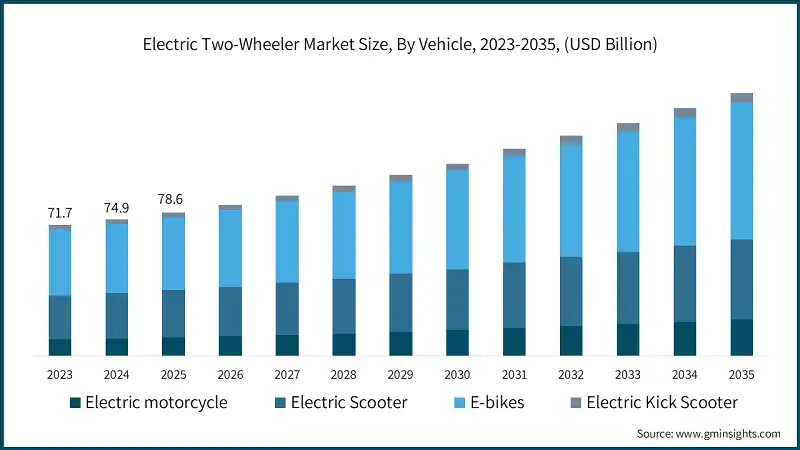
Based on vehicle, the electric two-wheeler market is divided into electric motorcycle, electric scooter, e-bikes, and electric kick scooter. The e-bikes segment dominated the electric two-wheeler market accounting for around 50% in 2025 and is expected to grow at a CAGR of over 6.5% from 2026 to 2035.
- E-bikes offer a combination of the benefits of cycling with the assistance of electricity. This is very appealing to health-conscious consumers who look for eco-friendly and low-impact alternatives to exercise. The growing trend of fitness as well as outdoor activities is adding to the popularity of e-bikes as a fun means of exercising, especially for those who might find a normal cycle a problem.
- With the growing need for sustainable transport from the city populace, e-bikes are a sustainable mode of transport. Another advantage of e-bikes over other forms of transport, such as cars, is that they emit no emissions. Thus, the ever-growing need for green transport, owing to the rise in climate change worries, is increasing the demand for e-bikes as a sustainable source of transport.
- Many governments are providing incentives such as subsidies and tax exemptions to promote the adoption of e-bikes as part of eco-friendly transportation systems. This initiative by the governments reduces the purchase cost of e-bikes and makes them accessible to everyone. Government incentives are an important factor contributing to market growth, especially in developed nations.
- E-bikes are an efficient means of transportation that helps people commute from one place to another quickly. They offer a faster travel alternative that takes less time when compared to automobiles. Moreover, they are easier to park when compared to automobiles. Thus, rising urbanization and traffic congestion in cities make people opt for an alternative like an e-bike that helps reduce commuter stress.
- The technological innovations in e-bike technology intended to enhance the functionality of e-bikes include material science to reduce the weight of e-bikes, advancements in batteries with extended ranges, faster charging batteries, and the integration of smart elements into e-bikes. The advances in batteries provide many benefits to consumers who have been concerned about the feasibility of using e-bikes.
Learn more about the key segments shaping this market
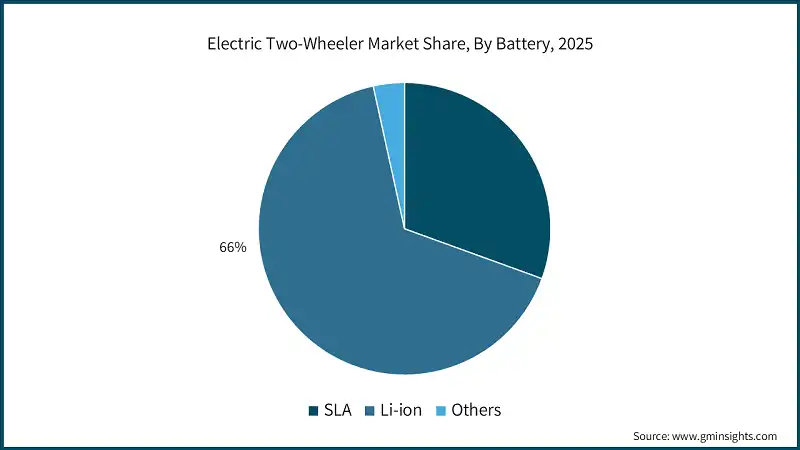
Based on battery, the electric two-wheeler market is segmented into SLA, Li-ion, and others. The Li-ion dominate the market with 66% share in 2025, and the segment is expected to grow at a CAGR of over 6% from 2026 to 2035.
- Li-ion batteries have higher energy density values than lead-acid batteries and allow two-wheeler to travel long distances before needing battery recharge due to the use of Li-ion batteries. With advancements in battery technology and the rising demand for long-lasting performance, Li-ion batteries are increasingly turning out to be the popular choice.
- Li-ion batteries are now being integrated with fast charging options. This will result in faster charging times. Fast charging technology will play a very important role in the lives of consumers who are always in search of convenience and efficiency in their electric two-wheelers. Fast charging will make electric vehicles a reality because charging times will no longer matter much.
- Li-ion batteries offer a light and compact design compared to conventional batteries, thus making them a perfect fit for electric two-wheelers, where the lightness of the batteries helps in improving the maneuverability of the vehicles. Moreover, the use of Li-ion batteries in electric two-wheelers further helps in improving the efficiency of the vehicles
- Li-ion batteries are much more durable and can sustain more charge cycles as compared to any normal battery. It is due to their durability that they are cost-effective for electric two-wheelers, which reduces the frequency of replacement and also lessens the cost of ownership in the long run. Since people very much consider longevity and value, Li-ion batteries have slowly become the dominant energy storage solution.
- These are much 'greener' than traditional battery technologies, as they offer higher efficiency with fewer toxic materials and can even be recycled. As consumers increasingly look for more sustainable transportation options, Li-ion batteries play to the values of that eco-consumer. Contributing to reducing carbon footprints, Li-ion batteries are considered one of the key enablers of growth in the electric two-wheeler market.
- While manufacturing of Li-ion batteries is scaling up, the cost per unit has fallen substantially. Lower prices make electric two-wheelers more affordable for a larger group of customers. The reducing cost of Li-ion batteries, with increased volumes of production, is fueling the market growth since electric two-wheelers turn out to be much cheaper than conventional vehicles.
Based on end use, the electric two-wheeler market is segmented into personal, commercial and shared mobility. The personal segment dominated the market, accounting for share of 69% in 2025.
- Electric two-wheelers can be considered a cost-effective option for people looking to replace their cars. Compared to cars, these vehicles require minimal initial investment, as there are no fuel costs and maintenance expenses. This has increased their appeal to those looking for an economical mode of transportation. The rising fuel costs have encouraged people to use electric two-wheelers. This has led to an increase in the personal category.
- With the increasing awareness about environmental concerns, consumers are becoming more conscious about their carbon prints. Electric two-wheelers, which emit zero carbon, can be a green solution for individual mobility. Environmental-aware buyers are increasingly opting for electric two-wheelers as they contribute towards reducing air pollution in urban areas, making this application type a prominent driver for the electric two-wheeler market.
- Governments are using incentives like tax rebates, subsidies, and grants to promote the consumption of electric vehicles like two-wheelers in the personal end-use sector. The incentives used by the governments are making it feasible for the general consumer to buy an electric two-wheeler. The rising support from the governments worldwide is having a crucial impact on promoting the use of electric two-wheelers.
- With an increase in the number of people inhabiting cities, the need for personal transport is being made increasingly difficult by traffic congestion and a lack of places to park. The solution comes with the advent of electric two-wheelers, which allow owners to traverse traffic with ease. The increased demand for convenient modes of transport has encouraged many people to opt for using electric two-wheelers.
- However, with the increased fuel costs, the need to find alternative means of transportation to and from home that are less expensive is on the rise. In this respect, electric two-wheelers make a major difference in terms of fuel and maintenance costs. In fact, the economy associated with using an electric two-wheeler, instead of a gasoline two-wheeler, makes the electric two-wheeler very popular.
Based on motor, the electric two-wheeler market is divided into mid-drive, hub and others. Mid-drive dominates with 70% market share in 2025.
- Mid-drive motors are recognized for their efficient performance, which is more efficient than hub motors, as they directly propel the bicycle’s drive train. Hence, they perform best for cyclists who value performance, especially when they need to ride uphill. The improvement in control and performance is recognized as one of the factors for their increased use in two-wheeler e-vehicles.
- Mid-drive motors are known to have an improved center of balance since the motor is mounted right in the middle of the bicycle. This results in greater stability and comfort when on the bike, most especially for bicycles that have electric motors. The rider will feel more natural when on the bike, making mid-drive motor systems extremely preferable for their functionality.
- Another advantage of the mid-drive motor is that the motor produces higher torque. This increases acceleration, especially during uphill acceleration and when starting off. This attribute makes electric two-wheelers with the capability of using a mid-drive motor more efficient during daily commutes and adventure tours. This is because they produce higher torque values, making them the preferred option among the required customers.
- Mid-drive motors utilize bike gears, further reducing the motor load and increasing energy efficiency. Consequently, this results in less power consumption for the same distance to be covered, adding to the battery's life span. This increased energy efficiency appeals to consumers who desire longer rides between charges, thus driving demand for mid-drive motor systems in the market.
- Mid-drive motors lead to better performance in hilly and off-road conditions. They give smoother performance in difficult circumstances because their torque output is more regular at every speed. That's why mid-drive systems hold the greatest appeal for many customers who are looking for an electric two-wheeler capable of handling both urban commuting and recreational off-road riding.
Looking for region specific data?
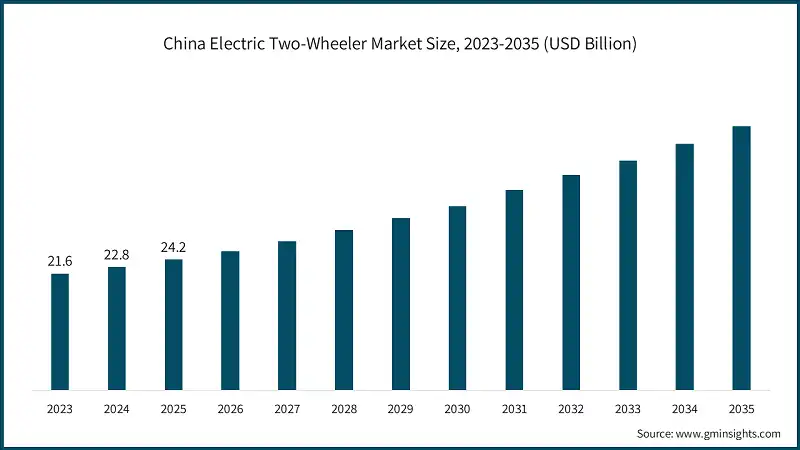
China dominated the electric two-wheeler market in Asia Pacific with around 40% share and generated USD 24.2 billion in revenue in 2025.
- The government provides subsidies and tax exemptions to favor the use of electric vehicles, including two-wheelers in the country. The above factor has contributed immensely to reducing the acquisition costs associated with the use of electric two-wheelers in the country. Moreover, the environmental measures initiated by the government of the country to reduce pollution in the country are a prominent driver for the market in the country.
- With the increased urbanization in China, congestion in cities such as Beijing, Shanghai, and Shenzhen has particularly worsened. Electric two-wheelers are becoming an ideal commuting mode in such congested cities. This is owing to their convenience in navigating through congested cities, affordability, and efficiency in performing short-distance travel, an aspect that makes them ideal compared to using automobiles.
- With rising health and environmental hazards associated with air pollution and global climatic conditions, Chinese consumers have raised their concern levels towards the environment. Electric two-wheelers have gained popularity in the Chinese market as they are environment-friendly and do not produce emissions. Increased applications of eco-friendly transportation in the market are fueling the demand for electric two-wheelers.
- Electric two-wheelers are an economic means of transportation available to the growing middle class in China. As fuel costs rise and the cost of living in urban China increases, the use of electric two-wheelers becomes an attractive option compared to buying a car. Another factor that makes electric two-wheelers an attractive means of transportation in China is their low operation and maintenance costs.
- China is increasing its electric two-wheeler charging infrastructure at a fast pace. This increase in the charging infrastructure of electric two-wheelers is expected to ensure that it becomes easily accessible to the consumer to recharge his/her electric two-wheeler. A significant decrease in range anxiety is expected due to the increase in the accessibility of the charging points of electric two-wheelers.
The US electric two-wheeler market is projected to exceed USD 3.2 billion in 2025, driven by high demand for eco-friendly transportation, government incentives, and increasing urbanization.
- The adoption of advanced battery technologies, enhanced motor efficiency, and improvements in range and charging infrastructure are supporting market growth. The growing preference for cost-effective, sustainable mobility solutions among consumers also fuels the expansion of electric two-wheelers in the US market.
- The US government provides incentives for the adoption of the electric two-wheelers as well as other electric vehicles. There are tax credits as well as rebates to make the adoption of the electric two-wheelers more accessible to the majority of the people, which has thereby increased the demand for the electric two-wheelers.
- With mounting concerns over the environment, consumers are turning towards greener alternatives for transportation. Electric two-wheelers, which emit no pollution, reduce air pollution in cities. Environmental awareness, along with a look towards greener modes of transportation, is a key factor propelling the adoption of electric two-wheelers in the US.
- Due to the heavy traffic experienced in many cities across the US, electric two-wheelers prove to be a highly efficient means of traveling over a shorter range. They can easily commute through traffic and overcome parking challenges compared to other modes of transport.
- The rise of charging points in the US has solved the range anxiety issue for consumers who own electric two-wheelers. With the steady growth of the charging point network, the confidence of consumers in the use of electric two-wheelers for commuting purposes will increase, thus fueling the growth of the market further.
- With increased fuel prices, consumers are looking for alternative solutions that are cost-effective. The operating cost of electric two-wheelers is lower when compared to gasoline two-wheelers, making such products attractive for those looking for a cost-effective alternative, thus propelling growth within the US
- Improved technology in batteries, motoring, and connectivity is making e-two-wheelers more attractive to customers. The factors which could boost the adoption rate in the US, especially in the area of e-bikes meant for urban mobility and recreation, include better battery life, fast-charging capabilities, and improved performance.
The electric two-wheeler market in Germany is projected to grow at a robust CAGR of 5.5% from 2026 to 2035, driven by the increasing adoption of eco-friendly transportation, stringent EU regulations on battery safety, rapid expansion of charging infrastructure, and growing consumer demand for advanced, high-performance electric two-wheelers.
- The government in Germany is offering huge subsidies and tax benefits to encourage the development of electric mobility. The stringent emissions rules set by the EU are pushing the adoption of cleaner transport solutions. The factors are promoting the uptake of two-wheelers with electric technology in both urban and rural environments in Germany.
- Consumers in Germany are increasingly turning to eco-friendly solutions, which is a part of the overall commitment to the concept of sustainability. Electric two-wheelers represent a cleaner and greener alternative to conventional gasoline-powered vehicles. In the event of high environmental awareness within the country, the focus is on electric mobility, especially for short-distances and fun rides.
- In the past, technologies such as long-life, fast-charging batteries helped improve the performance and ease of use of e-two-wheelers, and such technologies have emerged from Germany, which is leading in technological innovations, especially in the development of batteries and efficient motors. Range anxiety and charging time are two prime concerns for all users, which such technologies can easily resolve.
- Due to the high rate of urbanization being experienced in Germany, traffic congestion is a problem being experienced in cities. The use of electric two-wheelers can be a highly efficient alternative mode of transport. The fact that they can easily navigate through cities is a major attraction for commuters in Germany.
- Germany is heavily investing in the development of the charging infrastructure for electric two-wheelers, apart from passenger vehicles. With more and more charging points being set up in urban and semi-urban areas, it is becoming increasingly easier for customers to charge their electric two-wheelers, thus encouraging people to switch from conventional two-wheelers to electric two-wheelers.
- As the cost of owning and using conventional vehicles, such as maintenance, fuel, and insurance costs, continues to increase, consumers in Germany are looking at alternative means of transportation that are cheaper. Electric two-wheelers are an attractive alternative due to the low associated costs.
The electric two-wheeler market in Brazil reached significant scale in 2025, driven by increasing demand for sustainable transportation, growing consumer awareness of environmental impact, and government incentives for electric vehicle adoption.
- The government in Brazil is offering incentives for the adoption of electric two-wheelers as well as other electric vehicles. The incentives include tax exemptions and lowered import duties. This reduces the cost associated with the usage of electric two-wheelers. The initiatives undertaken by the government to reduce pollution associated with the use of energy are major drivers of the electric two-wheeler market in Brazil.
- Brazil is undergoing rapid urbanization, which is resulting in increased traffic congestion in cities. The need for a feasible and economic mode to traverse such densely populated cities is being fulfilled by electric two-wheelers. The advantage offered by two-wheelers in navigating traffic and parking is what is making such vehicles desirable for urban Brazilian commutes.
- Due to rising awareness pertaining to air pollution and global warming, Brazilian consumers are gradually shifting towards a sustainable mode of transportation. Electric two-wheelers, being emission-free, are perfectly aligned with Brazil’s commitment to sustainability, thus triggering higher adoption rates due to increased support from eco-conscious Brazilian consumers. Additionally, the integration of advanced battery technologies and enhanced motor efficiency supports the widespread adoption of electric two-wheelers in Mexico
The electric two-wheeler market in the UAE is projected to grow at a CAGR of 7.9% from 2026 to 2035, driven by the country’s increasing adoption of sustainable transportation, growing consumer demand for eco-friendly mobility solutions, and government incentives promoting electric vehicle adoption.
- As cities in the UAE, like Dubai, keep on growing, so do the problem of congestion on the roads. Electric two-wheelers provide a compact, efficient, and affordable mode of transport to help solve this problem of mobility through crowded streets. Their traffic-jam-avoiding ability and low operating costs make them ideal for city driving in the UAE.
- The UAE has been investing in expanding the network for electric vehicle charging, therefore easing the recharge process for electric two-wheeler owners. The more this network of charging stations expands, the more convenient the use of electric two-wheelers will be, which is expected to encourage their adoption in both public and private sectors.
- The UAE market is famous for its fondness for luxury, performance, and smart technologies. Thus, electric two-wheelers integrated into advanced features like smart connectivity, GPS, and app integration are gaining momentum. Such innovative technological features attract end-consumers who give importance to convenience, performance, and modern solutions while commuting daily.
Electric Two-Wheeler Market Share
- The top 7 companies in the electric two-wheeler industry are Yadea, Giant Bicycles, Yamaha Motor Company, Jiangsu Xinri E-Vehicle, Gogoro, Hero Electric, and Niu Technologies, contributing around 13% of the market in 2025.
- Yadea maintains competitiveness with a range of electric scooters and bicycles where price and performance are balanced. R&D spending by the company is directed towards battery efficacy, intelligent connectivity, and more. This is coupled with a proper expansion of the firm into the global markets. Additionally, the firm collaborates with local dealers as well as online platforms to ensure brand recognition within the desired markets.
- Giant Bicycles draws upon its long-term knowledge and competencies in cycling to produce quality-assured e-bikes boasting sophisticated battery technologies, light material constructions, and outstanding ride dynamics. To create superior e-mobility experiences, they focus on integrating intelligent technologies and ergonomics. World-class market presence and distribution networks, and advances in battery and motor technologies, make Giant competitive in the markets.
- The Yamaha Motor Company maintains competitiveness in terms of engineering expertise, reliability, and brand reputation. Yamaha’s electric two-wheelers are known for their powerful motor performance, elegant designs, and smart features. Yamaha, with its large global aftermarket support, widespread dealership, and focus on technology upgradation, maintains high consumer loyalty. Partnerships and modularity help with easy scalability and quick response to market trends.
- Jiangsu Xinri E-Vehicle leverages the cost leadership and mass production strengths of the company to provide budget-friendly electric two-wheelers to consumers globally. The organization focuses on efficient production, localized value chain, and variational offerings based on customer preferences. By teaming up with regional distributors and fulfilling legal requirements, Xinri E-Vehicle grabs a large market share, especially in emerging countries.
- The competitive advantage for Gogoro is its unique battery swap system, which allows easy refuelling. The intelligent scooters from this brand are equipped with internet capabilities, apps, and modularity. The collaboration by the firm between cities or operators helps to improve accessibility of the infrastructure. The firm concentrates on customer experience and energy scalability, putting it in a strong brand loyalty position as the first mover in next-generation mobility solutions.
- Hero Electric maintains competitiveness based on pricing, localisation, and a range of products suitable for daily commuting. Being a part of one of the leading two-wheeler companies in India, Hero Electric holds significant market knowledge, reach, and support services. Its focused efforts on improvements in the battery, support, and finance areas help it tap the price-conscious segment and reach penetration in both urban and rural areas.
- Niu Technologies maintains a competitive position in the market through its technologically advanced electric scooters, smart connectivity, GPS tracking, and power-efficient batteries. Niu aims to enhance design quality and satisfy the technological needs of its consumers. Through direct-to-consumer sales channels and online engagements, Niu maintains a stronger relationship with its consumers. Continuous technological upgrades and data analysis capabilities improve performance, and internationalization of the brands maintains a higher sales position.
Electric Two-Wheeler Market Companies
Major players operating in the electric two-wheeler industry are:
- Ather
- Giant
- Gogoro
- Hero Electric
- Jiangsu Xinri E-Vehicle
- Niu Technologies
- Ola
- VMOTO SOCO
- Yadea
- Yamaha Motor Company
- Electric two wheelers market is quite intense and is driven by the focus of key participants on innovative and efficient products and prices. Top market participants such as Yadea, Yamaha Motor, and Hero Electric are majorly spending on researching and developing improved battery technology and intelligent capabilities such as internet and AI integration. Electric two-wheeler technology is developing at a very rapid pace and is majorly focused on meeting user requirements such as safety and comfort by market participants.
- Players in the region also contribute significantly, especially in new markets, where the factors of affordability and accessibility become key. Gogoro and Niu Technologies, for instance, are improving their competitive advantage by incorporating distinct value additions such as battery-swapping technologies. Partnerships for new markets, especially from the regional governments, retailers, and infrastructure companies, become essential for increasing access to the markets. Incentivization from the governments for environmentally friendly modes of transport is also increasing, leading to more competition as new players vie for the markets using cost-effective and environmentally sound technologies.
Electric Two-Wheeler Industry News
- In December 2025, Bajaj plans to launch the new Chetak electric scooter in 2026. It would come equipped with all the required ‘pocket-friendly’ pieces like a simplified hub motor, Telescopic fork, Twin rear shock absorber, and a floorboard-mounted battery pack.
- In December 2025, Samsung entered the electric mobility market with the launch of its latest electric cycle, reaching out to provide an efficient and affordable travel option. With fuel prices increasing by the day and road traffic getting congested in cities, electric cycles are becoming the favorite mode of transport for people in their daily commuting needs. With a long range of 150KM with a 250W motor, the Samsung Electric Cycle is designed for people wanting an eco-friendly and affordable mode of transport
- In November 2025, Honda launched its first electric motorcycle, named Honda WN7. The motorcycle is powered by its new compact and lightweight water-cooled motor, along with the inverter integrated in it. The maximum output for the new engine is 50 kW, which is as powerful as that of 600 cc ICE vehicles, along with maximum torque of 100 Nm, which is like 1000 cc ICE vehicles.
- In September 2025, Indian electric two-wheeler maker Zelio E Mobility launched an updated variant of its successful low-speed electric scooter, Gracyi, in the market. The new variant combines performance, comfort, and commute-centric features.
The electric two-wheeler market research report includes in-depth coverage of the industry with estimates & forecasts in terms of revenue ($ Mn/Bn) and shipment (Units) from 2022 to 2035, for the following segments:
Market, By Vehicle
- Electric motorcycle
- Electric Scooter
- E-bikes
- Electric Kick Scooter
Market, By Battery
- SLA
- Li-ion
- Others
Market, By Motor
- Mid-drive
- Hub
- Others
Market, By Motor Power
- Below 3.5 kW
- 3.5 kW – 6.5 kW
- Above 6.5 kW
Market, By Voltage
- 48V
- 60 V
- 72V
- Others
Market, By End Use
- Personal
- Commercial
- Shared Mobility
The above information is provided for the following regions and countries:
- North America
- US
- Canada
- Europe
- UK
- Germany
- France
- Italy
- Spain
- Russia
- Denmark
- Asia Pacific
- China
- India
- Japan
- South Korea
- ANZ
- Singapore
- Latin America
- Brazil
- Argentina
- Mexico
- MEA
- UAE
- Saudi Arabia
- South Africa
Frequently Asked Question(FAQ) :
Who are the key players in the electric two-wheeler industry?
Key players include Ather, Giant, Gogoro, Hero Electric, Jiangsu Xinri E-Vehicle, Niu Technologies, Ola, VMOTO SOCO, Yadea, and Yamaha Motor Company.
What are the upcoming trends in the electric two-wheeler market?
Advances in battery technology, growth of mobility-sharing services, supportive government incentives, and rising demand for emission-free transportation.
What is the growth outlook for the personal segment from 2026 to 2035?
The personal segment, which held a 69% market share in 2025, as electric two-wheelers offer a cost-effective alternative to cars, driven by rising fuel costs and minimal maintenance expenses.
Which region leads the electric two-wheeler sector?
China leads the Asia Pacific region with a 40% market share, generating USD 24.2 billion in revenue in 2025. Government subsidies, tax exemptions, and environmental initiatives to reduce pollution are key drivers in the region.
How much revenue did the e-bikes segment generate in 2025?
The e-bikes segment accounted for approximately 50% of the market in 2025 and is expected to grow at a CAGR of over 6.5% till 2035.
What is the market size of the electric two-wheeler in 2025?
The market size was USD 78.6 billion in 2025, with a CAGR of 6.4% expected through 2035. Increasing concerns over air pollution and climate change, coupled with the demand for eco-friendly transportation, are driving market growth.
What was the market share of Li-ion batteries in 2025?
Li-ion batteries dominated the market with a 66% share in 2025 and is set to expand at a CAGR of over 6% up to 2035.
What is the expected size of the electric two-wheeler industry in 2026?
The market size is projected to reach USD 82.6 billion in 2026.
What is the projected value of the electric two-wheeler market by 2035?
The market is poised to reach USD 143.9 billion by 2035, driven by advancements in battery technology, government incentives, and the growing trend of sustainability.
Electric Two-wheeler Market Scope
Related Reports