Summary
Table of Content

Electric Transporters Market
Get a free sample of this report
Form submitted successfully!
Error submitting form. Please try again.
Thank you!
Your inquiry has been received. Our team will reach out to you with the required details via email. To ensure that you don't miss their response, kindly remember to check your spam folder as well!
Request Sectional Data
Thank you!
Your inquiry has been received. Our team will reach out to you with the required details via email. To ensure that you don't miss their response, kindly remember to check your spam folder as well!
Form submitted successfully!
Error submitting form. Please try again.
Electric Transporters Market Size
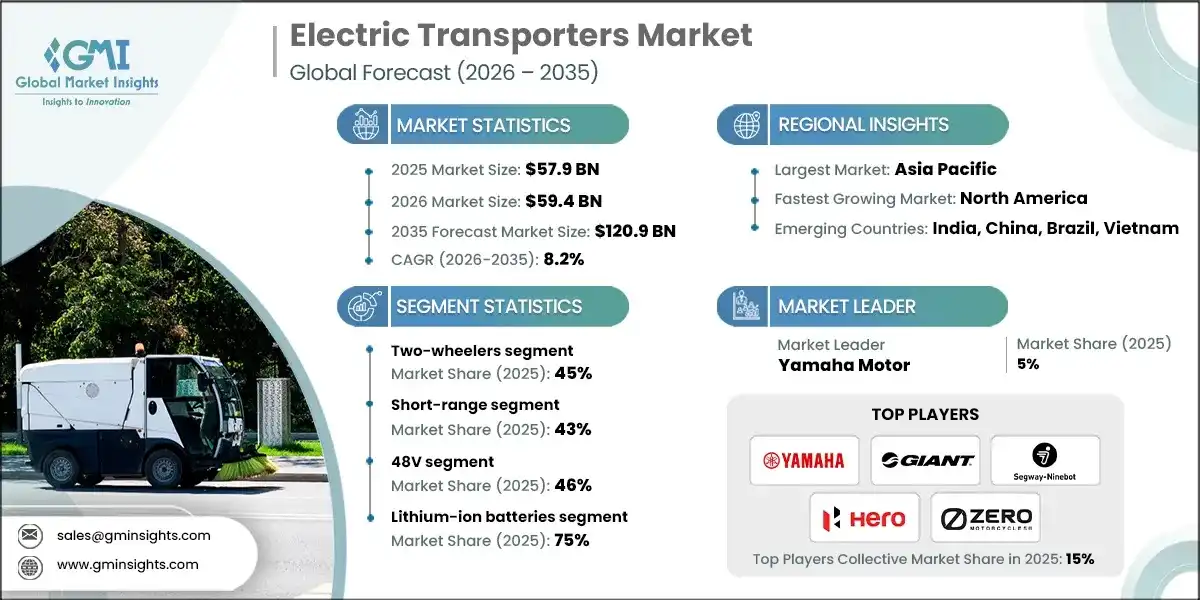
The global electric transporters market size was estimated at USD 57.9 billion in 2025. The market is expected to grow from USD 59.4 billion in 2026 to USD 120.9 billion in 2035, at a CAGR of 8.2% according to latest report published by Global Market Insights Inc.
Electric Transporters Market Key Takeaways
Market Size & Growth
- 2025 Market Size: USD 57.9 Billion
- 2026 Market Size: USD 59.4 Billion
- 2035 Forecast Market Size: USD 120.9 Billion
- CAGR (2026–2035): 8.2%
Key Market Drivers
- Urbanization and traffic congestion.
- Environmental concerns and regulatory support.
- Growth in e-commerce and logistics.
- Advances in battery technology and declining costs.
- Rising fuel prices and lower operating costs.
Challenges
- Limited charging infrastructure and range anxiety.
- High upfront costs and long payback period.
Opportunity
- Expansion of last-mile delivery solutions.
- Development of battery-swapping and fast-charging infrastructure.
- Integration with smart city and urban mobility initiatives.
- Fleet electrification for logistics and public transport.
Key Players
- Market Leader: Yamaha Motor led with over 5% market share in 2025.
- Leading Players: Top 5 players in this market include Yamaha Motor, Giant, Segway Ninebot, Hero Motor, Zero Motorcycles, which collectively held a market share of 15% in 2025.
Get Market Insights & Growth Opportunities
Rising global fuel prices and volatility in traditional energy markets are prompting businesses to seek cost-effective alternatives. For instance, according to the International energy agency, in November 2024, Brent crude oil was priced at USD 75.29 per barrel, WTI oil at USD 71.47, and the OPEC basket at USD 74.02.
Additionally, oil prices are expected to increase by USD 5/barrel and reach USD 80/bbl. Electric transporters offer significant savings on fuel and maintenance costs. Total cost of ownership increasingly favors electric options, especially in regions with stable electricity prices or access to renewable energy sources.
Rapid urbanization continues to intensify traffic congestion in cities worldwide, creating strong demand for compact, maneuverable electric transporters. More than 1 billion people currently lack access to all-weather roads according to United Nations Organization, while existing urban road infrastructure struggles to accommodate growing vehicle populations.
According to World Bank, urban passenger demand is set to more than double by 2050 from 2015 levels, spurring an urgent need for efficient and compact transportation solutions. In 2024, the International energy agency reported that electric two-wheelers now represent about 8% of the global two-wheeler fleet. In response to this surge, cities around the globe are enhancing their infrastructure, expanding bike lanes, and redesigning parking facilities to better serve the rising number of electric micro-mobility vehicles.
Battery technology advancements are propelling market growth. As per International energy agency, the cost of lithium-ion batteries plummeted from over USD 500 per kWh in 2015 to just USD 135 per kWh in 2023.
Battery technology advancements are propelling market growth. As reported by International energy agency, lithium-ion battery costs plummeted from over USD 500 per kWh in 2015 to just USD 135 per kWh in 2023. This significant drop in costs has positioned electric transporters as formidable competitors to traditional options, especially in high-demand sectors like ridesharing and delivery services.
As e-commerce rapidly expands, the demand for electric cargo transporters in last-mile delivery has surged. According to World Bank, the COVID-19 pandemic not only sped up e-commerce adoption but also heightened the number of last-mile delivery vehicles on urban roads.
To get key market trends
Electric Transporters Market Trends
Battery swapping technology is addressing charging time and range anxiety in the electric transport market. The International energy agency approved standard P3240.14 in November 2025, enabling interoperability and traceability across manufacturers through distributed ledger technology, fostering widespread adoption and cross-brand compatibility.
Battery swapping offers a quick 2–3-minute solution compared to the 30 minutes to several hours required for conventional charging. This minimizes downtime, making it ideal for ridesharing, delivery fleets, and public transport, thereby boosting fleet productivity.
China and India lead in battery swapping infrastructure, driven by companies like Gogoro, Nio, and Sun Mobility. International energy agency highlights its growing adoption in Asia's two-wheeler and three-wheeler segments due to high usage rates and standardized battery formats.
Smart cities leverage real-time data from electric transport fleets to enhance traffic management, implement dynamic pricing, and optimize vehicle distribution. These measures help identify congestion patterns, adjust traffic signals, and balance transportation system loads efficiently.
According to World Bank, MaaS platforms not only curb private vehicle ownership but also boost public transport usage, leading to less congestion and lower emissions. Cities like Amsterdam, Copenhagen, and Singapore have taken the lead, weaving electric micro-mobility into their broader MaaS frameworks, showcasing the promise of a fluid multi-modal transport system.
Standardization of data formats, and communication protocols is advancing integration efforts. International energy agency has established standards for vehicle-to-infrastructure communication, enabling interoperability among manufacturers and service providers. These fosters open platforms, encouraging competition, innovation, and consistent user experiences.
Regulatory frameworks for electric transporters are evolving globally, enhancing clarity for manufacturers and consumers while ensuring safety and interoperability. International energy agency standards, such as IEEE 1860 and IEEE 1725, address lithium-ion battery systems, safety protocols, performance testing, and environmental considerations, including recycling and disposal.
According to International energy agency, governments representing over 50% of global vehicle sales have endorsed the Paris Declaration on electric mobility, aiming for 20% road transport electrification by 2030. This commitment is driving regulations like emissions standards, zero-emission vehicle mandates, and internal combustion engine.
Electric Transporters Market Analysis
Learn more about the key segments shaping this market
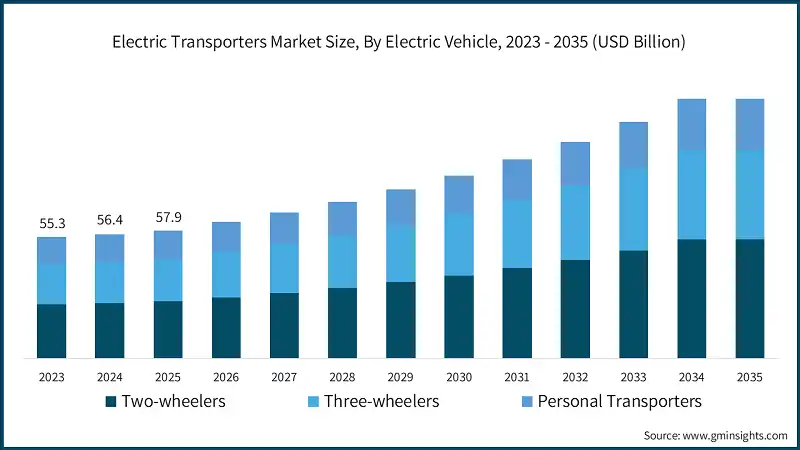
Based on electric vehicles, electric transporters market is segmented into two-wheelers, three-wheelers and personal transporters. The two-wheelers segment dominates the market with 45% share in 2025, and the segment is expected to grow at a CAGR of 8.5% from 2026 to 2035.
- Electric two-wheelers have the highest electrification rate among road transport segments. According to International energy agency, approximately 8-9% of the global two-wheeler fleet is expected to be electrified by 2024.
- The segment benefits from small battery requirements, ensuring competitive pricing despite declining battery costs.
- For instance, in 2024, China led with 6.92 million electric two-wheeler sales (78% of global volume), while India recorded 1.25 million sales in 2023, growing 40% year-over-year according International energy agency.
- Low-speed electric scooters and bicycles dominate sales volumes in Asia, offering affordable short-distance urban transportation. These vehicles are typically priced below USD 1,000, making them accessible to a broad consumer base.
- Premium electric motorcycles from brands like Zero Motorcycles, Harley-Davidson, and BMW Motorrad, priced between USD 10,000 and USD 30,000, offer performance comparable to traditional bikes.
- The mid-range segment, comprising commuter-focused electric scooters and motorcycles priced at USD 2,000 to USD 8,000, is growing rapidly due to declining battery costs and improved performance.
- In 2025, personal transporters, including electric skateboards, hoverboards, electric unicycles, and standing electric scooters, accounted for 25% of the market share. This segment is growing with a CAGR of 6.8% from 2026 to 2035.
- Personal transporters, priced between USD 200 and USD 2,000, have become increasingly popular for first-mile and last-mile connectivity. They complement public transit systems and provide flexible urban mobility options.
- The personal transporters segment encounters regulatory challenges in many jurisdictions, including unclear legal status and requirements for licenses or registration.
Learn more about the key segments shaping this market
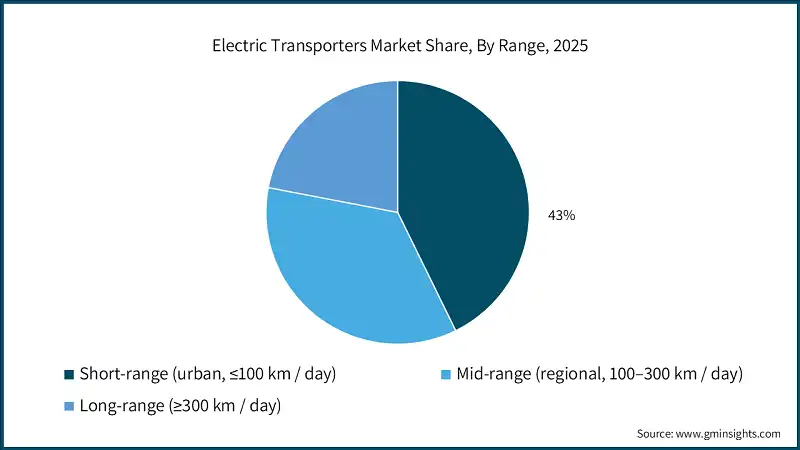
Based on range, electric transporters market is divided into into short-range (urban, ≤100 km/day), mid-range (regional, 100-300 km/day), and long-range (≥300 km/day). The short-range segment dominates with 43% market share in 2025 and is growing at the fastest rate of 8.6% CAGR till 2035, driven by urban micro-mobility and last-mile delivery applications.
- Short-range electric transporters are designed for urban areas with daily travel under 100 km and accessible charging infrastructure. These vehicles prioritize affordability, maneuverability, and parking ease, using smaller battery packs to reduce costs and weight.
- The World Bank projects urban passenger demand to more than double by 2050, fueling the need for efficient short-range mobility solutions. Electric scooters and bicycles, aligned with the micro-mobility trend, enhance first-mile and last-mile connectivity within public transit systems.
- Short-range electric transporters boast a compelling economic advantage, as their total cost of ownership is notably lower than traditional counterparts, thanks to minimal battery needs and less frequent maintenance.
- According to International energy agency, electric two-wheelers and three-wheelers have the highest electrification rates in road transport, driven by urban adoption. Cities worldwide are supporting this trend with bike lanes, parking, and charging infrastructure.
- In 2025, the mid-range segment secured a 35.3% share of the market, boasting an 8.3% CAGR from 2026 to 2035. This segment caters to commuters with longer daily travel needs, regional delivery services, and recreational users desiring extended touring capabilities.
- Mid-range vehicles benefit from declining battery costs, which have dropped from over USD 500 per kWh in 2015 to USD 135 per kWh in 2023 (IEA.ORG). This reduction supports the affordability of larger battery packs needed for extended operation and highway speeds.
- In 2025, the long-range segment holds a 22% market share, with a 7.3% CAGR during forecast period. This segment includes performance electric motorcycles and commercial vehicles requiring over 300 km daily for inter-city deliveries, touring, and professional use.
- Long-range vehicles, featuring large battery packs and efficient drivetrains, often include fast charging to reduce downtime. According to World Bank, investments in charging infrastructure effectively drive electric vehicle adoption, supporting the segment's growth.
Based on voltage, the electric transporters market is segmented into 24V, 36V, 48V and above 48V. The 48V segment dominates with 46% market share in 2025, representing the optimal balance for most urban electric transporter applications.
- The 48V standard is widely adopted for electric bicycles, scooters, and light motorcycles, offering sufficient power for urban speeds (25-45 km/h) while ensuring compatibility with existing components and charging infrastructure.
- The 48V segment is growing at a 8.1% CAGR, driven by urban micro-mobility and e-commerce delivery applications. This voltage level ensures efficient motor operation, reduces resistive losses, and meets urban transportation needs, including moderate hills and cargo loads.
- In 2025, the 48V segment accounted for 33% of the market, and recorded the fastest growth at an 8.7% CAGR from 2026 to 2035. It includes 60V, 72V, and higher voltage systems used in performance electric motorcycles, high-speed scooters, and commercial delivery vehicles.
- Higher voltage systems enable more powerful motors and faster charging while reducing current levels for given power outputs, improving efficiency and reducing conductor costs.
- The International energy agency establishes safety standards for high-voltage electric vehicle systems, including insulation, protection, and maintenance. Brands like Zero Motorcycles and Harley-Davidson use 100V+ systems to rival traditional motorcycle performance.
- In 2025, the 36V segment holds a 15% market share, growing at a 7.8% CAGR. These systems are widely used in entry-level electric bicycles and scooters, particularly in Europe, where they align with regulatory definitions and benefit from favorable licensing and operational permissions.
- The 36V standard provides sufficient power for urban cycling on flat terrains, offering cost-effective electrical systems with mature components and established safety standards.
- In 2025, the 24V segment commanded a 6% share of the market, with a robust growth rate of 7.5% CAGR. This segment, the lowest in voltage, encompasses basic electric bicycles, children's electric vehicles, and specialized applications prioritizing simplicity and safety.
- 24V systems ensure safety with minimal electrical hazards, making them ideal for recreational and light-duty applications. However, they face competition from 36V and 48V systems due to declining battery costs and rising consumer demands.
Based on battery, the electric transporters market is divided into lithium-ion, lead-acid, nickel-metal hydride, and solid-state batteries, each offering distinct performance, cost, and application characteristics. Lithium-ion batteries dominate with 75% market share in 2025, reflecting superior energy density, longer lifespan, and declining costs that have made them the preferred choice for most electric transporter applications.
- As per International energy agency, lithium-ion battery costs dropped from over USD 500 per kWh in 2015 to USD 135 per kWh in 2023, a 73% reduction. This decline, driven by manufacturing scale, technology advancements, and supply chain optimization, continues at 10-15% annually.
- International energy agency has established standards like IEEE 1860, focusing on battery management systems, safety protocols, and environmental considerations for electric vehicles. Lithium-ion batteries, with energy densities of 150-250 Wh/kg, enable ranges of 50-150 km for standard electric two-wheelers, while premium models exceed 200 km.
- In 2025, lead-acid batteries hold a 16% market share with a 9.7% CAGR. Their lower upfront costs, established recycling infrastructure, and proven reliability offset limitations in energy density and lifespan.
- In price-sensitive markets like India and China, lead-acid batteries dominate the scene. They're the go-to choice for low-speed electric scooters and three-wheelers, where the allure of a lower initial cost often overshadows performance limitations, especially for short-range urban use.
- According to World Bank, in developing countries where upfront costs are a primary concern, lead-acid batteries continue to be the economically preferred choice for specific applications.
- In 2025, nickel-metal hydride batteries held a 7% market share, growing at a 9% CAGR. This mature technology offers moderate energy density and excellent safety with high tolerance to abuse conditions.
- Nickel-metal hydride batteries are widely used in hybrid electric vehicles and electric two-wheelers due to their superior performance and safety. They benefit from well-established manufacturing and recycling infrastructure.
- In 2025, solid-state batteries account for a 2.2% market share and are growing at the fastest rate, with a CAGR of 10.4%.
- Solid-state batteries, unlike conventional lithium-ion batteries that use liquid electrolytes, utilize solid materials. This shift promises benefits such as enhanced energy density, quicker charging times, heightened safety, and extended longevity.
- The International energy agency is developing standards for solid-state battery systems as technology transitions to commercial deployment. Ongoing R&D aims to overcome high costs and manufacturing challenges, enabling cost-competitive production by 2030 to transform electric vehicle performance and economics.
Looking for region specific data?
Asia Pacific region dominated the electric transporters market with a market share of 73% in 2025, which is anticipated to grow at a CAGR of 7.8% during the analysis timeframe. The region benefits from robust production in China and rising demand across India and Southeast Asia.
- China leads the electric transporter market, accounting for approximately 78% of global sales volume according to International energy agency. This dominance stems from strong government support, extensive manufacturing capacity, and a large domestic consumer base.
- Leading Chinese manufacturers like Yadea, Aima, and Sunra produce millions of electric two-wheelers annually for domestic and export markets. As per International energy agency, over 30% of two-wheeler sales in China are electric, highlighting their mainstream adoption.
- According to International energy agency, India is set to lead Asia Pacific's major markets, projecting sales of 1.25 million electric two-wheelers and 700,000 electric three-wheelers in 2024.
- Electric three-wheelers in India have reached a 57% electrification rate, driven by cost-effectiveness for commercial use and government support. The PM E-DRIVE scheme allocates USD 1.3 billion to support 2.5 million electric two-wheelers through subsidies and charging infrastructure investments.
- Hero Electric, Ather Energy, Ola Electric, and TVS Motor, among other Indian manufacturers, are swiftly ramping up production capacities and crafting innovative products to meet the unique demands of the domestic market.
- Countries like Vietnam, Indonesia, Thailand, Japan, and South Korea showcase diverse market dynamics and adoption patterns across the Asia Pacific region.
- Vietnam, with support from the World Bank, has introduced an E-Mobility Roadmap targeting a reduction of 5.3 million tons of CO2 equivalent emissions by 2030.
- According to International energy agency, Vietnam sold 0.25 million electric two-wheelers in 2024. While Southeast Asian nations swiftly adopt electric three-wheelers for taxis and deliveries, Japan and South Korea are homing in on premium electric motorcycles and cutting-edge tech advancements.
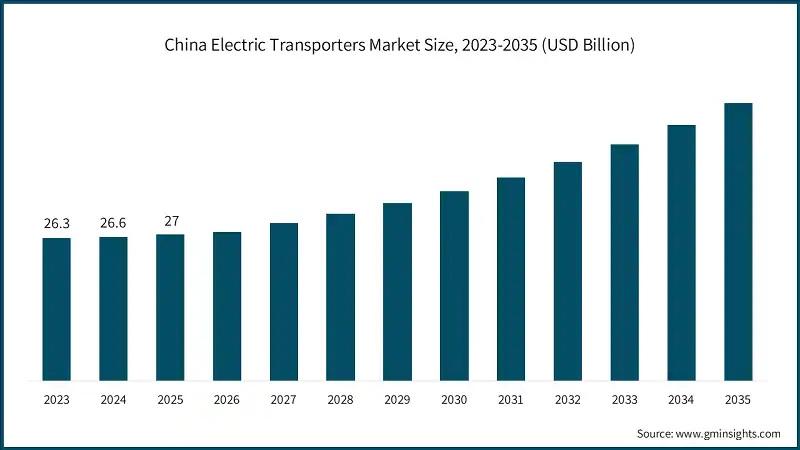
The electric transporters market in China is expected to experience significant and promising growth from 2026 to 2035.
- China's electric transporter market is growing rapidly, driven by the adoption of electric bicycles, scooters, and motorcycles in urban and semi-urban areas. The market offers models ranging from under USD 500 to over USD 5,000, catering to various income groups.
- China is accelerating e-mobility adoption through policies such as EV purchase subsidies, charging infrastructure funding, and restrictions on gasoline two-wheeler registrations, driving consumers and delivery fleets toward electric transporters.
- China has developed an advanced infrastructure for electric two- and three-wheelers, with millions of charging points across residential, office, and commercial areas, ensuring widespread accessibility and convenience.
- Nio and Aulton are driving the rapid expansion of battery-swapping networks, enabling quick battery exchanges for two-wheelers and three-wheelers. This development is fostering increased adoption in delivery fleets, couriers, and urban logistics.
- Chinese manufacturers are scaling up electric transporter production by utilizing domestic supply chains for key components, reducing costs, and enabling rapid deployment. They also enhance user experience and fleet efficiency through smart connectivity, IoT tracking, and app-based charging.
- China, supported by a cohesive EV policy, advanced infrastructure, and strong domestic manufacturing, leads the Asia Pacific electric transporter market, driven by the world’s largest two-wheeler user base.
North America is the fastest growing electric transporters market, which is anticipated to grow at a CAGR of 12% during the analysis timeframe.
- Major US cities, including New York, San Francisco, Los Angeles, and Washington DC, are driving the adoption of shared electric scooters, bikes, and personal transporters. Operators like Lime, Bird, and Uber have deployed thousands of vehicles, establishing North America as a key market for shared micro-mobility.
- City-level regulations are shaping market expansion, with some cities promoting micro-mobility to reduce congestion, while others impose restrictions due to concerns like sidewalk clutter and rider safety. This is driving the market toward a more structured phase with defined operational frameworks.
- Zero Motorcycles and Harley-Davidson's LiveWire division dominate the high-performance electric two-wheeler market, offering advanced motorcycles priced between USD 10,000 and USD 30,000. These brands reinforce North America's leadership in the premium electric transport segment.
- The deployment of 5G networks, multi-access edge computing (MEC), and IoT-based fleet management platforms is enhancing fleet connectivity for electric mobility services. These technologies enable real-time tracking, optimized charging, predictive maintenance, and safer shared e-mobility fleet operations.
- North America is witnessing significant venture capital and corporate investments in electric micro-mobility, battery technology, and fleet electrification, driving innovation and urban market growth.
- Canada is emerging as a growing market in the region, driven by EV incentives, environmental awareness, and expanding e-scooter and e-bike sharing programs in cities like Toronto, Vancouver, and Montreal. Advancements in cold-weather battery performance are further supporting micro-mobility solutions in harsh winter climates.
The US is fastest growing country in North America electric transporters market growing with a CAGR of 12.3% from 2026 to 2035.
- The US dominates the North American electric transport market, driven by the growth of micro-mobility solutions, premium electric motorcycles, and urban electric scooters and bicycles. Companies like Lime, Bird, and Lyft have deployed extensive shared fleets in major cities.
- US micro-mobility and EV manufacturers are adopting IoT, GPS, swappable batteries, and advanced fleet analytics to enhance vehicle utilization and optimize last-mile connectivity in urban areas.
- Federal and state-level incentives, including EV tax credits, clean transportation grants, and city-level pilot programs, are driving the adoption of electric two- and three-wheelers nationwide.
- The US ecosystem, comprising software, connectivity, battery R&D, and telematics, facilitates seamless integration of smart electric transporters. Cloud-based fleet management, AI-driven diagnostics, and 5G connectivity enhance fleet efficiency and reduce operating costs for shared mobility operators.
- Shared mobility companies in the US are expanding operations to meet the rising demand for sustainable short-distance travel. Cities are introducing frameworks for parking, safety compliance, and sidewalk management to support micro-mobility growth.
Europe electric transporters market accounted for USD 13.4 billion in 2025 and is anticipated to show growth of 8.8% CAGR over the forecast period.
- The electric transport market in Europe is steadily growing, driven by sustainability goals, urban micro-mobility adoption, and stringent environmental policies. Key markets include Germany, the Netherlands, Denmark, and Belgium.
- Germany holds a 33% share of the European market, driven by advanced cycling infrastructure, strong domestic e-bike manufacturing, and high consumer demand for premium electric transport solutions.
- In Southern Europe, which includes Italy, Spain, and France, there's a swift embrace of electric scooters, primarily for urban commuting and tourism. Meanwhile, the UK, bolstered by clearer regulations and trial initiatives in its major cities, is also witnessing an expansion in this trend.
- The Alternative Fuels Infrastructure Regulation (AFIR) in Europe mandates minimum charging infrastructure and safety standards, driving the adoption of electric transporters across member states.
- Collaborations between manufacturers, technology providers, and municipal governments are driving the integration of electric transporters into Mobility-as-a-Service platforms, enabling cities like Amsterdam, Copenhagen, and Helsinki to offer seamless multi-modal transportation.
Germany dominates the Europe electric transporters market, showcasing strong growth potential, with a CAGR of 9.2% from 2026 to 2035.
- Germany's electric transporters market is driven by leading OEMs and e-mobility manufacturers, including Bosch, Continental, Mahle, and Giant, fostering innovation in electric bicycles, scooters, and motorcycles.
- Supportive government policies, such as subsidies for electric vehicle purchases, investments in charging infrastructure, and restrictions on conventional vehicle registrations, are adopted by driving electric vehicle adoption in urban and suburban areas.
- German engineering and technology firms are improving battery systems, drive units, and smart connectivity platforms, driving the development of high-performance e-bikes, scooters, and light electric motorcycles for personal and commercial use.
- For instance, in 2024, Bosch and Giant collaborated to create advanced e-bike platforms with smart connectivity and long-range batteries, strengthening Germany's role as Europe's premium electric transport hub.
Brazil leads the Latin American electric transporters market, exhibiting remarkable growth of 7.7% during the forecast period of 2026 to 2035.
- The electric transporters market in Brazil is steadily growing, driven by increasing urban mobility needs and the rising adoption of electric bicycles, scooters, and motorcycles in cities like Sao Paulo, Rio de Janeiro, and Brasília.
- Government initiatives are accelerating electric mobility adoption by providing purchase subsidies, investing in charging infrastructure, and restricting conventional vehicle registrations in major urban centers.
- Brazilian OEMs, e-mobility startups, and logistics operators are collaborating with global electric transporter manufacturers to develop localized solutions for last-mile delivery, shared micro-mobility, and affordable urban electric vehicles.
- The expansion of charging networks, battery-swapping infrastructure, and smart fleet management systems is improving the practicality and scalability of electric transporters across personal, commercial, and logistics segments.
UAE to experience substantial growth in the Middle East and Africa electric transporters market in 2025.
- The UAE's electric transport market is growing rapidly, driven by government initiatives like Dubai's "Smart Mobility 2030" and Abu Dhabi's e-mobility strategies, boosting demand for electric bicycles, scooters, and last-mile delivery vehicles.
- Government funding, smart city initiatives, and extensive charging infrastructure are accelerating the adoption of electric transporters, particularly in urban areas.
- Global and regional e-mobility players, including Lime, Bird, and local startups, are expanding fleets in Dubai and Abu Dhabi by introducing advanced electric scooters, e-bikes, and light commercial electric vehicles.
- The UAE is enhancing operational efficiency through battery-swapping stations, smart fleet management systems, and connected mobility platforms, solidifying its position as the Middle East’s leading hub for electric transporters.
- Supportive regulations, government incentives, and urban planning initiatives in GCC nations are driving the adoption of sustainable and zero-emission urban mobility solutions.
Electric Transporters Market Share
The top 7 companies in the electric transporters industry are Yamaha Motor, Giant, Segway Ninebot, Hero MotoCorp, Zero Motorcycles, BMW Motorrad and Harley-Davidson contributed around 17% of the market in 2025.
- Yamaha Motor, a prominent player among major motorcycle manufacturers, is making strides in the electric transporter market. Drawing on its vast experience in the motorcycle industry, the Japanese firm is harnessing its global distribution networks and strong brand recognition to carve a niche in the electric scooter and motorcycle arenas.
- Giant leads the electric bicycle market with a portfolio ranging from entry-level commuter models to premium performance bicycles priced between USD 1,500 and USD 10,000. Its dominance is evident in developed markets like Europe and North America, where quality, performance, and brand reputation drive consumer preferences.
- Segway Ninebot, a leader in personal transporters and electric scooters, pioneered self-balancing vehicles and expanded into electric kick scooters, mopeds, and related products.
- Hero MotoCorp, India's largest two-wheeler manufacturer, is expanding its electric vehicle portfolio through Hero Electric and new product innovations. Its extensive distribution network, strong brand, and manufacturing scale ensure competitive pricing.
- Zero Motorcycles dominate North America and Europe by targeting enthusiast riders and early adopters with premium electric technology, offering industry-leading battery energy density, power output, and range.
- BMW Motorrad targets the premium electric motorcycle segment with high-performance models priced above USD 15,000, leveraging its brand reputation, advanced technology, and dealer network to attract affluent customers.
- Harley-Davidson, through its LiveWire brand, targets the premium electric motorcycle segment with models priced around USD 22,000. The company aims to attract younger, eco-conscious customers while planning to expand into affordable electric motorcycles and bicycles.
Electric Transporters Market Companies
Major players operating in the electric transporters industry are:
- Ather Energy
- BMW Motorrad
- Giant
- Harley-Davidson
- Hero MotoCorp
- Niu Technologies
- Segway Ninebot
- Yadea Technology
- Yamaha Motor
- Zero Motorcycles
- Leading the charge in the electric two-wheeler segment, Ather Energy, Hero MotoCorp, and Niu Technologies are pioneering the development of connected scooters and e-bikes. These innovations boast features like smart battery management, IoT-enabled telematics, and modular electric drive systems, all designed to enhance urban commuting and streamline fleet operations.
- In Europe and North America, BMW Motorrad, Zero Motorcycles, and Harley-Davidson are targeting enthusiasts and long-range riders by offering premium electric motorcycles. These bikes come equipped with high-performance battery packs, advanced motor controllers, and integrated ride analytics.
- Yamaha Motor, Yadea Technology, and Giant are driving the widespread adoption of e-bikes and scooters. They're achieving this through large-scale production, lightweight designs, smart connectivity, and regional customization, catering to both personal and commercial mobility demands.
- In urban areas, Segway Ninebot leads the way in personal mobility, offering e-scooters and compact e-bikes. By integrating IoT, GPS tracking, and app-based fleet management, the company is championing shared micro-mobility solutions.
Electric Transporters Market Report Attributes
| Key Takeaway | Details |
|---|---|
| Market Size & Growth | |
| Base Year | 2025 |
| Market Size in 2025 | USD 57.9 Billion |
| Market Size in 2026 | USD 59.4 Billion |
| Forecast Period 2026-2035 CAGR | 8.2% |
| Market Size in 2035 | USD 120.9 Billion |
| Key Market Trends | |
| Drivers | Impact |
| Urbanization and traffic congestion | Urban congestion drives demand for compact, low-emission electric transporters for faster travel. |
| Environmental concerns and regulatory support | Strict emission norms and incentives drive the shift to electric transporters. |
| Growth in e-commerce and logistics | The rise in last-mile delivery drives the adoption of electric bikes, scooters, and cargo e-bikes in commercial fleets. |
| Advances in battery technology and declining costs | Advancements in lithium-ion and solid-state batteries improve range, reliability, and affordability of electric transporters. |
| Rising fuel prices and lower operating costs | Rising fuel prices are driving the shift to cost-efficient electric transporters. |
| Pitfalls & Challenges | Impact |
| Limited charging infrastructure and range anxiety | Limited charging networks and range anxiety hinder electric transporter adoption. |
| High upfront costs and long payback period | High purchase costs and long ROI timelines delay fleet electrification. |
| Opportunities: | Impact |
| Expansion of last-mile delivery solutions | Rising demand for efficient urban deliveries drives the adoption of electric scooters, bikes, and cargo e-bikes. |
| Development of battery-swapping and fast-charging infrastructure | Quick energy replenishment reduces downtime and accelerates adoption. |
| Integration with smart city and urban mobility initiatives | Smart traffic systems and emission-reduction policies drive new deployments and partnerships. |
| Fleet electrification for logistics and public transport | Electric transporter manufacturers benefit from growing EV fleet transitions by logistics firms, municipal bodies, and transit agencies. |
| Market Leaders (2025) | |
| Market Leaders |
5% Market Share |
| Top Players |
Collective market share in 2024 is Collective Market Share is 15% |
| Competitive Edge |
|
| Regional Insights | |
| Largest Market | Asia Pacific |
| Fastest Growing Market | North America |
| Emerging Country | India, China, Brazil, Vietnam |
| Future Outlook |
|
What are the growth opportunities in this market?
Electric Transporters Industry News
- In October 2025, Ather Energy launched the Ather 450X Pro with features like real-time battery diagnostics, predictive maintenance alerts, and cloud-enabled navigation, along with remote monitoring for fleet operators to enhance micro-mobility efficiency.
- In September 2025, Giant Group launched the Giant Explore E+ 2026 lineup, featuring long-range e-bikes with smart pedal-assist, IoT theft protection, and customizable ride modes for commuters and delivery fleets in Europe and Asia.
- In August 2025, BMW Motorrad launched the CE 04 Electric Scooter with AI-driven features like adaptive braking, route optimization, and health monitoring, enhancing its position in Europe's premium urban mobility market.
- In November 2024, LiveWire, a leader in electric motorcycles, and KYMCO, a powersports giant, expanded their strategic partnership to develop LiveWire's first electric maxi-scooter for the European market. LiveWire will provide its S2 powertrain technology, while KYMCO will contribute its scooter innovation expertise.
- In July 2024, Niu Technologies announced its retail expansion into over 800 Best Buy stores across the United States. This strategic move aims to accelerate the adoption of electric two-wheelers in the US Consumers can now purchase NIU’s electric kick-scooters (KQi series) and e-bikes (BQi series) at Best Buy stores, online at BestBuy.com, and through the Best Buy Mobile App.
The electric transporters market research report includes in-depth coverage of the industry with estimates & forecasts in terms of revenue (USD Mn) and Volume (Units) from 2022 to 2035, for the following segments:
Market, By Electric Vehicle
- Two-wheelers
- E-bikes
- E-scooters
- Electric motorcycles
- Three-wheelers
- Personal transporters
- Skateboards
- Hoverboards
Market, By Voltage
- 24V
- 36V
- 48V
- Above 48V
Market, By Battery
- Lithium-ion
- Lead-acid
- Nickel-metal hydride
- Solid state
Market, By Range
- Short-range (urban, ≤100 km / day)
- Mid-range (regional, 100-300 km / day)
- Long-range (≥300 km / day)
Market, By Application
- Micro-mobility
- Ridesharing
- Freight & cargo transport
- Public transport
- Personal leisure
- Others
Market, By End Use
- Personal purchase
- Commercial enterprises
- Government & Non-Profit Buyers
- Industrial & Logistics
- Others
The above information is provided for the following regions and countries:
- North America
- US
- Canada
- Europe
- Germany
- UK
- France
- Italy
- Spain
- Russia
- Nordics
- Portugal
- Croatia
- Asia Pacific
- China
- India
- Japan
- Australia
- South Korea
- Singapore
- Thailand
- Indonesia
- Vietnam
- Latin America
- Brazil
- Mexico
- Argentina
- MEA
- South Africa
- Saudi Arabia
- UAE
- Turkey
Frequently Asked Question(FAQ) :
What was the market size of the electric transporters in 2025?
The market size was USD 57.9 billion in 2025, with a CAGR of 8.2% expected through 2035. Rising fuel prices, urbanization, and demand for compact electric transporters are driving market growth.
What is the projected value of the electric transporters market by 2035?
The market is poised to reach USD 120.9 billion by 2035, driven by advancements in battery technology, urban micro-mobility, and regulatory support for electrification.
What is the expected size of the electric transporters industry in 2026?
The market size is projected to reach USD 59.4 billion in 2026.
How much market share did the two-wheelers segment hold in 2025?
The two-wheelers segment held a 45% market share in 2025 and is expected to grow at a CAGR of 8.5% from 2026 to 2035.
What was the market share of the short-range segment in 2025?
The short-range segment accounted for 43% of the market share in 2025 and is growing at the fastest rate of 8.6% CAGR through 2035, led by urban micro-mobility and last-mile delivery applications.
What was the market share of lithium-ion batteries in 2025?
Lithium-ion batteries dominated the market with a 75% share in 2025, owing to their superior energy density, longer lifespan, and declining costs.
Which region led the electric transporters sector?
The Asia Pacific region led the market with a 73% share in 2025 and is anticipated to expand at a CAGR of 7.8% during the forecast period.
What are the key trends in the electric transporters market?
Key trends include battery swapping for reduced downtime, smart city integration, MaaS-driven public transport adoption, standardized communication protocols, and evolving regulations for safety and environmental compliance.
Who are the major players in the electric transporters industry?
Major players include Ather Energy, BMW Motorrad, Giant, Harley-Davidson, Hero MotoCorp, Niu Technologies, Segway Ninebot, Yadea Technology, Yamaha Motor, and Zero Motorcycles.
Electric Transporters Market Scope
Related Reports