Summary
Table of Content

Electric Mobile Light Tower Market
Get a free sample of this report
Form submitted successfully!
Error submitting form. Please try again.
Thank you!
Your inquiry has been received. Our team will reach out to you with the required details via email. To ensure that you don't miss their response, kindly remember to check your spam folder as well!
Request Sectional Data
Thank you!
Your inquiry has been received. Our team will reach out to you with the required details via email. To ensure that you don't miss their response, kindly remember to check your spam folder as well!
Form submitted successfully!
Error submitting form. Please try again.
Electric Mobile Light Tower Market Size
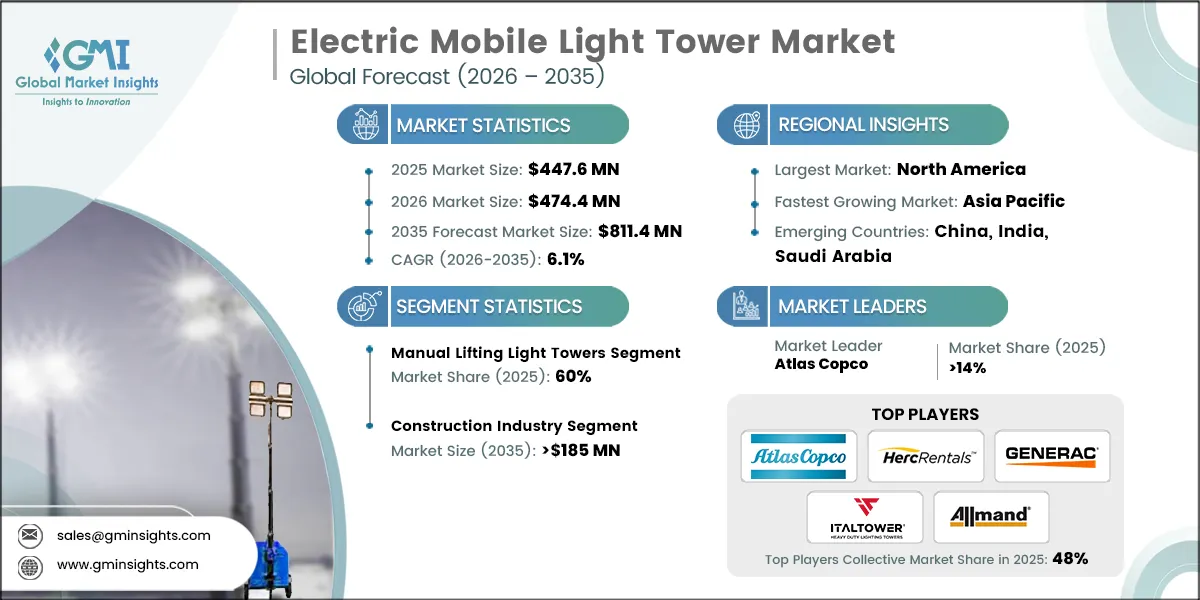
According to a recent study by Global Market Insights Inc., the electric mobile light tower market was estimated at USD 447.6 million in 2025. The market is expected to grow from USD 474.4 million in 2026 to USD 811.4 million by 2035, at a CAGR of 6.1%.
Electric Mobile Light Tower Market Key Takeaways
Market Size & Growth
- 2025 Market Size: USD 447.6 Million
- 2026 Market Size: USD 474.4 Million
- 2035 Forecast Market Size: USD 811.4 Million
- CAGR (2026–2035): 6.1%
Regional Dominance
- Largest Market: North America
- Fastest Growing Region: Asia Pacific
Key Market Drivers
- Rising infrastructural construction activities.
- Growing environmental concerns.
- Substantial rise in mobile light tower adoption.
Challenges
- High initial cost.
Opportunity
- Rising demand for sustainable technologies.
- Growing demand for rental services.
Key Players
- Market Leader: Atlas Copco led with over 14% market share in 2025.
- Leading Players: Top 5 players in this market include Italtower, Generac Power Systems, Allmand Bros, Atlas Copco, Herc Rentals, which collectively held a market share of 48% in 2025.
Get Market Insights & Growth Opportunities
- Decarbonization targets and fiscal incentives are accelerating the shift from diesel to electric mobile light towers by improving total cost of ownership, compliance readiness, and access to financing. For instance, the U.S. Inflation Reduction Act dedicates USD 369 billion to climate and clean‑energy incentives, including large tax incentives administered by Treasury, which is stimulating demand for zero‑emission equipment across construction and events where generators are being phased down and silent operation is valued.
- Energy‑security priorities and fuel‑supply disruptions are pushing contractors and municipalities toward plug‑in, battery, and solar light towers that reduce diesel dependency, refueling logistics, and exposure to fuel price spikes. For example, the European Commission’s REPowerEU Plan (May 2022) proposes raising the EU renewable energy target to 45% by 2030 and rapidly scaling solar PV installations, signaling stronger policy backing for electrified temporary power and lighting solutions on worksites and public projects.
- Falling clean‑technology costs and expanding manufacturing capacity are making battery‑electric light towers more accessible for rental fleets and end users across regions. For instance, the IEA reported in 2024 that global energy investment is expected to exceed USD 3 trillion for the first time, with around USD 2 trillion directed to clean technologies such as renewables, grids, and storage, and highlighted that improving supply chains and lower technology costs are supporting this momentum.
- Large public infrastructure programs increase night‑work activity and safety requirements, lifting demand for mobile lighting while favoring quieter, zero‑emission equipment in urban corridors. For instance, the U.S. Infrastructure Investment and Jobs Act became law in November 2021 and was positioned as a once‑in‑a‑generation infrastructure investment under the Bipartisan Infrastructure Deal, supporting extensive road, bridge, transit, and utility works where temporary lighting is essential during lane closures and night shifts safely.
- Rapid infrastructure build‑out in emerging markets is expanding the addressable base for electric light towers, especially where projects aim to limit local air and noise impacts. For instance, India’s Union Budget 2023‑24 increased the central capital expenditure outlay to USD 110.60 billion to drive growth and jobs, with major infrastructure ministries leading spend, conditions that typically translate into higher temporary lighting needs and growing preference for electrified solutions on megaprojects.
- National off‑road equipment decarbonization roadmaps are creating a clearer regulatory runway for electric light towers as a near‑term substitution for diesel generators. For example, the UK government’s NRMM decarbonization call for evidence (Dec 2023–Mar 2024) noted NRMM emissions of about 11.4 MtCO2e in 2021 and emphasized co‑benefits such as reducing air and noise pollution, reinforcing the business case for electric lighting towers on construction and industrial sites near communities nationwide.
- Public R&D and industrial policy funding is supporting higher‑performance batteries, power electronics, and hydrogen systems that indirectly improve electric tower reliability, charging flexibility, and operating range. For instance, the REPowerEU Plan stated the Commission would top up Horizon Europe investments in the Hydrogen Joint Undertaking by USD 236.4 million, strengthening innovation pipelines and commercialization pathways that also benefit portable power architectures used in advanced, grid‑linked, and hybrid‑ready lighting towers.
- Grid modernization and clean‑industry funding in resource‑rich regions is enabling wider deployment of plug‑in and hybrid‑charging light towers, particularly for remote projects and events. For instance, Australia’s 2023–24 Budget factsheet states the government has committed over USD 28.12 billion toward becoming a renewable‑energy superpower, including major grid and electrification investments that expand access to clean electricity and reduce reliance on diesel for temporary site power at scale across sectors.
To get key market trends
Electric Mobile Light Tower Market Trends
- Urban procurement is trending toward quiet, zero‑emission site operations, making electric mobile light towers a preferred standard for municipal works and downtown renewals. For instance, Oslo reported that in 2024 roughly 85% of work at municipal construction sites was carried out with zero‑emission machinery, reflecting rapid operational normalization of electrified jobsite systems and a procurement environment that rewards quiet, emissions‑free solutions for night and community‑adjacent activities in dense urban cores.
- Incentive‑led electrification is trending upward as eligible equipment catalogs broaden, pulling more battery‑based site power solutions into mainstream procurement alongside lighting. For instance, California’s CORE implementation manual for FY 2024–25 notes the Board‑approved funding plan allocated USD 14.97 million for CORE vouchers and consolidates eligible equipment into categories including mobile power units, helping reduce upfront costs and accelerating battery‑based site power that pairs naturally with electric lighting.
- Noise‑management compliance is trending as an operational differentiator, pushing contractors toward quieter electric lighting and power solutions for extended work hours. For example, Singapore’s Ministry of Sustainability and the Environment stated in September 2024 that construction work is permitted if permissible limits are met, with stricter limits after 7 p.m. and 10 p.m., and noted that contractors may use quieter equipment such as electric machinery to comply, supporting broader deployment on transit and housing projects.
- Construction noise governance is trending toward formalized planning and enforcement, favoring engineered, lower‑decibel temporary lighting packages, especially where after‑hours variances are common. For instance, New York City’s Department of Environmental Protection requires construction sites to adopt a Construction Noise Mitigation Plan, keep it available on‑site, and obtain after‑hours authorization outside weekday 7 a.m. to 6 p.m. windows, a compliance environment that increasingly favors silent electric light towers over diesel units and reduces enforcement risk.
- Electrification is trending into temporary power design assumptions, increasing demand for plug‑in light towers and battery charging capability as grid capacity expands. For instance, Canada’s draft Clean Electricity Regulations backgrounder (August 2023) notes provinces and territories will require major electricity‑system investments and estimates about USD 292.97 billion in investments from now to 2050, reinforcing expectations of wider grid capacity for electrified jobsite loads, charging nodes, and resilient temporary power.
- Structured purchase and retrofit subsidies are trending from pilots to repeatable programs, accelerating availability of emission‑free equipment across construction value chains and indirectly supporting electric lighting adoption. For example, the Netherlands’ SSEB program offers purchase, retrofit, and innovation subsidies to buy new zero‑emission construction equipment or modify existing assets, creating a broader electrified jobsite ecosystem where charging infrastructure and standardized electric auxiliaries, including lighting towers, become more economical for rental firms and contractors.
- Supply‑chain localization and workforce scaling are trending as clean‑energy deployment expands, reducing lead times for batteries, LEDs, and power electronics used in electric light towers. For instance, IRENA and the ILO reported in 2024 that renewable‑energy jobs rose to 16.2 million in 2023, with solar PV alone supporting 7.2 million jobs, signaling continued industrial scaling that benefits adjacent electrified products, strengthens competition, and speeds product iteration in portable lighting cycles.
Electric Mobile Light Tower Market Analysis
Learn more about the key segments shaping this market
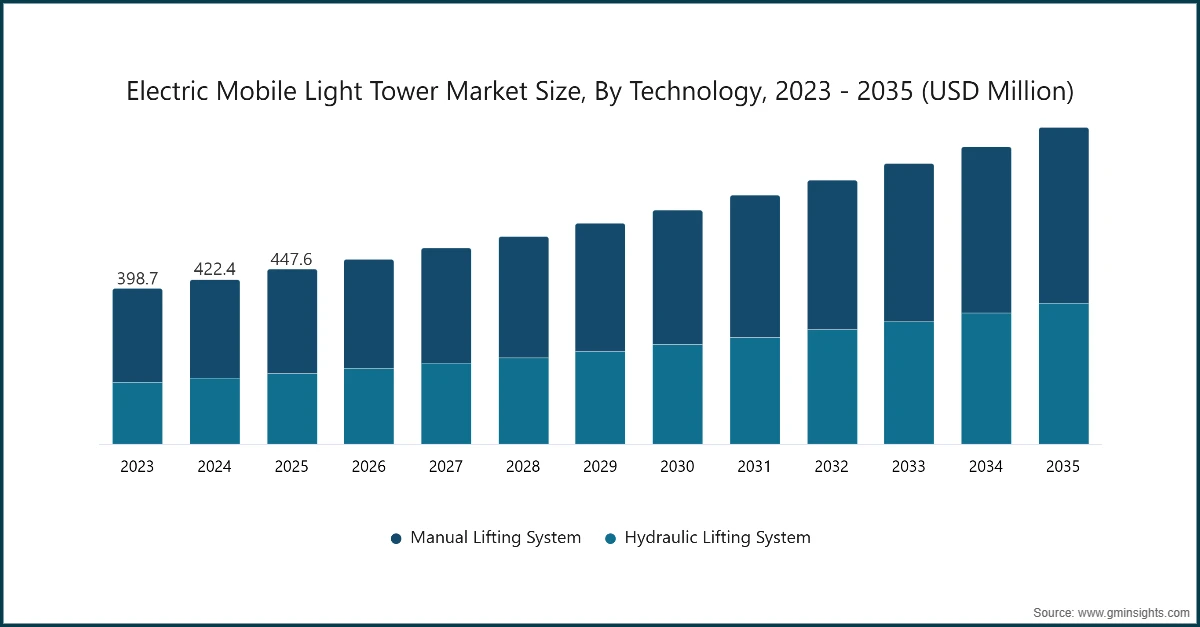
- The electric mobile light tower industry is categorized by technology into manual lifting and hydraulic lifting. The electric mobile light tower market in 2023, 2024 and 2025 was valued at USD 398.7 million, USD 422.4 million, USD 447.6 million. Manual lifting light towers hold about 60% share in 2025 and is projected to expand at around 5.3% CAGR through 2035.
- Manual‑lifting masts are trending in electric mobile light towers because they deliver low‑complexity elevation, faster field serviceability, and lower training burden for smaller crews. For instance, OSHA’s shipyard lighting standard requires work areas and walkways to be adequately lit and allows temporary lighting when permanent sources are not obtainable, reinforcing the operational need for portable towers that can be quickly positioned and raised with simple mechanisms such as manual winches.
- Manual‑lifting systems are increasingly paired with low‑noise electric powertrains as buyers prioritize community impact and worker exposure, making quiet, mechanically simple towers more attractive. For example, CDC/NIOSH refreshed guidance in February 2024 emphasizing “Buy Quiet” procurement, encouraging organizations to purchase or rent quieter machinery and tools to reduce worker noise exposure and community noise impact, an approach that aligns well with electric light towers using manual mast elevation without hydraulic power units.
- Manual‑lifting designs are trending in rental fleets for applications that value portability over maximum height, such as events, utility response, and indoor‑adjacent work. These units typically use compact footprints, fewer hydraulic components, and straightforward inspection routines, which can reduce downtime and enable faster turnaround between jobs. As LED efficacy rises, contractors can meet illumination requirements with shorter masts, reinforcing preference for manually elevated electric towers where simplicity and logistics efficiency outweigh incremental height gains.
- Hydraulic‑lifting masts are trending for high‑output electric light towers because they support taller elevations, faster deployment, and safer control of heavy luminaire heads and cable management. For instance, Regulation (EU) 2023/1230 on machinery establishes EU‑wide health and safety requirements for machinery and related products, including lifting accessories and chains/ropes, encouraging manufacturers to engineer robust, compliant lifting architectures, often hydraulic, when placing advanced mobile mast systems on the market for professional use today.
- Hydraulic‑lifting is increasingly favored on dense urban projects where frequent repositioning and rapid setup reduce disruption and labor exposure. For example, the City of Stockholm’s Persikan project describes its first fully electric, emission‑free ground‑works construction site and notes that a competitive dialogue in spring 2023 led to procurement with works starting in October 2023, highlighting a delivery environment that rewards efficient, low‑impact equipment deployment, conditions that favor hydraulically actuated, quick‑cycle tower masts.
- Hydraulic‑mast integration is trending toward smarter control packages, including auto‑leveling, wind‑response logic, and remote diagnostics, to protect uptime and reduce operational risk in all‑electric or hybrid fleets. While manual systems remain common for compact units, higher‑mast electric towers increasingly adopt hydraulic actuation to standardize setup times and minimize ergonomic strain. This trend also supports fleet standardization, as hydraulic lifting can maintain consistent performance across varying site grades and repeated duty cycles.
Learn more about the key segments shaping this market
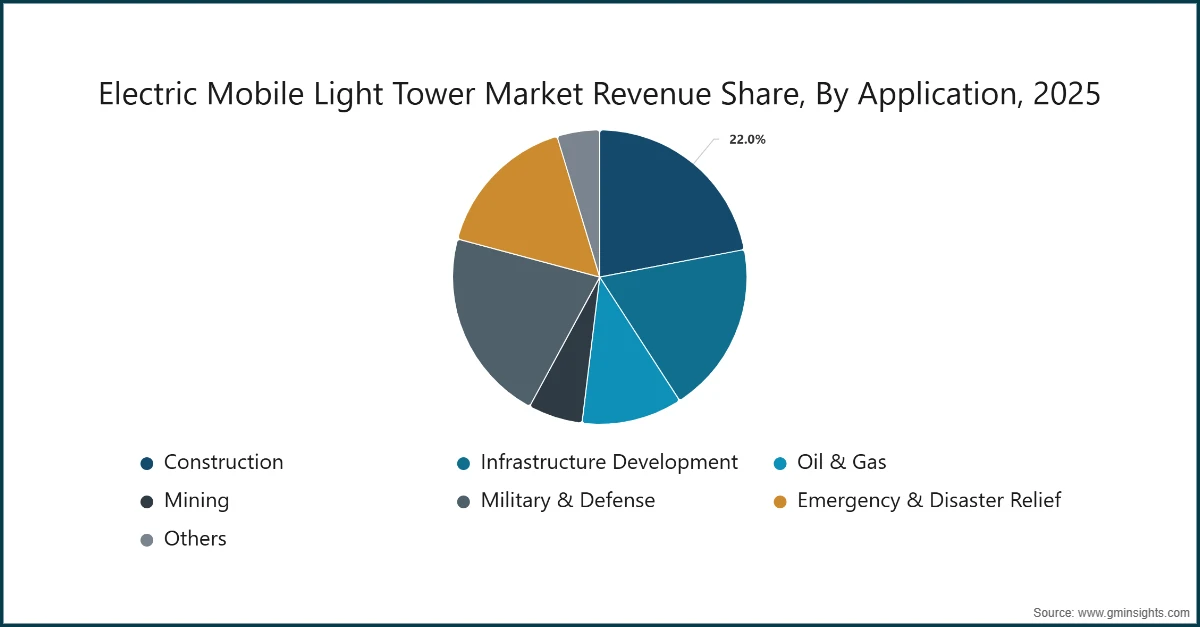
- Based on application, the electric mobile light tower market is bifurcated into construction, infrastructure development, oil & gas, mining, military & defense, emergency & disaster relief, and others. The construction industry holds a share of 22 % in 2025 and is set to reach over USD 185 million by 2035.
- Construction is a primary application for electric mobile light towers because contractors need compliant illumination while minimizing neighborhood noise and on‑site emissions during extended work windows. For instance, Singapore’s National Environment Agency states that construction sites must comply with permissible noise limits that become progressively more stringent after 7 p.m. and 10 p.m., especially near residences, reinforcing demand for quieter, electric lighting towers that avoid diesel generator noise and support night work without exceeding limits.
- Infrastructure development is a major application as roadway and resilience projects require continuous, relocatable illumination for lane closures, bridge work, and emergency detours, often in environmentally sensitive corridors and harsh weather conditions. For instance, FHWA’s PROTECT Formula Program funding table shows an estimated five‑year total of USD 7.3 billion to strengthen surface‑transportation resilience to hazards, expanding the pipeline of projects where low‑emission, plug‑in light towers can support safe nighttime construction and rapid restoration activities.
- Oil & gas applications favor electric mobile light towers as operators face tightening air‑emissions obligations and need safer, lower‑pollution work zones for inspections, repairs, and shutdowns. For example, the U.S. EPA announced a final rule in December 2023 to sharply reduce methane and other harmful pollution from oil and natural gas operations, including requirements that drive improved leak monitoring and reduced routine flaring, strengthening the business case for electrified auxiliary equipment such as battery‑powered lighting.
- Mining applications are expanding as large sites seek to decarbonize ancillary loads, improve worker comfort, and reduce diesel logistics across remote operations and multi‑shift production cycles. For instance, Australia’s reformed Safeguard Mechanism commenced on July 1, 2023, and applies to facilities emitting over 100,000 tCO2‑e annually, including mining, oil, and gas, creating sustained pressure to cut on‑site emissions and encouraging adoption of electric light towers as part of broader electrification programs.
- Military & defense operations increasingly value electric mobile light towers for expeditionary use because silent, fuel‑efficient lighting reduces logistics exposure and supports energy resilience at contingency locations. For instance, the U.S. Department of Defense Operational Energy Strategy (May 2023) highlights risk to assured delivery of power and fuel and prioritizes reducing operational energy demand while adopting more efficient and clean energy technologies, aligning with deployable, battery‑based lighting for bases and field missions.
- Emergency & disaster relief relies on mobile lighting to support shelters, distribution points, debris removal, and restoration work when grid power is disrupted, with growing federal support for resilience planning and mitigation pipelines. For instance, FEMA’s FY 2023 Flood Mitigation Assistance notice states that $800 million is available for communities to address future disaster risks, signaling sustained investment in preparedness and post‑event operations where electric light towers provide fast, low‑emission illumination.
- Others, including ports, logistics yards, events, and municipal maintenance, are adopting electric mobile light towers to reduce diesel exhaust in densely populated areas while maintaining high‑visibility operations. For example, the U.S. EPA reports awarding 53 grants for nearly USD 3 billion under its Clean Ports Program to fund zero‑emission port equipment and infrastructure plus planning, accelerating electrified site ecosystems where battery and plug‑in lighting towers can support nighttime cargo, safety, and maintenance activities.
Looking for region specific data?
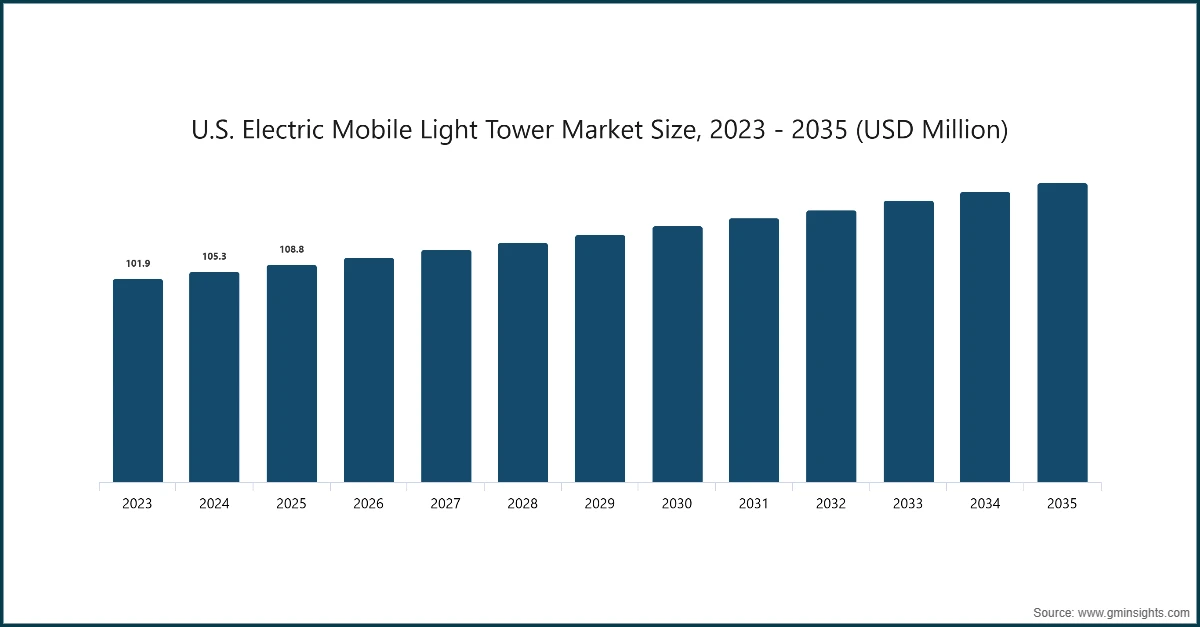
- The U.S. electric mobile light tower market was valued at USD 101.9 million in 2023, USD 105.3 million in 2024, and USD 108.8 million in 2025, reflecting steady expansion. This growth is increasingly supported by rising adoption of energy‑efficient LED and hybrid lighting systems to reduce operating costs, enhance sustainability, and improve performance across construction and industrial applications.
- U.S. is seeing accelerating uptake of electric mobile light towers as jobsite electrification and corridor charging expand, enabling rental fleets to support battery‑based lighting without diesel refueling. For instance, FHWA’s NEVI Formula Program provides USD 1 billion annually from FY 2022 through FY 2026 to build an interconnected EV charging network, strengthening the availability of high‑power charging along major routes that contractors increasingly leverage for electrified equipment and temporary lighting.
- Canada is strengthening demand for electric mobile light towers through climate‑resilience construction programs that increase field activity while encouraging lower‑emission temporary power. For instance, Housing, Infrastructure and Communities Canada notes the Disaster Mitigation and Adaptation Fund committed USD 1.4 billion over 10 years and was renewed with USD 1 billion, with up to an additional USD 357 million for resiliency projects, conditions that expand infrastructure work where quiet, deployable electric lighting improves safety and reduces local impacts.
- Europe is prioritizing deep decarbonization across buildings, transport, and industry, reinforcing procurement preference for electric, low‑noise site equipment such as mobile light towers. For instance, the German Federal Government’s 2023 Climate Action Programme states that emissions reductions must more than double and then almost triple by 2030 to meet national targets and reach climate neutrality by 2045, signaling sustained policy pressure that supports electrified temporary power and lighting on construction and maintenance sites.
- Asia Pacific market is being driven by massive transport build‑out and modernization that elevates demand for temporary lighting across highways, rail projects, ports, and urban works, while policy attention to new‑energy systems supports electrified equipment. For instance, China’s Ministry of Transport reported that fixed‑asset investment in transportation reached approximately USD 521 billion in 2024 end, sustaining high work volumes where electric light towers improve site safety without adding local diesel emissions.
- Middle East & Africa market is supported by giga‑project construction and national sustainability programs that favor quieter, emissions‑reduced jobsite operations in high‑visibility developments. For instance, the Saudi Green Initiative portal states that since its 2021 launch, 77 initiatives have been activated representing investments of more than USD 186 billion, reflecting sustained capital deployment into greener infrastructure ecosystems where electric mobile light towers can replace diesel lighting for construction, logistics, and public‑realm works.
- Latin America is benefiting from a renewed public‑private infrastructure cycle that expands nighttime and multi‑shift construction activity, increasing the need for reliable mobile lighting while creating headroom for electrified alternatives. For instance, Brazil’s federal government announced the Novo PAC will invest over USD 320 billion across all states, including major allocations from the federal budget, state‑owned companies, financing, and the private sector, an execution pipeline that strengthens rental demand for electric light towers on urban and infrastructure jobs.
Electric Mobile Light Tower Market Share
- The top five companies, Italtower, Generac Power Systems, Allmand Bros., Atlas Copco, and Herc Rentals, collectively account for approximately 48% of the global electric mobile light tower industry in 2025, underscoring their strong technological capabilities, diversified product portfolios, and well‑established global networks that reinforce their competitive positioning in the rapidly expanding electric mobile lighting sector.
- These five companies maintain a substantial market share due to their consistent investment in advanced lighting technologies, particularly LED, hybrid, and energy‑efficient electric systems that meet rising global sustainability requirements. Their offerings integrate enhanced durability, remote monitoring, and improved lifting mechanisms, capabilities strongly emphasized in modern electric tower designs. Additionally, their presence across major demand regions such as North America, Europe, and Asia enables them to capture large‑scale construction, industrial, and oilfield lighting demand.
- Market dominance is further strengthened by their well‑developed rental networks, robust distribution channels, and customer‑centric service models, enabling rapid deployment for infrastructure, industrial, and emergency applications. These companies also lead in product innovation, focusing on efficiency, reliability, and eco‑friendly solutions, allowing them to meet evolving regulatory and operational requirements. Their broad portfolios and brand reputation make them preferred suppliers for high‑performance electric mobile light towers in demanding field conditions worldwide.
Electric Mobile Light Tower Market Companies
Major players operating in the electric mobile light tower industry are:
- Alrouf
- Allmand
- Atlas Copco
- Axiom Equipment Group
- Boss LTR
- Chicago Pneumatic
- Generac
- Grandwatt Electric
- Herc Rentals
- Italtower
- Larson Electronic
- Metrolite
- Olikara Lighting Towers
- Pramac
- Tower Light
- TRIME
- United Rentals
- Wanco
- Italtower sustains meaningful share by offering a broad electrified portfolio, plug‑in, battery-powered towers and hybrid/solar models such as Shield Hybrid and Astrid Hybrid. Key differentiators include LED arrays, long autonomy (battery + hybrid runtime), hydraulic masts, compact skid handling, and dusk/dawn sensors for automated operation.
- Generac holds substantial share through an extensive “Electric Line” and battery solutions built for rental fleets and urban, low‑noise jobsites. Its MLTB Battery tower emphasizes silent, zero‑emission operation, up to 75 hours runtime, and high-efficiency LED fixtures, backed by durable, rental‑ready design. Dominance is supported by strong corporate performance: 2024 net sales reached about USD 4.30 billion, enabling ongoing product development, distribution reach, and aftermarket support.
- Allmand’s share is anchored by event- and site-ready electric towers, notably the Night‑Lite E‑Series (plug‑in) featuring 4 LED fixtures, timer/photocell auto on/off, high-wind stability, and forklift pockets for rapid deployment. Financial strength comes from being backed by Briggs & Stratton, improving manufacturing scale and channel access; historically, Allmand was reported around over USD 80 million annual sales at acquisition, indicating meaningful commercial footprint.
- Atlas Copco protects share with premium, emissions‑free light towers such as HiLight MS3 and next‑gen solar models using LiFePO₄ batteries, SMD high‑lumen LEDs, fast recharge (hours), and broad area coverage, ideal for noise‑regulated urban and remote projects. Innovation is funded by strong scale: full‑year 2025 revenues approximately USD 18.6 billion and consistently high profitability, reinforcing R&D, global servicing, and fleet adoption.
- Herc Rentals holds share primarily through distribution power, not manufacturing, placing electric/LED lighting and mobile light tower solutions into customers’ hands via a broad rental catalog emphasizing energy‑efficient LED options for safer, compliant worksites. Its ability to buy, refresh, and standardize fleets at scale supports market influence.
Electric Mobile Light Tower Market Report Attributes
| Key Takeaway | Details |
|---|---|
| Market Size & Growth | |
| Base Year | 2025 |
| Market Size in 2025 | USD 447.6 Million |
| Market Size in 2026 | USD 474.4 Million |
| Forecast Period 2026-2035 CAGR | 6.1% |
| Market Size in 2035 | USD 811.4 Million |
| Key Market Trends | |
| Drivers | Impact |
| Rising infrastructural construction activities | Growing infrastructure development and nighttime construction needs significantly boost demand for electric mobile light towers, supported by safety requirements and expanding project scales. Energy-efficient LED and solar-powered models further accelerate adoption through lower operating costs and sustainability benefits. |
| Growing environmental concerns | Rising environmental concerns and the global shift toward renewable and low-emission energy solutions drive adoption of electric and hybrid light towers. LED efficiency improvements and reduced maintenance burdens strengthen the case for replacing diesel-powered alternatives in rugged industrial environments. |
| Substantial rise in mobile light tower adoption | The increasing deployment of mobile lighting across construction, mining, emergency response, and events drives market expansion. Enhanced portability, automation, and remote monitoring technologies are improving operational efficiency, making electric towers more attractive for long-duration, off‑grid applications. |
| Pitfalls & Challenges | Impact |
| High initial cost | High upfront costs for electric, solar, and hybrid light towers, combined with installation, maintenance, and battery replacement expenses, pose a significant adoption barrier. Industrial users may hesitate to transition from diesel units due to cost constraints and raw material price fluctuations. |
| Opportunities: | Impact |
| Rising demand for sustainable technologies | Rapid growth in renewable-powered lighting, especially solar and hybrid towers, presents substantial opportunities as industries pursue decarbonization. Increasing integration of LED systems and IoT-based monitoring enhances efficiency, supporting long‑term deployment in remote, off-grid, and sustainability‑focused applications. |
| Growing demand for rental services | Expansion of rental-based light tower services allows companies to avoid capital investment while accessing flexible, modern, energy-efficient equipment. Rising urban development and disaster-response operations further broaden demand across short-term, mission-critical deployments. |
| Market Leaders (2025) | |
| Market Leader |
Over 14% Market Share |
| Top Players |
Collective Market Share of 48% |
| Competitive Edge |
|
| Regional Insights | |
| Largest Market | North America |
| Fastest growing market | Asia Pacific |
| Emerging countries | China, India, Saudi Arabia |
| Future outlook |
|
What are the growth opportunities in this market?
Electric Mobile Light Tower Industry News
- In March 2025, Atlas Copco launched the second generation of its solar‑powered light towers, the HiLight MS 4 and HiLight MS 5, expanding its zero‑noise, low‑emission lighting portfolio. The company highlighted a more compact solar panel design, parallel solar panels for improved reliability, and SMD High Lumen LED floodlights for better efficiency and coverage. Atlas Copco also noted optimized container loading to simplify logistics for rental and contractor fleets.
- In February 2024, Allmand announced it would unveil its Hybrid LT‑Series concept light tower at The ARA Show, featuring a Vanguard lithium‑ion battery to reduce emissions, fuel use, and noise. The company emphasized smart controls that optimize charging efficiency and provide real‑time runtime feedback to help customers manage carbon footprint through light‑level settings. Allmand also stated the Hybrid LT‑Series would be available to order in the fall at scale.
- In September 2023, PR Power and Trime reported a collaboration that produced the T‑Zero X‑SOLAR lighting tower for hire fleets in Australia. The partners positioned the solar‑and‑lithium solution as a zero‑emissions, low‑noise alternative for construction, events, and mining, highlighting lithium‑ion batteries, advanced lighting, and a Victron controller for online monitoring of location and performance. The announcement reinforces rising demand for renewable, rental‑ready mobile lighting across urban and remote projects.
- In March 2022, Larson Electronics announced the release of an explosion‑proof solar LED light tower designed for hazardous locations, featuring a five‑stage mast that deploys 400 watts of LED illumination up to 30 feet. The unit integrates Class I, Division 2 solar panels, charge controllers, and a 1,000Ah battery bank, plus a photocell and manual crank mast on a trailer. The launch targets remote worksites needing off‑grid, low‑emission lighting.
The electric mobile light tower market research report includes in-depth coverage of the industry with estimates & forecast in terms of revenue (USD Million) and volume (‘000 Units) from 2022 to 2035, for the following segments:
Market, By Technology
- Manual lifting system
- Hydraulic lifting system
Market, By Application
- Construction
- Infrastructure development
- Oil & gas
- Mining
- Military & defense
- Emergency & disaster relief
- Others
The above information has been provided for the following regions & countries:
- North America
- U.S.
- Canada
- Mexico
- Europe
- Germany
- UK
- France
- Italy
- Spain
- Russia
- Asia Pacific
- China
- Japan
- India
- Australia
- South Korea
- Middle East & Africa
- Saudi Arabia
- UAE
- Qatar
- Iran
- South Africa
- Latin America
- Brazil
- Argentina
Frequently Asked Question(FAQ) :
What was the market size of the electric mobile light tower in 2025?
The market size was USD 447.6 million in 2025, with a CAGR of 6.1% expected through 2035. Decarbonization targets and fiscal incentives are driving the shift from diesel to electric mobile light towers.
What is the projected value of the electric mobile light tower market by 2035?
The market is poised to reach USD 811.4 million by 2035, driven by the adoption of zero-emission equipment, fiscal incentives, and advancements in battery-based power solutions.
What is the expected size of the electric mobile light tower industry in 2026?
The market size is projected to reach USD 474.4 million in 2026.
What share did manual lifting light towers hold in 2025?
Manual lifting light towers held approximately 60% of the market share in 2025 and is projected to grow at a CAGR of 5.3% through 2035.
What was the valuation of the construction industry segment in 2025?
The construction industry held a 22% market share in 2025, valued at over USD 98.5 million, and is expected to exceed USD 185 million by 2035.
What is the growth outlook for the U.S. electric mobile light tower sector?
The U.S. market was valued at USD 108.8 million in 2025, led by the adoption of energy-efficient LED and hybrid lighting systems to reduce costs and enhance sustainability.
What are the upcoming trends in the electric mobile light tower market?
Urban procurement is favoring zero-emission equipment, supported by electrification incentives, noise regulations, grid expansion for plug-in light towers, and structured subsidies.
Who are the key players in the electric mobile light tower industry?
Key players include Alrouf, Allmand, Atlas Copco, Axiom Equipment Group, Boss LTR, Chicago Pneumatic, Generac, Grandwatt Electric, Herc Rentals, Italtower, Larson Electronic, and Metrolite.
Electric Mobile Light Tower Market Scope
Related Reports