Summary
Table of Content

Electric Forklift Market
Get a free sample of this report
Form submitted successfully!
Error submitting form. Please try again.
Thank you!
Your inquiry has been received. Our team will reach out to you with the required details via email. To ensure that you don't miss their response, kindly remember to check your spam folder as well!
Request Sectional Data
Thank you!
Your inquiry has been received. Our team will reach out to you with the required details via email. To ensure that you don't miss their response, kindly remember to check your spam folder as well!
Form submitted successfully!
Error submitting form. Please try again.
Electric Forklift Market Size
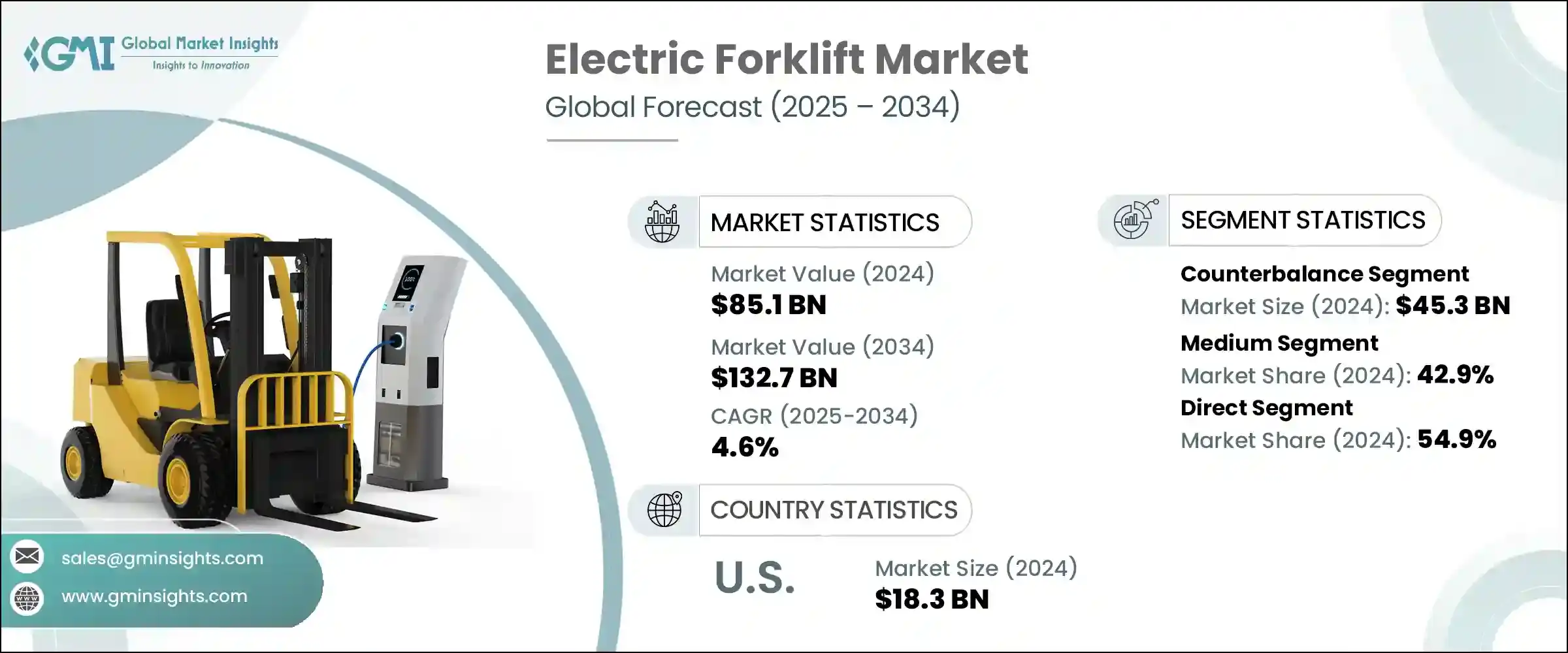
The global electric forklift market size was estimated at USD 85.1 billion in 2024. The market is expected to grow from USD 88.8 billion in 2025 to USD 132.7 billion in 2034, at a CAGR of 4.6%.
Electric Forklift Market Key Takeaways
Market Size & Growth
- 2024 Market Size: USD 85.1 Billion
- 2034 Forecast Market Size: USD 132.7 Billion
- CAGR (2025–2034): 4.6%
Key Market Drivers
- Advancements in battery technology.
- Growth of e-commerce and warehousing.
Challenges
- High initial investment costs.
- Limited heavy-duty capabilities.
Opportunity
- Expansion into emerging markets.
- Integration with smart warehousing.
- Development of fast-charging and swappable battery solutions.
Key Players
- Market Leader: Toyota Material Handling led with over 27% market share in 2024.
- Leading Players: Top 5 players in this market include Toyota Material Handling, Mitsubishi Logisnext Co., Ltd., KION Group AG, Jungheinrich AG, Hyster-Yale Materials Handling, Inc., which collectively held a market share of 55% in 2024.
Get Market Insights & Growth Opportunities
- The evolving battery technology, in part, has fueled the market's advance. Traditional lead-acid batteries are reliable but have inherent disadvantages including long charge times, low energy density, and high maintenance. Lithium-ion batteries have disrupted this approach with rapid load times, enhanced energy efficiency, and better life span. Lithium-ion batteries can also take advantage of "opportunity charging," a process where electric forklifts charge during short breaks, without affecting battery performance, with opportunity charging can maintain battery life span at higher levels.
- In fact, the U.S. Department of Energy has reported that lithium-ion batteries can achieve energy efficiency of up to 95% compared to lead-acid batteries' 80% efficiency ratio, which provides long term sustainability options and potential cost-savings from electric forklifts.
- Hydrogen fuel cell technology is also emerging as an attractive alternative, especially in heavy-duty applications. Hydrogen fuel cells can provide refueling times typically in three minutes or less and fuel cells can provide extended run times that can support a fast paced work flow. Plug Power, a leader in hydrogen fuel cell solutions indicated their solution can provide improved down time from battery powered electric forklifts by up to 15%. These innovations can help extend the capabilities of electric forklifts for outdoor work, cold storage, and even industries that require operations that run '24 hours', like automotive manufacturing and logistics.
- Leading manufacturers like Toyota Material Handling, Jungheinrich, and Crown Equipment Corporation are heavily investing in R&D to enhance battery performance and integrate advanced technologies into their electric forklift offerings. These companies are also focusing on modular battery systems and smart energy management solutions to further optimize operational efficiency.
- The global emphasis on sustainability is another significant factor driving the adoption of electric forklifts. Governments worldwide are implementing stringent emission regulations and offering financial incentives to promote clean energy solutions. For instance, the European Union’s Green Deal aims to achieve carbon neutrality by 2050, encouraging industries to transition to zero-emission equipment. Similarly, the U.S. Environmental Protection Agency (EPA) has introduced programs to support the adoption of electric vehicles, including forklifts, through tax credits and grants.
- Electric forklifts are being favored more and more in applications where air quality, noise impact and carbon footprint are at a premium. Primarily, these applications exist in indoor environments such as warehouses, food processing facilities, and pharmaceutical manufacturing operations. Additionally, many companies are actively seeking alignment with corporate sustainability goals. For example, Amazon has committed to achieve net zero carbon by 2040 and is actively replacing all internal combustion forklifts with electric versions at many of its facilities. Manufacturers are also influencing the paradigm shift from internal combustion to electric forklifts.
- The likes of Mitsubishi Logisnext and Hyster-Yale have brought to market electric forklift models that feature cutting-edge telematics and energy efficient systems to satisfy the change in demand for green energy material handling solutions. The combination of new regulations, expectations for corporate responsibility, and technological change is enhancing the transition from internal combustion to electric forklift and allowing the electric forklift market to gain traction toward growth in the forecast period.
To get key market trends
Electric Forklift Market Trends
- Smart luggage is altering the travel industry by adding advanced features like GPS tracking, biometric locks, and USB charging ports. These developments appeal to tech-savvy travelers who seek convenience, security, and connectivity. Leading brands like Samsonite and Away have launched smart luggage lines, including Samsonite’s GeoTrackeR, which uses GPS tracking to prevent lost baggage. This trend gained traction from 2021. Smart luggage will become a standard for frequent travelers. Airports and airlines may develop infrastructure to support smart baggage systems, enhancing travel efficiency and reducing lost luggage incidents.
- Manufacturers focus on environmental sustainability. Brands are increasingly using recycled plastics, organic fabrics, and biodegradable materials to meet consumer demand for eco-friendly products. This trend gained more importance from 2023. Samsonite’s Eco-Nu collection, made from 100% recycled PET bottles, exemplifies this shift. Additionally, Rimowa has pledged to lower its carbon footprint by using sustainable materials in its production, in line with global sustainability goals. Sustainability will influence consumer loyalty and regulatory compliance. Brands not adopting eco-friendly practices may face market exclusion or reputational risks.
- Consumers are gravitating to luggage that communicates their style but are also practical and functional. Monogramming, modular compartments, and color palettes are all trending and can be customized. TUMI, obviously, has many customization options to choose from which it translates into customers being able to personalize their luggage. Personalization will be a driving force to create brand differentiation and engage customers. Retailers may go to make-to-order business models to minimize inventory waste and potentially improve customer satisfaction.
- The merging of online and in-store retail channels is changing how consumers shop for luggage. Retailers are integrating different technologies, like augmented reality (AR) previews, virtual try-ons, and seamless mobile platforms that customers can engage with from anywhere.
- For example, American Tourister uses AR technology to let customers visualize the luggage in real-time before purchasing, which enhances purchase making for the consumer. This approach produces higher sales conversions and creates better overall customer engagement in lifestyle luggage. Retail experiences will lean towards experiential, augmented reality, and data-driven models. Brand(s) that invest in tech-enabled shopping will create sales conversion opportunities and enhance consumer loyalty.
Electric Forklift Market Analysis
Learn more about the key segments shaping this market
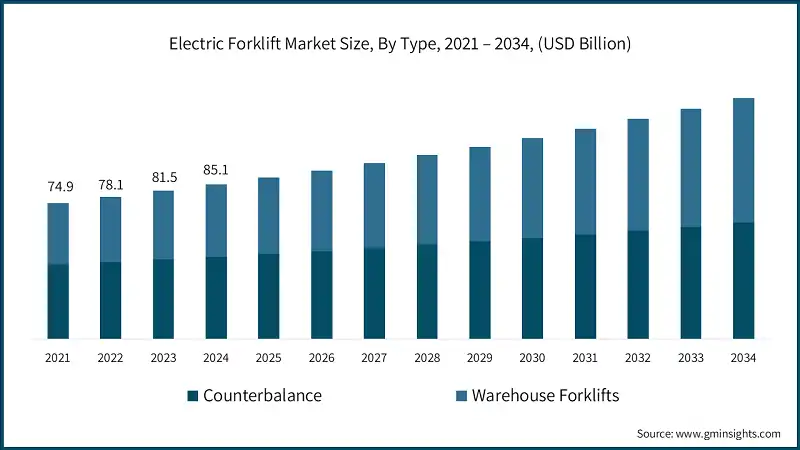
Based on type, the electric forklift market is categorized into counterbalance and warehouse forklifts. The counterbalance forklifts accounted for revenue of around USD 45.3 billion in the year 2024 and is estimated to grow at a CAGR of 3.5% from 2025 to 2034.
- Counterbalance forklifts are still the dominant type of lift truck in the world, accounting for 60% of all forklift sales, according to the Industrial Truck Association (ITA). They hold this position because of their engineering flexibility, simple operation, and general applicability in various industrial sectors. Their designs either specifically include or can add a counterweight to the machine to balance a load. They have a design with balance, engineered with a weight placed on the rear of the machine to counterbalance a substantial front load up to 100,000 lbs.
- The weight is called a "counterweight" and allows goods to be carried without the need for outriggers to stabilize a load on a lift truck. With data from the Occupational Safety and Health Administration (OSHA) that states counterbalance forklifts have an incident rate of 15% lower than other models due to being easier to use and a more stable design. They are utilized in many different industries with 30% of usage in manufacturing, 25% in logistics, and 20% in construction (Material Handling Industry of America (MHIA) report 2023).
- Counterbalance forklifts come with incrementally more technology, including IoT sensors to help track and do predictive maintenance of the truck and monitor performance in real-time. Counterbalance lift trucks (and more modern versions) often include operator assist systems that the latest OSHA workplace safety data suggests can help reduce accident rates up to 25%. Generally, costs are approximately 30% lower for maintenance than for types of lift trucks and the mean time between failures is 1,000 hours of operation
- Counterbalance forklifts typically offer load capacities ranging from 3,000 to 100,000 pounds, while warehouse-specific models generally handle loads up to 4,500 pounds. According to MHIA data, counterbalance forklifts demonstrate 40% greater flexibility across varied terrain conditions.
Learn more about the key segments shaping this market
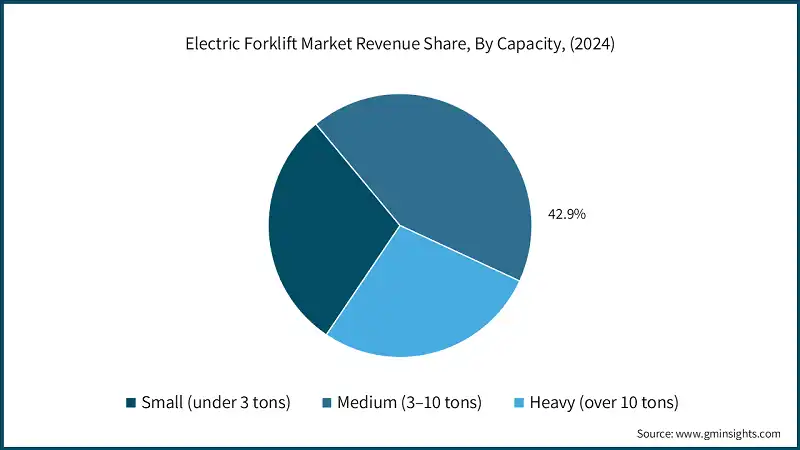
Based on capacity, the electric forklift market is segmented into small (under 3 tons), medium (between 3-10 tons), heavy (over 10 tons). The medium segment holds the largest share of 42.9% in 2024 and is anticipated to grow at a CAGR of 5.1% from 2025 to 2034.
- Medium-capacity models are increasingly being accepted in manufacturing, logistics, and port operations. These models offer an increasingly attractive option for traditional internal combustion engines. modern-day lithium-ion battery technologies allow for 8–16-hour shifts of service, along with the rapid charge time of 1-2 hours.
- The vehicle market for medium capacity has been positively impacted by significant advancements in technology. lithium-ion batteries are now achieving energy densities of 150-200 Wh/kg, compared to the 90-100 Wh/kg energy density of just five years ago. The European Materials Handling Federation (FEM) suggests that each medium-capacity battery unit is capable of exceeding 2500-3000 cycles, which represents a life of 7-8 years of heavy use.
- Heavy capacity, electric forklifts are expected to grow at a CAGR of 5.9% during the forecast period of 2025-2034. Heavy-capacity electric forklifts are used mainly in steel manufacturing, timber processing, and container movement and require extensive electrical facilities. Charging is also expected to require 400-800V power supplies.
Based on distribution channel, electric forklift market is segmented into direct and indirect. The direct segment emerged as leader and held 54.9% from the total market share in 2024 and is anticipated to grow at a CAGR of 4.8% from 2025 to 2034.
- Manufacturers have increasingly encouraged their dedicated sales teams and technical specialists to build satisfying relationships with the end-user. With this model, companies can provide customized solutions. To this point, manufacturers have seen a nearly 40% increase in custom requests from 2019 to 2023.
- The direct-to-customer model enables all round after-sales service programs, preventative maintenance schedules, operator training, and technical support without taking up staff time at manufacturers. These service solutions are recognized as advantageous for large organizations, the Electric Power Research Institute claimed their direct-channel customers performing on average 20% less equipment downtime as manufacturer support is available when needed.
- Conversely, the service sector continues to grow with expect growth rates from the indirect distribution channel to be 4.30% for the entire forecast period of 2025 to 2034. This channel has introduced itself into emerging economies and markets for years, including countries where emerging dealers have increased their presence by about 15% annually since the beginning of 2020. Principal manufacturers, like Crown Equipment Corporation, have noted their authorized dealer networks reaches 84% of secondary markets in regard to dealer access to manufacturers, which helps reach markets where manufacturers do not call on customers directly.
Looking for region specific data?
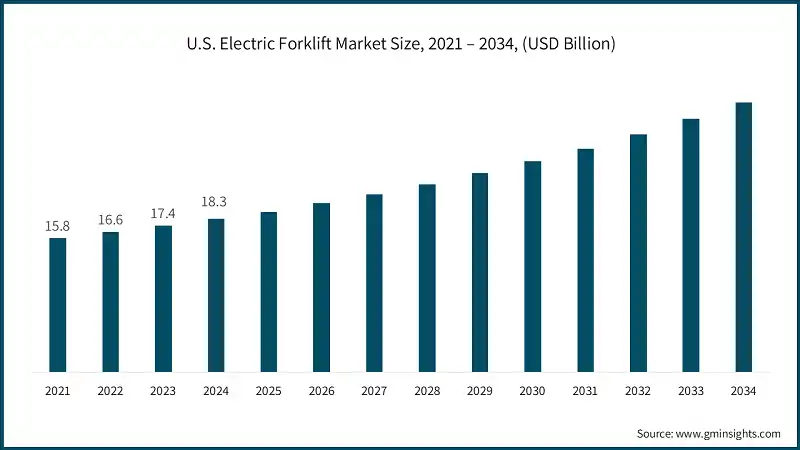
The U.S. dominates an overall North America electric forklift market and valued at USD 18.3 billion in 2024 and is estimated to grow at a CAGR of 5.3% from 2025 to 2034.
- The United States holds a dominant position in the electric forklifts market, driven by its advanced manufacturing sector, widespread adoption of automation, and strong emphasis on workplace safety and sustainability. Major investments in logistics, e-commerce, and warehousing have fueled demand for electric forklifts, which offer lower emissions and reduced operating costs compared to traditional models. The presence of leading global manufacturers, robust after-sales support, and a mature distribution network further reinforce the US’s leadership in this market, making it a key hub for innovation and technological advancement in material handling equipment.
The electric forklift market in Europe, Germany is expected to grow at a CAGR of 4.5% from 2025 to 2034.
- Germany stands out as a leader in the European electric forklifts market, thanks to its highly developed industrial base, focus on precision engineering, and commitment to environmental standards. The country’s strong automotive, manufacturing, and logistics sectors drive continuous demand for efficient and sustainable material handling solutions. German companies are at the forefront of integrating advanced technologies such as automation, telematics, and energy-efficient battery systems into electric forklifts. This, combined with stringent regulations on emissions and workplace safety, ensures that Germany remains a benchmark for quality and innovation in the global electric forklift industry.
The Asia Pacific dominated the global electric forklift market, with China accounting for 30.2% market share in 2024 and is anticipated to grow at a CAGR of 5.2% from 2025 to 2034.
- China dominates the Asia-Pacific electric forklifts market, propelled by rapid industrialization, urbanization, and the expansion of e-commerce and manufacturing activities. The country’s large-scale infrastructure projects and booming logistics sector have created substantial demand for electric forklifts, particularly as environmental regulations tighten and companies seek to reduce their carbon footprint.
In the Middle East and Africa electric forklift market, Saudi Arabia held 35.7% market share in 2024 and is anticipated to grow at a CAGR of 2.6% from 2025 to 2034.
- Saudi Arabia is emerging as a dominant force in the Middle East’s electric forklifts market, driven by ambitious economic diversification initiatives and significant investments in logistics, warehousing, and industrial infrastructure. The government’s Vision 2030 plan emphasizes sustainability and modernization, encouraging the adoption of electric vehicles and equipment across various sectors.
Electric Forklift Market Share
- In 2024, the top 5 companies, including Toyota Material Handling, Mitsubishi Logisnext Co., Ltd., KION Group AG, Jungheinrich AG, Hyster-Yale Materials Handling, Inc. collectively hold around 40-45% market share. These firms focus on quality, brand reputation, and the evolving needs of warehousing enables them to maintain a loyal customer base and capture a significant share of the global market, despite intense competition and rapidly changing consumer preferences.
- Toyota Material Handling has a strategy that is focused on innovation, operational excellence, and customer-oriented solutions. The organization commits significant resources to research and development in the area of electric forklift technology, automation, and connectivity to ensure that its handling products will meet new demands in efficiency and sustainability as the industry evolves.
- In addition to innovation, Toyota capitalizes on its global manufacturing and distribution networks to create a customer experience that is reliable in terms of after-sales service and support, while at the same time, focused on expanding its product line to fulfill many different possible material handling applications.
- Mitsubishi Logisnext has a strategy of global expansion and technological advancement with a focus on developing sustainable and energy-efficient material handling equipment. The company works to integrate telematics, advanced automation and lithium-ion battery technologies into its electric forklift product line, enabling better productivity practices and cost savings for customers. Mitsubishi Logisnext focuses on investing in its dealer network and service capabilities globally, ensuring comprehensive service and reasonable response times.
- KION Group AG intends to take advantage of digital transformation, innovation, and global expansion. The company invests into smart technology like fleet management systems, automation, and robotics to create integrated intralogistics solutions that will maximize efficiency and transparency to clients.
- Jungheinrich AG’s strategy is focused on innovation, digitalization, and sustainability in the material handling sector. The company leads in the development of electric forklifts, automated guided vehicles (AGVs), and warehouse management systems, providing comprehensive solutions for intralogistics.
- Hyster-Yale Materials Handling, Inc. adopts a strategy of product diversification, customer-focused innovation, and global market penetration. The company develops a wide range of electric and internal combustion forklifts to meet the specific needs of various industries, from warehousing to heavy manufacturing. Hyster-Yale invests in advanced technologies, such as telematics and automation, to enhance safety, productivity, and fleet management capabilities.
Electric Forklift Market Companies
Major players operating in the electric forklift industry include:
- Anhui Heli Co., Ltd.
- Clark Material Handling Company
- Crown Equipment Corporation
- Doosan Industrial Vehicle Co., Ltd.
- EP Equipment Co., Ltd.
- Hangcha Group Co., Ltd.
- Hyster-Yale Materials Handling, Inc.
- Hyundai Material Handling
- Jungheinrich AG
- KION Group AG
- Komatsu Ltd.
- Lonking Holdings Limited
- Mitsubishi Logisnext Co., Ltd.
- Noblelift Intelligent Equipment Co., Ltd.
- Toyota Material Handling
The competitive landscape of the electric forklift market is characterized by intense rivalry among global leaders and regional players, each striving to differentiate through innovation, technology integration, and customer service. The market is also witnessing increased focus on sustainability, automation, and digital solutions, with companies racing to introduce energy-efficient models and smart fleet management systems.
Toyota Material Handling provides one of the most extensive product portfolios of any company in the material handling industry; this includes a variety of electric and internal combustion forklifts, pallet trucks, reach trucks, order pickers, and automated guided vehicles (AGVs). Toyota is most well-known for its innovative electric forklifts, which are built with advanced safety features, energy-efficient lithium-ion batteries, and ergonomic designs.
Toyota also provides integrated warehouse solutions, including racking systems and fleet management software that spans multiple industries, including logistics, manufacturing, retail, and e-commerce. With its wide-ranging, technologically advanced portfolio, Toyota has the ability to meet the changing needs of customers around the world.
Mitsubishi Logisnext Co., Ltd. offers a wide portfolio of material handling equipment, including electric and engine-powered forklifts, reach trucks, pallet trucks, tow tractors, as well as automated-manned and -unmanned material handling systems.
As of late 2021, Mitsubishi Logisnext has continued to grow via acquisitions and develop ingenious solutions by offering electric impact forklift models that are energy efficient, developed intelligently with safety features, and capable of being used in indoor or outdoor environments. They also manufactured innovative models from the ground up that feature lithium-ion batteries and intelligent fleet management systems on several of their electric models. Like Toyota, Mitsubishi Logisnexts offer a wide range of material handling needs for industries such as warehousing and logistics, manufacturing and distribution.
Electric Forklift Market Report Attributes
| Key Takeaway | Details |
|---|---|
| Market Size & Growth | |
| Base Year | 2024 |
| Market Size in 2024 | USD 85.1 Billion |
| Forecast Period 2025 – 2034 CAGR | 4.6% |
| Market Size in 2034 | USD 132.7 Billion |
| Key Market Trends | |
| Drivers | Impact |
| Advancements in battery technology | Improved battery performance enables longer operation, faster charging, and reduced maintenance, making electric forklifts viable for more demanding applications. |
| Stricter emissions standards and corporate sustainability initiatives are accelerating the shift from diesel to electric forklifts across industries. | |
| Growth of e-commerce and warehousing | The surge in e-commerce is fueling demand for electric forklifts in automated, high-efficiency warehouses and distribution centers. |
| Pitfalls & Challenges | Impact |
| High initial investment costs | High upfront costs limit adoption among budget-constrained businesses despite long-term savings. |
| Limited heavy-duty capabilities | Performance limitations in heavy-duty tasks restrict electric forklift use in demanding industrial sectors. |
| Opportunities: | Impact |
| Expansion into emerging markets | Emerging markets offer untapped potential for electric forklift growth through policy support and industrialization. |
| Integration with smart warehousing | Smart warehouse integration boosts efficiency and positions electric forklifts as key players in automated logistics. |
| Development of fast-charging and swappable battery solutions | Advanced charging solutions enhance uptime and make electric forklifts more viable for high-intensity operations. |
| Market Leaders (2024) | |
| Market Leaders |
27% Market Share of Toyota Industries Corporation |
| Top Players |
Collective market share in 2024 is 55% |
| Competitive Edge |
|
| Regional Insights | |
| Largest Market | Asia Pacific |
| Fastest growing market | North America |
| Emerging countries | Germany, China, India, Saudi Arabia |
| Future outlook |
|
What are the growth opportunities in this market?
Electric Forklift Industry News
- In June 2025, HELI launched a 25-ton electric forklift at Bauma, marking a breakthrough in large-tonnage electric forklifts for Europe.
- In April 2025, Clark expanded its S-Series Electric line with new 3- and 4-wheel models (STE and SE series), replacing older GTX and GEX models.
- In May 2025, EP won the IFOY Award 2025 for Warehouse Truck of the Year and introduced the Green Range remanufactured electric forklifts using recycled diesel chassis.
- In 2025, Hyundai introduced medium and heavy-duty electric forklifts (up to 9 tons) with IP67-rated waterproofing and 11-hour runtime on 1-hour charge.
The electric forklift market research report includes in-depth coverage of the industry, with estimates & forecast in terms of revenue (USD Billion) and volume (Thousand Units) from 2021 to 2034, for the following segments:
Market, By Type
- Counterbalance
- Warehouse Forklifts
- Pallet jacks and stackers
- Reach trucks
- Others
Market By Capacity
- Small (under 3 tons)
- Medium (3–10 tons)
- Heavy (over 10 tons)
Market, By End use
- Factories
- Warehouses
- Retail stores
- Food and pharma
- Construction sites
- Others
Market, By Distribution channel
- Direct
- Indirect
The above information is provided for the following regions and countries:
- North America
- U.S.
- Canada
- Europe
- UK
- Germany
- France
- Italy
- Spain
- Asia Pacific
- China
- Japan
- India
- South Korea
- Australia
- Malaysia
- Latin America
- Brazil
- Mexico
- MEA
- Saudi Arabia
- UAE
- South Africa
Frequently Asked Question(FAQ) :
What is the market size of the global electric forklift in 2024?
The market size was estimated at USD 85.1 billion in 2024, with a CAGR of 4.6% expected through 2034. Advancements in battery technology and the shift toward sustainable solutions are driving market growth.
What is the projected value of the global electric forklift market by 2034?
The market is projected to reach USD 132.7 billion by 2034, driven by the adoption of lithium-ion batteries, automation in industries, and increasing demand for efficient material handling solutions.
How much revenue did the counterbalance forklifts segment generate in 2024?
The counterbalance forklifts segment generated approximately USD 45.3 billion in 2024, accounting for 60% of all forklift sales globally.
What was the market share of the medium segment in 2024?
The medium segment held the largest share of 42.9% in 2024 and is anticipated to grow at a CAGR of 5.1% from 2025 to 2034, driven by its adoption in manufacturing, logistics, and port operations.
What is the growth outlook for the direct segment from 2025 to 2034?
The direct segment is set to expand at a CAGR of 4.8% till 2034, maintaining its leadership position with a 54.9% market share in 2024.
Which region leads the electric forklift sector?
The U.S. market was valued at USD 18.3 billion in 2024 and is poised to witness 5.3% CAGR from 2025 to 2034. The market growth is led by advancements in manufacturing, automation, and sustainability initiatives.
What are the upcoming trends in the electric forklift market?
Key trends include the adoption of lithium-ion batteries, opportunity charging, the integration of automation technologies, and the growing focus on sustainability and workplace safety.
Who are the key players in the electric forklift industry?
Key players include Anhui Heli Co., Ltd., Clark Material Handling Company, Crown Equipment Corporation, Doosan Industrial Vehicle Co., Ltd., EP Equipment Co., Ltd., Hangcha Group Co., Ltd., Hyster-Yale Materials Handling, Inc., Hyundai Material Handling.
Electric Forklift Market Scope
Related Reports