Summary
Table of Content

Electric Aeration Systems Market
Get a free sample of this report
Form submitted successfully!
Error submitting form. Please try again.
Thank you!
Your inquiry has been received. Our team will reach out to you with the required details via email. To ensure that you don't miss their response, kindly remember to check your spam folder as well!
Request Sectional Data
Thank you!
Your inquiry has been received. Our team will reach out to you with the required details via email. To ensure that you don't miss their response, kindly remember to check your spam folder as well!
Form submitted successfully!
Error submitting form. Please try again.
Electric Aeration Systems Market Size
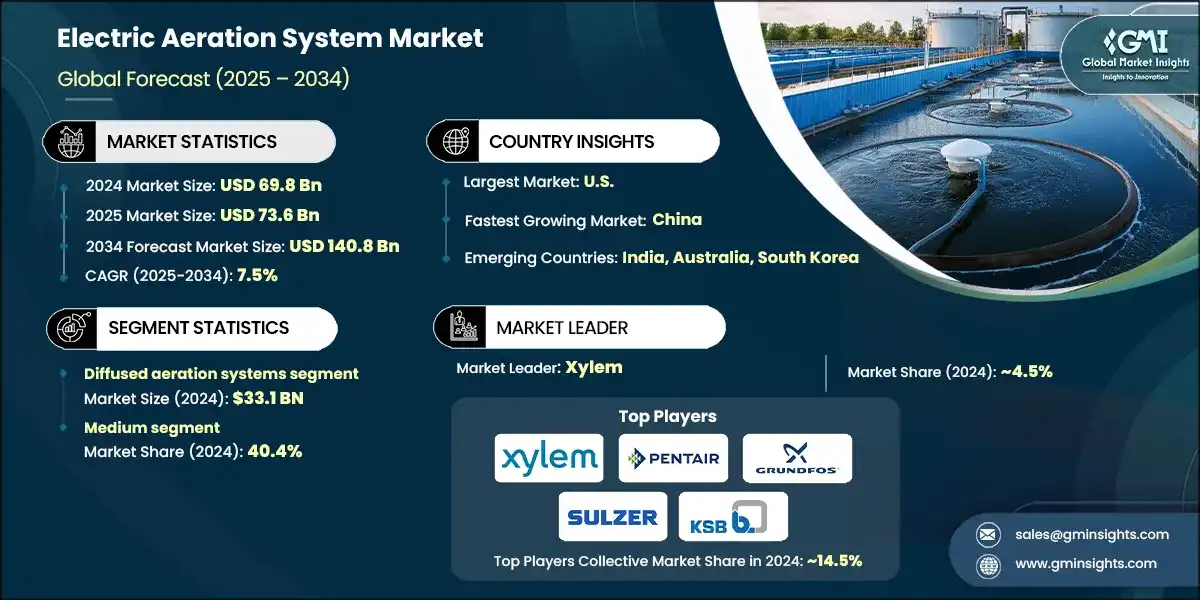
The global electric aeration systems market was estimated at USD 69.8 billion in 2024. The market is expected to grow from USD 73.6 billion in 2025 to USD 140.8 billion in 2034 at a CAGR of 7.5% according to latest report published by Global Market Insights Inc.
Electric Aeration Systems Market Key Takeaways
Market Size & Growth
- 2024 Market Size: USD 69.8 Billion
- 2025 Market Size: USD 73.6 Billion
- 2034 Forecast Market Size: USD 140.8 Billion
- CAGR (2025–2034): 7.5%
Regional Dominance
- Largest Market: U.S.
- Fastest Growing Region: China
Key Market Drivers
- Regulatory Push for Energy Efficiency in Wastewater Treatment.
- Decentralized Infrastructure Expansion in Emerging Regions.
- Integration of Intelligent Water Technologies.
Challenges
- High Initial Capital and Retrofit Costs.
- Operational Complexity and Skill Gaps.
Opportunity
- Expansion into Agricultural Water Management.
- Public-Private Partnerships (PPPs) in Decentralized Wastewater Projects.
Key Players
- Market Leader: Xylem led with over 4.5% market share in 2024.
- Leading Players: Top 5 players in this market include Xylem Inc., Pentair plc, Grundfos, Sulzer Ltd, KSB Group, which collectively held a market share of 14.5% in 2024.
Get Market Insights & Growth Opportunities
The electric aeration systems market is driven by the key role of aeration in wastewater treatment. It usually makes up 50 to 80% of the total energy consumption of a plant, according to the journal MDPI. The German Environment Agency reports that wastewater treatment plants in Germany use about 4,400 GWh of electricity each year. This figure accounts for 1% of the country's total electricity use and results in around 3 million tonnes of CO2 emissions.
This high energy use has created strong market demand. Utilities and industrial facilities are focusing more on energy-efficient aeration technologies to lower operational costs and achieve carbon reduction goals. Research from the California Energy Commission shows that traditional aerobic secondary treatment uses 0.4 to 0.65 kWh/m³. In comparison, advanced anaerobic alternatives could become net energy positive at 0.35 kWh/m³. This indicates significant pressure in the market for more effective aeration solutions.
The market is undergoing a major shift toward smart, precision-controlled aeration systems that combine monitoring and automation features. Research published in MDPI's Energies journal shows that effective control methods can lead to significant energy savings. Small wastewater treatment plants (WWTPs) can save 10 to 25% by using PID control. Medium plants can achieve 15 to 30% savings with cascade control and model predictive control (MPC). Large facilities can reduce energy use by 30 to 40% by combining MPC with artificial intelligence and computational fluid dynamics.
The industry is also using variable frequency drives (VFDs), real-time dissolved oxygen control, and integrated SCADA systems. These updates enable better optimization of aeration based on changes in influent and treatment requirements. European standardization efforts, particularly EN 12255-15, have created consistency in oxygen transfer measurement methods. This has resulted in clearer performance comparisons among manufacturers and has led to improvements in technology.
The competitive landscape includes both established manufacturers with broad global reach and innovative technology developers who are introducing groundbreaking solutions. Major players are Aeration Industries International, which has installed over 50,000 AIRE-O2 aerators in more than 85 countries, and Aqua-Aerobic Systems, which offers a wide range of products such as direct drive mixers, sequencing batch reactors, and aerobic granular sludge technology.
The industry is undergoing consolidation through strategic purchases, seen in Fluence Corporation's sale of its aeration assets to Newterra in February 2024 and Axius Water's acquisition of Triplepoint Environmental in October 2023. Emerging technologies include membrane-aerated biofilm reactors (MABR), which claim to cut energy use by up to 75% compared to traditional bubble aeration. There are also new methods like hydrodynamic supercavitation and micro-bubble generation systems that promise improved oxygen transfer efficiency.
The future growth of the market is shaped by several trends. These include the use of renewable energy sources with aeration systems and the development of energy-positive wastewater treatment plants. There is also growth in specialized areas, such as concentrated animal feeding operations (CAFOs), where meeting regulatory requirements pushes the use of new treatment technologies. Aquaculture applications are expanding worldwide.
The EU-funded AirX project is creating specialized air diffusers for large-scale fish and shrimp farming. The market is also growing in niche areas, such as noise-sensitive installations. Products like Natural Waterscapes' PowerAir Sound Shield Series meet the needs of residential and commercial markets that require quiet operation.
To get key market trends
Electric Aeration Systems Market Trends
- The market is experiencing a strong shift toward digitally integrated and energy-efficient aeration technologies. Manufacturers are adding IoT sensors, AI-based controllers, and predictive maintenance tools to diffused and hybrid aeration systems. For example, companies like Grundfos and Xylem have launched smart aeration platforms. These allow real-time monitoring of dissolved oxygen levels and energy use, improving performance while lowering operational costs. This trend is fueled by regulatory pressure to cut carbon footprints and consumer demand for long-term savings and automation.
- On the consumer side, there is a growing preference for modular and decentralized wastewater treatment solutions, especially in emerging markets and rural areas. Governments in APAC and Latin America are funding small-scale treatment plants that need compact, scalable aeration systems. This shift encourages manufacturers to create flexible systems that can be used in distinct locations without extensive civil infrastructure. The rise of decentralized models also helps improve resilience in water management, especially in areas facing climate-related challenges or rapid urban growth.
- On the supply side, manufacturers are increasingly localizing production and sourcing to reduce geopolitical risks and meet sustainability standards. With rising raw material costs and uncertainties in international trade, companies are investing in regional manufacturing hubs and circular supply chains. For instance, European firms are following EU Green Deal guidelines by using recyclable parts and cutting emissions throughout their production processes. This trend not only ensures compliance with regulations but also boosts brand value among environmentally aware customers.
Electric Aeration Systems Market Analysis
Learn more about the key segments shaping this market
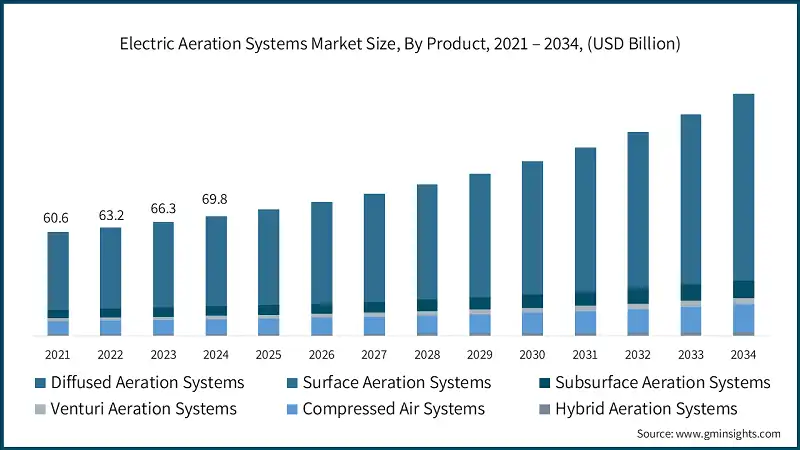
Based on product, the electric aeration systems market is segmented into diffused aeration systems, surface aeration systems, subsurface aeration systems, venturi aeration systems, compressed air systems, and hybrid aeration systems. In 2024, the diffused aeration systems segment dominated the market and generated a revenue of USD 33.1 billion and is expected to grow at CAGR of around 7.2% during the forecast period 2025 to 2034.
- The dominance of diffused aeration systems in the electric aeration systems market in 2024 is primarily due to their superior energy efficiency and oxygen transfer capabilities. These systems use fine bubble diffusers that maximize surface area contact with water, leading to more effective aeration with lower energy consumption. This makes them particularly attractive for municipal wastewater treatment plants and industrial facilities aiming to reduce operational costs and meet stringent environmental regulations. Their adaptability to various tank configurations and scalability across small and large installations further enhances their appeal.
- Moreover, the growing emphasis on sustainability and automation in water treatment is driving demand for technologies that support long-term efficiency and smart integration. Diffused aeration systems are compatible with advanced control systems and IoT-based monitoring, allowing operators to optimize performance in real time. This aligns with global trends toward digital water infrastructure, especially in regions like North America, Europe, and APAC, where governments and utilities are investing heavily in modernizing aging treatment facilities. Their minimal maintenance requirements and long operational life also contribute to lower lifecycle costs, making them a preferred choice over surface or compressed air systems.
- Emerging economies are adopting these systems to improve water quality while keeping energy usage in check, and developed markets are upgrading legacy systems with diffused aeration to meet climate goals. With continuous innovation in diffuser materials and configurations, the segment is well-positioned to maintain its leadership and capture additional share in both municipal and industrial applications.
Learn more about the key segments shaping this market
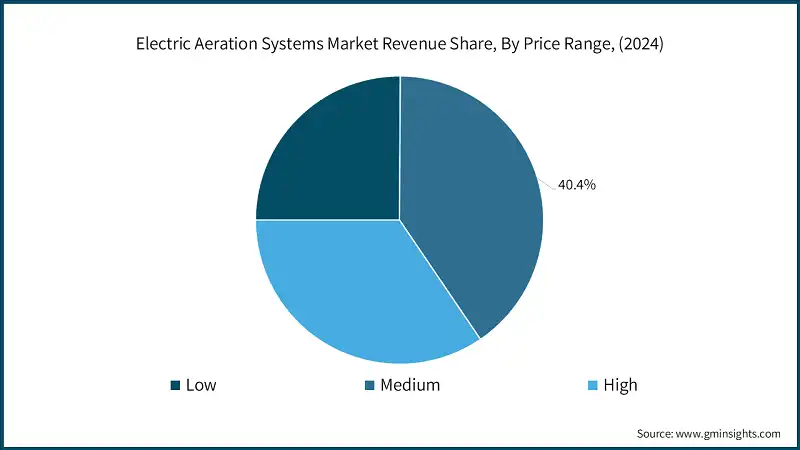
The electric aeration systems market by price range is segmented into low, medium and high. The medium segment was the leading segment in this market in 2024 with a revenue of USD 28.1 billion and has a market share of around 40.4%.
- The dominance of the medium price range segment in the electric aeration systems market in 2024 can be attributed to its optimal balance between performance and affordability.
- Medium-priced systems typically offer advanced features such as energy efficiency, digital controls, and modular designs without the premium cost of high-end models. This makes them highly attractive to municipalities, mid-sized industries, and agricultural users who require reliable aeration solutions but operate within budget constraints. Their versatility across applications, from wastewater treatment to aquaculture, further boosts their adoption.
- Additionally, the medium segment benefits from economies of scale and widespread availability through established distribution networks. Leading manufacturers like Xylem, Grundfos, and Pentair have focused their product development and marketing efforts on this segment, recognizing its broad appeal. These systems are often bundled with service contracts and remote monitoring capabilities, enhancing their value proposition. As regulatory standards tighten and sustainability becomes a priority, medium-range systems are increasingly seen as the most cost-effective way to comply with environmental norms while maintaining operational efficiency.
Looking for region specific data?
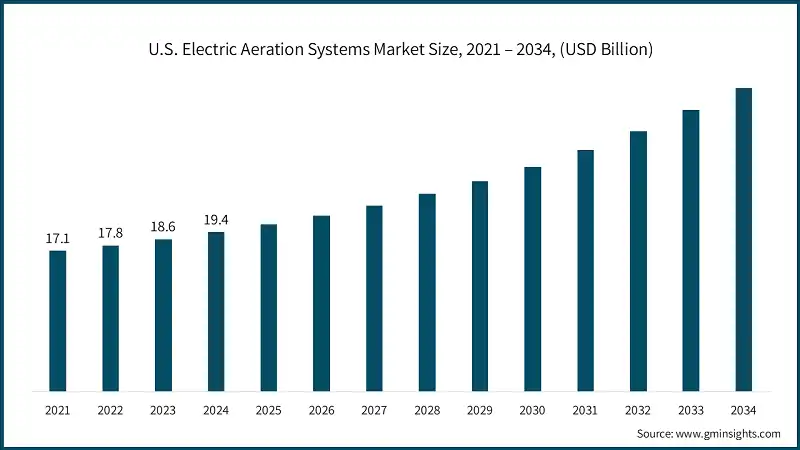
The U.S. electric aeration systems market was valued at around USD 19.4 billion in 2024 and is anticipated to register a CAGR of 6.8% between 2025 and 2034.
- The U.S. electric aeration systems industry is experiencing steady growth due to a combination of aging infrastructure, regulatory pressure, and technological advancement. Many wastewater treatment facilities across the country are decades old and require modernization to meet current environmental standards. The Environmental Protection Agency (EPA) has identified significant gaps in wastewater infrastructure, prompting federal and state governments to allocate substantial funding through programs like the Clean Water State Revolving Fund and WIFIA. These initiatives are driving upgrades that often include the adoption of electric aeration systems, which offer improved energy efficiency and operational control.
- Another key factor is the increasing emphasis on sustainability and energy conservation. Electric aeration systems are being favored over traditional mechanical systems due to their lower energy consumption and compatibility with smart monitoring technologies. The U.S. Department of Energy is actively supporting research and deployment of energy-efficient water treatment technologies, which aligns with broader national goals to reduce carbon emissions and improve resource efficiency. This policy alignment is encouraging municipalities and industrial users to invest in modern aeration solutions that meet both environmental and economic objectives.
- Looking ahead, the U.S. market is expected to evolve toward more decentralized and intelligent systems. With growing interest in smart cities and resilient infrastructure, electric aeration systems integrated with IoT and AI capabilities will become increasingly common. These systems enable predictive maintenance, real-time performance optimization, and remote management, making them ideal for both urban and rural applications. As federal funding continues and private sector innovation accelerates, the U.S. is poised to remain a leader in the adoption of advanced aeration technologies.
Europe witnessed promising demand in the electric aeration systems market with a share of around 26.7% in 2024 and is expected to grow at a robust CAGR of 7.5% during the forecast period.
- Europe is demonstrating steady growth in the market due to its mature infrastructure, stringent environmental regulations, and consistent public investment in wastewater treatment. According to the European Environment Agency (EEA), over 90% of urban wastewater across the EU is treated in compliance with the Urban Wastewater Treatment Directive, with countries like Germany, Austria, and the Netherlands achieving 100% compliance. This regulatory rigor drives continuous upgrades in treatment technologies, including energy-efficient aeration systems.
- Moreover, Eurostat reports that 43.7% of all environmental protection investments between 2006–2022 were directed toward wastewater management, highlighting the sector’s priority status in public spending. These investments are not only maintaining existing infrastructure but also integrating smart and low-emission technologies to meet EU climate goals.
- The European Commission’s Recovery and Resilience Facility has allocated over USD 50 million specifically for energy-efficient wastewater discharge and treatment projects, with a focus on reducing electricity consumption by at least 10% in upgraded systems. Additionally, the EU’s Multiannual Financial Framework (2028–2034) proposes nearly USD 2 trillion, with substantial funding earmarked for water resilience and clean technology through programs like Horizon Europe and the European Competitiveness Fund. These initiatives support innovation in aeration systems, including IoT integration and predictive maintenance.
Asia Pacific is fastest growing market and is expected to grow at 7.8% during the forecast period.
- Asia-Pacific (APAC) is demonstrating the fastest growth in the electric aeration systems market due to a confluence of rapid urbanization, industrial expansion, and strong government-backed environmental initiatives. According to the Ministry of Jal Shakti, India allocated over USD 9.3 billion in 2024–25 for drinking water and sanitation, with a massive portion directed toward wastewater treatment infrastructure under the Jal Jeevan Mission and Swachh Bharat Mission.
- Similarly, China’s Ministry of Ecology and Environment reported that in 2023, the country invested USD 77 billion in urban environmental infrastructure, including wastewater treatment systems. These figures reflect a strong policy push toward improving water quality and expanding treatment capacity, which directly fuels demand for advanced aeration technologies.
- Moreover, APAC’s growth is underpinned by its strategic adoption of smart and energy-efficient aeration systems. Governments in ASEAN countries are also actively promoting decentralized wastewater management and IoT-enabled monitoring systems, as seen in initiatives led by the ASEAN Working Group on Water Resources Management and Japan-funded programs in the Philippines. These efforts not only enhance operational efficiency but also support scalable solutions for diverse urban and rural needs. The region’s initiative-taking stance on sustainability, combined with its demographic and industrial momentum, makes APAC the most dynamic and promising market for electric aeration systems globally.
Electric Aeration Systems Market Share
- The top 5 companies in the electric aeration systems industry, such as Xylem Inc., Pentair plc, Grundfos, Sulzer Ltd, and KSB Group, hold a market share of 14.5%.
- Xylem has fortified its market position through a blend of strategic acquisitions, innovation, and global expansion. The acquisition of Evoqua Water Technologies significantly broadened its portfolio in water treatment and aeration systems, enabling deeper penetration into industrial and municipal segments.
- Xylem’s emphasis on smart water technologies and sustainability aligns with global environmental goals, making its offerings more attractive to eco-conscious clients. Its robust R&D investments and presence in over 150 countries allow it to swiftly adapt to regional demands and regulatory shifts. Additionally, its large installed base ensures recurring revenue through aftermarket services and parts, helping it withstand competitive pricing pressures.
- Pentair’s strategy revolves around operational excellence, innovation, and a balanced portfolio across Flow Technologies, Water Solutions, and Pool Systems. Its Transformation Program, which streamlines operations and focuses on high-margin products, has driven margin expansion and improved cost efficiency. Pentair is also leveraging digital tools and sustainability initiatives to differentiate itself, such as integrating ESG goals into product development. Its strong brand recognition and global footprint, especially in North America and Europe, provide resilience against market volatility. The company’s focus on emerging markets and continuous product innovation in water filtration and aeration systems further strengthens its competitive edge.
- Grundfos is aggressively expanding in key markets like the USA and India, supported by strategic investments such as a new factory in Texas and the acquisition of Newterra. Its product strategy emphasizes energy efficiency and digital integration, with launches like the TPE3 and ALPHA GO series that combine smart features with reduced energy consumption. The company’s long-term strategy, Ignite’27, focuses on sustainability, innovation, and technology development to meet future water and climate challenges. Grundfos also benefits from a diversified global presence and a strong reputation in pump technology, helping it maintain growth even in slower markets like Germany and the UK.
Electric Aeration Systems Market Companies
Major players operating in the electric aeration systems industry are:
- Aqua-Aerobic Systems
- Carrier Global
- Daikin Industries
- Danner Manufacturing
- Evoqua Water Technologies
- Grundfos
- Honeywell
- Johnson Controls
- KSB Group
- Pentair plc
- Sanitaire
- SUEZ Water Technologies
- Sulzer Ltd
- Trane Technologies
- Veolia Water Technologies
- Xylem Inc.
Sulzer’s competitive strategy in the aeration systems market is built on its engineering excellence and specialization in fluid technologies. Although specific recent strategic moves were not found in the latest search, Sulzer is known for its focus on high-performance equipment and tailored solutions for wastewater treatment and industrial applications. The company typically leverages its global service network and innovation in rotating equipment and separation technologies to maintain customer loyalty and operational efficiency. Its ability to deliver customized, energy-efficient solutions helps it compete effectively in niche and high-demand segments.
KSB’s “Mission TEN30” strategy aims for a double-digit return on sales by 2030 through operational excellence, digital transformation, and sustainability. The company is expanding its aftermarket services under the SupremeServ brand and investing in renewable energy solutions and smart technologies. KSB’s strong presence in diverse sectors—water/wastewater, mining, energy, and petrochemicals—provides a stable revenue base. Its global footprint, customer-centric innovation, and long-standing reputation for reliability foster deep client relationships, which translate into high-margin service and spare parts business. Strategic initiatives like digitization and supply chain strengthening further enhance its resilience.
Electric Aeration Systems Market Report Attributes
| Key Takeaway | Details |
|---|---|
| Market Size & Growth | |
| Base Year | 2024 |
| Market Size in 2024 | USD 69.8 Billion |
| Market Size in 2025 | USD 73.6 Billion |
| Forecast Period 2025 - 2034 CAGR | 7.5% |
| Market Size in 2034 | USD 140.8 Billion |
| Key Market Trends | |
| Drivers | Impact |
| Regulatory Push for Energy Efficiency in Wastewater Treatment | This driver is accelerating global adoption of low-energy aeration technologies, especially in regions with strict environmental mandates like the EU and North America. |
| Decentralized Infrastructure Expansion in Emerging Regions | It is expanding the market footprint in rural and peri-urban areas across APAC, Africa, and Latin America, where modular electric aeration systems are becoming essential for localized water treatment. |
| Integration of Intelligent Water Technologies | This trend is transforming operational models worldwide by enabling data-driven, automated aeration systems that improve efficiency and reduce lifecycle costs. |
| Pitfalls & Challenges | Impact |
| High Initial Capital and Retrofit Costs | This challenge is delaying adoption in cost-sensitive regions and small-scale facilities, limiting market penetration despite long-term efficiency benefits. |
| Operational Complexity and Skill Gaps | It is causing underutilization of advanced systems and increasing reliance on legacy technologies, especially in areas lacking trained technical personnel. |
| Opportunities: | Impact |
| Expansion into Agricultural Water Management | If leveraged, this opportunity could diversify the market beyond municipal and industrial segments, creating new revenue streams and accelerating adoption in rural economies. It would also position electric aeration systems as a climate-resilient solution, aligning with global food security and water conservation goals. |
| Public-Private Partnerships (PPPs) in Decentralized Wastewater Projects | Capitalizing on this opportunity would enable manufacturers to scale operations in high-growth regions while sharing financial and operational risks with public entities. It would also foster innovation in low-cost aeration systems tailored to local needs, enhancing brand visibility and long-term market sustainability. |
| Market Leaders (2024) | |
| Market Leaders |
Market share of ~4.5% |
| Top Players |
Collective market share in 2024 ~14.5% |
| Competitive Edge |
|
| Regional Insights | |
| Largest Market | U.S. |
| Fastest growing market | China |
| Emerging countries | India, Australia, South Korea |
| Future outlook |
|
What are the growth opportunities in this market?
Electric Aeration Systems Industry News
- In April 2025, Natural Waterscapes announced the launch of its PowerAir Sound Shield Series, a new line of bottom-diffused pond aeration systems featuring advanced noise-reduction technology. The systems feature a proprietary sound-suppressing air compressor housed within a sound-absorbing cabinet liner, designed for residential, golf course, and commercial applications where quiet operation is essential.
- Available in 115V and 230V versions from 1/4 to 3/4 horsepower, the systems can be configured with 1 to 4 bottom-plate aeration diffusers and are built in the U.S. with a 3-year manufacturer's warranty. The systems create water circulation currents that prevent stagnation and low oxygen zones while operating with minimal noise intrusion.
- In November 2024, Komline Industries acquired Aerator Solutions, a provider of aerators and mixers for municipal wastewater operations and stormwater retention ponds, with the announcement made in November 2024. Post-acquisition, the business operates as Komline Aerator Solutions within Komline's Diversified Water Business Unit. The acquisition integrated Aerator Solutions' water aeration expertise with Komline's existing capabilities to offer a broader solution set. Komline Aerator Solutions' product lineup includes EcoJet High-Speed Floating Aerators, EcoJet High-Speed Floating Direct Drive Mixers, Blue Frog Hybrid Aerators for lagoon discharge standards, and ASPIRO Aerators/Mixers featuring aspirating subsurface mixers with quiet operation and directional mixing capabilities.
- In July 2024, Toshiba Infrastructure Systems & Solutions Corporation launched the Habuki pretreatment system for sewage treatment facilities utilizing the oxidation ditch method, introducing Japan’s first solution that integrates a rotating fiber unit with this process. Designed to enhance treatment efficiency and reduce energy consumption, Habuki significantly lowers pollutant loads, cutting biochemical oxygen demand and total nitrogen by over 70% within 15 minutes and reduces excess sludge by 10–20%.
- By eliminating the need for traditional aeration and enabling capacity expansion without new infrastructure, the system is poised to impact the electric aeration systems market by offering a low-power, maintenance-friendly alternative that aligns with global energy conservation and carbon neutrality goals.
- In February 2024, Fluence Corporation Limited successfully completed the sale of its Aeration & Mixing assets owned by subsidiary Fluence USA (formerly Aeromix Systems Incorporated) to Newterra Inc. in an all-cash transaction. The portfolio sold included well-known aeration equipment brands like Tornado, Hurricane, Twister, Typhoon, Monsoon, Zephyr, Breeze and Riptide.
- Aeromix, founded in 1987 and acquired by Fluence in 2011, specialized in designing, manufacturing, installing, and servicing mechanical aeration equipment for municipal and industrial wastewater treatment markets. Fluence determined these assets to be non-core and the transaction was expected to improve liquidity while allowing the company to focus on its core municipal water and wastewater operations.
The electric aeration systems market research report includes in-depth coverage of the industry, with estimates & forecasts in terms of revenue (USD Billion) and volume (Thousand Units) from 2021 to 2034, for the following segments:
Market, By Product
- Diffused Aeration Systems
- Surface Aeration Systems
- Subsurface Aeration Systems
- Venturi Aeration Systems
- Compressed Air Systems
- Hybrid Aeration Systems
Market, By Technology
- Mechanical Aeration Technology
- Pneumatic Aeration Technology
- Electrochemical Aeration
- Hybrid Technology Systems
- Smart/IoT-Enabled Systems
Market, By Price Range
- Low
- Medium
- High
Market, By Application
- Municipal Wastewater Treatment
- Large-Scale Facilities (>50 MGD)
- Medium-Scale Facilities (5-50 MGD)
- Small/Decentralized Systems (<5 MGD)
- Industrial Process Water Treatment
- Manufacturing
- Chemical Processing
- Food & Beverage Industry
- Pharmaceutical
- Others
- Residential
- Commercial
Market, By Operation Mode
- Automatic
- Semi-automatic
- Manual
Market, By Distribution Channel
- Direct sales
- Indirect sales
The above information is provided for the following regions and countries:
- North America
- U.S.
- Canada
- Europe
- Germany
- U.K.
- France
- Italy
- Spain
- Netherlands
- Asia Pacific
- China
- Japan
- India
- South Korea
- Australia
- Latin America
- Brazil
- Mexico
- Argentina
- MEA
- UAE
- Saudi Arabia
- South Africa
Frequently Asked Question(FAQ) :
What was the market size of the electric aeration systems in 2024?
The market size was USD 69.8 billion in 2024, growing at a CAGR of 7.5% till 2034, driven by the critical role of aeration in wastewater treatment and increasing energy efficiency demands.
What is the projected value of the electric aeration systems market by 2034?
The market is projected to reach USD 140.8 billion by 2034, fueled by advancements in energy-efficient technologies and regulatory pressures.
What is the expected size of the electric aeration systems market in 2025?
The market size is expected to reach USD 73.6 billion in 2025.
How much revenue did the diffused aeration systems segment generate in 2024?
The diffused aeration systems segment generated USD 33.1 billion in 2024 and is anticipated to witness over 7.2% CAGR during the forecast period.
What was the valuation of the medium segment in 2024?
The medium segment was valued at USD 28.1 billion in 2024, holding a market share of around 40.4%.
Which region leads the U.S. electric aeration systems sector?
The U.S. market was valued at around USD 19.4 billion in 2024 and is set to expand at a CAGR of 6.8% through 2034, led by aging infrastructure, regulatory mandates, and technological advancements.
What are the upcoming trends in the electric aeration systems market?
Key trends include IoT-AI integration, modular decentralized treatment, localized production, and compliance with sustainability standards.
Who are the key players in the electric aeration systems industry?
Key players include Aqua-Aerobic Systems, Carrier Global, Daikin Industries, Danner Manufacturing, Evoqua Water Technologies, Grundfos, Honeywell, Johnson Controls, and KSB Group.
Electric Aeration Systems Market Scope
Related Reports