Summary
Table of Content

Edible Packaging for Frozen Foods Market
Get a free sample of this report
Form submitted successfully!
Error submitting form. Please try again.
Thank you!
Your inquiry has been received. Our team will reach out to you with the required details via email. To ensure that you don't miss their response, kindly remember to check your spam folder as well!
Request Sectional Data
Thank you!
Your inquiry has been received. Our team will reach out to you with the required details via email. To ensure that you don't miss their response, kindly remember to check your spam folder as well!
Form submitted successfully!
Error submitting form. Please try again.
Edible Packaging for Frozen Foods Market Size
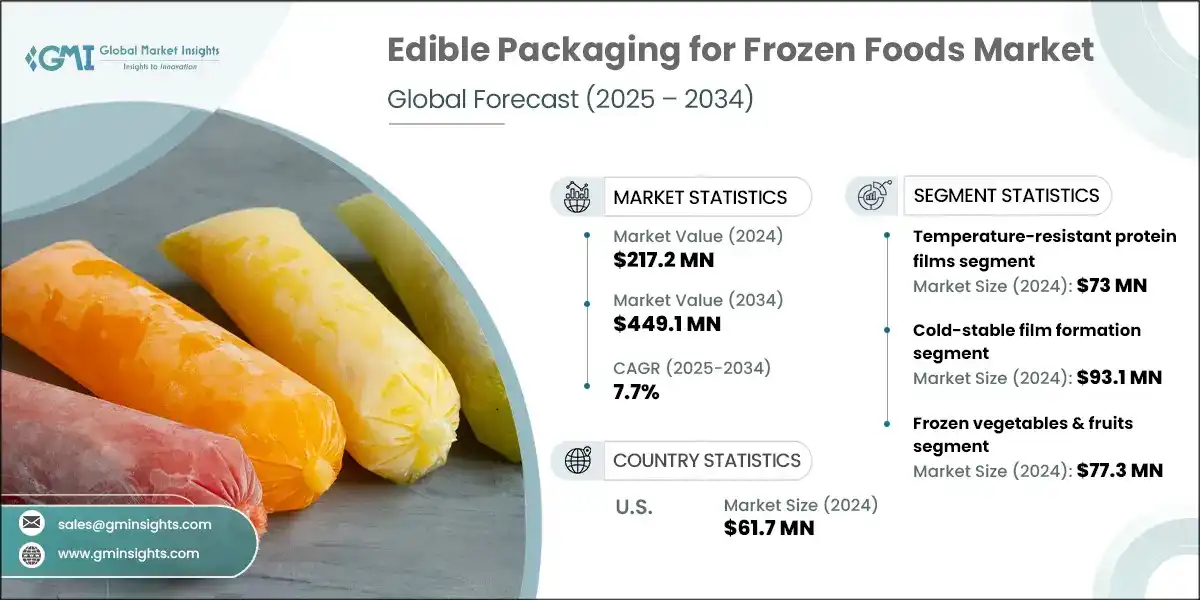
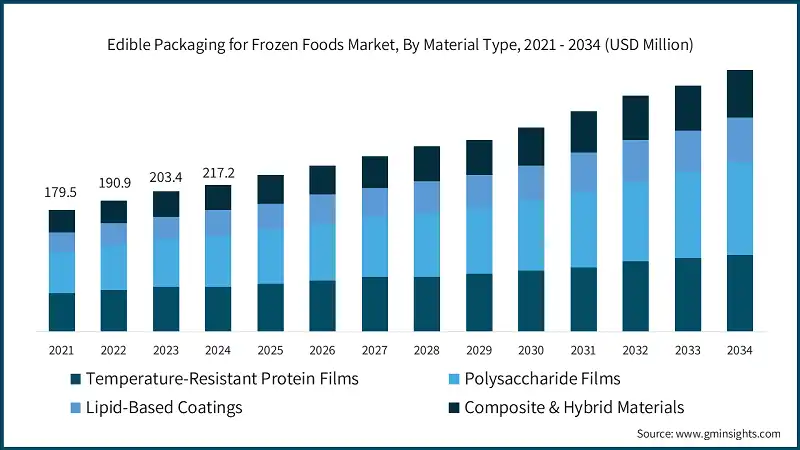
The global edible packaging for frozen foods market size was estimated at USD 217.2 million in 2024. The market is expected to grow from USD 231 million in 2025 to USD 449.1 million by 2034, growing at a CAGR of 7.7%.
Edible Packaging for Frozen Foods Market Key Takeaways
Market Size & Growth
- 2024 Market Size: USD 217.2 Million
- 2034 Forecast Market Size: USD 449.1 Million
- CAGR (2025–2034): 7.7%
Key Market Drivers
- Ban on single-use plastics in frozen food packaging.
- Rising demand for clean-label and biodegradable food packaging.
- Growth in private-label frozen food brands across regions.
Challenges
- High production cost vs. synthetic packaging.
- Limited barrier performance in high-humidity cold-chain environments.
- Regulatory ambiguity in edible labeling and claims.
Opportunity
- Integration of flavor-enhanced edible coatings.
- Growth in vegan, gluten-free, and organic frozen categories.
- Public–private R&D partnerships for sustainable food packaging.
Key Players
- Market Leader: Amcor Plc led with over 14.6% market share in 2024.
- Leading Players: Top 5 players in this market include Amcor Plc, WikiCell Designs Inc., Tate & Lyle PLC, BASF SE, Ingredion Incorporated, which collectively held a market share of 57.3% in 2024.
Get Market Insights & Growth Opportunities
- There has also been a growing demand for biodegradable packaging that is cold stable, and specifically for IQF (individually quick frozen) fruits and vegetables, microwaveable frozen ready meals, and "heat and serve" meals, which has resulted in the volume growth across North America, Europe, and into select aspects of Asia-Pacific (i.e. Japan, South Korea, Australia).
- From 2021 to 2024, the market was characterized with a compound annual growth rate (CAGR) of 6.4% over the period, led largely by the early adoption of edible films based on proteins and polysaccharides.
- Appetite came primarily from sale of the edible packaging used on frozen particular fruits and plant-based meals in North America and Europe as well as through lower-cost alternatives using chitosan and starch in parts of Asia-Pacific.
- According to estimates, the edible packaging for frozen foods market growth will come as a result of technological advances in barrier enhancements, increased methanol investment in food-grade cold-chain logistics, and policy support for more sustainable packaging in developed economies.
- The polysaccharide films segment is expected to witness the highest growth because of its cost advantages and freeze stability, while demand from frozen ready meals and meat/seafood will be the greatest due to their high perishability and export dependence. Cold-chain optimization and flavor-integrated edible coatings will be the key differentiator in premium product categories.
- Overall, the growth of private-label frozen food has, especially in North America and Western Europe, contributed to the growth of edible packaging. In order to differentiate retailer brands, retailers are increasingly demanding cost-effective and sustainable alternatives. Consequently, between 2022 and 2024 there was a 15–18% lift in new product launches with edible films, generating over USD 38 million in new annual incremental revenues in the segment by the end of 2024.
To get key market trends
Edible Packaging for Frozen Foods Market Trends
- Shift toward cold-stable, multi-layer edible films: Manufacturers are increasingly using multi-layered edible films consisting of both polysaccharides and proteins. These films will enhance moisture and oxygen barriers while frozen. These films are expected to encompass more than 40% of edible packaging volume by 2030, especially frozen seafood and frozen entrées. This is a trend that is developing out of the need to maintain texture through cold terminal storage supply chains, and also with the goal of shelf-life extension.
- The growth of plant-based and vegan film adoption: The increase in consumer demand for frozen vegan and frozen gluten-free foods corresponds with the expansion of edible packaging using plant-based materials like modified starch, alginate, or cellulose. By 2034, plant-based films should represent over 60% of polysaccharide-based formats (by volume), with a particular opportunity in the Asia Pacific and Europe, where regulatory support drives R&D and there are significant amounts of affordable bio-based raw materials available for innovation.
- The supermarket's private label push will promote edible films: Retailers are designing private-label frozen food portfolios that use edible packaging as a value-differentiating attribute. Conservative estimates suggest that by 2034 more than 25% of new private-label frozen product launches in Western Europe and North America will incorporate edible films. By using an edible film the secondary packaging is reduced, the delivery to the consumer is more sustainable and the product is more consumer-friendly.
- Flavor-integrated edible coatings gain traction: There are some cool edible coatings with herbs, spices, or umami flavors that are becoming more prominent in the frozen ready meal or dessert categories. They are effective both as packaging and flavor enhancement. Trials from leading food producers show that more than 35% of consumers prefer flavor-infused wraps on frozen products, which can provide a premium advantage for the brand.
Edible Packaging for Frozen Foods Market Analysis
Learn more about the key segments shaping this market
The edible packaging for frozen foods market from temperature-resistant protein films segment was valued at USD 73 million in 2024, and it is anticipated to expand 7.1% of CAGR during 2025-2034.
- Polysaccharide films are the leading type of material due to their low price, low allergen risk, and dependable performance under frozen conditions. They are produced from starch, alginate, cellulose, etc. and are projected to be over 34.9% of the market by 2034. These films have good flexibility and may be adapted to meet the texture and moisture needs of frozen vegetables, seafood, and readymade meals.
- Composite and hybrid materials are lowering their share of the market with premium applications, due to their dual-barrier properties, combining moisture resistance from lipids, and structural strength from proteins or polysaccharides. With their superior characteristics, hybrid materials are better suited for frozen ready meals and grade A, fresh frozen seafood and will offer packaging integrity in frozen storage whilst also being compostable and biodegradable.
- The predicted growth rate in profitability of edible and biodegradable polymer blends, indicates that composite films will exceed 20% of the market share by 2034; thus, aggregating them as an emerging player in mid to premium (frozen) packaging.
Based on technology, the edible packaging for frozen foods market from cold-stable film formation was valued at USD 93.1 million in 2024, and it is anticipated to expand 8% of CAGR during 2025-2034.
- Cold-stable film formation is widely recognized as the core technology and accounted for 42.5% of the overall market share in 2021, while it is expected to decline to 34.6% by 2034 as barrier enhancements take hold. Cold-stable films are vital to basic edible packaging, especially in mass-market frozen products that do not use non-recyclable plastic. Cold stable films meet the mechanical requirements to hold their structural integrity through freezing and thawing cycles without failure such as cracking or deterioration of the film.
- Barrier enhancements including the utilization of multi-layer structures and incorporating active compounds will be the fastest growing area of technological focus, and projected to take on 39.2% of the share in 2034. These technologies are very effective in enhancing shelf life since they protect food from the major cause of spoilage what comes from oxygen and moisture migration. Barrier enhancements become critical in the case for mass-produced frozen meats and seafood because of their susceptibility to freezer burn and degradation of quality. Enhanced barrier films are being refined to meet the unique needs of specialty items such as gluten-free frozen pizzas and dairy free desserts.
Learn more about the key segments shaping this market
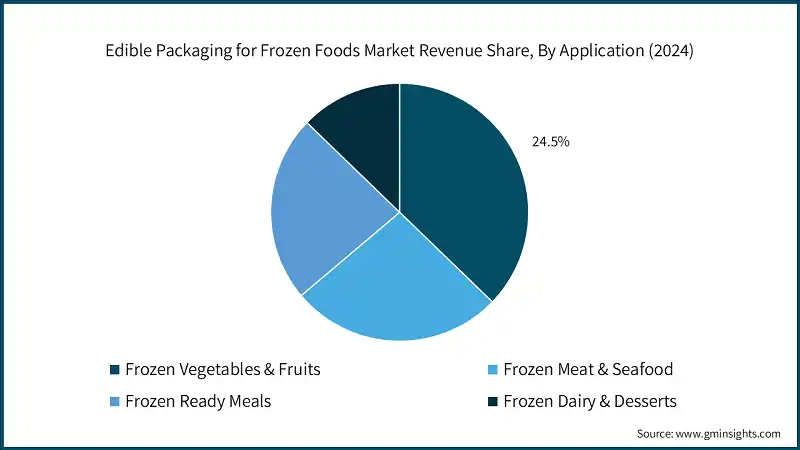
Based on application, the edible packaging for frozen foods market from frozen vegetables & fruits segment was valued at USD 77.3 million in 2024, and it is anticipated to expand 7.2% of CAGR during 2025-2034.
- In 2024, frozen vegetables & fruits experienced the largest share of the market at 35.6% came mainly from their high-volume exports and earlier uptake of edible coatings to retain moisture and eco-friendly brand association. The films act as a breathable layer to keep fresher for cold storage. The ownership of edible packaging supports the segment's benefits from the increasing organic labeling requirements and the banning of plastic wraps on frozen produce in Europe and several markets in Asia.
- Frozen meat & seafood and ready meals will have the fastest growth through overtaking approximately 53.5% share (combined) by 2034. The categories will benefit from the quicker turnaround of clean-label, portion-controlled, and preservative-free solutions. The use of edible packaging makes for a direct-to-pan convenience as well as enhancing flavors with the use of flavor-infused films, a new trend in gourmet-ready-to-eat meals in North America and Japan.
Looking for region specific data?
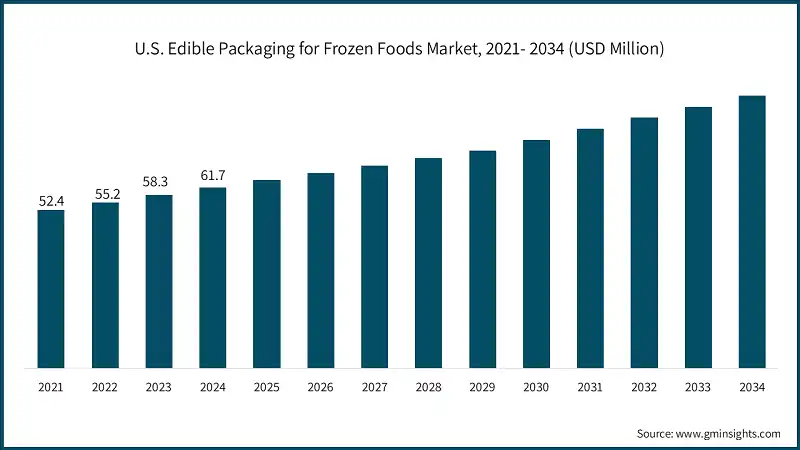
Based on region, North America led with approximately 33% share in 2024, the uptake by retailers, innovative edible packaging start-ups, and growing consumer awareness. U.S. constituted of USD 61.7 million in 2024. The region has also seen an increase in private-label frozen foods with edible films being featured as a sustainable point of differentiation. However, with high raw materials and costs associated with regulatory compliance, growth will be further subdued and the share will diminish by 2034.
The market in the Asia Pacific region will be the fastest growing and largest market by 2034 capturing over approximately 26% market share. The region will take advantage of local sourcing of starch, chitosan, and seaweed-based raw materials along with mandated sustainability for governments in China, India, South Korea and ASEAN. The need for cost-effective edible packaging formats that are designed for cryogenic supply chains will be further enhanced by export-focused frozen seafood and fruits.
Edible Packaging for Frozen Foods Market Share
- In 2024, Amcor Plc, holding approximately 14.6% share, leads the edible packaging category in frozen food, the largest sub-segment in edible packaging, thanks to its first-to-market position on cold-stable multilayer films and providing successful frozen brands with solutions to issues created from frozen storage.
- Amcor has maintained led through advanced edible barrier technologies and sustainable clean packaging solutions. WikiCell is market uptake with flavor-enabled membranes for frozen dairy and desserts, while Tate & Lyle is using long-chain starches as a built-in advantage to service the high-volume sectors of Asia Pacific.
- BASF is seeking growth through temperature-resistant biopolymers in meat and seafood applications while Ingredion is growing share within peasant-level, plant-based skins in low-cost regions like Latin America and India.
- In the last three years, there has been a gradual change in market share within the polysaccharide film creators. Both Ingredion and Tate & Lyle have gained approximately a 2% market share on account of emerging-market expansion and clean-label-film innovation. These changes reflect increased demand for plant-based and freeze-equipped solutions across a variety of freezer and chilled food categories presented to consumers. The market currently remains moderately concentrated, new entrants and regional manufacturers are making competitive strides as they enter niche areas of frozen ready meals and portion control packs. As demand and use cases for smart, flavor-rich, edible films continue to rise there will be new entrants who will disrupt the current hierarchy across cost-sensitive and innovate-led regions by 2030.
Edible Packaging for Frozen Foods Market Companies
The top five prominent market player in the edible packaging for frozen foods industry are:
- Amcor Plc
- WikiCell Designs Inc.
- Tate & Lyle PLC
- BASF SE
- Ingredion Incorporated
o Amcor Plc is projected to have USD31.7 million in sales in 2024 and to capture a 14.6% of the edible packaging for frozen foods market share. Amcor is highly involved in edible films including patented multi-layer edible films made specifically for sub-freezing temperatures and are designed to also have freeze-thaw barrier layers. Amcor recently introduced a biodegradable protein-based wrap for frozen vegetables in Europe, and it has strong R&D and established relationships with retailers in North America and the EU for rapid market entry opportunity.
o WikiCell Designs Inc. is the second largest company in this space by market share at 11.2%, what translates into USD 24.3 million in revenue in 2024. They've already changed the game with their flavor infused edible membranes, which have taken off in the frozen desserts and dairy-based snacks sectors. WikiCell recent product introduction is a cocoa-butter-based shell with natural antimicrobials - is a new precedent in the premium frozen dessert segment, attracting the attention of environmentally-conscious consumers as well as fine food chains.
o Tate & Lyle PLC was approximately USD 22 million for all edible packaging in 2024 and a 10.1% market share. The company globally distributed reach and experience in starch processing includes temperature-stable polysaccharide films. The company has recently started commercializing edible packaging in the frozen meals segment in Asia using a proprietary blend of high-amylose starch and edible plasticizers, all with extended shelf life, but flexible enough to freeze.
o BASF SE has a slight advantage in this niche with revenues of USD 21.04 million and a market share of 9.7%; it has leveraged its chemicals background to develop coatings with composite cryoprotectants able to hold up the quality of frozen proteins and seafood products. This very recently-launched cryo-film, a glycerol-based extension that retains aromas, is being used by a lot of the major frozen meat exporters in Europe today. Working with food manufacturers, this strong IP portfolio of BASF allows an advantage in B2B.
o Ingredion Incorporated, with revenues of USD 18.4 million and an 8.5% market share. Ingredion is taking a targeted approach toward low-cost applications introducing the first low-cost chitosan-based edible coatings for frozen vegetables in LATAM and India. The company also expanded application labs for cold chain in 2023 to foster the very innovation of freeze-tolerant plant-based films. The basis of Ingredion's competitive stance is twofold: flexible pricing, based on low sourcing costs, and ability to design and produce customized equipment within the region-that will enable Ingredion to be highly competitive in the price-sensitive markets.
Edible Packaging for Frozen Foods Market Report Attributes
| Key Takeaway | Details |
|---|---|
| Market Size & Growth | |
| Base Year | 2024 |
| Market Size in 2024 | USD 217.2 Million |
| Forecast Period 2025 - 2034 CAGR | 7.7% |
| Market Size in 2034 | USD 449.1 Million |
| Key Market Trends | |
| Drivers | Impact |
| Ban on single-use plastics in frozen food packaging | Drives mandatory adoption of sustainable, edible formats globally |
| Rising demand for clean-label and biodegradable food packaging | Boosts innovation in edible films for meat and vegetable categories |
| Growth in private-label frozen food brands across regions | Expands commercial volume of edible wraps and coatings |
| Pitfalls & Challenges | Impact |
| High production cost vs. synthetic packaging | Limits large-scale adoption among cost-sensitive frozen food brands |
| Limited barrier performance in high-humidity cold-chain environments | Shortens shelf life and increases spoilage risk in certain applications |
| Regulatory ambiguity in edible labeling and claims | Slows global adoption due to compliance hurdles and safety validations |
| Opportunities: | Impact |
| Integration of flavor-enhanced edible coatings | Adds product differentiation and consumer experience in frozen meals |
| Growth in vegan, gluten-free, and organic frozen categories | Opens demand for plant-based edible films and biodegradable formats |
| Public–private R&D partnerships for sustainable food packaging | Enables material innovation and cost reduction through government backing |
| Market Leaders (2024) | |
| Market Leaders |
Approximately 14.6% |
| Top Players |
Collective market share in 2024 is Approximately 57.3% |
| Competitive Edge |
|
| Regional Insights | |
| Largest Market | North America |
| Fastest Growing Market | Asia Pacific |
| Emerging Country | India, Thailand, Brazil |
| Future Outlook |
|
What are the growth opportunities in this market?
Edible Packaging for Frozen Foods Industry News
- In December 2024, Tate & Lyle and BioHarvest's active partnership is centered around development of the next generation of sweeteners - botanical sweetening ingredients deploying plant derived molecules. Apart from BioHarvest proprietary platform, this will meet consumer desire for a sugar-like taste - with no after-taste - and give more children more access to more choices of ingredients that can help improve the healthiness of products.
- In November 2024, Berry Global will be acquired by Amcor Plc for USD 8.43 billion in all equity in creating a packaging powerhouse with USD 24 billion in total revenues. Amcor's global supply chain reach and innovative edible film will be greatly expanded by this deal.
- In March 2022, Amcor's Brazil division introduced a recyclable flow-pack for frozen food that uses 44% less water and 38% less carbon. Despite not being edible in and of itself, it demonstrates Amcor's dedication to environmentally friendly film technologies aimed at improving the line of cold-chain edible packaging.
The edible packaging for frozen foods market research report includes in-depth coverage of the industry with estimates & forecast in terms of revenue (USD million) & (Units) from 2021 to 2034, for the following segments:
Market, By Material Type
- Temperature-resistant protein films
- Polysaccharide films
- Lipid-based coatings
- Composite & hybrid materials
Market, By Technology Type
- Cold-stable film formation
- Barrier enhancements
- Cold chain integration
Market, By Application
- Frozen vegetables & fruits
- Frozen meat & seafood
- Frozen ready meals
- Frozen dairy & desserts
The above information is provided for the following regions and countries:
- North America
- U.S.
- Canada
- Europe
- UK
- Germany
- France
- Italy
- Spain
- Rest of Europe
- Asia Pacific
- China
- India
- Japan
- South Korea
- Australia
- Rest of Asia Pacific
- Latin America
- Brazil
- Mexico
- Argentina
- Rest of Latin America
- MEA
- UAE
- Saudi Arabia
- South Africa
- Rest of Middle East and Africa
Frequently Asked Question(FAQ) :
What is the market size of the edible packaging for frozen foods in 2024?
The market size was USD 217.2 million in 2024, with a CAGR of 7.7% expected through 2034. Rising demand for cold-stable biodegradable packaging for IQF produce and ready-to-eat meals is boosting market growth.
What is the projected value of the edible packaging for frozen foods market by 2034?
The market is poised to reach USD 449.1 million by 2034, driven by advancements in multi-layer edible films, plant-based materials, and flavor-infused coatings.
How much revenue did the temperature-resistant protein films segment generate in 2024?
The temperature-resistant protein films segment generated USD 73 million in 2024, with a projected CAGR of 7.1% from 2025 to 2034.
What was the valuation of the cold-stable film formation technology segment in 2024?
The cold-stable film formation technology segment was valued at USD 93.1 million in 2024 and is anticipated to expand at a CAGR of 8% till 2034.
What is the growth outlook for the frozen vegetables and fruits application segment from 2025 to 2034?
The frozen vegetables and fruits application segment is set to expand at a CAGR of 7.2% up to 2034, after being valued at USD 77.3 million in 2024.
Which region leads the edible packaging for frozen foods sector?
The U.S. market accounted for USD 61.7 million in 2024, driven by retailer adoption, innovative start-ups, and consumer awareness.
What are the upcoming trends in the edible packaging for frozen foods market?
Key trends include multi-layer edible films for moisture/oxygen barriers, plant-based and vegan options, private-label frozen foods with edible packaging, and flavor-infused coatings to boost appeal.
Who are the key players in the edible packaging for frozen foods industry?
Key players include Tate & Lyle PLC, Kerry Group plc, Ingredion Incorporated, Cargill, Incorporated, Archer-Daniels-Midland Company, DuPont de Nemours, Inc., BASF SE, Corbion N.V., and Roquette Frères.
Edible Packaging for Frozen Foods Market Scope
Related Reports