Summary
Table of Content

Eco-friendly Cleaning Products Market
Get a free sample of this report
Form submitted successfully!
Error submitting form. Please try again.
Thank you!
Your inquiry has been received. Our team will reach out to you with the required details via email. To ensure that you don't miss their response, kindly remember to check your spam folder as well!
Request Sectional Data
Thank you!
Your inquiry has been received. Our team will reach out to you with the required details via email. To ensure that you don't miss their response, kindly remember to check your spam folder as well!
Form submitted successfully!
Error submitting form. Please try again.
Eco-friendly Cleaning Products Market Size
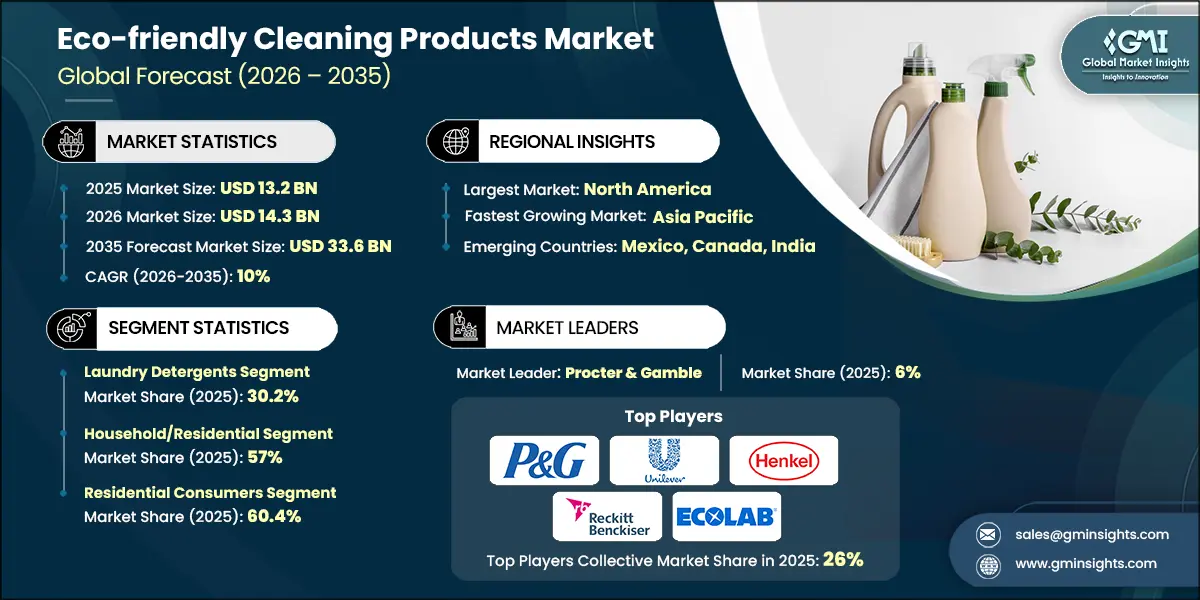
The global eco-friendly cleaning products market was estimated at USD 13.2 billion in 2025. The market is expected to grow from USD 14.3 billion in 2026 to USD 33.6 billion in 2035, at a CAGR of 10% according to latest report published by Global Market Insights Inc.
Eco-friendly Cleaning Products Market Key Takeaways
Market Size & Growth
- 2025 Market Size: USD 13.2 Billion
- 2026 Market Size: USD 14.3 Billion
- 2035 Forecast Market Size: USD 33.6 Billion
- CAGR (2026–2035): 10%
Regional Dominance
- Largest Market: North America
- Fastest Growing Region: Asia Pacific
Key Market Drivers
- Rising consumer demand for sustainable & non toxic products.
- Stringent environmental regulations & eco label adoption.
- Growth of commercial & institutional green cleaning programs.
Challenges
- Higher production costs & raw material price volatility.
- Performance perception & consumer skepticism.
Opportunity
- Concentrated, refill & low waste product formats.
- Corporate ESG commitments & green procurement policies.
Key Players
- Market Leader: Procter & Gamble led with over 6% market share in 2025.
- Leading Players: Top 5 players in this market include Procter & Gamble, Unilever, Henkel, Reckitt Benckiser, Ecolab, which collectively held a market share of 26% in 2025.
Get Market Insights & Growth Opportunities
The global market for eco-friendly cleaning products is in a state of profound evolution, characterized by the widespread development of three major trends. The combined effect of these factors is redefining the formulation, manufacturing, and usage of eco-friendly cleaning products throughout the world. Among the more notable developments is the evolving tendency for manufacturers to replace traditional components like petrochemical-based surfactants, phosphates, and chlorine components with more environmentally friendly materials like plant-derived enzymes, plant-based surfactants, and mineral-based disinfectants, which provide similar product efficacy while offering enhanced sustainability. The advent of advanced formulation capabilities today enables consumers to achieve near-identical levels of effectiveness from eco-friendly cleaning products, as evidenced by testing that verifies 95% - 99% levels of effectiveness against a range of household and industrial pathogens.
The increasingly widespread development of concentrated, refillable, and water-efficient formats in eco-friendly cleaning products signals a profound transformation in the market. Concentrated formulas reduce packaging, transportation, and storage while offering enhanced sustainability. The system achieves these levels of performance through a maximum 70% reduction in packaging materials and a 30% - 50% reduction in carbon emissions normally associated with traditional single-bottle formats. Leading brands like Seventh Generation, Ecover, Method, and ECOS have also expanded offerings to include refill stations, pouch‑based concentrates, and dissolvable tablet systems that allow consumers and commercial users to reduce waste without sacrificing cleaning efficacy. This, in turn, is enabling manufacturers to improve their margins by decreasing raw material and distribution costs.
Increasing awareness among consumers of health, indoor air quality, and chemical exposure risks is one of the major factors driving up demand for ecofriendly cleaning products in households and commercial facilities. Most conventional cleaners contain VOCs, synthetic fragrances, and antimicrobial agents that have been linked to respiratory irritation and long-term health problems. Eco-friendly alternatives formulated without ammonia, bleach, or phthalates are increasingly preferred in homes with children, elderly populations, and pets. The commercial segment includes schools, hospitals, hospitality facilities, and office buildings applying green cleaning programs based on occupational health guidelines and sustainability commitments, thereby further fortifying market demand.
The global push toward sustainability regulations and corporate ESG commitments is creating strong structural growth for eco‑friendly cleaning products. Governments and regulatory bodies are clamping down on hazardous chemicals, wastewater toxicity, and non‑recyclable packaging. Many regions require biodegradability standards, eco‑labels, and life‑cycle assessments for cleaning products used in public facilities. Large corporations and facility management companies are implanting green procurement policies, prioritizing certified eco‑labels such as EU Ecolabel, Green Seal, EcoLogo, and USDA BioPreferred. Regulatory and ESG‑driven procurement requirements account for an estimated 30%–35% impact on the market’s compound annual growth rate, making this the single largest growth driver in the sector.
Manufacturers all over the world are investing in automation, sustainable manufacturing practice, and low-carbon supply chains to meet the soaring demand while keeping costs down. Production facilities are setting up energy-efficient mixing systems, closed-loop water recycling, and renewable sources of energy that cut down footprints. Fully automated filling, labeling, and quality-control systems also have volume production of greener products and allow consistent formulation accuracy with minimal waste. Moving toward a digital supply chain management and predictive demand planning is also improving inventory efficiency and reducing overproduction that supports both profitability and sustainability goals.
The commercial and institutional cleaning sector is coming up as another significant growth sector for green cleaners owing to labor problems, increasing hygiene levels, and the demand for safer workplaces. Janitorial service companies, along with facility managers, are shifting towards green cleaning solutions that meet specifications and minimize worker exposure to strong chemical cleaners and lower liability risks. With automation control, closed-loop dispensing, and color-coded EcoClean lineups, worker safety is increased, and chemical overuse is avoided, making this growth dimension of eco-friendly cleaners contributing partially, or approximately, 25% towards overall growth.
The US healthcare industry, as well as food service and hospitality industries, require unsurpassed cleaning efficacy, traceability, and compliance, and hence place ever greater mandates on advanced technology-based eco-friendly cleaning and disinfection agents. The healthcare and food processing industries demand cleaning products that offer unsurpassed sanitation properties and at the same time offer hypo-toxicity and biodegradability. New technology-based disinfection agents, such as those employing hydrogen peroxide, organic acids, and plant-based antimicrobial agents, have emerged and proven capabilities that satisfy disinfection efficacy criteria and at the same time offer clean residuals on the environment.
To get key market trends
Eco-friendly Cleaning Products Market Trends
Green Chemistry and Sustainable Formulation Integration: The largest and most prominent trend in the green cleaning product category is the incorporation of principles of green chemistry by product manufacturers in their formulation of cleaning agent products. Plant-based surfactants, enzyme-based cleaners, biodegradable solvents, and mineral-based disinfectants are now being increasingly incorporated in place of petroleum-based and harmful chemicals. Facilities in formulation science enable product manufacturers to balance cleaning effectiveness, biodegradability, and human safety through tools such as life cycle assessment technology.
- Concentrated Refillable & Water Efficient Product Innovations: The evolution from traditional ready-to-use cleaners to concentrated, refillable, and dissolvable cleaners reflects an essential transformation in product and package redesign. Concentrate and refill systems prove to have substantial positive effects, cutting plastic, weight, and storage volume, and delivering cost savings for industries and end-users. Similarly, it reduces overuse, enabling precise dilution control and helping to meet sustainability targets by cutting packaging waste up to 70%.
- Increasing demand owing to health awareness and indoor non-toxic environments:Growing consumer concern about chemical exposure, indoor air quality, and long-term health effects is driving changes in demand for cleaning products. Eco-friendly cleaners that are ammonia-free, chlorine bleach-free, phosphate-free, and synthetically fragrance-free are increasingly favored for households with children, elderly, and pets. This trend is especially heightened in residential and institutional settings where less-toxic daily-use cleaning solutions are becoming an increasing concern.
- Growth of commercial and institutional green cleaning programs:Comprehensive adoption of eco-friendly cleaning solutions in commercial and institutional settings represents a critical market trend driven by ESG commitments, regulatory compliance, and worker safety objectives. Green cleaning protocols for offices, hospitals, schools, hospitality facilities, and food-service operators are being implemented, based on the usage of certified eco-friendly products. Emphasis is placed on standardized dilution systems, closed-loop dispensing, and documented cleaning processes to ensure consistency, safety, and sustainability while reducing chemical exposure for cleaning staff.
- Automation and use of smart systems in the dispensing process: Sophisticated dispensing techniques are increasingly being incorporated into eco-friendly cleaning practices to drive efficiency and cut down waste. Advanced dilution control systems can automatically control the mixing of chemicals that are received, thus preventing errors and helping to control consumption rates. Smart dispensers track the use of chemicals in facilities and can be used to optimize purchasing and prevent overuse.
- Brand innovation and the retail expansion of sustainable product lines:Major manufacturers are further expanding their ranges of eco-friendly products through innovations applied to product packages, scent compositions, and formulas for better performance. Major brands are launching plant-based disinfectants and zero-waste packages, among others, to address demand from changing customer needs. Expanding outlets through supermarkets, online shopping sites, and refill outlets are improving accessibility, hence increasing adoption rates for such products across different markets.
Eco-friendly Cleaning Products Market Analysis
Learn more about the key segments shaping this market
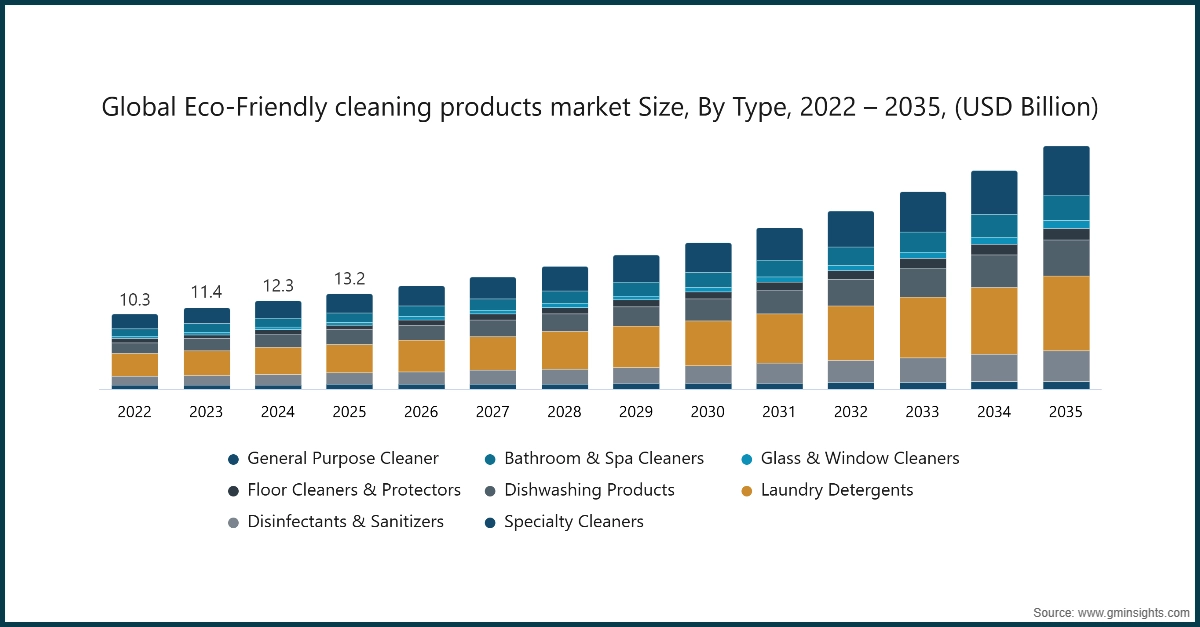
Based on type, the global market is segmented into general purpose cleaners, bathroom & spa cleaners, glass & window cleaners, floor cleaners & protectors, dishwashing products, laundry detergents, disinfectants & sanitizers, and specialty cleaners. The laundry detergents segment held the largest share, accounting for 30.2% of the global market in 2025, driven by high consumption frequency and growing demand for plant‑based, skin‑safe formulations.
- Laundry detergents dominate the market due to their essential daily‑use nature and increasing consumer preference for biodegradable, phosphate‑free, and low‑toxicity formulations that reduce water pollution and skin irritation.
- Rising adoption of eco‑friendly laundry solutions in households, hotels, hospitals, and commercial laundry further strengthens demand, particularly in regions with stringent wastewater and chemical discharge regulations.
- General purpose cleaners benefit from versatility across multiple surfaces, including kitchens, living spaces, and offices, making them a staple product in both residential and commercial settings.
- The dishwashing products segment represented nearly 15% of the market in 2025. Growth in this segment is supported by rising awareness of eco‑friendly formulations that are free from chlorine, phosphates, and synthetic fragrances while remaining effective on grease and food residue.
- Disinfectants & sanitizers accounted for around 12.1% of the global market in 2025. Demand remains strong due to heightened hygiene awareness across households, healthcare facilities, and commercial spaces.
Learn more about the key segments shaping this market
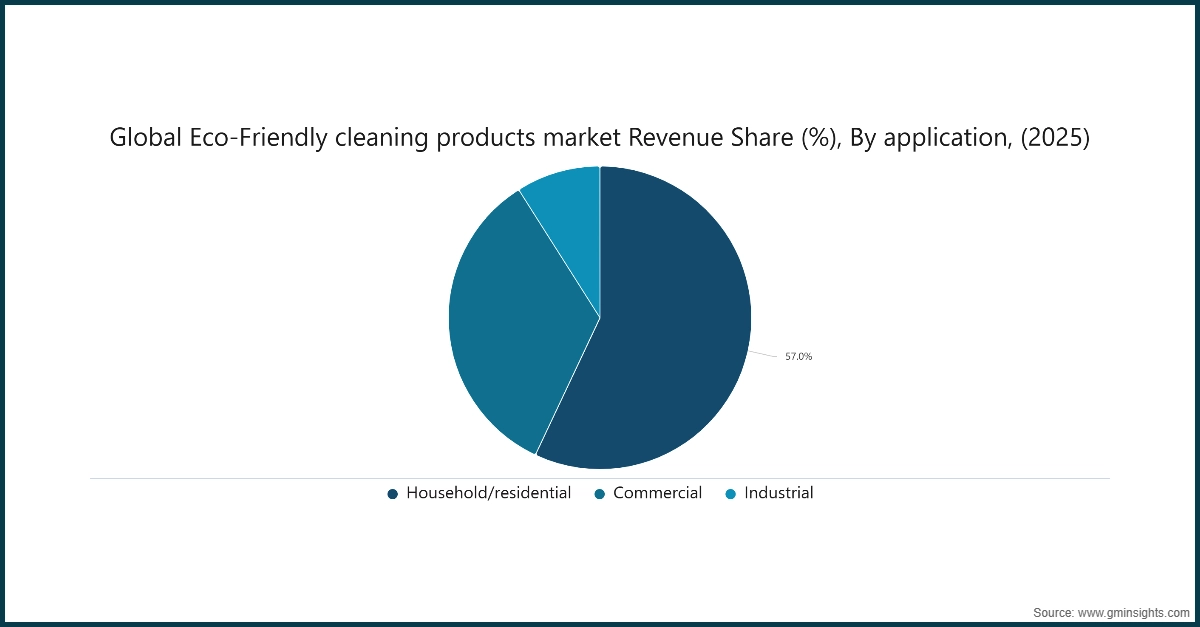
Based on applications, the global eco-friendly cleaning products market is segmented into household/residential, commercial, and industrial applications. The household/residential segment dominated the market, accounting for 57% of the global share in 2025.
- The household segment’s dominance is driven by rising consumer awareness regarding health risks associated with conventional chemical cleaners, particularly in homes with children, elderly individuals, and pets.
- Increasing availability of eco‑friendly products through retail chains and e‑commerce platforms further supports adoption.
- The commercial segment accounted for approximately 34% of the market in 2025. Offices, hotels, educational institutions, retail spaces, and healthcare facilities are increasingly adopting green cleaning programs to meet ESG targets, worker safety standards, and sustainability certifications such as LEED and BREEAM.
- The commercial segment is expected to drive by long‑term supply contracts and standardized eco‑cleaning protocols.
Based on end‑user, the global eco-friendly cleaning products market is segmented into residential consumers, healthcare facilities, educational institutions, government & public sector, commercial real estate, and the food & beverage industry.The residential consumers segment dominated the market, accounting for 60.4% of the global market share in 2025, driven by rising health awareness, frequent product usage, and increasing availability of eco‑friendly cleaning solutions.
- The residential segment benefits from strong demand for non‑toxic, biodegradable, and fragrance‑free cleaning products that reduce exposure to harsh chemicals in everyday household environments.
- Growing penetration of eco‑friendly brands through supermarkets, specialty stores, and e‑commerce platforms has significantly improved accessibility and affordability, accelerating adoption across urban and semi‑urban households.
- Office buildings, retail complexes, hotels, and mixed‑use developments are increasingly adopting eco‑friendly cleaning products to comply with sustainability certifications such as LEED and BREEAM and to support corporate ESG initiatives.
- Demand is driven by the need for safe, low‑VOC products that improve indoor air quality while maintaining cleaning efficiency in high‑traffic areas.
- Hospitals, clinics, and long‑term care facilities require cleaning products that meet strict hygiene standards while minimizing risks to patients and staff from chemical exposure.
Looking for region specific data?
North America Eco-friendly Cleaning Products Market
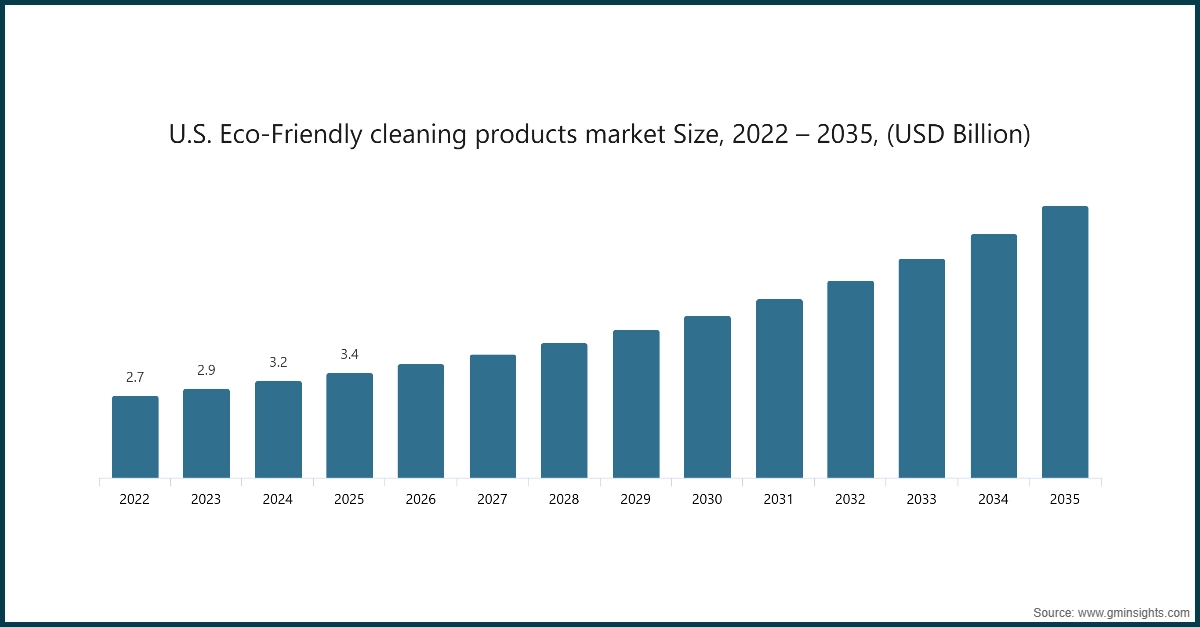
North America is the largest regional market for eco‑friendly cleaning products, accounting for 34% of the global market with USD 4.5 billion in revenue in 2025, and is projected to grow at a CAGR of 10% during 2022 to 2035.
- In 2025, the U.S. dominated the North American market, accounting for 76.8% of regional revenue, equivalent to USD 3.4 billion, and is forecast to grow at a strong CAGR of 10.2%, supported by high consumer awareness and widespread adoption of sustainable household products.
- Market growth is strongly driven by health‑conscious consumer behavior, increasing preference for non‑toxic and biodegradable cleaning solutions, and rising concerns over indoor air quality and chemical exposure.
- The region benefits from strict environmental regulations, strong enforcement of eco‑labeling standards, and corporate ESG mandates that encourage the use of green cleaning products across commercial buildings, healthcare facilities, and educational institutions.
- Rapid expansion of e‑commerce platforms and private‑label eco‑friendly brands further accelerates product accessibility and adoption across both residential and commercial segments.
Europe Eco-friendly Cleaning Products Market
Europe represents the second‑largest regional market, accounting for 29% of global revenue with USD 3.8 billion in 2025 and is expected to grow at a CAGR of 10.2% over the forecast period.
- Germany leads the European market, accounting for 34.5% of regional revenue in 2025, with a robust CAGR of 10.5%, supported by strong consumer preference for certified eco‑labels and sustainable household products.
- The market is driven by stringent EU regulations restricting hazardous chemicals, phosphates, and VOCs in cleaning formulations, accelerating the shift toward biodegradable and plant‑based alternatives.
- Europe has a mature eco‑label ecosystem, including EU Ecolabel and national sustainability certifications, which enhances consumer trust and encourages premium pricing for eco‑friendly products.
- Commercial adoption is expanding rapidly across offices, hospitality, healthcare, and public buildings, supported by sustainability mandates and green procurement policies.
Asia Pacific Eco-friendly Cleaning Products Market Market
Asia Pacific accounted for 24% of the global market with USD 3.2 billion in 2025 and is the fastest‑growing region, projected to expand at a CAGR of 10.8% from 2022 to 2035.
- China dominated the APAC market, holding a 37.7% share of the regional revenue in 2025 and possessing the highest CAGR in the region.
- Market growth is fueled by increasing environmental awareness, government initiatives to reduce water pollution, and rising demand for safer household cleaning products in densely populated urban centers.
- Expanding commercial infrastructure, including offices, retail spaces, hotels, and healthcare facilities, is accelerating adoption of eco‑friendly cleaning solutions across institutional applications.
- E‑commerce growth and increasing penetration of international and domestic eco‑friendly brands are significantly improving product accessibility across emerging Asia Pacific economies.
Latin America Eco-Friendly Cleaning Products Market
Latin America represents a smaller but steadily growing market, accounting for 6% of global revenue with USD 0.8 billion in 2025 and is projected to grow at a CAGR of 8.5%.
- Market growth is supported by gradual improvement in environmental regulations, increasing awareness of sustainable products, and rising urbanization across major economies such as Brazil and Mexico.
- The residential segment dominates demand, while commercial adoption remains moderate due to price sensitivity and limited availability of certified eco‑friendly products.
- Growth opportunities exist through local manufacturing, private‑label brands, and affordable concentrated formulations tailored to price‑conscious consumers.
Eco-friendly Cleaning Products Market Share
Procter & Gamble is leading with 6% market share. Procter & Gamble, Unilever, Henkel, Reckitt Benckiser and Ecolab collectively hold around 26%, indicating moderately fragmented market concentration. These prominent players are proactively involved in strategic endeavors, such as mergers & acquisitions, facility expansions & collaborations, to expand their product portfolios, extend their reach to a broad customer base, and strengthen their market position.
Seventh Generation expanded its product portfolio through increased investment in plant‑based chemistry and biodegradable formulations, strengthening its presence beyond household cleaners into high‑growth adjacent segments such as institutional, healthcare, and commercial cleaning. This strategic move enhances the company’s positioning in premium eco‑certified cleaning solutions while deepening its expertise in non‑toxic disinfectants, enzyme‑based cleaners, and sustainable packaging.
Procter & Gamble announced a strategic consolidation and rebranding of its sustainable cleaning product lines under a unified eco‑focused portfolio. This initiative strengthens P&G’s commitment to sustainability and circular economy principles by making its green product offerings more recognizable and accessible to consumers and commercial buyers. The streamlined branding, combined with investments in concentrated formulations, recyclable packaging, and digital consumer engagement platforms, supports easier adoption of eco‑friendly cleaning products while improving supply‑chain efficiency and ESG reporting transparency.
Eco-friendly Cleaning Products Market Companies
Major players operating in the eco-friendly cleaning products industry are:
- BASF SE
- Biokleen
- Church & Dwight Co., Inc.
- Croda International PLC
- Diamond Wipes International, Inc.
- Diversey, Inc.
- Earth Friendly Products
- Ecolab Inc.
- Ecover
- Evonik Industries AG
- Henkel AG & Co. KGaA
- Novozymes A/S (Novonesis)
- Procter & Gamble
- Reckitt Benckiser Group PLC
- Seventh Generation
- Spartan Chemical Company, Inc.
- Unilever
Unilever made a pivotal portfolio‑level strategic shift by expanding its sustainable and eco‑certified cleaning brands across both consumer and professional segments.This moves significantly strengthened Unilever’s capabilities in plant‑based chemistry, biodegradable surfactants, and low‑carbon manufacturing, enabling the company to accelerate innovation in household, institutional, and commercial cleaning applications. The strategy directly addresses growing regulatory pressure and ESG‑driven procurement requirements, positioning Unilever as a single‑source supplier of scalable, eco‑friendly cleaning solutions across global markets.
Ecover entered into a strategic collaboration with sustainable packaging suppliers to advance refillable and low‑plastic cleaning product formats. This partnership focuses on co‑developing refill stations, concentrated solutions, and fully recyclable packaging materials to reduce plastic waste and lifecycle emissions.
Eco-friendly Cleaning Products Market Report Attributes
| Key Takeaway | Details |
|---|---|
| Market Size & Growth | |
| Base Year | 2025 |
| Market Size in 2025 | USD 13.2 Billion |
| Market Size in 2026 | USD 14.3 Billion |
| Forecast Period 2026-2035 CAGR | 10% |
| Market Size in 2035 | USD 33.6 Billion |
| Key Market Trends | |
| Drivers | Impact |
| Rising consumer demand for sustainable & non toxic products | Shifts purchasing behavior toward plant based, biodegradable, and chemical free cleaning formulations. Increased demand is driven by health awareness, indoor air quality concerns, and preference for products safe for children and pets |
| Stringent environmental regulations & eco label adoption | It accelerates adoption of certified eco‑friendly cleaning products across residential, commercial, and institutional sectors. Regulations restricting phosphates, VOCs, and hazardous surfactants push manufacturers to reformulate products and invest in compliant alternatives |
| Growth of commercial & institutional green cleaning programs | Hospitals, schools, offices, hospitality, and food service facilities increasingly adopt eco friendly cleaning solutions to meet ESG targets, worker safety standards, and sustainability certifications such as LEED and BREEAM. |
| Pitfalls & Challenges | Impact |
| Higher production costs & raw material price volatility | Bio based surfactants, essential oils, and enzyme formulations are more expensive than conventional petrochemical ingredients, impacting margins and limiting price competitiveness—especially in price sensitive markets. |
| Performance perception & consumer skepticism | Despite technological improvements, some consumers and commercial buyers still perceive eco friendly cleaners as less effective than traditional chemical products, slowing adoption in high demand sanitation environments. |
| Opportunities: | Impact |
| Concentrated, refill & low waste product formats | Creates new revenue streams through reduced packaging, lower transportation costs, and improved sustainability metrics. Refill stations, dissolvable tablets, and concentrated solutions significantly reduce plastic waste and carbon footprint. |
| Corporate ESG commitments & green procurement policies | Large enterprises and public institutions are mandating eco certified cleaning products, creating long term, contract based demand. This trend strongly supports premium pricing and brand loyalty for certified manufacturers. |
| Market Leaders (2025) | |
| Market Leader |
6% market share |
| Top Players |
Consolidate share of 26% |
| Competitive Edge |
|
| Regional Insights | |
| Largest Market | North America |
| Fastest growing market | Asia Pacific |
| Emerging countries | Mexico, Canada, India |
| Future outlook |
|
What are the growth opportunities in this market?
Eco‑friendly Cleaning Products Industry News
- In December 2024, Seventh Generation launched an expanded range of plant‑based disinfectants for commercial and institutional use.The new product line is designed to meet stringent hygiene requirements in healthcare facilities, schools, and office buildings while avoiding chlorine, ammonia, and synthetic fragrances. This launch reflects the growing demand for high‑efficacy, non‑toxic disinfectants that support green cleaning programs and indoor air quality standards.
- In January 2025, Procter & Gamble announced the expansion of its refillable and concentrated eco‑friendly cleaning product formats across North American and European retail chains. The initiative aims to significantly reduce single‑use plastic packaging and transportation emissions, while offering consumers cost‑effective sustainable alternatives. This moves underscores P&G’s broader commitment to circular economy practices and ESG performance improvement.
- In March 2025, Method Products introduced a new generation of enzyme‑based multi‑surface cleaners optimized for cold‑water and low‑rinse applications. The product innovation enables effective cleaning with reduced water and energy consumption, making it particularly attractive for commercial facilities and hospitality operators seeking to lower operational costs while meeting sustainability targets.
- In June 2025, ECOS expanded its manufacturing operations with investments in renewable energy and water‑efficient production systems. The facility upgrade focuses on reducing carbon emissions, improving resource efficiency, and increasing production capacity to meet rising demand for eco‑certified laundry detergents and dishwashing products across North America and Asia‑Pacific.
- In August 2025, Ecover partnered with large retail chains to roll out in‑store refill stations across major urban centers in Europe. This initiative allows consumers to refill existing bottles for laundry detergents and surface cleaners, significantly reducing plastic waste and strengthening consumer engagement with sustainable purchasing models.
- In November 2025, multiple global eco‑friendly cleaning brands showcased innovations in biodegradable formulations and zero‑waste packaging at international sustainability and consumer goods expos. These developments highlight the industry’s continued focus on formulation transparency, lifecycle sustainability, and performance parity with conventional chemical cleaning products.
The Eco-friendly Cleaning Products market research report includes in-depth coverage of the industry with estimates & forecasts in terms of revenue (USD Billion) and volume (Thousand Units) from 2022 to 2035, for the following segments:
Market, By Type
- General purpose cleaner
- Multi-surface household cleaners
- Commercial all-purpose cleaners
- Bathroom & spa cleaners
- tub & tile cleaners
- Toilet bowl cleaner
- Shower & glass cleaners
- Glass & window cleaners
- Residential glass cleaners
- Commercial window cleaning solutions
- Automotive glass cleaners
- Floor cleaners & protectors
- Hard surface floor cleaners
- Carpet & upholstery cleaners
- Floor protectors & finishes
- Dishwashing products
- Manual dishwashing liquids
- Automatic dishwasher detergents
- Rinse aids & additives
- Laundry detergents
- General purpose laundry products
- Concentrated liquid detergents
- Powder & Pod formulations
- Fabric softeners & conditioners
- Disinfectants & sanitizers
- EPA DFE certified antimicrobial products
- Hand sanitizers & personal care
- Surface disinfectants
- Specialty cleaners
- Oven & grill cleaners
- Metal cleaners & polishes
- Carpet & upholstery cleaners
- Drain maintenance products
Market, By Application
- Household/residential
- Commercial
- Industrial
Market, By Price Range
- Low
- Mid
- High
Market, By Distribution Channel
- Online
- E-commerce websites
- Company-owned websites
- Offline
- Supermarket/hyper market
- Retailer stores
- Others
The above information is provided for the following regions and countries:
- North America
- U.S.
- Canada
- Europe
- Germany
- UK
- France
- Italy
- Spain
- Asia Pacific
- China
- India
- Japan
- Australia
- South Korea
- Latin America
- Brazil
- Mexico
- Argentina
- Middle East and Africa
- South Africa
- Saudi Arabia
- UAE
Frequently Asked Question(FAQ) :
What is the market size of the eco-friendly cleaning products market in 2025?
The market size for eco-friendly cleaning products was valued at USD 13.2 billion in 2025, driven by rising consumer health awareness, and increasing adoption of plant-based.
What is the projected value of the eco-friendly cleaning products market by 2035?
The market is expected to reach USD 33.6 billion by 2035, growing at a CAGR of 10.0%, supported by ESG mandates, and expanding commercial adoption.
What will be the eco-friendly cleaning products industry size in 2026?
The market is projected to grow to USD 14.3 billion in 2026, reflecting strong demand for concentrated, and non-toxic cleaning solutions across residential and commercial sectors.
Which type segment held the largest share in 2025?
The laundry detergents segment led the market, accounting for 30.2% of the global share in 2025, supported by high usage frequency and growing preference for biodegradable.
How much share did the dishwashing products segment account for in 2025?
The dishwashing products segment represented approximately 15.0% of the global market in 2025, driven by increasing demand for chlorine-free.
Which application segment dominated the market in 2025?
The household/residential segment dominated the market with 57% of the global share in 2025, driven by increasing health consciousness.
Which region leads the eco-friendly cleaning products market?
North America is the largest regional market, accounting for 34% of global revenue with USD 4.5 billion in 2025, driven by strong environmental regulations, and widespread ESG adoption.
Who are the key players in the eco-friendly cleaning products market?
Key players include Procter & Gamble, Unilever, Henkel AG & Co. KGaA, Reckitt Benckiser, Ecolab Inc., BASF SE, Seventh Generation, Ecover, Diversey, Inc., and Novozymes A/S (Novonesis).
Eco-friendly Cleaning Products Market Scope
Related Reports