Summary
Table of Content

e-Corner System Market
Get a free sample of this report
Form submitted successfully!
Error submitting form. Please try again.
Thank you!
Your inquiry has been received. Our team will reach out to you with the required details via email. To ensure that you don't miss their response, kindly remember to check your spam folder as well!
Request Sectional Data
Thank you!
Your inquiry has been received. Our team will reach out to you with the required details via email. To ensure that you don't miss their response, kindly remember to check your spam folder as well!
Form submitted successfully!
Error submitting form. Please try again.
e-Corner System Market Size
The growing adoption of electric vehicles (EVs) across the globe is one of the major driver of the market, as this system is ideal for EV architectures. Implementing electric propulsion, braking and steering, and suspension into singular wheel modules allows automotive builders to augment vehicle efficacy, simplify mechanical systems, and improve space utilization.
e-Corner System Market Key Takeaways
Market Size & Growth
- 2025 Market Size: USD 305.9 Million
- 2026 Market Size: USD 416 Million
- 2035 Forecast Market Size: USD 5.3 Billion
- CAGR (2026–2035): 32.7%
Regional Dominance
- Largest Market: Asia Pacific
- Fastest Growing Region: Asia Pacific
Key Market Drivers
- Growing demand for enhanced vehicle maneuverability and advanced parking solutions.
- Rising adoption of autonomous and electric vehicles integrating steer-by-wire and brake-by-wire technologies.
- Increasing focus on vehicle safety, stability, and dynamic control.
- Advancements in in-wheel motor technology and modular e-corner architectures.
Challenges
- High development and integration costs.
- Regulatory and standardization challenges.
Opportunity
- Expansion of Electric Vehicle (EV) Adoption Worldwide.
- Growing Demand for Autonomous and Smart Mobility Solutions.
Key Players
- Market Leader: Elaphe Propulsion Technologies led with over 14% market share in 2025.
- Leading Players: Top 5 players in this market include Elaphe Propulsion Technologies, Continental, REE Automotive, Schaeffler, Hyundai Mobis, which collectively held a market share of 34% in 2025.
Get Market Insights & Growth Opportunities
In addition, the increase focus toward maneuverability of vehicles drives the growth of the market. With these innovative technologies, vehicles can execute precise maneuvers and rotate the chassis in 360 degrees and perform split and lateral movement. The increasing traffic in urban areas and the shortage of parking spots will fuel the demand for cars with e-corner technology. Bengaluru and Pune account for 34 mins 10 seconds and 33 minutes and 22 seconds average travel time respectively for every 10 kilometers. TomTom's numbers indicate that with rapidly urbanizing regions such as Pune and Bangalore, traffic congestion is ever growing problem. The principle aim of e-corner is to increase the efficiency of driving, reduce accidents and damage to parked vehicles hence, fulfilling the needs of urban cities.
Dynamic torque vectoring, adaptive control of the suspension, and modernized braking parts give the E-corner system the advantages of improving control over the car while ensuring maximum stability and optimal traction with the ground in every possible driving condition. Moreover, these systems minimize skidding and maximize vehicle handling by redistributing power to each wheel in real-time. Thus, manufacturers are likely to focus on these systems in the forecast years in order to comply with safety regulations and ultimately improve safety on the roads.
The global e-Corner system market was valued at USD 305.9 million in 2025. The market is expected to grow from USD 416 million in 2026 to USD 5.3 billion in 2035 at a CAGR of 32.7%, according to latest report published by Global Market Insights Inc.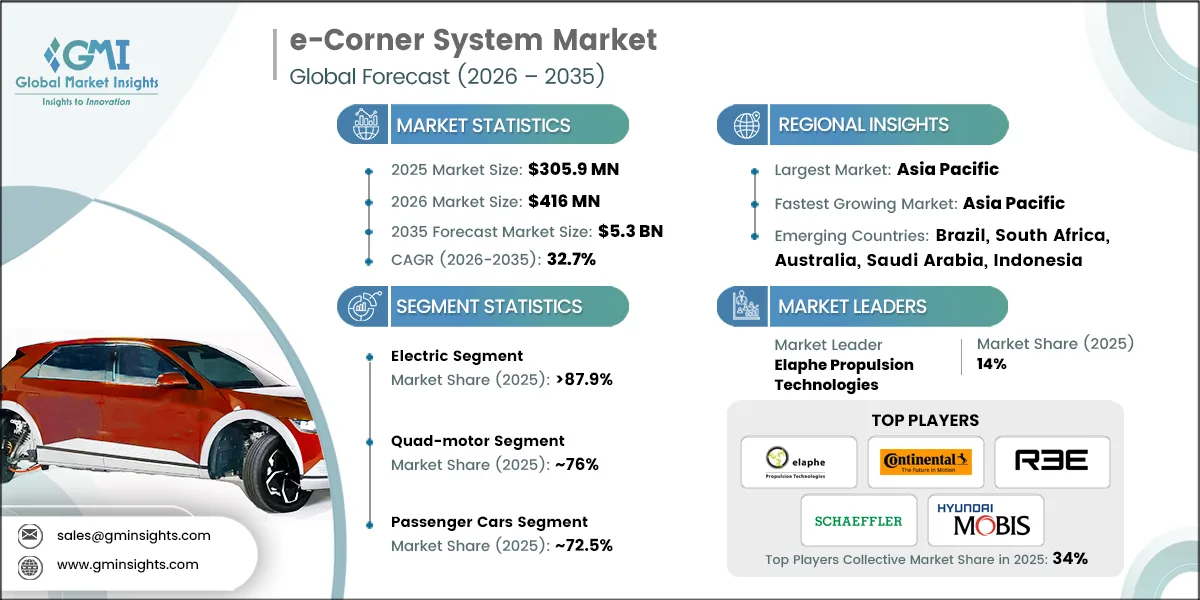
To get key market trends
e-Corner System Market Trends
The introduction of innovations such as steer-by-wire and brake-by-wire is greatly changing vehicle control systems. These used to rely on mechanical linkages but are being controlled electronically which improves vehicle responsiveness, decreases maintenance needs, and enables more compact structures. Automakers integrating these advancements into e-corner modules can design more flexible and modular platforms which helps in the faster progression of the mobility industry with solutions reaching from autonomous vehicles to electric fleets and shared mobility services.
The market is witnessing the launch of EVs with the new e-corner system. For instance, in January 2024, Hyundai Mobis launched the ‘MOBION’ electric vehicle equipped with e-Corner system technology at CES 2024. To enable sideways movement, diagonal driving, and pivot turns, MOBION's four wheels are individually controlled. The e-Corner System translates these dynamic movements into reality, comprises four key technologies. At its core is the "In-Wheel" technology, which literally propels the EV forward.
As autonomous driving technology advances, the adoption of e-corner systems is propelling forward due to their complete control over steering, braking and suspension which are vital for driving in urban settings. These systems facilitate precise e-parking, lane changes and obstacle evasion by allowing wheels to turn independently.
E-corner systems incorporate modern features like steer-by-wire, brake-by-wire, and other sophisticated sensors. These innovations raise the costs associated with the initial development and manufacture which makes it unaffordable. Additionally, the inclusion of e-corner systems increases the cost of automobiles which leads to low demand by consumers, thus stunting the growth of the market, particularly in sensitive regions.
The integration of e‑corner systems enables enhanced maneuverability in advanced concept vehicles and next‑generation mobility platforms, supporting urban parking, lateral driving, and pivoting movements that improve traffic flow and reduce congestion in dense cities.
In the 2025 Seoul Mobility Show, Hyundai Mobis showcased its MOBION demonstrator vehicle equipped with a next‑generation e‑Corner System, featuring independently controllable wheel modules that allow diagonal, pivot, and parallel movements, highlighting how automakers are applying e‑Corner technology in future mobility concepts.
e-Corner System Market Analysis
Learn more about the key segments shaping this market
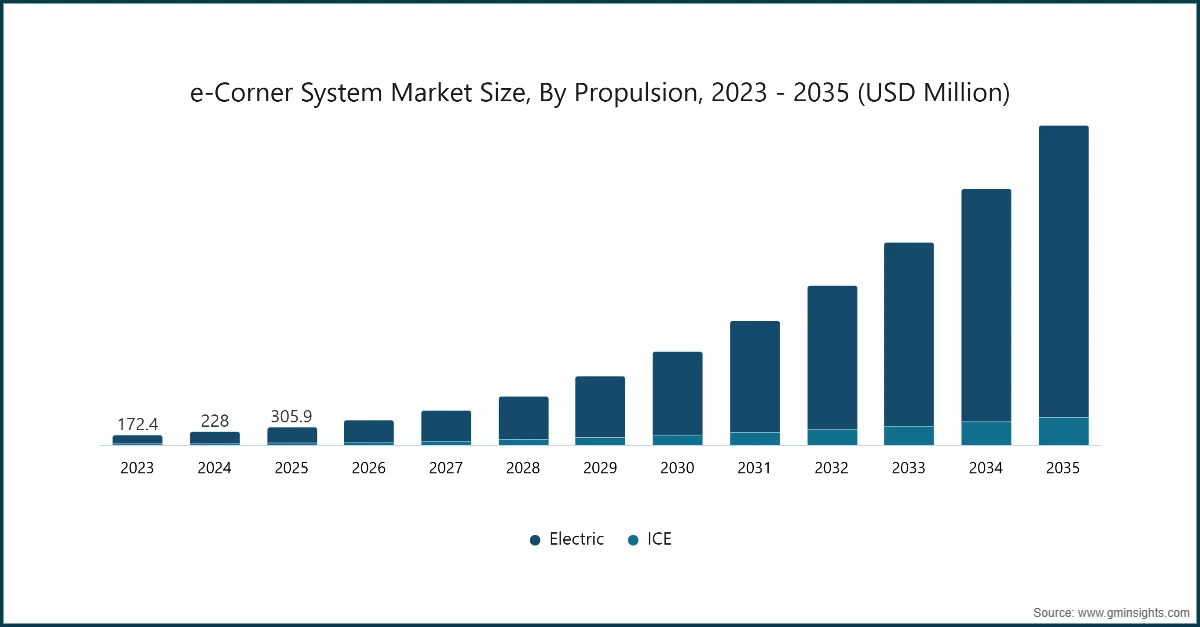
Based on propulsion, the market is divided into electric and ICE. In 2025, the electric segment held a market share of over 87.9% and is expected to cross USD 4.8 billion by 2035.
- The global shift towards electric mobility, driven by the need to reduce emissions, is also a key factor for the e-corner system market. Motors of electric vehicles (EVs) make use of e-corner systems as the systems enable accurate propulsion, control, and handling, which are critical for any EV's performance.
- The increasing sales of BEVs across the globe is contributing to the demand for e-corner technologies. Additionally, increased focus on sustainability and emission regulations is also contributing to the adoption of electric cars equipped with e-corner systems.
- Advancements in electric powertrain technology and in-wheel motors are enabling more compact, efficient, and high-performance e-corner systems, making them increasingly attractive for EV manufacturers seeking to improve energy efficiency, vehicle handling, and overall driving experience.
- In March 2025, Tesla incorporated advanced in-wheel motor e‑Corner prototypes in its new Model S Plaid refresh, demonstrating improved torque vectoring, tighter turning radius, and enhanced stability for high-performance EV driving.
Learn more about the key segments shaping this market
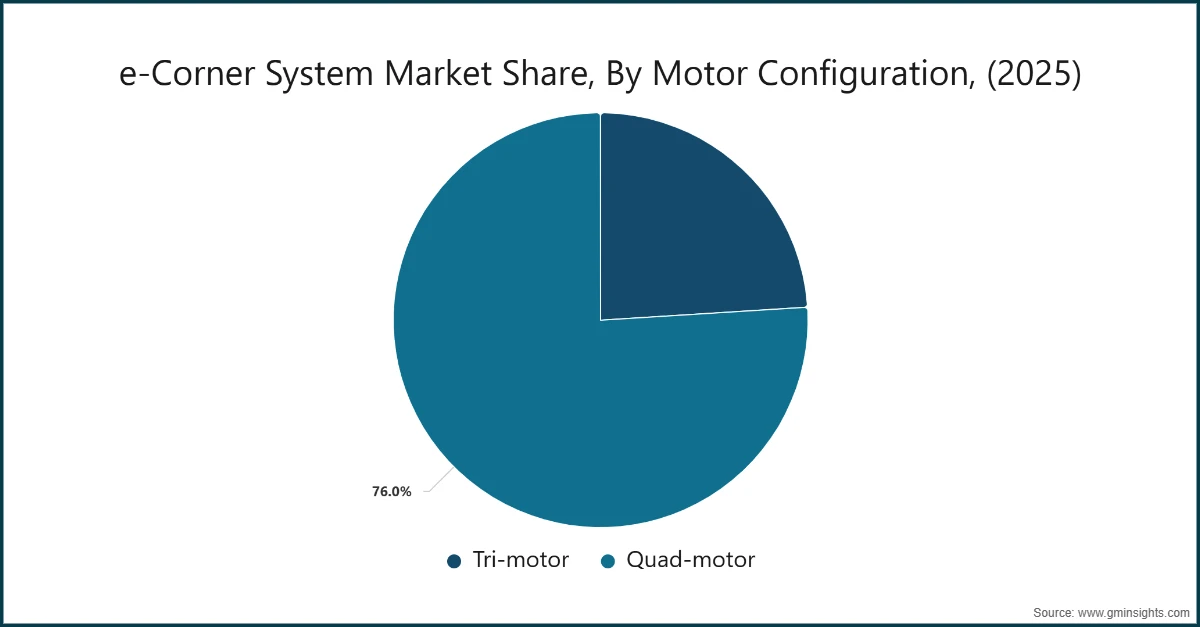
Based on motor configuration, the e-Corner system market is categorized into tri-motor and quad-motor. The quad-motor segment held a market share of around 76% in 2025.
- The aid of e-corner systems are improved with the combination of tri-motor set-ups, as these configurations allow for more precise control over each wheel’s torque, which also improves the vehicle’s handling and stability during complicated maneuvers.
- With help from e-corner systems, power distribution can be balance and efficient. Enhanced power distribution is employed effectively which is the most sought out feature for automakers and consumers.
- To optimize power consumption and range for EVs with e-corner systems , a tri-motor configuration is most ideal. The additional rotors help manage energy more efficiently, ensuring that the system is sustained during high demanding driving situations such as sharp turns.
- Quad-motor configurations paired with e-corner systems enable advanced torque vectoring, allowing each wheel to respond independently to road conditions. This improves traction, stability, and handling on slippery or uneven surfaces, which is particularly beneficial for high-performance EVs and off-road capable vehicles.
- E-corner systems integrated with quad-motor setups support regenerative braking at each wheel, maximizing energy recovery and extending the driving range. This makes EVs more efficient while maintaining precise control during deceleration and emergency braking scenarios.
Based on vehicle, the e-Corner system market is segmented into passenger cars and commercial vehicles. The passenger cars segment held a market share of around 72.5% in 2025.
- The growing demand for maneuverable vehicles, majorly in urban areas is expected to increase the integration of e-corner systems in passenger cars. These systems allows vehicles to perform 360-degree turns, perform better parking, and navigate through congested streets and tight parking areas.
- With the evolution of safety guidelines and expectations from consumers, car manufacturers are focused on improving the control and stability of passenger cars.
- E-corner systems help by allowing the flexible distribution of power, which enhances cornering performance and minimizes skidding. These characteristics support the growing phenomena of advanced safety technology incorporation into passenger vehicles, thus increasing the demand for e-corner systems.
Based on technology, the e-Corner system market is segmented into hydraulic, electric and others. The electric segment held a market share of around 72.9% in 2025.
- Electric e-corner systems are integrated into lightweight vehicles such as small and electric passenger cars. These systems increase energy efficiency and improve precision of torque control along with the ever increasing expectation for electric mobility which requires extreme energy performance.
- Modern electric vehicles are easier to maneuver owing to the innovative Electric e-Corner systems, which integrate seamlessly into contemporary electric powertrains. The improved performance and safety features offered by e-Corner systems contributes to their increasing appeal.
- Electric e-Corner systems support advanced driver-assistance and autonomous driving features, enabling independent wheel control, precise torque distribution, and enhanced vehicle stability key factors in next-generation smart mobility solutions.
Looking for region specific data?
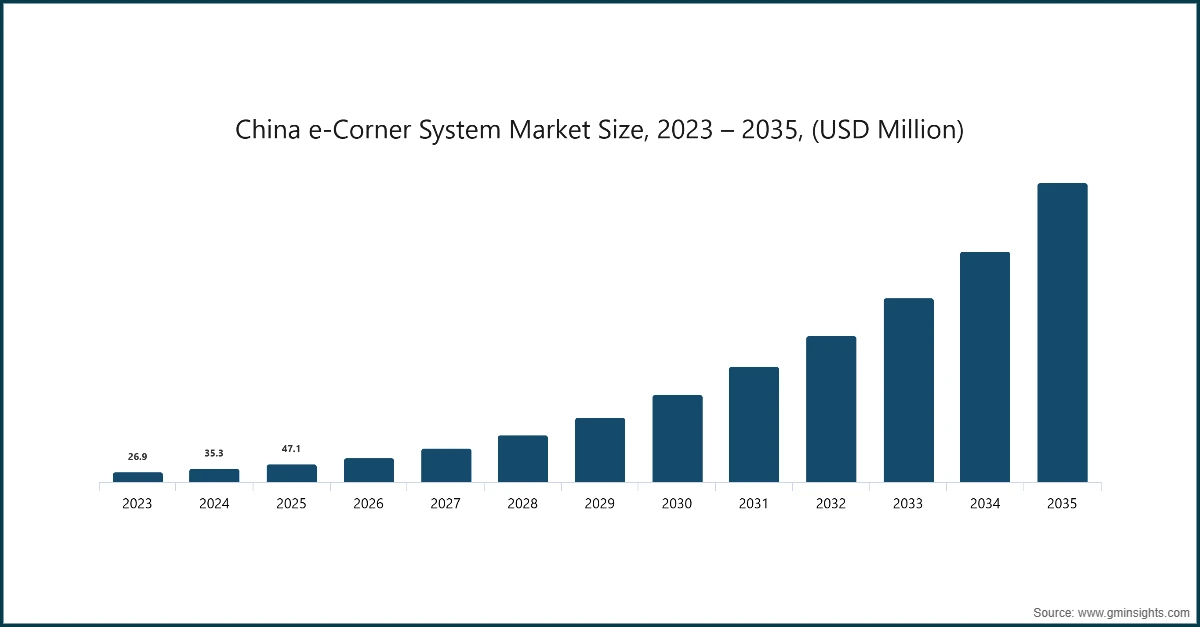
Asia Pacific dominated the e-Corner system market with a major share of around 38.2% in 2025 and China leads the market in the region.
- There is a growing need for highly maneuverable vehicles in regions such as India, South Korea, and Japan due to rapid urbanization. As experienced with E-corner systems, independent wheel control enables lateral movement alongside 360 degree turns. Such features elicit enhanced vehicle handling and mobility in congested cities, making them prime candidates for future mobility solutions such as compact EVs and autonomous vehicles.
- China is the largest EV producer with its major automobile manufacturers such as BYD, NIO, and XPeng leading the industry. The emerging EV market needs advanced vehicle technology. This means that energy efficiency, stability, and driving performance all need improvement through e-corner systems.
- The increasing competition amongst the Chinese automakers is enabling the development of modern vehicle control systems which enhances system differentiation and complimenting the primary demand for e-corner solutions.
- Japan is emphasizing innovation in next-generation EVs and autonomous mobility platforms, with companies like Toyota and Honda investing heavily in advanced vehicle control technologies. The adoption of e-corner systems in these vehicles enhances safety, precision handling, and compact design, supporting both urban mobility and high-tech autonomous vehicle initiatives.
- South Korea’s growing electric and smart vehicle industry, led by Hyundai and Kia, is driving the integration of e-corner systems to meet consumer expectations for advanced maneuverability and energy efficiency. These systems help vehicles navigate congested urban environments while enabling futuristic mobility solutions such as automated valet parking and autonomous last-mile transport.
The e-Corner system market in U.S. is expected to experience significant and promising growth from 2026 to 2035 with CAGR 32.5%.
- The shift to autonomously controlled vehicles as well as electric and smart transport systems has seen increased investment in the mobility sector in the U.S. As with many other factors, Tesla, Rivian, and GM are spending on vehicle control technologies which enhance strength of e-corner systems, maneuverability, and safety.
- E-Corner systems satisfy the self-parking feature in modern electric vehicles, making them highly desirable alongside automated lane changes and precise movement.
- The growing adoption of electric and autonomous vehicles in the U.S. is driving OEMs to integrate advanced e-corner systems for improved stability, handling, and energy efficiency. Companies like Lucid Motors and Fisker are leveraging these technologies to differentiate their EV models in a competitive market.
- Increasing urban congestion and demand for compact, maneuverable vehicles are encouraging U.S. automakers to adopt e-corner systems. These systems enable features such as diagonal driving, 360-degree rotation, and enhanced parking capabilities, aligning with the push for smart and flexible mobility solutions.
The e-Corner system market in Germany is anticipated to witness lucrative growth between 2026 - 2035.
- Germany has presence of some of the famous car makers in the world that include BMW, Mercedes-Benz, and Volkswagen which puts a lot of resource into new vehicle technologies. The need for sophisticated luxury and high-performance automobiles with sophisticated handling features is driving the adoption of e-corner systems.
- Germany has some of the most rigorous vehicle safety and efficiency standards in the world. E-corner systems enhances vehicle dynamics performance, vehicle stability, increased tire life, and more efficient braking which makes them an attractive add on for automakers seeking ways to comply with the strict EU safety norms.
- The increasing focus on electric mobility and autonomous driving in Germany is encouraging automakers to integrate e-corner systems into next-generation EVs. Companies like Audi and Porsche are investing in these technologies to improve maneuverability, energy efficiency, and overall driving experience.
- German urban centers face high traffic density and limited parking spaces, making advanced e-corner systems highly valuable. Features such as precise steering, lateral movement, and 360-degree rotation enhance vehicle handling in congested areas, supporting smart city mobility initiatives.
The e-Corner system market in Mexico is expected to experience significant and promising growth from 2026 to 2035.
- Mexico is becoming a central place for automotive production as many international car manufacturers are setting up their plants in this region. For instance, in June 2024, BYD announced it would build a factory in Mexico. The factory will supply the Mexican and Latin American markets. With newer EVs coming out and an increase in exports, car manufacturers adopting e-corner systems will enhance mobility and vehicle performance.
- The need to develop and manufacture advanced vehicles is expected to create demand for e-corner solutions for vehicles in the region.
- Government initiatives and incentives to promote electric mobility in Mexico are expected to accelerate the adoption of e-corner systems, as policies supporting EV manufacturing, charging infrastructure, and green transportation encourage automakers to integrate advanced wheel technologies into their vehicles.
e-Corner System Market Share
- The top 7companies in the market are Hyundai, Continental, ZF Friedrichshafen, Protean Electric, Schaeffler Group, Elaphe Propulsion Technologies, REE Automotive hold a market share of over 81.6% in the market.
- Hyundai is developing fully modular wheel systems aimed at enhancing vehicle maneuverability, including self-parking, sideways driving, and tight turning. The company is integrating e-corner modules into urban mobility solutions such as robo-taxis and shared autonomous fleets, showcasing prototypes in the Ioniq and future EV platforms. Investments in smart mobility and modular electric architectures are accelerating the adoption of e-corner technology across Hyundai’s next-generation electric vehicles.
- Continental focuses on creating highly integrated e-corner modules that combine electric drive, braking, and steering in a compact form factor for passenger and commercial vehicles. Its scalable, energy-efficient wheel hub motors enable precise torque vectoring, improved vehicle stability, and support for advanced driver-assistance systems (ADAS), reinforcing Continental’s leadership in modular EV propulsion technology.
- ZF leverages its expertise in chassis, driveline, and electric drive systems to advance intelligent e-corner solutions. Its modular wheel hubs integrate propulsion, steering, and braking, allowing for precise torque control, enhanced safety, and seamless integration into autonomous and electric mobility platforms, positioning ZF at the forefront of next-generation EV wheel technology.
- Schaeffler develops e-corner systems with a focus on lightweight, high-efficiency electric wheel modules that improve torque distribution and vehicle dynamics. The company emphasizes integration with electric powertrains to support energy-efficient urban mobility and autonomous driving applications, while leveraging its extensive experience in precision automotive components.
- Protean Electric specializes in in-wheel motor solutions, creating compact and high-torque e-corner systems that combine drive, braking, and steering capabilities. Its technology is designed to enhance vehicle efficiency, enable precise torque vectoring, and support electrification across passenger vehicles, commercial fleets, and emerging mobility platforms.
- Elaphe focuses on integrating high-torque, compact wheel motors into direct-drive in-wheel systems for e-corner applications. Its solutions deliver precise torque vectoring, adaptive braking, and improved vehicle dynamics, enabling lightweight and energy-efficient electric mobility while supporting modular EV architectures and advanced driver-assistance functionalities.
- REE Automotive commercializes its fully modular REEcorner platform, which integrates steering, braking, suspension, and powertrain directly into the wheel arches. Targeted at electric commercial vehicles, autonomous shuttles, and delivery fleets, the system allows flexible, scalable, and space-efficient vehicle designs while improving performance, safety, and maintainability.
e-Corner System Market Companies
Major players operating in the e-Corner system industry include:
- Hyundai
- Continental
- ZF Friedrichshafen
- Schaeffler
- Protean Electric
- Elaphe Propulsion Technologies
- REE Automotive
- BorgWarner Drive Systems
- Dana
The e-corner system market is highly competitive, driven by the automotive industry’s focus on electrification, advanced mobility, and vehicle maneuverability. Leading players like Hyundai, Continental, and ZF Friedrichshafen are developing fully integrated wheel modules that combine steering, braking, and propulsion to enhance energy efficiency, torque control, and safety across passenger and commercial vehicles. These companies leverage modular and scalable technologies to support electric and autonomous mobility platforms.
Companies such as Schaeffler Group and Protean Electric provide lightweight, high-torque in-wheel motor solutions that enable precise torque vectoring, adaptive braking, and improved vehicle dynamics. Their innovations help OEMs design energy-efficient, high-performance electric vehicles while supporting advanced driver-assistance and autonomous driving capabilities.
Elaphe Propulsion Technologies and REE Automotive contribute with highly modular platforms, integrating steering, braking, suspension, and powertrain directly into wheel arches. REE’s REEcorner platform targets commercial electric fleets, autonomous shuttles, and delivery vehicles, while Elaphe focuses on compact, direct-drive wheel motors that improve torque distribution and vehicle agility.
Together, these companies create a diverse and dynamic e-Corner system ecosystem, offering solutions for electric passenger cars, commercial EVs, and next-generation autonomous mobility platforms across global markets. Their combined innovations are driving the growth, adoption, and technological advancement of e-Corner systems worldwide.
Strategic collaborations between automotive OEMs, technology providers, and mobility service companies are accelerating innovation in e-Corner solutions. Joint efforts on testing, software integration, and production scaling help bring advanced steering, braking, and propulsion technologies to market faster, enhancing vehicle performance and maneuverability for next-generation electric and autonomous fleets.
For instance, in 2025, Elaphe Propulsion Technologies partnered with a European electric bus manufacturer to integrate its compact in-wheel motors into a new autonomous shuttle fleet. This collaboration enabled precise torque control, enhanced maneuverability, and reduced vehicle weight, demonstrating the practical benefits of e-Corner technology in commercial autonomous transport.
e-Corner System Market Report Attributes
| Key Takeaway | Details |
|---|---|
| Market Size & Growth | |
| Base Year | 2025 |
| Market Size in 2025 | USD 305.9 Million |
| Market Size in 2026 | USD 416 Million |
| Forecast Period 2026-2035 CAGR | 32.7% |
| Market Size in 2035 | USD 5.3 Billion |
| Key Market Trends | |
| Drivers | Impact |
| Growing demand for enhanced vehicle maneuverability and advanced parking solutions | Increasing urban congestion and demand for compact mobility solutions drive adoption of e-corner systems that enable crab walking, zero turns, and improved parking flexibility. |
| Rising adoption of autonomous and electric vehicles integrating steer-by-wire and brake-by-wire technologies | EV and autonomous vehicle platforms rely on electronic control systems, making e-corner modules highly compatible and accelerating integration across next-generation vehicles. |
| Increasing focus on vehicle safety, stability, and dynamic control | Advanced torque vectoring, adaptive braking, and independent wheel control enhance vehicle stability and safety, supporting wider adoption of e-corner technologies. |
| Advancements in in-wheel motor technology and modular e-corner architectures | Continuous innovation in compact, lightweight, and high-torque in-wheel motors improves efficiency, scalability, and OEM integration capabilities. |
| Pitfalls & Challenges | Impact |
| High development and integration costs | Complex integration of steering, braking, suspension, and propulsion into a single wheel module increases R&D expenses and vehicle production costs. |
| Regulatory and standardization challenges | Variations in vehicle safety regulations and certification requirements across regions may slow commercialization and large-scale deployment. |
| Opportunities: | Impact |
| Expansion of Electric Vehicle (EV) Adoption Worldwide | Growing global EV production creates a larger addressable market for modular e-corner systems integrated into electric platforms. |
| Growing Demand for Autonomous and Smart Mobility Solutions | Robo-taxis, shared mobility fleets, and autonomous shuttles benefit from enhanced maneuverability and precise wheel control offered by e-corner systems. |
| Market Leaders (2025) | |
| Market Leader |
14% market share |
| Top Players |
Collective market share in 2025 is 34% |
| Competitive Edge |
|
| Regional Insights | |
| Largest Market | Asia Pacific |
| Fastest growing market | Asia Pacific |
| Emerging countries | Brazil, South Africa, Australia, Saudi Arabia, Indonesia |
| Future outlook |
|
What are the growth opportunities in this market?
The increasing emphasis on software-defined vehicles and advanced vehicle control systems is expected to support the adoption of e-Corner technologies in the coming years. Automakers are integrating sophisticated electronic control units, sensors, and AI-driven control algorithms to enable precise coordination between propulsion, steering, braking, and suspension systems at each wheel. This integration enhances vehicle responsiveness, supports advanced driver-assistance systems (ADAS), and enables new mobility concepts such as autonomous vehicles and smart urban transport solutions. As automotive manufacturers continue to invest in next-generation electric vehicle platforms, the demand for integrated wheel-based systems such as e-Corner is anticipated to grow steadily.
e-Corner System Industry News
In June of 2024, UK-based Protean launched their next generation in-wheel motor. With improved performance, scalability, and affordability, this new technology is set to greatly aid businesses in their efforts to convert vehicles into electric power. The system provides a full range of wheel sizes, torque, and power options. Moreover, it includes both integrated and standalone inverters. 400V products are available now, while the 800V versions expected by the end of 2024 would enable more power and faster charging.
In September 2025, Protean Electric showcased its in-wheel motor solution with cost parity to traditional e-axle systems, meaning it can replace conventional e-axles at similar cost while being more compact and efficient. This in-wheel motor the core of e-corner systems delivers high performance and is production-ready, with at least one OEM selecting it for a vehicle debuting in 2026. This advancement enhances modularity and packaging efficiency for next-generation EV platforms.
- In January 2023, Hyundai Mobis exhibited its “e-Corner system” installed in the Ioniq 5 on the 2023 CES stage. The Ioniq 5’s in wheel module allows movement diagonally with the vehicle’s wheels being capable of turning up to 90 degrees demonstrating progress made by Hyundai Mobis in EV technology innovation.
- In December 2025, REE Automotive announced a strategic partnership with Cascadia Motion to supply electric drive units (EDUs) integrating REEcorner technology for global OEM programs. These drive units will be commercialized through Cascadia Motion’s manufacturing capabilities, marking a significant step in scaling REE’s core technology into mainstream electric vehicle drive architectures. In mid-2025, the company also reported strategic collaborations with OEMs like Mitsubishi Fuso, reflecting a shift toward technology partnerships and adoption of REE’s corner module and software-defined vehicle expertise.
The e-Corner System market research report includes in-depth coverage of the industry with estimates & forecast in terms of revenue ($Bn) and volume (Units) from 2022 to 2035, for the following segments:
Market, By Motor Configuration
- Tri-motor configuration
- Quad-motor configuration
Market, By Vehicle
- Passenger cars
- Sedans
- Hatchbacks
- SUVs
- Commercial vehicles
- Light Commercial Vehicles (LCVs)
- Medium Commercial Vehicles (MCVs)
- Heavy Commercial Vehicles (HCVs)
Market, By Propulsion
- ICE
- Electric
- BEV
- HEV
- PHEV
- FCEV
Market, By Vehicle Configuration
- 2-Wheel Drive (2WD)
- All-Wheel Drive (AWD)
- 4-Wheel Drive (4WD)
Market, By Technology
- Hydraulic
- Electric
- Others
The above information is provided for the following regions and countries:
- North America
- U.S.
- Canada
- Europe
- UK
- Germany
- France
- Italy
- Spain
- Russia
- Nordics
- Asia Pacific
- China
- India
- Japan
- Australia
- South Korea
- Southeast Asia
- Latin America
- Brazil
- Mexico
- Argentina
- MEA
- UAE
- South Africa
- Saudi Arabia
Frequently Asked Question(FAQ) :
What was the market size of the e-Corner system in 2025?
The market size was valued at USD 305.9 million in 2025, supported by a CAGR of 32.7% till 2035. The market is driven by the increasing adoption of electric vehicles (EVs) and advancements in vehicle architecture.
What is the projected value of the e-Corner system market by 2035?
The market is poised to reach USD 5.3 billion by 2035, fueled by innovations in autonomous driving and modular vehicle platforms.
What is the expected size of the e-Corner system industry in 2026?
The market size is expected to grow to USD 416 million in 2026, reflecting the rising demand for advanced mobility solutions.
What was the market share of the electric segment in 2025?
The electric segment held a market share of over 87.9% in 2025, led by the increasing penetration of EVs globally.
What was the market share of the quad-motor segment in 2025?
The quad-motor segment accounted for approximately 76% of the market share in 2025, with tri-motor setups enhancing torque control and vehicle stability.
What was the market share of the passenger cars segment in 2025?
The passenger cars segment held a market share of around 72.5% in 2025, driven by the demand for maneuverable vehicles in urban areas.
Which region dominated the e-Corner system sector in 2025?
Asia Pacific dominated the market with a share of approximately 38.2% in 2025, led by China and supported by rapid urbanization in countries like India, South Korea, and Japan.
What are the upcoming trends in the e-Corner system market?
Trends include steer-by-wire and brake-by-wire technologies, modular vehicle platforms, advanced autonomous driving capabilities, and enhanced urban mobility solutions.
Who are the key players in the e-Corner system industry?
Key players include Hyundai, Continental, ZF Friedrichshafen, Schaeffler, Protean Electric, Elaphe Propulsion Technologies, REE Automotive, BorgWarner Drive Systems, and Dana.
e-Corner System Market Scope
Related Reports