Summary
Table of Content

Dual Clutch Transmission Market
Get a free sample of this report
Form submitted successfully!
Error submitting form. Please try again.
Thank you!
Your inquiry has been received. Our team will reach out to you with the required details via email. To ensure that you don't miss their response, kindly remember to check your spam folder as well!
Request Sectional Data
Thank you!
Your inquiry has been received. Our team will reach out to you with the required details via email. To ensure that you don't miss their response, kindly remember to check your spam folder as well!
Form submitted successfully!
Error submitting form. Please try again.
Dual Clutch Transmission Market Size
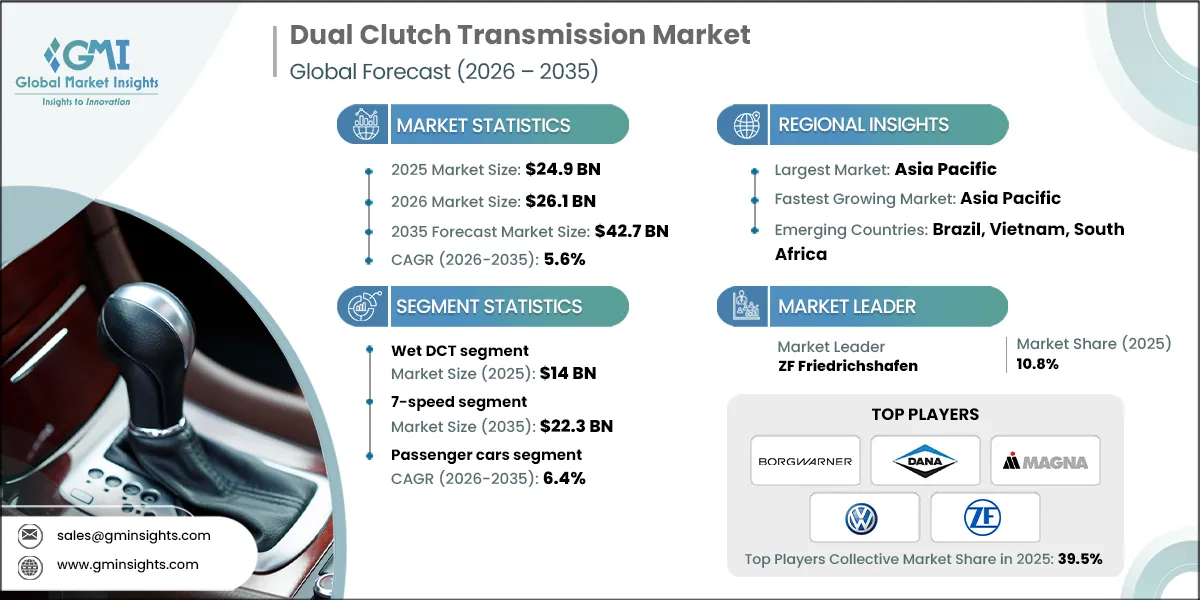
The global dual clutch transmission market size was valued at USD 24.9 billion in 2025. The market is expected to grow from USD 26.1 billion in 2026 to USD 42.7 billion in 2035 at a CAGR of 5.6%, according to latest report published by Global Market Insights Inc.
Dual Clutch Transmission Market Key Takeaways
Market Size & Growth
- 2025 Market Size: USD 24.9 Billion
- 2026 Market Size: USD 26.1 Billion
- 2035 Forecast Market Size: USD 42.7 Billion
- CAGR (2026–2035): 5.6%
Regional Dominance
- Largest Market: Asia Pacific
- Fastest Growing Region: Asia Pacific
Key Market Drivers
- Expansion of the Worldwide Passenger Car Production.
- Growing Adoption of Automatic and Semi-Automatic Transmissions.
- Strong Penetration of DCT in Premium and Sports Cars.
- Increasing Adoption of DCT in Hybrid Vehicles.
Challenges
- Rising Penetration of Battery Electric Vehicles (BEVs).
- Complexity in Design and Manufacturing.
Opportunity
- Rising Adoption of DCT in Hybrid Powertrains.
- Growing Demand for DCT in Compact and Mid-Segment Vehicles.
- Expansion Opportunities in Emerging Automotive Markets.
- OEM Collaborations and Strategic Partnerships.
Key Players
- Market Leader: ZF Friedrichshafen led with over 10.8% market share in 2025.
- Leading Players: Top 5 players in this market include BorgWarner, Dana, Magna, Volkswagen, ZF Friedrichshafen, which collectively held a market share of 39.5% in 2025.
Get Market Insights & Growth Opportunities
A dual clutch transmission (DCT) is an advanced transmission system that is used in passenger cars and sports vehicles to provide quick, smooth gear shifts. Over the past years, it has been spread across commercial vehicles and some of the two-wheelers. Honda was the first company that introduced the DCT system for motorcycles. Steadily, it is growing in popularity.
According to OICA, in 2024, the worldwide vehicle production reached over 92.5 million, decreasing around -1.1% from 2023 which could be a result of weak economic conditions, high interest rates, and ongoing supply chain disruptions. However, continuous demand is increasing from high-performance and commercial vehicle segments that would help to recover this dip.
Premium and performance vehicles have been the main users of DCTs, new developments are making them more affordable and suitable for hybrid vehicles. Automakers are also working with experts to improve DCT performance and software to stay competitive.
DCTs are popular because they provide smooth gear shifts and better performance compared to traditional systems. Suppliers are investing in DCT technology and focusing on research to use lighter materials and integrate with hybrid systems. These improvements show how important DCTs are for better fuel efficiency and driving performance worldwide.
Asia Pacific is maintaining its continuous dominance in the dual-clutch transmission because of two major automotive producers, China and India. Recent vehicle production stats have proven China’s increased vehicle production volume. For instance, in the first three quarters of 2025, China produced over 24 million vehicles, which is up 13% from the same quarters of 2024. This makes China a major growth area for DCTs. The region’s strong manufacturing base and low component costs support large-scale production of DCTs, strengthening ties between suppliers and automakers.
Manufacturers are improving DCT designs by using lightweight materials and advanced control systems to handle torque better and make gear shifts smoother. Wet plate clutch systems, which are good for high torque and heat management, are being developed alongside dry clutch systems that are more cost-effective. Adaptive software and integration with vehicle diagnostics are also making DCTs smarter, supporting trends in connected and autonomous vehicles.
Some regions, like Europe, are moving towards zero-emission vehicles, which will impact the market of DCT. As an EV rarely uses DCT, it will be challenging for market players. However, expanding into regions like Asia Pacific and Middle East & Africa would be beneficial for DCT manufacturers.
To get key market trends
Dual Clutch Transmission Market Trends
OEMs are using the same DCT designs across different vehicle platforms to reduce costs and speed up production for compact, mid-size, and premium vehicles. In June 2025, Hyundai Motor India Limited launched a 7-speed dual-clutch transmission (DCT) in the petrol version of the Hyundai Alcazar Prestige. This made it the most affordable DCT option in the Alcazar lineup.
Nowadays, DCTs are now being used in mild-hybrid and full-hybrid vehicles. Future trends suggest that the hybrid segment will grow at the fastest rate between 2026 and 2035. DCTs help in managing better torque and providing smooth gear shifts.
Moreover, the wet dual-clutch transmissions are becoming more popular for hybrids because they handle heat better and support higher torque. These features make them a good choice for SUVs and performance vehicles.
Vehicle production is growing fast in China and India, and more people are choosing automatic transmissions. This is increasing the use of DCTs in mass-market passenger vehicles. For example, in January 2026, Volkswagen announced plans to launch the Tayron SUV in India. It is expected to come with petrol, diesel, and plug-in hybrid options, all featuring a Dual-Clutch Transmission (DCT).
While fully electric vehicles may reduce the need for multi-speed transmissions in the future, DCTs are still important for internal combustion engine (ICE) and hybrid vehicles, keeping demand steady in the medium term.
Dual Clutch Transmission Market Analysis
Learn more about the key segments shaping this market
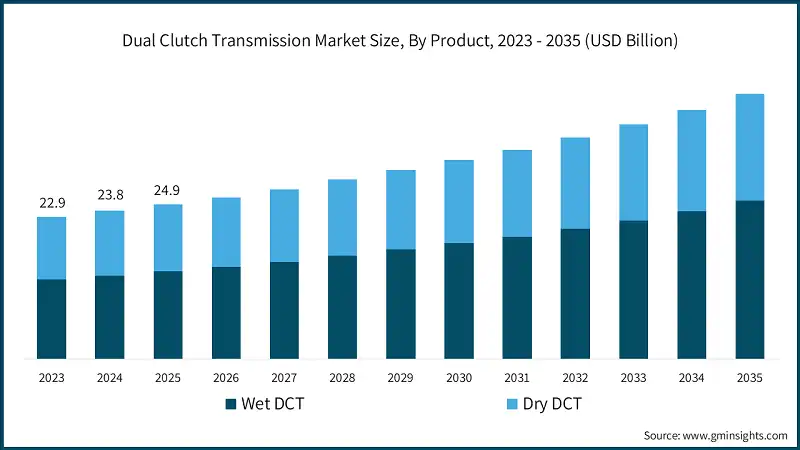
Based on product, the dual clutch transmission market is divided into wet DCT and dry DCT. The wet DCT segment dominated the market with market share of around 55% and generating revenue of around USD 14 billion in 2025.
- Wet dual clutch transmissions (DCTs) are the most popular type in the DCT market because they work well with modern vehicles like SUVs, turbocharged engines, and high-torque petrol engines. Wet DCTs use oil-covered clutches, which help them handle heat and torque better than dry DCTs. This makes them more reliable in stop-and-go traffic, heavy loads, and hot weather, especially in large markets like China and India.
- The wet DCT market is expected to grow at a CAGR of 6.2% from 2026 to 2035. This growth is mainly due to their increasing use in hybrid vehicles and premium passenger cars. Wet DCTs are ideal for mild-hybrid and full-hybrid systems because they can handle frequent torque changes and regenerative braking without wearing out quickly.
- Companies like Tata Motors and Hyundai are adding DCTs to more of their models to meet the growing demand for automatic transmissions that offer both performance and fuel efficiency.
- Hyundai has widely used wet DCTs in turbo-petrol versions of compact SUVs and premium hatchbacks to improve smoothness and durability in city traffic. Tata Motors has also introduced DCT options in its new petrol models to make driving more comfortable and to compete in markets where automatic cars are in high demand.
Learn more about the key segments shaping this market
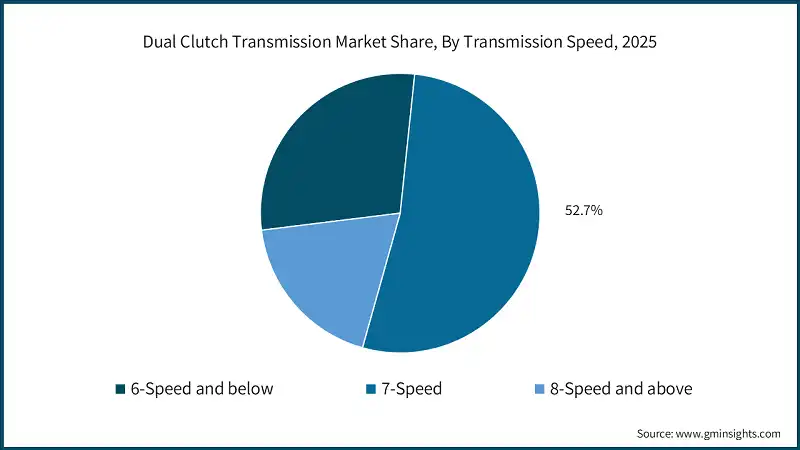
Based on transmission speed, the dual clutch transmission market is divided into 6-speed & below, 7-speed and 8-speed & above. The 7-speed segment accounts for 52.7% in 2025 and is expected to reach USD 22.3 billion by 2035.
- Due to characteristics like balance performance, fuel efficiency, and reliability, 7-speed DCTs are the most used transmission speed segment. The segment is holding 52.7% of the share in 2025.
- 7-speed DCTs provide smoother acceleration and better torque control compared to 6-speed systems, making them ideal for mid-range sedans, hatchbacks, and compact SUVs. Both mid-range and premium vehicles widely use 7-speed DCTs, as they offer good drivability and efficiency without the added complexity of 8-speed systems.
- On the other hand, 6-speed and below DCTs are mainly used in compact cars and budget vehicles where keeping costs low is important and engine torque needs are moderate.
- 8-speed and above DCTs are growing the fastest because they are commonly found in premium, sports, and high-torque SUVs because they provide smoother acceleration, better fuel efficiency on highways, and improved driving performance. It is estimated that the 8-speed and above DCT segment will grow at a CAGR of 7.7% between 2026 and 2035 because of the increasing demand for high-end vehicles, especially in China, Europe, and the U.S.
Based on vehicle, the dual clutch transmission market is divided into passenger cars, commercial vehicle, sports cars and two-wheelers. The passenger cars segment is expected to grow at the fastest CAGR of 6.4% between 2026 and 2035.
- The passenger cars segment is the largest in the dual clutch transmission (DCT) market because more people now prefer automatic transmissions for city and suburban driving. In 2024, global car sales reached 74.6 million units, which is a 2.5% increase compared to 2023.
- New car registrations also increased by 1.4% as of November 2025 (ACEA). DCTs are popular because they offer smooth gear changes, better fuel efficiency, and more comfort, making them a preferred choice for compact, mid-size, and premium passenger cars.
- DCTs are used differently based on the type of vehicle. In passenger cars, they focus on improving fuel efficiency and comfort. Light trucks in the commercial vehicle market use DCTs to make city driving smoother.
- Sports cars use DCTs for faster gear shifts and better performance. In two-wheelers, DCTs are used in smaller markets. Honda was the first to bring DCTs to motorcycles, allowing riders to change gears without using a clutch in scooters and sport bikes.
- The passenger car segment is expected to grow at a CAGR of 6.4% from 2026 to 2035. This growth is driven by increasing urbanization, stricter fuel efficiency and emissions rules, and automakers’ plans to include DCTs in compact and mid-size models. These factors make passenger cars the fastest-growing segment in the global DCT market.
Looking for region specific data?
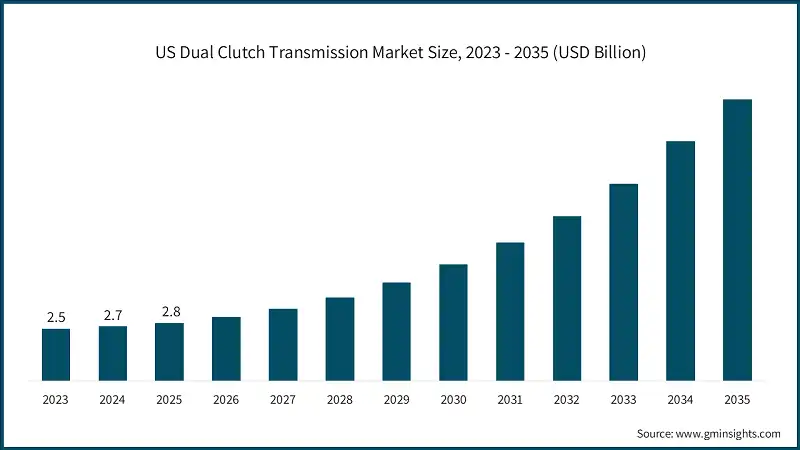
The US dual clutch transmission market reached USD 2.8 billion in 2025, growing from USD 2.7 billion in 2024.
- The DCT market is expected to grow at a CAGR of 5.3% between 2026 and 2035 as a result of its popularity among high-performance or sports vehicles. According to Statista, over 245,000 sports cars are expected to be sold in the U.S. by 2030.
- Around 57% of these will likely be internal combustion engine (ICE) models, showing that many buyers still prefer performance-focused vehicles where DCTs are a key feature.
- Luxury brands like Ferrari also highlight this trend, with a 25.1% increase in U.S. sales in 2024 compared to 2023, as many of their cars come with advanced transmissions.
- Car manufacturers are also offering more transmission options. DCTs are becoming common in performance and enthusiast cars because they provide quick and smooth gear changes, making the driving experience more enjoyable. Mainstream brands are adding DCTs to higher-end models to combine better fuel efficiency with improved drivability.
The North America dual clutch transmission market is estimated to reach USD 5.2 billion by 2035 and expected to grow at the CAGR of 5.2% between 2026 and 2035.
- North America’s strong automotive industry, supported by well-known carmakers and transmission suppliers, is helping to bring advanced systems like DCTs into both common and specialized vehicles. For instance, in January 2026, Toyota Motor North America reported year-end 2025 U.S. sales of 2,518,071 vehicles, up 8.0 percent on a volume basis and up 8.3 percent on a daily selling rate (DSR) basis compared to 2024.
- Sales of electrified vehicles for the year totaled 1,183,248, up 17.6 percent on a volume basis and up 17.9 percent on a DSR basis, representing 47.0 percent of total sales volume. The growth of EVs in the region could slow down the demand for DCTs, as they are not used in EVs except hybrids.
- Moreover, the growing use of DCTs in high-performance and premium vehicles, where fast and smooth gear changes are important. This matches a broader trend in the region, where performance-focused vehicles, like sports cars and luxury sedans, are more likely to have dual-clutch systems.
Europe region holds 19.8% of the dual clutch transmission market, accounting for USD 4.9 billion in 2025.
- In Europe, Dual-Clutch Transmissions (DCTs) are still popular because of the region's strong history in advanced car engineering and its many premium and performance car brands. Automakers like Volkswagen, BMW, and Mercedes-Benz use DCT systems to offer smoother gear changes and better fuel efficiency, which align with what consumers want in terms of performance and fuel savings.
- However, the fast growth of electric vehicles (EVs) is creating challenges for DCTs in Europe. Last year, global car sales increased by 10%, and Europe’s market share rose to 21%, driven by government support for zero-emission vehicles. As Europe works toward its goal of 90% zero-emission vehicles by 2035, the demand for traditional transmissions like DCTs may decrease, especially as internal combustion engine (ICE) vehicles become less common.
- At the same time, regulations and market trends are changing how DCTs are used. Strict emission rules make efficient transmissions important for hybrid vehicles, but the shift to EVs means DCTs are now mostly used in mild hybrids and performance cars instead of regular passenger cars. In southern and eastern Europe, where EV adoption is slower than in northern countries, DCT demand might last longer, helping with the transition to full electrification.
Germany dual clutch transmission market is growing quickly in Europe, with a CAGR of 3.8% between 2026 and 2035.
- Germany's strong history in the automotive industry continues to influence the use of dual clutch transmissions (DCTs). The country is home to major carmakers known for developing advanced drivetrain technologies. Brands like Porsche and BMW use DCTs in their performance and premium models because they offer quick gear changes and better driving performance.
- Germany's high vehicle production highlights its key role in the DCT market. In 2025, BMW Group produced over one million vehicles in its German factories, meaning one out of every four cars made in Germany came from a BMW plant. According to the German Association of the Automotive Industry (VDA), a total of 4.15 million vehicles were produced in Germany during the same time. This high production supports the demand for advanced transmissions like DCTs, especially in cars that focus on performance and efficiency.
- At the same time, the shift to electric vehicles (EVs) and new regulations are changing transmission trends in Germany. DCTs are still important for internal combustion engine (ICE) and hybrid vehicles, especially in premium and performance models. However, since EVs usually don’t need multi-speed gearboxes, the demand for DCTs is slowly decreasing.
Asia Pacific dual clutch transmission market is estimated to grow at fastest CAGR of 6.8% during the analysis timeframe.
- The DCT market in the region is valued at USD 13.9 billion in 2025 because automakers are increasingly using Dual-Clutch Transmissions (DCTs) to meet different customer needs. Countries such as India, China, South Korea, and Japan are leading the way. For example, in January 2026, Volkswagen announced that it is planning to launch the Tayron SUV in India that will offer petrol, diesel, and plug-in hybrid engines, all paired with DCTs. This shows that automakers trust DCTs for their efficiency and performance.
- Established car manufacturers are also making DCTs more affordable to attract price-sensitive customers in the region. For instance, Hyundai Motor India Limited introduced a 7-speed DCT for the petrol version of the Alcazar Prestige in June 2025. This made it the most affordable DCT option in the Alcazar lineup.
- Automakers are now focusing on making automatic driving more accessible, not just for luxury cars but also for regular ones. As DCTs become more affordable, more customers are choosing vehicles with this technology.
China is estimated to grow with a CAGR of 7.3% in the projected period between 2026 and 2035, in the Asia Pacific dual clutch transmission market.
- China represents over 31% of global car sales as per the statistics shown in 2024, with more than 27.5 million passenger cars sold in China. This gives DCT manufacturers a big opportunity, as carmakers want to add efficient and high-performance transmissions to both regular and premium vehicles. The large number of cars sold also helps suppliers lower costs and grow their presence in one of the world’s biggest car markets.
- Another important trend is the stronger partnerships between suppliers and carmakers in China. In May 2025, BorgWarner expanded its leadership in dual clutch modules for DCTs by signing a new deal with a major Chinese transmission company and renewing its contract with a German carmaker in China.
- Carmakers are adding DCTs to mid-range and performance cars to meet customer expectations for better driving and fuel efficiency. With China’s strong car sales and active supplier partnerships, the country is becoming a key area for the growth of dual-clutch transmission technology.
Latin America dual clutch transmission market is estimated to reach USD 2 billion in 2025 and is anticipated to show lucrative growth over the forecast period.
- The automotive industry in Latin America, especially in Brazil and Mexico, is upgrading vehicles to meet the growing demand for fuel-efficient and high-performance technologies. In cities, more people are choosing cars with automatic transmissions.
- This has led to an increase in the use of Dual-Clutch Transmissions (DCT), as they offer smoother gear changes and better fuel efficiency compared to manual transmissions.
- Car manufacturers are focusing on fuel efficiency and advanced drivetrains, making DCTs more relevant. Companies like Volkswagen, Ford, and General Motors are investing in advanced transmission systems to improve performance and meet local efficiency standards.
Brazil is estimated to grow with a CAGR of 4.5% between 2026 and 2035, in the Latin America dual clutch transmission market.
- In Brazil, the choice of automatic gearboxes is getting more and more popular with the increasing urbanization and traffic congestion. This trend has led to a rising demand for technologies like dual-clutch transmissions (DCT), which are known for their fast and smooth gear transitions overshadowing the conventional ones.
- DCTs initially were regarded to be unreliable and pricey. Nonetheless, the latest models are gaining traction as the manufacturers are enhancing their quality and performance.
- The legislation governing emissions and fuel efficiency, along with the preference of the drivers for smoother rides, are acting as the driving forces behind the back-and-forth of automakers in the offering of advanced options like DCTs.
- While torque converter automatics and CVTs still remain to be the most popular, the automotive sector of Brazil's drive to modernize its market and the increasing thirst for fuel-efficient and high-performance vehicles are paving the way for DCTs in a whole new light.
The Middle East and Africa dual clutch transmission market accounted for USD 941.3 million in 2025 and is anticipated to show lucrative growth over the forecast period.
- In the Middle East & Africa, the automatic transmission types, especially the high-tech DCT, are chosen by more people as driving in cities will be the future and comfort is a major factor in people's choice of driving.
- The Gulf Cooperation Council (GCC) is one of the most important markets where automatic gearboxes are getting popular because they offer the smooth driving characteristic, especially for the premium cars and SUVs that are common in the cities. This shift indicates a change in people's vehicle choices and driving needs.
- DCT systems are being marketed along with various types of automatic transmissions in the UAE and Saudi Arabia where the luxury and high-end segment is the biggest part of the market.
- The GCC is quicker in this regard as people are more affluent and there are more luxury cars. On the other hand, many African markets still go for simpler and cheaper transmission types.
UAE to experience substantial growth in the Middle East and Africa dual clutch transmission market in 2025.
- In the UAE automatic transmissions are becoming more popular, and they are coupled with the automatic gearboxes' increased acceptance of advanced transmission systems such as DCT in the passenger car and SUV segment. The main reason behind this is that automatic vehicles are easier and more comfortable to drive in heavy city traffic.
- The trend of preference for automatic cars is reflected by the rising figures of automatic vehicle registrations in the cities of Dubai and Abu Dhabi. Modern DCTs, along with other automatic gear systems, are very helpful in reducing driver fatigue while the vehicle is stuck in traffic, a very critical feature considering the hot climate and busy roads in the region.
- The consumer choices and the vehicles that they are accustomed to are also major factors that are influencing the view of DCT technology in the UAE. The luxury and premium segments with advanced automatic gearboxes still have their place in the UAE market, these areas still represent a demand for systems like DCT even amidst the growing popularity of electric and hybrid vehicles.
Dual Clutch Transmission Market Share
The top 7 companies in the dual clutch transmission industry are ZF Friedrichshafen, Magna, BorgWarner, Volkswagen, Dana, Schaeffler, Great Wall Motors, contributing 45.2% of the market in 2025.
- ZF makes advanced dual-clutch transmissions for road and motorsport use. These systems provide fast gear shifts, include built-in control electronics, and support hybrid powertrains.
- Magna offers dual-clutch transmissions, including wet and dry types like the 6DCT260, 7DCT300, and 7DCT400. These are designed for different torque levels and have smart controls for efficient gear shifting.
- BorgWarner makes DualTronic modules and assemblies that reduce friction and rotational inertia. These are used in regular and mild hybrid vehicles.
- Volkswagen sells its dual-clutch transmissions as DSG (Direct-Shift Gearbox). These automatic gearboxes, available in dry and wet versions, provide smooth and quick shifts in six- and seven-speed options.
- Dana’s Graziano division makes high-performance dual-clutch transmissions, including eight-speed systems for high-torque and sports vehicles.
- Schaeffler provides parts for dual-clutch transmissions, such as clutch systems, actuators, and software, to ensure smooth gear changes and efficient operation.
- Great Wall Motors builds its own seven-speed Wet DCTs, used in models like the Haval H6 and Wey SUVs, focusing on high efficiency and performance.
Dual Clutch Transmission Market Companies
Major players operating in the dual clutch transmission industry are:
- ZF Friedrichshafen
- Magna
- BorgWarner
- Volkswagen
- Dana
- Schaeffler
- Great Wall Motors
- Aisin
- Punch Powertrain
- TREMEC
- ZF Friedrichshafen uses its expertise in transmission engineering to provide dual clutch systems for various vehicles. The company has long-term partnerships with OEMs and manufacturing facilities in Europe, Asia, and North America.
- Magna offers flexible dual clutch solutions through its Getrag transmission portfolio. These solutions are used by many global automakers and are designed for compact, mid-size, and performance vehicles.
- BorgWarner makes dual clutch modules and related parts. It works with well-known OEMs and is expanding its programs in Asia, especially in China, for both traditional and hybrid powertrains.
- Volkswagen uses its in-house DSG dual clutch technology, which is widely used in its passenger cars. This has helped the company produce on a large scale and improve the system over time.
- Dana uses its experience in drivetrain and power transmission to support dual clutch components. These components are part of larger propulsion systems for traditional and electric vehicles.
- Schaeffler supports the dual clutch market by providing precision parts, clutch systems, and hybrid transmission designs. The company works closely with global OEMs and has strong engineering skills.
- Great Wall Motors develops its own dual clutch transmissions for its passenger cars and SUVs. The company designs these transmissions to meet local market needs and keep costs low for its vehicles.
Dual Clutch Transmission Market Report Attributes
| Key Takeaway | Details |
|---|---|
| Market Size & Growth | |
| Base Year | 2025 |
| Market Size in 2025 | USD 24.9 Billion |
| Market Size in 2026 | USD 26.1 Billion |
| Forecast Period 2026 - 2035 CAGR | 5.6% |
| Market Size in 2035 | USD 42.7 Billion |
| Key Market Trends | |
| Drivers | Impact |
| Expansion of the Worldwide Passenger Car Production | Increasing global passenger car output directly boosts demand for advanced transmission systems, including DCTs, as OEMs scale production across multiple vehicle segments. |
| Growing Adoption of Automatic and Semi-Automatic Transmissions | Rising consumer preference for driving convenience accelerates the shift toward automatic and semi-automatic transmissions. |
| Strong Penetration of DCT in Premium and Sports Cars | Premium and sports car manufacturers favor DCTs for rapid gear shifts and performance benefits, reinforcing market growth through high-value vehicle segments globally. |
| Increasing Adoption of DCT in Hybrid Vehicles | Hybrid vehicles increasingly integrate DCTs to optimize power delivery and fuel efficiency, supporting gradual expansion of DCT applications beyond conventional ICE platforms. |
| Pitfalls & Challenges | Impact |
| Rising Penetration of Battery Electric Vehicles (BEVs) | Growing BEV adoption reduces demand for multi-speed transmissions, limiting long-term growth potential for DCT systems in fully electric vehicle platforms. |
| Complexity in Design and Manufacturing | High engineering complexity, precision requirements, and integration challenges increase production costs, restricting DCT adoption in cost-sensitive and entry-level vehicle segments. |
| Opportunities: | Impact |
| Rising Adoption of DCT in Hybrid Powertrains | Hybrid powertrain development creates opportunities for DCT suppliers to deliver efficiency-focused solutions balancing electric assistance with multi-gear internal combustion engines. |
| Growing Demand for DCT in Compact and Mid-Segment Vehicles | Cost optimization and modular DCT designs enable penetration into compact and mid-segment vehicles, expanding addressable market beyond premium categories. |
| Expansion Opportunities in Emerging Automotive Markets | Rapid motorization, rising disposable incomes, and expanding vehicle production in emerging markets support new demand for advanced transmission technologies like DCTs. |
| OEM Collaborations and Strategic Partnerships | Strategic collaborations between OEMs and transmission suppliers accelerate innovation, cost reduction, and localization of DCT systems for diverse global vehicle platforms. |
| Market Leaders (2025) | |
| Market Leaders |
10.8% market share |
| Top Players |
|
| Competitive Edge |
|
| Regional Insights | |
| Largest Market | Asia Pacific |
| Fastest growing market | Asia Pacific |
| Emerging countries | Brazil, Vietnam, South Africa |
| Future outlook |
|
What are the growth opportunities in this market?
Dual Clutch Transmission Industry News
- In January 2026, Volkswagen plans to launch the Tayron SUV in India. It will offer petrol, diesel, and plug-in hybrid engines, all paired with a Dual-Clutch Transmission (DCT).
- In June 2025, Hyundai Motor India Limited introduced a 7-speed dual-clutch transmission (DCT) for the petrol version of the Alcazar Prestige. This made it the most affordable DCT option in the Alcazar lineup.
- In May 2025, BorgWarner expanded its leadership in dual clutch modules for DCTs. The company signed a new deal with a major Chinese transmission manufacturer and extended its contract with a German OEM in China.
- In January 2025, Stellantis announced it had acquired the minority stake held by Punch Powertrain in their joint venture formed in 2018. This gave Stellantis full control over the design and production of eDCT transmissions.
- In October 2024, Magna secured a major supply deal with a European OEM for its new DCT Eco system. This was the first large-scale contract for the DCT Eco, showing the growing demand for efficient powertrain solutions, especially in regions with stricter emission rules.
The dual clutch transmission market research report includes in-depth coverage of the industry with estimates & forecasts in terms of revenue ($ Mn/Bn) and volume (units) from 2022 to 2035, for the following segments:
Market, By Product
- Wet DCT
- Dry DCT
Market, By Transmission Speed
- >6-Speed & below
- 7-Speed
- 8-Speed & above
Market, By Powertrain
- Internal Combustion Engine (ICE)
- Hybrid
- HEV
- PHEV
Market, By Vehicle
- Passenger Cars
- Hatchback
- Sedan
- SUV
- Commercial Vehicle
- LCV
- MCV
- HCV
- Sports Cars
- Two-wheelers
Market, By Sales Channel
- OEM
- Aftermarket
The above information is provided for the following regions and countries:
- North America
- US
- Canada
- Europe
- Germany
- UK
- France
- Italy
- Spain
- Russia
- Czech Republic
- Belgium
- Netherlands
- Asia Pacific
- China
- India
- Japan
- South Korea
- Australia
- Singapore
- Malaysia
- Indonesia
- Vietnam
- Thailand
- Latin America
- Brazil
- Mexico
- Argentina
- Colombia
- MEA
- South Africa
- Saudi Arabia
- UAE
Frequently Asked Question(FAQ) :
What was the market size of the dual clutch transmission in 2025?
The market size was USD 24.9 billion in 2025, with a CAGR of 5.6% expected through 2035. Increasing adoption in hybrid vehicles and advancements in transmission technology are driving market growth.
What is the projected value of the dual clutch transmission market by 2035?
The market is poised to reach USD 42.7 billion by 2035, driven by rising demand for automatic transmissions, especially in hybrid and performance vehicles.
What is the expected size of the dual clutch transmission industry in 2026?
The market size is projected to reach USD 26.1 billion in 2026.
How much revenue did the wet dual clutch transmission segment generate in 2025?
The wet dual clutch transmission segment generated approximately USD 14 billion, dominating the market with a 55% share in 2025.
What was the market share of the 7-speed segment in 2025?
The 7-speed segment accounted for 52.7% of the market in 2025 and is expected to reach USD 22.3 billion by 2035.
What is the growth outlook for the passenger cars segment from 2026 to 2035?
The passenger cars segment is set to expand at a CAGR of 6.4% till 2035, led by increasing consumer preference for automatic transmissions in urban and suburban areas.
What was the valuation of the US dual clutch transmission sector in 2025?
The US market was valued at USD 2.8 billion in 2025, supported by advancements in automotive technology and rising adoption of automatic transmissions.
What are the upcoming trends in the dual clutch transmission market?
Rising use of DCTs in hybrid vehicles, preference for wet DCTs for better heat and torque handling, and expansion into mass-market cars in China and India.
Who are the key players in the dual clutch transmission industry?
Key players include ZF Friedrichshafen, Magna, BorgWarner, Volkswagen, Dana, Schaeffler, Great Wall Motors, Aisin, Punch Powertrain, and TREMEC.
Dual Clutch Transmission Market Scope
Related Reports