Summary
Table of Content

Dried Honey Market
Get a free sample of this report
Form submitted successfully!
Error submitting form. Please try again.
Thank you!
Your inquiry has been received. Our team will reach out to you with the required details via email. To ensure that you don't miss their response, kindly remember to check your spam folder as well!
Request Sectional Data
Thank you!
Your inquiry has been received. Our team will reach out to you with the required details via email. To ensure that you don't miss their response, kindly remember to check your spam folder as well!
Form submitted successfully!
Error submitting form. Please try again.
Dried Honey Market Size
- The dried honey market refers to the commercial use of honey in powdered or granulated form which results from the drying process that maintains its original sweet taste and functional benefits.
- Dried honey provides people with simple handling advantages, extended storage capabilities and better product reliability when compared to honey in its liquid form. The product serves as a sweetener for food and drink items and dietary products and baked treats which cannot use liquid honey.
- The honey product enables manufacturers to use natural sweetness in their products without introducing extra moisture. Dried honey combines well with dry ingredients which makes it suitable for use in seasoning mixes and health supplements and cereals and confectionery items. Its ability to deliver honey flavour in a controlled form supports its usage across both food preparation and industrial processing environments.
- The market experiences a major technological transformation through new drying methods which achieve three objectives when drying products. The new spray drying and low-temperature dehydration methods help to preserve honey's natural features while producing honey at a consistent particle dimension. The new development creates products which offer better solubility and flow properties and stability abilities for use in various processed food products and packaged items.
- The dried honey market experiences growth because more people want to buy natural products which display transparent ingredient labels. People who produce and consume products show a preference for natural sweeteners which make dried honey an ideal choice because of its unrefined nature. The product helps people who want to understand their food better through its complete transparency about its ingredients and processing steps.
- The market extends its reach to various products which include nutritional powders and nutraceuticals and specialized formulations. The product maintains its popularity because people find it easy to store and transport and control their serving sizes. The food industry needs dried honey because it provides manufacturers with consistent natural sweetness and product adaptability through its use.
The global dried honey market was valued at USD 996.4 million in 2025. The market is expected to grow from USD 1.1 billion in 2026 to USD 2.3 billion in 2035, at a CAGR of 8.8% according to the latest report published by Global Market Insights Inc.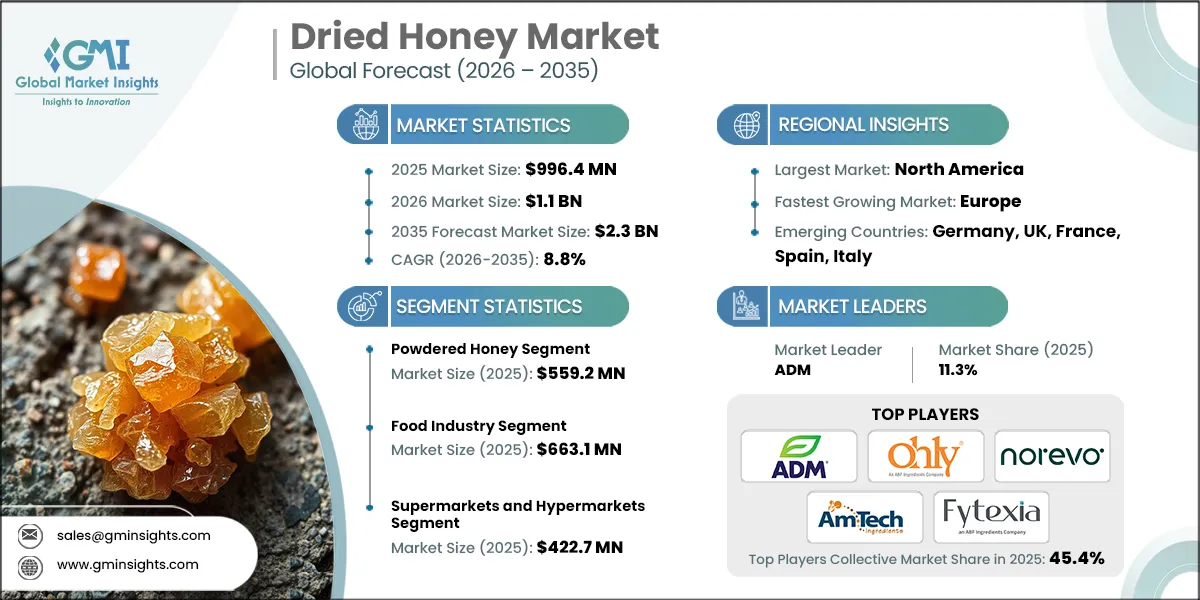
Dried Honey Market Key Takeaways
Market Size & Growth
- 2025 Market Size: USD 996.4 Million
- 2026 Market Size: USD 1.1 Billion
- 2035 Forecast Market Size: USD 2.3 Billion
- CAGR (2026–2035): 8.8%
Regional Dominance
- Largest Market: North America
- Fastest Growing Region: Europe
Key Market Drivers
- Increasing preference for natural sweeteners in foods globally.
- Growing use of powdered ingredients in processing foods.
- Demand for longer shelf-life ingredients in applications.
Challenges
- Sensitivity of honey nutrients during drying processes operations.
- Higher production costs compared to liquid honey formats.
Opportunity
- Expansion of clean label and natural formulations worldwide.
- Growth in nutraceutical and supplement products segments.
Key Players
- Market Leader: ADM led with over 11.3% market share in 2025.
- Leading Players: Top 5 players in this market include ADM, Ohly, Norevo, AmTech Ingredients, Fytexia, which collectively held a market share of 45.4% in 2025.
Get Market Insights & Growth Opportunities
To get key market trends
Dried Honey Market Trends
- The dried honey industry shows a clear pattern of people using natural sweeteners in their daily food consumption. Manufacturers to developing product alternatives which enable customers to recognize dried honey through its practical advantages of structured contents.
- The food processing industry results in increase in demand for powdered and dry ingredient materials. In automated production systems dried honey fits well because it maintains better flowability and consistent performance while reducing the handling difficulties that come with liquid sweeteners.
- Consumers preferred products that contain basic components. Dried honey helps food brands achieve clean ingredient labeling through its ability to create transparent products which contain familiar elements and meet consumer demands for minimally processed items.
- Product innovation trends show rising use of dried honey in specialty and value-added formulations. The material finds increasing use in blends which include seasoning mixtures and nutritional powders that require controlled sweetness and stability.
- The convenience and shelf-life stability trend continues to shape how people consume products. Dried honey provides extended storage capabilities together with simple transportation and practical application, which makes it ideal for contemporary food manufacturing and distribution systems.
Dried Honey Market Analysis
Learn more about the key segments shaping this market
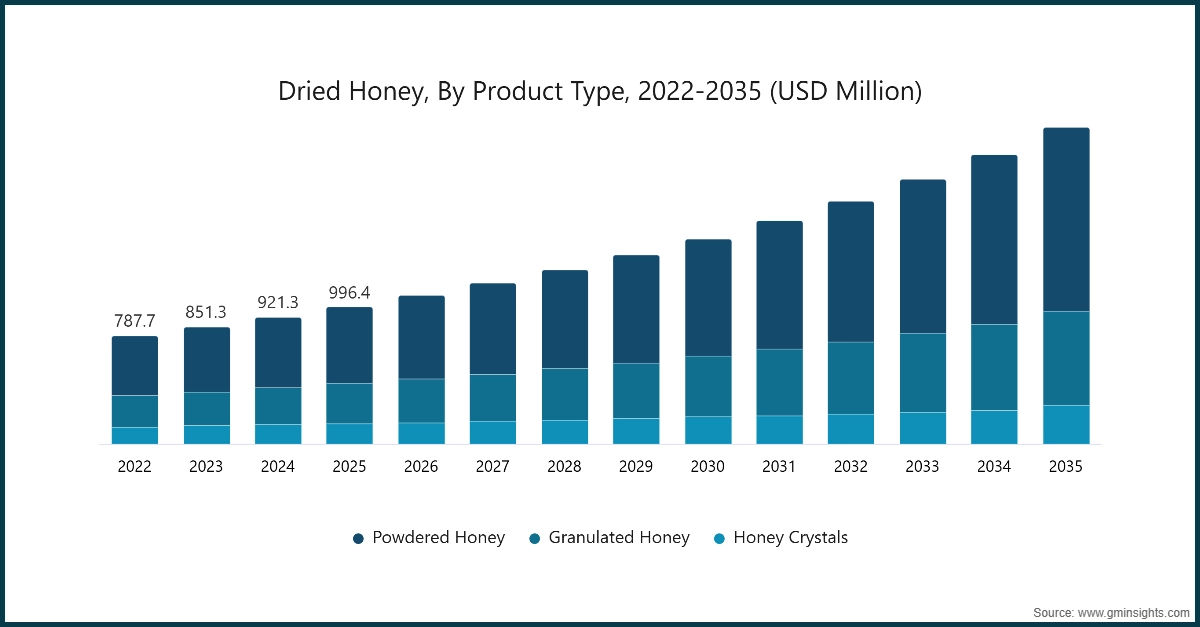
Based on product type, the market is segmented into powdered honey, granulated honey and honey crystals. Powdered honey holds the largest market value of USD 559.2 million in 2025.
- Food manufacturers use powdered honey as their primary dry sweetener because it provides two advantages which include simple handling and moisture control. The key trend shows increasing use of the product across bakery mixes and beverages and seasonings and nutrition powders which need their components to blend evenly while staying fresh. Manufacturers provide different honey content levels and solubility options which enable customers to create specific product formulas.
- Granulated honey continues to gain interest in applications where a natural appearance and slower dissolution are preferred, such as toppings, coatings, and specialty foods. Honey crystals are being adopted because their particles maintain a constant size while workers can easily handle them in cereal production, snack coating and dry food manufacturing processes. The two formats demonstrate a growing demand for convenient honey products which preserve taste while enabling simple processing and storage operations.
The dried honey market by end user is segmented into food industry, nutraceuticals, cosmetics & personal care and others. Food industry holds the largest market value of USD 663.1 million in 2025.
- The food industry uses dried honey as a natural sweetener for bakery items and breakfast cereals and snack foods and drinks and dry mixing products which need moisture control and uniform product distribution. The product exists in both powdered and granulated forms which enable consistent flavor delivery and simple processing handling. Dried honey serves as a common ingredient in dietary supplements and protein powders and wellness products because its natural origin matches the requirements of dry products which include capsules and sachets in nutraceuticals.
- Dried honey functions as an essential ingredient in cosmetics and personal care products which include face masks and scrubs and soaps and powdered skincare products because it helps maintain product stability and enables precise formulation control. Dried honey functions across multiple areas including animal nutrition and specialty ingredient blends and customized formulations because its storage and transport and dosing convenience makes it suitable for broader applications.
Learn more about the key segments shaping this market
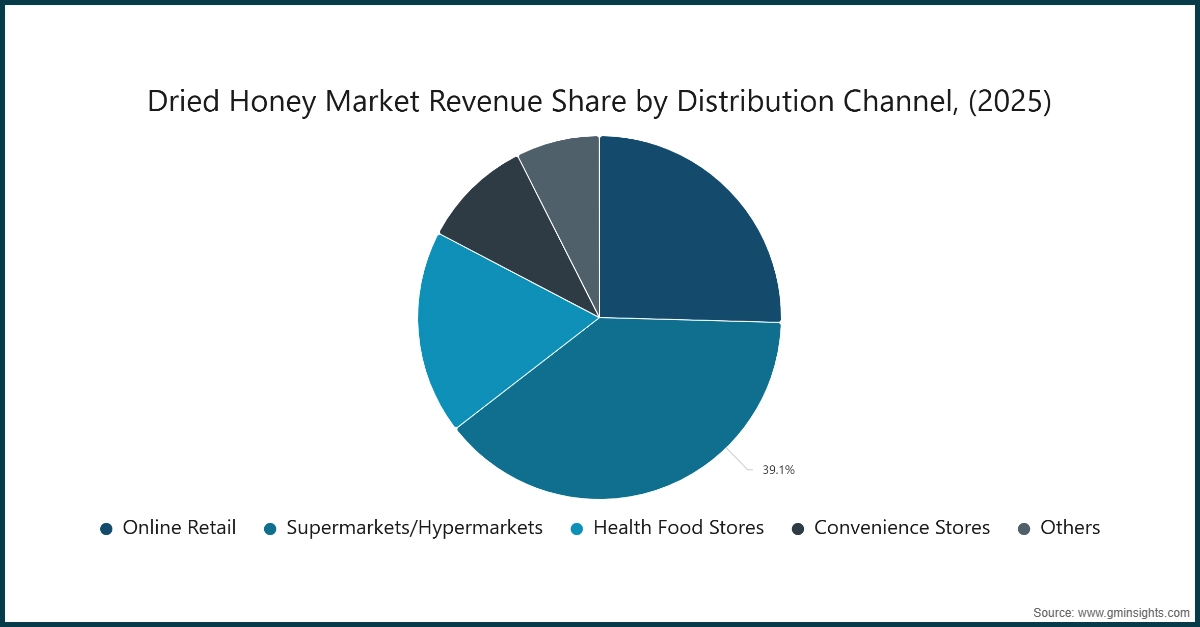
- Consumers now access dried honey products through brand websites and e-commerce platforms for online retailing, which enables them to reach more consumers while offering convenient shopping options to both small buyers and regular customers. Supermarkets and hypermarkets distribute dried honey through their packaged food and health section and specialty ingredient section, which combines the product visibility with natural sweeteners and baking ingredients.
- Health food stores use dried honey because it serves as a pure natural component that wellness customers, who usually buy supplements and specialty foods, will appreciate. The stores provide limited products that customers can buy through small packs for fast purchases, while their stock includes special distributors and bulk suppliers and business-to-business channels that support food processors and formulators.
Looking for region specific data?
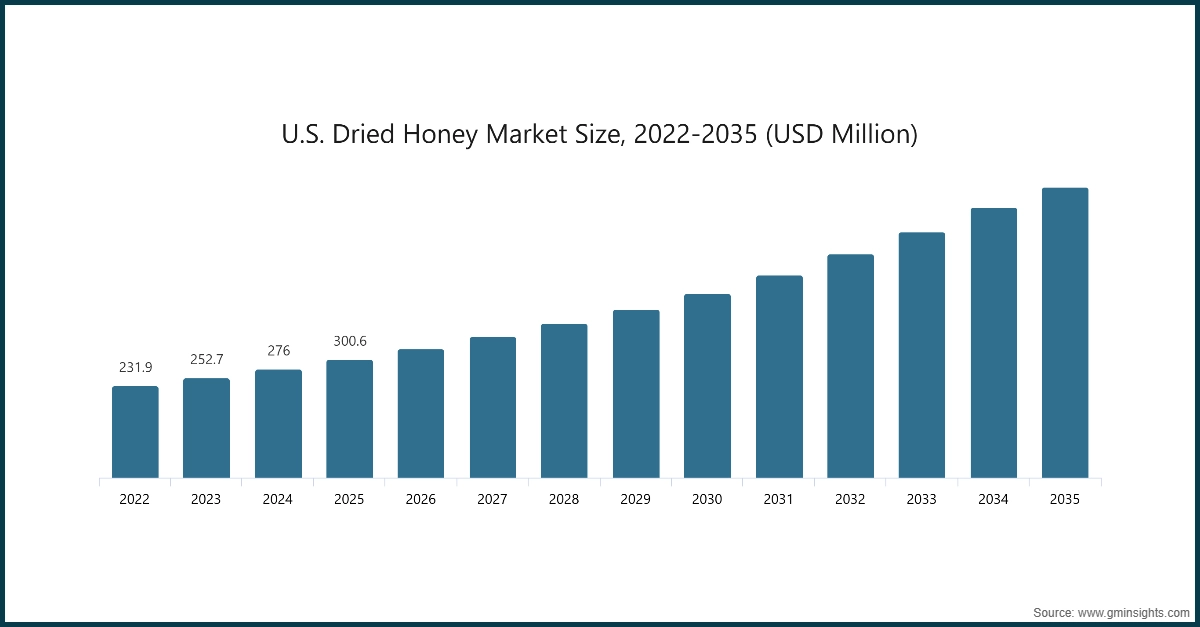
The market in the North America is expected to experience significant and promising growth from USD 354.7 million in 2025 to USD 856.2 million in 2035. The U.S. dried honey market accounted for USD 300.6 million in 2025.
- The use of dried honey in North American food products continues to grow because consumers prefer natural ingredients and manufacturers reformulate their products and produce more powdered sweeteners for use in baking and snack and beverage production. Dried honey becomes popular in the United States nutrition bar and cereal and processed food markets because producers develop convenience-based systems and customers increasingly want clean ingredient products across the country.
The market in the Europe is expected to experience significant and promising growth from USD 293.2 million in 2025 to USD 685.9 million in 2035.
- European markets use dried honey in bakery products and confectionery items and functional foods through clean labeling practices and ingredient transparency requirements and the need for manufacturers to deliver consistent quality across all product applications. Dried honey use in Germany has expanded to specialty breads and organic foods and nutritional blends because manufacturers need sweetening solutions that meet both processing standards and product quality requirements.
The dried honey market in Asia Pacific is expected to experience increasing growth from USD 242.7 million in 2025 to USD 557 million in 2035.
- The region of Asia Pacific shows increasing adoption of dried honey for use in packaged food products and beverage products because of changing dietary patterns and growing food processing industries and rising interest in natural sweeteners. Dried honey use in India has become popular among manufacturers who make health snacks and dietary supplements and traditional Indian products because it provides convenient portion control and simple use in dry mix products for modern production methods.
Middle East & Africa market is expected to experience significant and promising growth from USD 34.3 million in 2025 to USD 62.1 million in 2035.
- The Middle East and Africa region uses dried honey in food production at a moderate rate because storage conditions and shelf-life requirements and the growing demand for packaged food in urban centers affect its use. The United Arab Emirates sees rising demand for dried honey in premium food products and health products and beverage preparation because these products provide stable quality and convenient use and meet the needs of climate-sensitive supply chain operations.
Latin America is expected to experience significant and increasing growth from USD 71.4 million to USD 140.4 million in 2035.
- The food processing industry in Latin America has started to show interest in dried honey because of its ability to maintain product quality during storage and delivery and its increasing use as a natural ingredient in the development of packaged food products across the region. Dried honey use in Brazil has expanded to bakery mixes and beverage powders and nutritional products because those products help manufacturers achieve stable sweetness and easy product storage and better product handling through all stages of production and distribution.
Dried Honey Market Share
- Dried Honey industry are moderately consolidated with players like ADM, Ohly, Norevo, AmTech Ingredients and Fytexia holding 45.4% market share and ADM being the market leader holding the market share of 11.3% in 2025.
- To maintain their market position companies that are dealing in the dried honey business use their reliable formulation methods and dependable product quality. The food manufacturers establish trust through their ability to produce consistent particle sizes and taste preservation and their product stability throughout multiple production runs.
- The company creates multiple dried honey products that food manufacturers can use in baking and nutrition and beverage production and seasoning recipes to reach multiple customer groups without needing to specialize in one product category.
- The business needs operational efficiency to maintain its competitive edge. The combination of improved drying techniques and moisture control and packaging efficiency enables businesses to minimize product waste while delivering products to their customers. The company builds its competitive advantage through its strong connections with food and ingredient manufacturers.
- The company provides technical support and product customization and application guidance to establish partnerships with customers who need products beyond basic ingredient supplies.
- The company maintains its regional presence through ongoing quality control and adherence to regulatory standards. The company needs to ensure product safety and traceability and maintain proper documentation to build long-term customer trust and secure repeat business.
Dried Honey Market Companies
Major players operating in the dried honey industry are:
Ohly
- Mitthi Foods
- AmTech Ingredients
- ADM
- Essentra Natural
- Flavor Consultants, Inc.
- Mevive International
- Fytexia
- Norevo
- AVNI HERBAL & HEALTHCARE
- Vedant Agro Foods
ADM operates as a global ingredient manufacturing business which serves food and beverage and nutritional markets through its extensive product line. The company provides dried honey products in powdered form which facilitate easy usage while enabling different processing methods to create baked goods and breakfast cereals and snack foods and dry ingredient mixes.
Ohly develops specialized ingredient solutions for food manufacturers through its production of spray-dried honey powders which function as flavor and functional ingredients. The company develops products which maintain consistent performance throughout their shelf life while enabling customers to use them for seasoning and coating and sauce and dry blend applications.
Norevo offers honey powder products which enable dry formulation development through their moisture control capabilities because especially for bakery and confectionery and cereal and nutraceutical products the company requires both standardized quality and reliable product performance.
AmTech Ingredients produces specialty food powders through spray drying which includes honey powder as a product for food processing and formulation uses. The company delivers tailored drying systems to its clients while it develops ingredient products which enhance blending performance and maintain product stability and consistent manufacturing processes.
Fytexia sells honey powder as part of its bee product line which operates in the nutrition and functional ingredient industry. The company provides standardized honey powders which serve wellness and dietary supplement and functional food markets that require consistent ingredient composition and controlled product specifications.
Dried Honey Market Report Attributes
| Key Takeaway | Details |
|---|---|
| Market Size & Growth | |
| Base Year | 2025 |
| Market Size in 2025 | USD 996.4 Million |
| Market Size in 2026 | USD 1.1 Billion |
| Forecast Period 2026-2035 CAGR | 8.8% |
| Market Size in 2035 | USD 2.3 Billion |
| Key Market Trends | |
| Drivers | Impact |
| Increasing preference for natural sweeteners in foods globally | Consumers increasingly prefer natural sweetening sources, encouraging manufacturers to replace refined sugars. Dried honey supports this shift by offering familiar taste, natural image, formulation flexibility, and compatibility with food products. |
| Growing use of powdered ingredients in processing foods | Food producers rely more on dry ingredients to improve handling efficiency. Powdered honey blends easily, reduces processing complexity, enhances consistency, and supports standardized production across large scale food manufacturing operations. |
| Demand for longer shelf-life ingredients in applications | Extended shelf-life ingredients help reduce waste and storage challenges. Dried honey remains stable under controlled conditions, making it suitable for packaged foods, bulk storage, distribution networks, and distance transportation. |
| Pitfalls & Challenges | Impact |
| Sensitivity of honey nutrients during drying processes operations | Drying honey requires careful temperature control to avoid nutrient degradation. Improper processing may affect flavor, aroma, and functional qualities, limit product acceptance and reduce confidence among food manufacturers globally today. |
| Higher production costs compared to liquid honey formats | Producing dried honey involves specialized equipment and processing steps. These factors increase costs, influence pricing decisions and potentially limiting adoption among cost sensitive processors, smaller brands, and emerging food businesses. |
| Opportunities: | Impact |
| Expansion of clean label and natural formulations worldwide | Clean label trends encourage the use of recognizable and natural ingredients. Dried honey supports these formulations by replacing artificial sweeteners while maintaining taste appeal and meeting transparency expectations across categories. |
| Growth in nutraceutical and supplement products segments | Nutraceuticals and supplements increasingly utilize powdered natural ingredients. Dried honey fits these formats by offering sweetness, energy association, ease of blending, and compatibility with vitamins, minerals, and protein formulations systems. |
| Market Leaders (2025) | |
| Market Leader |
Market share 11.3% |
| Top Players |
Collective market share of 45.4% in 2025 |
| Competitive Edge |
|
| Regional Insights | |
| Largest Market | North America |
| Fastest growing market | Europe |
| Emerging countries | Germany, UK, France, Spain, Italy |
| Future outlook |
|
What are the growth opportunities in this market?
Dried Honey Industry News
- In May 2025, Switzerland‑based innovation hub FoodYoung Labs acquired US food‑tech startup MeliBio, known for its plant‑based honey brand Mellody, as part of a strategic move to expand bee‑free sweetener alternatives.
- In November 2024, Wisdom Natural Brands, the parent company of the SweetLeaf natural sweetener brand, announced the acquisition of Canada‑based Drizzle Honey as part of its strategy to expand its natural sweetener portfolio.
The dried honey market research report includes an in-depth coverage of the industry with estimates and forecast in terms of revenue in USD Million and volume in terms of kilo tons from 2022–2035 for the following segments:
Market, By Product Type
- Powdered honey
- Granulated honey
- Honey crystals
Market, By End User
- Food industry
- Nutraceuticals
- Cosmetics and personal care
- Others
Market, By Distribution Channel
- Online retail
- Supermarkets/hypermarkets
- Health food stores
- Convenience stores
- Others
The above information is provided for the following regions and countries:
- North America
- U.S.
- Canada
- Europe
- Germany
- UK
- France
- Spain
- Italy
- Rest of Europe
- Asia Pacific
- China
- India
- Japan
- Australia
- South Korea
- Rest of Asia Pacific
- Latin America
- Brazil
- Mexico
- Argentina
- Rest of Latin America
- Middle East and Africa
- Saudi Arabia
- South Africa
- UAE
- Rest of Middle East & Africa
Frequently Asked Question(FAQ) :
What is the market size of the dried honey in 2025?
The market size was USD 996.4 million in 2025, with a CAGR of 8.8% expected through 2035, driven by increasing demand for natural sweeteners and advancements in drying technologies.
What is the projected value of the dried honey market by 2035?
The dried honey market is expected to reach USD 2.3 billion by 2035, fueled by its growing use in food, nutraceuticals, and cosmetics industries.
What is the current dried honey market size in 2026?
The market size is projected to reach USD 1.1 billion in 2026.
How much revenue did the powdered honey segment generate in 2025?
Powdered honey generated USD 559.2 million in 2025, leading the market due to its ease of handling and moisture control benefits.
What was the valuation of the food industry segment in 2025?
The food industry segment held the largest market value of USD 663.1 million in 2025, driven by its use in bakery, cereals, snacks, and beverages.
Which region leads the dried honey market?
The North American market is projected to reach USD 856.2 million in 2035, driven by consumer preference for natural ingredients and clean-label products.
What are the upcoming trends in the dried honey market?
Key trends include advancements in drying technologies, increasing adoption of clean-label products, and growing use in nutraceuticals and cosmetics.
Who are the key players in the dried honey market?
Key players include Ohly, Mitthi Foods, AmTech Ingredients, ADM, Essentra Natural, Flavor Consultants, Inc., Mevive International, Fytexia, Norevo, AVNI HERBAL & HEALTHCARE, and Vedant Agro Foods.
Dried Honey Market Scope
Related Reports