Summary
Table of Content

Dozers Market
Get a free sample of this report
Form submitted successfully!
Error submitting form. Please try again.
Thank you!
Your inquiry has been received. Our team will reach out to you with the required details via email. To ensure that you don't miss their response, kindly remember to check your spam folder as well!
Request Sectional Data
Thank you!
Your inquiry has been received. Our team will reach out to you with the required details via email. To ensure that you don't miss their response, kindly remember to check your spam folder as well!
Form submitted successfully!
Error submitting form. Please try again.
Dozers Market Size
The growth of the global dozer industry can largely be attributed to the rapidly increasing amount of urbanization and infrastructure development that is occurring worldwide. In recent years, while 55% of the world's population resided in cities by 2050 this number is expected to rise to 68%. The growth of urban areas creates an increased need for earth moving machines, primarily dozers.
Dozers Market Key Takeaways
Market Size & Growth
- 2025 Market Size: USD 15.2 Billion
- 2026 Market Size: USD 16 Billion
- 2035 Forecast Market Size: USD 27 Billion
- CAGR (2026–2035): 6%
Regional Dominance
- Largest Market: Asia Pacific
- Fastest Growing Region: North America
Key Market Drivers
- Expansion of construction & infrastructure sectors globally.
- Technological advancements.
- Rising demand in mining industry.
Challenges
- Market saturation.
- Seasonal fluctuations.
Opportunity
- Sustainability‑driven premium solutions.
- Rising demand from younger consumers for affordable fragrance.
Key Players
- Market Leader: Caterpillar led with over 16.5% market share in 2025.
- Leading Players: Top 5 players in this market include Caterpillar, Komatsu, Liebherr Group, XCMG Group, Deere & Company, which collectively held a market share of 41.5% in 2025.
Get Market Insights & Growth Opportunities
There are various government-funded construction projects throughout the world that will help spur growth in the dozer market. For instance, as part of the Infrastructure Investment and Jobs Act, Congress approved a total of USD 1,200 billion for the purpose of rebuilding and upgrading highways, bridges, and mass transit, all of which will provide many opportunities for manufacturers that produce dozers.
Major players in the dozer market are taking advantage of this growth by making investments in new technologies. Caterpillar, one of the leading manufacturers, has designed a new line of dozers that are equipped with advanced GPS technology to allow for more accuracy in the construction process. Another leading manufacturer, Komatsu, has developed a line of hybrid dozers that are environmentally friendly and help meet current sustainability requirements.
Moreover, the increase in the use of automation in construction equipment will also change the way the market operates. AI and IoT will enhance the capabilities of automated dozer machinery, providing operators with improved productivity and safety. This will lead to ongoing development and increased competition between major players in this market during the predicted time frame.Thus, with urbanization, government funding and technological advances continuing to drive growth in die-dozers, there will be a continuing demand for dozers of all sizes for both residential, commercial & industrial construction worldwide during the forecast period.
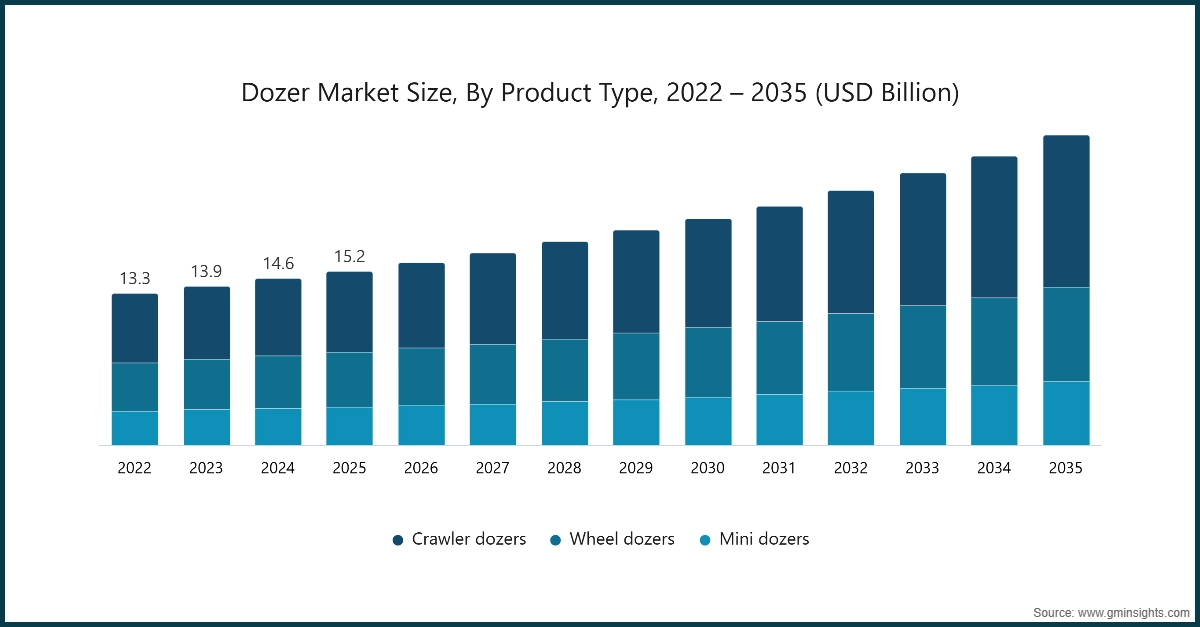
The global dozers market was valued at USD 15.2 billion in 2025. The market is expected to grow from USD 16 billion in 2026 to USD 27 billion in 2035, at a CAGR of 6%, according to latest report published by Global Market Insights Inc.
To get key market trends
Dozers Market Trends
Changing innovation and technology transformation are important for the growth of the global dozers industry.
- Battery-electric and hybrid drives are proving their case in mining-scale deployments, with early adopters citing lower energy costs and reduced maintenance complexity with fewer moving parts, no transmission overhauls mining’s fixed sites and shift-based operations suit depot charging, while construction’s mobile jobs need flexible power—so adoption sequences will diverge by end-use.
- Autonomy and operator-assist become a labor strategy as much as a tech stor, retrofit kits bring autonomy to installed fleets without full machine replacement, which lowers the threshold for mid-size contractors to participate builtrobotics.com. Market projects using operator assist can cut finish passes by double digits and shorten schedules, boosting bid competitiveness.
- Penetration rates above 70% on new units in North America and rising in Europe point to a de facto standard for precision earthmoving on infrastructure and industrial jobs. Centimetre-level tolerances reduce staking, eliminate rework, and deliver 6–12-month paybacks for most contractors. Because of this, the dozers market increasingly competes on integrated machine-control ecosystems and software interoperability, not just iron and horsepower.
- Telematics feeds predictive maintenance and new service models, always-on connectivity is table stakes for Tier 1 brands, with cloud analytics flagging component wear and letting fleets schedule planned downtime before failures occur. Higher availability, more consistent productivity, and a shift toward equipment‑as‑a‑service contracts on select fleets where hours-based billing aligns with uptime guarantees.
- Compact and mini dozers outgrow the market in dense urban work. Urbanization and utility upgrades favor smaller machines that fit tight rights-of-way, reduce mobilization costs, and finish more work with fewer people—an attractive formula when crews are stretched thin. The rental channel amplifies this trend as utilization stays high and tech features trickle down to compact classes.
Dozers Market Analysis
Learn more about the key segments shaping this market
Based on product type, the dozers market is segmented into crawler dozers, wheel dozers and mini dozers. The crawler dozers segment accounts for revenue of around USD 7.1 billion in the year 2025 and is expected to reach USD 13.3 billion by 2035.
- The market skews toward crawler dozers based on traction needs and material push requirements in heavy civil and mining, with wheel dozers serving mobility-driven use cases and mini dozers accelerating in urban and utility jobs.
- Crawler units command the majority share, supported by applications that demand drawbar pull and stability on varied soils; wheel dozers shine on large, level sites where relocation speed matters, according to Construction Equipment Magazine.
- Mini dozers gain ground where access, transport cost, and single-operator efficiency trump pure production. From an application lens, highway corridors, mine overburden, and industrial pads keep crawler dozers central to production flows.
- Wheel dozers carve out roles at airports, ports, and sprawling logistics sites that reward speed of redeployment. Meanwhile, mini dozers exploit the shift toward infill, utility upgrades, and residential work, where smaller footprints and standard-trailer transport reduce total job cost.
- Public spending cycles plus rental-fleet optimization sustain this mix by pairing production crawlers with compact units on the same projects for finish work and site access tasks, as reflected in U.S. DOT documentation and American Rental Association data. That pairing reduces mobilization costs and lets crews sequence bulk earthmoving and fine grading more predictably.
Learn more about the key segments shaping this market
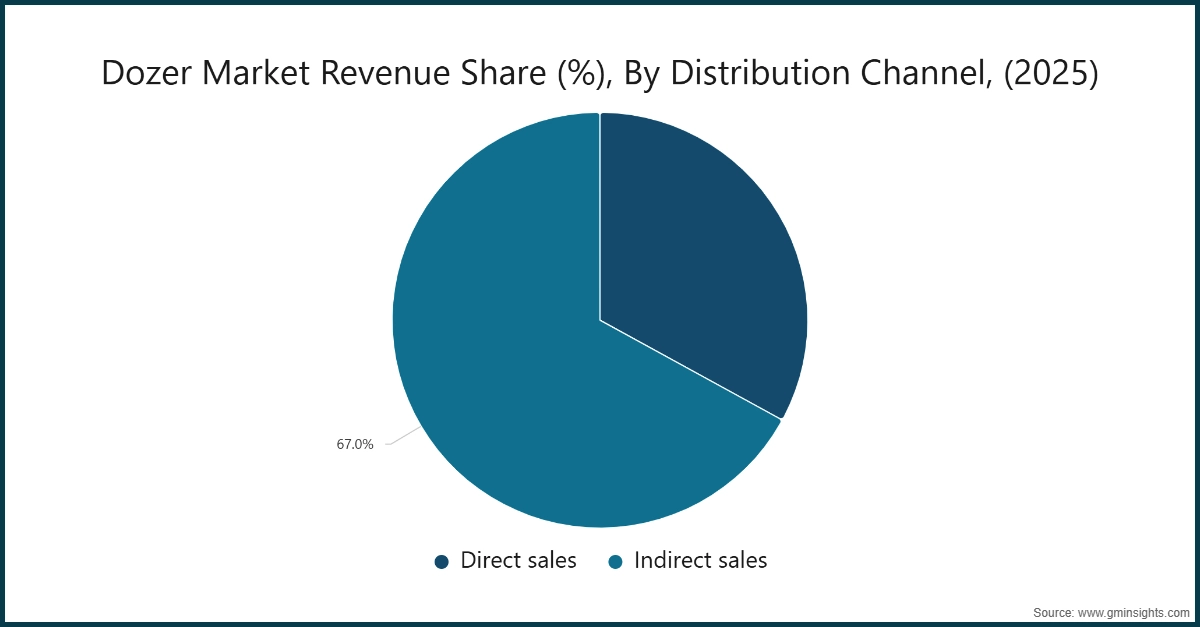
Based on the distribution channel, the dozers market is bifurcated into direct and indirect. The indirect segments held the largest share, accounting for 67% of the global market in 2025.
- Indirect channels such as distributors, dealers, and third-party vendors have the ability to address a large variety of customer needs. Due to their large scope of market reach and accessibility, indirect channels are the channel of choice for both manufacturers and end users.
- Indirect channels allow manufacturers to penetrate a variety of different markets without having to create their own direct infrastructure, which lowers the costs of doing business while still maintaining efficient distribution. This strategy has been particularly effective in developing markets where there are limited opportunities for direct sales.
- Additionally, distributors and dealers typically have a high level of expertise in their field and possess extensive established networks, resulting in improved customer engagement and after-sales service. By establishing a high degree of trust and loyalty with customers, the indirect channel has reinforced its position in the dozer market. By providing localized service, indirect channels have further enhanced their appeal to customers.
- The technological evolution of case management for the supply chain has enabled enhanced efficiency in indirect sales channels through enhanced logistics and inventory control systems. Products can be now delivered in a timely manner and inventory levels are more precisely managed than before. Therefore, there is currently high demand for these products in the marketplace.
- As the dozer market develops, indirect channels are likely to maintain their dominant position throughout the first half of the prediction period given the nature of these channels that make them well suited to accommodate any growth and/or changes in market conditions. Cost-effective, widely accessible, and adaptable to marketplace needs are the main characteristics of indirect channels that will allow these channels to continue growing their presence and importance in this industry.
North America Dozers Market
Looking for region specific data?
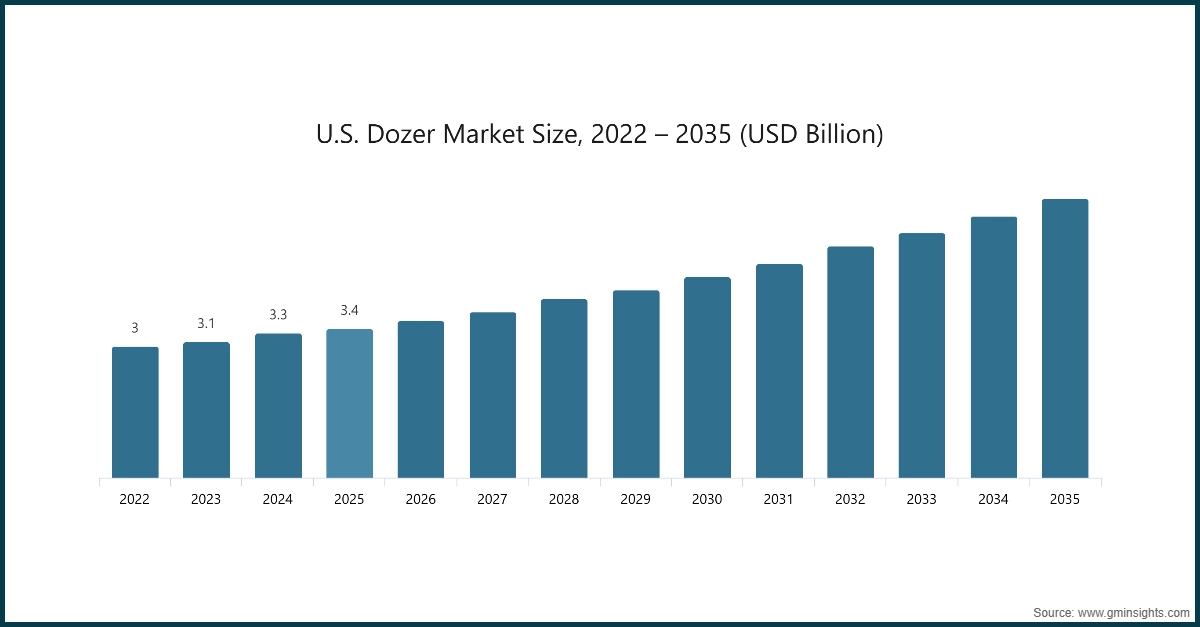
In 2025, the U.S. dominated the dozers market growth in North America, accounting for 76.8% of the share in the region.
- The U.S. dominated the North America market driven by heavy investments in large‑scale infrastructure upgrades across transport, energy, and urban development. Continuous expansion of commercial and residential construction fuels sustained demand for high‑capacity machines. Strong technological adoption- including GPS, telematics, and autonomous systems- further accelerates equipment modernization.
- Growth is also supported by rising earthmoving requirements in road expansion, utility installation, and land development projects across U.S. states. Mining and quarrying activities continue to contribute to steady demand for crawler and heavy‑duty dozers. Favorable government spending on public infrastructure rehabilitation boosts market momentum.
Asia Pacific Dozers Market
Asia Pacific market is expected to grow at 6.7% during the forecast period.
- The Asia Pacific market is driven by massive investments in transportation corridors, energy networks, and rapid urbanization across countries such as India and China. Large‑scale mining developments in Australia and parts of Southeast Asia further elevate equipment demand. The region remains the largest global consumer of dozers due to its continuous infrastructure expansion. Strong government‑supported development programs amplify long‑term growth.
Europe Dozers Market
Europe market is expected to grow at 5.6% during the forecast period.
- Europe’s growth is supported by increasing adoption of fuel‑efficient and low‑emission dozers aligned with EU sustainability policies. Ongoing investments in transport modernization, urban redevelopment, and renewable energy infrastructure maintain equipment demand. Technological upgrades- including automation and GPS‑enabled systems- remain a key purchasing driver.
Middle East and Africa Dozers Market
Middle East and Africa market is expected to grow at 3.3% during the forecast period.
- The Middle East & Africa region benefits from expanding construction activity in urban mega‑projects, logistics hubs, and industrial zones. Mining sector growth- particularly in Africa, driven by rising global demand for minerals- supports steady equipment adoption. Government‑backed infrastructure initiatives in transport and utilities continue to generate need for heavy earthmoving machinery.
Dozers Market Share
The top companies in the market include Caterpillar, Komatsu, Liebherr Group, XCMG Group and Deere & Company and collectively hold a share of 41.5% of the market in 2025. These prominent players are proactively involved in strategic endeavors, such as mergers & acquisitions, facility expansions & collaborations, to expand their product portfolios, extend their reach to a broad customer base, and strengthen their market position.
- Caterpillar is a dominant global force in the dozers market, supported by an extensive product portfolio such as the D‑series models that remain industry benchmarks. Its leadership is reinforced by strong global distribution networks and continuous innovation in automation, grade control, and electrification. The company plays a pivotal role in meeting rising infrastructure and mining demand worldwide.
- Komatsu is a leading full‑line manufacturer of construction and mining dozers, offering models across small, medium, and large segments for global markets. The dozer industry is driven by in‑house component development, telematics (Komtrax), and lifecycle fleet‑management support. Robust international sales and aftermarket service networks position Komatsu as a key competitor in the global dozer landscape.
- Liebherr participates in the dozer market with its advanced crawler dozers engineered for precision grading, heavy pushing, and high‑efficiency operation through hydrostatic drives and operator‑assistance systems. Its machines support major earthmoving, construction, and mining applications worldwide. High‑grade materials, smart systems, and strong European engineering reinforce Liebherr’s relevance in premium dozer segments.
Dozers Market Companies
Major players operating in the dozers industry are:
- Caterpillar
- CNH Industrial
- Deere & Company
- Doosan
- Hitachi Construction Machinery
- JCB
- Komatsu
- Liebherr Group
- Liugong
- Sany Construction
- SDLG
- Shantui
- Volvo Construction Equipment
- XCMG Group
- Zoomlion
XCMG is a rapidly expanding global equipment producer with a growing footprint in mining and large‑scale earthmoving dozers. Its portfolio emphasizes smart, automated, and electric‑powered heavy machinery, including large mining dozers aligned with global infrastructure and resource‑sector investments. Strategic exports and rising adoption in Asia‑Pacific, Africa, and the Americas strengthen its competitive position.
Deere participates in the dozers market as a recognized U.S. manufacturer providing crawler and track‑type dozers used across construction, mining, and infrastructure projects. Its presence in the bulldozer segment contributes to the strong North American market, which remains the largest regional consumer of such equipment.
Dozers Market Report Attributes
| Key Takeaway | Details |
|---|---|
| Market Size & Growth | |
| Base Year | 2025 |
| Market Size in 2025 | USD 15.2 Billion |
| Market Size in 2026 | USD 16 Billion |
| Forecast Period 2026-2035 CAGR | 6% |
| Market Size in 2035 | USD 27 Billion |
| Key Market Trends | |
| Drivers | Impact |
| Expansion of construction & infrastructure sectors globally | Global infrastructure investment and urban development are directly increasing demand for dozers due to their essential role in earthmoving and site preparation. This surge in construction activity across regions like North America, Asia‑Pacific, and Europe continues to be a primary growth engine for the marke |
| Technological advancements | Integration of GPS, telematics, automation, and autonomous systems is improving operational efficiency and productivity in dozers. These technologies are accelerating adoption among contractors seeking precision, fuel savings, and reduced operating costs |
| Rising demand in mining industry | Expansion of mining activities driven by high commodity prices and increased mineral demand is boosting dozer utilization in site clearing, hauling support, and heavy‑duty earthmoving. Major mining regions such as Australia, Africa, and Latin America continue to elevate global dozer demand. |
| Pitfalls & Challenges | Impact |
| Market saturation | Advanced dozers with automation and telematics come with substantial upfront costs, creating affordability barriers for smaller contractors. High capital expenditure also slows replacement cycles and increases reliance on rentals. |
| Seasonal fluctuations | Growing consumer interest in eco‑friendly materials, circular fashion, and ethical production enables brands to command higher value through sustainable apparel lines. This creates new premium niches centered around recycled fabrics, low‑impact dyes, and transparent supply chains. |
| Opportunities: | Impact |
| Sustainability‑driven premium solutions | As mineral extraction intensifies worldwide, dozer demand rises for mine development, overburden removal, and haul‑road maintenance. New mining investments in Australia, Africa, and South America create long‑term, stable growth opportunities for dozer OEMs. |
| Rising demand from younger consumers for affordable fragrance | Growing regulatory pressure for low‑emission machinery is accelerating demand for electric and hybrid dozers, especially in public projects and eco‑sensitive zones. Manufacturers adopting sustainable technologies gain a competitive edge as the industry transitions to greener solutions. |
| Market Leaders (2025) | |
| Market Leader |
16.5% market share |
| Top Players |
Collective market share in 2025 is 41.5% |
| Competitive Edge |
|
| Regional Insights | |
| Largest Market | Asia Pacific |
| Fastest growing market | North America |
| Emerging countries | U.K., India, Japan, Brazil |
| Future outlook |
|
What are the growth opportunities in this market?
Dozers Industry News
- In Feb 2026, Caterpillar introduced its next-generation D8T, equipped with an electric-assist hybrid powertrain, aiming to achieve an 18% improvement in fuel efficiency. This innovation reflects the company's commitment to sustainability and operational efficiency in heavy machinery. The D8T is expected to set a new benchmark in the construction and mining equipment market.
- In Jan 2026, Komatsu expanded its teleoperation technology to 50 mining sites, marking a significant milestone in autonomous operations. By the end of Q4 2025, the company surpassed 12,000 autonomous operating hours, showcasing its leadership in automation. This development aligns with Komatsu's strategy to enhance productivity and safety in mining operations.
- In Dec 2025, Fortescue received its first Liebherr PR 776 battery-electric mining dozers as part of a USD 2.8 billion zero-emission agreement. This collaboration underscores both companies' dedication to reducing carbon emissions in the mining sector. The delivery represents a critical step toward achieving Fortescue's sustainability goals.
- In Nov 2025, Built Robotics successfully raised a series D funding round and achieved a significant milestone with 500 autonomous retrofit kit deployments. These kits, which include rental partnerships, are designed to enhance automation in construction equipment. The funding will likely support further innovation and expansion of its product offerings.
- In Oct 2025, John Deere launched the 850 X-Tier electric-drive dozer, featuring the integrated SmartGrade system for enhanced precision and efficiency. This product launch highlights the company's focus on electrification and advanced technology in construction equipment. The 850 X-Tier is expected to cater to the growing demand for sustainable and high-performance machinery.
The dozers market research report includes in-depth coverage of the industry, with estimates & forecasts in terms of revenue (USD Billion) volume (Million Units) (from 2022 to 2035), for the following segments:
Market, By Product Type
- Crawler dozers
- Wheel dozers
- Mini dozers
Market, By Blade Type
- Straight Blade (S-Blade)
- Universal Blade (U-Blade)
- Angle Blade
- Others (semi-u blade, pitch blades, etc.)
Market, By Engine Power
- Up to 100 HP
- 100–200 HP
- More than 200 HP
Market, By End-use
- Building & construction
- Mining
- Forestry & agriculture
- Others (manufacturing, military, etc.)
Market, By Distribution Channel
- Direct sales
- Indirect sales
The above information is provided for the following regions and countries:
- North America
- U.S.
- Canada
- Europe
- Germany
- France
- UK
- Italy
- Spain
- Asia Pacific
- China
- Japan
- India
- Australia
- South Korea
- Latin America
- Brazil
- Mexico
- Argentina
- MEA
- Saudi Arabia
- UAE
- South Africa
Frequently Asked Question(FAQ) :
What is the market size of the dozers market in 2025?
The market size was USD 15.2 billion in 2025, with steady expansion supported by a 6% CAGR forecast through 2035. Growth in the dozers industry is primarily driven by rising global infrastructure development, rapid urbanization, and increasing mining activities.
What is the projected dozers market size in 2026?
The market is projected to reach USD 16 billion in 2026. Continued government-backed infrastructure spending and strong construction activity are supporting stable demand across the heavy equipment industry.
What is the projected value of the dozers market by 2035?
The market is expected to reach USD 27 billion by 2035. Long-term industry growth is fueled by automation integration, electrification trends, and expanding mining and construction projects worldwide.
How much revenue did the crawler dozers segment generate in 2025?
Crawler dozers generated USD 7.1 billion in 2025 and remain the dominant product segment within the market. Their strong traction, stability, and suitability for heavy civil and mining applications reinforce their leadership across the global industry.
What was the market share of the indirect distribution channel in 2025?
The indirect sales segment accounted for 62.7% of the global dozers market in 2025. Dealer and distributor networks continue to dominate the industry due to their wide regional reach, strong after-sales service, and cost-efficient market penetration capabilities.
How much share did the U.S. account for in the North America dozers industry in 2025?
The U.S. accounted for 76.8% of the North America dozers market in 2025. Strong federal infrastructure funding, road expansion projects, mining activity, and rapid adoption of GPS and automation technologies are driving sustained growth in the U.S. construction equipment industry.
What are the emerging trends in the dozers industry?
Key trends in the market include increasing adoption of battery-electric and hybrid powertrains, integration of GPS-based machine control systems, telematics-driven predictive maintenance, and growing deployment of autonomous and operator-assist technologies to enhance productivity and reduce operating costs.
Who are the key players in the dozers industry?
Key players in the market include Caterpillar, Komatsu, Liebherr Group, XCMG Group, and Deere & Company. These companies collectively held 41.5% market share in 2025 and continue to strengthen their competitive position through automation, electrification, and global expansion strategies.
Dozers Market Scope
Related Reports