Summary
Table of Content

Dirt Bike Market
Get a free sample of this report
Form submitted successfully!
Error submitting form. Please try again.
Thank you!
Your inquiry has been received. Our team will reach out to you with the required details via email. To ensure that you don't miss their response, kindly remember to check your spam folder as well!
Request Sectional Data
Thank you!
Your inquiry has been received. Our team will reach out to you with the required details via email. To ensure that you don't miss their response, kindly remember to check your spam folder as well!
Form submitted successfully!
Error submitting form. Please try again.
Dirt Bike Market Size
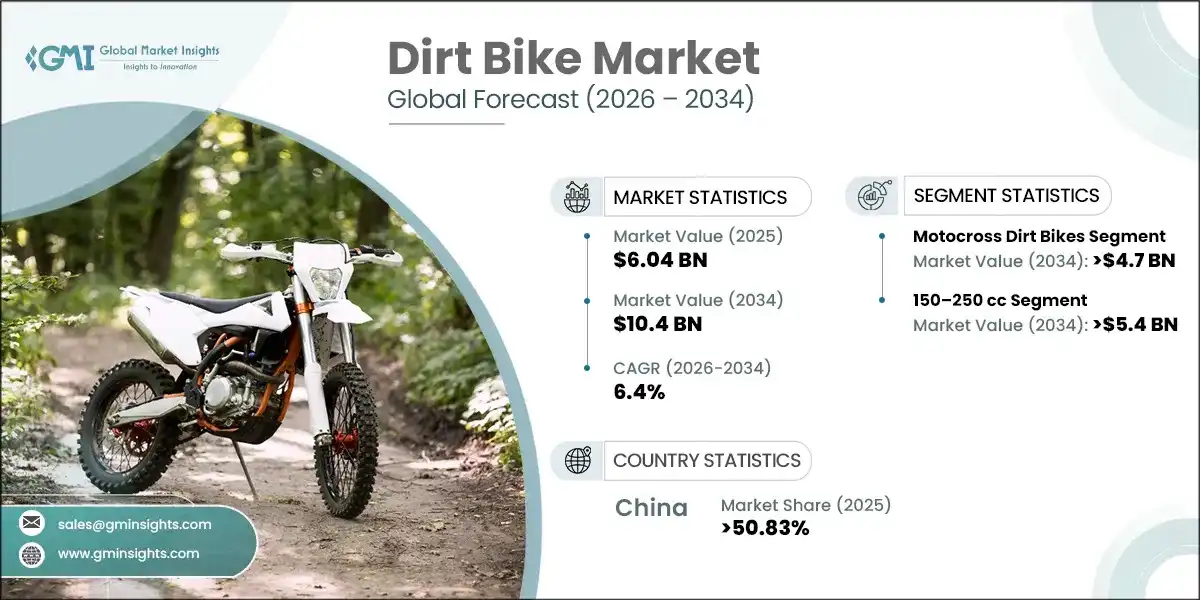
The global dirt bike market size was valued at USD 6.04 billion in 2025 and is projected to grow at a CAGR of 6.4% from 2026 to 2034, according to the latest report published by Global Market Insights Inc.
Dirt Bike Market Key Takeaways
Market Size & Growth
- 2025 Market Size: USD 6.04 Billion
- 2035 Forecast Market Size: USD 10.4 Billion
- CAGR (2026–2035): 6.4%
Key Market Drivers
- Surge in the adventure tourism industry.
- Rising disposable income in emerging regions.
- Growing youth participation in adventure sports.
- Adoption of electric dirt bikes.
Challenges
- Growing environmental regulations.
- Limited riding areas for dirt bikes.
Get Market Insights & Growth Opportunities
To get key market trends
Adventure tourism has become a major catalyst for the global dirt bike market and the broader off-road motorcycle industry. According to Global Market Insights (GMI), the adventure tourism market reached USD 483.3 billion in 2023 and is forecast to grow at a CAGR of over 15.2% from 2024 to 2032. This growth is directly influencing dirt bike sales statistics, rental demand, and new customer acquisition across emerging and developed markets.
Regions such as South America, Southeast Asia, and Africa are increasingly positioning themselves as off-road riding destinations due to their diverse terrain and favorable climate. Countries including Argentina, Brazil, Mexico, South Africa, India, and parts of Europe such as Germany are witnessing steady expansion in the off-road motorcycle market size and tourism-linked vehicle demand.
Dirt Bike Market Trends
Smart Technology Reshaping Modern Dirt Bikes
The dirt bike industry is rapidly evolving as manufacturers integrate advanced electronics to improve safety, performance, and rider experience. New models increasingly feature traction control, multiple riding modes, intelligent suspension systems that adjust to terrain, and off-road GPS navigation. Smartphone app connectivity is now common, enabling riders and fleet owners to monitor performance data, maintenance needs, and diagnostics in real time.
Safety innovations such as crash detection and location sharing are also becoming standard, strengthening the value proposition for both recreational and professional users. These developments are expanding the off-road motorcycle market and influencing purchasing decisions among buyers comparing dirt bike market size, and long-term operating efficiency.
Product Innovation and Competitive Landscape
Leading dirt bike manufacturers are accelerating product launches to capture emerging segments, including electric and youth-focused models. A notable example is GASGAS, which introduced the MC-E 3 electric mini motocross bike in April 2024, positioned between entry-level balance bikes and the MC-E 5. With adjustable seat height and multiple ride modes, it highlights the industry’s shift toward customizable platforms and electrification.
This innovation trend also supports growth in adjacent segments such as the pit bike market; while strengthening overall dirt bike market analysis metrics related to adoption rates, customer demographics, and usage patterns - including commonly searched data points such as how many people ride dirt bikes and how many dirt bikes are sold each year.
Environmental Regulations and Market Constraints
Environmental compliance is now a critical factor shaping the dirt bike market trends outlook. Stricter emission and noise regulations are increasing R&D costs, particularly for traditional two-stroke engines, which face rising production barriers and tighter approval processes. In parallel, land-use restrictions, protected-area policies, and seasonal trail closures are limiting available riding zones in many regions. Manufacturers must also address broader sustainability concerns such as soil erosion, wildlife disturbance, and habitat protection. As a result, balancing high-performance engineering with regulatory compliance has become a defining challenge influencing future market size growth and regional market share distribution.
Dirt Bike Market Analysis

Learn more about the key segments shaping this market
Based on product type, the market is segmented into motocross dirt bikes, enduro, trail, and dual-sport models. In 2025, motocross dirt bikes accounted for more than 47.31% of total market share and is projected to exceed USD 4.7 billion by 2034.
The dirt bike market and the broader off-road motorcycle market are undergoing a technology-led shift, driven by electrification and advanced lightweight materials. Leading dirt bike manufacturers such as KTM and Husqvarna are expanding their electric portfolios, accelerating growth in the electric dirt bike market. Modern electric motocross models deliver instant torque, low maintenance, and zero tailpipe emissions while matching the performance expectations of professional racing and advanced training. Practical innovations fast charging, swappable batteries, and regenerative braking are improving race-day usability and lifecycle economics, factors increasingly reflected in market analysis and market size forecasts for 2024 and beyond.
At the same time, manufacturers are redesigning frames and components using carbon-fiber composites, titanium alloys, and aerospace-grade aluminum to improve strength-to-weight ratios and rider control. These material upgrades enhance durability for competitive motocross while supporting scalable production, a key consideration as global dirt bike sales statistics, annual unit volumes, and regional demand in markets such as the US, Germany, Brazil, India, and Mexico continue to rise.

Learn more about the key segments shaping this market
Based on engine capacity, the dirt bike market is segmented into below 150 cc, 150–250 cc, 250–450 cc, and above 450 cc categories. The 150–250 cc segment expected to surpass USD 5.4 billion by 2034.
The 150–250cc category is one of the fastest-evolving segments within the market, reflecting broader shifts in the off-road motorcycle industry toward efficiency, digital integration, and rider accessibility. As highlighted in recent market analysis and off-road motorcycle market trends, manufacturers are rapidly replacing carburetors with electronic fuel injection (EFI) to improve fuel economy, throttle precision, and performance consistency across climates and altitudes. Leading dirt bike manufacturers such as KTM and Honda now offer EFI-equipped 250cc models with smartphone-based tuning, supporting both recreational riders and competitive motocross users.
Another key trend reshaping the segment is the adoption of multi-map electronic control units (ECUs). Once limited to premium motocross bikes, configurable power modes are now expanding into entry-level models, enabling riders to switch between trail, sport, and race settings in real time. This technology directly supports growing demand from first-time buyers and performance enthusiasts, contributing to rising dirt bike market share and annual unit volumes reported across major regions.
Together, these developments are positioning the 150–250cc class as a strategic growth engine within the global off-road motorcycle market, influencing purchasing behavior, pricing benchmarks, and long-term industry competitiveness.

Looking for region specific data?
In 2025, the Chinese dirt bike market dominated, capturing a revenue share exceeding 50.83%. The market and broader off-road motorcycle market are evolving rapidly, driven by electrification, rider diversification, and new riding formats. Industry analysis shows that electric dirt bike market growth is being led by Chinese dirt bike manufacturers, who leverage strong battery supply chains to deliver affordable models with lithium-ion batteries, fast charging, and high-efficiency motors. These bikes are increasingly competitive with petrol models on range and performance, supporting global dirt bike sales statistics, market size expansion, and rising adoption among urban and recreational riders.
In Europe, manufacturers are reshaping product design to attract new buyer segments especially women riders through adjustable ergonomics, lower seat heights, lighter frames, and digital features such as GPS tracking, smartphone connectivity, and performance monitoring. These innovations influence dirt bike market share shifts among premium brands and reflect changing buyer behavior around “who buys dirt bikes” and average dirt bike price expectations.
Another major trend in the off-road motorcycle industry is the growth of indoor riding facilities in regions with long winters or heavy rainfall. These centers use climate-controlled tracks, modular synthetic terrain, training zones, and maintenance services, supporting year-round participation and expanding the rider base answering common questions such as “how many people ride dirt bikes” and “how many dirt bikes are sold each year.”
At the same time, European brands are modernizing two-stroke engines with electronic fuel injection and emissions controls, while developing hybrid powertrains that combine small combustion engines with electric motors to meet regulations without sacrificing motocross performance.
Overall, the dirt bike industry is shifting toward cleaner technology, inclusive design, and experience-driven growth key factors shaping dirt bike market analysis, competitive positioning, and long-term investment decisions for manufacturers, distributors, and equipment suppliers.
Dirt Bike Market Share

Dirt Bike Market (2024–2025): Competitive Landscape and Buyer-Driven Insights - The global dirt bike industry (also referred to as the off-road motorcycle market and motocross market) continues to consolidate around a few dominant manufacturers, with Honda, KTM, and Yamaha holding over 35% market share in 2024, according to industry-level market analysis. These brands shape overall dirt bike market size, influence dirt bike sales statistics, and set benchmarks for technology, pricing, and rider segmentation across regions such as the US, Germany, India, Brazil, Mexico, Argentina, Russia, and South Africa.
Honda leads through a diversified portfolio covering entry-level to professional models, combining lightweight frames, fuel-injected engines, and low-emission designs—key factors for buyers evaluating how much a dirt bike costs, long-term ownership value, and regulatory compliance. KTM positions itself as a premium dirt bike manufacturer for competitive riders, leveraging strong KTM global sales, Dakar Rally credibility, race-ready suspension systems, and high-power engines to dominate the performance segment of the off-road motorcycle industry.
Yamaha focuses on loyalty and lifetime customer value, upgrading models with smart suspension and lightweight materials while supporting riders through training programs and event sponsorships an approach that directly impacts repeat purchases and how many dirt bikes are sold each year. For managers assessing dirt bike market trends, electric dirt bikes, pit bikes, and aftermarket equipment growth represent the next demand drivers, alongside steady expansion in rider participation (often searched as how many people ride dirt bikes). Collectively, these strategies explain why these three companies remain the most influential dirt bike companies in the global market today.
Dirt Bike Market Companies
Major players operating in the dirt bike industry are:
- AJP
- Beta Group
- Honda
- Hyosung
- Kawasaki
- KTM
- Sherco
- SSR Motorsports
- Suzuki
- Yamaha
Dirt Bike Market Report Attributes
| Key Takeaway | Details |
|---|---|
| Market Size & Growth | |
| Base Year | 2025 |
| Market Size in 2025 | USD 6.04 Billion |
| Forecast Period 2026-2035 CAGR | 6.4% |
| Market Size in 2035 | USD 10.4 Billion |
| Key Market Trends | |
| Growth Drivers |
|
| Pitfalls & Challenges |
|
What are the growth opportunities in this market?
Dirt Bike Industry News
- In July 2024, Yamaha announced its 2025 off-road motorcycle lineup, featuring significant updates. Targeting riders across all skill levels, the YZ250FX and WR250F are key highlights, both adapted from the YZ250F motocrosser and optimized for specific applications.
- In May 2024, Honda introduced extensive updates to its 2025 CRF450R and CRF250R motocross models, incorporating feedback from Team Honda HRC riders Jett and Hunter Lawrence. Chassis improvements enhance rigidity and handling, while engine upgrades provide controlled power. These advancements are also applied to the CRF450RX, CRF250RX, and the premium CRF450RWE.
The dirt bike market research report includes in-depth coverage of the industry with estimates & forecasts in terms of revenue ($ Mn/Bn), and shipment (units) from 2021 to 2034, for the following segments:
Market, By Product
- Motocross dirt bikes
- Enduro
- Trail
- Dual-sport
Market, By Engine Capacity
- Below 150 cc
- 150 cc - 250 cc
- 250 cc - 450 cc
- Above 450 cc
Market, By Propulsion
- ICE
- Electric
Market, By Application
- Recreational
- Professional sports
- Adventure and touring
Market, By Sales Channel
- OEM
- Aftermarket
The above information is provided for the following regions and countries:
- North America
- U.S.
- Canada
- Europe
- UK
- Germany
- France
- Italy
- Spain
- Russia
- Nordics
- Asia Pacific
- China
- India
- Japan
- South Korea
- ANZ
- Southeast Asia
- Latin America
- Brazil
- Mexico
- Argentina
- MEA
- UAE
- Saudi Arabia
- South Africa
Frequently Asked Question(FAQ) :
What was the market size of the dirt bike in 2025?
The market was valued at USD 6.04 billion in 2025, with a projected CAGR of 6.4% from 2026 to 2034.
What was the market share of motocross dirt bikes in 2025?
Motocross dirt bikes accounted for over 47.31% of the total market share in 2025 and are set to exceed USD 4.7 billion by 2034.
What is the projected value of the 150–250 cc segment by 2034?
The 150–250 cc segment is expected to surpass USD 5.4 billion by 2034, led by efficiency improvements, digital integration, and enhanced rider accessibility.
Which region dominated the dirt bike sector in 2025?
China led the market in 2025, capturing a revenue share exceeding 50.83%. The regions dominance is fueled by advancements in electric dirt bikes, supported by strong battery supply chains and competitive pricing.
What are the key trends shaping the dirt bike market?
Key trends include the integration of advanced electronics such as traction control, intelligent suspension systems, off-road GPS navigation, and smartphone app connectivity.
Who are the key players in the dirt bike industry?
Key players include AJP, Beta Group, Honda, Hyosung, Kawasaki, KTM, Sherco, SSR Motorsports, Suzuki, and Yamaha.
Dirt Bike Market Scope
Related Reports