Summary
Table of Content

Digital Textile Printer Market
Get a free sample of this report
Form submitted successfully!
Error submitting form. Please try again.
Thank you!
Your inquiry has been received. Our team will reach out to you with the required details via email. To ensure that you don't miss their response, kindly remember to check your spam folder as well!
Request Sectional Data
Thank you!
Your inquiry has been received. Our team will reach out to you with the required details via email. To ensure that you don't miss their response, kindly remember to check your spam folder as well!
Form submitted successfully!
Error submitting form. Please try again.
Digital Textile Printer Market Size
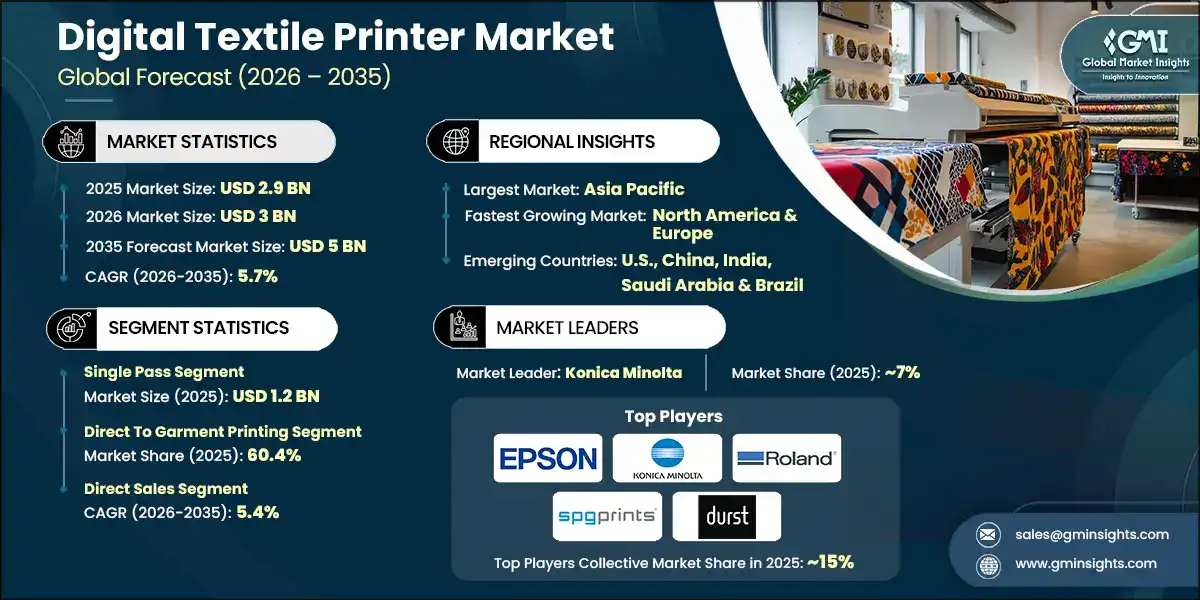
The digital textile printer market was estimated at USD 2.9 billion in 2025. The market is expected to grow from USD 3 billion in 2026 to USD 5 billion in 2035, at a CAGR of 5.7% according to latest report published by Global Market Insights Inc.
Digital Textile Printer Market Key Takeaways
Market Size & Growth
- 2025 Market Size: USD 2.9 Billion
- 2026 Market Size: USD 3 Billion
- 2035 Forecast Market Size: USD 5 Billion
- CAGR (2026–2035): 5.7%
Regional Dominance
- Largest Market: Asia Pacific
- Fastest Growing Region: North America & Europe
Key Market Drivers
- Consumer demand for personalization & on-demand production.
- Water-saving and eco-friendly inks.
- Technological advancements.
Challenges
- High initial investments & operating costs.
- Ink quality, durability & sustainability hurdles.
Opportunity
- Smart textiles & technical applications.
- Customization & on-demand micro factories.
Key Players
- Market Leader: Konica Minolta led with over 7% market share in 2025.
- Leading Players: Top 5 players in this market include Seiko Epson Corporation, Konica Minolta, Roland DG, SPGPrints, Durst Group, which collectively held a market share of 15% in 2025.
Get Market Insights & Growth Opportunities
- The digital textile printer market is developing rapidly, primarily because three primary trends are encouraging growth. One major driver for growth is the increased consumer desire for on-demand textile production and personalized textiles. The emergence of "fast fashion", e-commerce sites and social media influencers of new fashion trends has forced textile companies to create products that are highly individualized and can be made in smaller batches. Digital printing of textiles provides companies with the ability to create custom printed textiles in a much quicker timeframe and with less equipment set up time compared to conventional textile printing methods. Faster turnaround and lower inventory costs are the primary benefits of utilizing digital textile printing, especially for companies utilizing micro-collection or print-on-demand production models. According to the WTO, the global e-commerce sector saw an 8% increase in sales in 2023, driving more companies to adopt digital textile printing technology to satisfy their consumers' desire for personalized and rapid delivery options.
- Furthermore, the innovations in technology and the increased use of digital textile printers by the apparel and textile industries is another driving factor for digital textile printers. Technologies like single pass print heads, artificial intelligence (AI) based color management systems and automated workflows help increase productivity, speed, precision and efficiency. These new technologies combine high-resolution capabilities along with the ability to print onto a wide variety of textile types while also reducing costs and downtime.
- The rise of cloud-based systems and the internet of things (IoT) will continue to improve production monitoring and predictive maintenance, as well as create new opportunities for digital textile printing processes to be scalable and maintain consistent quality over time. Reports published by the international data corporation (IDC) indicate that the rate of growth for IoT usage in manufacturing is estimated to increase by approximately 12% compounded annually over the next five years, thus driving further efficiencies in the production of digital textile printing solutions. When all these trends come together, they create an ideal solution for an environmentally friendly and custom textile manufacturing process.
To get key market trends
Digital Textile Printer Market Trends
- The digital textile printer industry is undergoing significant change driven by three trends towards increased standards of production as well as sustainability. Increasingly manufacturers are turning to technologies that do not use water (aero spring) and the use of biodegradable materials (ink) thus committing the industry to lower their environmental footprint and stay smart with innovation. Traditional processes of printing textiles use large volumes of water and chemicals (traditional methods are said to consume 50-60L per meter of fabric).
- In comparison, via digital print can reduce water consumption 90%, both in water & chemicals, therefore providing a far more resource efficient option. The evolution of Digital Printing will also play a key role in supporting the global sustainability initiative (i.e. unsustainable development goals) through meeting the growing demand for environmentally friendly products and will be further pushed forward due to the implementation of stronger environmental protection regulations (i.e. REACH) and corporate social responsibility efforts (i.e. to achieve their environmental/carbon neutrality targets).
- The advancement of print heads and ink chemistry was also another key trend affecting the digital textile printing market. Digital textile printers equipped with print heads that produce variable size droplets and have a higher density of nozzles allow to produce full-color, high-resolution, quality printed textiles. The highest-quality images created by digital printers can achieve a resolution of 1200 dpi, which is suitable for high-quality projects.
- Furthermore, new ink formulas have been created, such as pigment inks that are used for printing on natural fibers (e.g., cotton and linen) and sublimation inks optimized for synthetic fibers (e.g., polyester and synthetic blends). As a result of these developments in both ink and print head technology, digital textile printers now have access to a wider range of product applications without the need for extensive pre-treatment processes. As a result, the durability of printed textiles will increase, and productivity will be improved due to reduced production time. Because of these developments, digital textile printing has become a very economical option across many different market segments, including fashion, home furnishings, sportswear, and technical textiles, which are used in the automotive and healthcare industries.
- Automation technologies such as artificial intelligence (AI) color management systems for accurate color matching; predictive maintenance tools (up to 30% less down-time) and integrated curing systems for post-printing processing are providing manufacturers with improved production workflow processes and have increased the ability for them to scale their production capacity while maintaining flexibility, reducing costs and continuing to produce consistent product quality. Digital textile printing is an important driver of flexible, fast-responding and sustainable supply chains, and is fast becoming a key component of the modern textile manufacturing process.
Digital Textile Printer Market Analysis
Learn more about the key segments shaping this market
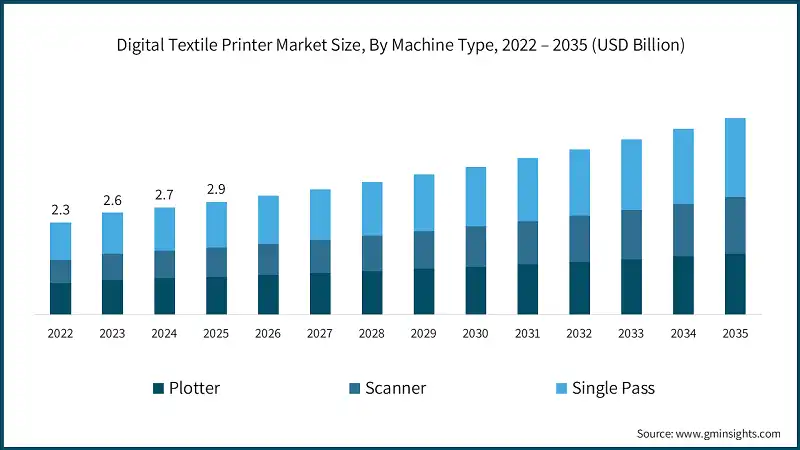
Based on machine type, the market is categorized into plotter, scanner and single pass. The single pass printer accounted for revenue of around USD 1.2 billion in 2025 and is anticipated to grow at a CAGR of 5.7% from 2026 to 2035.
- Unlike multi-pass systems, single-pass printers can print entire designs in one pass, dramatically reducing production time and enabling manufacturers to meet the rising demand for fast fashion, on-demand printing, and large-volume orders. This efficiency is critical for brands and textile producers seeking to minimize lead times and respond quickly to shifting consumer trends, especially in e-commerce and personalized apparel markets.
- Additionally, single-pass technology supports high-resolution printing on diverse fabrics, making it ideal for applications in fashion, home décor, and technical textiles. The integration of advanced automation, AI-driven color management, and inline fixation systems further enhances productivity and reduces operational costs, making these machines attractive for large-scale operations.
Based on printing process of digital textile printer market consists of direct to garment printing and direct to fabrics. The direct to garment printing emerged as leader and held 60.4% of the total market share in 2025 and is anticipated to grow at a CAGR of 6% from 2026 to 2035.
- DTG printing allows manufacturers and brands to print high-quality, full-color designs directly onto finished garments without the need for screens or complex setup, making it ideal for on-demand and e-commerce-driven business models. This flexibility is particularly attractive to small and medium enterprises, custom apparel businesses, and online platforms offering personalized products.
- Additionally, the surge in fast fashion trends and micro-collections requires rapid design changes and smaller batch sizes, which DTG technology supports efficiently. Sustainability is another key factor DTG uses water-based inks and minimal water consumption, aligning with global environmental regulations and consumer preference for eco-friendly products.
Learn more about the key segments shaping this market
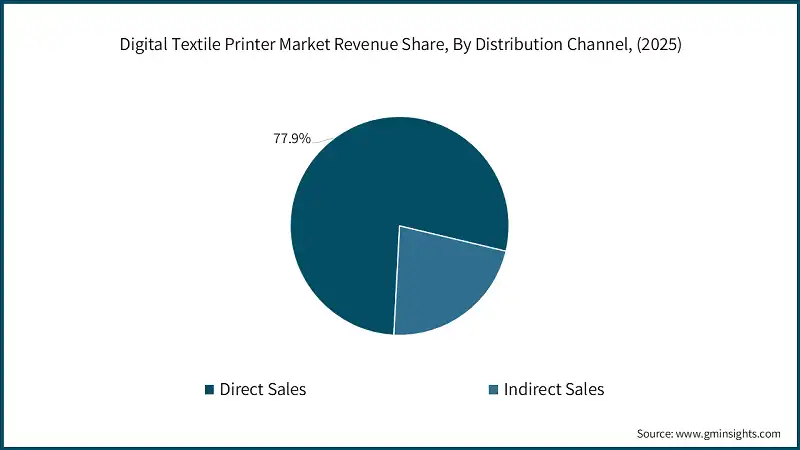
Based on distribution channel of digital textile printer market consists of direct and indirect sales. The direct sales channel emerged as leader and held 77.9% of the total market share in 2025 and is anticipated to grow at a CAGR of 5.4% from 2026 to 2035.
- Direct sales enable printer manufacturers to provide personalized technical support, installation services, and training, which are critical for high-value equipment like digital textile printers. This approach also allows companies to bundle hardware with software, maintenance contracts, and consumables, creating long-term partnerships and recurring revenue streams.
- Additionally, direct engagement helps manufacturers gather real-time feedback on performance and emerging customer needs, driving innovation and product improvements. As the market shifts toward advanced technologies such as single-pass printers, AI-driven workflows, and sustainable printing solutions, customers increasingly seek end-to-end solutions and after-sales support, which direct sales channels can deliver more effectively than intermediaries.
Looking for region specific data?
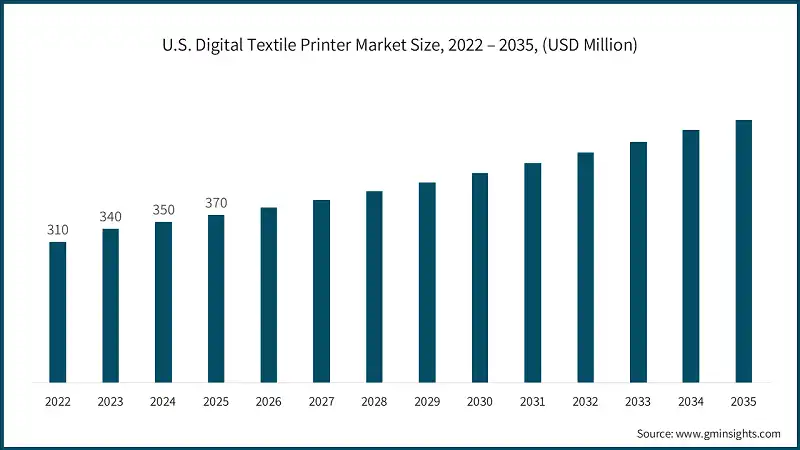
The U.S. dominates an overall North America digital textile printer market and valued at USD 370 million in 2025 and is estimated to grow at a CAGR of 4.6% from 2026 to 2035.
- The country’s strong presence in fashion, home décor, and technical textiles industries drives demand for advanced printing technologies that enable mass customization and rapid design turnaround, aligning with the fast-fashion and e-commerce boom.
- Additionally, U.S. manufacturers and brands are increasingly adopting on-demand production models and micro factory setups, reducing inventory costs and meeting consumer expectations for personalized products. Sustainability is another major growth catalyst stringent environmental regulations and consumer preference for eco-friendly products have accelerated the shift toward waterless printing technologies and low-impact inks, which digital printers provide.
In the European digital textile printer market, Germany is expected to experience significant and promising growth from 2026 to 2035.
- As Europe’s largest textile machinery hub, Germany benefits from advanced manufacturing capabilities and a well-established network of high-end fashion, home décor, and technical textile producers that increasingly demand customization and short-run flexibility key advantages of digital printing. The country’s commitment to eco-friendly production under stringent EU environmental regulations is accelerating the adoption of waterless printing technologies and low-impact inks, aligning with circular economic goals.
- Additionally, Germany’s emphasis on Industry 4.0 integration including automation, IoT-enabled workflows, and AI-driven color management supports efficiency and cost optimization, making digital textile printing a strategic choice for manufacturers. The rise of smart textiles and technical applications in automotive, healthcare, and sports sectors further fuels demand for precision printing solutions.
In the Asia Pacific digital textile printer market, the China held 20.7% share in 2025 and is anticipated to grow at a CAGR of 5.7% from 2026 to 2035.
- As the world’s largest textile producer and exporter, China is embracing digital printing technologies to meet global requirements for short-run, customized, and eco-friendly textiles, which traditional methods struggle to deliver. The country’s booming e-commerce and fast-fashion sectors are fueling demand for quick turnaround and on-demand production, making digital printers an ideal solution.
- Additionally, government initiatives promoting green manufacturing and water conservation under strict environmental regulations are accelerating the shift from conventional dyeing to waterless digital printing processes. China’s strong focus on automation and smart factories, supported by investments in AI-driven workflows and IoT-enabled production systems, enhances efficiency and reduces operational costs, further encouraging adoption
In the Middle East and Africa digital textile printer market, Saudi Arabia held 30.4% market share in 2025 promising growth from 2026 to 2035.
- The country is witnessing rising investments in modern manufacturing infrastructure and smart production technologies, creating a favorable environment for digital textile printing adoption. Growing consumer demand for customized apparel, home décor, and luxury textiles, coupled with the rapid expansion of e-commerce platforms, is fueling the need for on-demand and short-run printing solutions.
- Additionally, Saudi Arabia’s commitment to sustainability and water conservation critical in a region with limited water resources makes waterless digital printing technologies highly attractive compared to traditional dyeing processes. The government’s support for industrial automation and advanced technology integration, along with partnerships between global printer manufacturers and local textile firms, further accelerates market penetration.
Digital Textile Printer Market Share
- In 2025, the prominent manufacturers in digital textile printer industry are Seiko Epson Corporation, Konica Minolta, Roland DG, SPGPrints, and Durst Group collectively held the market share of ~15%.
- Epson solidifies its leadership by consistently innovating high-precision printing technology while championing sustainability. The company pioneers advanced printhead systems and eco-conscious ink solutions, achieving superior image quality with a significantly reduced environmental footprint. Epson's investments in integrated workflow tools and cloud-based services enable automated color management, precise job tracking, and real-time production oversight. These advanced solutions support on-demand manufacturing, lean operations, and enhanced operational efficiency, solidifying Epson's position as the preferred partner for both large-scale textile manufacturers and small boutique producers.
- To maintain its competitive edge, Konica Minolta focuses on automation and intelligent printing solutions tailored for high-performance textile production. Its state-of-the-art single-pass printers incorporate advanced smart printhead technology with automatic nozzle compensation, ensuring uninterrupted high-speed production and consistent print quality. The company emphasizes eco-compliance by offering certified reactive inks, energy-efficient systems, and reduced carbon footprint solutions. Additionally, Konica Minolta leverages AI-driven workflows, predictive analytics, and remote monitoring capabilities to optimize productivity, minimize downtime, and deliver cost-effective, sustainable textile printing solutions.
Digital Textile Printer Market Companies
Major players operating in the digital textile printer industry include:
- Aleph S.r.l.
- Durst Group
- EFI (Electronics For Imaging)
- Epson
- Hollanders Printing Systems
- JK Group
- Konica Minolta
- Kornit Digital
- Mimaki Engineering
- MS Printing Solutions
- Mutoh
- Reggiani Machine
- Roland DG
- Seiko Epson Corporation
- SPGPrints
Roland DG differentiates itself by prioritizing versatility and advanced connectivity across its product offerings. The company provides compact, high-speed direct-to-garment (DTG) and direct-to-film (DTF) printers designed for small and medium-sized enterprises (SMEs) and creative businesses, alongside industrial-grade solutions for large-scale operations. Roland DG enhances user experience through robust software platforms that enable remote management, detailed analytics, and automated workflow optimization. By integrating cutting-edge hardware with innovative digital services, Roland DG empowers customers to achieve operational flexibility, improved efficiency, and exceptional print quality in a highly competitive market.
SPGPrints strengthens its market position by combining expertise in hardware development with advanced ink chemistry. The company produces a comprehensive range of inks, including reactive, acid, sublimation, and pigment formulations, meticulously designed to ensure seamless compatibility with its printers. This approach guarantees consistent performance, enhanced durability, and reduced operational disruptions for customers. SPGPrints also prioritizes customer satisfaction by investing in extensive technical support and a global service network, reinforcing its reputation for delivering high-quality, customer-centric solutions tailored to the textile printing industry.
Digital Textile Printer Market Report Attributes
| Key Takeaway | Details |
|---|---|
| Market Size & Growth | |
| Base Year | 2025 |
| Market Size in 2025 | USD 2.9 Billion |
| Market Size in 2026 | USD 3 Billion |
| Forecast Period 2026 - 2035 CAGR | 5.7% |
| Market Size in 2035 | USD 5 Billion |
| Key Market Trends | |
| Drivers | Impact |
| Consumer demand for personalization & on-demand production | Drives rapid adoption of digital printing for short runs and custom designs, boosting e-commerce and fast-fashion segments. |
| Water-saving and eco-friendly inks | Strengthens market appeal by meeting sustainability regulations and reducing resource consumption, attracting eco-conscious brands. |
| Technological advancements | Improves speed, precision, and automation, lowering operational costs and enabling large-scale, high-quality production. |
| Pitfalls & Challenges | Impact |
| High initial investments & operating costs | Limits adoption among small players and delays scaling, creating entry barriers for emerging markets. |
| Ink quality, durability & sustainability hurdles | Impacts consumer trust and compliance, requiring continuous R&D and higher production costs. |
| Opportunities: | Impact |
| Smart textiles & technical applications | Expanding market into healthcare, automotive, and wearable tech, creating high-value niche segments. |
| Customization & on-demand micro factories | Supports lean manufacturing and zero-inventory models, opening doors for SMEs and direct-to-consumer brands. |
| Market Leaders (2025) | |
| Market Leaders |
Market share of ~7% |
| Top Players |
Collective market share in 2024 is ~15% |
| Competitive Edge |
|
| Regional Insights | |
| Largest Market | Asia Pacific |
| Fastest growing market | North America & Europe |
| Emerging countries | U.S., China, India, Saudi Arabia & Brazil |
| Future outlook |
|
What are the growth opportunities in this market?
Digital Textile Printer Industry News
- In January 2025, Epson introduced its advanced garment-decorating and textile printing platforms at the Impressions Expo, focusing on enhanced production efficiency for short-run, on-demand apparel production. These systems feature next generation printheads and ink technologies, specifically designed to deliver faster printing speeds, superior image quality, and improved eco-performance.
- In May 2025, Durst expanded its portfolio in North America by introducing the KJet hybrid label printer, designed for versatile label production.
- In September 2024, Konica Minolta launched its upgraded C14010s press, equipped with white-toner capability and automated color calibration, alongside the MGI JetVarnish 3D Web 400 at Labelexpo. The company also announced a strategic partnership with First Citizens Bank for 2025, offering tailored financing solutions to facilitate equipment acquisitions, thereby accelerating the adoption of advanced digital printing technologies among customers.
- In October 2024, Durst achieved a significant milestone by manufacturing its 100th P5 TEX iSUB, a single-step sublimation printer with inline fixation, known for its energy efficiency and water-based technology.
- In September 2024, Roland DG Corporation unveiled the TY-300 direct-to-film production transfer printer, offering exceptional image quality, high productivity, and cost efficiency. This printer delivers vibrant colors and intricate details, meeting the demanding requirements of the apparel industry. Its inks and powders are certified under the OEKO-TEX ECO PASSPORT standard, ensuring compliance with global safety regulations and the absence of harmful substances.
- In April 2024, Epson America, a subsidiary of Seiko Epson Corporation, introduced the SureColor F11070 and F11070H dye-sublimation printers, engineered for industrial reliability and high-volume production. These printers feature a large roll media unwinder, with the F11070H offering an expanded ink set to meet the needs of high-capacity print shops. Both models are designed with user-friendly interfaces and low maintenance requirements, optimizing efficiency for industrial and web-to-print applications.
- In January 2024, Agfa announced a collaboration with EFI, a global technology leader, to integrate their advanced technologies. As part of this partnership, Agfa incorporated EFI's roll-to-roll system into its product lineup, while EFI added Agfa's hybrid inkjet printers to its offerings.
The digital textile printer market research report includes in-depth coverage of the industry, with estimates & forecast in terms of revenue (USD Billion) and volume (Thousand Units) from 2022 to 2035, for the following segments:
Market, By Machine Type
- Plotter
- Scanner
- Single pass
Market, By Ink Type
- Reactive ink
- Acid ink
- Disperse ink
- Pigment ink
- Other
Market, By Material
- Cotton
- Polyester
- Silk
- Blended fabrics
Market, By Technology
- Thermal inkjet
- Piezoelectric inkjet
- Continuous inkjet
- Thermal transfer
- Electrostatic
- Electrophotography
- Others
Market, By Printing Process
- Direct to garment printing
- Direct to fabrics
Market, By Application
- Fashion and clothing industry
- Home furnishing
- Automotive and transportation
- Healthcare and medical
- Sports and fitness industry
- Advertising and marketing
- Others (aerospace, education, construction)
Market, By Distribution Channel
- Direct sales
- Indirect sales
The above information is provided for the following regions and countries:
- North America
- U.S.
- Canada
- Europe
- Germany
- UK
- France
- Italy
- Spain
- Asia Pacific
- China
- Japan
- India
- South Korea
- Australia
- Indonesia
- Malaysia
- Latin America
- Brazil
- Mexico
- Argentina
- MEA
- Saudi Arabia
- UAE
- South Africa
Frequently Asked Question(FAQ) :
What is the market size of the digital textile printer in 2025?
The market size was USD 2.9 billion in 2025, with a CAGR of 5.7% expected through 2035 driven by rising demand for on-demand and personalized textile production.
What is the projected value of the digital textile printer market by 2035?
The digital textile printer market is expected to reach USD 5 billion by 2035, propelled by technological advancements, sustainability initiatives, and growing demand for customization in fast fashion and e-commerce.
What is the current digital textile printer market size in 2026?
The market size is projected to reach USD 3 billion in 2026.
How much revenue did the single pass printer segment generate in 2025?
Single pass printers generated around USD 1.2 billion in 2025, dominating the market due to their ability to print entire designs in one pass, dramatically reducing production time.
What was the market share of the direct to garment printing segment in 2025?
Direct to garment printing held 60.4% market share in 2025 and is anticipated to grow at a CAGR of 6% from 2026 to 2035.
What is the growth outlook for direct sales distribution channel from 2026 to 2035?
Direct sales channel held 77.9% market share in 2025 and is projected to grow at a 5.4% CAGR till 2035, driven by personalized technical support and long-term customer partnerships.
Which region leads the digital textile printer market?
North America leads the digital textile printer market, with the U.S. dominating the region at USD 370 million in 2025, supported by strong demand from the fashion, home décor, and technical textiles industries.
What are the upcoming trends in the digital textile printer market?
Key trends include waterless printing technologies, biodegradable ink formulations, AI-driven color management systems, automation workflows, and integration of IoT-enabled production monitoring for enhanced efficiency.
Who are the key players in the digital textile printer market?
Key players include Aleph S.r.l., Durst Group, EFI (Electronics For Imaging), Epson, Hollanders Printing Systems, JK Group, Konica Minolta, Kornit Digital, Mimaki Engineering, MS Printing Solutions, Mutoh, Reggiani Machine, Roland DG, Seiko Epson Corporation, and SPGPrints.
Digital Textile Printer Market Scope
Related Reports